Our readers keep the lights on and my smoothie glass nicely filled. As an Amazon Associate, I earn from qualifying purchases.
A dedicated CD transport does one thing and one thing only: reads the optical disc with maximum precision and sends a pure digital signal to your external DAC. By stripping away analog stages, headphone amps, and radio tuners, a transport focuses every engineering dollar on laser assembly stability, clock accuracy, and jitter reduction — which directly translates to a wider soundstage and tighter bass when paired with a quality converter.
I’m Mohammad Maruf — the founder and writer behind WellFizz. My research pipeline involves comparing S/PDIF interface performance, servo system response times, and clocking architectures across dozens of transports to identify which models actually deliver measurable improvements in signal integrity.
Whether you are building a desktop stack or upgrading a legacy system, finding the right best cd transport means scrutinizing output options, clock inputs, and the mechanical quality of the disc drive itself — factors that separate an entry-level spinner from a reference-grade digital source.
How To Choose The Best CD Transport
Every transport looks simple — a slot or tray with a few buttons — but the engineering inside determines whether your DAC receives a pristine bitstream or one polluted with timing errors. Focus on these four decision points before you buy.
Digital Outputs: Matching Your DAC
Coaxial RCA is the most universal S/PDIF interface and supports up to 192kHz at 24-bit. Optical (Toslink) offers galvanic isolation but caps out at the same rate on most transports. AES/EBU (XLR) provides a balanced connection with better noise rejection over longer runs. I²S (commonly via HDMI) can push up to DSD512 and PCM 768kHz, but pinout compatibility varies by brand — check your DAC’s I²S layout before relying on this output. USB Audio output on transports like the Shanling ET3 also delivers ultra-high sample rates directly to a computer or DAC.
Clock Architecture: Jitter Is the Enemy
Jitter — timing jitter between the transport and DAC — blurs transients and compresses the soundstage. Entry-level transports rely on a single internal crystal. Mid-range and premium models add dual clocks (one for 44.1kHz-based rates, one for 48kHz-based rates) or separate word-clock inputs (44.1kHz and 10MHz) that allow locking to an external atomic or master clock. The SMSL PL200T and Eversolo T8 exemplify this approach with dedicated clock inputs and ultra-low-phase-noise oscillators.
Disc Mechanism: Slot-Load vs. Top-Load vs. Tray
Slot-load mechanisms (TEAC PD-301-X, Audiolab 6000CDT) are compact and elegant but can be finicky with off-center discs. Top-loading clamps (SMSL PL200T, Shanling ET3) reduce mechanical complexity and often incorporate better vibration damping. Traditional tray mechanisms (Yamaha CD-C603) allow multi-disc changers but introduce more moving parts. The ideal mechanism pairs a brushless spindle motor with a hardened laser pickup and a stable chassis that resists acoustic feedback from nearby speakers.
Extra Features: Ripping, Streaming, and Upsampling
Pure transports do nothing but output digital audio, but many modern units blur the line. CD ripping to USB (SMSL PL20) is convenient for archiving. MQA-CD full decoding (PL200T) extracts the highest resolution from MQA-encoded discs. Upsampling to DSD512 via a dedicated chip (Shanling ET3) can improve DAC performance in theory but adds a conversion stage — some purists prefer bit-perfect transmission. Network streaming built into the Eversolo T8 eliminates the need for a separate streamer but increases cost and complexity.
Quick Comparison
On smaller screens, swipe sideways to see the full table.
| Model | Category | Best For | Key Spec | Amazon |
|---|---|---|---|---|
| SMSL PL200T | Premium Transport | Reference desktop stack | I²S, AES/EBU, clock in/out, MQA | Amazon |
| Eversolo T8 | Flagship Streamer/Transport | All-in-one digital hub | Dual femto clocks, SFP network | Amazon |
| Shanling ET3 | Premium Transport | Upsampling to DSD512 | Philips servo, CT7302CL upscaler | Amazon |
| Audiolab 6000CDT | Mid-Range Transport | Reliable slot-load with buffer | Read-ahead buffer, play scratched discs | Amazon |
| Marantz CD6007 | Integrated CD Player | Headphone listening + CD | 3.5mm jack, USB-A playback | Amazon |
| Yamaha CD-C603 | Multi-Disc Changer | Uninterrupted multi-album playback | 5-disc carousel, optical only | Amazon |
| TEAC PD-301-X | Compact Lifestyle | Small desktop + FM tuner | Slot-load, USB memory playback | Amazon |
| SMSL PL20 | Value All-in-One | Ripping + Bluetooth + headphone | Dual CS43131, USB ripping to WAV | Amazon |
In‑Depth Reviews
1. SMSL PL200T

The SMSL PL200T is a dedicated reference transport that leaves nothing to chance. Its self-developed P.A.S.S. servo system reads discs with exceptional precision, while the dual clock input (44.1kHz and 10MHz) lets you lock to an external atomic or master clock — a feature normally reserved for five-figure studio gear. The transparent acrylic top-loading lid adds a mechanical ritual that slot-loads simply cannot replicate.
Outputs include optical, coaxial, AES/EBU, and I²S, covering virtually every DAC on the market. The PL200T also performs full MQA-CD decoding, unfolding up to 384kHz without requiring a software renderer. Users upgrading from a basic DVD player or budget transport consistently report a wider soundstage, better instrument separation, and lower noise floor. The aluminum chassis and piano-style buttons feel reassuringly dense.
Triple power modes — internal linear PSU, USB-C, and external DC input — give you flexibility to experiment with cleaner power sources. The only compromise is the lack of a headphone jack, but that is intentional: this is a pure transport designed to feed an external DAC and nothing else. If you are building a high-resolution desktop chain, the PL200T is the benchmark at this level.
Why it’s great
- Full MQA-CD decoding with 8x unfolding
- Clock input for external master or atomic reference
- I²S, AES/EBU, coaxial, and optical outputs
- Anti-vibration top-loading mechanism
Good to know
- No headphone output (pure transport design)
- Transparent lid shows disc spin but adds height to stack
2. Eversolo T8
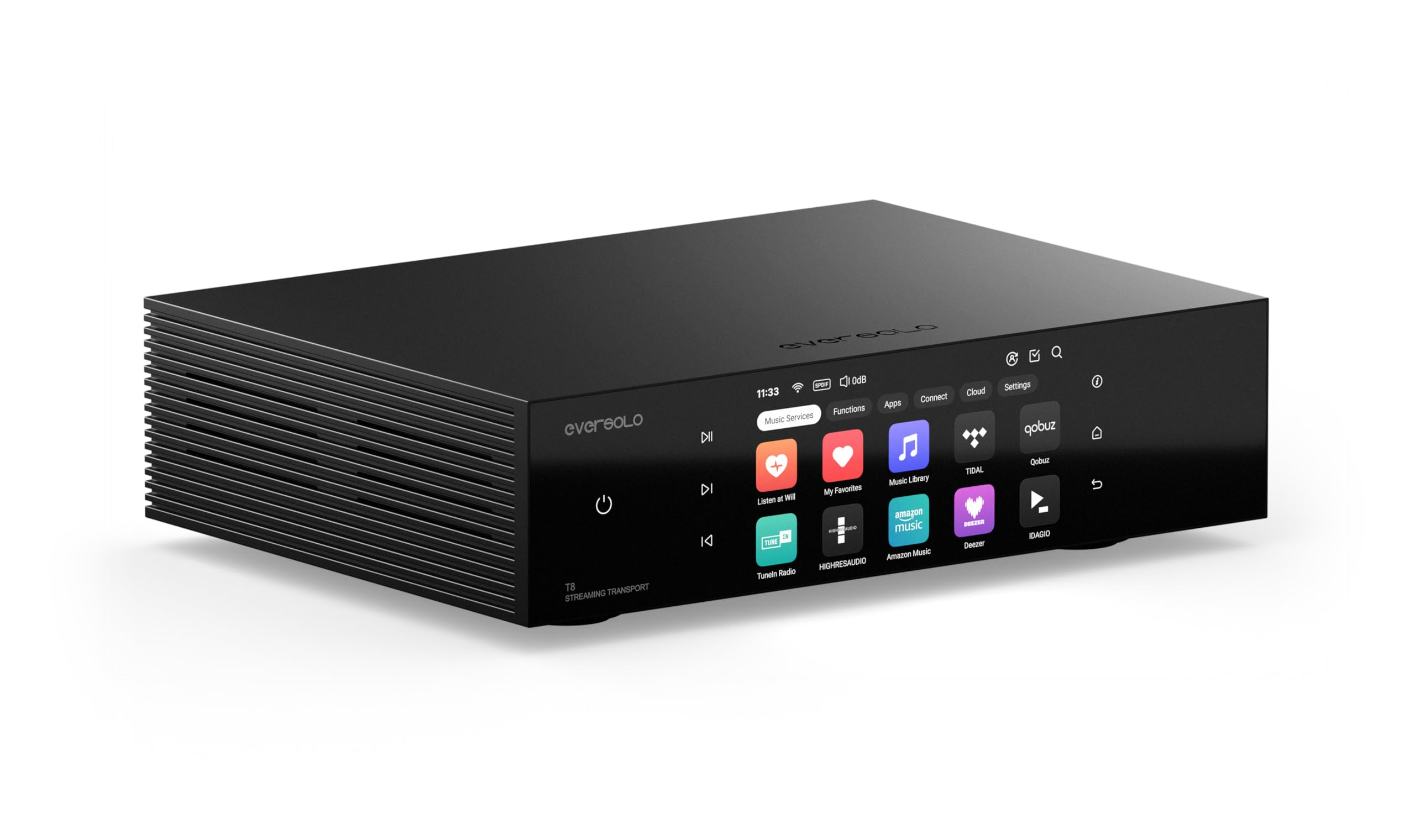
The Eversolo T8 is not just a CD transport — it is a full digital hub that merges network streaming, local file playback, and CD transport into one chassis. Dual AS318-B femtosecond clocks (49.1520 MHz) directly drive the USB Audio and AES/EBU outputs, dramatically reducing jitter at the source. Every digital output — I²S, coaxial, AES/EBU, USB Audio, optical — is fully galvanically isolated to kill ground-loop hum.
Beyond the transport role, the T8 integrates Roon Ready, TIDAL Connect, Qobuz Connect, and Spotify Connect, plus a 6-inch touchscreen that displays VU meters and album art. Two internal NVMe SSD bays (up to 16 TB total) make it a formidable music server. The proprietary evotune calibration system applies 10-band parametric EQ and FIR filtering to compensate for room acoustics when used as a streamer.
Setup is intuitive via the touchscreen, remote, or iOS/Android app. Users praise the blackest background and micro-detail retrieval when paired with high-end DACs. The SFP fiber network module provides total electrical isolation from the network switch. If your system demands pristine digital output from both discs and streaming services, the T8 is the most complete solution available. The main caveat is software beta instability reported by some Qobuz users — firmware updates have addressed most dropouts, but it remains a consideration.
Why it’s great
- Fully galvanically isolated digital outputs
- Dual femtosecond clocks for ultra-low jitter
- Roon Ready / TIDAL Connect / Qobuz Connect
- Two NVMe SSD bays for local music storage
Good to know
- Streaming software can have occasional hiccups
- High price reflects streamer + transport + server functionality
3. Shanling ET3

The Shanling ET3 pairs a Philips SAA7824 servo and Sanyo HD850 pickup with a dedicated CT7302CL upscaling chip that converts all signals to PCM 768kHz or DSD512 on the fly. This is a genuine upsampling transport, not a simple sample-rate converter — the algorithm adds no audible artifacts and genuinely smooths out the treble region when fed into a delta-sigma DAC.
Output options are comprehensive: I²S (HDMI), USB Audio, AES/EBU, coaxial, and optical. The I²S output at DSD512 produces an exceptionally liquid and spacious presentation that many users describe as indistinguishable from high-resolution streaming. The ET3 also includes Bluetooth 5.0 with LDAC, Wi-Fi streaming via DLNA and AirPlay, and a full-function remote app. The top-loading mechanism is a satisfying, deliberate motion — place the CD on the center hub, close the lid, and press play.
Build quality is excellent with a milled aluminum chassis that weighs 3.5 kg, providing ample vibration damping. One unit among customer reports arrived DOA, but the majority of owners report years of flawless operation. The lack of a built-in headphone amp keeps the signal path pure. For users who want to extract every bit of resolution from their CD collection before it reaches the DAC, the ET3’s upsampling engine is a standout feature.
Why it’s great
- Dedicated CT7302CL upsampling to DSD512
- I²S output for highest bandwidth to DAC
- Philips/Sanyo servo for reliable reading
- Wi-Fi and Bluetooth streaming built in
Good to know
- No headphone output
- Occasional unit quality variation reported
4. Audiolab 6000CDT

The Audiolab 6000CDT has earned its reputation as one of the most reliable dedicated transports in the mid-range. Its slot-load mechanism is coupled with a read-ahead digital buffer that pre-loads the next few seconds of audio, dramatically reducing the chance of disc-reading failures. Multiple users report that this transport spins CDs that other players skip on — even discs with visible scratches or surface wear.
Outputs are coaxial and optical (S/PDIF), both galvanically isolated to prevent ground loops. The 6000CDT is a pure transport: there is no internal DAC, no USB input, no headphone jack. This single-minded focus delivers a clean, low-jitter signal that pairs beautifully with external converters from Schiit, Gustard, and Topping. Users consistently note an expansive soundstage with deep, tuneful bass when matched with a quality DAC.
The chassis is solid and compact (20.15 x 17.5 x 3.15 inches) with a discreet black finish and clear OLED display. The included remote is basic and some users find the front-panel knobs hard to read in low light, but the core performance is hard to fault. If you need a transport that simply works every time and rescues discs that other drives reject, the 6000CDT is the default recommendation.
Why it’s great
- Read-ahead buffer plays scratched discs
- Galvanically isolated digital outputs
- Solid build, reliable slot-load mechanism
- Clean, jitter-free signal for external DACs
Good to know
- No USB, I²S, or AES/EBU outputs
- Remote and knob labeling could be better
5. Marantz CD6007
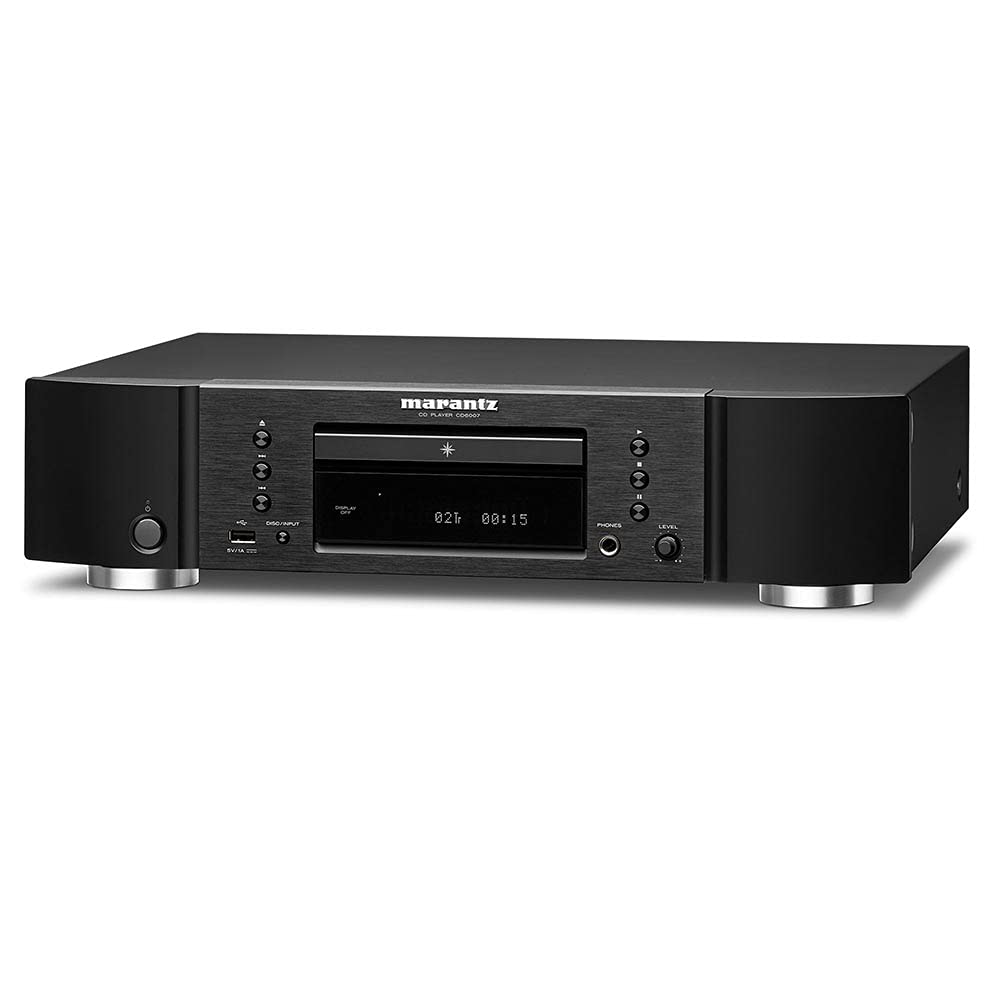
The Marantz CD6007 is a full CD player with a high-quality internal DAC and a dedicated headphone amplifier, but it also functions superbly as a transport via its coaxial and optical outputs. The Hyper Dynamic Amplifier Modules (HDAM) and custom chipset deliver exceptional analog performance if you ever want to bypass an external DAC, while the transport section reads discs with the same precision Marantz has refined over decades.
USB-A input supports FLAC, WAV, ALAC, and AIFF up to 192kHz/24-bit, making the CD6007 a versatile digital source for thumb drives and external storage. The headphone output is unusually good for an integrated player — clean, with sufficient current to drive 300-ohm cans. Owners upgrading from entry-level players consistently describe the CD6007 as revealing details in familiar recordings that were previously masked.
The gold-finished chassis and front-panel display carry Marantz’s unmistakable design language. Setup is straightforward via the included remote. The main limitation is the lack of NTFS support for USB flash drives over 32 GB, so format your media in FAT32 or exFAT. If you want the flexibility of a high-quality CD player that also works as a transport for a future DAC upgrade, the CD6007 gives you both paths in one elegant package.
Why it’s great
- Strong internal DAC with HDAM modules
- Excellent headphone amplifier stage
- USB-A input up to 192kHz/24-bit
- Classic Marantz build and aesthetics
Good to know
- USB does not support NTFS drives
- More expensive than pure transports with similar digital output quality
6. Yamaha CD-C603

The Yamaha CD-C603 is a 5-disc carousel changer that adds serious convenience for long listening sessions. Load five discs at once and the transport seamlessly switches between them in under three seconds, delivering uninterrupted playback for over six hours. The fully opening tray lets you swap four discs while the fifth is still playing — a feature called PlayXchange that is genuinely useful during dinner parties or background listening.
As a transport, the CD-C603 outputs via optical Toslink only (no coaxial), which is a limitation if your DAC lacks an optical input. The laser pickup floating mechanism and intelligent digital servo are Yamaha’s proven approach to stable disc reading. The front USB-A slot plays MP3, WMA, AAC, WAV, and FLAC up to 96kHz/24-bit. The 12.3-pound chassis provides excellent acoustic isolation.
One trade-off is that random/shuffle playback can only apply to one disc at a time, not across the whole carousel. The remote is functional and includes direct disc selection buttons. If your priority is effortless multi-album playback without the need for a streaming subscription, and your DAC accepts optical input, the CD-C603 is the only serious multi-disc transport currently in production.
Why it’s great
- 5-disc carousel for hours of uninterrupted playback
- PlayXchange lets you swap discs while playing
- USB playback of FLAC/WAV up to 96/24
- Heavy chassis for vibration damping
Good to know
- Optical output only — no coaxial or USB
- Random playback limited to one disc at a time
7. TEAC PD-301-X

The TEAC PD-301-X is a compact slot-load CD player that doubles as a CD transport via coaxial and optical outputs. Its footprint is just 6.5 inches wide, making it one of the few high-quality transports that fit into a desktop headphone setup or a small shelf. The slot mechanism is smooth and quiet, and the unit ships with a dedicated remote that includes direct track selection.
As a transport, the PD-301-X outputs via both Toslink and coaxial, so it pairs cleanly with most DACs. The internal DAC uses a Burr-Brown chip and delivers a warm, detailed sound when used as a standalone player. The FM tuner is a surprisingly capable addition — users report better reception than many car radios. USB memory playback supports MP3, WMA, and AAC files from a thumb drive.
Build quality is excellent, with a 2.1 kg aluminum chassis that feels dense and well-damped. The three-stage display brightness adjustment is a thoughtful touch for dark rooms. One user replaced the PD-301-X after a Syitren and an SMSL both failed within months — the TEAC has been running flawlessly. The only missing feature is a headphone jack, so you will need an external amp for headphone listening. For a space-efficient transport that does not compromise on sound or reliability, the PD-301-X is a very strong contender.
Why it’s great
- Ultra-compact footprint (6.5″ wide)
- Coaxial and optical digital outputs
- Built-in FM tuner with excellent reception
- Slot-load mechanism runs smoothly
Good to know
- No headphone jack
- Internal DAC is good but not reference-grade
8. SMSL PL20
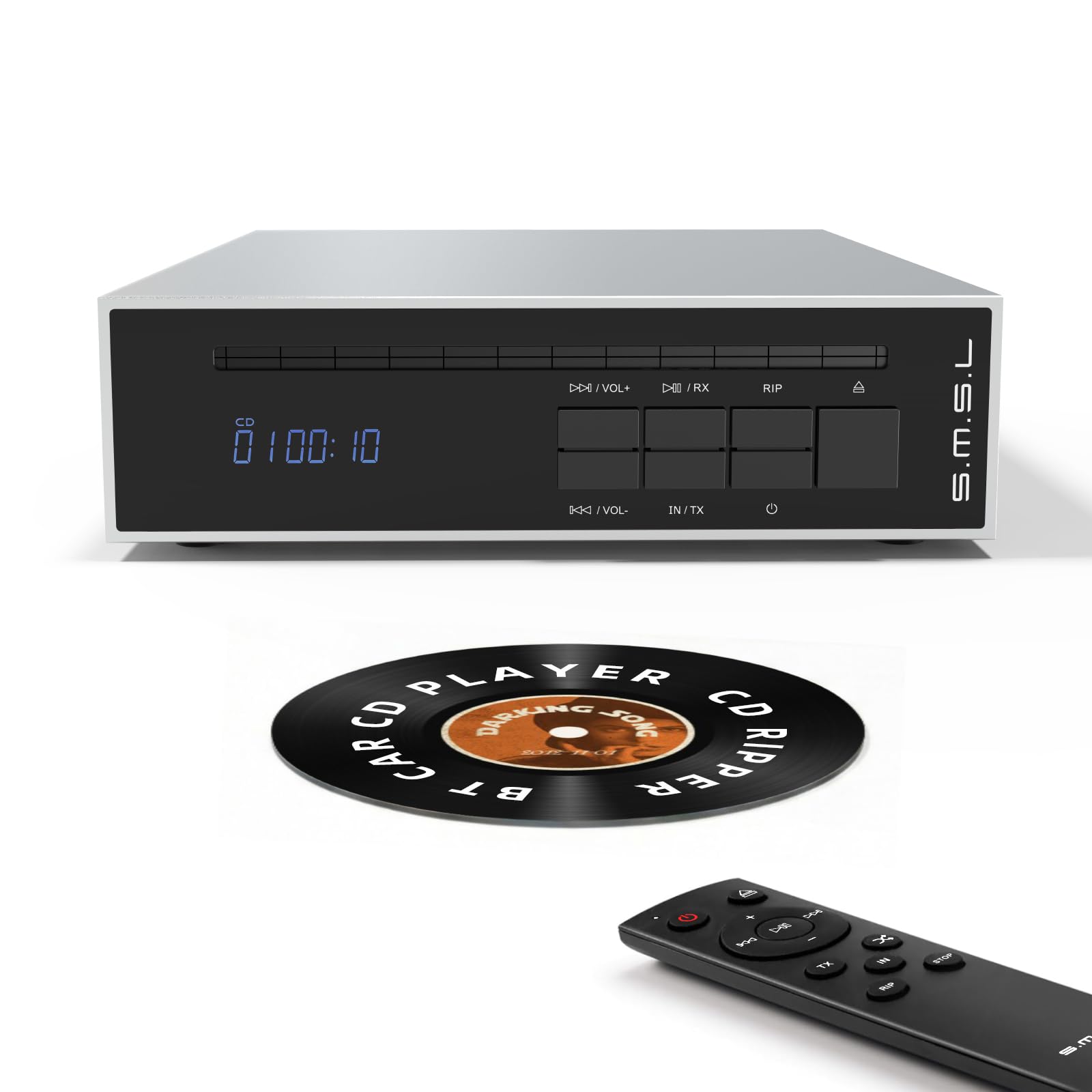
The SMSL PL20 is an entry-level CD transport that packs an astonishing feature set for its reasonable price. Dual CS43131 DAC chips drive the headphone outputs (3.5mm and 4.4mm balanced), while the coaxial and optical digital outs serve as a clean transport to an external DAC. The slot-load mechanism uses an auto-clamp design — slide the disc halfway in and it pulls itself the rest of the way, protecting the disc surface from scratches.
CD ripping is a standout feature: press and hold the RIP button for two seconds and the PL20 converts the entire CD to lossless WAV on a USB thumb drive (supports up to 256 GB via exFAT or FAT32). The bidirectional Bluetooth 5.3 works both as a receiver (play from your phone) and as a transmitter (send CD audio to Bluetooth headphones or a car stereo). This is the only transport in this roundup that can physically rip CDs to a USB stick.
The all-CNC aluminum chassis weighs 1.2 kg and sits on four rubber feet. Users report excellent sound quality through the digital outputs, though some note a minor resampling to 48 kHz rather than bit-perfect transmission. Gapless playback has a tiny blip on some discs, and the remote lacks a number pad for direct track entry. For its price, the PL20 delivers an incredible breadth of functionality — ripping, Bluetooth, headphone amp, and digital transport — making it the ideal gateway device for someone re-entering physical media.
Why it’s great
- One-touch CD ripping to WAV on USB
- Bi-directional Bluetooth 5.3 (TX/RX)
- 3.5mm and 4.4mm balanced headphone outputs
- Dual CS43131 DAC chips
Good to know
- Digital output resamples to 48 kHz, not bit-perfect
- Gapless playback has minor blip between tracks
FAQ
Do I need an external DAC with a dedicated CD transport?
Will an expensive transport sound better than a cheap DVD player?
What is the difference between a CD player and a CD transport?
How important is the disc mechanism type (slot vs. top vs. tray)?
Final Thoughts: The Verdict
For most users, the best cd transport winner is the SMSL PL200T because it delivers reference-grade clocking, MQA decoding, and multiple output options (I²S, AES/EBU, coaxial, optical) at a price that undercuts competing designs with similar specs. If you need a streaming hub that also serves as a transport, grab the Eversolo T8 for its galvanically isolated outputs and Roon-ready interface. And for a compact, reliable desktop transport that fits anywhere, the TEAC PD-301-X is hard to beat.

Mo Maruf
I created WellFizz to bridge the gap between vague wellness advice and actionable solutions. My mission is simple: to decode the research and give you practical tools you can actually use.
Beyond the data, I am a passionate traveler. I believe that stepping away from the screen to explore new environments is essential for mental clarity and physical vitality.