Our readers keep the lights on and my smoothie glass nicely filled. As an Amazon Associate, I earn from qualifying purchases.
The first time your baby smacks a button and a plastic animal springs up—or whacks a peg and hears a satisfying *ding*—they’re not just making noise. They’re building a neural bridge between action and reaction, control and consequence. That tiny burst of understanding is the cornerstone of cognitive development, and the right cause-and-effect toy is the tool that unlocks it.
I’m Mohammad Maruf — the founder and writer behind WellFizz. I’ve spent years analyzing early childhood development products, dissecting their mechanical action cycles, material safety specs, and sensory complexity to separate the fleeting distractions from the genuine learning tools.
Whether you want a board that teaches switches, a hammer set that builds motor planning, or a classic pop-up that never needs batteries, this guide cuts through the options to help you pick the very best cause and effect toys for your child’s stage.
How To Choose The Best Cause And Effect Toys
The best cause-and-effect toy for your baby depends on their current motor stage and your tolerance for noise. A 9-month-old needs a simple press-and-reveal action; a 15-month-old craves multi-step sequences like hammering a peg that rings a bell. Here’s what to look for.
Action Variety: Mechanical vs. Electronic Feedback
Mechanical toys (pop-ups with springs, squeakers, clicking switches) teach the purest relationship between a child’s physical effort and the outcome. Electronic toys add lights and recorded sounds, which hold attention longer but can overwhelm a sensitive child. The best sets blend both: a manual toggle that triggers a quiet LED, or a hammer strike that plays a xylophone note.
Material Safety and Durability
Babies explore with their mouths, so non-toxic finishes are non-negotiable. Look for BPA-free ABS plastic or solid wood with water-based paint. The toy must survive the drop-from-high-chair test—check that seams are fusion-welded (not glued) on plastic sets, and that wooden pieces are splinter-free with no loose hardware.
Challenge Progression
A great cause-and-effect toy grows with the child. Early-stage toys require a single action (push a button, pull a lever). More advanced toys require sequencing (turn a dial, then press a switch, then watch five things happen). Check the manufacturer’s age range, but also look at the number of distinct actions—four or more different mechanisms offer longer replay value.
Quick Comparison
On smaller screens, swipe sideways to see the full table.
| Model | Category | Best For | Key Spec | Amazon |
|---|---|---|---|---|
| Fisher-Price Busy Buddies Pop-Up | Premium | Pure mechanical cause-effect (no batteries) | 4 pop-up animal actions + 4 sensory sounds | Amazon |
| Infantino Bop & Drop Ball Tower | Mid-Range | Ball-drop action + hammer play | 2 slides, 2 peek-a-boo tunnels, 4 balls | Amazon |
| Joyreal Wooden Montessori Toy | Mid-Range | Multi-activity: pounding + xylophone + fishing | 5 activities: hammer bench, xylophone, gears, fishing | Amazon |
| Duchong Pop Up Animals | Value | Early pop-up learning with animal sounds | 3 modes: animal sounds, game, quiet play | Amazon |
| HarVow LED Busy Board | Budget | Switch exploration with visual feedback | 13 switches, 24 LED lights, wooden frame | Amazon |
In‑Depth Reviews
1. Fisher-Price Baby Early Learning Toy with Fine Motor Activities, Busy Buddies Pop-Up

The Fisher-Price Busy Buddies Pop-Up is the purest expression of cause-and-effect on this list—every action produces a distinct mechanical result with zero batteries. Your baby presses, flips, spins, or slides one of four activations, and a corresponding animal pops up with a sensory reward: the giraffe button squeaks, the elephant slider chimes, the lion toggle clicks, and the crocodile spinner clicks rhythmically. This tactile variety teaches fine motor differentiation in a way that recorded sounds cannot.
The engineering is noticeably robust. The base is wide and stable enough to prevent tipping during aggressive toddler play, and the animal springs are tensioned to provide satisfying resistance without being too stiff for a 9-month-old. Each activation mechanism—button, slider, toggle, spinner—requires a slightly different grip and motion pattern, building finger strength and dexterity through varied repetition. Parents consistently report that the toy remains engaging from 5 months through toddlerhood, and the absence of electronics means it works every single time without any failure mode.
The only limitation is the lack of volume control for the built-in squeaker and chime—they’re not loud, but they are fixed. The toy also occupies more counter space than a compact busy board. For families who want a screen-free, durable, and genuinely developmental pop-up that teaches pure cause-and-effect through physical effort, this Fisher-Price model is the gold standard.
Why it’s great
- Four distinct mechanical actions (push, flip, spin, slide) target different fine motor patterns
- No batteries needed—reliable, quiet, and impossible to break from electrical failure
- Sturdy build survives drops and aggressive toddler play with no loose parts
Good to know
- Cannot be mounted or secured to a table—may slide on smooth surfaces during active play
- Fixed sound volume on the built-in squeaker and chime; no mute option
2. Joyreal Wooden Montessori Toys for 1 Year Old – Hammering Pounding Toy with Xylophone & Fishing Game
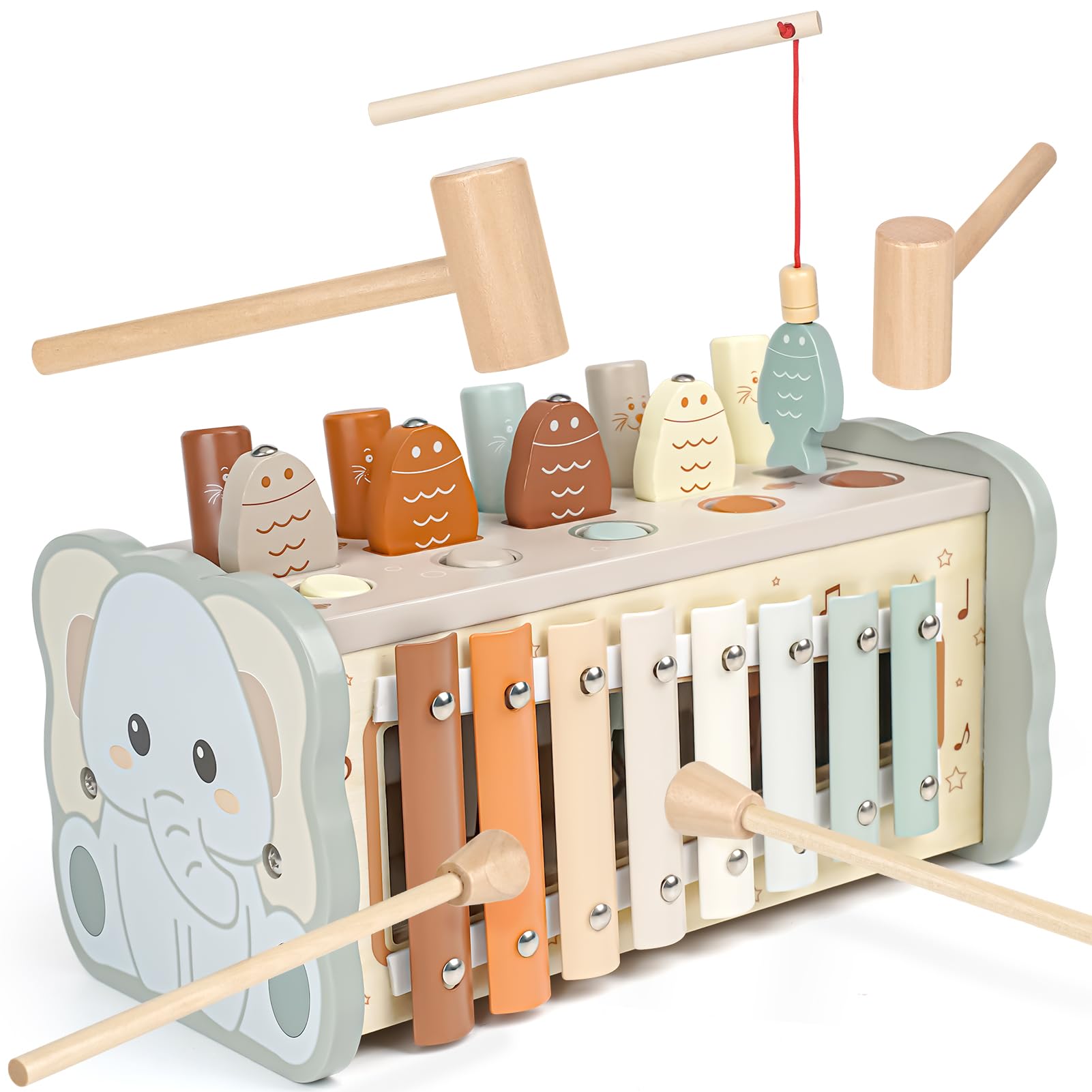
The Joyreal Wooden Montessori Toy is a multi-functional powerhouse that packs a hammering bench, a xylophone, a magnetic fishing game, and a gear-spinning activity into one compact wooden platform. Each sub-activity teaches cause and effect from a different angle: hammering a peg makes a hamster pop up, spinning a gear turns the adjacent gear, drawing a magnet across the fishing pond lifts the wooden fish, and striking the xylophone bars produces distinct musical notes. This variety prevents the boredom plateau that single-action toys hit after a few weeks.
The construction is where this set excels—premium natural wood with non-toxic water-based paint in a calming neutral palette that is deliberately less visually overwhelming than the neon-bright plastic alternatives. Edges are hand-sanded to a splinter-free smoothness, and the included two hammers and two mallets allow parent-child or sibling co-play, turning solo exploration into a social skill builder. The xylophone bars are tuned to recognizable notes, not random pings, which introduces musical cause-and-effect at the same time.
At roughly 10 x 6 inches, the base is smaller than some competitors, which is actually a benefit for a 1-year-old’s reach. The magnetic fishing poles require steady hands—better suited for an 18-month-old than a younger baby. Some users note that the xylophone mallet is attached by a short string that can fray over time. For parents seeking a durable, multi-skill Montessori toy that pairs fine motor cause-and-effect with musical and logical thinking, this is the clear top pick.
Why it’s great
- Five distinct cause-and-effect activities in one set extend replay value dramatically
- Solid wood construction with water-based paint ensures safety and longevity through heavy use
- Two hammers and two mallets enable cooperative play and parent-child bonding
Good to know
- Magnetic fishing activity requires more refined motor control, best for 18+ months
- Xylophone mallet attachment string may wear down with aggressive use
3. Infantino Bop & Drop Ball Tower – STEAM Educational Play, 12M+

The Infantino Bop & Drop Ball Tower is a deceptively simple toy that teaches a powerful cause-and-effect sequence: bop the ball through the ring, watch it race down a slide, track it through a peek-a-boo tunnel, and retrieve it at the bottom. This loop of action, observation, and repeat builds attention span and working memory far more effectively than a single pop-up event. The included child-safe hammer adds a second action modality—children can push balls through with their hands or use the hammer for striking practice.
The color-coded ball-to-ring matching system introduces an early sorting element: each of the four balls matches its corresponding ring slot, adding a cognitive layer beyond pure motor play. The two separate slides and two tunnels create different visual trajectories, so the child must visually track which path the ball took—a critical pre-reading skill. The plastic construction is lightweight enough for a toddler to carry but thick-walled enough to survive repeated throws. Parents consistently report that the open-ended nature keeps children engaged in 20+ minute sessions.
The primary downside is that the balls can occasionally get stuck at the transition point between the ring and the slide if pushed at a sharp angle. Cleaning is straightforward since the entire tower disassembles. For families wanting a screen-free toy that teaches sequencing, visual tracking, and fine motor cause-and-effect through a satisfying loop of drop-and-retrieve, the Infantino Bop & Drop delivers exceptional value.
Why it’s great
- Sequential cause-effect loop (bop → drop → track → retrieve) strengthens attention span
- Color-coded ball-to-ring matching adds a cognitive sorting challenge
- Hammer tool provides an alternate striking action for varied motor practice
Good to know
- Balls may occasionally stick at the ring-to-slide junction if pushed crooked
- Lightweight base can slide if the child pulls on the tower during play
4. Duchong Pop Up Toys for 1 Year Old – Interactive Cause and Effect Learning Toys with Music & Light

The Duchong Pop Up Animals toy is an upgraded take on the classic pop-up format, adding three distinct play modes that adapt to your child’s developmental stage. In Animal Sound Mode, each popped-up animal announces its name and plays its corresponding sound—building vocabulary alongside cause-and-effect. Game Mode challenges the toddler to follow a light pattern and move the correct button to find hidden animals, introducing a working-memory element. Quiet Mode lets the animals pop up mechanically with no sounds, preserving the core cause-effect lesson for noise-sensitive environments.
The action mechanisms include a lever, a switch, a dial, and a button—four different grip types that build hand strength across different finger movements. The ABS plastic construction is polished smooth with no sharp edges, and BPA-free certification gives peace of mind during mouthing phases. The compact footprint (roughly the size of a small book) makes it genuinely portable for car rides or restaurant waits, and the three-mode flexibility means the toy doesn’t get relegated to the closet after the initial novelty fades.
The main durability caveat: some users report that the pop-up flaps can get stuck if a child pushes down too hard, requiring a manual reset. The lightweight build is convenient for travel but means the toy can slide during energetic play on slick surfaces.
Why it’s great
- Three play modes (animal sounds, game, quiet) adapt to the child’s skill level
- Four distinct activation mechanisms (lever, switch, dial, button) build varied fine motor skills
- BPA-free ABS plastic with polished edges ensures safe mouthing exploration
Good to know
- Pop-up flaps can jam if pressed too forcefully; may need occasional manual reset
- Lightweight body slides on smooth table surfaces during vigorous play
5. HarVow Busy Board with LED Light Switches – Montessori Wooden Toy for 1 2 3 Year Olds
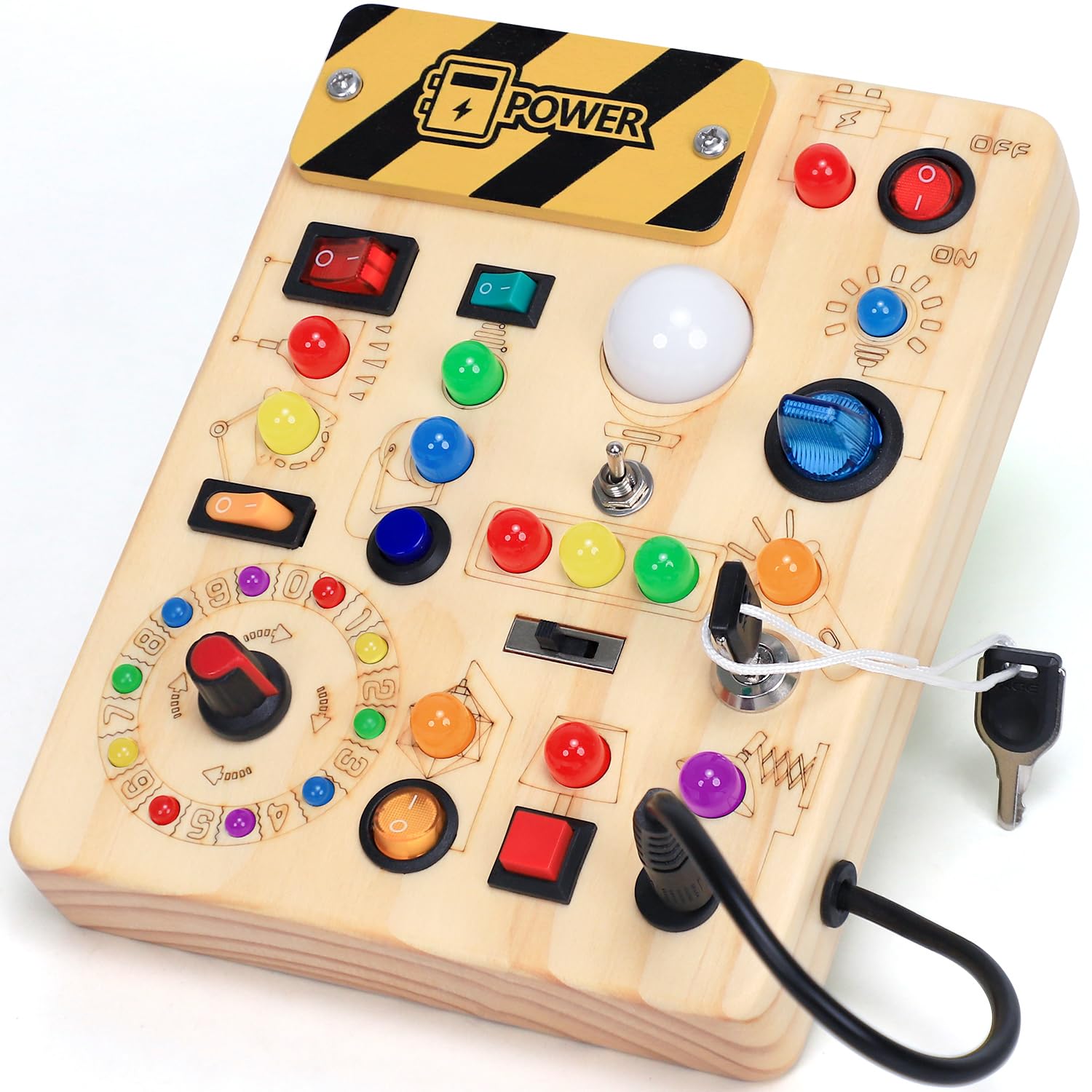
The HarVow LED Busy Board translates the real-world cause and effect of light switches into a toddler-safe wooden form factor. Thirteen different switch types—toggles, rockers, push buttons, dials, and key switches—each trigger one of 24 LED lights in different colors and patterns, teaching the child that each specific action produces a unique visual result. The compact 6.7 x 5.3-inch size fits in a diaper bag and is small enough for a 1-year-old to hold independently.
The construction is solid natural wood with hand-sanded edges and no splinters—a significant step up from the particle-board busy boards that dominate the lower price tier. The backside is engraved with A-Z letters and 0-9 numbers, adding a pre-literacy layer when the child is ready. A master switch lets parents cut power to all LEDs with one click, extending battery life and preventing overstimulation. The LEDs are calibrated to a safe brightness that won’t strain developing eyes while remaining vivid enough to hold attention.
The primary trade-off is that this board is less physically engaging than pop-up or pounding toys—the child sits and manipulates switches rather than moving their whole body. The requirement for 2 AAA batteries (not included) is a minor inconvenience, and one reviewer noted that a single button’s light flickered intermittently. For car travel, restaurant waits, or quiet-time exploration where you want a screen-free, lightweight cause-and-effect tool that teaches switch mechanics and visual tracking, the HarVow board is an excellent compact choice.
Why it’s great
- Thirteen unique switch types provide extensive fine motor and tactile variety
- Solid wood construction with smooth, splinter-free edges exceeds typical budget board quality
- Master power switch prevents battery drain and gives parents control over stimulation
Good to know
- Requires 2 AAA batteries (not included); no mechanical-only play mode
- Stationary format limits gross motor engagement compared to ball drops or hammering toys
FAQ
At what age should I introduce cause and effect toys?
Are electronic cause and effect toys with lights and sounds better than mechanical ones?
How many different actions should a good cause-and-effect toy have?
Final Thoughts: The Verdict
For most families, the best cause and effect toys winner is the Fisher-Price Busy Buddies Pop-Up because it delivers four distinct mechanical actions with zero batteries, zero failure modes, and durable construction that survives from 9 months through toddlerhood. If you want a multi-activity wooden set that pairs cause-and-effect with music and fine motor work, grab the Joyreal Wooden Montessori Toy. And for a quiet, travel-friendly option that teaches switch mechanics through visual LED feedback, nothing beats the HarVow LED Busy Board.

Mo Maruf
I created WellFizz to bridge the gap between vague wellness advice and actionable solutions. My mission is simple: to decode the research and give you practical tools you can actually use.
Beyond the data, I am a passionate traveler. I believe that stepping away from the screen to explore new environments is essential for mental clarity and physical vitality.