Our readers keep the lights on and my smoothie glass nicely filled. As an Amazon Associate, I earn from qualifying purchases.
A gap between a window frame and the wall, a crack in a baseboard, or a rotted section of a deck rail—these are the moments that define a trim carpenter’s skill. The wrong filler shrinks back, cracks under movement, or rejects stain, leaving a repair that screams for attention. The right sealant locks in place, moves with the wood, and disappears into the finish.
I’m Mohammad Maruf — the founder and writer behind WellFizz. I’ve spent hundreds of hours analyzing wood filler and sealant formulations, comparing cure times, bonding strengths, and compatibility with paints and stains across dozens of brands to separate the chemistries that actually work from the ones that fail after a season.
Whether you are patching nail holes in interior trim or rebuilding a rotted windowsill, the right caulk for wood hinges on elasticity, adhesion, and stainability—three specs that determine whether your repair lasts or peels within months.
How To Choose The Best Caulk For Wood
Selecting a filler for woodwork isn’t about grabbing the first white tube on the shelf. The chemistry needs to match the substrate, the environment, and the finish you plan to apply. Here are the three factors that separate a lasting repair from a weekend redo.
Chemistry: Acrylic vs. Epoxy vs. Solvent-Based
Water-based acrylic formulas offer easy cleanup, low odor, and excellent stainability—ideal for interior trim and furniture. Two-part epoxy fills like the Bondo formulas create a permanent, rock-hard bond that resists water and won’t shrink, making them the only choice for exterior rot repair or deep structural gaps. Old-school solvent-based fillers have largely been replaced because they emit strong fumes and can crack over time.
Shrinkage and Flexibility
A filler that shrinks back below the wood surface creates a concave divot that catches light and looks like a defect. Premium formulas use ceramic microspheres or real wood fibers to resist shrinkage. Equally important is flexibility—wood expands and contracts with humidity. A caulk that stays slightly pliable after curing moves with the wood instead of pulling loose from the edges.
Finish Compatibility
If you plan to paint, any paintable filler will do. But if you want a stain-grade finish, the filler must accept pigment evenly without blotching. Many white or light-colored putties block stain absorption, leaving a visible white spot under the color. Look for a filler that explicitly states it works with stains—products like the Elmer’s ProBond contain real wood fibers that take stain naturally.
Quick Comparison
On smaller screens, swipe sideways to see the full table.
| Model | Category | Best For | Key Spec | Amazon |
|---|---|---|---|---|
| Elmer’s ProBond | Acrylic Putty | Interior/exterior holes & cracks | Ceramic microspheres, 3x stronger | Amazon |
| 3M Bondo Wood Filler | Two-Part Epoxy | Structural rot & large gaps | Sandable in 15 min | Amazon |
| LOBA Gap Filler | Acrylic Caulk | Floor gaps & wood trim seams | Light Oak color match | Amazon |
| Bondo Wood Filler (12 oz) | Two-Part Epoxy | Quick exterior repairs | Blue hardener, fast cure | Amazon |
| SEISSO Wood Putty | Water-Based Putty | DIY furniture touch-ups | 18 oz tub, sandable | Amazon |
In‑Depth Reviews
1. Elmer’s ProBond Professional Strength Wood Filler

The Elmer’s ProBond is a mid-range acrylic putty that punches above its weight class. Its patented formula incorporates ceramic microspheres that prevent shrinkage and cracking—a common failure point in cheaper fillers. The 32-ounce resealable tub offers plenty of material for multiple projects, from filling nail holes in cedar siding to patching rotted deck boards.
One of its strongest selling points is compatibility with both paint and stain. Real wood fibers in the formula allow stain to penetrate naturally, so repairs on stained trim or furniture disappear into the surrounding grain. Users report that it fills large woodpecker damage on cedar posts and holds up well under dark stain without blotching. The paste consistency is stiff enough to stand up in deep holes without sagging.
Note that the manufacturer recommends this for exterior use, but some long-term user reports suggest that direct rain exposure can degrade it over seasons. It sets up faster than standard Elmer’s wood filler, meaning you have less working time but a quicker path to sanding. Keep a spray bottle of water handy to prevent a skin from forming on the surface on warm days.
Why it’s great
- Ceramic microspheres resist shrinkage and cracking
- Takes stain and paint equally well
- Large 32-oz tub provides good project coverage
Good to know
- Not fully waterproof for long-term exterior exposure
- Stiff consistency can be tough to spread in thin layers
2. 3M Bondo Wood Filler (30 fl oz)

The 30-ounce Bondo Wood Filler is the premium epoxy option for serious structural repairs. This two-part system uses a resin and a red hardener that chemically bond to create a mass as hard as concrete. It’s the go-to choice for rebuilding rotted window sills, filling deep gouges in deck posts, or repairing furniture legs where strength matters more than cosmetics.
Cure time is fast—you can sand it smooth in as little as 15 minutes, which means same-day completion on many jobs. The material sands cleanly without gumming up paper, and it will not shrink or expand after curing. Users consistently highlight how it drills and routes like real wood, making it suitable for repairing architectural details that require shaping. The bond is permanent and water-resistant, suitable for both interior and exterior applications.
The trade-off is working speed: you have about 5 minutes of open time before the mixture becomes unworkable. Mix small batches and discard any unused portion. The red hardener must be used sparingly—too much can tint the repair pink, which will show through under light paint. The quartz-size container (30 fl oz) is generous for multiple repairs.
Why it’s great
- Rock-hard cure that sands and machines like wood
- Sets in 15 minutes for same-day completion
- Permanent, waterproof bond for exterior use
Good to know
- Very short working time—must mix in small batches
- Red hardener can tint the repair pink if overused
3. LOBA Gap Filler (Light Oak)

The LOBA Gap Filler is a premium acrylic caulk designed for one specific use case: matching stained wood floors and trim without needing to paint. The Light Oak color closely matches rustic pine and lighter hardwoods, and the manufacturer offers a wide color range that outperforms big-box hardware store selections. It’s formulated to perform on wood, cork, tile, and resilient flooring.
This caulk stays slightly flexible even after full cure, making it ideal for floor gaps where seasonal wood movement is a concern. Users report that a single 310-ml tube covers approximately 36 linear feet of 1/8-inch gap. The material is sandable and recoatable with finish, oil, or care products, meaning you can fine-tune the surface after application. It contains no solvents and has very low odor, which is a major advantage for indoor use.
Application can be messy—the consistency is thin enough to drip if over-applied, and the tube requires a caulking gun. The color-matching is precise, but because it’s pre-colored, you cannot stain it to a darker shade. It’s also only water-resistant, not fully waterproof, so avoid using it in direct, standing-water exposure. For stained floor repairs and trim transition gaps, it’s nearly invisible.
Why it’s great
- Excellent color match for light oak and pine
- Remains flexible after cure, works with wood movement
- Low odor, solvent-free, safe for indoor use
Good to know
- Application can be messy and requires a caulking gun
- Not fully waterproof—avoid standing water exposure
4. Bondo Wood Filler (12 oz with Hardener)
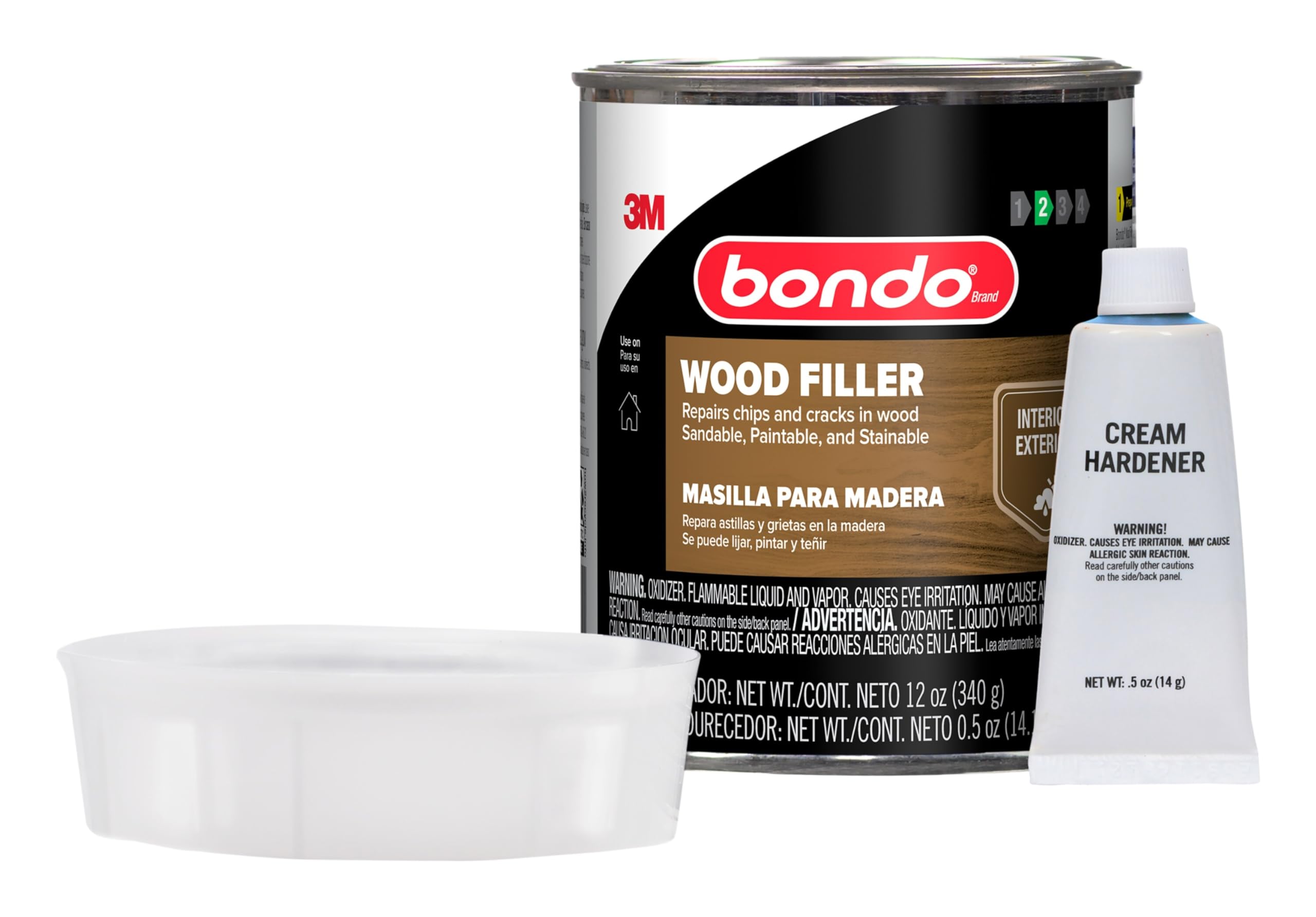
The 12-ounce Bondo Wood Filler is the smaller, more portable version of the premium epoxy formula, ideal for on-the-go repairs or smaller projects. It uses the same two-part chemistry—a salmon-colored resin and a blue hardener—that creates a non-shrinking, water-resistant bond suitable for interior and exterior use. It’s a top choice for quick fixes on window sills, deck boards, and furniture.
The fast-curing formula sands smooth in about 15 minutes, allowing you to complete a repair in a single afternoon. Users report that it fills large gaps without bubbling and adheres permanently to the wood surface, even when the surrounding wood is slightly rotted. The included hardener makes it easy to mix exact amounts, though the blue hardener can leave a greenish tint in the final cure if the ratio is off.
The working time is extremely short—you must have the repair area prepped and ready before mixing. The odor is stronger than water-based putties, so ventilation is recommended. For small jobs like filling nail holes or hairline cracks, a one-part acrylic putty might be more convenient. But for any repair where strength and durability are non-negotiable, this compact kit delivers professional results.
Why it’s great
- Sets rock hard and won’t shrink or crack
- Sands smooth in just 15 minutes
- Small size ideal for tool bags and quick repairs
Good to know
- Blue hardener can tint final repair greenish
- Very short working time requires quick application
5. SEISSO Wood Filler & Putty (White)

The SEISSO Wood Filler is a budget-friendly, water-based putty that comes as a complete kit with gloves, scrapers, and sandpaper. It’s aimed squarely at DIY homeowners who need to fix scratches, chips, and small holes on white or painted furniture, cabinets, and trim. The medium-to-high viscosity means it stays where you put it without running.
The formula is non-toxic and water-cleanup-friendly, making it safe for indoor use without strong fumes. Users report that it dries quickly and can be sanded smooth with minimal effort. The white color works best on white-painted surfaces—if you try to stain it, the white base will show through. For painted trim touch-ups around the house, it’s a solid performer at an entry-level price point.
The main compromise is durability: as a one-part water-based putty, it lacks the structural strength of a two-part epoxy and may crack or shrink if applied in thick layers. It also won’t hold up to outdoor moisture. The 18-ounce tub is generous, but some units arrive with a large air bubble that leaves the container only half full. For light-duty interior repairs on white surfaces, it’s a practical and affordable solution.
Why it’s great
- Complete kit with tools included
- Non-toxic, water cleanup, low odor
- Dries quickly and sands smoothly
Good to know
- White color limits use to painted surfaces only
- May shrink or crack in thick applications
FAQ
Can I use regular painter’s caulk on wood?
How long should a wood filler dry before sanding?
Can I paint or stain over wood filler?
Final Thoughts: The Verdict
For most users, the caulk for wood winner is the Elmer’s ProBond because it delivers 3X strength, resists shrinkage, and takes stain beautifully—all at a mid-range price that works for both interior trim and exterior deck repairs. If you need rock-hard structural performance for rotted wood or deep gaps, grab the 3M Bondo Wood Filler. And for a color-matched seam on stained floors where invisibility is everything, nothing beats the LOBA Gap Filler.

Mo Maruf
I created WellFizz to bridge the gap between vague wellness advice and actionable solutions. My mission is simple: to decode the research and give you practical tools you can actually use.
Beyond the data, I am a passionate traveler. I believe that stepping away from the screen to explore new environments is essential for mental clarity and physical vitality.