Our readers keep the lights on and my smoothie glass nicely filled. As an Amazon Associate, I earn from qualifying purchases.
A crack in your concrete isn’t just an eyesore—it’s a channel for water, weeds, and frost heave that widens every freeze-thaw cycle. The wrong caulk peels, cracks, or lets moisture through, turning a quick repair into a recurring headache.
I’m Mohammad Maruf — the founder and writer behind WellFizz. I’ve spent hundreds of hours analyzing the chemical formulations, adhesion specs, and real-world durability data behind concrete repair sealants so you don’t have to test a dozen tubes yourself.
This guide breaks down the five most effective formulas available right now to help you choose the best caulk for concrete cracks that fits your specific repair situation.
How To Choose The Best Caulk For Concrete Cracks
Selecting the right concrete crack sealant comes down to three factors: crack width, exposure to water pressure, and the need for flexibility after curing. A hydraulic cement plugs active leaks in minutes, while a flexible silicone or MS polymer sealant handles seasonal expansion. A powder filler works best for hairline cracks on horizontal surfaces.
Crack Width and Depth
Narrow cracks under 1/4 inch require a self-leveling liquid or fine-grain powder that flows into the gap. Wider cracks over 1/2 inch benefit from a backer rod and a flexible sealant that can bridge the gap without sagging. Always clean the crack of debris and loose concrete before applying any caulk to ensure a mechanical bond.
Location and Movement
Driveways and sidewalks exposed to freeze-thaw cycles need a sealant that stretches and compresses without tearing. Vertical cracks on foundation walls or retaining walls require a non-sag formula that won’t drip during application. For cracks below grade where water pressure is present, a hydraulic cement that sets against running water is the only reliable option.
Quick Comparison
On smaller screens, swipe sideways to see the full table.
| Model | Category | Best For | Key Spec | Amazon |
|---|---|---|---|---|
| Quikrete Hydraulic Water Stop Cement | Hydraulic Cement | Active water leaks below grade | Sets in 3-5 minutes | Amazon |
| GE Silicone II Concrete & Masonry Caulk | Silicone Sealant | Driveway cracks with movement | Flexible after full cure | Amazon |
| ConSandtrate Crack Filler | Powder Filler | Hairline cracks on flat slabs | Water-activated, self-leveling | Amazon |
| LUVBOATE High Elasticity Crack Filler | MS Polymer | Horizontal surface waterproofing | Self-leveling, rubbery finish | Amazon |
| Autosel Concrete Crack Filler (2-Pack) | Self-Leveling Gel | Patios and walkways | Self-leveling, flexible | Amazon |
In‑Depth Reviews
1. Quikrete Hydraulic Water Stop Cement

The Quikrete Hydraulic Water Stop Cement is the undisputed champion for stopping active water leaks. This hydraulic cement expands as it cures, creating a mechanical lock inside the crack that seals against running water above or below grade. It reaches initial set in 3 to 5 minutes, so you can stop a basement wall seepage or pool leak before the next rain hits.
Each 10-pound box provides multiple repair sessions, and you mix only what you can use in 2 to 3 minutes before it stiffens. Users report it plugs cracks in old foundations effectively and holds up better than competing brands on wet surfaces. The color is slightly lighter than standard concrete, but it accepts paint or masonry stain after full cure.
Best results come from carving a dovetail channel at least 3/4 inch wide at the surface and packing the cement firmly. For narrow cracks, you must widen the opening to ensure the hydraulic material locks in place. It works brilliantly for structures exposed to water pressure but is overkill for dry, non-structural driveway hairline cracks.
Why it’s great
- Sets against running water—no need to dry the crack first
- Reaches full hydraulic pressure resistance in minutes
- Can be used above or below grade with equal effectiveness
Good to know
- Mixes must be small: usable for only 2-3 minutes before hardening
- Narrow cracks require widening to ensure mechanical adhesion
2. GE Silicone II Concrete & Masonry Caulk
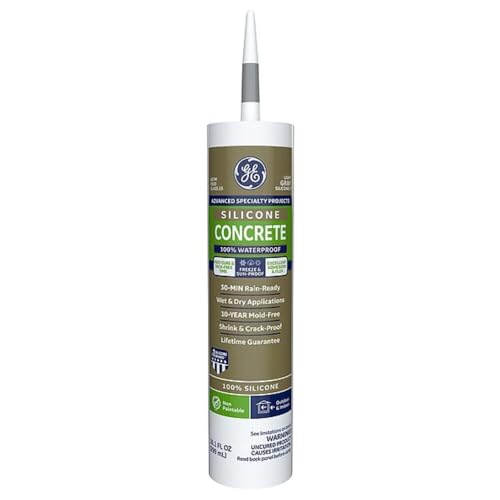
For driveways and patios where concrete expands and contracts with temperature swings, the GE Silicone II Concrete & Masonry Caulk provides the flexibility that rigid hydraulic cements lack. This 100-percent silicone formula stays pliable after curing, allowing it to stretch and compress with seasonal movement without losing adhesion. It’s paintable with some effort, but the light gray color matches most concrete closely enough that painting is optional.
Squeezing out of a standard caulk gun, this sealant adheres strongly to stone, brick, and mortar. Users have sealed chimney cracks and exterior brick wall mortar gaps with months of leak-free performance. It dries to the touch in about an hour and fully cures in 3 hours at moderate humidity, which is considerably faster than many polyurethane alternatives.
One note: the sealant is not paintable with standard latex paints, and tire marks on a driveway can leave dark smudges on the light gray surface. It’s best used for vertical mortar joints, patio control joints, and above-grade foundation cracks where movement is expected. Avoid using it on actively leaking cracks or below-grade applications where standing water is present.
Why it’s great
- Remains flexible after curing, accommodating concrete movement
- Excellent adhesion to stone, brick, and mortar surfaces
- Fast skin-over and full cure in 3 hours
Good to know
- Not paintable with typical latex paints
- Light gray may darken from tire marks on driveways
3. ConSandtrate Concrete Crack Filler
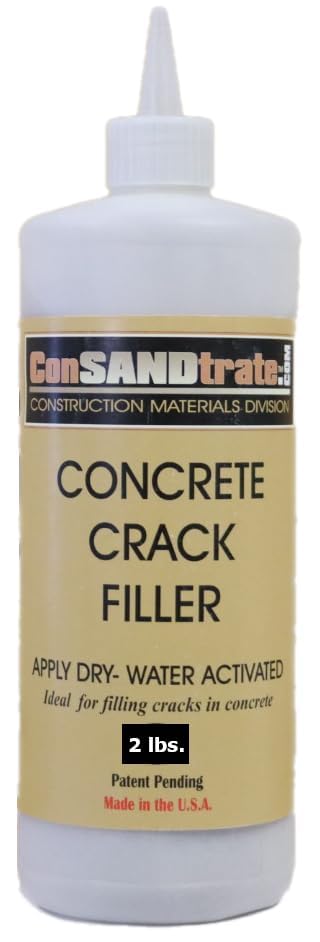
The ConSandtrate Concrete Crack Filler takes a different approach: a fine cementitious powder that you pour into the crack and spray with water to activate. There’s no mixing bucket, no caulk gun, and no waste. The material flows into hairline cracks down to 1/8 inch and self-levels, making it exceptionally easy for casual homeowners to apply with a putty knife and a spray bottle.
The formula includes polymers that reactivate when wet, giving the filler a self-healing quality that extends its lifespan in freeze-thaw climates. Users in northern regions report repairs lasting over a year before needing a quick touch-up. The 2-pound bottle provides enough material for several linear feet of narrow cracks, and the yorkere tip allows precise pouring directly into the seam.
The cured material is slightly softer than concrete and matches the existing slab fairly well, though the color may shift from brown during application to gray after drying. It’s best suited for horizontal surfaces like patios, walkways, and driveways. Avoid using it on vertical cracks, active water leaks, or gaps wider than 1/2 inch where mechanical strength is needed.
Why it’s great
- Mess-free application—just pour, press, and spray
- Self-healing polymers reactivate with moisture
- Excellent for fine hairline cracks on flat slabs
Good to know
- Not suitable for vertical or active leak repairs
- Annual touch-ups may be required in harsh freeze-thaw zones
4. LUVBOATE High Elasticity Crack Filler

Built on an MS polymer base, the LUVBOATE High Elasticity Crack Filler offers a unique combination of self-leveling flow and rubber-like flexibility after cure. It pours as a liquid, so gravity pulls it deep into horizontal cracks, then forms a waterproof membrane that moves with the concrete. The included scraper and gloves make the application kit complete for first-time users.
Once cured, the sealant remains flexible rather than turning rock-hard, absorbing the expansion and contraction cycles that cause rigid fillers to pop out. Reviewers have used it to seal cracked shower grout, fill driveway gaps, and even repair basement floors, with consistent adhesion reported across concrete, brick, tile, and wood surfaces. The 24.7-ounce container covers between 20 and 30 linear feet of 1/4-inch crack depending on depth.
Because it’s a true self-leveler, the product works only on horizontal or near-horizontal surfaces. It requires 24 to 48 hours for full cure, and the glossy dark gray finish can attract debris if foot traffic crosses it before it fully dries. Users with wide or deep cracks may need multiple applications, and the consistency can vary between batches.
Why it’s great
- Self-leveling formula flows into deep cracks without tooling
- Flexible rubber-like finish withstands concrete movement
- Waterproof barrier prevents moisture infiltration
Good to know
- Only effective on horizontal or slightly sloped surfaces
- Glossy finish can collect dust and small debris
5. Autosel Concrete Crack Filler (2-Pack)
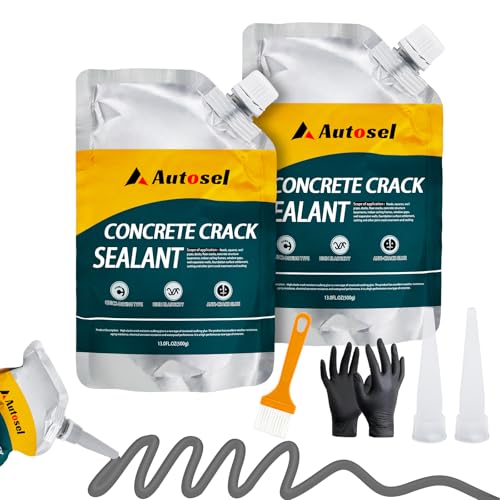
The Autosel Concrete Crack Filler comes as a two-pack of squeeze tubes, each equipped with a precision nozzle for injecting the self-leveling gel directly into the crack. The formula is thin enough to flow into narrow gaps, yet it self-levels to create a smooth, flush finish that blends with the surrounding concrete. Each tube holds roughly 2.2 pounds of material, enough for multiple repair sessions.
The gel cures into a flexible, waterproof seal that holds through rain and temperature swings. Users report that a single application on driveway cracks held up after several freeze-thaw cycles with no delamination. The included brushes and gloves simplify the application process, though mixing the contents of the tube by kneading before opening is recommended for consistent consistency.
On sloped surfaces, the thin liquid can run before it sets, so adding a little sand or using a backer rod on grades steeper than 15 degrees is advisable. The cured finish is moderately glossy, which may look slightly different from matte concrete. For large gaps over 1 inch, it works best as a cap layer over a sand or foam backer rod rather than a standalone fill.
Why it’s great
- Two-pack provides excellent coverage for multiple repairs
- Self-leveling consistency fills cracks without air pockets
- Flexible cure resists cracking in seasonal temperature shifts
Good to know
- Thin formula may run on sloped surfaces without sand
- Glossy finish stands out on matte concrete
FAQ
Can I use silicone caulk on a crack that is actively leaking water?
How wide of a crack can I fill with a self-leveling concrete sealant?
Do I need to widen the crack before applying concrete crack caulk?
Will concrete crack caulk match the color of my existing driveway?
Final Thoughts: The Verdict
For most users, the caulk for concrete cracks winner is the Quikrete Hydraulic Water Stop Cement because it stops active leaks fast and creates a permanent mechanical bond that no other formula matches. If you need a flexible sealant for driveway expansion joints, the GE Silicone II Concrete & Masonry Caulk provides reliable stretch without peeling. And for quick, mess-free repairs on patio hairline cracks, the ConSandtrate Powder Filler delivers the easiest application with decent long-term results.

Mo Maruf
I created WellFizz to bridge the gap between vague wellness advice and actionable solutions. My mission is simple: to decode the research and give you practical tools you can actually use.
Beyond the data, I am a passionate traveler. I believe that stepping away from the screen to explore new environments is essential for mental clarity and physical vitality.