Our readers keep the lights on and my smoothie glass nicely filled. As an Amazon Associate, I earn from qualifying purchases.
A chronic kidney disease diagnosis for your cat shifts every meal into a medical decision. The standard commercial kibble that sustained them for years is now a source of excess phosphorus and protein byproducts that tax already-stressed kidneys. Finding a food that manages those clinical markers while still appealing to a finicky feline appetite is the central challenge—and this guide breaks down the five most effective prescription diets and supplements that meet it.
I’m Mohammad Maruf — the founder and writer behind WellFizz. I analyze veterinary nutrition research, cross-reference ingredient panel data, and track real-world owner feedback to separate marketing claims from actual renal support metrics.
Whether your cat needs a restricted-phosphorus kibble, a phosphate-binding supplement, or a dual kidney-and-mobility formula, this guide to the best cat food for kidney disease compares proven options by their measurable nutritional impact rather than packaging promises.
How To Choose The Best Cat Food For Kidney Disease
Selecting a renal diet isn’t about picking the brand with the most attractive packaging. The clinical difference between effective and ineffective kidney support comes down to three controllable nutritional variables: phosphorus content, protein quality, and the inclusion of targeted additives like omega-3s and prebiotics. Understanding these factors prevents wasted money on foods that look healthy on the label but deliver negligible renal benefit.
Phosphorus Restriction is Non-Negotiable
Elevated blood phosphorus accelerates kidney damage in cats with chronic kidney disease. A proper renal diet keeps phosphorus below 1.0% on a dry matter basis, and many veterinary formulas target 0.5%–0.8%. Compare the guaranteed analysis panel, not the front-of-bag claims.
Protein Quantity Versus Protein Quality
Reducing protein eases the kidney’s filtration workload, but the protein that remains must be highly digestible—real chicken or ocean fish, not by-product meals. The goal is to provide essential amino acids without generating excess nitrogen waste that the kidneys must excrete.
Additives That Make a Measurable Difference
Omega-3 fatty acids (EPA and DHA) reduce renal inflammation, while prebiotic fibers like those in Hill’s ActivBiome+ Kidney Defense feed the gut microbiome to produce compounds that protect kidney function. Phosphate binders—like the ferric citrate in Nutramax Naraquin—physically block phosphorus absorption in the gut, offering an adjunct strategy when diet alone isn’t enough.
Quick Comparison
On smaller screens, swipe sideways to see the full table.
| Model | Category | Best For | Key Spec | Amazon |
|---|---|---|---|---|
| Hill’s k/d Early Support Chicken | Vet Diet Dry | Early-stage kidney protection | ActivBiome+ Kidney Defense prebiotics | Amazon |
| Hill’s k/d Kidney Care Ocean Fish | Vet Diet Dry | Appetite stimulation in late-stage CKD | Enhanced Appetite Trigger (E.A.T.) | Amazon |
| Blue Buffalo K+M Kidney + Mobility | Vet Diet Dry | Combined kidney and joint support | 7-lb bag, glucosamine + chondroitin | Amazon |
| Purina Pro Plan NF Kidney Function | Vet Diet Dry | Picky cats who refuse other renal diets | Reduced protein, restricted phosphorus | Amazon |
| Nutramax Naraquin | Phosphate Binder | Adjunct to diet for high phosphorus | Triple binder: ferric citrate + others | Amazon |
In‑Depth Reviews
1. Hill’s Prescription Diet k/d Early Support Kidney Care Dry Cat Food, Chicken

Hill’s k/d Early Support is the most thoroughly engineered renal kibble on this list, and it earns the top spot because it addresses the three clinical levers that matter most: phosphorus, inflammation, and appetite. The ActivBiome+ Kidney Defense is a proprietary prebiotic blend clinically shown to shift the gut microbiome in a way that reduces uremic toxin production—essentially giving the kidneys less work to do. The restricted phosphorus and sodium levels meet the International Renal Interest Society (IRIS) guidelines for early-stage CKD management.
The Enhanced Appetite Trigger (E.A.T.) technology is a real differentiator. Cats with kidney disease often stop eating due to nausea from uremia, but owner reports consistently note that even picky cats accept this kibble within a week. The chicken flavor and small, uniform pellet size make it accessible for cats with dental sensitivity. Combined with clinically proven antioxidants, this formula supports both kidney function and overall immune health.
At 4 pounds per bag, the cost per feeding is reasonable for a prescription diet. Some owners find the bag size smaller than expected for the price, but the nutritional density means cats need less volume to meet their energy and amino acid requirements. This is the go-to recommendation for any cat newly diagnosed with stage 1 or stage 2 kidney disease.
Why it’s great
- ActivBiome+ prebiotics target gut-kidney axis directly
- E.A.T. technology clinically tested to stimulate appetite in sick cats
- Restricted phosphorus and sodium meet IRIS early-stage guidelines
Good to know
- 4-lb bag is compact; frequent reordering needed for multi-cat households
- Requires veterinary authorization for purchase
2. Hill’s Prescription Diet k/d Kidney Care Dry Cat Food, Ocean Fish

When a cat with advanced CKD refuses food entirely, the ocean fish variant of Hill’s k/d becomes a critical tool. The Enhanced Appetite Trigger works synergistically with the strong fish aroma to overcome the anorexia that often accompanies stage 3 and stage 4 kidney failure. Owner reports describe cats who had stopped eating for days returning to their bowl within 24 hours of being offered this kibble.
Beyond appetite stimulation, this formula delivers the same ActivBiome+ Kidney Defense prebiotic technology found in the chicken version. The phosphorus and sodium are equally restricted, and the added omega-3 fatty acids provide anti-inflammatory EPA and DHA that help slow renal fibrosis. The pellets are noticeably smaller and softer than standard kibble, making them easier for cats with sore gums or missing teeth to chew.
The trade-off is that some cats initially accept the ocean fish flavor then later refuse it—a phenomenon noted in customer reviews. This is common with renal diets because a cat’s taste can change as uremia progresses. For most cats, rotating between the chicken and ocean fish k/d formulas provides enough variety to maintain consistent food intake throughout the disease course.
Why it’s great
- Strong fish aroma effectively overcomes uremia-related appetite loss
- Small, soft pellet texture ideal for cats with oral pain or missing teeth
- Full ActivBiome+ prebiotic and restricted-phosphorus profile
Good to know
- Some cats show flavor fatigue after several weeks of exclusive feeding
- Requires veterinarian authorization for purchase
3. Blue Buffalo Natural Veterinary Diet K+M Kidney + Mobility Support Dry Cat Food, Chicken
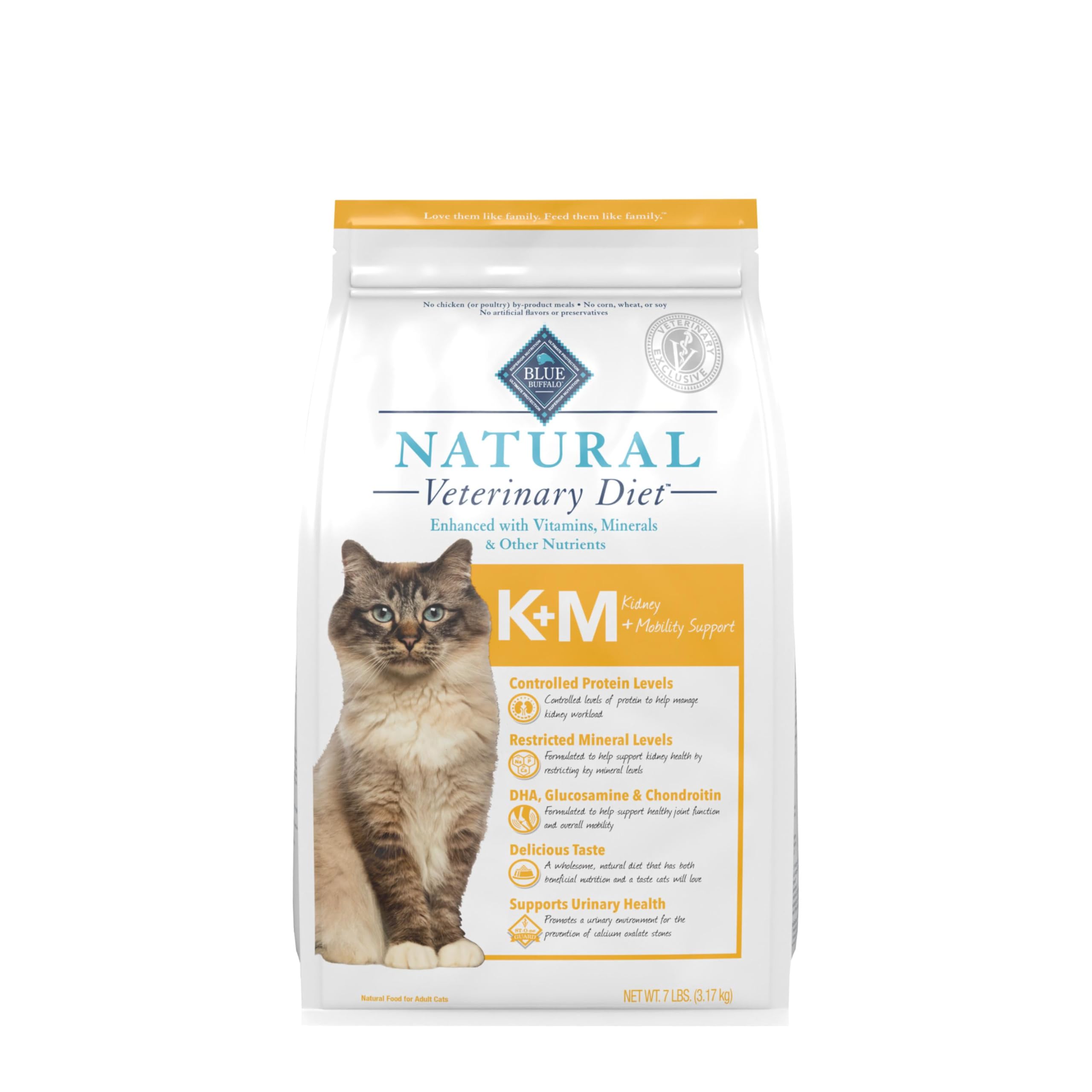
Blue Buffalo’s K+M formula occupies a unique niche: it addresses both kidney function and joint mobility in a single kibble. For senior cats—the demographic most affected by CKD—this dual approach is highly practical because kidney disease and arthritis often coexist. The controlled protein level (starting with real chicken, not by-product meal) reduces renal workload while the added glucosamine and chondroitin support cartilage health and ease stiffness.
The 7-pound bag is the largest size among the five products reviewed, offering a better cost-per-feeding ratio for multi-cat households or owners who prefer to buy in bulk. The kibble is noticeably smaller than standard Blue Buffalo formulas, which helps cats with gum disease or missing teeth eat comfortably. Customer reviews consistently note that picky cats who rejected other renal diets accepted this one eagerly, often eating an entire serving in one sitting.
One caveat: this formula is designed for cats with concurrent kidney and mobility issues. If your cat has CKD but no joint problems, the Hill’s k/d line offers more targeted prebiotic technology. However, for a 14-year-old cat with stage 2 kidney disease and noticeable hind-leg weakness, K+M delivers two therapeutic benefits in one purchase, reducing pill burden and feeding complexity.
Why it’s great
- Combines restricted-protein renal support with glucosamine/chondroitin for joints
- 7-lb bag reduces per-feeding cost and reorder frequency
- Small kibble size and real chicken flavor appeal to picky seniors
Good to know
- Dual focus means less specialized renal prebiotic technology than Hill’s k/d
- Not ideal for cats without concurrent mobility issues
4. Pro Plan Veterinary Diets Purina NF Kidney Function Advanced Care Feline Formula Dry Cat Food

Purina Pro Plan NF is the renal diet that picky cats most consistently accept. Multiple customer reviews describe cats who refused Royal Canin and Hill’s formulas but immediately ate Purina NF without any transition period. The likely reason is the flavor profile—Purina uses a specific palatability enhancer that appeals to cats who have developed food aversions secondary to CKD-related nausea.
The nutritional profile is straightforward: reduced high-quality protein to limit nitrogen waste, restricted phosphorus to slow kidney damage, and added omega-3 fatty acids as a source of EPA and DHA for anti-inflammatory support. The kibble is standard-sized but not overly hard, making it manageable for cats with mild dental issues. One remarkable owner report documented an 18-year-old cat with only 10% kidney function who regained 25% function after two months of eating this food exclusively.
The 3.15-pound bag is the smallest by volume, which means more frequent purchases for single-cat households. It also lacks the advanced prebiotic technology found in Hill’s ActivBiome+ line. But for the specific use case of a cat who refuses every other renal diet, Purina NF is the most reliable fallback option available.
Why it’s great
- Highest palatability among renal diets; cats who reject others often accept this
- Real-world owner reports show measurable kidney function improvement
- Omega-3 fatty acids provide renal anti-inflammatory support
Good to know
- 3.15-lb bag is small; requires frequent reordering
- Lacks prebiotic technology found in competing Hill’s k/d formulas
5. Nutramax Laboratories NARAQUIN Dietary Phosphate Binder + Renal Support Supplement

Nutramax Naraquin is not a food—it’s a phosphate-binding supplement that works alongside any renal diet to further reduce phosphorus absorption. The formulation uses three different binders—ferric citrate, calcium acetate, and chitosan—that each capture phosphorus at different points in the digestive tract. This triple-action approach is more effective than single-binder supplements for cats with persistently high phosphorus levels despite dietary restriction.
The capsule format is practical: you open the capsule, sprinkle the powder over your cat’s wet or dry food at each meal. The powder has a strong, somewhat unpleasant smell, so adding it after the food is heated (if serving warm) helps prevent the aroma from deterring the cat. Owner reports indicate that mixing it with strong-smelling wet food or canned pumpkin masks the scent effectively. Real-world results include a cat whose kidney values improved after three months of twice-daily half-capsule dosing.
This supplement is most appropriate for cats who are already on a veterinary renal diet but whose blood phosphorus remains elevated on lab work. It is not a replacement for a restricted-phosphorus food. The 60-count supply lasts one to two months depending on dosing, making it a cost-effective adjunct for late-stage CKD management when diet alone cannot control phosphorus.
Why it’s great
- Triple-binder mechanism captures phosphorus more effectively than single binders
- Sprinkle format allows precise dosing adjustment per meal
- Backed by Nutramax’s 30-year veterinary supplement reputation
Good to know
- Strong smell may deter cats if not mixed properly with strong-flavored food
- Must be used in conjunction with a restricted-phosphorus diet, not as a standalone fix
FAQ
Can I feed my cat over-the-counter senior food instead of a prescription renal diet?
How do I transition my cat from regular food to a renal diet without causing food aversion?
Do phosphate binders like Naraquin replace the need for a low-phosphorus diet?
Final Thoughts: The Verdict
For most cats with early- to mid-stage kidney disease, the best cat food for kidney disease winner is the Hill’s Prescription Diet k/d Early Support because its ActivBiome+ prebiotic technology and Enhanced Appetite Trigger directly address the two biggest clinical challenges: uremic toxin load and reduced food intake. If your cat has concurrent joint stiffness or mobility issues, grab the Blue Buffalo K+M Kidney + Mobility for dual-condition coverage in a single bag. And for a cat whose blood phosphorus remains stubbornly high despite a restricted diet, nothing beats the Nutramax Naraquin phosphate binder as a targeted adjunct therapy.

Mo Maruf
I created WellFizz to bridge the gap between vague wellness advice and actionable solutions. My mission is simple: to decode the research and give you practical tools you can actually use.
Beyond the data, I am a passionate traveler. I believe that stepping away from the screen to explore new environments is essential for mental clarity and physical vitality.