Our readers keep the lights on and my smoothie glass nicely filled. As an Amazon Associate, I earn from qualifying purchases.
Aphids, spider mites, and whiteflies can turn a lush indoor garden into a battlefield. Reaching for harsh synthetic insecticides often does more harm than good, stripping leaves of their natural protective wax and leaving toxic residue on herbs you plan to eat. Plant parents have long turned to a single, gentle solution that cleans foliage without the chemical fallout: pure castile soap.
I’m Mohammad Maruf — the founder and writer behind WellFizz. I’ve spent years analyzing the formulation of natural cleaning and pest-control products, focusing specifically on how saponified plant oils interact with delicate leaf surfaces and beneficial insect populations.
Whether you are battling a stubborn infestation or simply want to keep your Monstera dust-free, finding the right option starts with truly understanding the label. This guide breaks down the essential spec — organic oil base, concentration ratio, and fragrance profile — so you can confidently buy the best castile soap for plants for your specific growing setup.
How To Choose The Best Castile Soap For Plants
Not every bottle labeled “castile” is safe for your greenery. Some formulations contain added essential oils, synthetic thickeners, or high coconut-oil ratios that can burn leaf margins. When selecting a soap specifically for plant use, you must prioritize three criteria: the primary oil base, the absence of fragrance, and the concentration ratio. A soap that works beautifully as a body wash may wreck your ferns.
Oil Base: Olive vs. Coconut
Traditional castile soap is built on organic olive oil, which produces a mild, moisturizing lather. Coconut-oil-heavy blends create more foam but strip away the waxy cuticle on leaves, causing desiccation and browning. For foliar sprays, look for a formula where organic olive oil is listed first. That single ingredient choice determines whether your spray soothes or stresses.
Fragrance Profile: Unscented Is Non-Negotiable
Plant leaves are covered in stomata that absorb volatile compounds. Peppermint, tea tree, and lavender oils — common in castile soaps — can act as phytotoxins, especially under grow lights or in high humidity. Unscented (not “fragrance-free” which may use masking agents) ensures no unlisted botanical essence interferes with your plant’s respiration or attracts fungus gnats.
Quick Comparison
On smaller screens, swipe sideways to see the full table.
| Model | Category | Best For | Key Spec | Amazon |
|---|---|---|---|---|
| Dr. Bronner’s Baby Unscented | Premium | All-purpose foliar spray | Regenerative organic oils | Amazon |
| YARELI Unscented 64oz | Premium | Large gardens & refills | 6 organic oils, EWG verified | Amazon |
| WEBE Unscented 64oz | Mid-Range | Edible crop pest control | Organic olive oil base | Amazon |
| Dr. Bronner’s Tea Tree 32oz | Mid-Range | Soil drench for fungus gnats | Tea tree oil, 32 oz | Amazon |
| BAMBOO AND BIRCH Unscented 32oz | Budget | Entry-level plant cleaner | Palm-oil-free, 32 oz | Amazon |
In‑Depth Reviews
1. Dr. Bronner’s Pure-Castile Magic Soap (Baby Unscented, 32 oz)

This is the gold-standard bottle that serious plant keepers reach for. The Baby Unscented formulation swaps all essential oils for a completely neutral base, making it the safest option for foliar sprays on sensitive species like calatheas, ferns, and succulents. Over 70% of its ingredients are certified organic and fair trade, with regenerative organic olive oil as the primary lipid. At 3X concentration, a single tablespoon per quart of water creates a potent aphid-killing solution that won’t strip leaf wax.
The lack of synthetic detergents and foaming agents means the soap stays gentle even when used weekly as a preventative spray. Customer feedback consistently highlights its non-drying effect on skin, which translates directly to how it treats leaf surfaces — no browning edges, no wilting. The 32-ounce bottle is packaged in post-consumer recycled plastic, a detail that appeals to eco-conscious growers.
One practical limitation: because it is unscented, you lose the insect-repelling bonus that scent-based soaps sometimes provide. However, for edible crops like basil, mint, and leafy greens, that neutrality is exactly what you want — zero risk of off-flavors or chemical residue at harvest time. This is the professional grower’s default choice for routine maintenance.
Why it’s great
- Regenerative organic olive oil base is gentle on leaf cuticles
- 3X concentration means fewer bottles and less plastic waste
- Completely fragrance-free, safe for edible gardens
Good to know
- Higher sticker price than generic castile options
- No added pest-repelling essential oils for indoor funguses
2. YARELI Pure Castile Soap Liquid Unscented (64 oz)
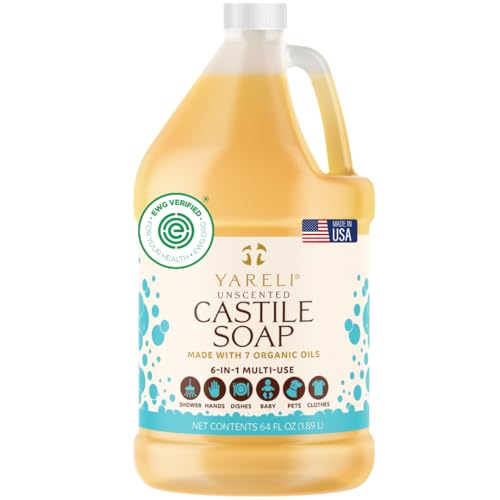
YARELI earns its spot by being EWG Verified — a third-party certification that confirms no hidden carcinogens, irritants, or environmental toxins. Its formula leads with organic olive oil, then layers in coconut, jojoba, hempseed, argan, and almond oils. For gardeners, that multi-oil blend creates a richer emulsion that clings to leaf undersides where spider mites hide, improving contact kill rates during spraying.
The 64-ounce jug is designed for refill use. At a standard 1-tablespoon-per-quart dilution, this single bottle yields over 4 gallons of spray — enough to treat a 40-plant collection for an entire growing season. Customer reviews note its effectiveness as a laundry and dish soap as well, meaning you can buy one product for home and garden without compromise.
A small number of users reported separation issues in cold temperatures, with fats solidifying at the top. While the manufacturer replaces affected bottles promptly, storing this jug at room temperature (above 60°F) is advisable. The extra oils also mean you should test-spray one leaf and wait 24 hours before treating rare tropicals, as the hemp and argan oils add slight emollient properties that some thin-leaved plants may not appreciate.
Why it’s great
- EWG Verified with transparent, non-toxic ingredient list
- 64-ounce bulk size provides excellent cost-per-use value
- Rich oil blend improves adhesion on waxy pest shells
Good to know
- May separate in cold shipping; store above 60°F
- Slightly thinner viscosity requires careful measuring
3. WEBE Pure Unscented Castile Liquid Soap (64 oz)
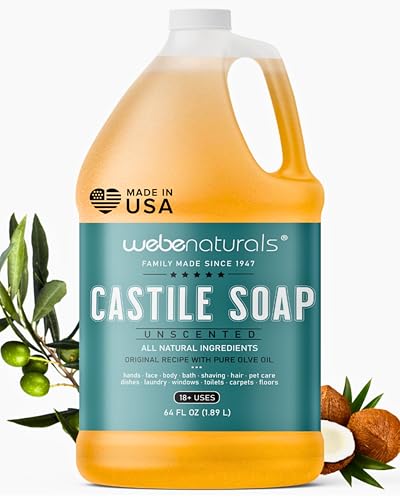
WEBE targets the sustainability-minded grower who wants a trusted olive-oil-first formula without paying the brand premium of legacy names. The soap is palm-oil-free, vegan, non-GMO, and gluten-free. For plant care, the lack of palm oil is crucial — palm-derived surfactants can be too harsh on the beneficial bacteria living in your soil’s rhizosphere, disrupting the natural ecosystem around roots.
Customers describe the consistency as slightly runnier than Dr. Bronner’s, but this actually helps in pump sprayers where thicker soaps can clog nozzles. The unscented label is genuine — no masking agents — making it ideal for seed starts and microgreen trays where any volatile compound could stunt tender growth. A single 64-ounce refill replaces 8 standard 8-ounce bottles, cutting plastic waste significantly.
The trade-off comes in lather quality. Because WEBE uses a higher proportion of olive oil relative to coconut, it produces less foam. Home gardeners accustomed to the bubbly action of coconut-heavy soaps may feel it isn’t “working” when sprayed. Rest assured, the saponification is sufficient to break down the waxy exoskeleton of aphids and mealybugs — foam volume is not correlated with pest-kill efficacy.
Why it’s great
- Palm-oil-free formula protects soil microbiology
- Runnier consistency works reliably in fine-mist sprayers
- 64-ounce bulk is cost-efficient for large gardens
Good to know
- Low foam may confuse first-time users expecting bubbles
- Faint natural oil scent detectable during mixing
4. Dr. Bronner’s Tea Tree Liquid Castile Soap (32 oz)
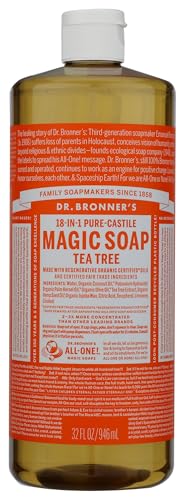
The tea tree variant of Dr. Bronner’s occupies a specific niche in the plant-care toolkit: it is the go-to choice when you need antifungal and antibacterial activity in the soil drench. Tea tree oil (melaleuca) is a known natural fungicide that can help suppress root rot pathogens like Pythium and Fusarium when diluted properly. At 1 teaspoon per gallon, it can be used as a preventive soil flush for seedlings prone to damping-off.
However, this product is emphatically not for routine foliar spraying. Tea tree oil is a potent phytotoxin on leaf tissue, especially under intense grow lights or direct sun. Multiple customer reviews highlight its efficacy as an insect repellent when diluted in a spray bottle for the perimeter of grow tents, but direct leaf contact will cause burning on soft herbs like cilantro and basil. Use this only as a targeted weapon.
The label’s entertaining writings by Dr. Bronner himself are a bonus only if you enjoy eccentric philosophy with your pest control. More practically, the 32-ounce size is compact enough to keep in a garden caddy without taking up shelf space. If you grow ornamentals exclusively and never deal with root fungus, you will get more value from the unscented version instead.
Why it’s great
- Tea tree oil provides natural antifungal action for soil drenches
- Highly concentrated, small amount per gallon goes far
- Great as a perimeter repellent spray for grow tents
Good to know
- Essential oil content burns leaf tissue on direct contact
- Not safe for edible crops if applied near harvest
5. BAMBOO AND BIRCH Pure Castile Soap Unscented (32 oz)
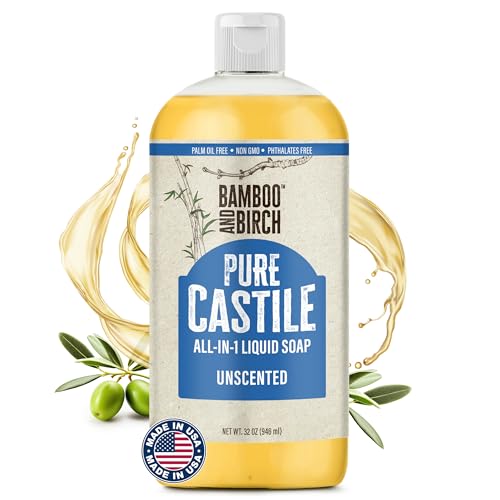
Bamboo and Birch enters the plant-care conversation as the most accessible entry point for new gardeners who want to try the castile soap method without a big upfront cost. Its 32-ounce bottle is priced to compete, yet it still carries an EWG verification and a certified palm-oil-free formulation. For a beginner managing a small collection of pothos, snake plants, and philodendrons, this soap delivers reliable aphid control at the lowest commitment.
The formula is built on natural vegetable oils and is completely unscented, which means it won’t shock your plants with unexpected aromatics. Customers have successfully used it as a hand soap and dog shampoo, confirming its gentle surfactant profile. When diluted at 1.5 tablespoons per quart, it produces moderate foam that coats leaf surfaces evenly, though you may need to reapply after heavy rain or overhead watering.
The main compromise is concentration. Users report that it feels slightly less “thick” than premium brands, requiring a fraction more soap per batch to achieve the same pest-kill rate. For a 5-plant household, this difference is negligible; for a 50-plant greenhouse, the extra per-bottle cost of Dr. Bronner’s becomes the cheaper option on a per-gallon-of-spray basis. Match the soap to your garden scale.
Why it’s great
- EWG verified and palm-oil-free at an accessible price point
- Unscented formula is safe for small ornamental collections
- Versatile enough for household cleaning and pet baths
Good to know
- Lower concentration means using more soap per spray batch
- Small 32-ounce size runs out quickly for larger gardens
FAQ
What dilution ratio should I use for spider mites on indoor plants?
Can I use scented castile soap like peppermint on my herbs?
Why does my castile soap spray leave white spots on leaves?
Final Thoughts: The Verdict
For most users, the best castile soap for plants winner is the Dr. Bronner’s Baby Unscented 32 oz because its regenerative organic olive oil base protects leaf cuticles while delivering consistent pest-kill at standard dilutions. If you want a bulk refill that cuts plastic waste and lowers your per-spray cost, grab the YARELI Unscented 64 oz. And for a targeted antifungal soil drench to combat root rot or damping-off, nothing beats the Dr. Bronner’s Tea Tree 32 oz.

Mo Maruf
I created WellFizz to bridge the gap between vague wellness advice and actionable solutions. My mission is simple: to decode the research and give you practical tools you can actually use.
Beyond the data, I am a passionate traveler. I believe that stepping away from the screen to explore new environments is essential for mental clarity and physical vitality.