Our readers keep the lights on and my smoothie glass nicely filled. As an Amazon Associate, I earn from qualifying purchases.
A true tamagoyaki pan is a rectangular skillet designed for one specific task: building the layered, fluffy rolled omelette central to Japanese home cooking. Its straight walls and narrow cooking surface force the egg into tight, even sheets that stack perfectly—something a round frying pan simply cannot replicate. For anyone who has fought with sticky eggs, uneven browning, or layers that refuse to hold, the geometry of the pan itself is usually the hidden variable.
I’m Mohammad Maruf — the founder and writer behind WellFizz. I analyze cookware across dozens of material categories, from carbon steel woks to enameled Dutch ovens, and I’ve tracked the unique seasoning and heat-retention demands of cast iron rectangular pans for over three years of market research.
The core challenge isn’t finding a non-stick surface—it’s understanding which cast iron tamagoyaki pan delivers the right wall height, interior width, and factory-initial seasoning quality to produce consistent rolls from day one.
How To Choose The Best Cast Iron Tamagoyaki Pan
Buying a cast iron tamagoyaki pan means accepting material-specific trade-offs that don’t exist with non-stick or stainless steel. The following four criteria separate a pan that produces silky eight-layer rolls from one that frustrates from the first pour.
Cooking Surface Dimensions and Wall Height
The interior width and length dictate the thickness of each egg layer. A surface that is too wide forces you to use more egg than necessary, creating thick folds that crack under their own weight. An ideal interior measures roughly 5.5 by 4.5 inches—wide enough for three eggs, narrow enough to roll tightly. Wall height also matters: low walls make flipping awkward, while walls above 1.5 inches can trap steam and make the omelette soggy.
Interior Surface Texture and Factory Seasoning
Cast iron arrives with a surface finish that ranges from glass-smooth to rough as 80-grit sandpaper. Rougher textures grip egg protein aggressively unless multiple seasoning layers have been applied at home. Some manufacturers pre-season with a thin oil coat that requires immediate re-seasoning; others deliver a cured layer ready for cooking. Read customer feedback about “first egg sticking” specifically—this tells you whether the factory seasoning actually functions.
Detachable Handle and Oven Compatibility
A wooden or metal handle that detaches allows the pan body to enter a 450°F oven for re-seasoning or finishing dishes. Fixed handles with plastic parts limit seasoning-repair options and force you to use stovetop-only methods that take longer. Detachable designs also improve storage—the pan stacks flat without handle protrusion.
Weight, Heat Distribution, and Stovetop Fit
Cast iron tamagoyaki pans weigh between 1.6 and 3.3 pounds. Heavier models retain heat through multiple egg pours, critical for maintaining constant temperature across four to five layers. Lighter pans cool faster between pours, leading to uneven cooking. On induction cooktops, verify the base is fully flat—some cheaper castings have a slight convex bottom that wobbles on glass surfaces.
Quick Comparison
On smaller screens, swipe sideways to see the full table.
| Model | Category | Best For | Key Spec | Amazon |
|---|---|---|---|---|
| YYMIYU Japanese Cast Iron Tamagoyaki Pan | Premium | Liquid nitrogen rust resistance | 9×7 in., 3.2 lbs | Amazon |
| LI-GELISI Pre-Seasoned Tamagoyaki Pan | Mid-Range | Accessory kit included | 9×7 in., 3.2 lbs | Amazon |
| Iwachu Iron Tamagoyaki Omelette Pan | Premium | Japanese craftsmanship | 2.7 lbs, interior 5.5×4.5 in. | Amazon |
| HAWOK Japanese Omelette Pan Set | Mid-Range | Best value two-pan bundle | 0.74 qt capacity, 16 oz each | Amazon |
| EdoEats Cast Iron Tamagoyaki Pan | Mid-Range | Detachable handle versatility | Interior 5.5×4.5 in., 2.3 lbs | Amazon |
| Toutrop 7.5″ Cast Iron Omelette Pan | Budget | Solid entry-level option | 7.5 in. square, Iron/steel hybrid | Amazon |
| Tissting Mini Egg Roll Pan | Budget | Smallest footprint | 14.4×6.1 in., ceramic non-stick | Amazon |
In‑Depth Reviews
1. YYMIYU Japanese Cast Iron Tamagoyaki Pan
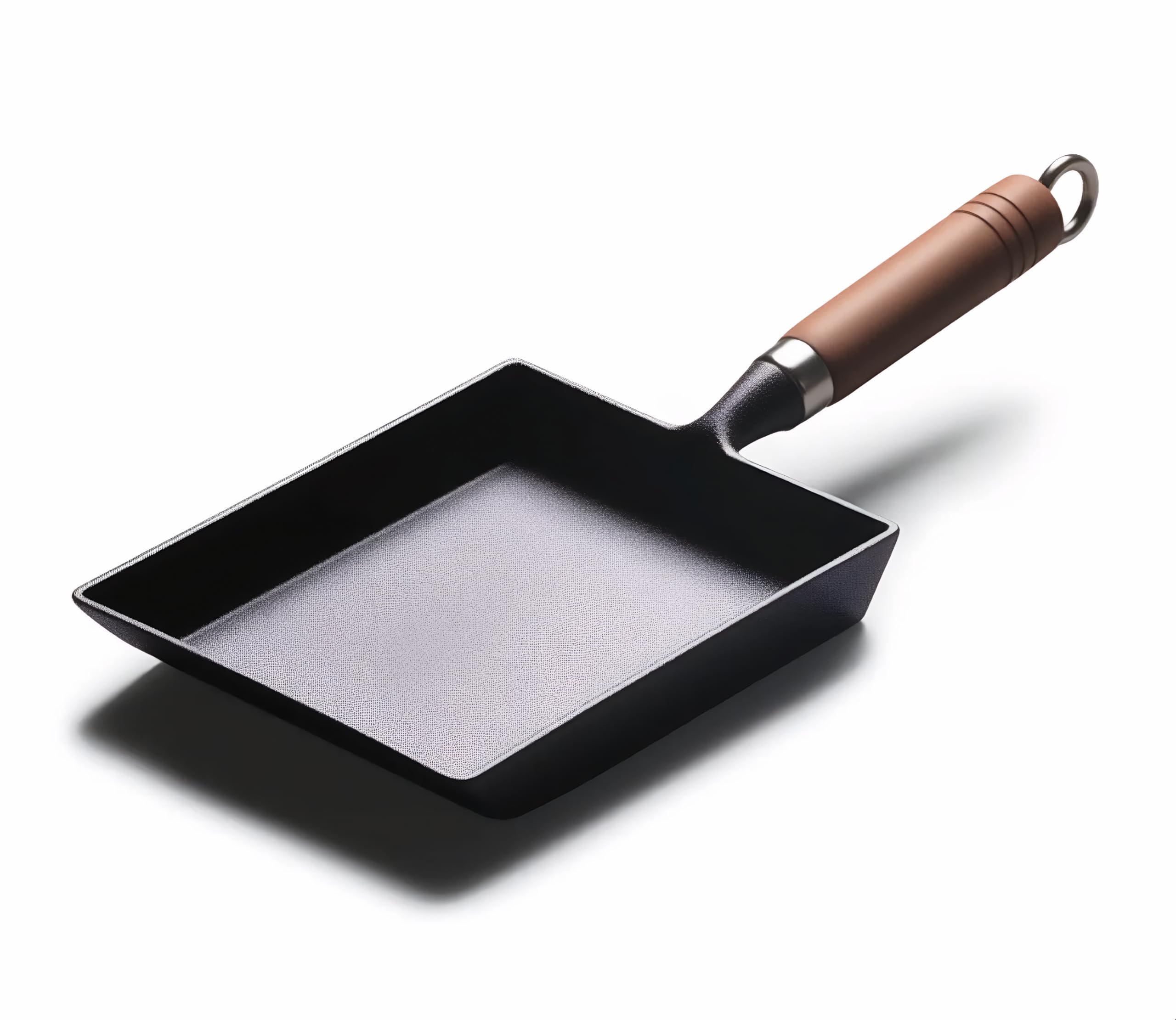
The YYMIYU pan arrives pre-seasoned but benefits from a unique liquid nitrogen treatment that produces a denser, more rust-resistant iron surface than conventional castings. At 3.2 pounds and a 9×7-inch form factor, the heat retention is impressive—each egg pour re-heats within 30 seconds on medium-low heat, allowing five uninterrupted layers. The interior texture is smoother than typical budget cast iron, which reduces the initial sticking period to two or three uses rather than a full week.
The detachable solid wood handle clicks into a threaded screw mount with a metal collar, staying cool during stovetop use. The pan body itself is oven-safe up to 500°F, making re-seasoning straightforward: strip, oil, bake, reattach. Several users noted that the included wooden spatula and scraper are useful but not essential—the pan works better with a thin offset metal spatula that slides cleanly under each fold.
Where this pan distinguishes itself is consistency across heat sources. Induction, gas, and electric coil users all report even heat distribution without hot spots near the corners. A few reviews mentioned the handle collar loosening after thermal cycling; a silicone O-ring or a dab of mineral oil on the threads resolves this. For the combination of rust resistance, smooth starting surface, and detachable handle, this is the most balanced premium option available.
Why it’s great
- Liquid nitrogen anti-rust treatment outperforms standard cast iron
- Detachable wood handle enables easy oven seasoning
- Smooth interior finish reduces early sticking frustration
Good to know
- Wood handle may need periodic mineral oil application
- Threaded handle mount requires occasional tightening
2. LI-GELISI Pre-Seasoned Cast Iron Tamagoyaki Pan

LI-GELISI positions this pan as “pre-seasoned and ready to use,” and that claim largely holds—the factory oil coat is one of the better ones in this category, reducing the initial sticking to a single egg instead of several failed attempts. The 9×7-inch body weighs the same 3.2 pounds as the YYMIYU, but the interior surface is a touch rougher, requiring about four uses before achieving a glassy patina. The pan comes bundled with a stainless steel scraper, a silicone oil brush, redwood chopsticks, and a detachable wood handle, making it the most complete kit in the lineup.
On the stove, heat distribution is even across the rectangular surface, though the corners heat slightly faster than the center—a common quirk in cast iron rectangular pans that is manageable by rotating the pan 180 degrees mid-cook. The wood handle attaches via a threaded bolt and remains cool enough to grasp barehanded after 15 minutes of cooking. One user noted that the included chopsticks are too short for comfortable use, but the scraper and brush are genuinely useful for layering oil between pours.
The pre-seasoning does not eliminate the need for a home re-season, but it does reduce the preparation time. A single oven seasoning cycle at 385°F with peanut oil produces a surface that releases egg cleanly. For someone who wants a single box containing every tool needed to start making tamagoyaki immediately, this is the most complete offering reviewed.
Why it’s great
- Best accessory bundle—scraper, brush, chopsticks included
- Factory pre-seasoning reduces first-use sticking
- Even heat retention suitable for 3-4 egg recipes
Good to know
- Rough interior surface needs multiple home seasoning coats
- Included chopsticks are shorter than standard
3. Iwachu Iron Tamagoyaki Omelette Pan

Iwachu has been producing cast iron cookware in Japan for generations, and this tamagoyaki pan reflects that heritage with a finish smoother than any other pan in this roundup. The interior surface feels polished rather than sandblasted, and the pre-seasoning is genuinely functional—multiple verified reviews report eggs releasing cleanly on the first use with just a light butter coating. The cooking surface measures approximately 5.5 by 4.5 inches, which is the ideal dimension for a three-egg tamagoyaki: each layer is thin enough to roll without tearing.
The total weight is 2.7 pounds, notably lighter than the YYMIYU and LI-GELISI models, which makes maneuvering during the roll sequence easier but reduces thermal mass. On a gas burner, the pan recovers slightly slower between pours, requiring a 45-second wait rather than 30 seconds. The detachable wood handle mounts via a simple slot-and-screw system and holds securely during cooking. A few users reported that the pan can wobble on flat glass stovetops because the bottom has a very slight convexity—a wooden cutting board or trivet underneath solves this.
The biggest advantage of the Iwachu is the finish quality. There is no rough texture to grind down through seasoning. The downside is the higher price point, which reflects the brand premium rather than any performance improvement over the YYMIYU. For purists who want a pan that feels like a heirloom from the first unboxing, this is the one buy.
Why it’s great
- Factory finish is the smoothest in this review
- Ready for non-stick cooking with minimal preparation
- Traditional size for authentic 3-egg tamagoyaki
Good to know
- Slight convex bottom may wobble on glass cooktops
- Premium price reflects brand, not raw performance improvement
4. HAWOK Japanese Omelette Pan Set
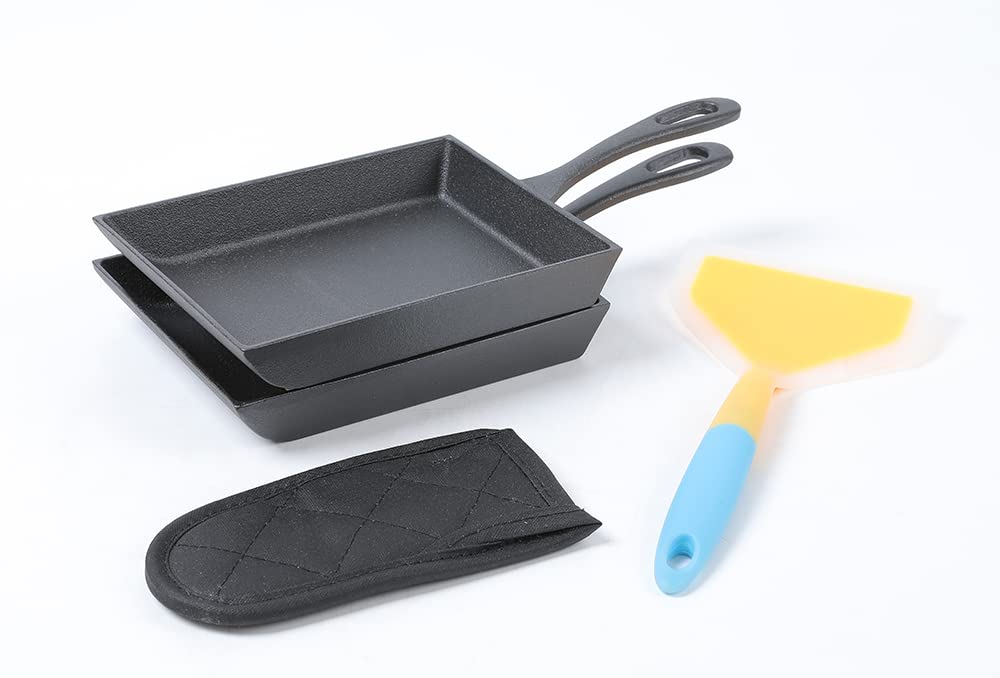
HAWOK packages two identical 16-ounce cast iron square pans with a silicone spatula and a cotton mitt, making this the only multi-pan option in the roundup. Each pan measures roughly 6.5 inches square, which is slightly wider than the ideal tamagoyaki dimension but versatile enough for frittatas, pizza bags, and apple rolls.
The factory pre-seasoning is thin, and multiple users reported that the first few eggs stuck aggressively despite following the manufacturer’s instructions. Three home seasoning cycles—applying vegetable oil and baking at 400°F for one hour—are necessary before the surface becomes functional for rolled omelettes. After seasoning, the pans perform well for their weight class, though the lighter mass means they cool faster between pours compared to the 3.2-pound options. The cast iron handle is integrated and does not detach, so oven seasoning must be done with the entire pan, which is manageable but slightly less convenient.
A notable limitation is the rough interior texture. Several verified reviews described the surface as “sandpaper-like” out of the box. This is not uncommon for budget cast iron, but it adds one to two extra seasoning sessions compared to the smoother LI-GELISI or YYMIYU pans. For cooks willing to invest the initial seasoning effort, the two-pan bundle offers excellent long-term value, especially for households that cook eggs multiple times per day.
Why it’s great
- Two pans for the price of one mid-range model
- Compact square shape suits multiple breakfast dishes
- Oven-safe construction for easy re-seasoning
Good to know
- Very rough surface requires multiple home seasonings
- Fixed handle means oven seasoning uses full pan space
5. EdoEats Cast Iron Tamagoyaki Pan
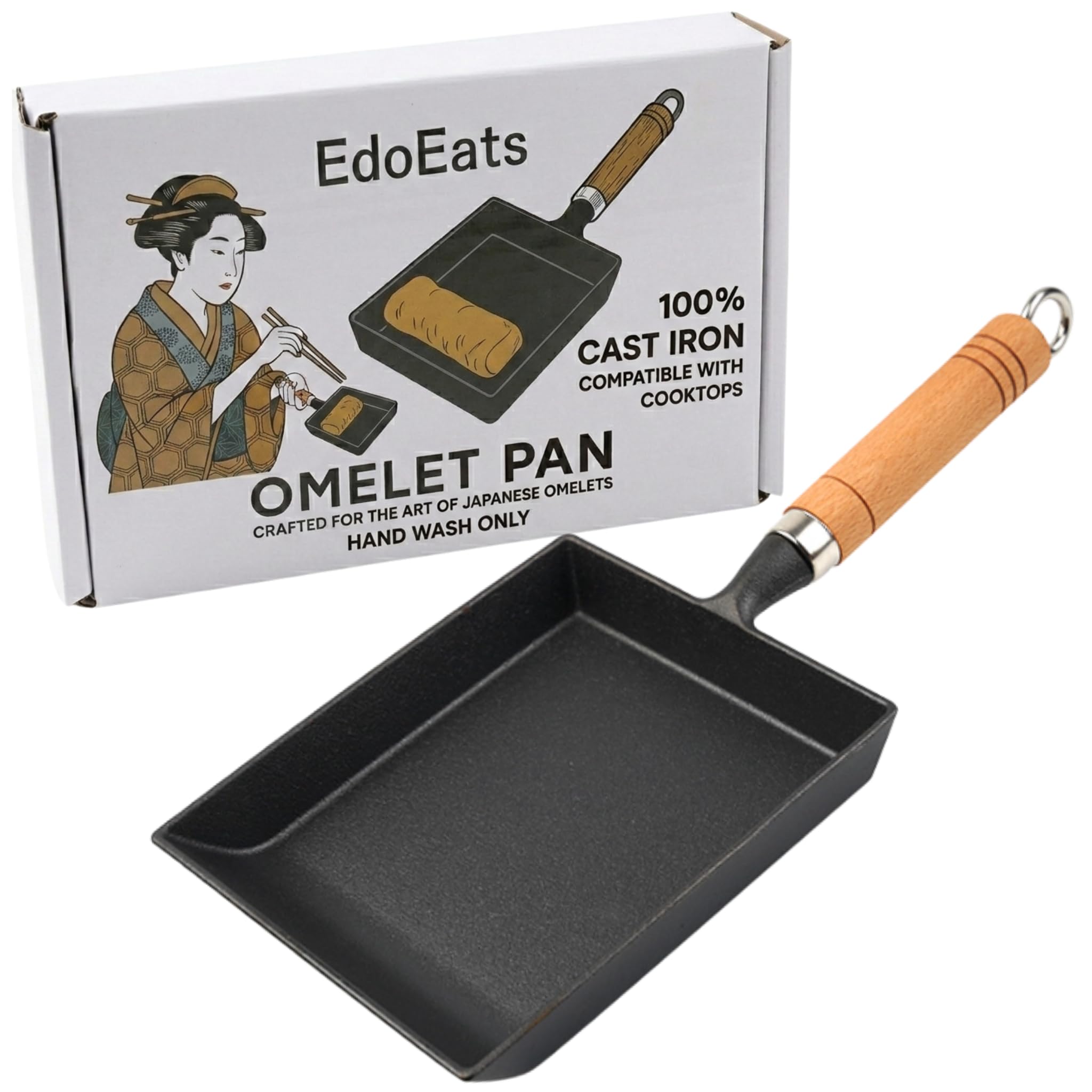
EdoEats positions this pan as a “no-teflon, no-ceramic” alternative, and the bare cast iron construction delivers exactly what it promises: a naturally non-stick surface that improves over time through seasoning rather than coating. The interior measures roughly 5.5 by 4.5 inches, matching the Iwachu in dimension, and comes pre-seasoned with a layer that several verified reviews described as rougher than a Lodge skillet. This roughness means the first two or three omelettes will stick, requiring patience and low heat—around medium-low for three full minutes of preheating before adding oil.
The detachable wood handle is fully oven-safe, making re-seasoning straightforward. One reviewer noted that the handle screw loosened after repeated thermal cycling; a small silicone washer prevents this issue. On gas and induction stovetops, the pan heats evenly without distinct hot spots, though the corners still run slightly hotter than the center. The flat bottom sits flush on glass cooktops without wobbling, a clear improvement over the Iwachu’s slight convexity.
Where this pan falls short for immediate usability is the surface texture. Several users described the interior as abrasive enough to catch on bamboo spatulas, requiring a full strip-and-season cycle with peanut oil at 400°F to smooth out. Once seasoned properly, however, the pan performs identically to options costing significantly more. For budget-conscious cooks willing to do the initial work, this represents solid value. For impatient cooks, the extra seasoning effort may be a dealbreaker.
Why it’s great
- Bare cast iron with no chemical coating
- Oven-safe detachable handle for easy seasoning
- Flat base compatible with glass induction cooktops
Good to know
- Factory seasoning is very rough, requires re-seasoning
- First several uses will involve significant sticking
6. Toutrop 7.5″ Cast Iron Omelette Pan
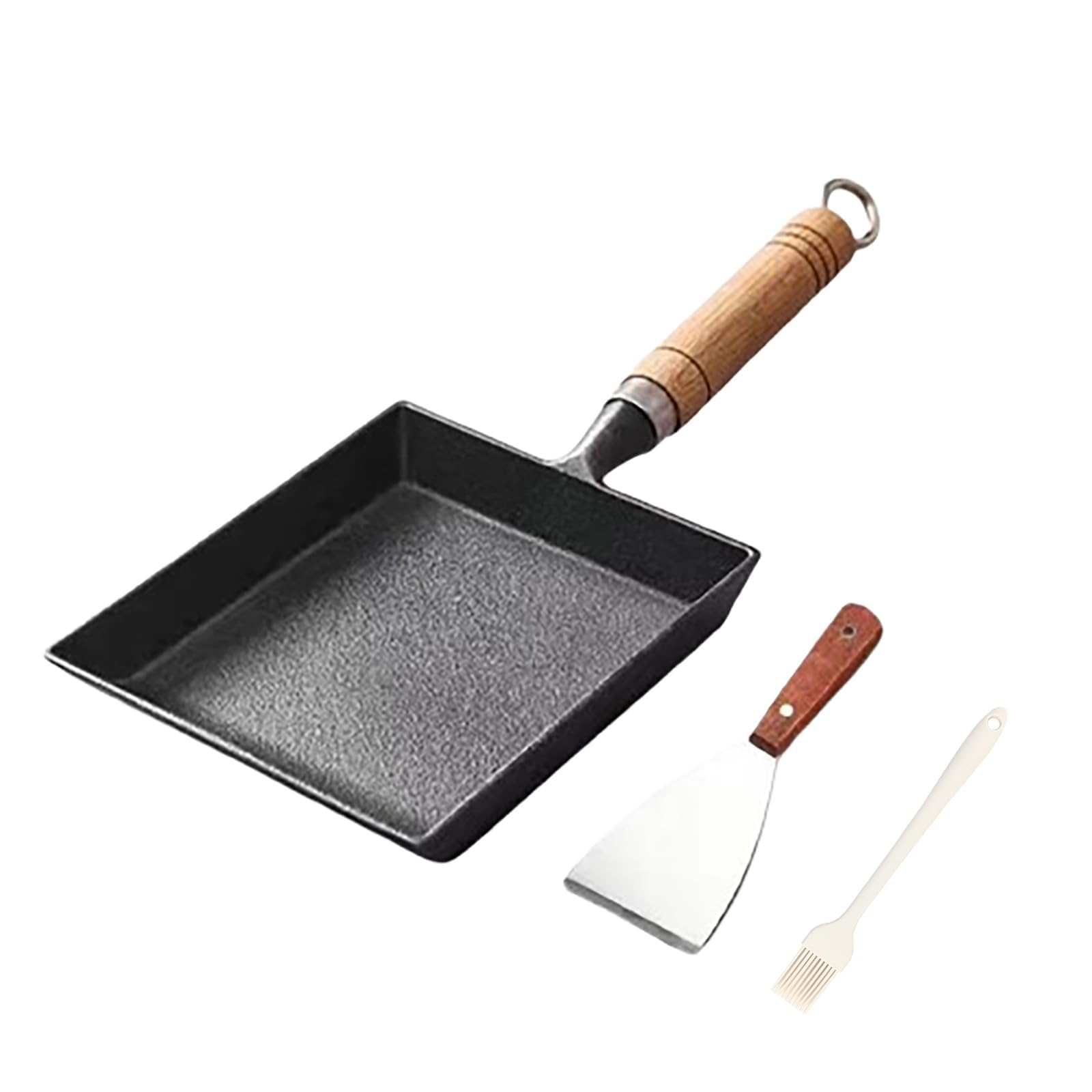
Toutrop’s rectangular pan is smaller than most at 7.5 inches on the longest side, and its material composition is a hybrid of iron and steel rather than pure cast iron. This results in a pan that weighs around 2.0 pounds—significantly lighter than the 3.2-pound premium models—and heats up faster but loses heat quickly between egg pours. The lighter mass makes it easier to handle for cooks with limited wrist strength, but the trade-off is that each consecutive egg layer requires a longer wait for the pan to recover temperature.
The handle must be attached by the user using two bolts that screw into pre-drilled holes on the pan body. Several verified reviews mention that the bolts left minor scratches on the surface during installation, which is cosmetic rather than functional but worth noting if perfect appearance matters. The surface finish is moderately rough, comparable to the HAWOK pans, and requires three to four seasoning cycles before eggs release reliably. One reviewer emphasized that room-temperature eggs and a preheating time of 3-4 minutes on a gas stove were necessary to achieve non-stick performance.
On the positive side, the pan’s square shape excels at cooking bacon strips lengthwise—a common secondary use for tamagoyaki pans—and the flat bottom is completely stable on glass cooktops. The metal handle does not heat up during stovetop use, eliminating the need for a mitt. For someone who wants to try tamagoyaki without committing to a heavy, thick pan, this is a reasonable entry point, but the rapid heat loss makes consistent multi-layer rolling harder than with denser cast iron options.
Why it’s great
- Lighter weight for easy maneuvering
- Stable flat base on induction and glass cooktops
- Metal handle stays cool during cooking
Good to know
- Iron/steel hybrid loses heat quickly between pours
- Handle bolts can scratch the pan surface during assembly
7. Tissting Mini Egg Roll Pan

The Tissting pan is the only coated option in this review, using a ceramic non-stick layer on a cast iron base rather than relying on natural seasoning. This immediately eliminates the multi-season preparation required by every other pan here—users report that the first egg slides off cleanly with minimal oil. The ceramic coating also means the pan is not oven-safe, which limits re-seasoning options if the coating degrades over time, but for cooks who want zero learning curve, this is the most forgiving starting point.
The pan dimensions are 14.4 by 6.1 inches, making it significantly longer and narrower than traditional tamagoyaki pans. This extended shape works well for making long rolls that can be sliced into many pieces, but the increased surface area means the egg layer cooks faster and can overcook near the edges if the heat is not kept low. The wood handle provides good insulation, though it is fixed and not detachable, so the pan cannot enter an oven. The ceramic coating is PTFE and PFOA-free, which addresses the health concerns that lead many buyers to choose cast iron in the first place.
The trade-off for the easy non-stick surface is durability. Cast iron pans with ceramic coatings eventually lose their non-stick property, typically after one to two years of regular use, at which point the pan becomes a conventional cast iron skillet that requires seasoning. Verified reviews are overwhelmingly positive for immediate performance, but none cover long-term degradation. For someone who wants to start making tamagoyaki tonight with no preparation, this is the best choice. For someone planning to hand the same pan to their grandchildren, the bare cast iron options are superior.
Why it’s great
- Ceramic coating works immediately with no seasoning needed
- Extended length produces long, uniform rolls
- PTFE and PFOA-free coating
Good to know
- Not oven-safe—cannot be used for re-seasoning
- Ceramic coating degrades faster than bare iron patina
FAQ
Why does my cast iron tamagoyaki pan make eggs stick on the first use?
Can I use a cast iron tamagoyaki pan on an induction cooktop?
How do I clean a cast iron tamagoyaki pan without ruining the seasoning?
Final Thoughts: The Verdict
For most users, the cast iron tamagoyaki pan winner is the YYMIYU Japanese Cast Iron Tamagoyaki Pan because its liquid nitrogen treatment delivers rust resistance and a smoother starting surface than any other pan at its price tier, and the detachable wood handle makes oven seasoning simple. If you want the most complete kit with every tool included from the first unboxing, grab the LI-GELISI Pre-Seasoned Cast Iron Pan. And for traditional Japanese craftsmanship with a factory finish that works from day one, nothing beats the Iwachu Iron Tamagoyaki Pan.

Mo Maruf
I created WellFizz to bridge the gap between vague wellness advice and actionable solutions. My mission is simple: to decode the research and give you practical tools you can actually use.
Beyond the data, I am a passionate traveler. I believe that stepping away from the screen to explore new environments is essential for mental clarity and physical vitality.