Our readers keep the lights on and my smoothie glass nicely filled. As an Amazon Associate, I earn from qualifying purchases.
That carefully built, shiny black seasoning on your skillet is the entire point of owning cast iron. You have spent hours layering it, and the wrong cleaner can strip it down to bare metal in seconds. The market is flooded with harsh chainmail, abrasive salts, and chemical soaps that promise a deep clean but deliver a ruined cooking surface instead. Choosing a cleaner designed specifically for this finicky cookware is the difference between a pan that lasts generations and one that needs constant re-seasoning.
I’m Mohammad Maruf — the founder and writer behind WellFizz. I have spent years analyzing the chemistry of cleaning agents and the mechanical wear of scrubbing tools, specifically for cast iron and carbon steel surfaces, to separate marketing fluff from genuine product performance.
This guide breaks down the five best options on the market, from pH-balanced soaps that protect your seasoning to chainmail scrubbers designed to remove stubborn residue without gouging the surface. Whether you are restoring a rusty heirloom or maintaining a daily driver, you need the right tool for the job to find the best cast iron cleaner for your kitchen.
How To Choose The Best Cast Iron Cleaner
Cast iron is porous and reactive. The wrong cleaner will either strip the seasoning or leave a metallic taste on your next meal. You need to match the product to your specific goal: daily maintenance, deep cleaning, or rust restoration. Focus on three critical factors before making a decision.
Mechanical vs. Chemical Cleaning
You have two schools of thought for cast iron care. Mechanical cleaners — chainmail scrubbers, scrapers, and paste scrubs — physically dislodge carbonized food and rust. Chemical cleaners — castile-based soaps and solvent-free scrubs — break down grease without friction. A good routine uses one or the other, not both in the same session, to avoid overworking the seasoning layer.
Ingredient Safety and Residue
Look for plant-based, paraben-free, and phthalate-free formulations. Soaps with artificial thickeners or heavy detergents can leave a film that turns rancid inside a hot pan. Coconut oil bases and castile soaps are preferred because they rinse clean and don’t react with the iron at high heat. Avoid any cleaner that lists sodium lauryl sulfate or phosphates as primary ingredients.
Scrubber Material and Surface Hardness
Chainmail scrubbers are effective, but the ring gauge and metal grade matter. 300-series stainless steel rings are standard, but 400-series or low-quality alloys can rust and leave micro-scratches. Silicone-backed scrubbers protect the seasoning while providing enough bite to dislodge burnt bits. For very old seasoning, a paste scrub with fine salt or a coconut-based scrub is safer than any metal tool.
Quick Comparison
On smaller screens, swipe sideways to see the full table.
| Model | Category | Best For | Key Spec | Amazon |
|---|---|---|---|---|
| Caron & Doucet Cast Iron Scrub | Paste Scrub | Rust removal without scratches | Refined coconut oil base (solvent-less) | Amazon |
| Cuisinel Chainmail Scrubber | Mechanical Scrubber | Stuck-on food on seasoned pans | 316 stainless steel rings | Amazon |
| Clark’s Cast Iron Cleaner | Liquid Soap | Preserving seasoning during daily wash | Castile-based, paraben-free foam | Amazon |
| Long Handle Chainmail Scrubber | Mechanical Scrubber | Deep cleaning with heat protection | 316 steel + silicone base, 8-inch handle | Amazon |
| Lodge Enameled Cast Iron Care Kit | Complete Kit | Enameled cookware maintenance | 11 oz cleaner + scraper + brush | Amazon |
In‑Depth Reviews
1. Caron & Doucet Cast Iron Cleaning Scrub

This is the only product in the round-up that functions as a true paste scrub designed to remove rust while simultaneously fortifying the seasoning. The base is refined coconut oil stripped of long-chain fatty acids, which means it won’t go rancid in the jar or inside your pan. It is a solvent-less formulation that relies on the mechanical action of the paste and the natural oil carrier to lift oxidized metal and carbonized food without scratching the substrate.
Users report that neglected pans with years of carbon buildup respond to a single application with minimal elbow grease. The scrub is thick enough to hold its shape against vertical sidewalls of a skillet, so you aren’t fighting runoff while scrubbing. The essential oils neutralize odors from fish or game, leaving a clean, neutral scent after rinsing.
Because it builds seasoning rather than stripping it, this product works equally well for restoration projects and weekly maintenance. It is a true two-in-one solution that eliminates the need for a separate seasoning oil after deep cleaning. The only caveat is that paste scrubs require a bit more rinsing than liquid soaps to ensure no coconut oil residue remains before re-seasoning.
Why it’s great
- Removes rust without harming seasoning layer
- Refined coconut oil base will not turn rancid
- Paste consistency grips vertical pan walls
- Fortifies seasoning during the cleaning process
Good to know
- Requires thorough rinsing to remove oil residue
- More expensive per ounce than plain salt alternatives
2. Cuisinel Chainmail Scrubber + Pan Scraper
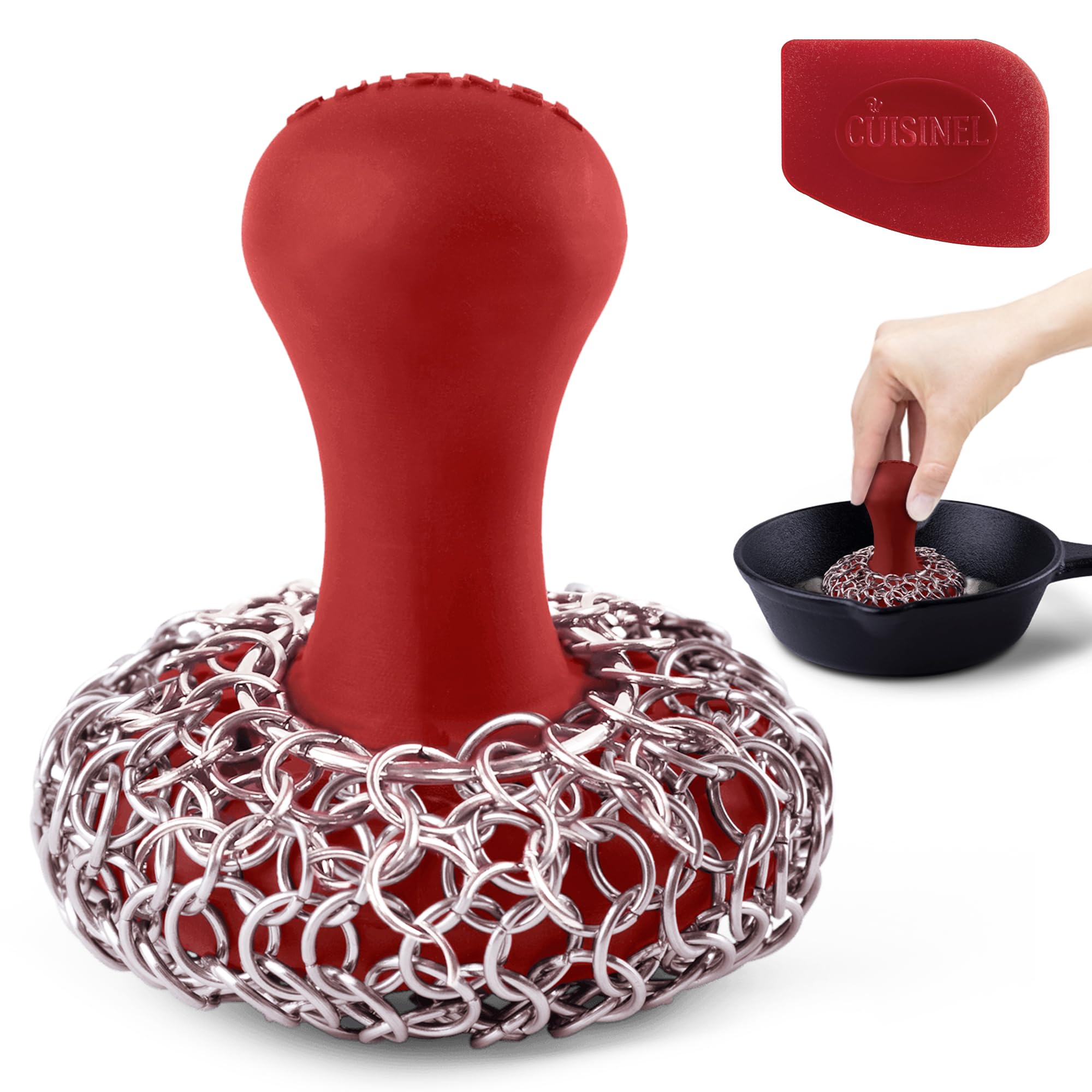
The Cuisinel scrubber uses 316-grade stainless steel rings woven into a mesh and bonded to a silicone backing pad. The silicone acts as a cushion that prevents the chainmail from gouging into the pan while still allowing the rings to shear off stubborn food particles. This design is superior to a bare chainmail ball because the backing absorbs the impact and distributes pressure evenly across the surface.
The ergonomic handle keeps your fingers away from the chainmail, a feature that matters when scrubbing hot pans under running water. The handle has a flat top that lets the scrubber stand upright for air drying, preventing water from pooling inside the silicone and reducing the risk of mold growth. Users report that it handles burnt-on cheese, caramelized onions, and seared meats without leaving micro-abrasions visible under a bright light.
Included in the package is a flexible plastic scraper that works well on flat surfaces but struggles on curved corners. The chainmail itself is dishwasher-safe, though hand rinsing under hot water is usually enough. The only consistent complaint is that the thick curve of the handle makes it awkward to reach into the tight internal corners of smaller griddles.
Why it’s great
- 316 stainless steel resists rust over time
- Silicone backing protects seasoning from gouging
- Ergonomic handle keeps hands away from hot chainmail
- Dishwasher safe and dries quickly
Good to know
- Awkward for cleaning tight corners on small pans
- Included scraper is less useful than the scrubber
3. Clark’s Cast Iron Cleaner
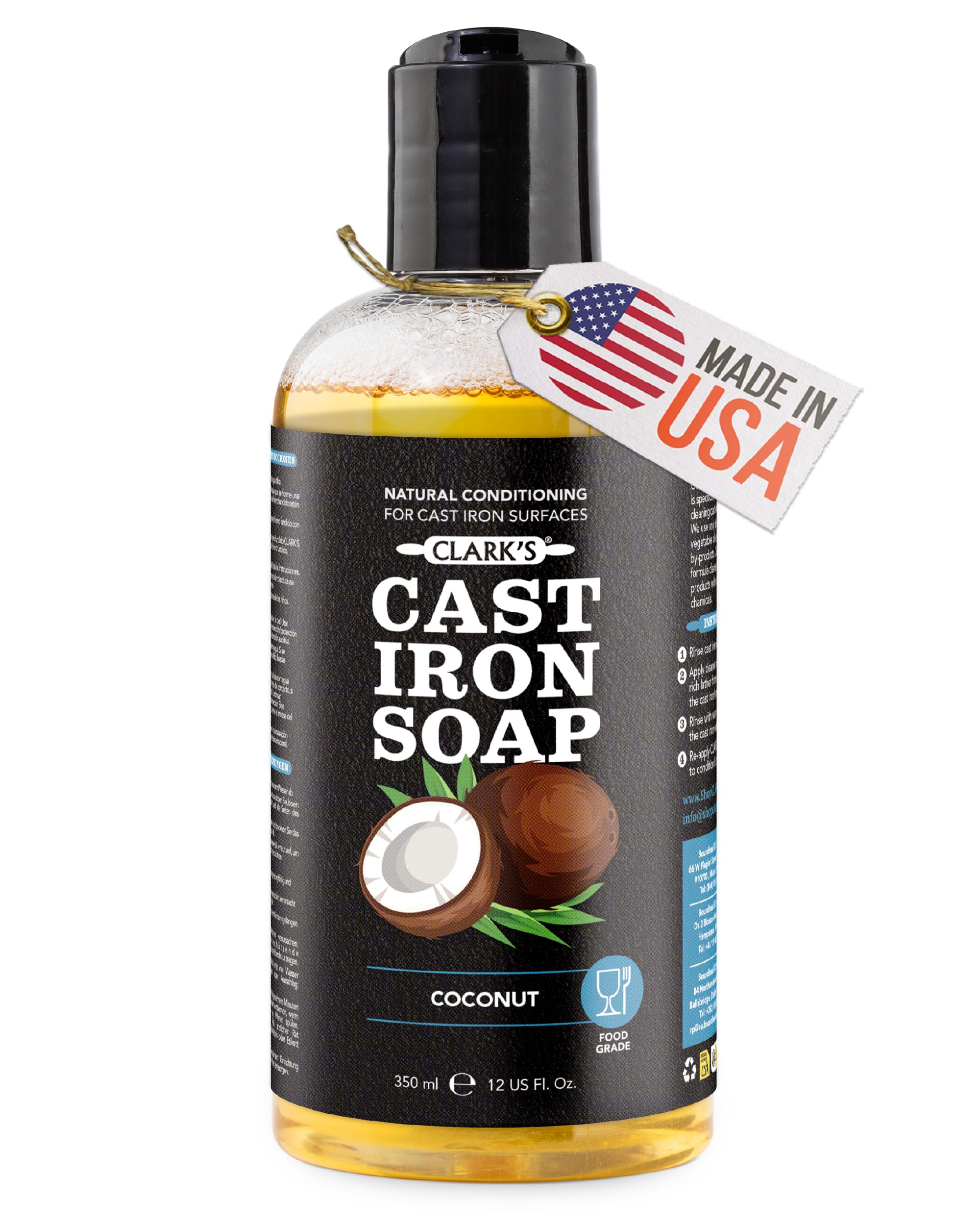
Clark’s is a castile-based liquid soap that dispenses as a foam. The foam structure is significant because it allows the surfactant to spread across the entire pan surface with a smaller volume of product than a liquid would require. The formulation is paraben-free, phthalate-free, and uses plant-derived cleaning agents that break down grease without dissolving the polymerized oil that constitutes seasoning.
Users specifically report that this soap works well in cold water, a common pain point because many natural soaps fail to lather or rinse clean when the tap runs cool. A single pump covers a 12-inch skillet, and the foam rinses completely without leaving a slick film. It removes oil splatters and light carbon buildup in a single pass without needing a separate degreasing step.
The bottle is 12 fluid ounces, which at the recommended usage rate lasts roughly two to three months of daily use. Clark’s recommends pairing this soap with their cast iron oil for post-wash seasoning, but the cleaner itself is complete on its own. The only downside is that foam soaps struggle with heavy burnt-on residue — you will still need a scrubber for that.
Why it’s great
- Castile-based formula preserves seasoning
- Foam dispenser reduces product waste
- Effective in cold water without residue
- No synthetic thickeners or gels
Good to know
- Not strong enough for carbonized food alone
- Requires a scrubber companion for tough jobs
4. Long Handle Chainmail Scrubber with Scraper

This scrubber addresses the main ergonomic flaw of shorter models — hand proximity to hot metal. The long handle is molded from flexible silicone bonded to a 316 stainless steel chainmail head, giving you a roughly four-inch reach distance from your grip to the scrubbing surface. That distance matters when cleaning a pan directly out of the sink after a hot rinse, where steam and residual heat can make short-handled scrubbers uncomfortable to use.
The silicone base is notably thicker and wider than competing models, which increases the contact patch and reduces the amount of pressure required to remove embedded food. The chainmail itself uses a hand-woven 3D structure with slimmer rings than the Cuisinel unit, allowing the mesh to flex into convex and concave cookware surfaces more naturally. Users note that this flexibility helps it conform to the curved walls of a Dutch oven better than rigid scrubbers.
A hanging hole at the end of the handle allows for convenient storage on a hook, keeping it dry between uses. The included scraper is made of thickened ABS plastic rated to 275°F, making it safe for scraping pans that have just cooled from a sear. The only minor complaint is that the silicone handle is soft and slightly wobbly, which some users find less stable than a rigid plastic handle.
Why it’s great
- Long handle keeps hands safe from hot pans and steam
- Thicker silicone base provides larger scrubbing contact area
- Hand-woven 3D chainmail conforms to curved cookware
- Hanging hole for convenient storage
Good to know
- Silicone handle feels slightly wobbly under heavy pressure
- Not ideal for very tight internal corners of square pans
5. Lodge Enameled Cast Iron Care Kit

Lodge’s care kit is specifically formulated for enameled cast iron, which has a glass-like coating that behaves differently from bare iron. The liquid cleaner is mild enough that it won’t dull the enamel’s gloss but strong enough to cut through olive oil residue that has baked onto the white interior of a Dutch oven. It is free of PFOA and PTFE, so there is no risk of chemical interaction with the enamel layer.
The kit includes a pan scraper, a scrub brush, and a pack of pot protectors for stacking storage. The brush is a stiff nylon unit designed for textured enamel surfaces, though some users report that the bristles break down within the first month of use. The scraper is flexible and non-stick, making it useful for lifting burnt cheese from the interior without chipping the enamel.
The cleaner itself has a pleasant, mild scent and requires no scrubbing for typical use — a soak with the solution lifts most residue. Users with heavily stained white enamel interiors note improvement after the first wash, though very old, deeply set stains may require multiple treatments. This kit is the most complete package for anyone who exclusively uses enameled cast iron, but bare iron users should look at the other options in this round-up.
Why it’s great
- Specifically designed for enameled cast iron coatings
- Includes scraper, brush, and pot protectors
- Removes baked-on oil without dulling enamel
- PFOA and PTFE free formulation
Good to know
- Scrub brush quality is below the rest of the kit
- Not formulated for seasoning preservation on bare iron
- Not effective on deep, set-in enamel stains
FAQ
Can I use a paste scrub on enameled cast iron?
How often should I use a chainmail scrubber on my skillet?
Will a long-chain fatty acid in a cleaner ruin my seasoning?
Final Thoughts: The Verdict
For most users, the best cast iron cleaner winner is the Caron & Doucet Cast Iron Cleaning Scrub because it cleans and fortifies seasoning in a single step, eliminating the need for a separate oil treatment after deep cleaning. If you prefer a mechanical scrubber that preserves your seasoning while blasting off stuck-on residue, grab the Cuisinel Chainmail Scrubber. And for owners of enameled cookware who want a complete care system, nothing beats the Lodge Enameled Cast Iron Care Kit.

Mo Maruf
I created WellFizz to bridge the gap between vague wellness advice and actionable solutions. My mission is simple: to decode the research and give you practical tools you can actually use.
Beyond the data, I am a passionate traveler. I believe that stepping away from the screen to explore new environments is essential for mental clarity and physical vitality.