Our readers keep the lights on and my smoothie glass nicely filled. As an Amazon Associate, I earn from qualifying purchases.
The quiet terror of not hearing a loved one’s call for help is the single heaviest weight a family caregiver carries. A dedicated caregiver call button slashes that anxiety, turning a simple press into an immediate, loud alert that frees you to move through the house without being chained to a bedside. The difference between hearing a faint moan from the hallway and a crystal-clear 110dB chime in the garage is the difference between constant worry and true peace of mind.
I’m Mohammad Maruf — the founder and writer behind WellFizz. I’ve spent years dissecting the hardware specifications of home care alert systems, comparing wireless range figures, decibel ratings, waterproofing standards, and battery configurations to separate the reliable workhorses from toys that will fail when you need them most.
Whether you need to cover a single-story ranch or a multi-level home, this guide cuts through the noise to help you choose the best caregiver call button that delivers real, measurable protection without locking you into a monthly contract.
How To Choose The Best Caregiver Call Button
A caregiver call button isn’t a one-spec-fits-all gadget. The right choice for an active senior living alone differs drastically from what works for a post-surgery patient in a multi-level home. You need to match the hardware specs to your living environment and the user’s physical condition. Let’s walk through the four critical decision points.
Wireless Range & Indoor Penetration
Manufacturers love to quote open-air range figures like 500 or 1000 feet. In a real home, those numbers drop dramatically as signals pass through walls, floors, and appliances. A system rated for 500 feet open-air might only deliver reliable coverage across 70–100 feet with two walls in between. For a single-story apartment, a 300-foot rated system is plenty. For a two-story house with a basement, you need a 500+ foot rated unit with strong penetration, or you need multiple receivers placed strategically.
Volume Control & Silent Modes
Not every care situation needs a siren. A 110dB alarm at max volume will wake the entire household—perfect for nighttime fall alerts. But during daytime rest or for a light sleeper nurse, a lower 60dB chime or a silent vibration-only mode on the receiver is essential. Look for systems with adjustable volume in at least 3–5 levels and a vibration-only mode. Some receivers offer an LED flash option for hearing-impaired caregivers.
Waterproofing & Placement in Wet Zones
Bathrooms are the most common fall location. You need a call button rated IP68 to survive actual submersion during a shower or bath accident. IP55 splash-proof buttons are okay for bedside or kitchen counters, but they risk failure in the bathroom. Check the fine print: some brands explicitly warn against immersive water contact, so a true waterproof rating (IP67 or IP68) is non-negotiable for bathroom use.
Button Form Factor & Mounting Options
Arthritis, limited hand dexterity, or poor eyesight demand a large, tactile button with a clear press feedback. Some systems offer pendant-style buttons worn around the neck, wrist-watch style pagers, or wall-mounted bedside brackets. The more mounting options (neck lanyard, wall bracket, double-sided tape, belt clip), the more likely the user will actually use it. Avoid tiny flush buttons that require precise finger pressure—they fail the most in real-world panic scenarios.
Quick Comparison
On smaller screens, swipe sideways to see the full table.
| Model | Category | Best For | Key Spec | Amazon |
|---|---|---|---|---|
| SYNLETT 3+2 Pager | Mid-Range | Multi-room home coverage | 3 buttons + 2 receivers, 500ft range | Amazon |
| Liotoin 3+2 Rechargeable | Mid-Range | Flexible portable + plug-in | IP68 waterproof, 600ft range, USB rechargeable | Amazon |
| CallToU 2+1 Round Combo | Budget-Friendly | Bathroom + bedroom safety | 2 receivers, 500+ft, 55 ringtones, AC powered | Amazon |
| CallToU 2+1 Digital Display | Budget-Friendly | Entry-level starter system | 2 call buttons + 1 receiver, 500ft, 120dB max | Amazon |
| Full House 1000ft System | Premium | Large homes & extended reach | 1000ft open range, 3 plug-in receivers, 52 melodies | Amazon |
| Daytech Watch Combo | Premium | Wearable wrist + bedside fall alert | Wrist pager + 2 buttons + 2 receivers, 100ft | Amazon |
| SecuLife Fall Alert Pendant | Premium | Mobile seniors with GPS needs | GPS + fall detection + 2-way calling, subscription | Amazon |
In‑Depth Reviews
1. SYNLETT 3 Call Buttons + 2 Portable Pagers

The SYNLETT system hits the sweet spot for most family care situations: three call buttons and two portable pagers give you broad coverage without overcomplicating the setup. Each call button includes a wall bracket and lanyard, so you can mount one by the bed, one in the bathroom, and keep one on the user’s walker. The two pagers clip to belts or sit on a nightstand, meaning both a primary and secondary caregiver can receive alerts simultaneously.
Real-world testing shows the 500-foot open-air range translates to reliable coverage across a typical 3-bedroom ranch and into the backyard. The 90dB maximum volume is loud enough to wake a sleeping caregiver in an adjacent room, and the dual-tone option (doorbell chime vs. continuous alarm) gives you situational flexibility. The rechargeable 12V batteries inside the pagers last weeks between charges under normal use.
One thoughtful design choice is the color-coded indicator lights on each receiver—each call button flashes a different color, so you instantly know which room needs attention. The buttons themselves are large and easy to press, which matters enormously for users with arthritis or Parkinson’s tremors. The only omission is vibration mode; the pagers rely on sound only, so a hearing-impaired caregiver will need to keep volume high.
Why it’s great
- Includes three waterproof IP68 call buttons for full house coverage
- Color-coded room indicators eliminate guesswork during an alert
- Two portable pagers let multiple caregivers stay mobile
Good to know
- No vibration or silent mode on the pagers
- 90dB maximum could be louder for very large or noisy homes
- Wall brackets require screws; no adhesive option included
2. Liotoin 3 Transmitters + 2 Receivers (Rechargeable)

The Liotoin system separates itself from the pack with a genuinely versatile receiver configuration: one portable USB rechargeable pager that you carry like a smartphone, and one plug-in receiver that stays powered 24/7 with an LED flash. The call buttons are rated IP68, meaning they can survive accidental immersion in a bathtub or toilet—a non-negotiable feature for bathroom placement that many budget units skip.
Range is class-leading at 600 feet open-air, and real-world feedback from users on a 13-acre property confirms the signal holds steady through multiple walls and outdoor distances. The portable receiver offers both vibration and sound modes across 58 ringtones, so you can set a unique tone for each transmitter. The plug-in receiver bumps volume up to 110dB, which is genuinely attention-grabbing even through closed doors. Four adjustable volume levels give you control from a soft 25dB chime to a room-filling 90dB alarm on the portable unit.
The USB rechargeable battery in the portable receiver is a major advantage over AAA-dependent units—no scrambling for alkaline cells at 2 AM. The downside is that the included charging cable is very short, and several users report it feels fragile. Also, the system arrived in open-box condition for some buyers, which raises questions about quality control from this seller. Still, once deployed, the combination of IP68 buttons and dual-receiver design makes it a rock-solid choice for homes with a bathroom alert zone.
Why it’s great
- IP68 fully waterproof call buttons survive bathroom submersion
- Portable receiver is USB rechargeable—no AAA battery scramble
- 600ft open-air range covers large properties and detached structures
Good to know
- Included charging cable is short and prone to wear
- Some units ship as open-box rather than factory-sealed new
- Coin battery in pendant requires a small screwdriver to replace
3. Full House 2 Call Button + 3 Plug-In Receivers

The Full House system addresses the biggest pain point for multi-level homes and larger properties: range anxiety. With an advertised 1000-foot open-air range (roughly 500 feet through walls), it comfortably reaches from a basement bedroom to a third-floor living room. The kit includes three plug-in receivers, meaning you can place one on each floor or at opposite ends of a long ranch without worrying about signal drop-off.
Volume control spans five levels from 0dB (silent LED flash only) up to 110dB. That silent mode is a lifesaver for households with a night-shift caregiver who needs to sleep during the day while still receiving visual alerts. The call buttons are IP55 splash-proof—enough for bathroom wall mounting but not for direct immersion, so the unit advises removing the button before baths or showers. The 52 built-in melodies let you assign distinct tunes to each button, so you know whether the call is from the bedroom or the kitchen without looking.
Setup is genuinely plug-and-play: the receivers plug into standard wall outlets and pair with the buttons out of the box. Battery life on the buttons is solid—users report 12+ months of trouble-free operation. The main trade-off is that the receivers are tethered to AC power, so they are not portable. If you need a wearable pager that follows you to the garden or garage, this system won’t work without an extension cord. But for a fixed in-home installation, it delivers unmatched coverage and reliability at a fair premium.
Why it’s great
- 1000ft open-air range outperforms every other system in this class
- Three AC-powered receivers create coverage across multiple floors
- Silent LED-only mode is ideal for daytime sleepers or quiet environments
Good to know
- Receivers are plug-in only—no portable battery-powered option
- Call buttons are IP55 splash-proof, not fully submersible
- Buttons require a coin cell battery replacement every 6-12 months
4. Daytech Watch Pager + 2 Call Buttons + 2 Receivers

The Daytech system takes a unique approach by including a wearable wrist pager alongside two standard call buttons and two plug-in receivers. The wrist pager is particularly clever: the caregiver wears it like a watch, and when a call button is pressed, the receiver vibrates and sounds an alert. This eliminates the risk of missing a call because you left the pager on the kitchen counter while you’re in the garden. The two traditional call buttons are splash-proof and can be wall-mounted or worn as pendants.
Range is listed at 150 meters (approx. 490 feet) open-air, which is sufficient for most single-family homes. The wrist pager offers five volume levels plus a vibration mode, making it suitable for hearing-impaired caregivers. The call buttons themselves have a large, tactile press surface that works well for users with limited grip strength. The 20 built-in ringtones are fewer than some competitors offer, but the wrist receiver’s constant physical contact with the caregiver compensates by providing immediate haptic feedback.
The biggest caveat is battery life. The wrist pager uses a small 12V alkaline battery that users report dying faster than expected—some get only 2-3 months of daily use. Replacing it requires a small screwdriver. Additionally, the wrist strap is designed for average-to-large wrists; smaller-framed caregivers find it bulky and loose. Still, for a caregiver who needs to be alerted by touch rather than sound, the Daytech wrist approach is more reliable than a belt-clip pager that can fall off or be forgotten.
Why it’s great
- Wrist-worn receiver provides instant haptic feedback you can’t miss
- Five volume levels plus vibration mode for hearing-impaired users
- Large, tactile call buttons ideal for arthritic hands
Good to know
- Wrist pager battery life is shorter than competing systems
- Wrist strap may be too loose for small or slender wrists
- Battery replacement requires a screwdriver and specific 12V cells
5. SecuLife Fall Alert Pendant with GPS & 2-Way Calling
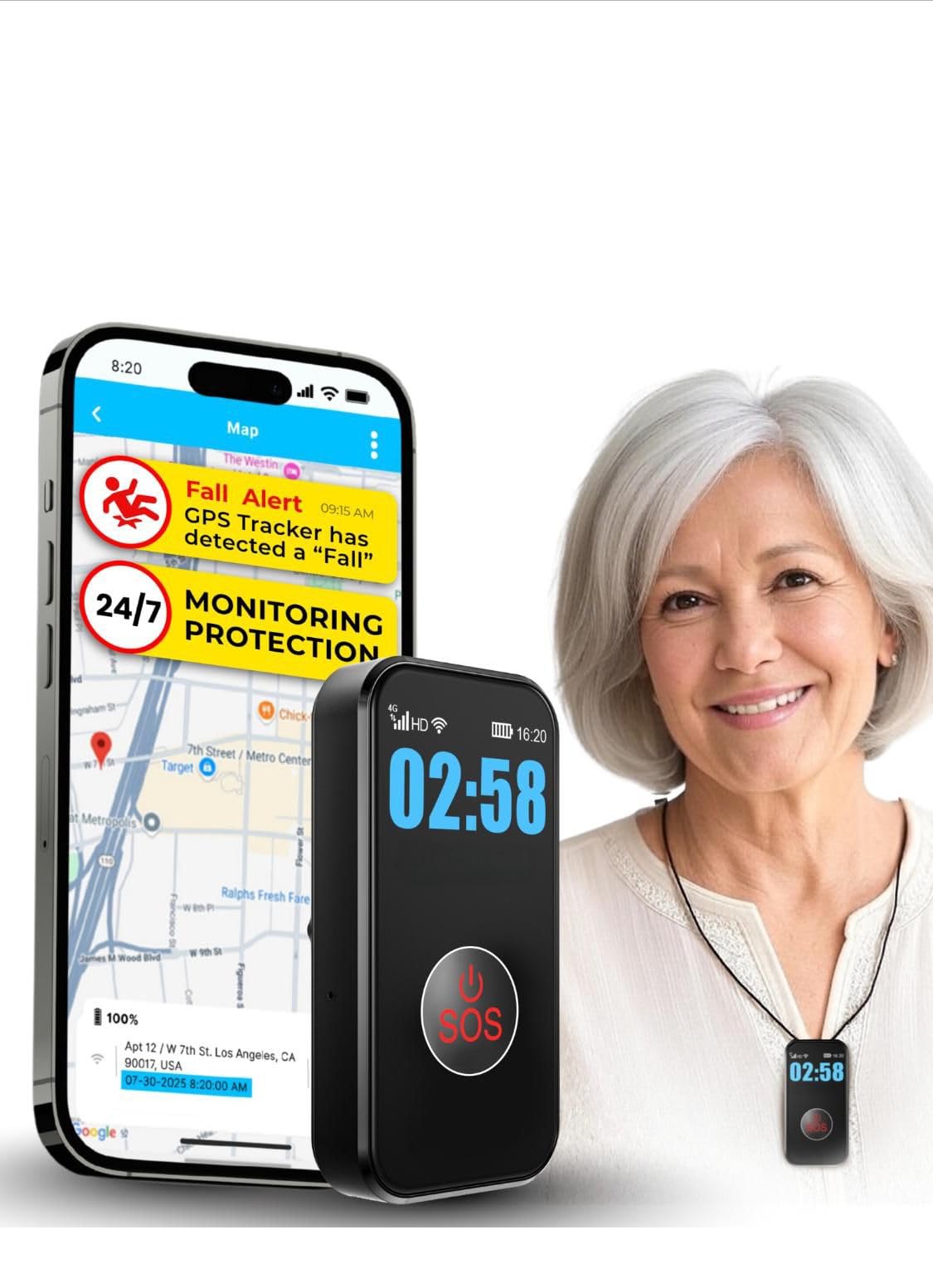
The SecuLife pendant is a fundamentally different category of device. It is not a simple in-home pager—it’s a cellular medical alert system with automatic fall detection, real-time GPS tracking, and two-way voice calling. This is the right choice for a senior who lives alone, is still mobile, and needs protection both inside the home and while out running errands. The SOS button on the pendant connects directly to preset emergency contacts via cellular 4G LTE, with no landline required.
Fall detection uses built-in accelerometers and algorithms to detect hard impacts and sudden stillness. Users report that it does notify family members within seconds of a genuine fall. The GPS tracking is accurate to within 1 meter, and geo-fence zones can be set to alert you if your loved one wanders outside a safe perimeter. The battery lasts up to 6 days with normal 1-hour interval tracking, which is decent for a device running cellular radios and GPS simultaneously. IP67 waterproofing means it survives showers and rain without issue.
The critical catch is the monthly subscription—the device itself is only the entry fee, and the service runs around per month for unlimited alerts and live tracking. Some early adopter reviews report inconsistent fall detection and difficulty reaching customer support for refunds. Also, the pendant does not directly call 911; it calls your preset contacts in order, which could introduce a dangerous delay in a real emergency. For indoor-only use, a simpler pager is more reliable. For an active senior who ventures outside alone, the SecuLife is a powerful safety net—provided you trust the subscription service.
Why it’s great
- Automatic fall detection with real-time cellular emergency calling
- GPS tracking with geo-fence zones for wandering prevention
- IP67 waterproof for 24/7 wear including showers
Good to know
- Requires a monthly subscription that adds recurring cost
- Pendant calls preset contacts, not 911 directly
- Fall detection and SOS reliability have mixed user reports
6. CallToU 2 Receivers + 1 Round Button (06WS)
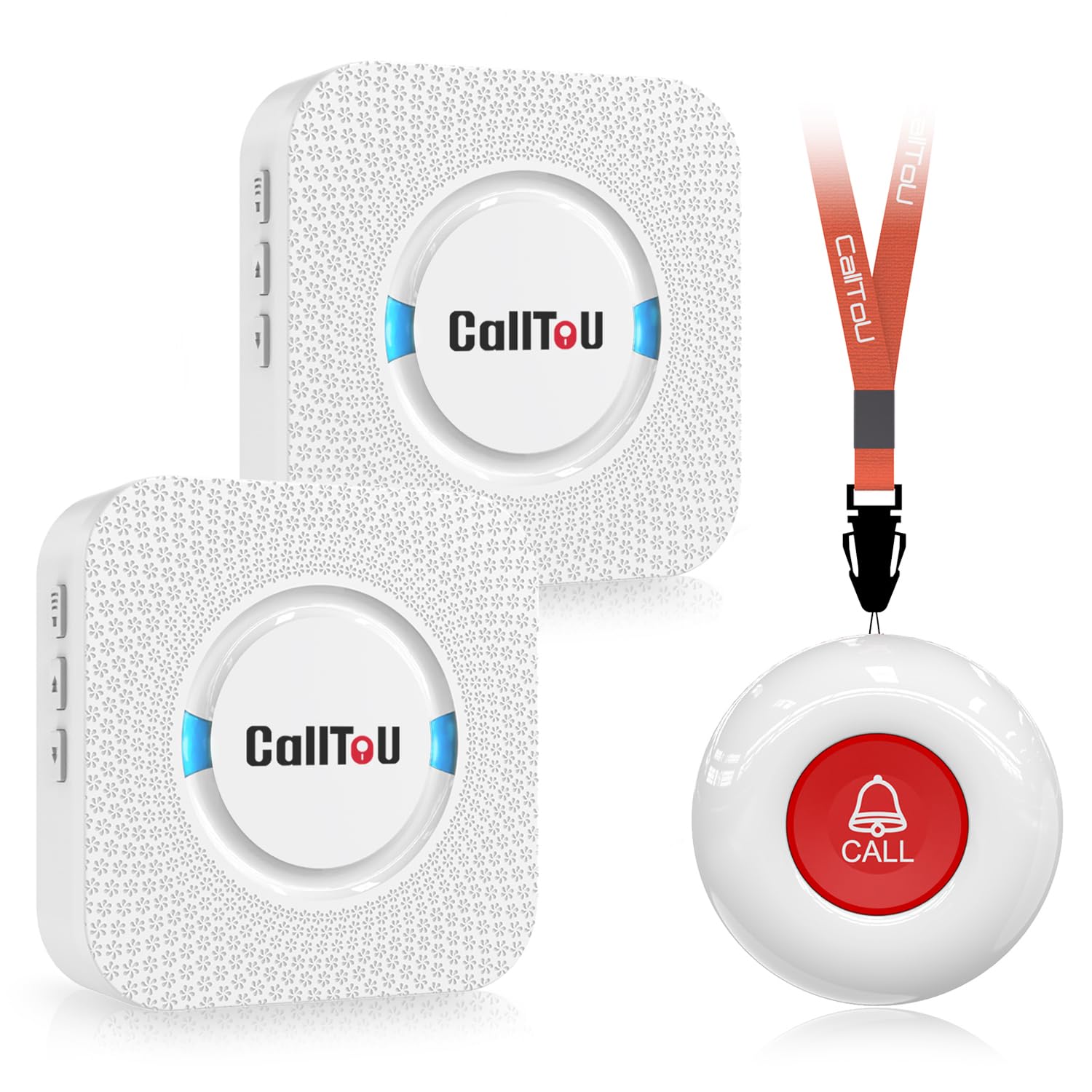
The CallToU 06WS is the simplest entry point into a caregiver call button system—one button, two receivers—but it punches above its weight with 55 ringtones and 5-level volume adjustable from silence to 110dB. The call button is IP66 waterproof, making it one of the few budget options that can safely mount inside a shower stall. The two receivers are AC-powered, meaning they plug into wall outlets and stay on 24/7 without battery anxiety. One receiver goes in the bedroom, one in the living area, and you have complete coverage with no dead zones.
Pendant mode is supported via a neck lanyard, so the user can wear the button around their neck or attach it to a walker with the included bracket. The 500-foot open-air range is standard for the price tier, but the AC receivers offer better signal stability than battery-powered pager units because they don’t suffer from voltage sag as alkaline cells drain. Users who tested it through a detached garage noted excellent penetration—the signal reached a receiver 70 feet away through multiple interior walls.
The main limitation is you only get one call button. For a two-person care situation or a multi-room setup, you will need to buy additional buttons separately. The button uses a coin cell battery (included), and the manual is famously confusing—non-English speakers may struggle with the pairing instructions. But if you need a no-fuss system for a single care recipient who spends time in two main rooms, this is the most cost-effective way to get reliable, loud coverage without monthly fees.
Why it’s great
- Two AC-powered receivers provide constant coverage with no battery concerns
- IP66 waterproof button is safe for bathroom installation
- 55 ringtones and 110dB max volume handle noisy environments
Good to know
- Only one call button included—additional buttons cost extra
- Coin cell battery in the button needs periodic replacement
- Manual is poorly translated and difficult to follow for setup
7. CallToU 2 Call Buttons + 1 Receiver (Digital Display)
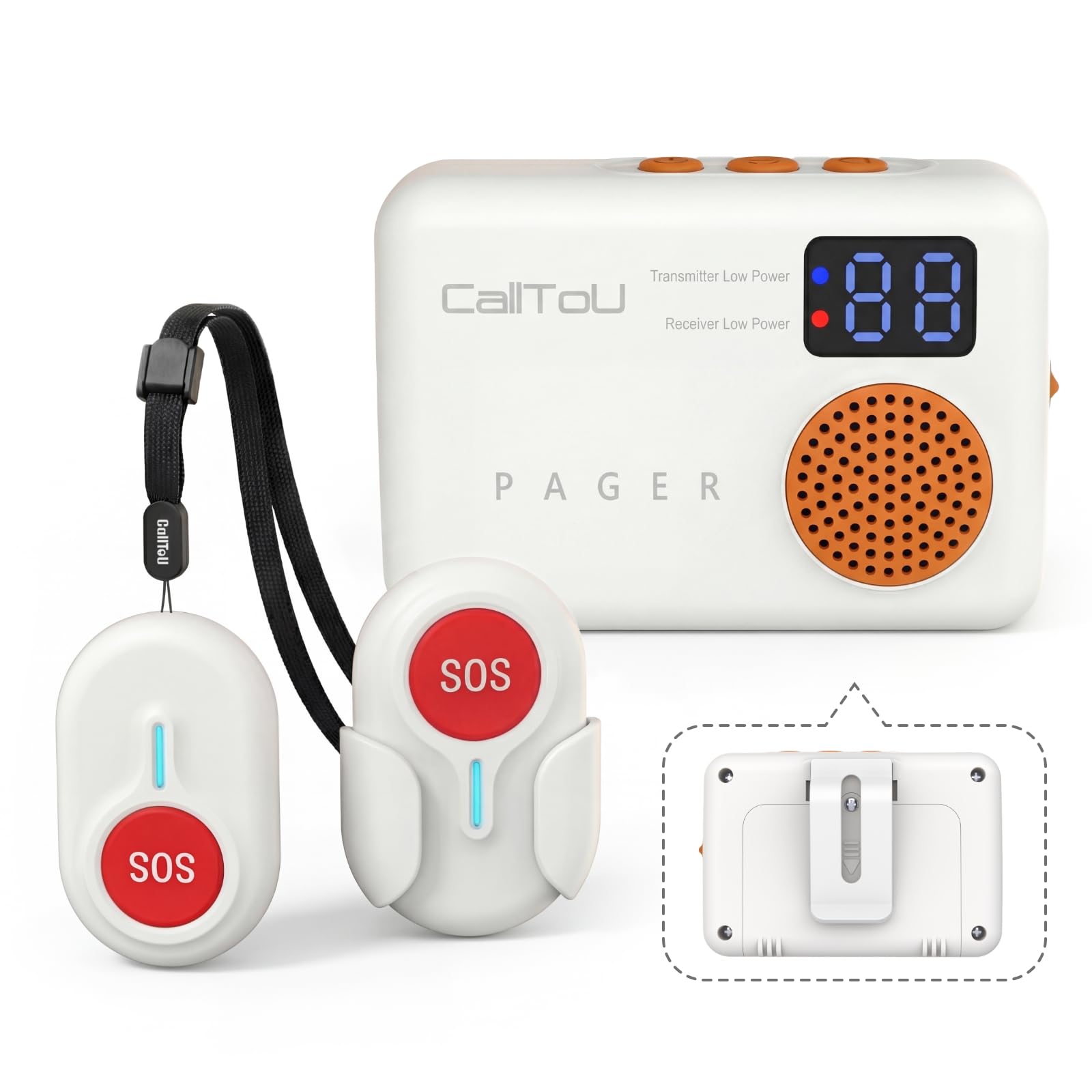
The original CallToU digital-display system is the most reviewed budget-friendly option, and for good reason: it offers two call buttons and one portable receiver at a price point that makes it accessible to nearly any family. The receiver features a small digital display that shows which button was pressed (Button 1 or Button 2), so you know whether the call came from the bedroom or the bathroom without installing color-coded units. Maximum volume hits 120dB, which is genuinely painful at close range—but that ensures you will hear it from anywhere in the house.
The call buttons are splash-proof rather than waterproof, so they can handle a bathroom sink splash but should not be mounted directly inside a shower stall. The receiver runs on 3 AAA batteries and includes a belt clip, making it truly portable. Users report that the receiver’s buttons are recessed to prevent accidental presses during pocket carry—a thoughtful design touch. Open-air range is rated at 500 feet, and real-world penetration through wall studs and brick is about 70 feet, consistent with the category standard.
Battery drain is the most common complaint. If you test the system frequently during initial setup, the AAA cells in the receiver drain faster than expected. Keep spare batteries handy. The two-button expandability (the receiver supports up to 20 transmitters) means you can grow the system as needs change without replacing the base unit. For a first-time buyer who wants to test whether a call button system actually improves daily life before investing in a multi-receiver setup, this is the smart, low-risk starting point.
Why it’s great
- Digital display identifies which room button was pressed
- 120dB max volume is the loudest in this comparison group
- Expandable to 20 transmitters as care needs grow
Good to know
- Receiver battery drains faster than average during initial testing
- Call buttons are splash-proof only—not safe for shower use
- Only one portable receiver means coverage is limited to one caregiver
FAQ
What is the difference between a caregiver call button and a medical alert system?
Can I use a caregiver call button in the shower or bathtub?
How long do the batteries last in a typical caregiver call button system?
Will a caregiver call button work through walls and between floors?
Final Thoughts: The Verdict
For most users, the single best caregiver call button is the SYNLETT 3+2 system because it delivers three waterproof buttons and two portable receivers at a fair price, with color-coded room indicators that eliminate confusion during an alert. If you need to cover a larger property or multiple floors, grab the Full House 1000ft system for its unmatched range and three plug-in receivers. And for a mobile senior who leaves home alone, nothing beats the SecuLife GPS pendant—just be ready for the monthly subscription cost.

Mo Maruf
I created WellFizz to bridge the gap between vague wellness advice and actionable solutions. My mission is simple: to decode the research and give you practical tools you can actually use.
Beyond the data, I am a passionate traveler. I believe that stepping away from the screen to explore new environments is essential for mental clarity and physical vitality.