Our readers keep the lights on and my smoothie glass nicely filled. As an Amazon Associate, I earn from qualifying purchases.
When subtle S3 and S4 gallops, faint murmurs, or early crackles dictate a patient’s next treatment step, your stethoscope becomes the single most critical diagnostic tool in your clinical arsenal. A standard scope simply won’t resolve the low-frequency energy below 120 Hz where these pivotal sounds live—leaving you guessing when you need certainty.
I’m Mohammad Maruf — the founder and writer behind WellFizz. I’ve spent years analyzing acoustic transmission data, chestpiece resonance mechanics, and clinician feedback across dozens of cardiology-grade instruments to separate high-fidelity performance from marketing claims.
This guide evaluates nine specific models ranging from premium-tier instruments with titanium chestpieces to budget-friendly dual-head designs, all unified by their ability to meet the rigorous demands of cardiac and pulmonary assessment. Whether you work in a quiet clinic or a chaotic ER, this analysis cuts through the noise to help you confidently select the best cardiology stethoscope for your practice.
How To Choose The Best Cardiology Stethoscope
A cardiology stethoscope earns its name through superior low-frequency resolution, durable chestpiece construction, and a sound delivery system that preserves waveform integrity from patient to eardrum. Three specifications separate clinical-grade auscultation from basic monitoring.
Chestpiece Material and Diaphragm Design
Stainless steel is the standard—affordable, durable, and acoustically sufficient for most environments. Titanium offers a higher stiffness-to-mass ratio, reducing unwanted resonance and damping subtle high-frequency murmurs while shedding weight for day-long wear. Brass, found in legacy premium scopes like the Harvey DLX, provides a distinct warm tone favored by cardiologists who prioritize very low-frequency body sounds. Pair the material with a tunable diaphragm: applying light pressure opens the low-frequency channel, firm pressure engages the high-frequency mode, eliminating the need to flip the chestpiece during continuous assessment.
Lumen Configuration and Tubing Thickness
Dual-lumen tubing carries sound from the chestpiece to each earpiece through separate channels, eliminating phase cancellation that occurs when a single bore splits into two. Thicker walls—typically 3/16 inch or greater—prevent ambient noise from bleeding into the acoustic path and resist kinking during transport. The longer the tubing, the lower the high-frequency roll-off, which is why most cardiology scopes use 27- to 28-inch lengths rather than the standard 22-inch found on basic models.
Earpiece Seal and Binaural Tension
An acoustic seal only as good as the eartip fit. Soft-sealing silicone tips in multiple sizes conform to the ear canal shape, blocking external noise that masks faint heart sounds. The binaural spring tension must hold the eartips snugly without causing pressure discomfort over an eight-hour shift. Anatomically angled ear tubes—typically 15 degrees—match the natural forward tilt of the ear canal, reducing the need to tilt your head to maintain seal and comfort.
Quick Comparison
On smaller screens, swipe sideways to see the full table.
| Model | Category | Best For | Key Spec | Amazon |
|---|---|---|---|---|
| 3M Littmann Cardiology IV | Premium Acoustic | Cardiac & Pulmonary Detail | Next-generation tunable diaphragm | Amazon |
| Welch Allyn Harvey DLX | Premium Cardiology | Very Low-Frequency Detection | Brass bell & 28” dual-lumen tubing | Amazon |
| MDF ProCardial Titanium | Titanium Performance | Lightweight Carry & Durability | Lightweight titanium chestpiece | Amazon |
| Welch Allyn Harvey Elite | Premium Acoustic | Differentiating S3/S4 & Murmurs | Double-head with non-chill rim | Amazon |
| ADC Adscope 601 | Convertible Cardiology | Adult & Pediatric Flexibility | Convertible chestpiece & AFD technology | Amazon |
| MDF ProCardial Stainless Steel | Dual Head Cardiology | High-End Value & Dual Head | Convertible pediatric diaphragm | Amazon |
| KilaScopes Specialist | Single Head Cardiology | Noise Reduction & Long Tubing | Carbon fiber diaphragm | Amazon |
| 3M Littmann Classic III | General Clinical | Versatile Multi-Patient Monitoring | 2X louder sound amplification | Amazon |
| MABIS Spectrum Series | Dual Head Basic | Occasional & Student Use | 22-inch Y tubing dual head | Amazon |
In‑Depth Reviews
1. 3M Littmann Cardiology IV
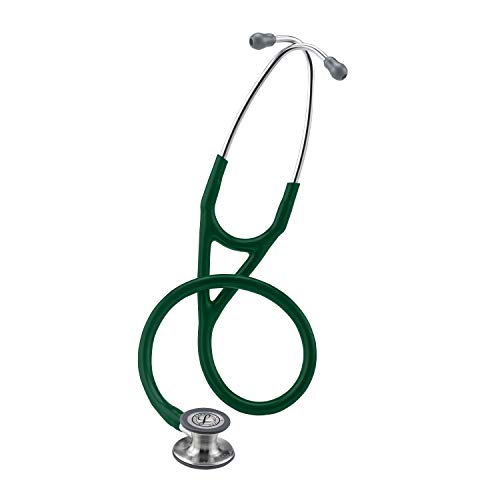
The 3M Littmann Cardiology IV stands as the benchmark for premium acoustic auscultation, featuring a next-generation tunable diaphragm that resolves subtle respiratory and cardiac sounds with remarkable clarity. Clinical users consistently note its ability to differentiate inhalation from exhalation phases, crackles, pleural rubs, and wheezes—detail that the Classic III simply cannot reproduce at the same fidelity. Its dual-lumen tubing design eliminates phase cancellation, ensuring that low-frequency S3 and S4 gallops arrive at each ear with zero cross-channel interference.
Built with a stainless steel chestpiece and a 27-inch length, the Cardiology IV balances acoustic transparency with physical durability. The ergonomic headset applies consistent tension without inducing fatigue, and the soft-sealing ear tips block ambient noise effectively even in loud pre-hospital environments like ambulance cabins or busy ED bays. Paramedics and nursing professionals with hearing loss have reported this scope restores auscultation confidence they had lost with lesser instruments.
While the premium price positions it above most mid-range competitors, the acoustic return justifies the investment for any clinician who regularly relies on auscultation for diagnostic decisions. The unit weighs 0.45 kg, slightly heavier than the Classic III but with substantially upgraded sound isolation. The Hunter Green color option adds a professional but personalized aesthetic that resists showing wear over years of daily use.
Why it’s great
- Best-in-class low-frequency resolution for detecting S3/S4 gallops and soft murmurs
- Tunable diaphragm eliminates chestpiece flipping during continuous monitoring
- Dual-lumen construction prevents phase cancellation for truer sound reproduction
Good to know
- Premium price positions it above mid-range competitors
- Slightly heavier than the Classic III at nearly one pound
- Some users prefer the warmer brass tone of legacy Harvey scopes
2. Welch Allyn Harvey DLX Stethoscope

The Welch Allyn Harvey DLX is a legacy instrument revered by practicing physicians for its chrome-plated brass chestpiece, which delivers a distinctly warm acoustic signature that many cardiologists prefer for detecting very low-frequency body sounds. Its double-head configuration includes a brass bell and a flat diaphragm, giving you dedicated physical tools for low versus high frequency auscultation rather than relying on pressure-sensitive tunable membranes. The rotatable stainless steel binaural and interchangeable comfort-sealing ear tips complete a headset designed for long shifts.
In direct comparisons, the Harvey DLX produces louder and clearer sound than the Littmann Cardiology IV, with several clinicians noting it can reveal subtle murmurs that electronic scopes might miss. The 28-inch dual-lumen tubing reduces high-frequency roll-off, preserving crispness of breath sounds from chestpiece to earpiece. Long-term owners report the scope lasting decades with only minor part replacements—a testament to the brass construction and robust binaural spring design.
However, the brass chestpiece is heavier than stainless steel or titanium alternatives, and some users find the 28-inch tubing slightly cumbersome for neck-carry during fast-paced rounds. The ear tips can loosen with use, and replacement parts are notably expensive if lost. For the working physician or PA student who values acoustic warmth and proven longevity over modern lightweight materials, the Harvey DLX remains a strong choice.
Why it’s great
- Brass chestpiece delivers warm, natural low-frequency tone preferred by cardiologists
- Dedicated bell and diaphragm eliminate reliance on pressure-sensitive tunable designs
- Proven build quality with reports of 20-30 years of service life
Good to know
- Heavier than stainless steel or titanium cardiology scopes
- Ear pieces and bell rim can loosen with use
- Replacement parts are costly relative to the initial investment
3. MDF Instruments ProCardial Titanium Sugar Skull

The MDF ProCardial Titanium line tackles the classic trade-off between acoustic performance and weight by constructing its dual-head chestpiece from acoustically-superior titanium. The result is a scope that weighs significantly less than stainless steel equivalents while maintaining deep diaphragm and bell channels that transmit heart, lung, and blood flow sounds with uncompromised integrity. The extra deep diaphragm geometry captures low-frequency energy below 120 Hz effectively, making this a true contender for dedicated cardiac assessment.
MDF packs patented technology into this instrument, including the GlideLock system that secures sound channels, the Acoustic Pyramid Chamber with patent-pending STEnT for structural sound integrity, and SafetyLock eartip adaptors. The C34 tubing features 34 internal channels etched to direct sound waves without interference, and the thicker dual-lumen wall resists ambient noise penetration. The ErgonoMax headset with dual-leaf spring construction delivers twice the durability of single-leaf designs while maintaining comfortable binaural tension.
One downside: the titanium chestpiece, while lighter than steel, still feels heavier around the neck compared to plastic-chestpiece scopes—a minor trade-off for the acoustic gain. The limited edition Sugar Skull aesthetic is striking but may not suit every clinical setting. MDF backs this with a full lifetime warranty and free-parts-for-life program, making the upfront investment lower-risk over the long term.
Why it’s great
- Titanium chestpiece reduces weight without sacrificing acoustic depth or resonance
- Patented Acoustic Pyramid Chamber and C34 tubing preserve sound waveform integrity
- Lifetime warranty and free-parts-for-life program reduce long-term cost of ownership
Good to know
- Heavier around the neck than some lighter plastic-chestpiece scopes
- Limited edition designs may not appeal to all clinical professionals
- Higher upfront cost than mid-range stainless steel options
4. Welch Allyn Harvey Elite Cardiology

The Welch Allyn Harvey Elite delivers full-range cardiology and pulmonology assessment through a double-head chestpiece that includes a dedicated brass bell and a flat diaphragm, giving you two distinct acoustic tools without any tunable mechanism. The stainless steel chestpiece includes a non-chill rim that improves patient comfort during chest contact—a thoughtful detail for pediatric or geriatric populations where cold metal causes flinch artifacts that mask subtle sounds. The rotatable binaural and interchangeable comfort-sealing ear tips complete a headset designed for extended wear.
Clinicians report that the Harvey Elite can differentiate S3 from S4 gallops, identify grade III murmurs missed by other scopes, and capture clear adventitious lung sounds in both human and veterinary applications. The 28-inch dual-lumen tubing preserves high-frequency detail, making asthmatic wheezes and pleural rubs distinctly audible. The scope ships with a pediatric bell accessory kit, expanding its utility across both adult and small-patient populations.
Long-term reliability is a known strength, with one user recording 30 years of service with only minor part swaps. However, the tube tension adjustment mechanism is somewhat cumbersome compared to modern scopes, and the ear tips can become uncomfortable during full-day wear for some users. The non-chill rim and bell assembly are prone to loosening, requiring periodic tightening.
Why it’s great
- Dedicated brass bell provides superior low-frequency detection for subtle murmurs and gallops
- Non-chill rim improves patient comfort and reduces muscle tension artifacts
- Proven 30-year service life with minor part replacements
Good to know
- Tube tension adjustment is less intuitive than modern turn-dial designs
- Ear tips may cause discomfort during extended 8+ hour shifts
- Bell and rim assembly tend to loosen and require periodic re-tightening
5. ADC Adscope 601 Convertible Cardiology
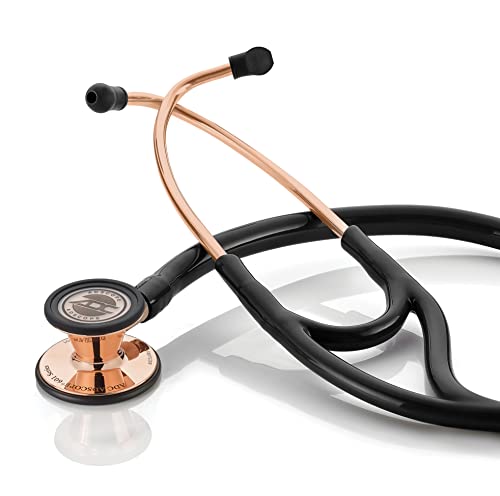
The ADC Adscope 601 punches above its price tier with proprietary Adjustable Frequency Design (AFD) technology that lets you use light pressure for low-frequency auscultation and firm pressure for high-frequency sounds—essentially mimicking a tunable diaphragm in a convertible form factor. The stainless steel chestpiece includes a fixed adult diaphragm and a threaded pediatric diaphragm that converts to an open bell for low-frequency sounds. This dual personality makes it a strong candidate for clinicians who rotate between adult and pediatric patients frequently.
Each unit is individually acoustic tested in the USA, and clinical comparisons against the 3M Littmann Cardiology III show virtually identical sound quality at roughly half the price. The dual-channel phthalate-free tubing and large-bore aluminum binaurals create a robust acoustic pathway, while the Adsoft Plus snap-on silicone eartips provide a comfortable seal. The scope weighs 8.5 ounces, lighter than many cardiology scopes, reducing neck fatigue during long shifts.
The convertible chestpiece adds height and weight compared to fixed dual-head designs, and the pediatric diaphragm requires unscrewing to convert to bell mode—an extra step during rapid patient swaps. Nonetheless, the lifetime refurbishment policy and free parts forever program make this an exceptionally low-risk investment for students, new graduates, or budget-conscious departments.
Why it’s great
- Acoustics nearly identical to the Littmann Cardiology III at a significantly lower price
- Convertible chestpiece works for both adult and pediatric patients
- Lifetime refurbishment and free parts forever program back the investment
Good to know
- Convertible chestpiece is slightly heavier and taller than fixed dual-head designs
- Pediatric diaphragm requires unscrewing to switch to bell mode
- Some users find the eartips tend to unscrew; a touch of threadlocker resolves it
6. MDF ProCardial Cardiology Stainless Steel Dual Head
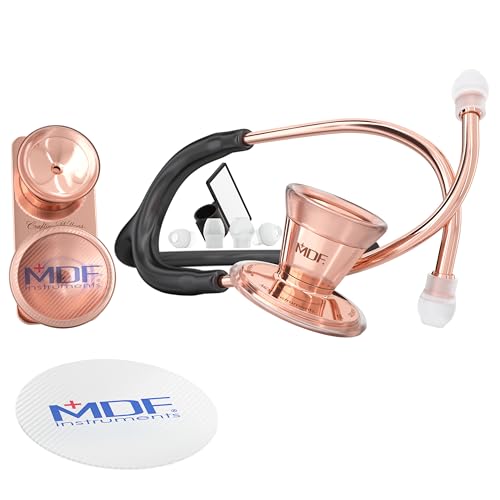
The MDF ProCardial in stainless steel is a handcrafted dual-head stethoscope that competes directly with the Littmann Cardiology III on acoustic performance while offering a convertible pediatric diaphragm attachment. The dual-leaf spring construction provides twice the durability of single-leaf binaural designs, and the ErgonoMax headset is pre-angled at 15 degrees to match the natural anatomy of the ear canal—reducing the need for head tilt to maintain a proper seal. This ergonomic consideration pays dividends during full-clinic days when neck and jaw fatigue accumulate.
Users with decades of clinical experience report that the MDF ProCardial delivers sound that is louder and clearer—by a margin of 2 to 3 points on a 10-point scale—compared to the Littmann Cardiology III. The thicker steel tubing amplifies acoustic energy, and the convertible pediatric diaphragm expands utility for family practice or labor and delivery nurses. The rose gold and black color option is visually striking while maintaining professional appearance standards.
However, the heavier chestpiece and stiffer ear cushions can feel less comfortable during extended wear compared to softer-sealing alternatives. Two long-term users reported earpiece breakage after 1.5 to 4 years, though both considered the scope’s acoustic superiority worth the trade-off. MDF offers a full lifetime warranty and free-parts-for-life program, adding a layer of security for the investment.
Why it’s great
- Louder and clearer acoustic output than the Littmann Cardiology III in direct comparisons
- Ergonomically angled headset reduces neck strain during extended clinical use
- Convertible pediatric diaphragm attachment expands patient age range
Good to know
- Heavier chestpiece and stiffer ear cushions than softer-sealing alternatives
- Earpiece breakage reported after 1.5 to 4 years of daily use
- Lifetime warranty and free-parts-for-life program mitigate long-term risk
7. KilaScopes Specialist Single Head Cardiology
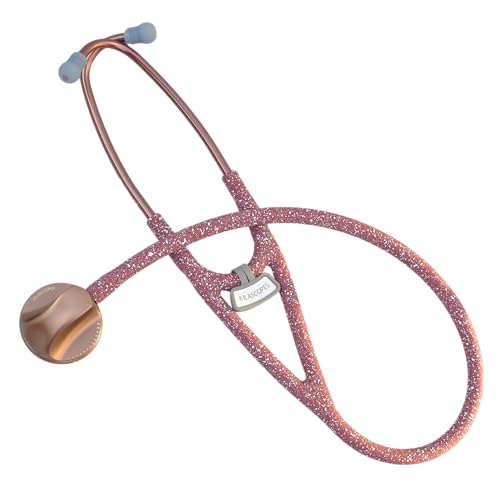
The KilaScopes Specialist K971 employs a patented noise reduction dual-frequency structure paired with a carbon fiber diaphragm that amplifies cardiac and respiratory sounds while filtering ambient ward noise. The sculpted chestpiece geometry maximizes skin contact area, and the advanced frequency-modulation technology lets you calibrate sensitivity by adjusting diaphragm tension. This makes the scope particularly useful in high-noise environments like emergency departments or during ambulance transport where conventional scopes pick up too much environmental interference.
The medical-grade silicone tubing extends to 32 inches—longer than the standard 27 inches—which hospitalists have adopted as an infection control measure, allowing them to maintain greater distance from potentially infectious patients while still hearing clear heart and lung sounds. The tubing is flexible, non-stick, and latex-free, resisting the kinking that plagues shorter PVC tubes. The pressure-relieving contour binaural design uses elastic cushioning to maintain a low-pressure seal, reducing ear fatigue over long shifts.
One downside is the single-head design: unlike convertible or dual-head scopes, the K971 does not offer a dedicated pediatric bell or separate bell mode, limiting its use in family practice or pediatric settings. The carbon fiber diaphragm is also somewhat fragile if dropped onto hard surfaces repeatedly. Veterinary users have adopted it as an excellent backup scope, noting the clear sound reproduction and comfortable matte tubing.
Why it’s great
- Patented noise reduction structure filters ambient sound for clearer auscultation in loud settings
- Extended 32-inch silicone tubing allows greater patient distance for infection control
- Carbon fiber diaphragm provides high sensitivity with a lightweight chestpiece
Good to know
- Single-head design lacks dedicated pediatric bell or separate bell mode
- Carbon fiber diaphragm can be damaged by repeated hard drops
- Neon color options may be too bright for some clinical environments
8. 3M Littmann Classic III Monitoring Stethoscope
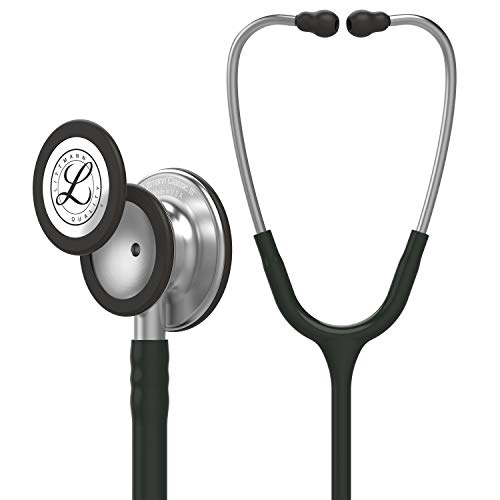
The 3M Littmann Classic III is the most widely adopted stethoscope in clinical education and general practice, serving as a reliable baseline for monitoring heart, lung, and blood pressure sounds in non-critical care environments. It features a tunable, dual-sided stainless steel chestpiece that lets you switch between open bell and closed diaphragm modes, and the non-chill bell sleeve improves patient comfort during chest contact. At less than half the weight of full cardiology scopes, the Classic III is the lightest in this comparison at 0.15 kg.
Acoustically, the Classic III delivers sound that is more than twice as loud as leading competitors in its class, with particular strength in the frequency range below 120 Hz where Korotkoff sounds, mitral stenosis, and S3/S4 gallops reside. The soft-sealing ear tips provide good occlusion, and the 27-inch tubing offers adequate reach for most clinical scenarios. Designed and manufactured in the USA, the scope carries a 5-year warranty and is intended for adult and pediatric use in general wards, medical offices, OB/GYN, and urgent care settings.
However, the Classic III is not a dedicated cardiology scope—clinicians who need to differentiate subtle murmurs, quantify gallop rhythms, or hear asthmatic wheezes at low amplitude will find the Cardiology IV or Harvey DLX significantly more resolving. The single-lumen tubing introduces some phase cancellation compared to dual-lumen designs, and the lightweight construction can feel less substantial during heavy daily use. As an entry-level cardiology-grade scope or a reliable backup, the Classic III remains a strong choice.
Why it’s great
- Acoustic output more than twice as loud as comparable stethoscopes in its class
- Extremely lightweight at 0.15 kg, reducing neck fatigue during all-day wear
- Tunable dual-sided chestpiece offers both open bell and closed diaphragm modes
Good to know
- Not a dedicated cardiology scope; less resolving for subtle murmurs and gallops
- Single-lumen tubing introduces some phase cancellation compared to dual-lumen designs
- Lightweight construction feels less durable than heavier cardiology-grade scopes
9. MABIS Spectrum Series Dual Head Stethoscope

The MABIS Spectrum Series is an entry-level dual-head stethoscope designed for basic auscultation of heart, lung, stomach, and blood pressure sounds in non-critical care settings. Its chestpiece features a rotating stem with a bell and diaphragm for switching between high and low frequency capture, and the 22-inch Y-tubing delivers sound to the binaurals through a traditional single-lumen split design. The lightweight plastic and aluminum construction makes it one of the least fatiguing scopes for extended wear, though at the cost of acoustic fidelity.
Users in home health, student training, and night-shift BP checks report that the MABIS delivers adequate sound quality for confirming heart rates and detecting significant murmurs or adventitious lung sounds when compared to more expensive scopes. The dual-sided chestpiece offers functional flexibility, with some reviewers noting that the smaller diaphragm side produces louder output. The wide color range (including purple, red, and turquoise) makes it a visually appealing option for students or clinicians who want personalized equipment.
However, the MABIS is not designed for cardiology-grade assessment. The sound quality is noticeably quieter and less resolving than the Classic III, let alone the Cardiology IV or Harvey DLX. Some units arrive with defective sound transmission—completely silent when tapping the chestpiece—indicating quality control issues. The earpieces fit very tightly and can become uncomfortable during extended use, and the rotating chestpiece stem requires alignment with the active side, which is not clearly documented in included instructions.
Why it’s great
- Extremely lightweight design for minimal neck fatigue during extended wear
- Dual-head chestpiece provides both bell and diaphragm functions
- Budget-friendly entry point for students or home health occasional use
Good to know
- Not suitable for cardiology-grade assessment; lower acoustic resolution
- Inconsistent quality control with some units arriving non-functional
- Earpieces fit tightly and become uncomfortable during extended use
FAQ
What is the difference between a tunable diaphragm and a convertible chestpiece?
How long should a cardiology stethoscope last with daily clinical use?
Can a cardiology stethoscope be used for both human and veterinary patients?
Final Thoughts: The Verdict
For most clinicians seeking the best balance of acoustic resolution, build quality, and ergonomic comfort, the best cardiology stethoscope winner is the 3M Littmann Cardiology IV because its next-generation tunable diaphragm and dual-lumen construction deliver industry-leading low-frequency detail without requiring you to flip or swap chestpiece components during continuous assessment. If you prioritize the warm acoustic signature of a dedicated brass bell for very low-frequency murmurs, grab the Welch Allyn Harvey DLX. And for a lightweight titanium option with lifetime warranty coverage that reduces long-term cost, nothing beats the MDF ProCardial Titanium.

Mo Maruf
I created WellFizz to bridge the gap between vague wellness advice and actionable solutions. My mission is simple: to decode the research and give you practical tools you can actually use.
Beyond the data, I am a passionate traveler. I believe that stepping away from the screen to explore new environments is essential for mental clarity and physical vitality.