Our readers keep the lights on and my smoothie glass nicely filled. As an Amazon Associate, I earn from qualifying purchases.
Screen fatigue is real, and the best antidote is a deck of cards that turns a quiet afternoon into a showdown of giggles, strategy, and maybe a little friendly trash talk. The right card game for kids doesn’t just fill time — it builds quick thinking, patience, and social skills while keeping every player, from the youngest to the oldest, fully engaged.
I’m Mohammad Maruf — the founder and writer behind WellFizz. I’ve spent years analyzing family gaming trends and evaluating the production specs, replayability, and age-gating logic behind the most popular card games on the market.
Whether you need a multi-deck kit for a varied play session or a single, high-stakes game to anchor family night, this guide helps you find the best card games for kids that match your family’s energy and skill level.
How to Choose The Best Card Games For Kids
Not all card games are created equal when it comes to kids. The right choice depends on age range, attention span, and whether you want a quick warm-up or a whole evening of play. Here are the key factors to weigh before buying.
Age Appropriateness and Reading Level
Games with text-heavy cards, like party games that require reading fill-in-the-blank answers, are best for older kids and teens. Simpler games with symbols, numbers, or matching patterns work well for ages 4 to 7. Always check the manufacturer’s age recommendation, but also consider your child’s actual reading confidence.
Card Stock and Durability
Kids handle cards differently than adults. Thin, flimsy stock bends, splits, and peels after a few rounds. Look for decks made with coated premium paper or a thickness of at least 300 gsm. Thicker cards shuffle better, resist moisture from sticky hands, and survive being tossed into a backpack for road trips.
Player Count and Play Time
A game designed for 2 to 4 players works for small families, but larger groups need a game that accommodates 6 or more. Also consider round duration. Games that take 10 to 20 minutes hold younger attention spans well, while 30-minute games suit older kids who can sustain focus. Avoid games that drag beyond 45 minutes unless the kids are already hooked.
Quick Comparison
On smaller screens, swipe sideways to see the full table.
| Model | Category | Best For | Key Spec | Amazon |
|---|---|---|---|---|
| Rokt&razo Upgraded 6-Deck Set | Multi-Deck Kit | Ages 4+ variety gameplay | 6 games, 54 cards each | Amazon |
| Mattel Games Skip Bo Junior | Sequencing Game | Counting & strategy, ages 5+ | 2 levels of play, 112 cards | Amazon |
| QUOKKA Fast-Paced Party Game | Reaction Game | Multi-age family game night | 72 cards, 10-20 min rounds | Amazon |
| Exploding Kittens Original Edition | Strategic Survival | Ages 7+ high-stakes fun | 56 cards, 15 min playtime | Amazon |
| Cards Against Humanity 2.0 | Party Game | Teens and adults, dark humor | 600 cards, 4+ players | Amazon |
In‑Depth Reviews
1. Rokt&razo Upgraded 6-Deck Set
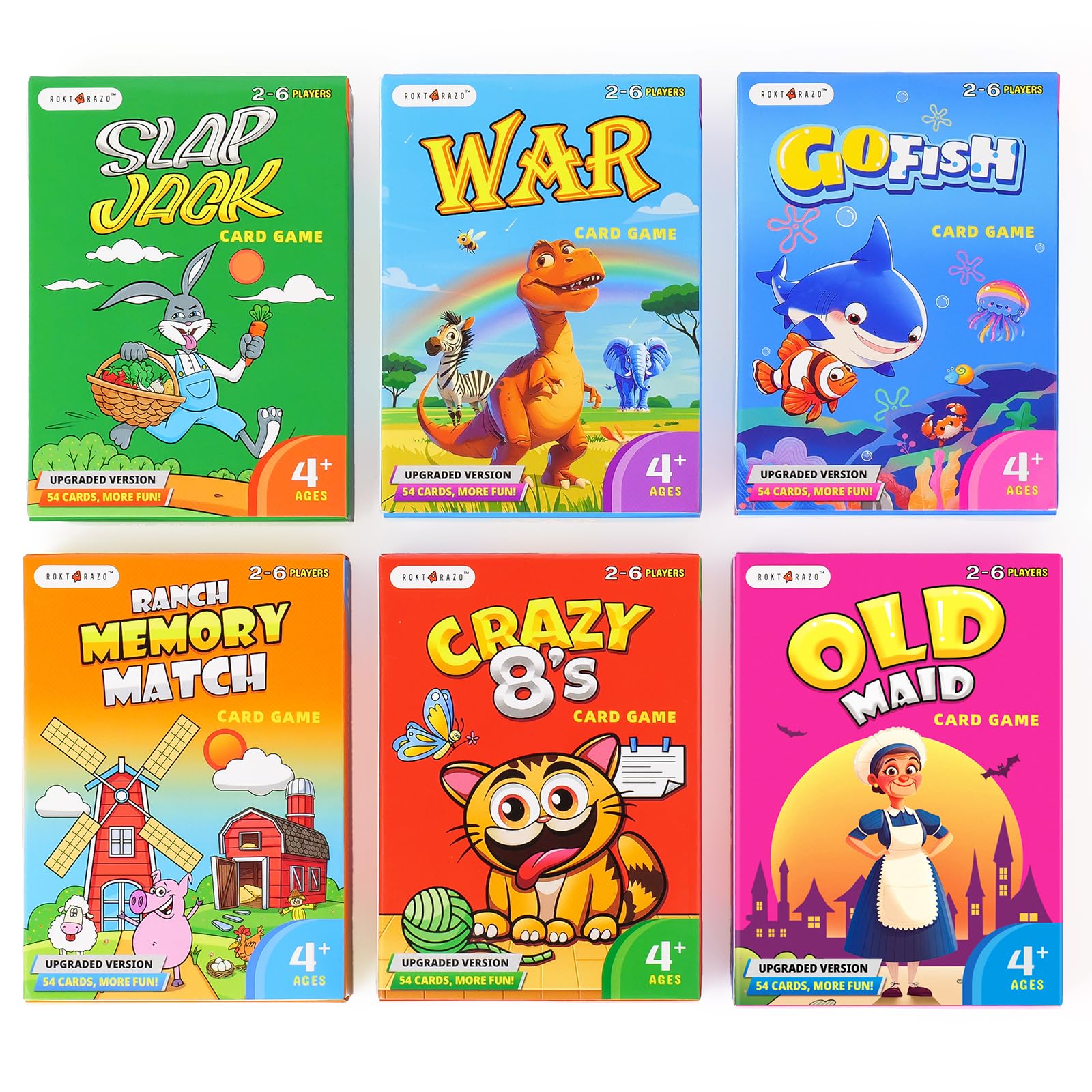
This is the Swiss Army knife of kids’ card games. With six complete decks — Go Fish, Old Maid, Crazy Eights, Memory Match, Slap Jack, and War — you get a full game library in one box. Each deck uses 30% thicker coated paper than standard playing cards, so the stock holds up to enthusiastic shuffling and the inevitable drop on a hardwood floor.
The upgraded version bumps each deck to 54 cards and includes senior function cards that add strategic wrinkles to classic rules. The illustrations are themed around grassland animals, sea life, vegetables, fruits, and occupations, which turns each game into a low-key learning moment without feeling like homework.
Cards are individually packed, making them easy to toss into a diaper bag or backpack for restaurant waits or road trips. For families with children as young as 4 who want variety without buying separate boxes, this set delivers exceptional versatility.
Why it’s great
- Six different games in one purchase keeps play fresh for months
- Thick, coated card stock resists bending and peeling
- Educational themes introduce new vocabulary and concepts naturally
Good to know
- One reviewer noted a card set had an unglued side that needed tape
- No fish-shaped cards in Go Fish, which some kids expect
2. Mattel Games Skip Bo Junior

Skip Bo Junior takes the classic adult sequencing game and scales it perfectly for younger minds. The core mechanic — stacking cards from 1 to 10 in the center — reinforces counting and number order without feeling like a math drill. Bright animal graphics keep the visual experience engaging for ages 5 and up.
What sets this apart from typical kids’ card games is the dual-level design. Level one keeps it simple: just build the sequence. Once a child masters that, level two introduces discard piles, adding real strategic depth. This means the game grows with the player rather than being outgrown after a handful of sessions.
With 112 cards and support for 2 to 4 players, it’s a solid choice for smaller families. The box is compact, the rules are easy to teach in under two minutes, and the game naturally encourages patience and forward planning.
Why it’s great
- Two difficulty levels extend the game’s lifespan significantly
- Reinforces counting and sequencing in a fun, pressure-free way
- Easy to teach and quick to set up
Good to know
- Limited to 4 players max, not ideal for large groups
- Cards are standard thickness, not particularly durable for rough handling
3. QUOKKA Fast-Paced Party Game
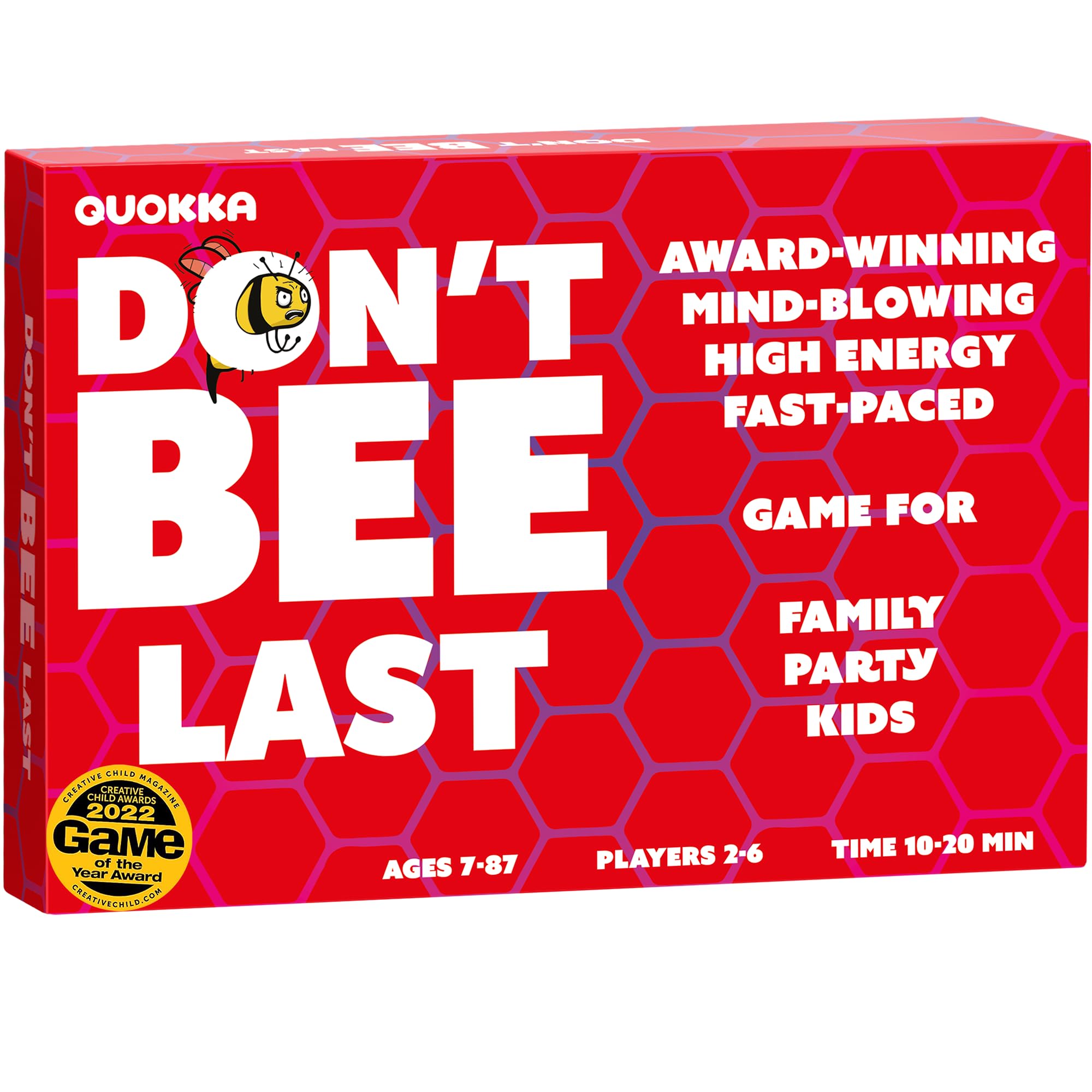
This game is pure controlled chaos. Players take turns placing cards and shouting the correct color, and if you mess up you start over. The real twist: when a BEE card lands in the center, everyone slaps it. The last to slap gets “stung” and adds the whole pile to their hand. It’s frantic, silly, and ridiculously addictive.
With rounds lasting 10 to 20 minutes and a learn-in-under-a-minute rule set, this is designed for mixed-age gatherings. Kids as young as 6 can compete alongside grandparents because the mechanics rely on reaction speed and attention, not reading ability. The cognitive workout — forcing your brain to switch between color identification and quick motor response — is surprisingly good for developing hand-eye coordination.
The 72-card deck supports 2 to 6 players. Some reviewers note the cards feel a bit thin out of the box, but they hold up well in practice as long as players aren’t too rough. For a game that generates genuine belly laughs across generations, this is hard to beat.
Why it’s great
- Teaches quick thinking and color recognition under pressure
- Bee slap mechanic creates hilarious, memorable moments
- Works across a wide age range without reading required
Good to know
- Card stock feels thinner than premium decks
- Best with a moderator for kids with more than a 2-year age gap
4. Exploding Kittens Original Edition

Exploding Kittens is the rare game that earned its status through genuine cleverness. The premise is simple: draw a card, and if you draw the Exploding Kitten, you’re out — unless you have a Defuse card. Strategic action cards let you skip turns, peek at the deck, or shuffle the discard pile back in. It’s Uno meets Russian Roulette with absurd Oatmeal art.
The rules take about two minutes to explain, and a full game wraps up in roughly 15 minutes, making it perfect for short attention spans and multiple rounds. The illustrations — featuring Tacocat, Rainbow-Ralphing Cat, and All-Seeing Goat Wizard — are genuinely funny for both kids and adults, which is why this game often gets played after the kids go to bed.
Designed for ages 7 and up and 2 to 5 players, it’s compact enough for camping trips or sleepovers. The card stock is standard but adequate, and the high replayability comes from the unpredictable nature of the draw-and-defuse cycle. It’s a must-have for any family game library.
Why it’s great
- Extremely high replay value due to randomized draws and strategic cards
- Humor appeals equally to kids and adults
- Very fast setup and rule explanation
Good to know
- Elimination mechanic means eliminated players have to wait for next round
- Not suitable for children under 7 due to strategy complexity
5. Cards Against Humanity 2.0

This is the uncensored, adults-only entry in the list. Cards Against Humanity puts players in the role of filling in the blank of a black card using their funniest white cards, with the judge picking the winner. The humor is deliberately offensive, politically incorrect, and utterly ridiculous — exactly what older teens and adults want from a party game.
Version 2.0 packs 500 white cards and 100 black cards, offering massive variety even after dozens of games. The rule booklet includes both sensible rules and preposterous alternate rules that keep the experience fresh. The cardboard box is surprisingly durable, and the card design is minimal — the content does all the work.
This is absolutely not for young kids. The recommended age is 17 and up, and that advice should be taken seriously. But for high school sleepovers, college game nights, or adult family reunions where everyone has a thick skin, it delivers uncontrollable laughter. It plays best with 4 to 8 players.
Why it’s great
- Extremely high replay value with 600 unique cards
- Designed for large groups, plays well with up to 8 players
- Humor is sharp and genuinely funny for the right audience
Good to know
- Completely inappropriate for children and sensitive groups
- Can lose appeal with the same group of players over time
FAQ
What age can kids start playing card games?
How can I tell if a card game is durable enough for kids?
Are there card games that work for both young kids and adults?
Final Thoughts: The Verdict
For most families, the best card games for kids winner is the Rokt&razo Upgraded 6-Deck Set because it gives you six complete games in one purchase, uses thick coated card stock that survives rough handling, and introduces educational themes without feeling like a lesson. If you want a game that builds counting and strategy skills with two difficulty levels, grab the Mattel Games Skip Bo Junior. And for chaotic, laugh-out-loud fun that works across multiple generations, nothing beats the QUOKKA Fast-Paced Party Game.

Mo Maruf
I created WellFizz to bridge the gap between vague wellness advice and actionable solutions. My mission is simple: to decode the research and give you practical tools you can actually use.
Beyond the data, I am a passionate traveler. I believe that stepping away from the screen to explore new environments is essential for mental clarity and physical vitality.