Our readers keep the lights on and my smoothie glass nicely filled. As an Amazon Associate, I earn from qualifying purchases.
A good family card game turns a quiet evening into a contest of wits, reflexes, and shared laughter. The challenge is finding one that actually holds the attention of both a six-year-old and a grandparent without collapsing into arguments over confusing rules.
I’m Mohammad Maruf — the founder and writer behind WellFizz. I spend my time dissecting game mechanics, card stock thickness, and player-count flexibility to find the sets that survive the real test: repeated family play.
After sorting through the most popular decks on the market, I’ve separated the genuine crowd-pleasers from the forgettable packs. This guide delivers the best card games for families based on replay value, age range, and build quality.
How To Choose The Best Card Games For Families
The perfect family card game balances three competing demands: simple enough for young children to grasp, strategic enough to keep adults engaged, and physically durable enough to survive excited hands. Here is how to evaluate each factor before you buy.
Player Count and Age Range
Check the listed age range carefully — “ages 7+” usually means the reading level and math skills required match a second grader, while “ages 4+” relies on color matching and picture recognition. Also confirm the maximum player count fits your family size. Games that support 6 to 8 players are far more versatile for gatherings than those capped at 4.
Card Quality and Durability
Card stock thickness is measured in microns. Budget decks use thin paper that bends, peels, or gets marked after a few sessions. Look for coated premium paper or linen finish that resists wear and makes shuffling easier. Thicker cards also stand up to spills and sticky fingers without warping.
Round Length and Replayability
A 15-minute round is ideal for younger attention spans and quick sessions between activities. Longer games (30 minutes or more) work better for dedicated game nights. Replayability depends on random elements and variable strategies — avoid games where every round plays out identically.
Quick Comparison
On smaller screens, swipe sideways to see the full table.
| Model | Category | Best For | Key Spec | Amazon |
|---|---|---|---|---|
| magilano SKYJO | Strategy | Mixed-age game nights | 150 cards, 2–8 players | Amazon |
| Exploding Kittens Original Edition | Elimination | Older kids and teens | 56 cards, 15 min rounds | Amazon |
| Slapburger Card Game | Action | High-energy young kids | Compact deck, ages 4+ | Amazon |
| Upgraded Kids Card Games Pack | Multi-game | Preschool learning | 6 decks, 54 cards each | Amazon |
| Cards Against Humanity | Party | Adult-only gatherings | 600 cards, 4+ players | Amazon |
In‑Depth Reviews
1. magilano SKYJO

Skyjo earns the top spot because it solves the hardest problem in family gaming: keeping an 8-year-old and a 70-year-old equally engaged. The objective is simple — collect the fewest points across multiple rounds by revealing and swapping cards — yet the strategy of when to stop flipping keeps adults calculating. The 150-card count supports up to 8 players, which makes it rare among family card games that usually cap out at 6.
The cards themselves use a thick stock that holds up well during frequent shuffles, and the included notepad for scorekeeping is a thoughtful touch that eliminates arguments. Rounds average about 30 minutes, long enough to feel meaningful but short enough to play multiple times in an evening. The negative-number scoring mechanic adds an unexpected twist that rewards risk-taking.
German engineering shows in the box construction and card finish. Unlike some imported games where the English instructions feel translated, Skyjo’s rulebook uses clear diagrams that get everyone playing within two minutes. This is the game I consistently see pulled out at family reunions long after the novelty decks have been shelved.
Why it’s great
- Accommodates 2 to 8 players, rare for a strategy card game
- Thick card stock resists bending and marking
- Negative scoring keeps every round tense until the last flip
Good to know
- Requires basic addition up to 100 for scoring
- Not ideal for children under 8 who struggle with number recognition
2. Exploding Kittens Original Edition

Exploding Kittens became a cultural phenomenon for good reason: Russian roulette with cards is immediately understandable and endlessly suspenseful. Each player draws until someone hits an Exploding Kitten, at which point they need a Defuse card — or they’re out. The 56-card deck is compact enough to toss in a bag, and the 15-minute round length makes it perfect for filling gaps between dinner and dessert.
The Oatmeal’s absurdist illustrations give the game a distinct personality that appeals strongly to the 8-to-14 age bracket. Teens who might roll their eyes at a standard deck of playing cards get hooked by the tactical decision of whether to Skip, Shuffle, or Attack. The rules are simple enough that a 7-year-old can play competently, but the bluffing and card-counting strategies give older players an edge.
One design limitation is the 5-player cap. Larger families may find themselves rotating out. The card quality is good but not exceptional — the finish can show wear after dozens of sessions, and the small text on some cards can be hard to read across a table. Still, for the energy it generates and the screaming laughter it produces, few games match its per-minute fun density.
Why it’s great
- Extremely fast to learn and teach to new players
- High-contrast art and clear card layout
- Defuse mechanics create dramatic reversals
Good to know
- Elimination format means eliminated players wait for the next round
- Text on action cards can be difficult to read at a distance
3. Slapburger Card Game

Slapburger takes the physical energy of Slapjack and gives it a food-themed makeover that younger children find irresistible. Players lay cards in a central pile, and when a Slapburger, Double Decker, or Sandwich appears, the first to slap wins the stack. The winner is the first to empty their hand, which typically happens within 15 minutes — matching the attention span of preschoolers perfectly.
The deck measures just 2.5 by 3.5 inches, smaller than standard playing cards, which makes it ideal for car trips and restaurant waits. The cards use a coated finish that survives the repeated slapping that is central to the game. Unlike fragile paper decks that get destroyed after one energetic session, these hold up well to the physical abuse that makes the game fun.
My main note is that the recommended age of 4 is accurate — older kids aged 10 and up may find the mechanic too repetitive after a few rounds. This game is best positioned as a high-energy opener or a tool for burning off steam, not as the centerpiece of a long game night. Parents should also watch for overly competitive slapping that can lead to bumped heads.
Why it’s great
- No reading required, perfect for pre-literate children
- Compact size fits in a purse or glove compartment
- Teaches turn-taking and reflexes without complex rules
Good to know
- Limited strategic depth for older players
- Physical slapping can be overstimulating before bedtime
4. Upgraded Kids Card Games Pack
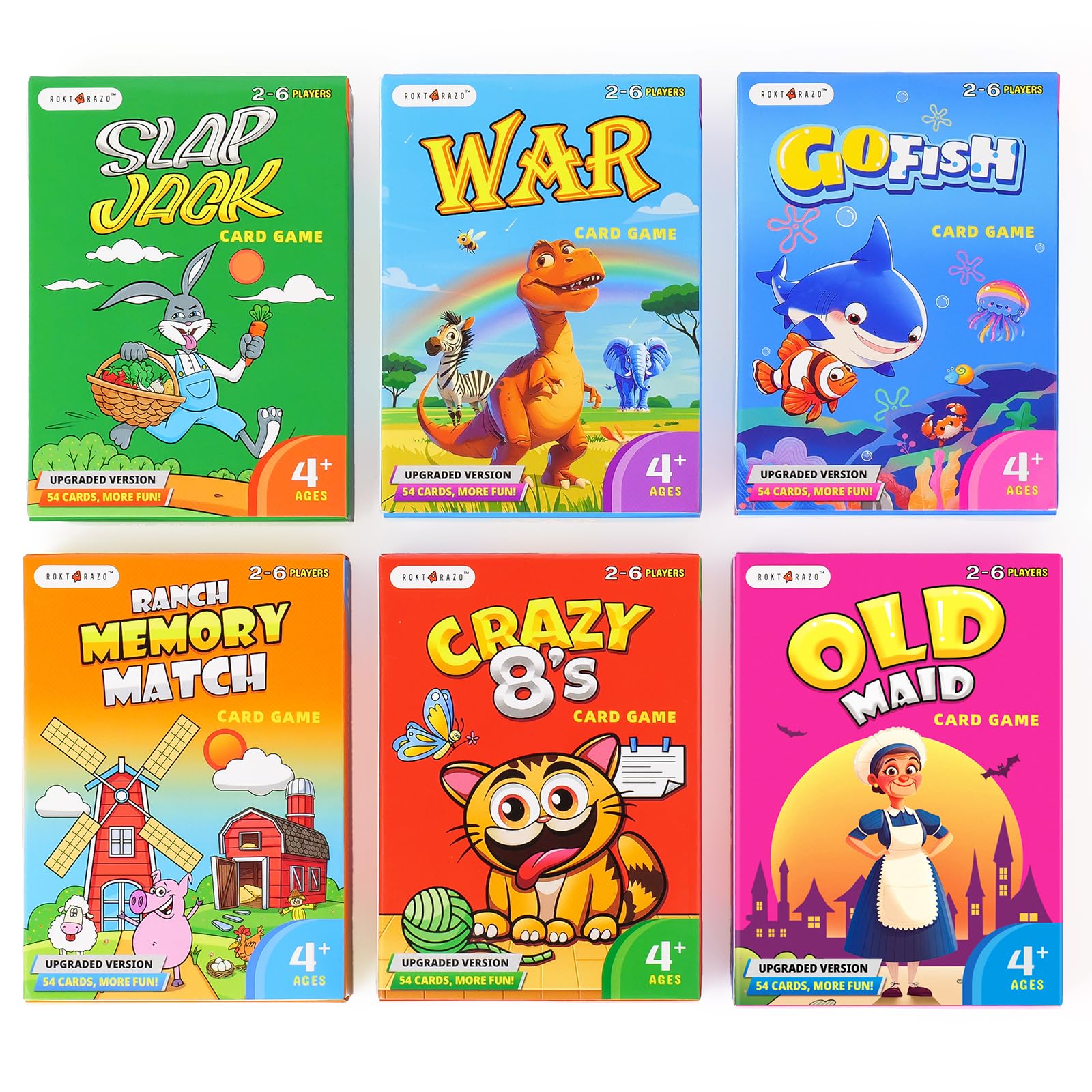
This six-deck set covers the classic childhood card games — Go Fish, Old Maid, Crazy Eights, Memory Match, Slap Jack, and War — with a significant upgrade in card quality. Each deck contains 54 cards printed on 30% thicker coated paper than typical dollar-store decks. The difference is immediately noticeable in hand feel and shuffle smoothness.
The themed artwork is a standout feature. Each deck uses a different illustration style: grassland animals, sea life, vegetables, fruits, occupations, and a mixed theme. This variety serves a dual purpose — it prevents visual boredom and introduces kids to new vocabulary and categories. The “senior versions” included in each deck add function cards that increase complexity for older players, extending the lifespan of games that kids might otherwise outgrow quickly.
Parents should note that the individual packaging for each deck is convenient for travel but creates extra waste. The 420-gram total weight is substantially heavier than a single-deck game, so this is better suited for home use than backpack carry. For families with children aged 4 to 8, this pack delivers the highest breadth of gameplay per dollar of any option here.
Why it’s great
- Six distinct games in one purchase, preventing early burnout
- Thick, coated card stock survives rough handling
- Educational themes reinforce school concepts during play
Good to know
- Individual deck boxes can be messy to store together
- Older kids ages 10+ may find the games too simple
5. Cards Against Humanity

Cards Against Humanity is the game you buy only when every adult in the room understands the content warning. The premise mirrors Apples to Apples: one player reads a black question card, and everyone else submits their funniest white answer card. The judge picks the winner. The 600-card total in version 2.0 provides substantial variety for the first several sessions.
The card quality is functional but not luxurious. The cardboard box serves as storage and is prone to wear at the corners. What matters is the writing — the humor leans heavily into shock value, taboo subjects, and dark comedy. This is not a game for conservative family gatherings or mixed-age parties. In the right crowd, however, it produces legendary moments of uncontrollable laughter that few party games can match.
Replayability is the biggest limitation. Once you have seen the majority of white cards, the shock factor diminishes, and the game becomes predictable. The best approach is to rotate judge responsibilities aggressively and mix in expansion packs when possible. For a single purchase that delivers two to three unforgettable game nights, it is a solid choice for adults only.
Why it’s great
- Instant crowd-pleaser for adults with compatible humor
- Massive card count means hours before repeat combinations
- Extremely simple rules, zero setup time
Good to know
- Absolutely not suitable for children or easily offended adults
- Replay value drops sharply after extended play with the same group
FAQ
What age is appropriate for most family card games?
How many players do I need for a good game night?
Can I play these games with just two players?
Final Thoughts: The Verdict
For most users, the card games for families winner is the magilano SKYJO because it scales effortlessly from 2 to 8 players and balances luck with genuine strategy that works across generations. If you want fast-paced elimination chaos that older kids and teens love, grab the Exploding Kittens Original Edition. And for families with preschoolers who need physical action and zero reading required, nothing beats the Slapburger Card Game.

Mo Maruf
I created WellFizz to bridge the gap between vague wellness advice and actionable solutions. My mission is simple: to decode the research and give you practical tools you can actually use.
Beyond the data, I am a passionate traveler. I believe that stepping away from the screen to explore new environments is essential for mental clarity and physical vitality.