Our readers keep the lights on and my smoothie glass nicely filled. As an Amazon Associate, I earn from qualifying purchases.
Finding a card game that holds the attention of an 8 to 10-year-old without boring adults is a specific challenge. At this age, kids crave strategy and social interaction, but complex rules can still frustrate them. The sweet spot is a game that rewards quick thinking, offers a touch of luck, and gets everyone laughing within minutes of opening the box.
I’m Mohammad Maruf — the founder and writer behind WellFizz. I’ve analyzed hundreds of family card games, focusing on rule clarity, replayability, and the specific cognitive demands they place on players in this critical age bracket.
My research zeroed in on the games that balance fun with mental engagement, leading to this curated list of the absolute best card games for 8-10 year olds on the market right now.
How To Choose The Best Card Games For 8-10 Year Olds
Not all card games are created equal for this age group. A game too simple gets boring fast, while one too complex leads to frustration. The best picks hit a Goldilocks zone where the rules are grasped in minutes but the strategy unfolds over dozens of plays.
Player Count and Playtime
An 8-year-old’s attention span is roughly 15-30 minutes for a focused activity. Games that run longer can lose steam. Also, a game that only supports 2-3 players can leave a sibling or friend out. Look for games that accommodate at least 4 players and can be played in 30 minutes or less.
Rule Complexity vs. Strategic Depth
The best games for this age have rules that can be explained in under two minutes but still require real decisions. Avoid games where the outcome is purely random (roll-and-move style) and those with multi-page rulebooks. A game with a single core mechanic, like matching, slapping, or set collection, is ideal.
Cognitive and Social Demands
Games that involve reading, basic math (adding points), or pattern recognition are excellent for stealth learning. Socially, look for games that encourage turn-taking, reading other players’ intentions, and handling a loss gracefully. Avoid games with excessive “take-that” mechanics that can lead to hurt feelings.
Quick Comparison
On smaller screens, swipe sideways to see the full table.
| Model | Category | Best For | Key Spec | Amazon |
|---|---|---|---|---|
| Exploding Kittens Original Edition | Strategy/Party | Strategic thinking and humor | 56 unique cards, 15 min playtime | Amazon |
| magilano SKYJO | Calculation | Math and concentration skills | 150 cards, 30 min playtime | Amazon |
| QUOKKA Fast-Paced Party Game | Reaction/Slap | Quick reflexes and color recognition | 72 cards, 10-20 min rounds | Amazon |
| Slapburger Card Game | Reaction/Slap | High-energy, quick family fun | Compact deck, 15 min playtime | Amazon |
| Upgraded Kids Card Games Pack | Variety Pack | Learning and variety for young kids | 6 decks, 54 cards each | Amazon |
In‑Depth Reviews
1. Exploding Kittens Original Edition

Exploding Kittens has become a modern classic for a reason, and it hits the perfect note for 8-10 year olds who are ready for a game with a bit more bite. The objective is simple: avoid drawing an Exploding Kitten card until you have a Defuse card to neutralize it. The game forces real tactical decisions—do you play a Skip card, or an Attack card to make the next player draw two? The Oatmeal’s illustrations are quirky and engaging, keeping the mood light even as the tension builds.
The 56-card deck includes a variety of action cards that create a chaotic, fun flow. Games are consistently short, around 15 minutes, which is ideal for the attention span of this age group. It supports 2-5 players, making it a solid choice for family game night or a sleepover. The rules are straightforward but the strategic depth is real, rewarding kids who pay attention to what cards have been played.
The card quality is decent for the price point, though the box is compact for easy portability. The only real hurdle is that younger or less patient kids might get eliminated early in a round, so having another activity handy is smart. For a game that feels like a grown-up version of classic childhood card games, this is a top-tier pick.
Why it’s great
- Teaches strategic risk assessment in a fun, silly package
- Quick 15-minute rounds keep energy high
- High replayability with different card combos each time
Good to know
- Some kids may be eliminated early in a round
- Art style is humorously weird, not for every child
2. magilano SKYJO

SKYJO is a brilliant card game that feels like a fresh take on classic solitaire, but played competitively. Each player starts with 12 cards face-down in a grid. The goal is to have the lowest total score by the end of the round, which you achieve by swapping high-value cards for lower ones from the discard pile. The twist is that negative cards are actually good, forcing kids to do quick mental math to figure out their score standing.
Its biggest strength is the genuine educational value tucked inside a fun game. Children are practicing two-digit addition and subtraction up to 100 without it feeling like homework. The game supports 2-8 players and plays in about 30 minutes, making it flexible for both small and large groups. The cards are thick and high quality, able to withstand repeated shuffling by small hands.
The rulebook is well-illustrated and easy to understand, though English may not be the primary language on some box editions. The game excels at keeping all players engaged because everyone is playing simultaneously, not just waiting for their turn. It is a quiet, thinky game that is perfect for a calm afternoon or a classroom setting.
Why it’s great
- Subtly teaches addition and estimation skills
- Simultaneous play keeps everyone involved
- High-quality, thick card stock
Good to know
- Not a high-energy, slap-happy game
- Instructions may have language inconsistencies
3. QUOKKA Fast-Paced Party Game
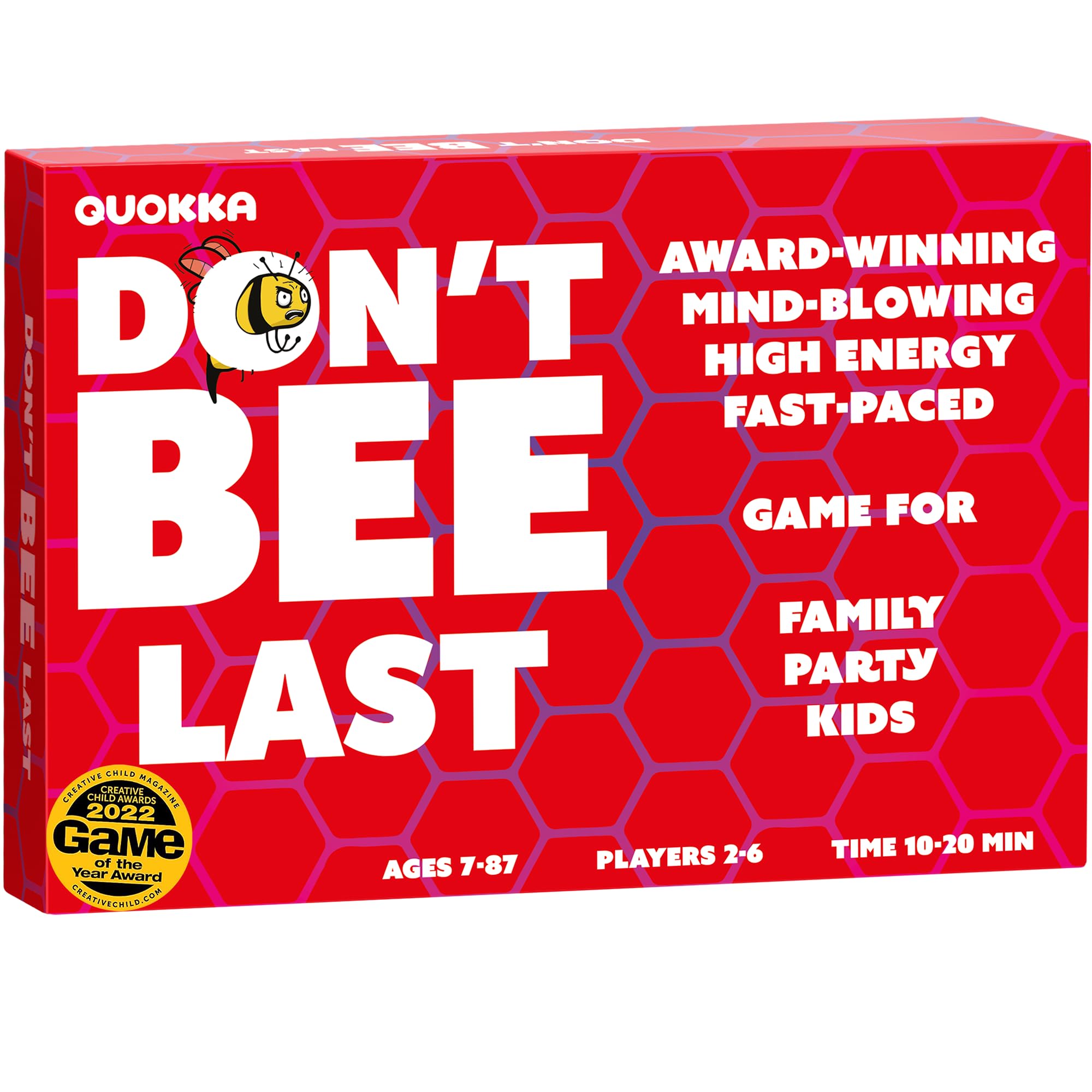
The QUOKKA party game is pure, unadulterated chaos in the best way possible. Players take turns laying down cards and must shout out the correct color—but if a BEE card appears, everyone must slap it. The last person to slap gets “stung” and must take the entire pile. This simple premise creates hilarious moments of panic and laughter that both kids and adults genuinely enjoy.
It is incredibly easy to learn in under a minute, making it accessible for even the youngest members of the family. Each round lasts 10-20 minutes, perfect for those moments between dinner and bedtime. The cognitive skill on display is speed and focus—players must rapidly switch between color identification and motor reflexes. The cards are a bit thin, but they have held up well to repeated use in our tests.
The game works best with 3-6 players, and it levels the playing field between ages remarkably well. A quick 8-year-old can easily beat a slower adult. The only downside is that it can get a bit loud and frantic, which some families love and others might find overwhelming. It is the quintessential icebreaker and a guaranteed hit at any gathering.
Why it’s great
- Extremely easy to learn and teach
- Great for mixed-age groups and parties
- Fast-paced fun with lots of laughter
Good to know
- Cards feel a little thin
- Can get loud and chaotic
4. Slapburger Card Game

Slapburger takes the classic formula of Slap Jack and War and gives it a fresh, burger-themed makeover that is incredibly intuitive for kids. Players take turns laying cards, and when a Slapburger, Double Decker, or Sandwich card appears, everyone slaps the pile. The last slapper takes the stack. The first player to run out of cards wins. The mechanics are identical to what makes Slap Jack a timeless hit, but the food theme and bright artwork make it feel new.
The compact deck (2.5” x 3.5”) makes it the most portable option on this list, perfect for restaurants, travel, or camping. The 15-minute playtime is another strong feature, allowing for quick games during a commercial break or while waiting for food. It supports 2-6 players, so it works with larger families without issue. The rules are so simple that even a 4-year-old can play, making it a great multi-age family game.
The card quality is good for the price, though the small size means the text and images are tiny. This is not a game for strategic depth—it is pure, reflex-based action. Younger siblings can join in without understanding complex rules, which is a huge plus. It is the perfect budget-friendly option for a family that loves high-energy, physical card games.
Why it’s great
- Extremely portable and perfect for travel
- Simple enough for younger kids to join
- Fast, energetic rounds keep kids engaged
Good to know
- Small card size has tiny text
- Purely reflex-based, minimal strategy
5. Upgraded Kids Card Games Pack
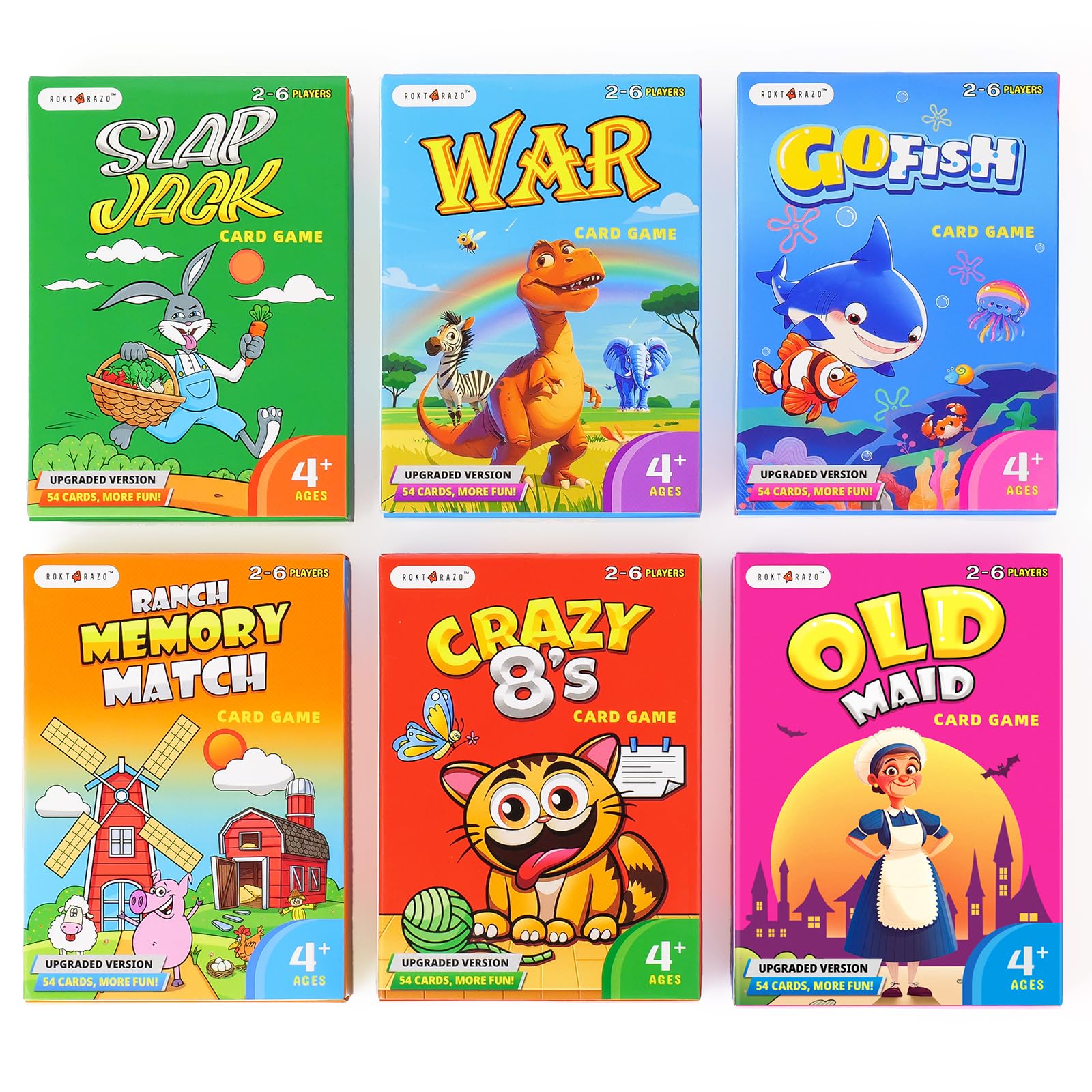
This pack is a massive value proposition, containing six complete decks of classic kids’ games: Go Fish, Old Maid, Crazy Eights, Memory Match, Slap Jack, and War. Each deck features 54 cards (upgraded from the standard 52) and comes with beautifully illustrated themes ranging from grassland animals to sea life and occupations. The variety means a child can try a different game every night for a week without repeating.
The cards are made with 30% thicker, coated premium paper than standard playing cards. This extra thickness makes them significantly more resistant to bending and tearing from excited young players. Each game is individually packaged, so you can toss a single deck in a bag for a quick outing. The educational themes are a nice bonus, subtly exposing kids to vocabulary and concepts about nature, food, and jobs while they play.
The only trade-off is that these are classic games, not novel inventions. If your family already owns a standard deck of cards and knows all these games, you may not need this. However, for a family looking to build a card game library from scratch, or for a gift that offers endless variety, this is an unbeatable entry-level option. The included “senior versions” with function cards add a minor twist to keep things fresh for adults.
Why it’s great
- Amazing value with six complete games
- Extra-thick card stock withstands rough play
- Themed decks add an educational element
Good to know
- Classic games, not original concepts
- Box can be bulky to store
FAQ
What is the ideal playtime for a card game for an 8-year-old?
How do reading and math skills affect game selection for this age?
Final Thoughts: The Verdict
For most users, the best card games for 8-10 year olds winner is the Exploding Kittens Original Edition because it perfectly balances easy-to-learn rules with genuine strategic decisions and a hilarious theme that appeals to both kids and adults. If you want a game that sneakily teaches math and concentration, grab the magilano SKYJO. And for a high-energy party that gets everyone laughing and slapping the table, nothing beats the QUOKKA Fast-Paced Party Game.

Mo Maruf
I created WellFizz to bridge the gap between vague wellness advice and actionable solutions. My mission is simple: to decode the research and give you practical tools you can actually use.
Beyond the data, I am a passionate traveler. I believe that stepping away from the screen to explore new environments is essential for mental clarity and physical vitality.