Our readers keep the lights on and my smoothie glass nicely filled. As an Amazon Associate, I earn from qualifying purchases.
Specs are compiled from manufacturer listings and verified buyer reviews and can change over time — please confirm the key details on the product page before buying.
If you are on well water, you already know the routine: a glass of water from the tap that smells like a struck match, white build-up on every faucet, and the constant worry about what is actually in that clear-looking glass. A standard fridge filter is not built for the load of sediment, iron, and hydrogen sulfide that wells throw at it. You need something that works at the point where the water enters your home — a whole-house carbon filter designed specifically for the high flow and specific contaminants of well water.
I’m Mohammad Maruf — the founder and writer behind WellFizz. This guide is built by comparing the manufacturers’ published specifications and the patterns across verified customer reviews, so you get each pick’s real strengths and trade-offs instead of marketing spin.
Whether you are battling a sulfur stench in the shower or orange staining on your laundry, choosing the right carbon filter for well water means understanding capacity, filter life, and whether the system handles iron and manganese alongside the chlorine.
Our Picks at a Glance
How To Choose The Best Carbon Filter For Well Water
Well water is not all the same. Some wells have high sediment, some are loaded with iron that leaves reddish streaks on tubs, and others smell like a damp basement because of hydrogen sulfide. Match the carbon filter to your well’s specific contaminants—sediment, iron, or hydrogen sulfide. Here are the main things to think about before you buy.
Understand Your Well Water Contaminants
The first step is knowing what you are filtering. If you have the classic sewer-egg smell, hydrogen sulfide is the culprit, and a catalytic carbon filter is your best bet. If you see orange rust stains on sinks and laundry, iron is the issue, and you will need a system with an iron-reduction stage. A basic sediment and carbon filter handles taste and particles, but it will not touch dissolved iron or manganese. A water test kit or a local lab test tells you exactly what your well needs.
Match the System Capacity
Gallon capacity tells you how long the filter media lasts before it needs replacing. A small system rated for 6,000 gallons might work for a small vacation cabin, but a family of four using an average of 300-400 gallons a day will exhaust that in a few weeks. Look for systems with 100,000-gallon capacities or more if you live in the house full-time. The flow rate also matters—a 15-gallon-per-minute system easily handles multiple showers running at once, while a 7-gallon-per-minute unit might leave a weak stream during peak use.
Look at the Number of Stages
A single-stage carbon filter is fine if your main issue is taste and odor and your water is otherwise clear. A two-stage system adds a sediment pre-filter to stop rust and sand before they clog the carbon. Three-stage systems bring in a dedicated iron and manganese reduction cartridge or a catalytic carbon layer. The more stages you have, the longer each filter lasts because the load is split across them.
Consider Installation and Maintenance
Some systems are designed for a confident DIY installer—they come with a bracket, a wrench, and clear instructions. Others are heavy tank-based units that are easier with a helper or a pro. Check the supply line size in your home. Most systems use standard 1-inch NPT ports, but if your home uses 3/4-inch PEX, you might need adapters. Also note whether the system comes with a pressure relief valve and a bypass setup. A bypass valve lets you shut off the filter for cartridge changes without cutting water to the whole house.
Quick Comparison
| Model | Best For | Capacity | Stages | Flow Rate | Amazon |
|---|---|---|---|---|---|
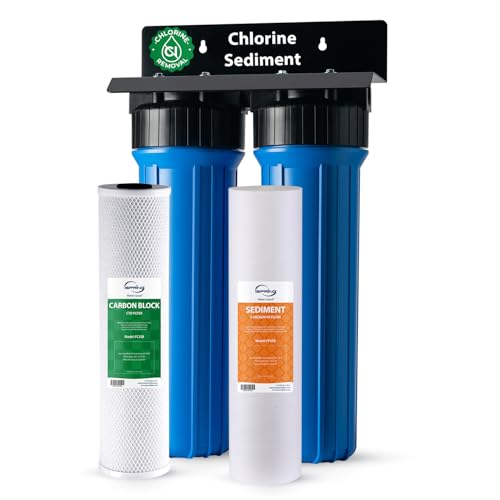
| iSpring WGB22B★ Best Overall | High-volume family home | 100,000 gallons | 2 | 15 GPM | Amazon |
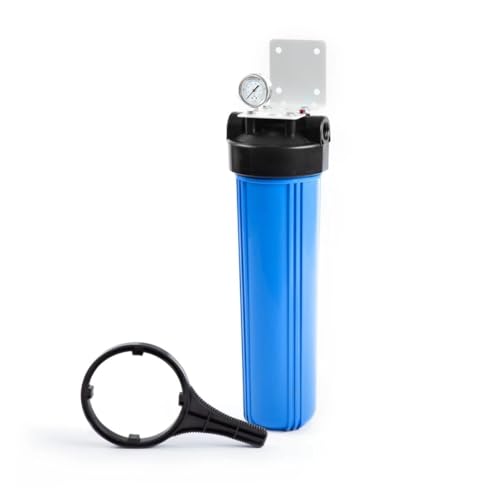
| Aquaboon 20″ x 4.5″Best Value | Budget DIY with high flow | 6000 gallons | 1 | 12+ GPM | Amazon |
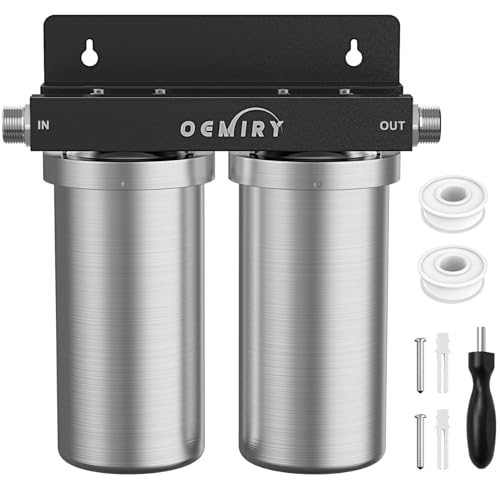
| OEMIRY 2-Stage SSTough Build | Corrosion resistance | 6000 gallons | 2 | 12 GPM | Amazon |
| PUREPLUS 3-Stage | Sulfur odor removal | 30,000 gallons | 3 | — | Amazon |
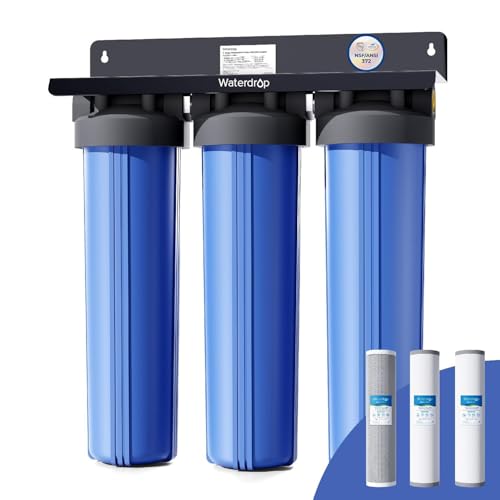
| Waterdrop WHF3T-FG | Iron & manganese reduction | 100,000 gallons | 3 | 15 GPM | Amazon |
| WaterBoss WB-WH-Filter | Ultra-long filter life | 600,000 gallons | 1 | 7 GPM | Amazon |
| HQUA WF3-01 | Heavy metal removal | 100,000 gallons | 3 | 15 GPM | Amazon |
| PRO+AQUA Elite GEN2 | Professional-grade performance | 100,000 gallons | 3 | 15 GPM | Amazon |
| Tier1 Pre-Filled Tank | No-mess, low-maintenance | 450,000 gallons | 1 | 12 GPM | Amazon |
In‑Depth Reviews
1. iSpring WGB22B 2-Stage Whole House Water Filtration System
Our pick — over 4.5★ from 800+ verified ratings; the strongest balance of quality and price.
The top-selling standard-setter that ends itchy skin and sulfur smells for a full year.
This is the system that owners consistently point to when they want clean water from every tap without thinking about it. The crowd favorite — a strong 4.6-star average across 800+ owners — wins on the total package: it is a 2-stage system with a 5-micron sediment pre-filter that catches sand and rust, followed by a high-grade coconut shell carbon block that knocks out chlorine, herbicides, and odors. What wins people over is the quality build — 144 owners single out the sturdy construction — and the straightforward installation that buyers regularly describe as a simple weekend project. The capacity is a standout: 100,000 gallons, which in a normal household translates to filter changes roughly once every 12 months, not every few weeks.
A common thread in the reviews is the transformation in skin and hair. As buyers report, the system “eliminated daughter’s itchy skin and wife’s need for moisturizer; softer hair.” The water runs clear and free of iron taste. The iSpring uses standard 20-inch by 4.5-inch filters, so you are never locked into expensive proprietary cartridges. The package includes a heavy-duty 9-inch filter wrench and double O-ring seals to minimize leak risk.
The Year-Long Champion
- 100,000-gallon capacity means annual filter swaps for most homes
- 5-micron sediment stage protects the carbon block from clogging
- Standard 20×4.5 filters are widely available and budget-friendly
- Lifetime technical support and extended warranty with registration
The Installation Gotcha
- Non-tapered ports need heavy Teflon tape — buyers recommend 10+ wraps
- It weighs 36 pounds.
You want this if: You need a proven, high-capacity system that handles sediment and odor for a busy home without demanding monthly maintenance.
Think twice if: Your water main is buried in a tight crawl space — the 16-by-28-inch footprint plus the weight demands room and a sturdy wall bracket.
2. Aquaboon 20″ x 4.5″ Whole House Well Water Filter System
A surprisingly tough single-stage housing that punches well above its weight class.
Do not let the compact size fool you. The Aquaboon is a reinforced polypropylene housing built for high-flow applications — the 1-inch inlet and outlet ports keep water moving without the pressure drop that smaller housings cause. The thing everyone raves about is the build. The plastic is thicker and darker than the Pentair/Pentek alternative, with better UV resistance, which matters if your setup gets any sunlight. The included oil-filled pressure gauge lets you see at a glance when the filter is clogging. At 10.4 pounds, it is a fraction of the weight of the iSpring, making it entirely manageable for a solo installer.
The catch is the plastic female threads. Multiple owners note that the threads are weak and require careful handling with generous Teflon tape and pipe dope to prevent leaks. One buyer who ran three units in series reported “no leaks at 60 psi” after that careful prep. The system is a single-stage unit, so it relies on whatever cartridge you drop into it — use a good 5-micron carbon block for well water and it works very well, but it does not have a separate sediment pre-filter, so heavy sediment loads will shorten your cartridge life.
The Ideal Backup or First Stage: This is the housing to grab when you want a high-flow, single-stage solution that you can mount in series with other units. It makes an excellent pre-filter for a finer carbon block or a UV light system downstream.
Smart pick if: You have low sediment levels and just need chlorine/odor reduction, and you want to spend your money on the cartridge, not the housing.
Not ideal if: Your well water has visible rust or sand — you need a sediment pre-filter stage upstream, and this unit alone will clog too fast.
3. OEMIRY 2-Stage Stainless Steel Whole House Water Filter
A stainless steel body that laughs at corrosion but lives with a small filter capacity.
If you have ever had a plastic housing crack in the cold or bulge from high pressure, this is the alternative. The OEMIRY is constructed from 304 food-grade stainless steel, and the manufacturer claims it survives a burst pressure of 406 psi — far above what a home well system will ever produce. The 2-stage setup pairs a PP sediment pre-filter with a CTO carbon block for odor and taste improvement. With 1-inch NPT ports and included adapters for 3/4-inch plumbing, it works on both common supply line sizes. It handles a flow rate of 12 GPM.
The main trade-off is the filter size. The OEMIRY uses 10-inch by 4.5-inch cartridges rated for 6,000 gallons, while the iSpring is rated for 100,000 gallons. A family of four on well water will be changing filters every few months, and the cost and availability of those filters is a recurring concern among buyers, who note the filters “are hard to find” and sold primarily by the same manufacturer. The stainless steel itself gets high marks for build quality, but a few owners experienced leaks from the locking ring after several filter changes.
The Corrosion-Proof Specialist: This is the pick for a damp basement, a well house, or any semi-outdoor installation where plastic housings degrade. The stainless build is genuinely impressive, but budget for more frequent cartridge swaps.
Best fit for: A small household (1-2 people) or a seasonal cabin where the 6,000-gallon capacity aligns with light usage.
skip it if: You have a full-time family of four — the filter changes will be too frequent and too expensive.
4. PUREPLUS 20-Inch 3-Stage Whole House Water Filter

The three-stage attack on rotten egg smells that leaves water fresh and clear.
If hydrogen sulfide is the main reason you are reading this, the PUREPLUS system is built for exactly that fight. The first stage is a pleated polypropylene pre-filter that grabs sand and silt. The second stage uses natural coconut activated carbon to strip out chlorine and odors. The third stage is a dedicated iron and manganese reduction cartridge — the component that directly addresses the metallic taste and orange staining that plague well water. The system targets over 52 different impurities according to the manufacturer.
Buyers who successfully installed the system report it “eliminated rotten egg smell from well water” and that water quality is now excellent. The included heavy-duty steel frame gives it a stable, permanent-feeling mount, and the pressure gauges make it easy to see when a cartridge is loading up. The draw back is that the system is rated for indoor installation only, and one owner could not install it at all because their home uses a 1.25-inch main line while the system expects 3/4-inch plumbing. At 30,000 gallons, the capacity sits between the budget 6,000-gallon units and the high-volume 100,000-gallon systems — a reasonable middle ground.
The Sulfur Specialist: If your well water has the classic rotten egg aroma and you want a purpose-built three-stage attack, this is the most direct pick on the list. Just be sure your supply line matches and you have an indoor location ready.
Reach for this if: Rotten egg smell is your primary complaint and you want a dedicated iron-manganese stage that goes beyond basic carbon.
Consider something else if: Your main water pipe is larger than 3/4 inch — you will need a plumber to adapt, and the indoor-only rating may be a hurdle.
5. Waterdrop WHF3T-FG 3-Stage Whole House Water Filter System
The third-party-tested solution that strips iron and manganese right out of the flow.
The Waterdrop is one of the few systems on this list that provides SGS testing numbers for its performance. The manufacturer states it reduces 95.9% of iron and 99.7% of manganese, which is exactly the kind of concrete data buyers need when they have orange-brown stains on their porcelain. The system uses a double iron and manganese removal cartridge alongside a high-quality carbon fiber filter and a GAC (granular activated carbon) stage, calling it “7-stage filtration” across the three physical housings. It is NSF/ANSI 372 certified for lead-free materials and has passed 100,000-plus water hammer tests.
What owners consistently note is that the improvement is immediate. Metallic smell, brown laundry stains, and shower cleaning frequency all drop. The system has a 15 GPM flow rate, which keeps pressure solid even with a shower and a washing machine running. The downside is maintenance frequency. The iron and manganese cartridge needs changing every 6 to 12 months, and the GAC filter at 12 months. That means you will be buying replacement cartridges every 6-12 months, while the iSpring requires an annual swap., and the cost adds up.
The Lab-Proven Workhorse
- SGS-tested 95.9% iron removal — not just a marketing claim
- 100,000-gallon total capacity across the three stages
- NSF/ANSI 372 certified for lead-free materials adds confidence
- Owners call it a bargain vs. – professional bids
The Replacement Reality
- Filter changes every 6-12 months mean more ongoing expense and effort
- At 49 pounds, it is the heaviest multi-stage system here
Your system if: You have tested your well water and know iron and manganese are the problem. The verified reduction numbers make this a scientifically-backed choice.
Not the one if: You want a low-maintenance system with annual maintenance only — the more frequent cartridge swaps here demand more attention.
6. WaterBoss Whole House Water Filter WB-WH-Filter
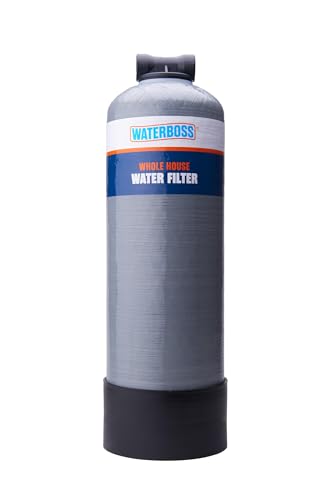
The tank-style system that filters for six years before you touch it again.
The WaterBoss looks different from the rest because it is a tank, not a set of canisters. Inside is 600,000 gallons of filtration capacity, compared to the iSpring’s 100,000 gallons and the Waterdrop’s 100,000 gallons. The manufacturer claims a filter life cycle of 6 years, meaning the internal media lasts 6 years before needing replacement. It is certified to NSF/ANSI Standard 42 for removing 96.9% of chlorine, taste, and odor. The whole unit is designed and assembled in the USA, which resonates with buyers who prefer domestic manufacturing.
The tank is fiberglass and stands 27 inches tall with an 8.75-inch diameter, so it has a relatively small footprint. The flow rate is 7 GPM, which is lower than the 12-15 GPM of the canister systems. That is fine for a single shower or sequential use but could be a bottleneck if you are trying to run two showers and a dishwasher at the same time. Owners mention that the water smells and tastes better immediately, and several note that it handles sediment well for a non-backwashing design. The unit is single-use in the sense that the tank itself is sealed; when the media is exhausted after roughly 600,000 gallons, you replace the whole tank or have it refilled professionally.
The Low-Maintenance Giant: If you hate changing filter cartridges and want a system that works for years without touching it, the WaterBoss is the simplest path. Just confirm your water pressure and supply line size match the 3/8-inch fitting requirement.
Best for: People who want six years of uninterrupted filtration without buying replacement cartridges every few months.
pass on it if: You have high iron or manganese levels — the WaterBoss is primarily a chlorine/odor carbon filter and does not have a dedicated iron reduction stage.
7. HQUA WF3-01 3-Stage Whole House Water Filtration System

A heavy-duty three-canister system with gadgetry that tracks filter life for you.
The HQUA WF3-01 is packed with convenience features that make maintenance feel less like a chore. Each of the three Big Blue 20-inch by 5.5-inch housings has its own pressure relief valve, a drain valve, and a built-in 180-day countdown timer that tells you exactly how many days remain on that cartridge. The system includes a compound GAC+KDF filter dedicated to reducing lead, mercury, arsenic, cadmium, and chromium — a strong selling point if your well water has heavy metal concerns. The flow rate is 15 GPM, so there is no pressure loss from the filtration.
Quality is the aspect that owners praise most — 37 of them single it out. The brass threads are a recurring point of praise because they prevent the leaks that plastic threads can cause. The package goes above and beyond: oil-filled pressure gauges, a long brush for cleaning the inside of the housings, extra gaskets, and adapters for both 3/4-inch and 1-inch NPT. The assembly is heavy at 44 pounds, and the 28-inch height demands decent clearance. A small number of owners (12) flagged leakage as a negative, but most of those resolved with careful Teflon tape application or by adding the second O-ring that a few units initially seemed to miss.
The Set-and-Track System: If you want a system that reminds you when to swap filters and includes every accessory you might need, this is the most complete package on the list. The heavy metal reduction is a meaningful bonus for wells near old mining or industrial areas.
Ideal for: The organized homeowner who wants timers, gauges, and a cleaning brush all in one box — and needs lead/mercury reduction from their well water.
Not for: Tight installation spaces — the three 20-inch canisters plus the bracket need a wall area roughly 22 inches wide and 28 inches high.
8. PRO+AQUA Elite Series GEN2 PRO-100-E 3-Stage System
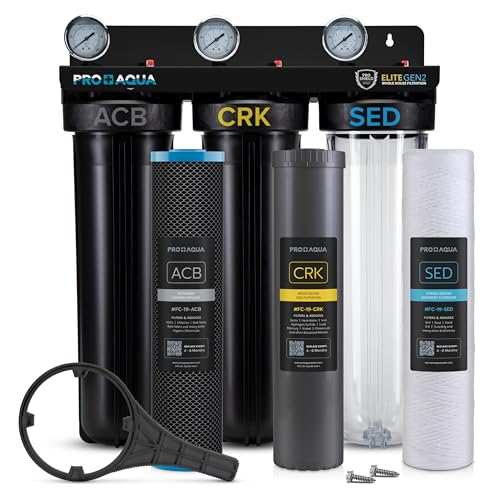
A professional-grade three-stage system designed for households that want to eliminate heavy metals and sulfur smells.
The PRO+AQUA Elite GEN2 is targeted at homes with 1 to 3 bathrooms and works on both well water and city water. The three stages are specifically engineered for well water’s toughest contaminants. Stage 1 is a clear sediment housing that captures rust, silt, and dirt. Stage 2 uses a proprietary CRK filter that blends media to reduce lead, iron, mercury, nickel, chromium, and hydrogen sulfide. Stage 3 is an activated coconut shell carbon filter that pulls out chlorine, VOCs, and pesticides down to 5 microns. The system includes stainless steel pressure gauges and industry-standard pipe threading components. At 50 pounds and requiring a professional install according to the manufacturer, this is not a casual weekend project.
Owners who had it installed report a dramatic improvement. The “water tastes like bottled water, skin feels better after shower” is a typical consensus. It removes chlorine taste and sulfur odor immediately. The high flow rate of 15 GPM keeps pressure strong even in larger homes. The main downsides are the professional-grade price and the fact that replacement filters cost more and need swapping roughly every six months. One owner noted it did lower their water pressure slightly, though most found it negligible.
The Serious Upgrade: This feels and performs like a system a plumber would spec for a custom home. The 5-year manufacturer warranty and lifetime U.S. tech support are genuine peace-of-mint additions that budget systems lack.
Right for you if: You want the highest assurance of quality for heavy metal and sulfur removal, and you are comfortable with a pro handling the installation.
Think twice if: You plan to DIY the install — the spec sheet recommends professional installation, and the 50-pound weight plus the need for precise threading make it a tough solo job.
9. Tier1 Whole House Water Filter System
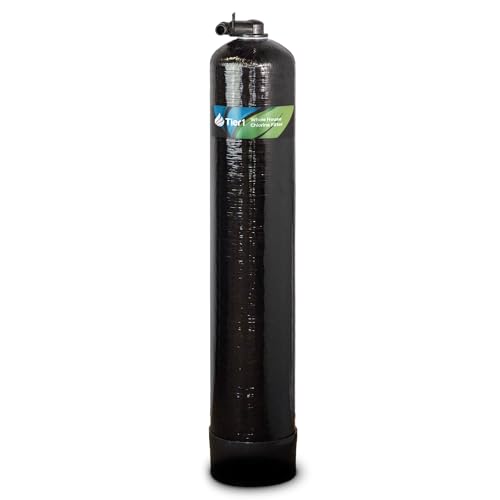
The pre-filled tank system that arrives ready to plumb in with zero media handling.
The Tier1 is for the buyer who wants tank-level capacity without the mess of filling a tank yourself. It arrives pre-loaded with 1 cubic foot of acid-washed coconut shell catalytic carbon media, certified to NSF/ANSI 42. The capacity is 450,000 gallons, which is massive — second only to the WaterBoss on this list. The upflow design uses no backwashing, no electricity, and no drainage, which simplifies installation enormously. At 65 pounds, it is the heaviest unit here, but that weight is all in the media and the tank wall.
Buyers describe the installation as straightforward and love the clear improvement in water quality, with one noting that chlorine outlet measured at 0.0 ppm after installation. The 10-year limited warranty from Tier1 adds long-term confidence. The downside is that this is a single-stage carbon filter. It handles chlorine, VOCs, and taste/odor very well, but it does not have a dedicated sediment stage or iron/manganese reduction media. If your well has visible rust or iron bacteria, you will need a pre-filter upstream. A few owners also reported a cracked head on arrival — quickly resolved by Amazon — and one noted a higher flow loss than expected, with 100 psi at the inlet dropping to roughly 40 psi between filters.
The No-Fuss Tank: If your water issues are chlorine taste and general odor, and you do not want to deal with loose carbon or filter changes for years, the Tier1 delivers that. Just flush it thoroughly before connecting to your house.
Grab this if: You want the longest possible interval between media replacements and a clean, pre-filled setup that does not require backwashing or electricity.
Pass if: Your well water has visible sediment, high iron, or hydrogen sulfide — you will need additional stages to handle those.
Understanding the Specs
Gallon Capacity and Filter Life
This is the total number of gallons a filter cartridge or media tank can treat before it needs replacing. A small 6,000-gallon system works for a seasonal cabin, while 100,000 gallons covers a family of four for roughly one year. The 450,000-gallon units can last multiple years. Look at your household daily water use — a typical person uses 80-100 gallons per day — and divide the capacity by that number to get the approximate lifespan. The “filter life cycle” or “years” spec is an estimate based on average use, so if you have a large family or heavy water usage, you will replace filters sooner.
Flow Rate Measured in GPM
Flow rate (gallons per minute, or GPM) tells you how fast filtered water can come out of the pipes. A low flow rate like 7 GPM means the system may struggle if you run two showers, a washing machine, and a toilet flush all at once. A high flow rate of 15 GPM can handle multiple simultaneous demands in a busy household. The trade-off is that high-flow systems often have larger housings and pricier cartridges. For most homes, a 10-12 GPM system is a comfortable balance.
Number of Filtration Stages
A single-stage system passes water through one type of media, typically carbon. A 2-stage system adds a sediment pre-filter that catches rust and sand before the carbon. A 3-stage system usually includes a dedicated iron, manganese, or heavy metal reduction layer in addition to the sediment and carbon stages. More stages mean better protection for the carbon filter (it does not clog with sediment as fast) and the ability to target specific well water contaminants like hydrogen sulfide or lead. The downside is more points where leaks could occur and more cartridges to buy.
Certifications and Material Safety
Certifications like NSF/ANSI 42 mean the system has been tested to reduce chlorine, taste, and odor. NSF/ANSI 372 certifies the materials are lead-free. SGS testing (like the Waterdrop system) applies to a specific claim like iron reduction. Certifications matter because they confirm the manufacturer’s claims are backed by lab testing. For well water specifically, look for systems that mention iron, manganese, or heavy metal reduction in their certification scope — not just basic chlorine reduction.
FAQ
Will a standard carbon filter remove the rotten egg smell from my well water?
How often do I need to change the filter cartridges?
Can I install these systems myself, or do I need a plumber?
Will a carbon filter reduce the iron and manganese in my well water?
What does “5-micron” filtration mean for well water?
Do I need a whole-house system or just an under-sink filter?
What size pipes do these systems connect to?
How do I know when to replace the carbon filter media?
Can I run these filters outside or in an unheated well house?
Final Thoughts: The Verdict
For most well water households, the carbon filter for well water that balances performance, capacity, and value is the iSpring WGB22B. Its 100,000-gallon capacity, standard filter sizing, and proven owner satisfaction make it the one to buy if you want a single system that handles sediment and odor for a year with minimal fuss. If iron and manganese are staining your fixtures, the Waterdrop WHF3T-FG brings verified third-party reduction numbers that the iSpring cannot match. And for pure long-term simplicity, the WaterBoss WB-WH-Filter offers six years of filtration in one tank install — just confirm your supply line works with its 3/8-inch fittings. Whichever you choose, test your well water first and match the system’s capabilities to your specific contaminants.
How We Picked
We do not accept paid placement. Every pick is matched to a real buyer and a real use-case; we do not hands-on test units.
Sources & Methodology
Specifications: manufacturer listings and product documentation. Review insights: verified customer reviews, as of July 2026. Pricing: not shown on this page (it changes often); check the current price via the retailer link.
As an Amazon Associate, WellFizz earns from qualifying purchases. This does not affect which products we feature.
Related Guides

Mo Maruf
I created WellFizz to bridge the gap between vague wellness advice and actionable solutions. My mission is simple: to decode the research and give you practical tools you can actually use.
Beyond the data, I am a passionate traveler. I believe that stepping away from the screen to explore new environments is essential for mental clarity and physical vitality.