Our readers keep the lights on and my smoothie glass nicely filled. As an Amazon Associate, I earn from qualifying purchases.
Hallux rigidus turns every step into a painful reminder that your big toe has lost its range of motion. The standard fix from specialists — limit that motion at the source — relies on an exceptionally stiff, thin, and durable material. Carbon fiber insoles work by preventing the toe joint from bending during the push-off phase of your gait, effectively acting as a mechanical brake on the painful articulation. Without that rigid barrier, the bone-on-bone grinding continues, inflammation flares, and walking becomes a carefully negotiated limp.
I’m Mohammad Maruf — the founder and writer behind WellFizz. My research focuses on the measurable physical specs (material thickness, flex modulus, and layup construction) that determine whether a thin plate of woven composite actually solves a structural foot problem or just adds a layer of discomfort.
The right insert must balance total stiffness with the ability to fit inside your existing footwear without raising your heel too much. This guide evaluates the top contenders to help you find the best carbon fiber insoles for hallux rigidus based on real-world performance and verified user outcomes.
How To Choose The Best Carbon Fiber Insoles For Hallux Rigidus
Not every rigid insole treats hallux rigidus equally. Some are pure carbon plates that sit under your existing insole, while others are full-length orthotics with an embedded plate. The wrong choice can cause ball-of-foot pain or create pressure points that make the condition worse. Focus on these four factors to narrow the field.
Material Construction: Pure 3K Carbon vs. Composite Blends
Genuine 3K twill carbon fiber offers the best stiffness-to-weight ratio for this application. A pure carbon plate (1.2mm to 1.6mm thick) provides the rigid Morton’s Extension needed to block big-toe dorsiflexion. Lower-cost inserts often use a carbon-fiber-reinforced polymer that flexes under load — those won’t stop the painful joint movement. Look for explicit “3K carbon fiber” or “aerospace-grade carbon” in the product specs.
Thickness and Insole Clearance
A standard carbon plate is 1.2mm to 1.6mm thick. That thinness is critical because you typically place it underneath your shoe’s removable insole. Stacking too much thickness raises your heel and disrupts gait. Thinner plates (1.0–1.2mm) fit more shoe types but may be too flexible for heavier users. Thicker plates (1.6mm) deliver maximal stiffness but limit shoe choices and may cause pressure under the metatarsal heads.
Sizing Precision — The 1cm Rule
Carbon fiber insoles cannot be trimmed like foam or gel inserts. Cutting a carbon plate compromises its structural integrity. The universal sizing rule: the insert must be ¼ to ½ inch (roughly 1cm) shorter than your shoe’s removable insole. If you are between sizes, always round down. A plate that is too long will buckle or push against the toe box; one that is too short loses the rigid extension under the toe joint.
Arch Support vs. Flat Plate Design
Hallux rigidus treatment requires a flat, rigid surface under the forefoot to block toe bending. Some products add a contoured arch support, which can benefit users with concurrent flat feet or overpronation, but a contoured arch may prevent the plate from sitting flat in shoes with a curved footbed. If your shoe has a neutral or low arch, a flat reversible plate typically works best. If you need arch correction, consider a full orthotic with an embedded carbon plate.
Quick Comparison
On smaller screens, swipe sideways to see the full table.
| Model | Category | Best For | Key Spec | Amazon |
|---|---|---|---|---|
| EstCarbon 2-Pack (B09QSWWCNR) | Premium Pair | High-performance athletes & daily wear | 1.6mm 3K carbon, 100,000-bend certified | Amazon |
| PowerStep Morton’s Extension (B0DN3WDZSW) | Cushioned Orthotic | All-day walking & arch support | Dual-layer cushion + carbon stability plate | Amazon |
| Morton´s Extension Orthotic (B0B492T26P) | Premium Pair | Golf & long-distance walking | 100% 3K carbon, left/right specific | Amazon |
| Sumiwish High Arch (B0CTJCCSFV) | Mid-Range Pair | Cuttable sizing & factory-floor standing | 1.0mm carbon with arch support, cuttable | Amazon |
| MRTHN Carbon Insole (B0BY5XKZ78) | Mid-Range Pair | Starting point for hallux rigidus relief | Flat design, sold as pair, ultra-thin | Amazon |
| EstCarbon Single (B08XZNM8YF) | Single Plate | Single-foot support or backup insert | 1.6mm 3K twill, reversible | Amazon |
| BlackCarbon Flat Pair (B09N6PLTDF) | Budget Pair | Light activity & testing the concept | 1.2mm pure carbon, matte finish | Amazon |
In‑Depth Reviews
1. EstCarbon Performance 2-Pack (B09QSWWCNR)
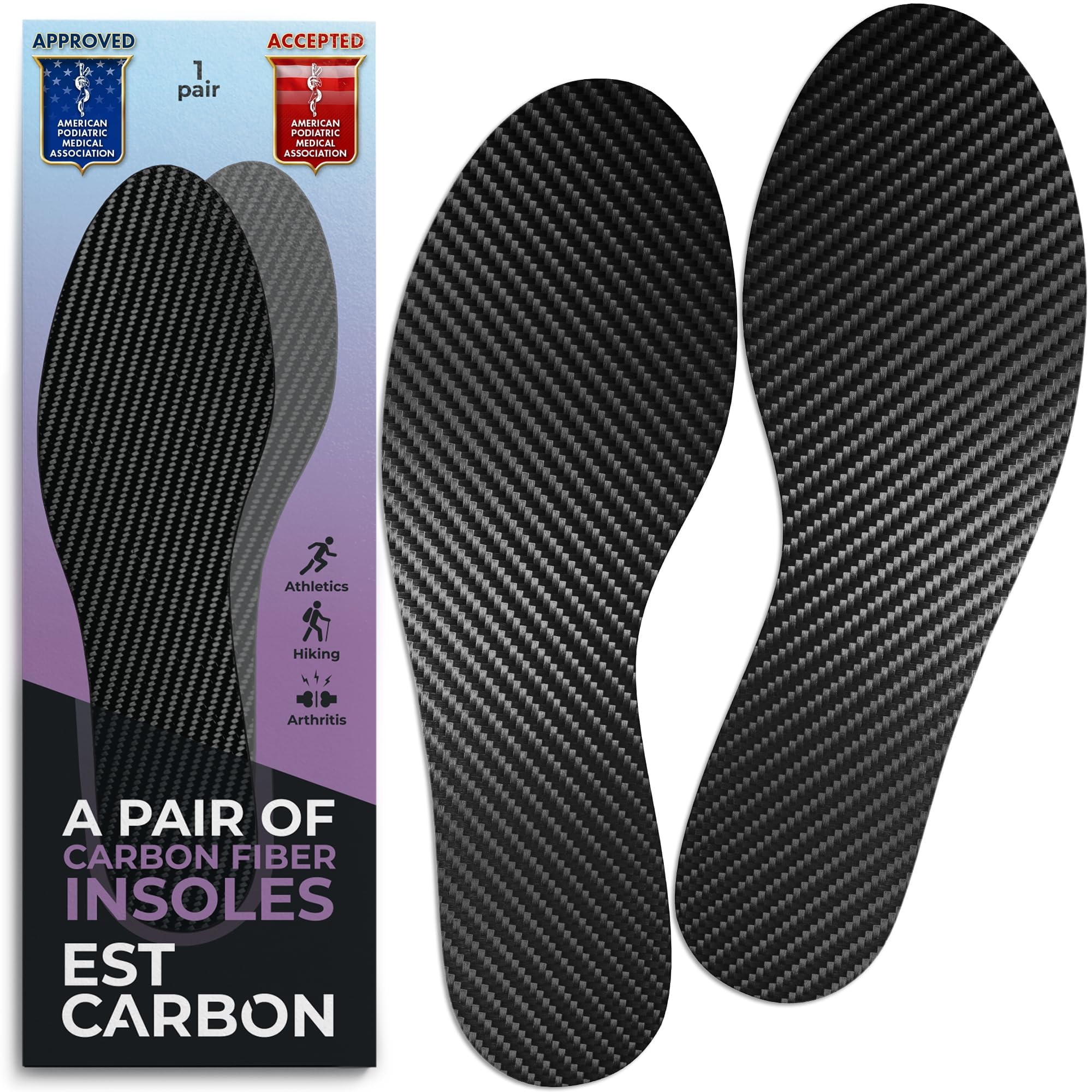
EstCarbon’s two-piece set delivers the stiffest plate in this lineup at 1.6mm thick, using true 3K twill carbon that has been endurance-certified for 100,000 bends. That rating matters for hallux rigidus because a plate that develops micro-cracks after a few weeks of walking loses its therapeutic stiffness. Multiple verified buyers report pain reduction between 80 and 90 percent within the first week, with one user walking 3-mile beach routes with halved pain after just one day. The flat, thin profile fits under the existing insole of most athletic shoes without raising the heel enough to alter gait.
It is sold as a pair, which is helpful if both feet need support (common with symmetrical osteoarthritis) or if you want a backup for the opposite shoe. The recommended sizing rule — order half a size smaller if unsure — matches the industry standard, and the 1.6mm thickness provides enough rigidity to stop dorsiflexion even for heavier users around 200 pounds. A small number of buyers found the plate too stiff for ultra-minimalist shoes like Converse or Vans, where the lack of a cushioned midsole transfers the hardness directly to the ground.
One verified reviewer described walking with these as “like walking on plates of steel,” which captures both the benefit (total motion restriction) and the downside (no shock absorption). For the hallux rigidus sufferer who needs a no-compromise motion blocker and is willing to pair it with a cushioned insole or shoe with midsole foam, this is the most reliable option tested.
Why it’s great
- Exceptional 100,000-bend fatigue rating ensures long-term stiffness retention.
- Sold as pair, reducing per-unit cost compared to single-plate brands.
- Thin enough (1.6mm) to fit under stock insoles in most sneakers and hiking boots.
Good to know
- Too rigid for very flat minimalist shoes without additional midsole cushioning.
- No built-in arch support; requires a shoe with neutral or low arch.
- A few users found the plate too stiff for casual walking on hard tile floors.
2. PowerStep Morton’s Extension (B0DN3WDZSW)

PowerStep takes a different approach from the raw carbon plate: this is a full-length orthotic with an embedded carbon fiber stability plate, combined with dual-layer cushioning and a contoured heel cradle. The carbon plate runs the full length of the insole to limit big-toe movement, but the top layer adds premium cushioning from heel to toe with moisture-wicking fabric. Verified users report that it fits the Hoka Arahi 8 without trimming, which is a strong indicator of dimensional accuracy. One 76-year-old user described it as enabling steep daily walks that had become impossible due to hallux rigidus pain.
The firm arch support is a double-edged sword for this category. It helps users with concurrent overpronation or plantar fasciitis, but the contoured shape may prevent the insole from laying flat in shoes that already have a pronounced arch built in. The dual-layer cushion, however, solves the “walking on concrete” complaint that surfaces with pure carbon plates — the foam layer absorbs impact before the carbon plate locks the toe. Made in the USA, it carries a premium price but consistently undercuts custom orthotics by a wide margin.
Reviewers note a required break-in period, with one user needing to loosen laces during the first week. The carbon plate does not extend quite as far under the toes as some standalone Morton’s Extension plates, so users with severe hallux rigidus (bone spurs limiting flexion to under 20 degrees) should verify the plate reaches the distal phalanx. For daily walkers who need both toe immobilization and arch correction, this is the most complete ready-to-wear option.
Why it’s great
- Combines carbon plate stiffness with dual-layer cushioning for impact absorption.
- Contoured arch support helps users with concurrent pronation or flat feet.
- Fit-tested in popular brands like Hoka without requiring trimming.
Good to know
- Requires a break-in period; may feel stiff initially.
- Contoured arch may not sit flush in shoes with high built-in arch support.
- Premium price point, though still below custom orthotics.
3. Morton´s Extension Orthotic Pair (B0B492T26P)
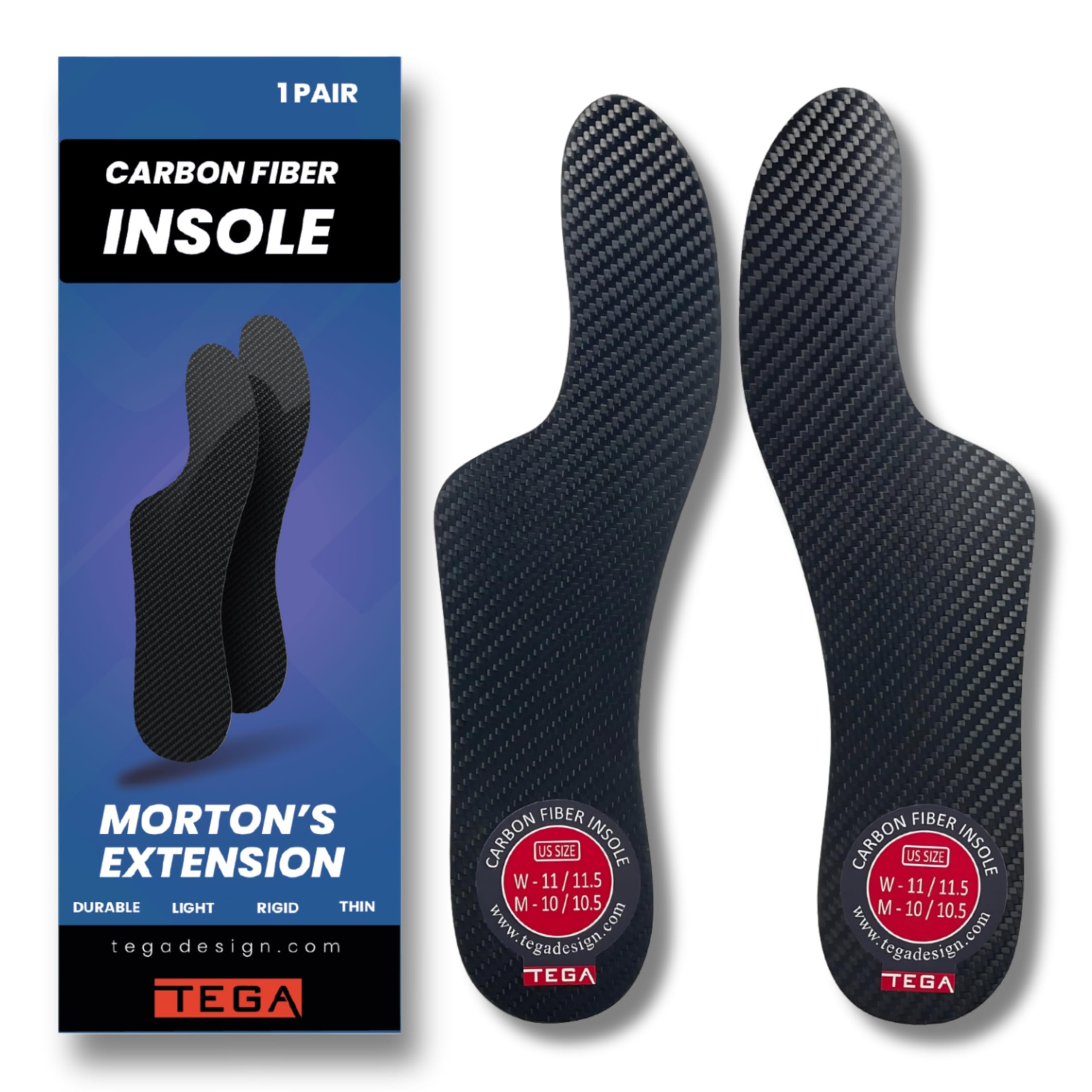
This pair from Tega Design is built around a true Morton’s Extension principle: a full-length 3K carbon fiber plate that extends under the entire foot, with a specific left and right shape that mirrors the natural asymmetry of human feet. The 1.6mm thickness puts it in the stiffest tier of plates tested, and the mirror-set design allows users to place both plates in a single shoe if additional stiffness is needed. Verified users report an 80% reduction in hallux limitus pain versus custom orthotics, with one golfer walking 18 holes pain-free for the first time in years.
The sizing system requires measuring your shoe’s removable insole length in inches and matching it to a size chart. This precision eliminates the sizing guesswork that plagues single-size-fits-most plates. However, multiple reviewers caution that the plate does not lay flat in shoes with a rocker sole (common in brands like Topo) or in cycling shoes with a pronounced built-in arch. The sharp edges of the carbon cut can also dig into the side of the shoe if the plate is slightly too wide for the footbed.
One durability complaint surfaced after extended use: the end of the plate broke and flaked, causing sharp pain under the metatarsal heads. This suggests the epoxy matrix at the edge may be vulnerable to shear stress in shoes that flex at the toe break. For most users with standard sneakers or hiking boots, the relief is dramatic and immediate. The 3K weave provides a balance of stiffness and weight that is hard to beat at this price point.
Why it’s great
- Left/right specific shaping improves fit and prevents shifting.
- Full-length rigid support blocks toe bending across the entire gait cycle.
- Mirror set design enables double-stacking for maximum stiffness.
Good to know
- Does not sit flat in rocker-sole shoes or those with high built-in arches.
- Carbon edges can be sharp and may abrade shoe lining over time.
- Some reports of edge delamination after extended use in high-flex shoes.
4. Sumiwish High Arch Carbon Insole (B0CTJCCSFV)

Sumiwish’s offering stands out for two reasons: it is one of the only carbon insoles in this price range that is designed to be cuttable, and it includes a built-in high arch support. The carbon plate thickness is 1.0mm — thinner than the 1.6mm EstCarbon plates — which makes it easier to fit into tighter shoes and reduces the chance of heel lift. The cuttable nature is a major advantage for users whose shoe size falls between standard increments; the carbon composite can be trimmed with heavy scissors without compromising the rigid structure too much, though you lose some stiffness at the cut edge.
Verified users report excellent results for hallux rigidus, with one buyer preferring these over a doctor-recommended insert. The high arch support is genuine and works well for users who stand on concrete floors for 10-hour shifts, as it maintains foot posture while the carbon plate blocks toe bending. However, the top silky fabric layer is not bonded strongly to the carbon base — multiple reviews mention peeling starting within the first few uses. After about a year, the heel fabric can wear away, exposing a green foam layer that eventually degrades.
A persistent complaint is noise: the carbon plate against the shoe’s midsole produces a squeak in quiet environments like offices or libraries. The squeak stems from the smooth carbon surface rubbing against the foam insole above it — a problem that can be mitigated by applying a thin layer of moleskin or silicone spray to the bottom of the plate. For the price and the inclusion of a high arch, this is a strong contender for users who want both toe immobilization and arch correction without paying for a custom orthotic.
Why it’s great
- Cuttable design allows sizing adjustment for non-standard shoe sizes.
- Built-in high arch support helps users with flat feet or overpronation.
- Very thin profile (1.0mm) fits into tighter dress shoes and low-profile sneakers.
Good to know
- Top fabric layer can peel within the first few weeks of use.
- Produces audible squeaking when walking on hard surfaces.
- Heel fabric may wear down over extended use, exposing foam core.
5. MRTHN Carbon Insole Pair (B0BY5XKZ78)

MRTHN’s carbon insoles are positioned as an entry-to-mid-level pair for those seeking hallux rigidus relief without the premium price. They are sold as a pair, which the manufacturer emphasizes is important because using a single carbon plate on one foot can create gait imbalances over time. The plate is flat, ultra-thin, and designed to sit under the existing insole. Verified users report that the insoles allowed them to resume calisthenics and hiking without the joint inflammation that had previously forced them to avoid exercise.
The thinness of the plate is both a strength and a limitation. It slides easily into most shoes without raising the heel, including gym sneakers, casual boots, and cycling shoes. However, several reviewers note that the plate feels “rather hard” underneath the ball of the foot and does not work well for running without added cushioning. One podiatrist-recommended user found that the insert works best in shoes with a firm, non-flexible sole — essentially, the shoe itself must be stiff enough to support the plate’s function.
Size selection is critical here: the insert cannot be cut, and ordering the wrong size means starting over. The size chart is specific to insole length rather than shoe size, which is more accurate but requires you to pull the insole from your shoe and measure it. For a straightforward, no-frills carbon plate that stops toe bending without adding bulk, the MRHTHN pair is a reliable starting point that podiatrists have recommended in verified reviews.
Why it’s great
- Sold as a pair, reducing the risk of gait imbalance from single-foot use.
- Ultra-thin profile fits into most athletic shoes, boots, and casual footwear.
- Podiatrist-recommended in multiple verified customer reviews.
Good to know
- Too hard for running; best paired with a cushioned shoe or additional insole.
- Not cuttable; precise sizing measurement is essential before purchase.
- Flat design lacks any arch contouring for users who need arch support.
6. EstCarbon Single Morton’s Extension (B08XZNM8YF)

This is the single-plate variant from EstCarbon, built with the same 1.6mm 3K twill carbon construction as the two-pack but sold individually. That makes it an ideal choice for users with unilateral hallux rigidus who only need support on one foot, or for those who want to test the therapy before committing to a pair. The plate is reversible, meaning it can be used on either foot with the same effect. Verified users report that it significantly reduced hallux rigidus pain during 3–10 mile daily walks, with one reviewer walking over 3 miles on an incline with zero toe pain after inserting the plate.
The 1.6mm thickness provides the same stiffness as the two-pack version, making it equally effective at blocking dorsiflexion. However, the single-purchase model means you pay a higher per-plate cost compared to buying the pair. The sizing follows the same 1cm-shorter-than-insole rule, and the plate should sit under the removable insole — never directly under the foot. Several reviewers note that the insert can cause squeaking as it rubs against the shoe’s insole, a common complaint with raw carbon plates that lack a fabric backing.
A minority of users had difficulty getting the plate to lie flat in shoes with curved footbeds. One reviewer reported that the insert created space under the toe joint, actually increasing pain. This highlights the importance of checking whether your shoe’s footbed is flat enough to accommodate a rigid carbon sheet. For single-foot relief at a lower upfront cost than a pair, this EstCarbon plate delivers the same raw stiffness as its premium sibling.
Why it’s great
- Same 1.6mm 3K carbon construction as the premium EstCarbon pair.
- Reversible design allows use on either foot.
- Proven pain reduction for high-mileage walkers and hikers.
Good to know
- Higher per-plate cost than buying the two-pack.
- May not lay flat in shoes with curved or rocker footbeds.
- Can produce squeaking due to carbon-on-foam friction.
7. BlackCarbon Flat Pair (B09N6PLTDF)

BlackCarbon’s pair is the most affordable entry point in this guide, making it a low-risk option for users who are uncertain whether a carbon plate will help their specific hallux rigidus symptoms. The plates are 1.2mm thick, slightly thinner than the premium 1.6mm options, which makes them easier to fit into shoes with limited clearance but also slightly less stiff. The matte surface finish reduces glare and feels less slick against an insole than glossy carbon, which helps with positioning stability.
Verified user outcomes are mixed in a way that is instructive for this category. One reviewer reported that the insole “cured second-toe capsulitis pain within minutes” when placed under the insole of a New Balance shoe, describing it as a game-changer. Another found that it helped hallux limitus but caused ball-of-foot pain after an hour of walking — a common complaint when a thin plate concentrates pressure under the metatarsal heads without enough shoe cushioning. A third reviewer, who wanted to use the insoles as a post-walking-boot stiffener, found the pair too flimsy and needed to double-stack them to achieve sufficient rigidity.
This inconsistency in stiffness perception is the key limitation: for lighter users (under 170 pounds) with mild hallux rigidus, the 1.2mm plate may provide enough motion restriction. For heavier individuals or those with advanced bone spurs, the plate may flex too much during push-off. The pair is sold as 2 pieces, and each weighs only 3.21 ounces including packaging, reflecting the lightweight nature of the thinner carbon layup. As an affordable trial product, it serves its purpose, but most users with confirmed hallux rigidus will likely outgrow it in stiffness demands.
Why it’s great
- Most affordable entry point for testing carbon plate therapy.
- Matte finish reduces slipping against the shoe’s insole.
- Works well in cushioned shoes for users with mild stiffening needs.
Good to know
- 1.2mm thickness may lack stiffness for heavier users or advanced hallux rigidus.
- Can cause metatarsal head pain if shoe lacks sufficient midsole cushioning.
- Some users found it too flexible for post-injury immobilization needs.
FAQ
Can I cut a carbon fiber insole to fit my shoe better?
Should I wear the carbon plate directly under my foot or under the insole?
Why do my carbon fiber insoles squeak when I walk?
Will a carbon fiber insole set off airport metal detectors?
Final Thoughts: The Verdict
For most users, the best carbon fiber insoles for hallux rigidus winner is the EstCarbon 2-Pack Performance Insoles because the 1.6mm 3K carbon layup with 100,000-bend certification delivers the stiffness needed to stop joint motion without requiring a custom orthotic. If you want built-in arch support and a cushioned top layer for all-day walking, grab the PowerStep Morton’s Extension. And for a true Morton’s Extension with left/right specific shaping that works well in hiking boots and golf shoes, nothing beats the Tega Design Carbon Fiber Orthotic Pair.

Mo Maruf
I created WellFizz to bridge the gap between vague wellness advice and actionable solutions. My mission is simple: to decode the research and give you practical tools you can actually use.
Beyond the data, I am a passionate traveler. I believe that stepping away from the screen to explore new environments is essential for mental clarity and physical vitality.