Our readers keep the lights on and my smoothie glass nicely filled. As an Amazon Associate, I earn from qualifying purchases.
A dead phone during a road trip isn’t just inconvenient — it’s a safety risk when you need navigation, a tow, or an emergency call. The cigarette lighter socket has evolved from a 12V novelty into a critical power hub, but most USB-C car chargers still deliver slow trickle charges that barely keep up with GPS and streaming. You need a unit that actually pushes Power Delivery fast enough to recover battery percentage during a short commute, not just maintain it.
I’m Mohammad Maruf — the founder and writer behind WellFizz. I’ve spent years analyzing USB-C charging specifications, GaN efficiency curves, and thermal throttling behavior in aftermarket automotive accessories to separate real fast-charging hardware from marketing labels.
Whether you drive a sedan, SUV, or truck, the best car charger usb-c for your needs depends on port count, cable management preference, and whether you need to monitor your vehicle’s electrical system. Below I break down five top contenders that actually deliver on their wattage claims.
How To Choose The Best Car Charger USB-C
Not every USB-C port is created equal. A port labeled “USB-C” may only deliver 5W — the same as an old iPhone brick. You need to match the charger’s output profile to your device’s fast-charging negotiation protocol. Here are the three specs that actually dictate real-world performance.
Power Delivery Wattage and PPS Support
USB-C Power Delivery (PD) negotiates voltage and current dynamically. A 30W PD port charges an iPhone 16 Pro to 50% in about 25 minutes. A 15W “USB-C” port takes over an hour for the same gain. If you own a Samsung Galaxy S25 or Google Pixel 9, look for PPS (Programmable Power Supply) support — it enables the 25W–45W super-fast charging those phones require. Without PPS, even a 30W port will cap at 15W on Samsung devices.
Port Count and Cable Management
Single-port chargers are compact but force you to choose between charging your phone and running a dash cam. Dual-port units (one USB-C, one USB-A) let you share. The trade-off: many dual-ports split total wattage unevenly, dropping the USB-C from 30W to 18W when both ports are active. For multi-device households, a six-port unit with retractable cables eliminates clutter but adds bulk that may block your gear shifter or center console lid.
Thermal Safety and Build Materials
Plastic enclosures are lighter and cheaper but transfer heat poorly. Aluminum alloy housings act as heatsinks, keeping internal components cooler under sustained 60W+ loads. Active thermal monitoring — like Anker’s ActiveShield — dynamically reduces current when the charger hits 45°C+ interior temperatures, which matters in summer parking lots where cabin temps exceed 60°C. USB-IF certification ensures the charger doesn’t exceed 2A per port without proper voltage regulation.
Quick Comparison
On smaller screens, swipe sideways to see the full table.
| Model | Category | Best For | Key Spec | Amazon |
|---|---|---|---|---|
| Anker 323 | Dual Port | Reliable daily single-device fast charging | 30W PD USB-C + 22.5W USB-A | Amazon |
| Costyle 3 Pack | Multi Port | Voltage monitoring and multi-vehicle households | 65W total, 4 ports, LED voltmeter | Amazon |
| SUPERONE 6-in-1 | Retractable | Clutter-free family road trips with 6 devices | 99W total, 2 retractable USB-C cables | Amazon |
| Amazon Basics 60W | Triple Port | Integrated coiled cable for phone charging | 60W, built-in 5ft coiled USB-C cable | Amazon |
| Belkin BoostCharge 30W | Compact USB-C | USB-IF certified safe charging with brand warranty | 30W PD PPS, USB-C cable included | Amazon |
In‑Depth Reviews
1. Anker 323 USB-C Car Charger Adapter (52.5W)

The Anker 323 hits the sweet spot between output and physical footprint. Its single USB-C port delivers a full 30W PowerIQ 3.0 — enough to push an iPhone 14 Pro from dead to 50% in 25 minutes — while the secondary USB-A port adds 22.5W for a second device. The dual-port arrangement does not split wattage in a way that cripples either port; when both are active, the USB-C maintains its fast-charging profile better than most budget competitors. The included 3.3-foot USB-C to USB-C cable is rated for 60W, so it won’t bottleneck the charger.
Anker’s proprietary ActiveShield 2.0 technology monitors internal temperature in real time and automatically reduces output if the charger approaches unsafe heat levels. In summer dashboard tests, this keeps the enclosure below 45°C even during sustained 30W charging — a feature that directly reduces lithium-ion battery swelling risk. The plastic housing is compact enough to fit flush in most cigarette lighter sockets, though the soft blue LED is visible day and night without being distracting.
Customer reports confirm consistent 0–50% recovery in under 30 minutes across iPhone 15 and 16 models. The 18-month warranty provides reasonable coverage for a sub- accessory. The only compromise is the lack of a dedicated USB-C cable management system — you’ll need to coil the included cable manually or buy a shorter aftermarket one for a truly clean install.
Why it’s great
- True 30W PD charging confirmed by real customer 0-50% tests
- ActiveShield 2.0 thermal monitoring prevents overheating damage
- Includes high-quality 60W-rated USB-C cable
Good to know
- Plastic enclosure lacks the thermal dissipation of aluminum builds
- No voltmeter or battery status indicator
2. Costyle 65W 4-Port Car Charger (3 Pack with Voltmeter)

The Costyle charger stands out because of its built-in LED voltmeter, which displays your car’s electrical system voltage in real time. This is a genuine troubleshooting tool — one customer accurately diagnosed an alternator output dropping to 11V and a voltage regulator spiking to 18V using this display. The unit packs four ports (two USB-C and two USB-A) with a total capacity of 65W, supporting PD 30W and QC 3.0 simultaneously. The aluminum alloy housing acts as a heatsink, keeping internal thermals lower than plastic alternatives during extended 65W draws.
The 3-pack format means you can install one in each family vehicle without buying separate units. Each charger accepts 12V–24V input, making them compatible with semi-truck cabins and RV auxiliary batteries. The built-in smart chip stops charging when the ignition turns off, preventing parasitic battery drain — a critical detail for older cars where the cigarette lighter socket stays live with the engine off. The voltmeter reading stays accurate enough to be compared against OBD-II sensor data.
Two observations from real use: the red voltmeter display is slightly bright at night and may annoy some drivers, though it dims moderately after a few seconds. The four ports are arranged on the edge, so thick USB plugs can partially block adjacent ports — slim-profile cables work best here. For under for three units, the value proposition is strong if you need multi-vehicle coverage plus battery health monitoring.
Why it’s great
- Live voltmeter catches alternator and regulator failures early
- Aluminum heatsink handles sustained 65W loads without throttling
- Three-pack covers multiple vehicles for a single purchase
Good to know
- Red LED voltmeter is slightly bright for night driving
- Port spacing is tight — chunky plugs may block adjacent ports
3. SUPERONE 6-in-1 Retractable Car Charger (99W)
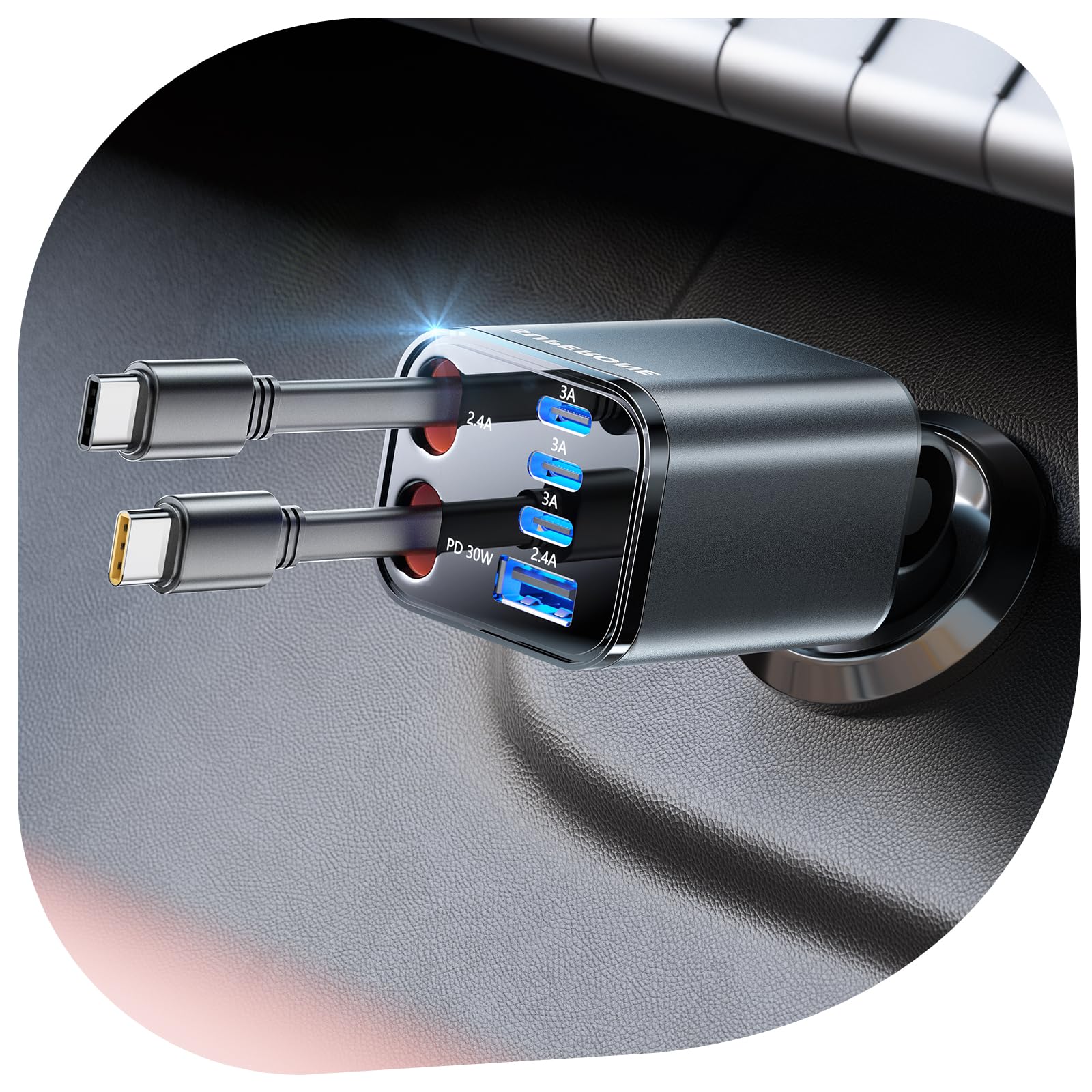
The SUPERONE addresses the single biggest annoyance of car charging: cable clutter. Its two retractable USB-C cables extend up to 31.5 inches and lock at any length; a gentle tug retracts them back into the housing. One cable delivers 30W PD for fast charging, while the second provides 12W — enough for a passenger’s AirPods or a secondary phone. Four additional ports (three USB-C and one USB-A) bring total capacity to 99W, enough to charge six devices simultaneously without per-port power collapse.
The 180° adjustable plug is a thoughtful ergonomic addition. In tight center consoles — where the cigarette lighter sits below the gear shifter — you can tilt the charger sideways to keep cables from snagging the shift lever. The anti-slip buckle at the base prevents the unit from vibrating loose on rough roads, a common failure point in cheaper retractable designs.
One caveat: the housing is plastic rather than aluminum, which means sustained 99W operation can generate noticeable warmth. The AI chip manages current distribution, but if you routinely charge three iPads and two phones at max output, the thermal limits of this design will eventually throttle. For most families, the convenience of built-in cables outweighs the thermals. UL, CE, and FCC certifications add a layer of safety confidence.
Why it’s great
- Retractable cables eliminate loose wires and clutter in the cabin
- 180° adjustable plug fits tight spaces and avoids gear shift interference
- Six ports simultaneously charge a full carload of devices
Good to know
- Plastic housing retains more heat under max load than metal builds
- Mechanical retraction mechanism may wear over extended daily use
4. Amazon Basics Fast-Charging Car Charger (60W)
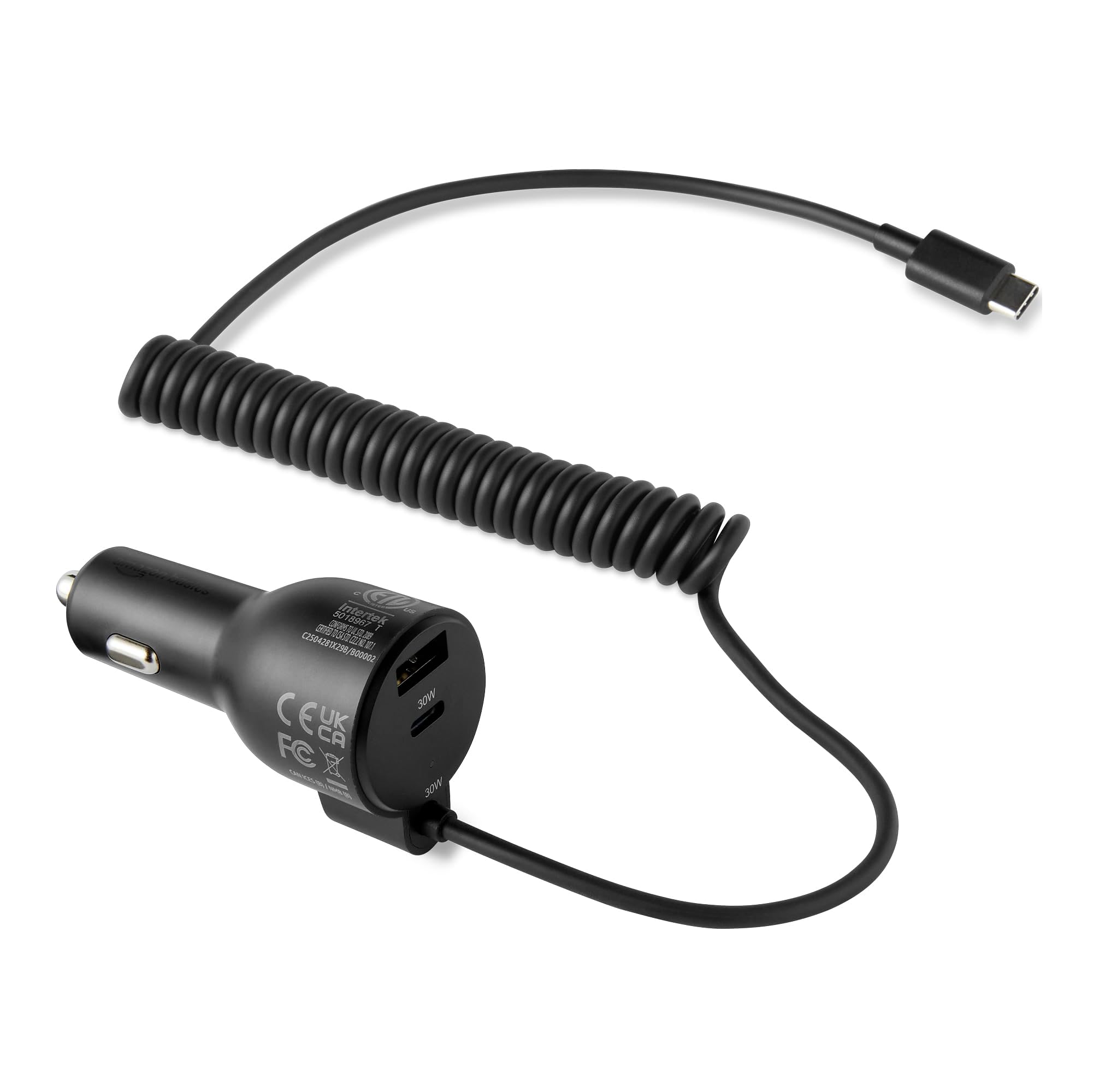
The Amazon Basics charger solves the “lost cable” problem by integrating a 5-foot coiled USB-C cable directly into the unit. That means you never have to dig under the seat for a loose cable — it’s always attached and always ready. The coiled design stretches to reach a phone mounted on the windshield or a passenger in the back seat, then recoils flat against the charger when not in use. The unit delivers 30W from the integrated cable and 30W from the dedicated USB-C port simultaneously, totaling 60W for two fast-charging devices.
Safety compliance here is more comprehensive than most budget chargers: UL 2089 certification, plus over-temperature, short-circuit, over-voltage, and over-current protection layers. The LED indicator glows white — softer than red or blue LEDs — and is barely noticeable at night. The plastic enclosure measures 2.95 inches tall, which is slightly longer than the Anker or Belkin units, so it may not sit flush in every socket. Customers report that the coiled cable maintains its tension well even after months of daily stretching and recoiling.
The compromise is in total output when all three ports are active. Using both USB-C ports plus the USB-A port simultaneously drops each USB-C to 10W — essentially slow charging. This unit is best used for one or two fast-charging devices at a time, not a full family load. For individual drivers who just want one reliable USB-C cable that never gets lost, this is a cleverly designed value option.
Why it’s great
- Built-in coiled USB-C cable prevents cable loss in the car
- UL 2089 safety certification exceeds typical budget charger specs
- Two 30W ports for simultaneous device fast charging
Good to know
- All three ports active drops each USB-C to just 10W
- Taller body may not fit flush in shallow cigarette lighter sockets
5. Belkin BoostCharge 30W USB-C Fast Car Charger

Belkin’s BoostCharge is the safest pick on this list if you care about certification depth. It carries USB-IF certification, meaning the 30W Power Delivery profile has been formally validated for voltage regulation, current ripple, and electromagnetic interference. This matters if you charge expensive devices — a poorly regulated 30W charger can introduce voltage noise that degrades battery health over time. The included USB-C to USB-C cable supports the full 30W PD profile, so there’s no bottleneck from a cheap cable.
The compact dimensions (2.1 x 0.8 inches) make this the smallest footprint charger in the lineup. It sits almost flush with the socket, leaving your center console completely unobstructed — ideal for cars where the cigarette lighter port is near the gear shifter. The PPS (Programmable Power Supply) support enables 25W super-fast charging on Samsung Galaxy S24 and S25 series, which the Anker 323 cannot match. Belkin also backs this unit with a 2-year limited warranty and a Connected Equipment Warranty (CEW) up to , covering damage to your phone if the charger malfunctions.
The trade-off: this is a single USB-C port only. There is no USB-A port for legacy accessories, and no secondary port for charging a second device simultaneously. If you need to run a dash cam or charge a friend’s phone at the same time, you’ll need a separate adapter. For the driver who owns one modern flagship phone and wants the most certified, compact, and warranty-backed charging experience, this Belkin is the cleanest execution.
Why it’s great
- USB-IF certification guarantees clean voltage regulation and safety
- PPS support enables 25W super-fast charging on Samsung Galaxy devices
- Smallest physical footprint — barely protrudes from the socket
Good to know
- Single USB-C port only — no secondary port or USB-A
- 2-year CEW only covers damage from charger malfunction, not cable wear
FAQ
Can a 30W USB-C car charger damage my phone battery?
How do I know if my car’s cigarette lighter socket supports 30W charging?
Does a retractable car charger cable wear out over time?
Final Thoughts: The Verdict
For most users, the best car charger usb-c winner is the Anker 323 because it delivers proven 30W PD fast charging with ActiveShield thermal protection at a price that makes it an easy daily driver. If you want a built-in voltmeter to monitor alternator health across multiple cars, grab the Costyle 3-pack. And for a clutter-free family cabin where six devices need power on road trips, nothing beats the SUPERONE 6-in-1 with its retractable cables.

Mo Maruf
I created WellFizz to bridge the gap between vague wellness advice and actionable solutions. My mission is simple: to decode the research and give you practical tools you can actually use.
Beyond the data, I am a passionate traveler. I believe that stepping away from the screen to explore new environments is essential for mental clarity and physical vitality.