Our readers keep the lights on and my smoothie glass nicely filled. As an Amazon Associate, I earn from qualifying purchases.
The core problem with driving and a rear-facing infant is the blind spot directly behind you—a zone where a mirror reflection distorts distance and leaves you guessing at every whimper or cry. A dedicated car camera for baby eliminates that guesswork by placing a high-definition, real-time video feed of your child’s face, hands, and posture right on your dashboard where you can glance safely without twisting your neck.
I’m Mohammad Maruf — the founder and writer behind WellFizz. Over years of analyzing automotive and parenting electronics, I’ve scrutinized the wiring, lens specs, and IR performance that separate a reliable rear-seat monitor from a frustration waiting to happen.
Whether you need dual-camera coverage for twins or a compact unit that doesn’t clutter the windshield, identifying the right best car camera for baby hinges on understanding the actual specs behind the marketing claims.
How To Choose The Best Car Camera For Baby
Selecting a rear-seat baby monitor involves more than just screen size. The wiring architecture, the camera’s field of view, and the specific type of infrared night vision directly affect how well the system performs during your daily commute or a cross-country trip.
Resolution and Image Quality
A camera’s CMOS sensor and the monitor’s panel work together to produce a usable image. At a minimum, look for a 1080P sensor paired with an IPS monitor—this combination provides good color accuracy and wide viewing angles. Cameras rated at 1440P (2K) deliver finer detail, which helps when you need to zoom in to check whether a pacifier is still in place without pulling over.
Wired vs. Wireless: Signal Stability
Wired systems transmit video through a dedicated cable that runs from the camera behind the rear headrest to the dash-mounted monitor. This ensures zero latency, no interference from nearby electronics, and no batteries to charge. The trade-off is the need to route a cable along the door molding or floor mat, but the reliability is unmatched. Wireless units offer a cleaner install but introduce potential signal dropouts and lower resolution caps.
Night Vision Technology
Most baby car cameras use infrared LEDs to illuminate the back seat in low light. The key distinction is the LED wavelength: 940nm “invisible” IR emits almost no red glow, making it ideal for a sleeping infant because it will not disturb their eyes or disrupt their sleep cycle. Older 850nm IR produces a visible red glow that can be noticed in a dark cabin.
Single Camera vs. Dual Camera (Split-Screen)
A single-camera system with a 150° wide-angle lens can cover the entire back seat of a sedan. For SUVs with a third row, families with twins, or parents who want to monitor a forward-facing toddler and a rear-facing infant simultaneously, a dual-camera system with a split-screen display is the practical choice. These units require two camera bodies, each wired to the same monitor, and they double the cable management work.
Quick Comparison
On smaller screens, swipe sideways to see the full table.
| Model | Category | Best For | Key Spec | Amazon |
|---|---|---|---|---|
| Bonoch 5″ 1440P | Premium Single Cam | Ultimate clarity & detail | 1440P / 5″ IPS / 2x Zoom | Amazon |
| Kidsneed Dual 7″ | Premium Dual Cam | Two kids simultaneous view | 1080P / 7″ Split / 150° Wide | Amazon |
| Wkzay Dual 6.9″ | Mid-Range Dual Cam | SUVs & 3-row families | 1080P / 6.9″ / 940nm IR | Amazon |
| Pemacom Dual 7″ | Mid-Range Dual Cam | Dual kids with 2-year warranty | 1080P / 7″ IPS Split / Dual Night | Amazon |
| Luckview BM1 5″ | Mid-Range Single Cam | Zoom & compact dash fit | 1080P / 5″ / 3x Zoom | Amazon |
| Babyvue USB | Budget Single Cam | Quick install & pet monitoring | 1080P / IPS / 360° Camera | Amazon |
| Fodkh 7″ Single | Budget Single Cam | Large screen value pick | 1080P / 7″ / Auto Brightness | Amazon |
In‑Depth Reviews
1. Bonoch 5″ 1440P Baby Car Camera

The Bonoch BCM01 is the only unit in this roundup that steps beyond 1080P, delivering a full 1440P (2K) image from its rear-seat camera. That extra pixel density translates into noticeably sharper detail when you zoom to 2X—useful for checking whether a sleeping newborn is breathing normally or if a toddler has dropped a toy. The monitor itself measures 5 inches diagonally, a size that fits neatly beside the steering wheel without obstructing the windshield, and it includes both a dashboard suction mount and an air-vent clamp. The camera uses RGB-IR technology with invisible infrared lights, meaning the sensor captures color during the day and seamlessly shifts to black-and-white night vision without emitting a red glow that could wake a baby.
Installation is genuinely plug-and-play: a single 2-in-1 cable carries power and video from the camera to the monitor, and the system draws power from any standard USB-A port or the included 12V car charger. Early user reports highlight the image quality as “amazing” and “crystal clear,” with accurate color reproduction during daylight and strong contrast at night. The zoom function is adaptive—0.5X, 1X, and 2X—so you can pull back to watch two children in the back seat or zoom in on a single infant. The provided Velcro straps for cable management (ten securing pieces) make it easy to keep the setup tidy, although the four-meter cable does require some creative routing in smaller sedans to avoid hanging loops.
Where this model differentiates itself is in the mounting hardware. The dashboard base uses a rubberized suction cup that sticks firmly even on textured dashboards, and the air vent bracket locks into the slats with zero wiggle. Owners report that the mount stays stable over potholes and sharp turns, solving the persistent shaking issue that plagues traditional baby mirrors. The absence of a wireless transmitter means there is zero signal lag and no batteries to recharge—a pragmatic trade-off for parents who prioritize reliability over cable-free aesthetics.
Why it’s great
- Highest resolution in the group (1440P) with usable 2x digital zoom
- Invisible 940nm IR prevents disturbing sleeping infants
- Rock-solid dual mounting system (suction cup + vent clip)
Good to know
- Single-camera design only—cannot monitor two children independently
- Long cable requires careful routing to avoid clutter in small cars
2. Kidsneed 7″ Dual Camera System
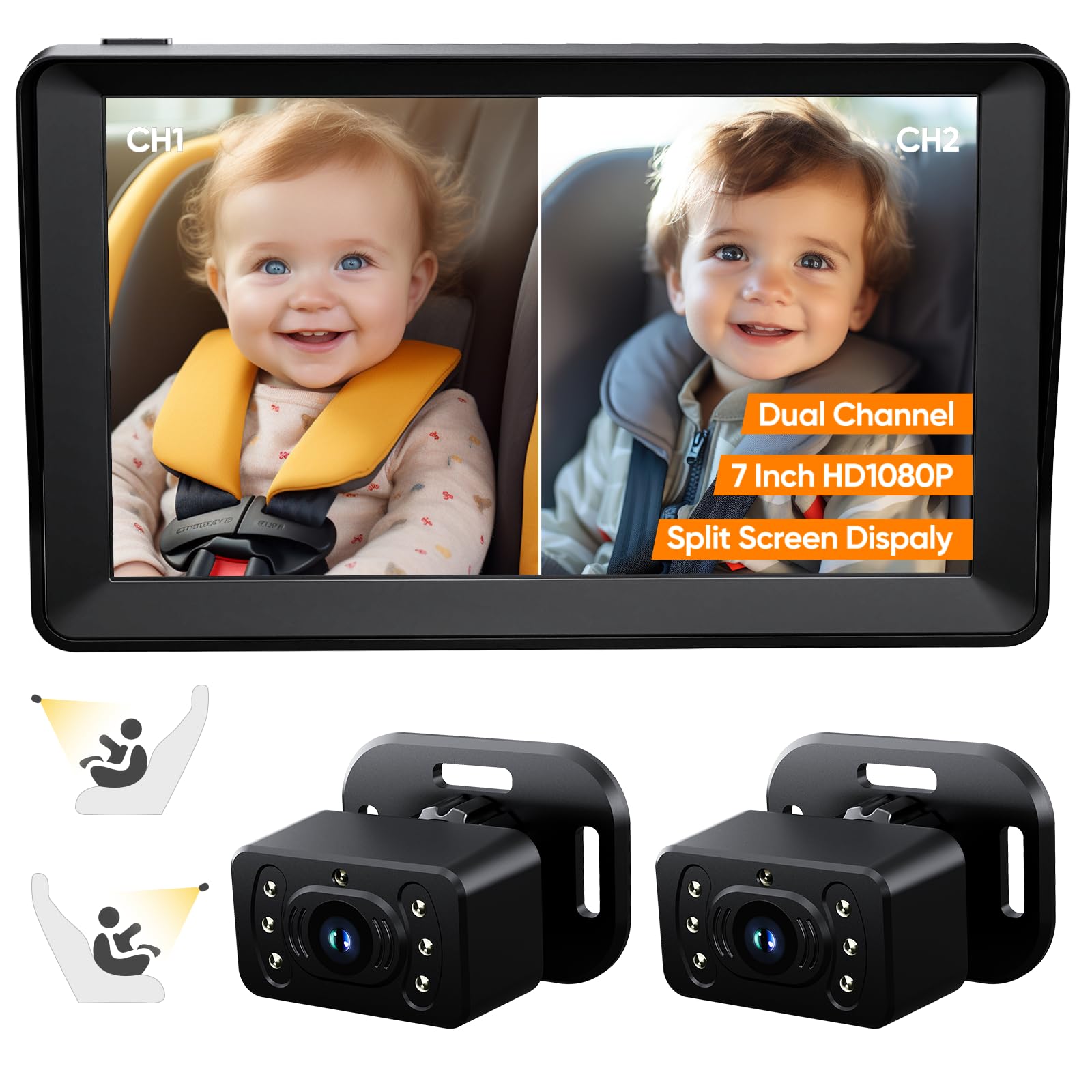
Families with two children sharing the back seat will appreciate the Kidsneed system, which pairs two 1080P cameras with a single 7-inch IPS monitor that displays both feeds side-by-side in split-screen mode. The monitor lets you toggle between a full-screen view of one child and a split view of both, giving you flexibility depending on whether you need to focus on a newborn or keep one eye on each kid during a long trip. Each camera uses a 150-degree wide-angle lens and rotates 360 degrees, so you can aim them at rear-facing infant seats or forward-facing toddlers without needing to reposition the headrest straps.
The night vision system employs 940nm infrared technology, which is the invisible type that emits no red glow and is less likely to disturb a sleeping child. In real-world use, the cameras automatically switch to black-and-white night mode in low light and deliver enough detail to see a child’s face and body language. The split-screen mode maintains full resolution on both halves of the display, so neither feed looks pixelated. The 7-inch monitor is bright enough to remain readable in direct sunlight thanks to an auto-dimming sensor that adjusts to ambient light, though users note the absence of a manual dimmer for nighttime driving—the screen can feel overly bright in a dark cabin.
Installation is straightforward: Velcro straps wrap around the rear headrests to secure each camera, and the two video cables merge into a single line that runs to the monitor. The monitor can sit on the dashboard or slot into a cupholder using the included bracket. Build quality feels sturdy, with a metal and plastic enclosure that resists heat buildup in summer. The biggest drawback mentioned by owners is that the cameras can be bumped out of alignment by active kids, requiring occasional re-adjustment between trips. Over months of use, the system has held up well, with no reports of cable fatigue or connection failures.
Why it’s great
- True dual-camera split-screen with independent camera adjustment
- Invisible 940nm IR for undisturbed sleep monitoring
- Large 7-inch IPS display is readable in bright sunlight
Good to know
- No manual screen dimmer for nighttime driving comfort
- Cameras can shift position if bumped by active children
3. Wkzay 6.9″ Dual Baby Car Camera
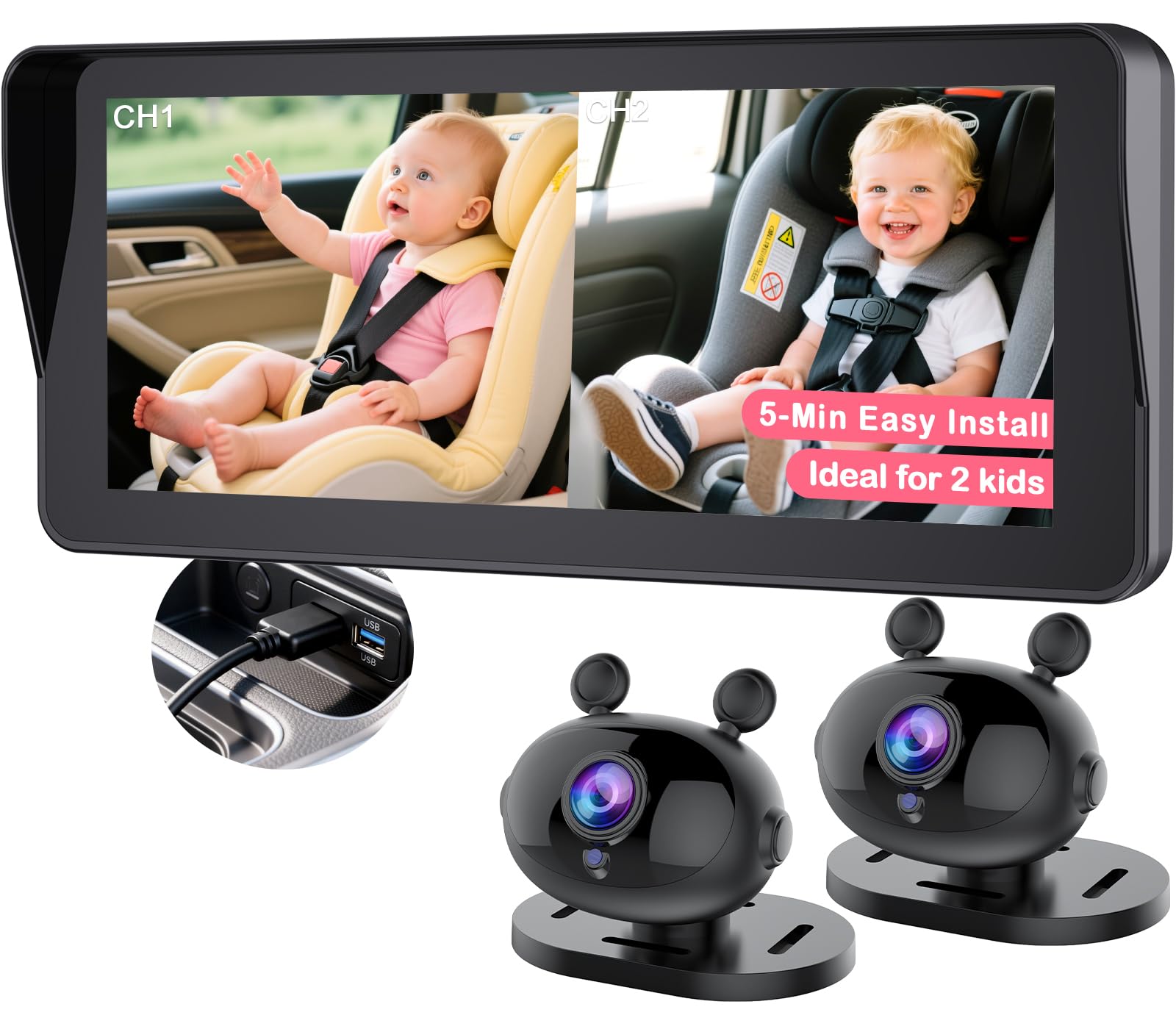
The Wkzay system occupies a sweet spot for families who need dual-camera coverage but do not want to pay a premium for a larger brand name. Its 6.9-inch split-screen monitor displays real-time 1080P video from both rear-facing cameras simultaneously, covering the second row of most SUVs and minivans with zero blind spots between the two seats. Each camera has a 150-degree field of view and full 360-degree rotation, so you can point one at a rear-facing infant carrier and the other at a forward-facing toddler without compromise. The wired connection delivers a lag-free feed that stays stable even when driving through tunnels or parking garages where wireless interference is common.
Night vision is handled by 940nm LEDs, making this one of the more affordable dual-camera options with invisible IR that does not cast a red glow into the car cabin. Reviews consistently praise the image clarity, noting that the 1080P resolution holds up well in both bright daylight and pitch-black nights. The monitor includes a touch control interface, which feels more modern than physical buttons, though some users mention the touch sensitivity requires a deliberate tap to register while driving. The included mounting kit provides Velcro straps for both cameras and a dashboard bracket for the monitor that uses an adhesive base or a suction cup depending on your preference.
Cable management is a key consideration here—two cameras mean two video cables to route along the door sills or floor mats, plus the power cable for the monitor. The kit includes cable clips, but owners of smaller cars report needing to spend extra effort to hide the wires cleanly. Build quality is solid for the price bracket, with a compact monitor that does not dominate the dashboard. The system has no batteries and stays powered via USB or cigarette lighter, so it is always ready when you start the engine.
Why it’s great
- Affordable dual-camera system with 940nm invisible night vision
- 150-degree wide-angle lenses eliminate blind spots between two seats
- Lag-free wired transmission with zero signal dropouts
Good to know
- Touch controls require deliberate taps and may be distracting while driving
- Routing two camera cables adds installation complexity in compact vehicles
4. Pemacom Dual 7″ Baby Car Camera

The Pemacom V8 is another dual-camera contender that emphasizes durability and long-term support with a two-year warranty period. The system uses two 1080P cameras feeding a 7-inch IPS monitor that supports split-screen, single-camera, and mirror-mode views. The mirror mode corrects the image orientation so that the view matches what you would see if you were facing your child, eliminating the reversed perspective that can be disorienting at a quick glance. The cameras rotate 360 degrees and have a wide enough field of view to monitor multiple children in a single row, and the mount uses high-temperature-resistant materials to prevent the adhesive from failing in a hot car during summer.
Night vision on the Pemacom uses a standard IR system that automatically activates in low light. Unlike the invisible 940nm systems, the IR LEDs on this model produce a subtle red glow that some parents notice in a dark cabin, though reviewers do not report it as disturbing enough to wake sleeping babies. The 7-inch display uses an IPS panel with good off-axis viewing, meaning the passenger can see the feed just as clearly as the driver. The included suction cup bracket is designed for window or smooth dashboard mounting, and a separate cupholder base is provided for alternative placement.
Where this unit shines is in its support policy. The manufacturer offers direct customer service for two years post-purchase, and several user reviews note that replacements for defective components (such as a loosened USB connector) were processed without hassle. Build quality is above average for the middle price tier, with a rigid housing that feels substantial rather than hollow. The primary criticism is that the USB power connector can loosen over time with repeated plugging and unplugging, potentially causing intermittent power loss if the cable is not secured in place.
Why it’s great
- Two-year warranty with responsive customer support for defect replacements
- IPS panel provides accurate colors and wide viewing angles for both driver and passenger
- Mirror mode corrects reversed image for more natural monitoring
Good to know
- Standard IR LEDs produce a visible red glow in the dark cabin
- USB power connector may loosen over many connection cycles
5. Luckview BM1 5″ Baby Car Camera
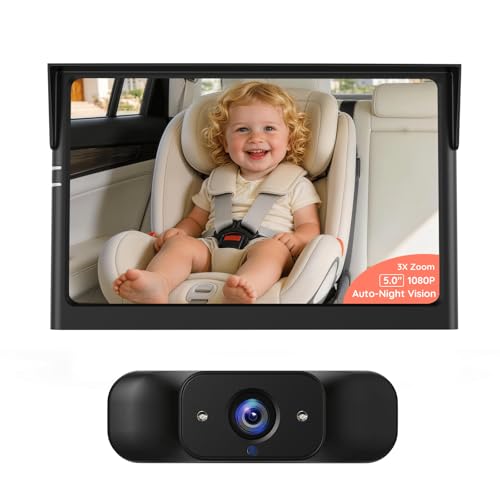
The Luckview BM1 is a single-camera system built around a 5-inch 1080P monitor, but its standout feature is a 3x digital zoom that allows you to crop in on a child’s face or a pet’s position without losing too much detail. This zoom capability is especially useful for parents who drive with a rear-facing newborn in a bucket seat and want to confirm breathing patterns or pacifier placement without taking eyes off the road. The monitor includes adjustable brightness settings to adapt to changing light conditions, and the suction cup mount secures to either the windshield or a smooth dashboard surface.
The camera uses a 150-degree wide-angle lens with 360-degree rotation, covering the entire back seat from a single mounting point behind the headrest. Infrared night vision is standard and switches on automatically in dark environments. Users report that the image remains sharp and contrast-rich in low light, with enough brightness to see facial expressions. The camera’s compact housing is lightweight, which helps it stay in position even when mounted on narrow headrest posts. The system is powered via a 12V car charger adapter, and the video cable is long enough to run discreetly under the door molding in most sedans and SUVs.
Luckview backs the BM1 with a one-year warranty and 24/7 customer support, and multiple user reviews highlight the company’s willingness to replace defective units quickly—one reviewer noted a night vision failure was resolved with a replacement unit after a single email. The only consistent critique is that the dashboard mounting tape may struggle to grip highly textured dashboards; some users supplement it with a stronger adhesive pad. The 5-inch screen is compact enough to avoid blocking the windshield, a distinct advantage over the 7-inch monitors for drivers of smaller vehicles.
Why it’s great
- 3x digital zoom provides detailed close-ups of a child’s face or a pet
- Compact 5-inch monitor fits easily in small cars without blocking windshield view
- Reliable warranty support with quick replacement of defective hardware
Good to know
- Single-camera only—cannot monitor two children independently
- Dashboard adhesive may need reinforcement on textured surfaces
6. Babyvue USB Baby Car Camera

The Babyvue is designed for parents who prioritize speed of installation above all else—the manufacturer claims a three-minute setup, and the package contains everything needed: a monitor, a camera, a single USB power cable, and three cable clips. The camera attaches to the rear headrest using Velcro straps, and the monitor sits on the dashboard with an adhesive base. Because the system draws power exclusively through USB, it works with any vehicle that has a USB port, eliminating the need for a separate 12V adapter unless you prefer using the included one. The camera itself has a 360-degree rotating lens encased in a small housing shaped like a cartoon animal, which some parents use as a visual distraction to calm fussy infants.
The video feed is 1080P on an IPS monitor, and early user reports describe the daytime picture as crisp with good color. Night vision uses infrared LEDs that switch on automatically in low light, and the no-glow design prevents any red glow from reaching the baby’s eyes. The Babyvue includes mirror mode, which flips the image horizontally so that the perspective matches the actual position of the rear-facing seat—a helpful detail for parents who struggle with reversed orientations. The cable is long enough to run along the door molding, and the included clips keep it tucked out of reach of curious hands.
Where this entry-level unit makes compromises is in build quality and image processing. Some users note that the 1080P feed looks “soft” compared to higher-end units, with visible scan lines reminiscent of an older analog display. The adhesive monitor base is permanent once applied, limiting repositioning options. The single-camera design also means you cannot watch two children independently; the wide-angle lens will cover both kids in a single row, but you lose the ability to zoom in on one face without cropping the other. For a single child or a pet, however, this is a simple and effective solution that gets the job done with minimal effort.
Why it’s great
- Truly quick three-minute installation with no special tools
- USB-only power simplifies setup in modern cars with built-in USB ports
- Fun camera design can help calm an unsettled baby during installation
Good to know
- Image quality is noticeably softer than competition, with visible scan lines
- Adhesive monitor base is permanent—no dashboard repositioning after install
7. Fodkh 7″ Single Baby Car Camera
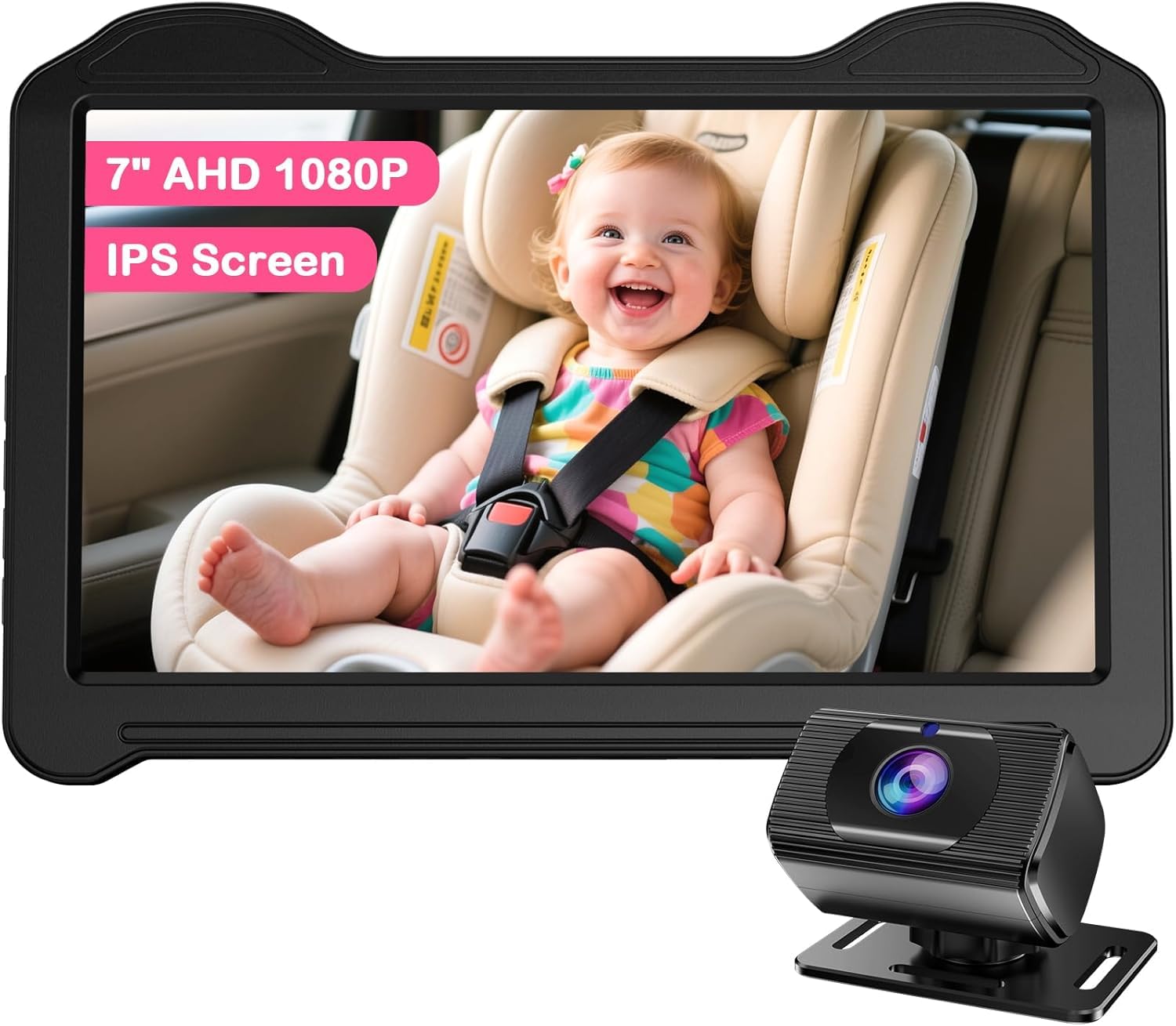
The Fodkh F20 is a budget-friendly single-camera system that distinguishes itself with a 7-inch monitor—the same screen size typically found in premium dual-camera units, but at a lower entry price point. This is a meaningful advantage for parents who want a large, readable display without needing to pay for a second camera they do not plan to use. The monitor includes an auto-brightness sensor that adjusts the backlight based on ambient light, reducing glare in sunny conditions and dimming the screen automatically at night so it does not blind the driver during dark drives. The camera captures 1080P HD video through a 150-degree wide-angle lens and rotates 360 degrees to cover the entire back seat from a single headrest mount.
Night vision is handled by an IR system that uses a no-glow LED configuration to avoid disturbing a sleeping infant. Reviewers consistently note that the image quality is excellent for the price, with clear detail even in pitch-black conditions inside the vehicle. The camera supports both mirror and normal image modes, which you can toggle via a button on the monitor—useful for switching between rear-facing and forward-facing seat orientations without uninstalling. The wired connection includes a 16-foot video cable that users report is long enough to route through the headliner or door molding in large SUVs like the 4Runner without being stretched taut.
Build quality feels solid given the price, with a lightweight plastic housing that resists vibration during rough roads. The dashboard mount uses a non-slip adhesive pad that holds well on textured surfaces. One notable feature is the ability to add a second camera later: the monitor supports dual-camera input, so you can purchase a separate camera kit if your family expands. However, the out-of-the-box system is single-camera only, and users who need instant split-screen coverage should look at the dual-camera systems listed above. For solo infants or toddlers, this provides a large, clear window into the back seat without breaking the budget.
Why it’s great
- Large 7-inch screen at a very accessible price point
- Auto-brightness sensor eliminates manual dimming during day-to-night transitions
- Supports future expansion to a second camera for growing families
Good to know
- Single-camera only out of the box—must buy extra camera for dual viewing
- Lightweight plastic housing feels less premium than metal-enclosed alternatives
FAQ
Can I use a baby car camera to monitor a forward-facing toddler?
Do all baby car cameras require hardwiring into the car’s electrical system?
Will a 7-inch monitor block my view of the road?
Is the night vision safe for a newborn’s developing eyes?
Final Thoughts: The Verdict
For most users, the best car camera for baby winner is the Bonoch 5″ 1440P because its 2K resolution and invisible IR night vision deliver the clearest, most usable image of any unit tested here. If you need to monitor two children simultaneously, grab the Kidsneed 7″ Dual Camera for its robust split-screen performance and easy headrest mounting. And for a compact, affordable solution in a small car, nothing beats the Luckview BM1 5″ with its 3x zoom and no-fuss installation.

Mo Maruf
I created WellFizz to bridge the gap between vague wellness advice and actionable solutions. My mission is simple: to decode the research and give you practical tools you can actually use.
Beyond the data, I am a passionate traveler. I believe that stepping away from the screen to explore new environments is essential for mental clarity and physical vitality.