Our readers keep the lights on and my smoothie glass nicely filled. As an Amazon Associate, I earn from qualifying purchases.
A multimeter will tell you if a capacitor has the right capacitance, but it won’t always tell you if it’s healthy under load. An ESR meter looks at the internal resistance of the capacitor at a specific frequency, revealing the hidden failures that capacitance alone can’t find. For anyone working on power supplies, motherboards, or vintage audio gear, this distinction separates a quick fix from a wild goose chase.
I’m Mohammad Maruf — the founder and writer behind WellFizz. I spend my time analyzing test equipment specs, cross-referencing user calibration results against lab-grade references, and tracking firmware updates that turn budget hardware into capable bench tools.
The bottom line is that you need a tester that matches your repair volume, component types, and desired accuracy. To help you find the perfect fit, I’ve put together this guide to the best capacitor tester for your bench.
How To Choose The Best Capacitor Tester
The right tool depends entirely on what you repair. If you only replace failed caps in power supplies, a dedicated ESR meter is perfect. If you need a general-purpose bench meter that also checks capacitance, a premium multimeter or LCR meter makes more sense. Focus on the measurement type, test frequency, and in-circuit capability.
ESR vs. Capacitance vs. LCR
A pure capacitance meter checks the stored charge value (microfarads). An ESR meter measures the internal resistance of the capacitor at a high frequency (usually 100kHz) to gauge its health under load. An LCR meter measures inductance and resistance in addition to capacitance and ESR, giving you the most complete picture for a wider range of components.
In-Circuit Testing and Low Voltage
The biggest time-saver is the ability to test a capacitor without desoldering it from the board. This requires a tester that applies less than 15–40 mV on the capacitor so it doesn’t turn on nearby semiconductor junctions. Most dedicated ESR meters are designed for this, while many standard multimeters are not.
Range, Accuracy, and Resolution
For general repair, a range covering 0.1pF to 20,000µF for capacitance and 0.01Ω to 100Ω for ESR covers almost all electrolytic and ceramic caps you will encounter. Accuracy of ±3% to ±5% is sufficient for a go/no-go decision. Higher-resolution meters (19,999-count) are better for matching and sorting components.
Quick Comparison
On smaller screens, swipe sideways to see the full table.
| Model | Category | Best For | Key Spec | Amazon |
|---|---|---|---|---|
| Fnirsi LC1020E | LCR Meter | Complete bench diagnostics | 19,999-count, 100kHz, dual display | Amazon |
| Signstek MESR-100 V2 | ESR Meter | In-circuit quick checks | 0.01 to 100Ω ESR range | Amazon |
| Geevorks MESR-100 V2 | ESR Meter | In-circuit with SMD support | 0.001 to 100.0R with SMD clip | Amazon |
| Klein Tools MM420 | Multimeter | HVAC and general electrical | TRMS, 600V, 50MΩ, 6.6-ft drop | Amazon |
| Supco MFD10 | Capacitance Tester | Quick MFD-only checks | 0.01 to 10,000mF, 5% accuracy | Amazon |
| Hztyyier Capacitance Meter | Capacitance Meter | Budget entry-level testing | 0.1pF – 20,000uF with backlight | Amazon |
| Fluke 17B+ | Multimeter | Professional long-term reliability | 1000V, 10A, CAT III 600V safety | Amazon |
In‑Depth Reviews
1. FNIRSI LC1020E 100kHz LCR Meter
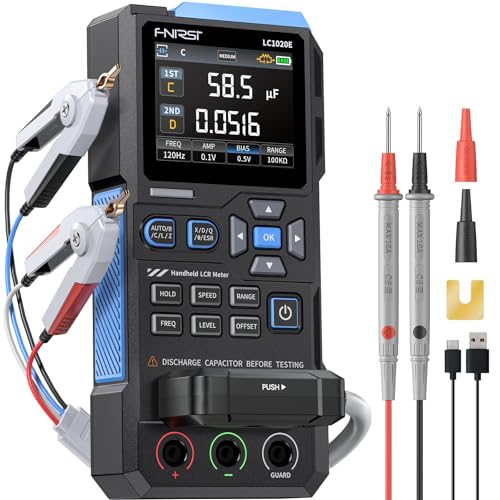
The FNIRSI LC1020E is a serious piece of bench gear that punches well above its price tier. It features a 19,999-count dual-parameter display that shows main and secondary values (C/D, L/Q, R/θ, ESR) simultaneously across five test frequencies from 100Hz to 100kHz. The 100 ohm output impedance and adjustable test voltage (0.1V, 0.3V, 0.6V) let it handle both in-circuit verification and lab-grade sorting.
Four-wire Kelvin connections via the 3-pin sockets and 5-slot jacks eliminate lead resistance errors, and the built-in sorting mode with audible pass/fail feedback makes it easy to bin components quickly. An internal 3000mAh rechargeable battery with USB-C charging means it can run all day on the bench without chewing through disposables.
User reviews confirm it matches HP 4263A and Agilent 4284A references on standard components, though it tends to read slightly low on ESR compared to an ESR70 above 100µF. The menu system requires a bit of learning, but the bright 2.8-inch TFT display and 4 readings-per-second speed make it a joy once you’re set up.
Why it’s great
- True 4-wire Kelvin measurement for lab-grade accuracy.
- Dual-parameter display shows capacitance and ESR simultaneously.
- Rechargeable battery and Type-C charging are very convenient.
Good to know
- Menu navigation takes time to learn.
- ESR readings can be slightly low above 100µF.
- No carry case included for transport.
2. Signstek MESR-100 V2 Auto Ranging ESR Meter
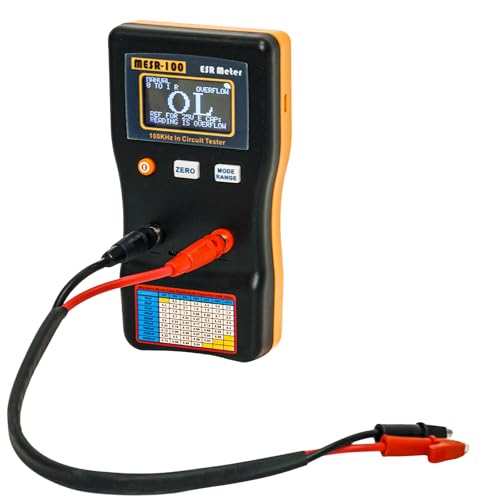
The Signstek MESR-100 V2 is the dedicated ESR meter that electronics repair forums have been recommending for years. It uses a 100kHz test frequency and applies less than 15mV on the capacitor, allowing you to test components in-circuit without the readings being corrupted by nearby semiconductor junctions. The auto-ranging ESR scale covers 0.01Ω to 100Ω, which is exactly the range where failing electrolytics reveal themselves.
A printed ESR reference chart is included on the device itself, so you can instantly compare your reading against known-good values for common capacitor types. The dual-terminal input lets you use either the included probes or custom clips, and the auto-ranging feature means no fiddling with range switches—just touch and read.
Reviewers consistently highlight that this tool saves hours of wasted desoldering. One user notes it correctly identified bad caps on an Xbox motherboard where a regular multimeter showed normal capacitance. The only recurring complaint is that the test leads are too short and too close together, making it awkward to reach tight spots on a crowded board.
Why it’s great
- True in-circuit testing at 15mV means no false readings from other components.
- Auto-ranging ESR from 0.01 to 100Ω covers the entire electrolytic failure zone.
- Built-in ESR chart for quick pass/fail decisions.
Good to know
- Test leads are too short and too close together.
- Battery door is blocked by the stand when open.
- Not very precise on very small value caps.
3. Geevorks Professional Capacitor Tester V2

The Geevorks MESR-100 V2 is essentially the same core design as the Signstek but with a better accessory bundle. It ships with two test clips plus a dedicated SMD alligator clip, making it much easier to probe surface-mount capacitors without slipping off the pads. The measurement range is slightly improved at 0.001Ω to 100.0R, giving you a bit more resolution on very low-ESR parts.
Like the Signstek, it uses a 100kHz test frequency and applies less than 40mV, so it is safe for in-circuit testing. A printed ESR table is also included on the device for quick reference. The package also lists NIST certification, which means each unit comes with a traceable calibration certificate—a rarity at this price point.
Owners report reliable and consistent go/no-go results on aging electronics, with one reviewer saying it identified a bad cap that was causing a TV to not power on, saving them hundreds of dollars in repair costs. A minor caveat is that the test leads can cause zeroing drift if moved after calibrating, so it helps to set them in position before pressing the zero button.
Why it’s great
- Includes SMD clip for testing surface-mount capacitors.
- NIST certification for traceable accuracy.
- Very fine resolution on low-ESR components.
Good to know
- Leads need to be stationary during zeroing to avoid drift.
- Only measures ESR, not capacitance value.
- Manual could be better; online resources help.
4. Supco MFD10 Digital Capacitor Tester
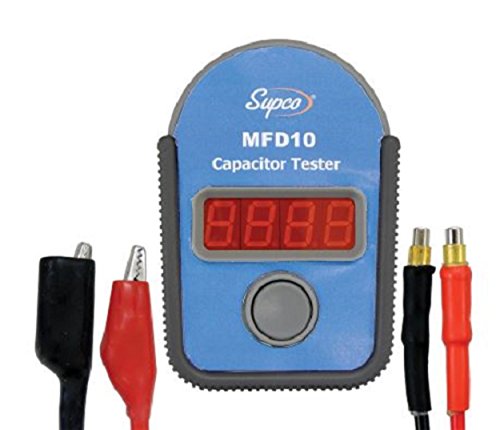
The Supco MFD10 is a dedicated microfarad tester built specifically for HVAC technicians and appliance repair. It measures capacitance from 0.01µF all the way up to 10,000mF (10,000µF) with 5% accuracy, which covers the vast majority of run and start capacitors found in air conditioners, refrigerators, and washers. The large LED display makes it easy to read in bright or dim conditions.
This unit does not measure ESR or resistance—it is purely a capacitance tester. For its intended use case, that simplicity is a feature. There are no range switches or modes to toggle; you discharge the cap, connect the leads, and read the value. It is fast, intuitive, and nearly foolproof.
Reviewers praise its ease of use and dependability, with one owner calling it the best capacitor tester on the market for the price. A few users note that it requires a 9V battery (not included) and that the leads could be a bit longer for reaching into tight compressor compartments, but overall it is a well-built, no-nonsense tool.
Why it’s great
- Wide capacitance range covers large HVAC run caps.
- Simple one-button operation requires no menu diving.
- Large, easy-to-read LED display.
Good to know
- No ESR or resistance measurement.
- Requires a 9V battery (not included).
- Leads could be longer for deep equipment access.
5. Klein Tools MM420 Digital Multimeter
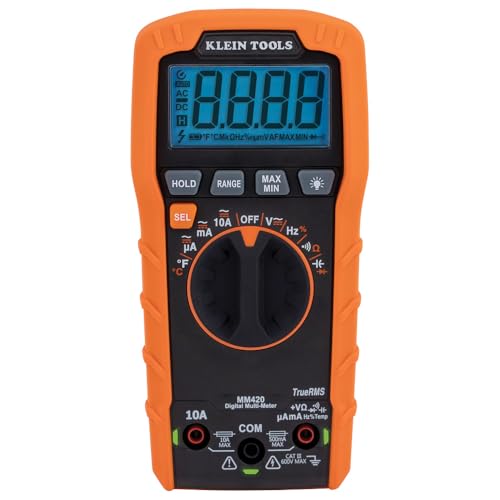
The Klein Tools MM420 is not a dedicated capacitor tester, but it is a top-tier multimeter that includes capacitance measurement as part of a complete feature set. It offers auto-ranging True RMS measurement of AC/DC voltage up to 600V, current up to 10A, resistance up to 50MΩ, plus capacitance, frequency, duty cycle, and temperature via the included thermocouple.
What sets the MM420 apart is its ruggedness. It is built to survive a 6.6-foot drop and comes with a Lead-Alert system that illuminates LEDs to confirm proper test lead placement. The backlit LCD display is crisp, and the included kickstand and optional magnetic hanger allow hands-free operation on a panel or bench.
HVAC and electrical pros appreciate the build quality and feature density. One reviewer used it to repair an EGO lawn mower and now keeps it as their go-to tool box meter. The capacitance range is sufficient for motor start and run capacitors, though it lacks the in-circuit ESR capability of a dedicated tester.
Why it’s great
- Extremely durable with 6.6-ft drop rating.
- Includes temperature measurement and TRMS for AC accuracy.
- Lead-Alert system prevents misconnection errors.
Good to know
- No ESR measurement for in-circuit testing.
- Capacitance testing is a secondary feature, not the focus.
- Magnetic hanger sold separately.
6. Fluke 17B+ Digital Multimeter
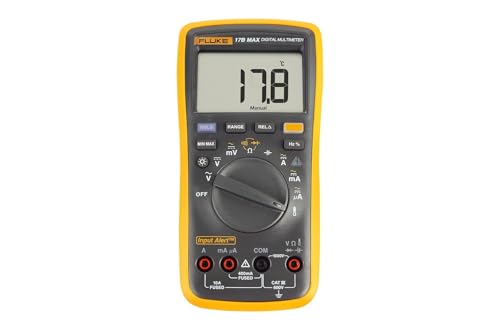
The Fluke 17B+ is the gold standard for a bench multimeter that includes capacitance measurement. It measures AC/DC voltage up to 1000V, current up to 10A, resistance, continuity, diode drop, capacitance, frequency, and temperature. The CAT III 600V safety rating means it is built for real-world electrical environments, with input protection that exceeds what most budget meters offer.
Fluke’s reputation for long-term accuracy and reliability is well earned. The 17B+ features auto-ranging, a large backlit display, and a built-in stand that makes it ideal for bench work. Users consistently report that readings match their lab-grade equipment within a few millivolts, and the meter holds calibration for years of regular use.
Reviewers note that the capacitance mode works reliably for typical through-hole and motor-run capacitors, but it is not designed for in-circuit ESR testing. One owner uses it as a secondary meter for microsoldering and appreciates the fast response time and easy lead swap. The main downside is the premium price, which reflects the build quality and long service life.
Why it’s great
- Fluke build quality and long-term calibration stability.
- CAT III 600V safety rating for real electrical work.
- Measures capacitance, frequency, and temperature in one unit.
Good to know
- No ESR measurement or in-circuit testing capability.
- Significantly more expensive than dedicated testers.
- Menu to access all modes requires some learning.
7. Hztyyier Digital Capacitance Meter Multimeter

The Hztyyier Digital Capacitance Meter is the entry-level option for hobbyists who need to check capacitor values without spending much. It measures capacitance from 0.1pF to 20,000µF with a 1999-count LCD that includes a backlight for low-light bench work. The rubber safety jacket provides a bit of drop protection, and the form factor is compact enough to toss into a tool drawer.
This meter is strictly for capacitance measurement—it does not measure ESR, voltage, or resistance. Accuracy is acceptable for general tinkering, with reviewers using it successfully for vintage audio recapping and basic component sorting. The included test leads are short, and a 9V battery is required but not included.
Owner feedback is largely positive given the price point. Users describe it as “easy to use, sturdy, and cheap” with accuracy that is “good enough for vintage audio recapping projects.” The manual is poorly translated, but a better one is available online. For someone just starting out with electronics repair, this is a low-risk way to get a capacitance reading.
Why it’s great
- Very affordable way to get capacitance measurements.
- Wide range from 0.1pF to 20,000µF.
- Backlit display and rubber safety jacket included.
Good to know
- No ESR or in-circuit testing capability.
- Short test leads and no battery included.
- Manual is poor; better documentation is available online.
FAQ
What is the difference between an ESR meter and a capacitance meter?
Can I test a capacitor in-circuit without desoldering it?
Why do ESR meters use a 100kHz test frequency?
Is a multimeter with capacitance mode enough for capacitor testing?
Final Thoughts: The Verdict
For most users, the best capacitor tester winner is the FNIRSI LC1020E because it combines full LCR functionality, 4-wire Kelvin accuracy, and a rich feature set at a price that undercuts traditional bench meters with similar specs. If you want pure in-circuit ESR speed, grab the Signstek MESR-100 V2. And for an all-in-one electrical meter with capacitance mode, nothing beats the toughness of the Klein Tools MM420.

Mo Maruf
I created WellFizz to bridge the gap between vague wellness advice and actionable solutions. My mission is simple: to decode the research and give you practical tools you can actually use.
Beyond the data, I am a passionate traveler. I believe that stepping away from the screen to explore new environments is essential for mental clarity and physical vitality.