Our readers keep the lights on and my smoothie glass nicely filled. As an Amazon Associate, I earn from qualifying purchases.
A beach canopy that collapses in the first gust of wind, a sun shelter that turns into a sail, or a tent that traps heat instead of blocking rays — these are the daily frustrations that turn a perfect beach day into a struggle for survival. Picking the right shelter means understanding a specific trade-off: you need a structure that blocks 98% of UV rays, handles shifting sand as an anchor medium, and packs down small enough to carry for a quarter-mile walk from the parking lot.
I’m Mohammad Maruf — the founder and writer behind WellFizz. I’ve analyzed dozens of beach canopy specifications, cross-referenced pole thicknesses, UV ratings, and sand-pocket designs to identify the models that actually perform when the tide comes in and the wind picks up.
This guide breaks down the essential specs — pole material, coverage area, and wind resistance — to help you confidently choose the best canopy tent for beach that matches your family size and tolerance for setup hassle.
How To Choose The Best Canopy Tent For Beach
Beach conditions are uniquely brutal on canopy tents. Salt spray corrodes cheap metal, wind gusts catch flat fabric surfaces like sails, and sand offers poor anchor hold for standard tent stakes. Every specification you evaluate should be read through these three harsh realities.
Pole Material and Thickness
Fiberglass poles dominate this category because they flex under wind load rather than snap. The critical spec is the diameter: 6.0 mm poles are standard on budget tents and prone to cracking after a few uses. Look for 8.5 mm or thicker fiberglass — the extra millimeter translates to noticeably better resistance against afternoon sea breezes. Aluminum poles offer lower weight and no corrosion, but they tend to bend permanently if overloaded.
UV Protection vs. Airflow
A UPF 50+ rating means the fabric blocks at least 98% of UV rays — the minimum for all-day exposure on the beach. But high UV protection often comes from dense silver coatings or thick polyester that traps heat. The solution is 360-degree ventilation: mesh windows on multiple sides, a roll-up rear door, or an extended canopy that creates an air gap. Without airflow, a UPF 50+ tent becomes an oven by noon.
Anchoring in Sand
Standard tent stakes are useless on the beach. The best canopy tents for sand use sandbags — fabric pouches sewn into the corners that you fill with sand on-site. More bags mean better distribution of wind load: 4 sandbags is the minimum for moderate wind, while 8 bags provide noticeably superior stability. Some premium models also include windproof ropes that attach to filled bags, creating a triangle anchor that resists lifting forces.
Quick Comparison
On smaller screens, swipe sideways to see the full table.
| Model | Category | Best For | Key Spec | Amazon |
|---|---|---|---|---|
| CoolCabanas Beach Shade Tent | Premium | Maximum wind resistance & premium build | 35 lbs sand pockets per corner | Amazon |
| Vibemo Beach Tent | Mid-Range | 8-person coverage with stable anchoring | 8 upgraded sandbags + aluminum poles | Amazon |
| Elegear CumbreX Beach Tent | Mid-Range | Built-in canopy for extra shade space | 8.5 mm fiberglass poles + sandbags | Amazon |
| Old Bahama Bay Pop Up Beach Tent | Mid-Range | Quick pop-up for 3-4 people | Pop-up design + 4 sand bags | Amazon |
| Rhino Valley Beach Tent | Mid-Range | Tall 6.5 ft height for standing room | 8 sandbags + 4 aluminum poles | Amazon |
| COMMOUDS Beach Tent | Budget-Friendly | Lightweight carry & small group shade | 4.85 lbs weight, 8.5mm fiberglass | Amazon |
| YENGIAM Beach Canopy | Budget-Friendly | Large 11×11 ft open coverage area | 4 metal poles + 4 windproof ropes | Amazon |
In‑Depth Reviews
1. CoolCabanas Beach Shade Tent

The CoolCabanas solves the single biggest beach canopy problem: wind lift. Its four corner sand pockets hold up to 35 pounds of sand each — that’s 140 pounds total anchoring force without a single stake. The aluminum frame is lightweight enough for one-person setup, yet the structure feels solid in gusts that would flip a standard pop-up. The 64-square-foot shade area comfortably fits a family of four with chairs and a cooler, and the UPF 50+ fabric is third-party tested for UV blockage.
Setup takes under two minutes once you’ve filled the pockets. The instructions are stitched into the carry bag, eliminating the panic of lost manuals. The large size folds down to a 41-inch package that fits across the back seat of most cars. At 14 pounds, it’s heavier than budget tents, but the weight directly translates to stability — you won’t be chasing this canopy across the sand.
The main trade-off is price: this is a premium-tier investment. The polyester fabric is durable but not as breathable as mesh-heavy designs, so ventilation depends on leaving the front open. Some users also report that filling pockets in hard-packed sand requires a scoop or small shovel. For families who want one canopy that will survive multiple seasons of heavy beach use, the CoolCabanas delivers unmatched anchoring confidence.
Why it’s great
- 35-pound sand pockets in each corner eliminate stake dependency entirely
- Aluminum frame resists corrosion from salt and moisture
- One-person setup with clear stitched instructions
Good to know
- Heavier than pop-up alternatives at 14 pounds
- Limited airflow without front opening fully exposed
- Price is significantly higher than mid-range options
2. Vibemo Beach Tent

The Vibemo 10×10 canopy uses eight sandbags — two per pole — to distribute wind load evenly across the structure. Combined with four thickened aluminum poles, this design provides noticeably better resistance against side gusts than four-bag systems. The Lycra fabric stretches slightly, which reduces flutter and noise in windy conditions. The UPF 50+ rating blocks direct UV penetration, though some users note that scattered light can still filter through lighter-colored sections.
Setup is straightforward with two people and manageable solo once you get the hang of the pole-and-bag sequence. The included sand shovel is a practical bonus that saves you from digging with bare hands. At 8.3 pounds, the Vibemo packs into a compact carry bag that fits easily in a trunk or even a large backpack. The 100-square-foot coverage comfortably seats six to eight adults with gear spread around.
The main concern reported by long-term users is the durability of the main poles under repeated use — some flexing has been noted after several trips. The Lycra fabric can also be machine-washed on delicate, which is a real advantage for removing salt and sand residue. For groups that need maximum coverage at a mid-range price point, the Vibemo delivers a strong balance of space and stability.
Why it’s great
- Eight sandbags provide superior anchoring redundancy
- Machine-washable Lycra fabric handles salt cleanup easily
- Spacious 10×10 ft fits large groups and gear
Good to know
- Aluminum poles may flex after extended use
- Fabric allows some light penetration despite UPF 50+ rating
- More time-consuming to fill eight bags than simpler designs
3. Elegear CumbreX Beach Tent

The Elegear CumbreX stands apart with a built-in canopy that extends from the main tent body, effectively doubling the shaded area when deployed. This design is rare in this category — most tents offer a single shade zone, while the CumbreX creates a front porch area that keeps sand out of the main compartment while providing extra coverage for coolers and bags. The 8.5 mm fiberglass poles are thicker than the industry-standard 6.0 mm, reducing the chance of snap under wind stress. The double-layer silver-coated polyester blocks 99% of UV rays and claims to lower interior temperatures by 9 degrees Fahrenheit.
Setup uses an external snap-on system that clips poles to the fabric rather than threading through sleeves — a time-saver that shaves off about half the assembly duration compared to traditional pole-sleeve designs. The 360-degree ventilation includes a zippered rear door and two large mesh windows with roll-up covers. The pack size is compact enough for carry-on luggage, and the 5.95-pound weight is manageable for one person to haul across soft sand.
The trade-off is that the canopy extension sits on its own support system, which adds complexity during takedown and requires careful folding to avoid losing parts. A few users report that the plastic-like fabric feels less premium than heavier-duty polyester. Still, for families who want flexible shade configurations — open canopy for groups, closed canopy for privacy while changing — the Elegear offers versatility you can’t get from a rigid-frame canopy.
Why it’s great
- Built-in canopy extension creates a shaded front porch area
- Thicker 8.5mm fiberglass poles resist wind better than standard 6.0mm
- Snap-on pole system speeds up assembly significantly
Good to know
- Canopy support adds complexity to takedown and storage
- Fabric texture feels less durable than heavier polyester options
- Instructions assume some prior beach tent experience
4. Old Bahama Bay Pop Up Beach Tent

The Old Bahama Bay uses a true pop-up mechanism — you unfold the hub structure and the tent springs into shape in seconds without threading poles or attaching clips. This is the fastest setup in this guide, ideal for parents managing children and gear simultaneously. The 4-person occupancy rating translates to comfortable seating for two adults with a cooler and bags, or three adults sitting upright. The front extension floor adds extra room for stretching out or changing, and it zips closed for privacy when needed.
The UPF 50+ silver-coated fabric blocks 98% of UV rays, and the four-sided ventilation with three mesh windows keeps the interior from overheating. The frame uses fiberglass with a pop-up hub, which sacrifices some wind rigidity compared to separate pole systems but gains immense speed in setup. The sand bags on each corner provide basic anchoring, though users report that additional stakes or weight bags are helpful on very windy days. At 8.2 pounds, it strikes a reasonable balance between portability and stability.
Several long-term reviews note that the pop-up mechanism can become harder to collapse over time as sand grit works into the hub joints. Also, the 54.5-inch width means you won’t fit a full family of four lying side by side — this is more of a base camp shelter than a sleeping tent. For solo parents or couples who prioritize speed over maximum coverage, the Old Bahama Bay delivers the fastest transition from trunk to shade.
Why it’s great
- Pop-up mechanism allows setup in under 60 seconds
- Front extension floor provides extra room and privacy option
- Lightweight enough for a single parent to carry and assemble
Good to know
- Width is too narrow for four adults to lie flat
- Sand bags may need additional weighting in strong winds
- Pop-up hub can jam if sand accumulates in the joints
5. Rhino Valley Beach Tent

The Rhino Valley Beach Tent offers the tallest peak height in this list at 90.55 inches — over 7.5 feet at the apex — providing genuine standing room for most adults. This matters when you’re changing clothes, feeding a baby, or simply don’t want to crouch every time you move inside the shelter. The 10×10 foot footprint covers 100 square feet, and the eight sandbags paired with four aluminum poles and windproof ropes create a multi-point anchoring system that stands up well to coastal gusts.
The Lycra fabric is triple-stitched at stress points to resist tearing, and the UPF 50+ rating provides effective sun blockage. Setup takes about 5-10 minutes: spread the fabric, fill the sandbags, insert the poles, and secure the ropes. The included sand shovel is genuinely useful for filling the eight bags. At 8.7 pounds, the Rhino Valley is portable but the bag count means you’ll spend more time on anchoring than with simpler four-bag designs.
The main limitation is that the 90-inch height is a peak measurement — the side slopes reduce headroom near the edges, so a 6-foot person can stand comfortably in the center but will need to duck near the perimeter. Some users also note that the plastic sand scoops feel flimsy and may crack after a few uses. For taller individuals or families who want a canopy they can stand under, the Rhino Valley offers the best vertical clearance in its class.
Why it’s great
- Peak height over 7.5 feet provides true standing room
- Triple-stitched Lycra fabric resists tearing at stress points
- Eight sandbags with ropes offer strong wind resistance
Good to know
- Side slopes reduce usable standing area near edges
- Included plastic sand scoops may not survive multiple trips
- Filling eight sandbags takes longer than simpler anchor systems
6. COMMOUDS Beach Tent
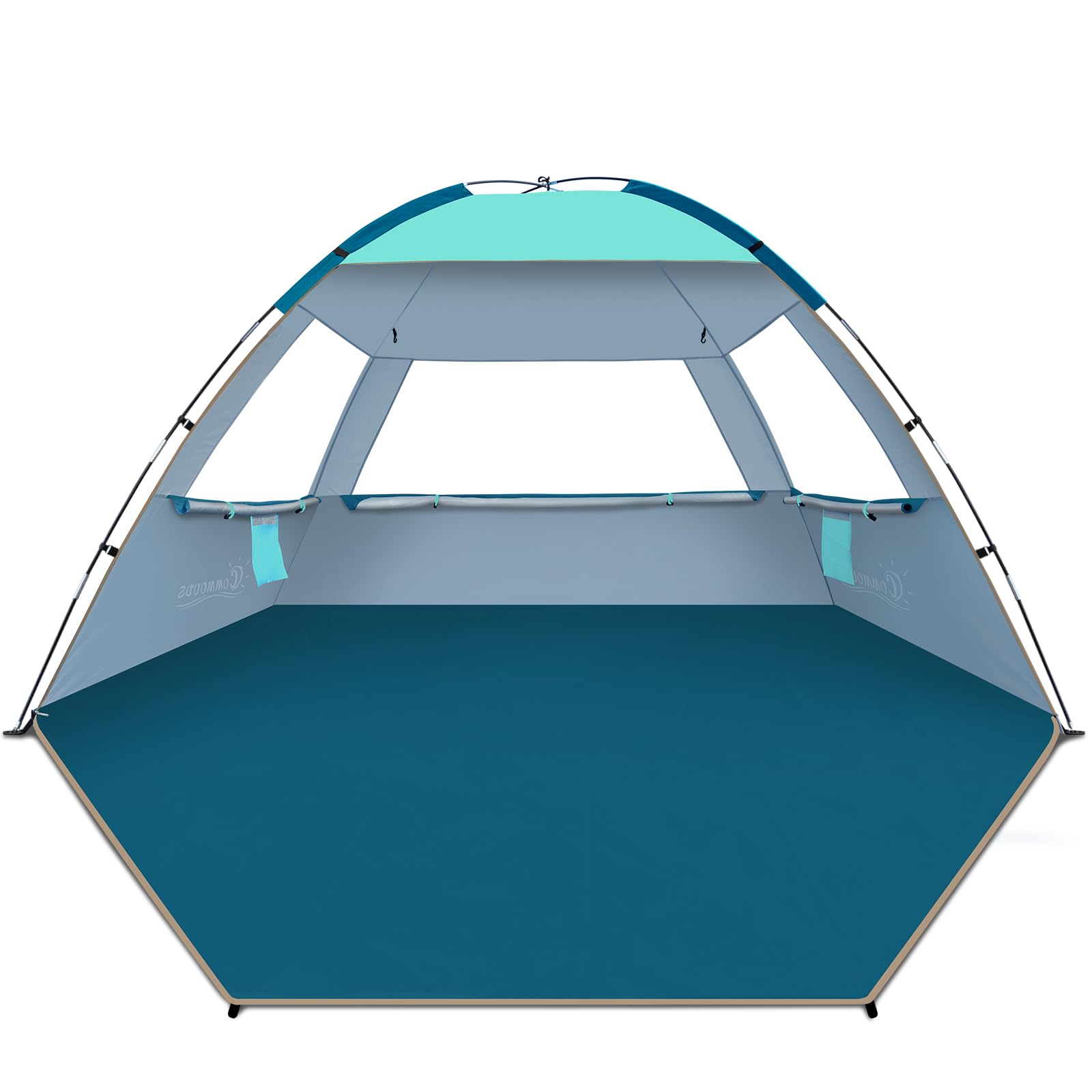
The COMMOUDS Beach Tent weighs just 4.85 pounds and folds to a package smaller than a rolled-up towel — 16.5 x 5.5 x 4.7 inches. This makes it the most portable option in the guide, designed for backpackers, public-transit travelers, or anyone who has to carry their shelter a long distance. Despite the light weight, the frame uses 8.5 mm fiberglass poles, the same thickness found on mid-range models, providing respectable wind resistance for a budget-friendly tent. The UPF 50+ silver coating blocks 98% of UV rays, and the 102.4 x 65 x 59.1-inch interior fits 4-5 people in a seated configuration.
The tent features three lockable mesh windows and a zippable front floor that can close for privacy during changing or napping. Setup is straightforward with two people — the instructions recommend a partner for easier assembly. The 40-inch extended front porch adds versatile space for shoes, bags, or a shaded play area. The carry bag is compact enough to strap to a backpack or stash in a carry-on suitcase.
The main compromises are in long-term durability: reports of frame breakage after three or four uses and missing corner hooks on some units indicate inconsistent quality control. The fiberglass poles, while thick, are not as well-anchored as the sandbag-heavy designs. For occasional beach days where portability is the top priority and you can handle a bit of DIY maintenance, the COMMOUDS delivers surprising value in a very small package.
Why it’s great
- Ultra-light 4.85 pounds with compact fold for backpack carry
- Thick 8.5mm fiberglass poles for a tent in this weight class
- Closed front floor provides privacy for changing and napping
Good to know
- Quality control issues reported with missing hardware and pole breakage
- Not designed for high-wind conditions without extra anchoring
- Better with two people for setup despite the lightweight design
7. YENGIAM Beach Canopy

The YENGIAM Beach Canopy provides the largest single coverage area in this guide at 11 x 11 feet or 121 square feet. This is a true canopy — open on all sides with a roof-only shade design, unlike the enclosed tents above. The structure uses four 0.8-inch metal poles with four large sandbags and four windproof ropes to create a triangular anchor geometry that resists wind lift. The Lycra fabric with UPF 50+ coating blocks harmful UV rays while allowing breeze to flow freely underneath, making it one of the coolest options for hot still days.
Setup is tool-free: spread the fabric, fill the sandbags, insert the poles, and tie down the ropes. The entire package weighs 10 pounds and packs into a backpack-style carry bag that’s easy to haul across sand. The open design is ideal for groups who want to socialize under shade without feeling trapped inside a tent — perfect for picnics, fishing trips, or large family gatherings where you need maximum coverage.
The trade-off is that metal poles with sandbag-only anchoring don’t hold up as well in sustained high winds as the fiberglass-frame pop-ups with full corner pockets. Multiple reports mention pole breakage on the first use, particularly when pushing the pole into hard sand. The stretchy fabric also creates a flapping issue in gusty conditions, and the gap between the canopy edge and sandbags can allow wind to get underneath. For calm-weather beach days with a large group, the YENGIAM offers unmatched coverage at a budget-friendly price, but it’s not the right choice for windy coastlines.
Why it’s great
- Largest coverage area at 121 square feet in this guide
- Open design allows maximum airflow underneath the shade
- Backpack carry bag makes transport convenient despite 10-pound weight
Good to know
- Metal poles prone to breakage when pushed into hard sand
- Stretchy fabric creates flapping issues in windy conditions
- Not suitable for sustained high-wind beach environments
FAQ
Can I use a regular camping tent as a beach canopy?
How do I clean a beach canopy after saltwater exposure?
What is the minimum pole thickness I should accept for beach use?
How many people can realistically fit under a 10×10 ft beach canopy?
Final Thoughts: The Verdict
For most users, the canopy tent for beach winner is the CoolCabanas Beach Shade Tent because its integrated 35-pound sand pockets provide unmatched wind resistance without requiring separate stakes or bags, plus the aluminum frame resists salt corrosion for long-term durability. If you want a built-in canopy extension for flexible shade configurations, grab the Elegear CumbreX. And for large group outings where coverage area is the priority, nothing beats the YENGIAM 11×11 ft Beach Canopy.

Mo Maruf
I created WellFizz to bridge the gap between vague wellness advice and actionable solutions. My mission is simple: to decode the research and give you practical tools you can actually use.
Beyond the data, I am a passionate traveler. I believe that stepping away from the screen to explore new environments is essential for mental clarity and physical vitality.