Our readers keep the lights on and my smoothie glass nicely filled. As an Amazon Associate, I earn from qualifying purchases.
The wax you choose dictates everything about a candle—how clean it burns, how well it holds scent, how long it lasts, and whether the surface finishes smooth or frosts over. One wrong selection means wasted fragrance, tunneling burns, or soot on your jars. The difference between a mediocre candle and a professional-grade one often comes down to a single melt point number or the origin of the soybeans.
I’m Mohammad Maruf — the founder and writer behind WellFizz. I spend my time dissecting wax chemistry, melting points, fragrance load capacities, and burn test data so you can skip the trial-and-error phase and pick the right material on the first order.
After comparing melt points, burn times, fragrance retention, and texture across five top contenders, I have assembled a focused guide to the best candle making wax for container candles, wax melts, pillars, and cosmetic applications.
How To Choose The Best Candle Making Wax
Three variables separate a frustrating first batch from a consistent, repeatable result: melt point, wax type, and format. Understanding these before you buy saves money and prevents failed pours.
Melt Point Determines Your Candle Style
Wax with a melt point between 120°F and 135°F works best in containers because it cools slowly and bonds to glass. Higher melt points around 145°F to 165°F suit pillars and tapers because the wax stands firm without a container. Using a low-melt wax in a pillar mold will likely cause collapse.
Soy vs. Paraffin vs. Beeswax
Soy wax offers clean burns, easy cleanup with soap and water, and excellent fragrance retention—ideal for beginners and scented container candles. Paraffin wax delivers stronger scent throw and a wider range of finishes (smooth, rustic, mottled) but burns with more soot. Beeswax provides the longest burn time and a natural honey aroma, though it costs more and carries a lower fragrance load capacity.
Flakes vs. Blocks vs. Slabs
Flakes melt faster and measure by volume without needing a scale, making them the most convenient format for frequent small batches. Blocks and slabs require cutting or breaking before melting, which adds prep time but can be more economical for bulk purchases. Bead form offers similar convenience to flakes with slightly less dust.
Quick Comparison
On smaller screens, swipe sideways to see the full table.
| Model | Category | Best For | Key Spec | Amazon |
|---|---|---|---|---|
| Candlewic Natural Soy Wax | Container Blend Soy | Container candles with strong hot throw | Melt point 121-125°F | Amazon |
| American Soy Organics Freedom Beads | Soy Wax Beads | Wax melts and scented tealights | Melt point 127-133°F | Amazon |
| Waxcanpy Natural Soy Wax Flakes | Soy Wax Flakes | Budget-friendly beginner projects | Melt point 120-140°F | Amazon |
| The Beeswax Co Pure Texas Beeswax Block | Beeswax Block | Food-grade balms and slow-burn candles | Food grade, natural honey scent | Amazon |
| Direct Candle Supply Fully Refined Paraffin | Paraffin Slabs | Pillar candles with mottled finishes | Low melt, pure paraffin | Amazon |
In‑Depth Reviews
1. Candlewic Natural Soy Wax, 10 lb. Bag

Candlewic delivers a purpose-built container blend with a tight 121-125°F melt point range, which is the sweet spot for jar candles that cool evenly and minimize air pockets. The 2% Universal Soy Wax Additive already mixed in improves adhesion to glass walls and reduces shrinkage, saving the step of buying separate additives. At 10 pounds, the bag splits into two 5-pound blocks that are easy to handle and microwave-safe in smaller chunks.
Testers consistently report exceptional hot throw—the scent releases strongly when the candle burns—and the ability to hold up to 15% fragrance oil without sweating or frosting. The wax melts fast in the microwave or double boiler, and beginners found it forgiving enough to produce smooth, professional-looking tops on their first attempt. Multiple verified purchasers mention switching from craft-store wax to Candlewic after a single batch because of the difference in burn consistency.
The only real trade-off is the lack of a flake or bead format, requiring you to cut or grate the blocks for precise measuring. But for anyone making regular container candles and prioritizing scent performance over convenience, this is the most technical soy wax blend available at this volume.
Why it’s great
- Pre-blended with wax additive for better glass adhesion
- Holds up to 15% fragrance oil for strong hot throw
- Tight melt point range ensures reliable container performance
- Burns slow and clean with minimal soot
Good to know
- Block format requires cutting before melting
- Works best in containers, not for pillar candles
2. American Soy Organics Freedom Soy Wax Beads, 10 lbs
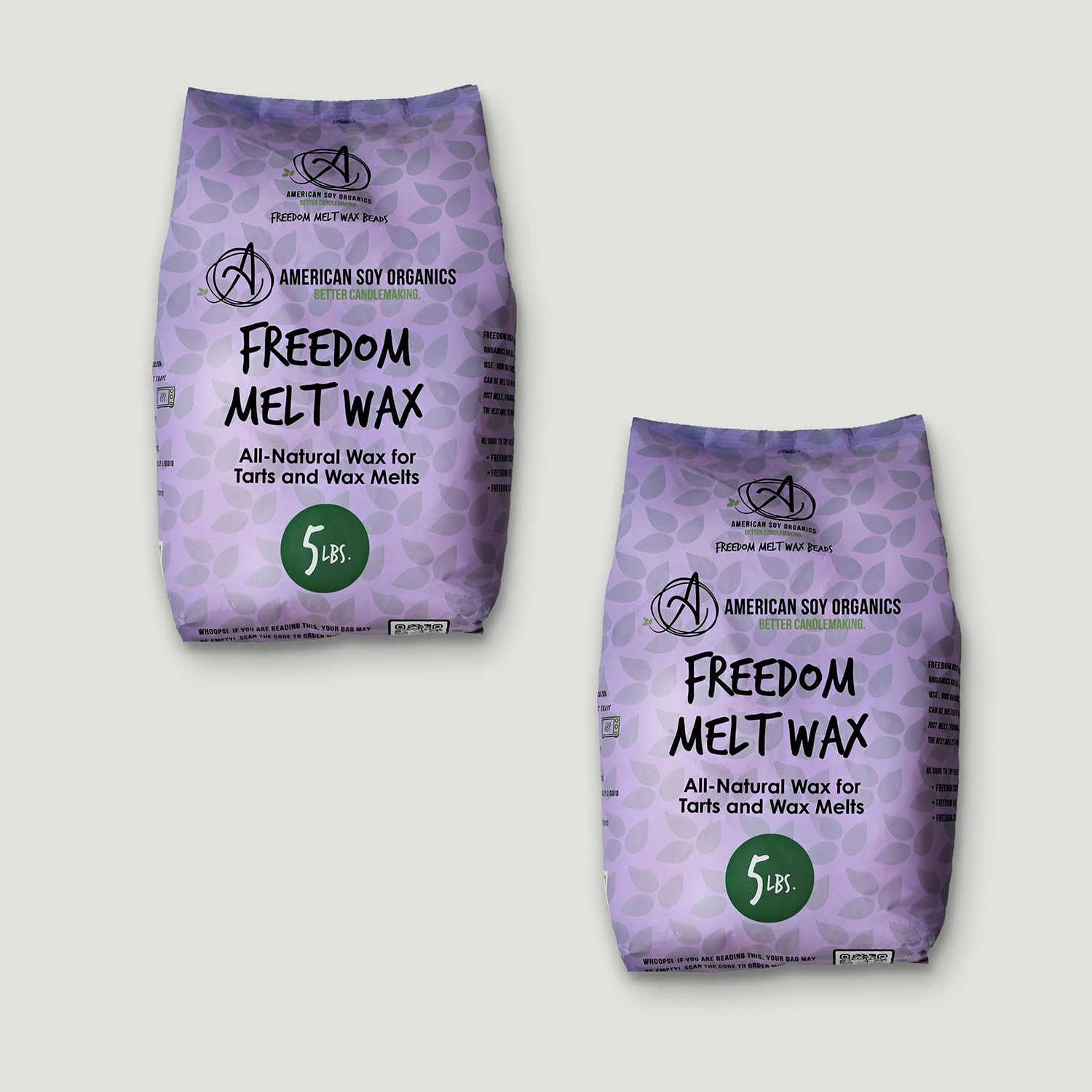
American Soy Organics shifts the format from block to bead, which eliminates the need to cut or grate wax before melting. The bead shape increases surface area, reducing melt time significantly compared to slabs. With a melt point of 127-133°F, this wax sits slightly higher than Candlewic, making it a better match for wax melts, tarts, and tealights where the wax needs to release fragrance from a warmer without puddling too fast.
The maximum fragrance load sits at 10% (1.6 ounces per pound), slightly lower than the Candlewic blend, but reviewers note that the scent retention is excellent over long periods—months-old melts still release fragrance when placed on a warmer. The beads melt uniformly with no hot spots, produce smooth tops, and require no filtering before pouring. Multiple users reported consistent results on their first attempt, and several experienced candle makers described this wax as their go-to for melt production because of the professional finish.
The higher melt point does mean this wax is less ideal for tall container candles where you want a slower, cooler burn. Stick with this for melts, tealights, and small jar candles where fragrance intensity is your priority.
Why it’s great
- Bead format melts fast with no cutting required
- Strong long-lasting fragrance retention for wax melts
- Smooth consistent tops with no frosting or sweating
- USA-sourced soy, paraffin-free and beeswax-free
Good to know
- 10% fragrance load is lower than some container blends
- Not ideal for deep jar candles or pillars due to higher melt point
3. Waxcanpy Natural Soy Wax Flakes, 10lb

Waxcanpy provides the most beginner-friendly entry point with its flake format and wide 120-140°F melt range, which covers both container and melt applications. The flakes pour easily into a measuring cup, melt in under three minutes in the microwave, and require no cutting, grating, or special tools. This makes the first batch significantly less intimidating for someone who has never worked with wax before.
The wax is unscented by design, allowing fragrance oils to shine without any background notes interfering. Testers report moderate shrinkage and minimal frosting, and the flakes produce clean-burning candles with noticeably less smoke than commercial store-bought alternatives. The flexibility in melting methods—microwave, double boiler, or dedicated wax pot—gives beginners room to experiment without committing to specialized equipment.
The trade-off for the lower price point is a broader melt range, which means results can vary slightly depending on pouring temperature and cooling conditions. Experienced makers may prefer a tighter melt point for consistency, but for cost-conscious users exploring candle making for the first time, this bag delivers reliable performance without the premium markup.
Why it’s great
- Flake format requires zero prep work before melting
- Wide melt range works for containers and melts
- No natural scent interference with added fragrance oils
- Very beginner-friendly with microwave-safe melting
Good to know
- Broader melt range can cause slight inconsistency
- Not formulated for high fragrance loads above 10%
4. The Beeswax Co Pure Texas Beeswax Block, 1lb

The Beeswax Co block is the only food-grade wax in this lineup, certified for direct contact with edibles and skin. The ultra-filtration process removes impurities down to pollen-grain size, leaving a clean yellow brick with a natural honey and wildflower aroma. This wax is not for scented candles—the natural scent is already strong enough to dominate most fragrance oils—but it excels in applications where purity matters, like lip balms, salves, butcher block conditioning, and sealing porous pottery.
The 1-pound block measures 5.25 inches by 2 inches and requires a knife or hammer to break into smaller pieces. Reviewers note that cutting is the only difficult part, but the payoff is a wax that burns significantly longer than soy or paraffin—beeswax has the highest melt point of common candle waxes, around 144-147°F, which translates to slow, drip-resistant candles that burn clean with negative ions that reduce indoor air pollutants. Multiple customers use it for infused balms and mention the domestic supply chain as a deciding factor.
The main limitation is volume: at 1 pound, this is a small quantity compared to the 10-pound soy bags. Frequent candle makers will need multiple blocks, and the higher price per pound makes beeswax a specialty choice rather than a production wax. But for anyone prioritizing food safety, burn duration, or natural materials, this is the purest option available.
Why it’s great
- Food-grade certification for balms and edible applications
- Ultra-filtered to pollen-grain purity for clean burn
- Natural honey scent without added fragrance
- American-sourced and ethically produced
Good to know
- Small 1lb block requires cutting before use
- Higher cost per pound than soy or paraffin
- Not suitable for scented candles due to strong natural aroma
5. Direct Candle Supply Fully Refined Household Paraffin, 10lb

Direct Candle Supply brings paraffin into the mix with a fully refined low-melt slab that ships in convenient small pieces rather than one massive block. Paraffin wax behaves differently from soy: it shrinks more when cooling, which creates the mottled or rustic finishes that soy cannot replicate. This characteristic makes it the top choice for pillar candles, votives, and tapers where the wax must hold its shape without a container.
The wax accepts dyes and fragrance oils readily, and reviewers report strong cold throw—the scent detectable before burning—along with solid hot throw during use. Some users mix this paraffin with crystal wax to create crackle effects, and others use it for wickless melts by adding strength to pillar formulas. The melting instructions specify a dedicated crock pot or double boiler, and the material is nontoxic when used as directed.
The primary concern with paraffin is the combustion byproducts: some reviewers note that paraffin can release trace chemicals when burned indoors. Mixing with soy or using only for melts mitigates this risk. This wax is explicitly not for spa uses because of the higher melt point, but for crafters seeking textured finishes, pillars, or cost-effective bulk production, it fills a role that soy simply cannot.
Why it’s great
- Enables mottled, rustic, and textured finishes
- Strong fragrance and dye absorption for vivid candles
- Ships in small slab pieces for easier handling
- Excellent for pillar candles and tapers without containers
Good to know
- Shrinks during cooling, requiring careful pouring
- Not recommended for spa use due to higher melt point
- Some users prefer mixing with soy to reduce indoor burn concerns
FAQ
Can I mix soy wax and paraffin in one candle?
Why do my soy candles get white spots or frosting on top?
What is the difference between wax flakes and wax beads?
Final Thoughts: The Verdict
For most users, the best candle making wax winner is the Candlewic Natural Soy Wax because the 121-125°F melt point, pre-blended additive, and 15% fragrance load capacity deliver consistent container candles with professional hot throw on the first pour. If you want a fast-melting bead format for wax melts, grab the American Soy Organics Freedom Beads. And for textured pillars or mottled finishes that soy cannot achieve, nothing beats the Direct Candle Supply Paraffin.

Mo Maruf
I created WellFizz to bridge the gap between vague wellness advice and actionable solutions. My mission is simple: to decode the research and give you practical tools you can actually use.
Beyond the data, I am a passionate traveler. I believe that stepping away from the screen to explore new environments is essential for mental clarity and physical vitality.