Our readers keep the lights on and my smoothie glass nicely filled. As an Amazon Associate, I earn from qualifying purchases.
A dead zone where your phone shows “No Service” is exactly where a reliable two-way radio earns its place in your pack. Unlike cell signals that fade the moment you hit a valley or a dense tree line, a purpose-built FRS or GMRS unit keeps your group linked across ridges, riverbanks, and remote campsites where voice clarity matters more than data bars.
I’m Mohammad Maruf — the founder and writer behind WellFizz. I’ve spent thousands of hours dissecting FCC compliance sheets, battery discharge curves, and real-world range reports to separate marketing claims from gear that actually performs when you need it most.
The quiet reality is that the advertised miles often drop to a fraction in forest cover or hilly terrain, which is why choosing the right camping walkie talkie comes down to water resistance, battery endurance, and how many watts you can legally push without a license.
How To Choose The Best Camping Walkie Talkie
A camping radio isn’t a single-purpose device — the right choice depends on whether you’re hiking a mountain ridge, base camping with kids, or working a backcountry job site. The specs that matter most shift with the terrain and how long you plan to stay out.
License vs License-Free Operation
FRS radios require no license and cap output at 2 watts, which is sufficient for most family camping within a mile or two. GMRS radios can legally transmit up to 50 watts but require an five-year FCC license that covers your whole household. If you think you might want repeater capability for extended range in hilly areas, go GMRS — otherwise FRS keeps things simple and legal out of the box.
Battery Endurance in Cold Conditions
Lithium-ion cells lose capacity below freezing. A radio rated for 20 hours of moderate use at room temperature may only deliver 10 to 12 hours in a 20°F forest. Look for radios with at least 1800mAh to 2000mAh battery packs if you’re planning multi-day trips, and always carry a portable USB-C power bank as a backup charging option.
Water and Drop Resistance
IP54 means protection against splashes and light rain, which covers most car camping. IP67 means the unit can survive submersion up to a meter for 30 minutes — critical for kayak trips, river crossings, or heavy downpours. MIL-STD-810H certification adds validated drop protection from 2 meters, so you don’t have to baby the radio on rocky terrain.
NOAA Weather Alerts
A dedicated NOAA weather scan feature automatically tunes into the nearest National Weather Service broadcast and issues alerts for storms, flash floods, or tornado warnings. For anyone camping in mountainous areas or near large bodies of water where weather can shift fast, this feature can be the difference between packing up early or getting caught unprepared.
Quick Comparison
On smaller screens, swipe sideways to see the full table.
| Model | Category | Best For | Key Spec | Amazon |
|---|---|---|---|---|
| Retevis RB48 | Premium FRS | Wet & rugged terrain | 2000mAh / IP67 / MIL-STD-810H | Amazon |
| Rocky Talkie Mountain Radio | Premium FRS | Backcountry alpine use | 4-day battery / 2W max / IP56 | Amazon |
| Midland GXT3000 | GMRS | Extended range & base camp | 50 channels / repeater capable | Amazon |
| NXGKET ZX-808 | Mid-Range FRS | Family camping & cruises | 1800mAh / NOAA / 9-level VOX | Amazon |
| BAOFENG T18 | Value FRS | Budget family 4-pack | 1500mAh / NOAA / dual PTT | Amazon |
| JIANUA T8 | Value FRS | Farm & open-field use | 1200mAh / 99 privacy codes / 5-mi claim | Amazon |
| HAOO 610B | Specialty Mini | Biking & umpiring | 0.7 oz / IP54 / 12-hr continuous | Amazon |
In‑Depth Reviews
1. Retevis RB48 FRS Walkie Talkies
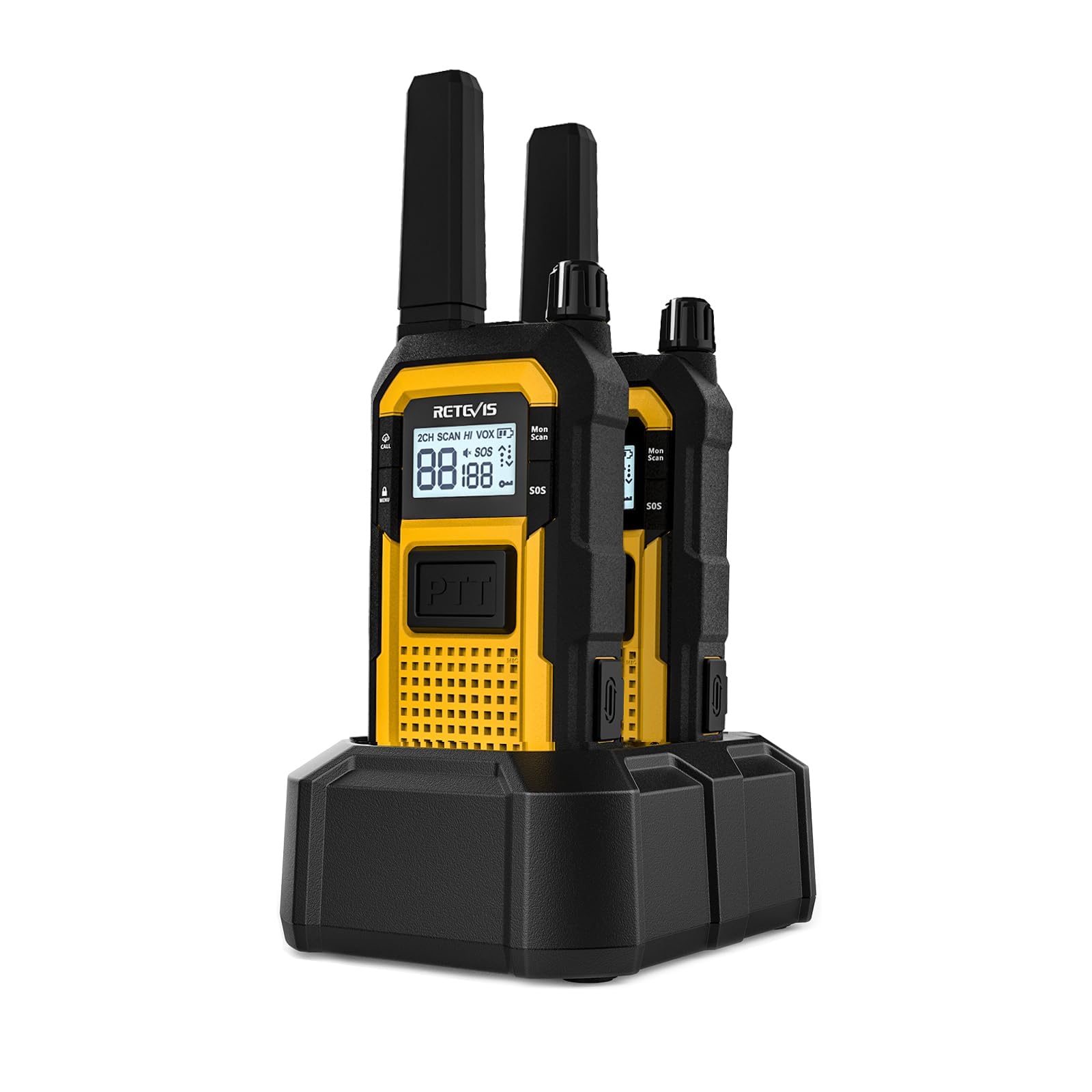
The Retevis RB48 is built around MIL-STD-810H drop certification and IP67 sealing, meaning it survives 2-meter falls onto rock and full submersion in a meter of water for 30 minutes. That level of protection is rare at this power tier — most radios in the same price bracket top out at IP54 splash resistance. The 2000mAh Li-ion battery delivers roughly 18 to 20 hours of mixed use, which covers a full weekend without needing a recharge, and the dual charging method (USB-C cable plus a 2-in-1 charging dock) keeps both units topped off overnight.
The high-visibility bright yellow housing makes it easy to spot if dropped in grass or snow, and the silicone-covered buttons and dual-PTT design work reliably with gloves on. For kayakers, canoeists, or anyone camping near rivers and lakes, the fact that this radio floats is a safety feature that cheaper units simply do not offer. Audio clarity is clean enough for loud environments, though the fixed speaker can sound slightly compressed at maximum volume compared to larger GMRS rigs.
Out of the box, the RB48 is pre-programmed on standard FRS channels with 121 privacy codes and NOAA weather scan — no manual tuning required. The roger beep can be turned off to avoid annoying your hiking partner. If your camping trips regularly involve rain, river crossings, or rocky terrain, this is the most durable FRS radio you can buy without stepping up to a commercial-grade unit.
Why it’s great
- Genuine IP67 waterproof and floats — safe for kayak and river use
- 2000mAh battery lasts a full weekend between charges
- MIL-STD-810H drop-tested to 2 meters without damage
Good to know
- Display scratches easily with fingernail pressure
- Menu button required to change channels — no dedicated knob
2. Rocky Talkie Mountain Radio
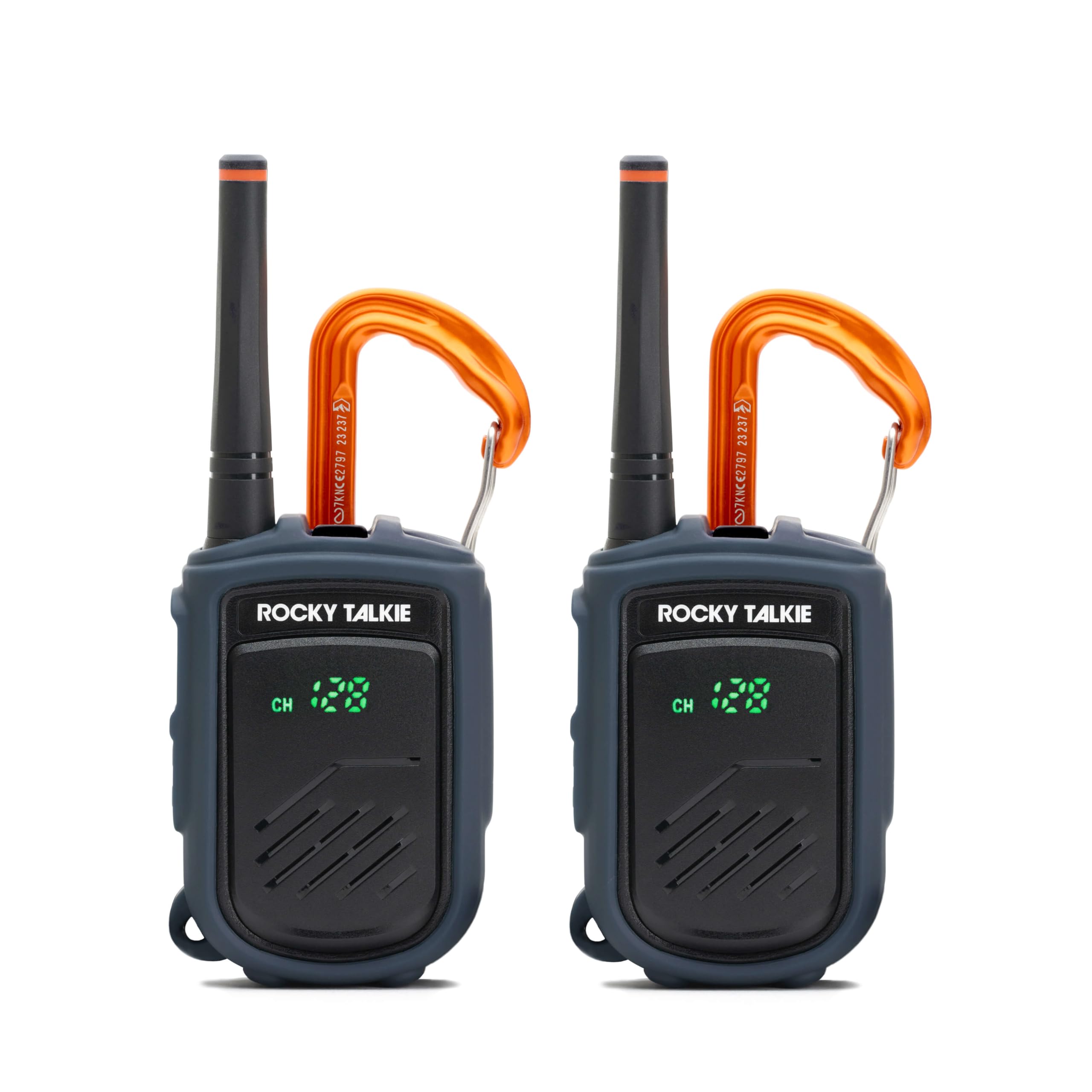
The Rocky Talkie Mountain Radio was designed specifically for climbers, skiers, and alpine backpackers who need a radio that survives subzero temperatures and rough handling. Its shatterproof LED screen and thermoplastic rubber armor absorb impacts that would crack a standard LCD, and the metal-reinforced backup leash plus a climbing-rated carabiner means you can clip it directly to a harness or pack strap without worrying about a broken belt clip. The 2-watt FRS output is the legal maximum for license-free use, and real-world backcountry range typically lands between 1 and 5 miles depending on terrain.
Battery life is the defining spec here — a specialized lithium-ion pack provides over four days of moderate use in cold conditions, which is roughly double what most 2000mAh radios deliver. The radio also ships with a low-power mode that stretches battery further when you are communicating across short distances. The IP56 rating handles snow and splashes, though it is not designed for submersion like the Retevis RB48. Audio is crisp even when the unit is stuffed inside a jacket pocket, and the five-button interface requires zero menu-diving.
What you give up is NOAA weather alerting — the Mountain Radio does not scan weather channels, so you will need a separate weather radio or phone app for storm warnings. The 128 sub-channels provide plenty of privacy, but there is no vibrate alert or adjustable VOX, which may disappoint users accustomed to those features. If technical alpine objectives are your primary use case, the build quality and cold-weather battery performance make this the most purpose-built option available.
Why it’s great
- Four-day battery in freezing conditions — unmatched for multi-day trips
- Shatterproof display and rubberized armor survive rock and ice impacts
- Climbing-rated carabiner clip eliminates fragile plastic clip failures
Good to know
- No built-in NOAA weather scan or alert feature
- Urban range drops significantly — best suited for open backcountry
3. Midland GXT3000 GMRS Two-Way Radio
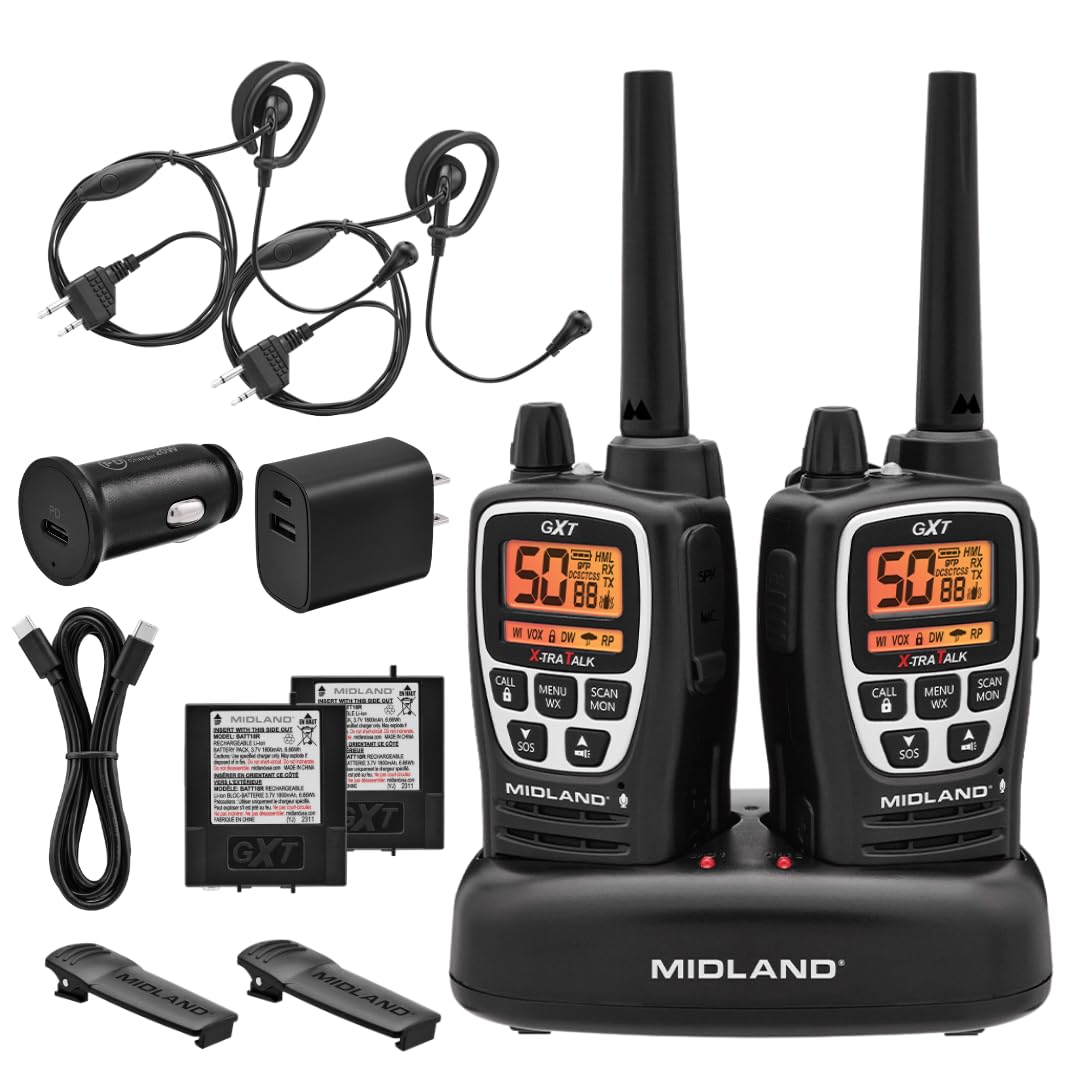
The Midland GXT3000 is a 50-channel GMRS radio that unlocks higher power output and repeater capability compared to FRS-only units. With an FCC license, you can access the full GMRS band and take advantage of repeater towers that extend your range well beyond the typical 2-mile line-of-sight limit — especially useful for base camp communication in rolling or forested terrain. The lithium-ion pack delivers roughly 18 hours of mixed-use runtime, and the ability to swap in standard AA alkaline batteries as a backup means you are never stranded without power even if the rechargeable pack dies.
NOAA weather scan is built in and automatically alerts you to severe weather, which is a welcome safety net for exposed campsites. Audio quality is very good for a handheld GMRS radio — voices come through clearly with minimal sibilance, and the dual-band receive lets you monitor two channels simultaneously. Users consistently report reliable communication at 1.5 to 3 miles in moderately wooded areas, and up to 8 miles on flat open ground. The bundled earpieces, however, are a weak point — the hard plastic shell and poorly positioned mic require you to speak loudly, and most reviewers recommend upgrading to a better aftermarket headset.
Channel management is straightforward, though the included manual has tiny font that makes initial setup tedious. The screen can discolor in high heat above 90°F, so avoid leaving it on a dash in direct sun. For group camping trips where you need a robust base-station radio with extended range and backup battery flexibility, the GXT3000 offers the most capability in its class.
Why it’s great
- Repeater-compatible for dramatically extended range in hilly terrain
- Dual power — rechargeable Li-ion plus standard AA backup
- NOAA weather alerts with automatic severe-weather scanning
Good to know
- Requires FCC GMRS license for full power and repeater use
- Bundled earpieces are uncomfortable and poorly designed
4. NXGKET ZX-808 Walkie Talkies
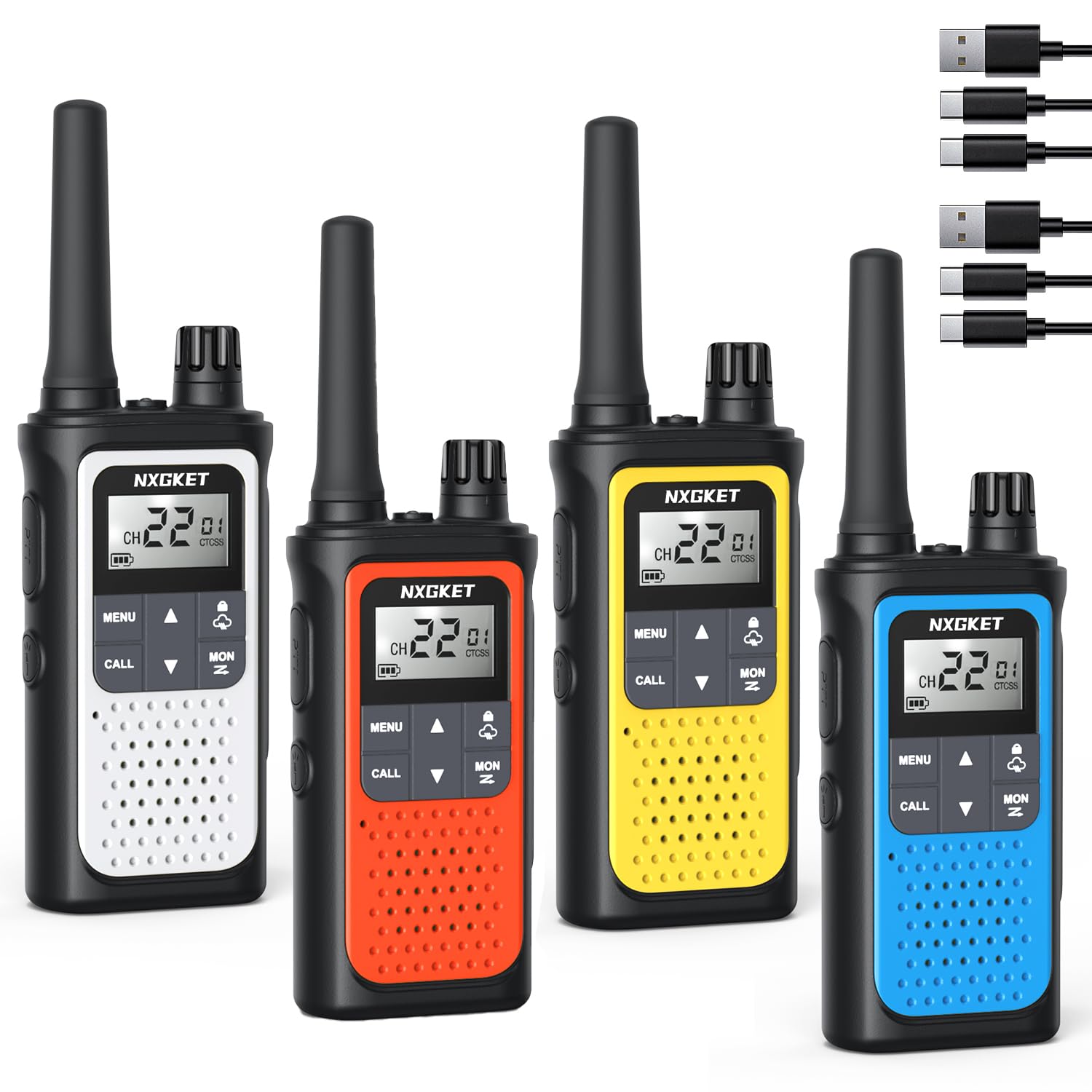
The NXGKET ZX-808 packs features usually reserved for radios costing twice as much: 1800mAh built-in lithium battery, NOAA weather scan with alert, and 9-level adjustable VOX for hands-free operation. The battery holds a charge for three to four days of light use, and the 2-in-1 USB-C cable charges two radios simultaneously from a single port — convenient when you are running off a power bank at camp. The bright multi-color housing improves visibility if you set it down in leaves or snow.
Range in open terrain reaches the advertised 5-mile claim under ideal line-of-sight, but in forested conditions expect the typical 0.6 to 1.5 miles. The upgraded speaker boosts maximum volume by 150% compared to older NXGKET models, which helps in windy conditions or near running water. The 121 privacy codes pair with 22 FRS channels to give over 2,600 combinations, making it easy to find a clear channel even in crowded campgrounds. The auto-squelch works well to filter out background hiss, and the drop-protection design has survived waist-height falls onto packed dirt in user reports.
The biggest limitation is the lack of a removable battery — when the internal cell eventually wears out after a few hundred charge cycles, the radio itself is effectively end-of-life. Audio clarity in very loud environments like highway-adjacent job sites is merely average, with some users noting the speaker maxes out too early. For family camping, cruise excursions, and general outdoor use where you want NOAA alerts and long battery life without spending premium money, the ZX-808 delivers exceptional value.
Why it’s great
- NOAA weather scan and alert at a mid-range price point
- 1800mAh battery lasts 3-4 days with normal camping usage
- Bright colored shells easy to spot in outdoor environments
Good to know
- Battery is non-removable — radio lifespan limited to battery cycle count
- Speaker lacks headroom for very loud environments
5. BAOFENG T18 Long Range Walkie Talkies
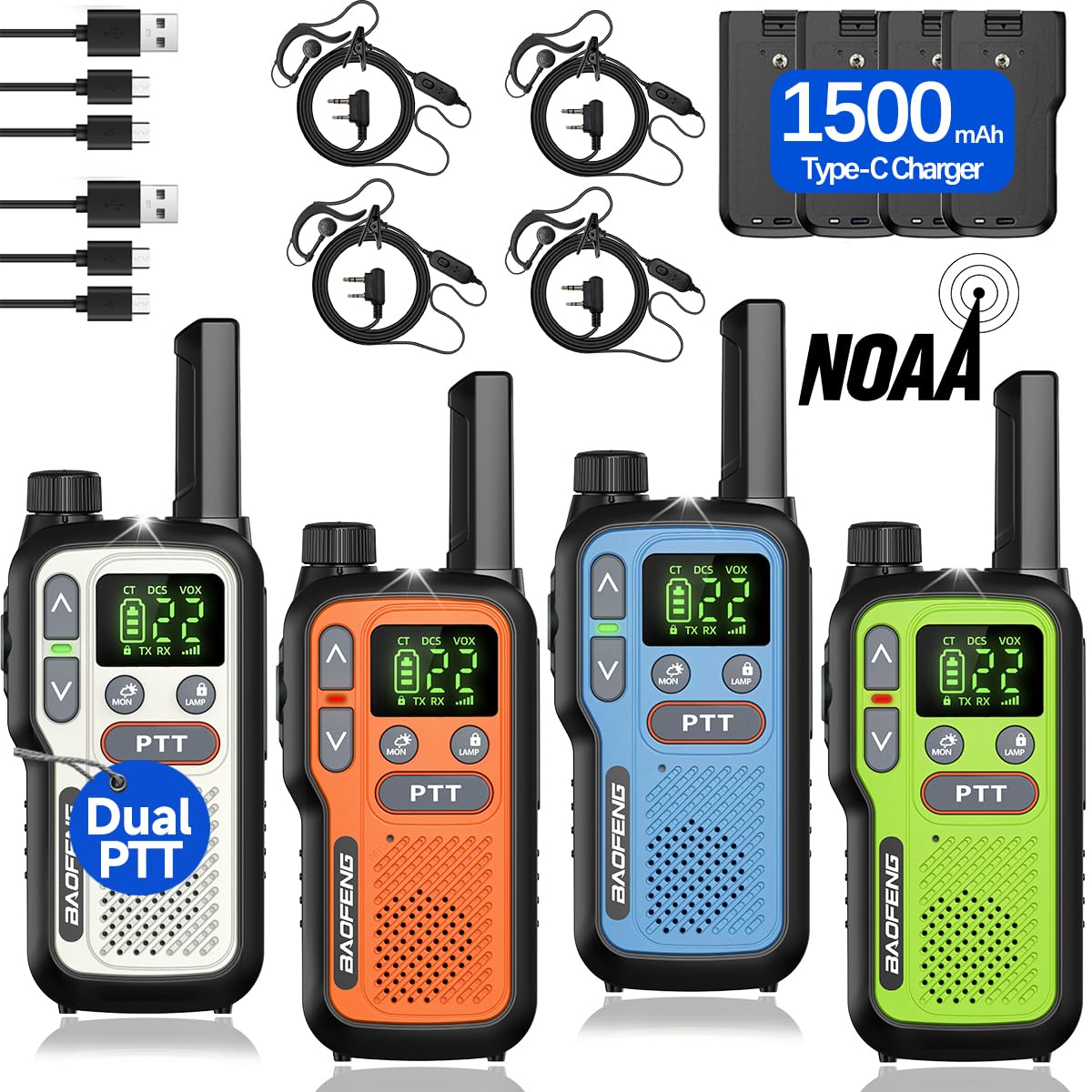
The BAOFENG T18 is a 4-pack FRS radio designed for families who want a set that works straight out of the packaging without any programming. Each unit ships with a 1500mAh lithium battery, a headset, a belt clip, and a lanyard — everything needed to equip four people for a weekend trip. The 22 FRS channels plus NOAA weather alert give you basic functionality without the complexity of privacy codes or menu settings. The dual PTT buttons on the side and top allow natural one-hand operation regardless of how you grip the radio.
Range in open areas like beaches or farmland reaches about 2 to 3 miles, but in forested terrain that drops to around 0.5 to 1 mile. The built-in flashlight is surprisingly useful for late-night tent setup or finding your way to the bathroom without fumbling for a headlamp. Audio clarity is good for the price tier — voices are loud and clear, though there is noticeable background hiss in areas with high RF interference. The VOX function works reliably at level 2 or 3, making it functional for hands-free use during bike rides or while cooking at camp.
Build quality is adequate for family use but not rugged — the plastic housing feels thin, and the belt clip can snap under heavy use. The orange, green, blue, and white color options make it easy to assign each family member their own unit. If you need a simple, low-cost set to keep kids connected on a campground or during a cruise and you do not expect heavy abuse, the T18 provides a fully functional kit at a very accessible price.
Why it’s great
- Complete 4-pack with headsets, clips, and lanyards included
- NOAA weather alert and flashlight add safety at night
- Dual PTT positions accommodate left and right hand use
Good to know
- Plastic housing feels less durable than premium alternatives
- Range in forest cover drops below 1 mile
6. JIANUA T8 Rechargeable Walkie Talkies

The JIANUA T8 offers 22 FRS channels with 99 CTCSS privacy codes, giving a total of 2,178 possible combinations to block out other conversations on crowded channels. This makes it a solid choice for group camping trips where multiple parties might be operating nearby. The 1200mAh battery is smaller than most competitors — expect 8 to 12 hours of continuous use and up to 96 hours of standby — but USB-C charging via the included cables keeps downtime relatively short. The pocket-sized form factor and wrap-around metal belt clip make it easy to carry all day without noticing the weight.
Range is listed at 5 miles in open areas, and real-world performance on a 100-acre farm with scattered tree cover proved reliable across the entire property. In forested or urban settings, expect the typical drop to 0.6 to 1.2 miles. The drop-proof and rainproof design handles light showers without issue, though it is not rated for submersion. The VOX has three adjustable levels, and the LCD backlight makes nighttime operation straightforward. Audio quality is clear enough for family communication, though not as loud as units with larger speakers like the NXGKET ZX-808.
The belt clip has drawn complaints from multiple users who wish it were stronger or included a lanyard for redundancy. The lack of a neck strap in the box is an oversight for users who need to keep hands free. If you are primarily using the radios on a farm, ranch, or other open property where range matters more than waterproofing, the T8 delivers dependable communication at an entry-level price.
Why it’s great
- 99 CTCSS privacy codes block interference from other groups
- Compact and lightweight — pocket-sized with wrap-around clip
- USB-C charging with 8-12 hours of continuous runtime
Good to know
- Belt clip is fragile and no lanyard included for backup
- 1200mAh battery is smaller than mid-range competitors
7. HAOO 610B Mini Walkie Talkies
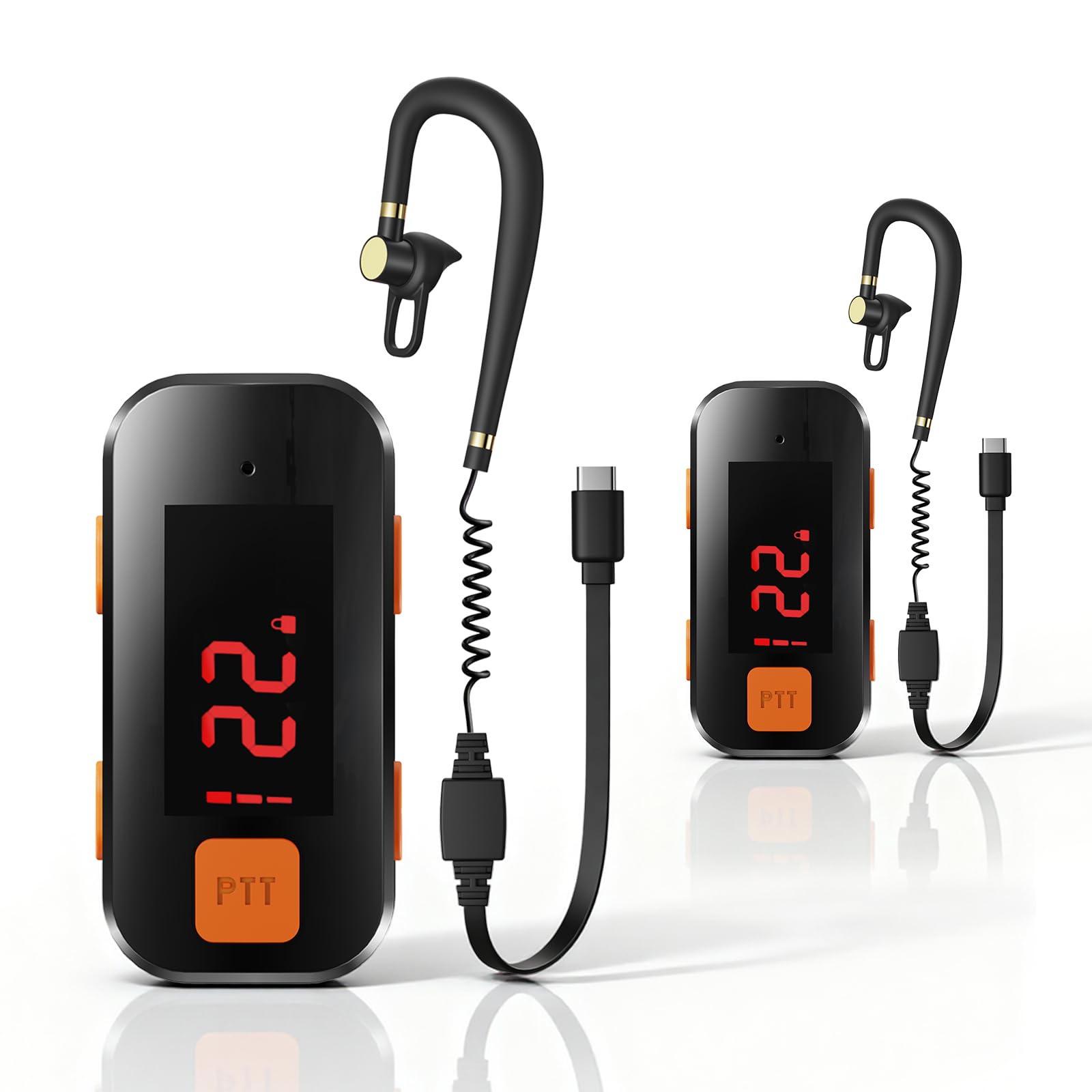
The HAOO 610B is a radical departure from traditional walkie-talkie design — it weighs only 0.7 ounces and measures just 2 inches tall, with the external speaker and microphone integrated into the antenna-earpiece assembly. There is no body speaker; you must wear the included rotating earpiece to communicate, which makes it essentially a wireless headset with a transmit function. This form factor is ideal for cyclists, umpires, restaurant staff, or anyone who needs continuous hands-free communication without carrying a bulky radio on their belt.
Battery life is surprisingly capable for such a tiny unit — a smart GaN chip and efficient power management deliver up to 12 hours of continuous use and 48 hours of standby on a single charge via USB-C. The IP54 rating protects against sweat and light rain, so it survives bike rides and outdoor work shifts without issue. The beep prompt design plays a tone when the other party finishes transmitting, signaling when it is your turn to speak — a useful feature in noisy environments where you cannot see a PTT indicator. The 360-degree rotating earpiece comes with three sizes of silicone tips for a secure fit.
Range tops out at about 1 to 2 miles in open areas, but heavy tree cover or building walls reduce that significantly — the radio is not designed for deep backcountry use. The tiny buttons are hard to read without glasses, and the fixed-volume beep cannot be adjusted. For specialized use cases like bike touring, baseball umpiring, or warehouse coordination where size trumps raw range and everyone is within a mile, the HAOO 610B is the most discreet and lightweight option on the market.
Why it’s great
- Extremely lightweight at 0.7 oz — barely noticeable on the ear
- 12-hour continuous battery life for full-day use
- IP54 waterproofing handles rain and sweat during sports
Good to know
- No external speaker — requires earpiece to hear or talk
- Range drops sharply in wooded or interference-heavy areas
FAQ
Do I need a license to use a camping walkie talkie on FRS channels?
Why does my walkie talkie range drop so much in the woods?
What is the difference between CTCSS privacy codes and actual channel privacy?
Can I use walkie talkies from different brands together?
Final Thoughts: The Verdict
For most users, the camping walkie talkie winner is the Retevis RB48 because its IP67 waterproofing, MIL-STD-810H durability, and 2000mAh battery cover the widest range of outdoor conditions without requiring a license. If you want a backcountry-specific radio with four-day battery life and shatterproof construction for technical alpine use, grab the Rocky Talkie Mountain Radio. And for base-camp communication with repeater extension and AA battery backup, nothing beats the Midland GXT3000.

Mo Maruf
I created WellFizz to bridge the gap between vague wellness advice and actionable solutions. My mission is simple: to decode the research and give you practical tools you can actually use.
Beyond the data, I am a passionate traveler. I believe that stepping away from the screen to explore new environments is essential for mental clarity and physical vitality.