Our readers keep the lights on and my smoothie glass nicely filled. As an Amazon Associate, I earn from qualifying purchases.
Nothing ruins a backcountry meal faster than a stove that sputters out in a light breeze or takes forever to boil water after a long day on the trail. The right camping stove delivers consistent, controllable heat regardless of the weather, turning dehydrated ingredients into a hot, comforting meal without frustration.
I’m Mohammad Maruf — the founder and writer behind WellFizz. My research focuses on dissecting BTU output, fuel efficiency, and regulator technology to find the stoves that actually perform as advertised.
Whether you need a featherweight setup for solo thru-hikes or a high-output dual burner for basecamp feasts, the best camping stove balances portability with reliable heat and precise flame control.
How To Choose The Best Camping Stove
Selecting the right stove comes down to your cooking style, typical trip duration, and the conditions you face. A weekend car camper has very different requirements than a long-distance backpacker, and the wrong choice can mean wasted fuel or hours of hunger.
Fuel Type and Temperature Performance
Propane stoves deliver consistent output even in freezing temperatures, making them ideal for winter car camping and basecamps. Butane is cheaper and burns cleanly above 32°F, but the gas stops vaporizing below that threshold — which is why dual-fuel models that accept both fuels offer year-round flexibility. For ultralight backpacking, isobutane-propane blends maintain pressure in cold conditions better than pure butane, though they still lag behind propane in deep cold.
BTU Output vs. Real-World Efficiency
High BTU numbers grab attention, but a stove with 15,000 BTUs can boil water faster than a 20,000 BTU model if it has a well-designed burner head and a pressure regulator. The regulator sustains consistent output even as the canister level drops or the temperature falls, preventing the frustrating “dying flame” effect that plagues unregulated stoves. Look for a regulated design if you ever cook at altitude or in cold weather.
Stability and Pot Support Geometry
A stove that tips when you stir a full pot is dangerous. Check the spread of the pot supports — wide, triangular or multi-prong supports grip large pans more securely. For multi-burner models, measure the spacing between burners: tightly packed burners limit the size of cookware you can use simultaneously. Non-slip feet and a low center of gravity also improve stability on uneven ground or picnic tables.
Wind Resistance and Ignition Reliability
Wind is the most common performance killer for outdoor stoves. Built-in wind blockers or integrated burner head designs that shield the flame from gusts make a bigger difference than you’d think. On the ignition side, a reliable piezo or push-start system eliminates the need for matches or lighters — but some cheap igniters fail after a few trips, so check user feedback on long-term durability before relying on them exclusively.
Quick Comparison
On smaller screens, swipe sideways to see the full table.
| Model | Category | Best For | Key Spec | Amazon |
|---|---|---|---|---|
| Coleman Classic 3-Burner | Premium Multi-Burner | Car Camping & Family Meals | 28,000 Total BTU | Amazon |
| Jetboil Flash | Premium All-in-One | Ultra-Fast Boil & Solo Trips | Boils 16 oz. in 2 Minutes | Amazon |
| Gas One B-5000WS | Premium High-Pressure | Large Pot Cooking & Tailgating | Adjustable 0-5 PSI Regulator | Amazon |
| MSR PocketRocket Deluxe | Mid-Range Ultralight | Backpacking & Cold Weather | 2.9 oz. with Pressure Regulator | Amazon |
| WLSINJL 2-Burner | Mid-Range Value Set | Complete Kit & Easy Setup | 17,000 Total BTU | Amazon |
| Cofiyard 2-Burner | Budget Dual Burner | Compact Dual Cooking | 20,000 Total BTU | Amazon |
| GasOne GS-3900PB-1 | Budget Dual Fuel | Versatile Fuel Flexibility | 15,000 BTU Single Burner | Amazon |
In‑Depth Reviews
1. Coleman Classic 3-Burner Propane Stove

The Coleman Classic 3-Burner is the benchmark for family-sized camp cooking, delivering 28,000 total BTUs spread across three independent burners. The burner spacing is generous enough to handle two 12-inch pans or three 8-inch pans simultaneously, which makes cooking a full breakfast or a multi-pot dinner entirely feasible at a single site. The wind-blocking panels fold down to create side tables, adding useful prep space that other stoves lack.
Pressure-control technology maintains consistent flame output even when the propane tank is near empty or the mercury drops, preventing the frustrating flicker that cheaper stoves develop. The InstaStart push-button ignition lights reliably without matches, and the entire cooking grate lifts off for straightforward cleanup after a greasy meal. At roughly 19 pounds, it’s not a backpacking tool — it’s built for car camping, tailgating, and basecamp scenarios where weight isn’t the primary concern.
The regulator hose exits the right rear of the unit, which forces the propane cylinder to sit behind the stove, increasing the overall footprint on a picnic table. Some users add an extension hose to reposition the tank more flexibly. The low-flame control isn’t as fine as on premium two-burner stoves, but the even heat distribution and impressive warranty support make this a solid long-term investment for group cooking.
Why it’s great
- Three-burner layout fits large family cookware easily
- Wind-blocking panels double as side tables
- Pressure regulator maintains steady output in cold weather
Good to know
- Regulator position forces tank behind stove
- Low-flame simmer control is less precise than premium two-burners
- Heavier design is car-camp only, not backpackable
2. Jetboil Flash Portable Stove
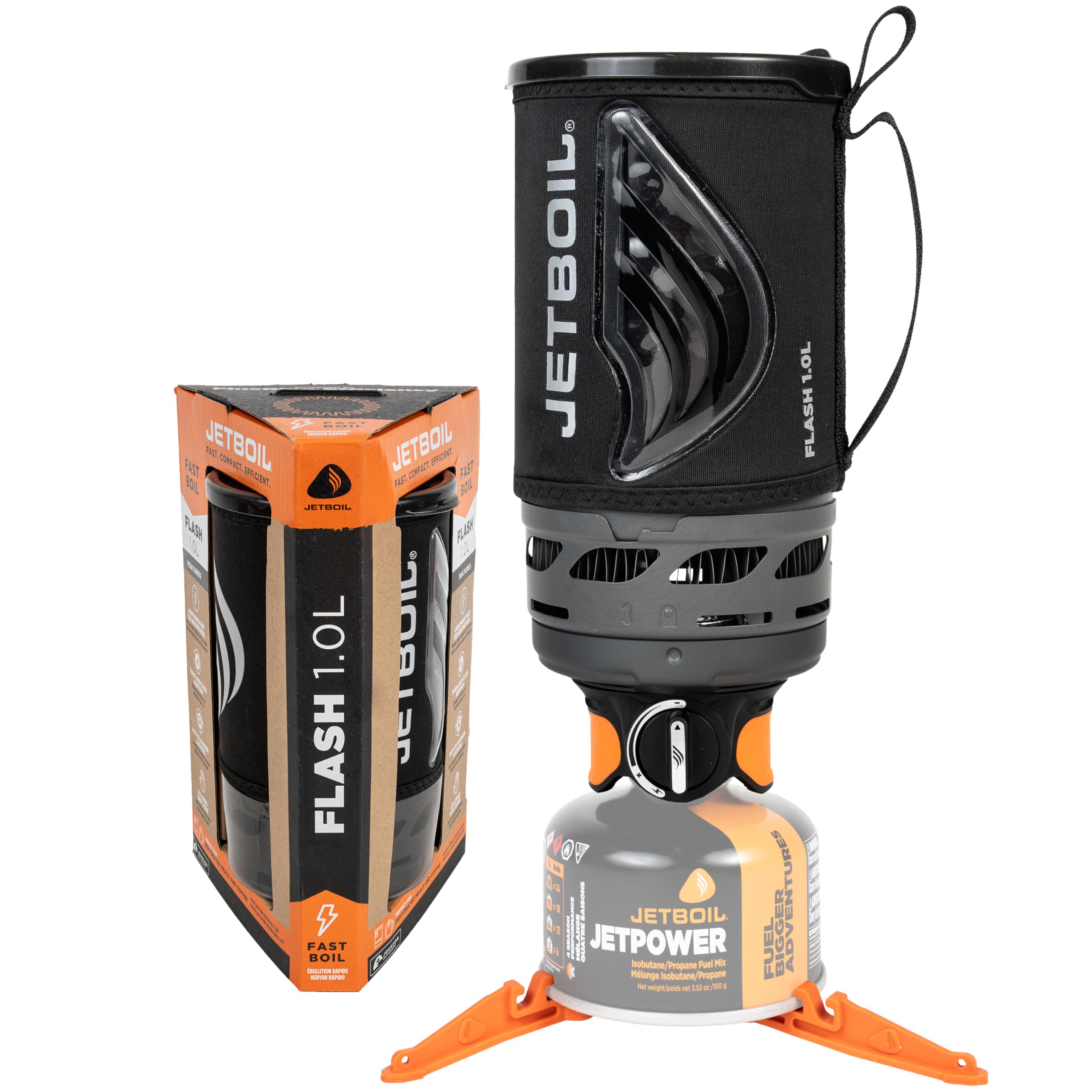
The Jetboil Flash redefines “fast” for solo campers, boiling 16 ounces of water in just two minutes thanks to the flux-ring heat exchanger that channels flame energy directly into the cup walls. The integrated 1-liter cooking cup, insulating cozy, and bottom measuring cup nest together with the burner and a 100g fuel canister inside, creating a self-contained system barely bigger than the cup itself. The one-step auto ignition works like a home stove knob — turn and click, no match required.
The Safe-Touch rubberized zones stay cool during operation, providing a secure grip even when the contents are at a rolling boil. The three-point locking system with visual indicators gives a confident click when the pot is properly seated, eliminating the wobble that afflicts screw-on designs. Fuel efficiency is exceptional; the FluxRing captures heat that would otherwise escape around the sides, meaning you get more boils per canister than with a standard open-flame stove.
This system is optimized for boiling water and simple rehydration — if you want to simmer sauces or pan-fry, the narrow pot shape and focused flame make that difficult. The 100g canister must be purchased separately, and the total cost positions this as a premium tool for backpackers who prioritize boil speed over cooking versatility. For freeze-dried meals and instant coffee, nothing in this class is faster.
Why it’s great
- Industry-leading 2-minute boil time
- Compact nesting design saves pack space
- Auto ignition and secure locking system
Good to know
- Narrow cup limits cooking to boiling and rehydration
- Fuel canister sold separately
- Premium price point for a single-person system
3. Gas One B-5000WS Propane Double Burner

The Gas One B-5000WS is built for serious outdoor cooking where standard camp stoves fall short — think deep-frying fish, boiling tamale pots, or running a massive stockpot for hours. The adjustable 0-5 PSI regulator connected via a 4-foot steel braided hose delivers an extremely wide range of flame control, from a gentle simmer to a roaring blast that rivals a home wok burner. Each burner has its own heat dial, so you can run one side low for sauce while the other goes full-throttle for searing.
Construction is rugged: alloy steel body with cast-iron burner heads, removable legs for transport, and included windscreen that shields the burners from cross drafts. The unit stands at a comfortable cooking height on its legs, eliminating the need to crouch over a picnic-table stove. While the windscreen helps with side gusts, the bottom of the burner is exposed, so wind coming from below can still affect flame stability on extremely breezy days — some users add a plywood or metal base to block it.
At 27 pounds, this is a heavy-duty appliance meant for tailgate parties, basecamp kitchens, and backyard off-grid cooking, not for packing into a canoe. The lack of a carrying case as a standard inclusion (some listings vary) is a minor oversight given the weight. The steel braided hose adds a layer of safety and durability compared to rubber hoses that crack over time. For anyone who needs restaurant-quality heat outdoors, this is the most capable dual-burner in the lineup.
Why it’s great
- Adjustable PSI regulator offers extreme flame range
- Steel braided hose is safer and more durable than rubber
- Removable legs and windscreen for semi-portable cooking
Good to know
- 27-pound weight is not portable for hiking
- Bottom of burner exposed to wind
- Carrying case not always included in packaging
4. MSR PocketRocket Deluxe

The MSR PocketRocket Deluxe weighs just 2.9 ounces and folds down to a package that fits inside a 700-milliliter cup alongside a fuel canister and mini lighter, making it the definitive ultralight option for gram-conscious backpackers. The built-in pressure regulator is the standout feature here: it maintains consistent flame output as the canister pressure drops in cold weather or as the fuel level decreases, preventing the tail-off that unregulated stoves suffer during the last few boils. It boils a liter of water in 3.5 minutes even at temperatures below freezing.
The broad burner head improved wind resistance significantly over the original PocketRocket, and the piezo igniter is protected inside the burner housing so it doesn’t snap off in a pack. Simmering is genuinely possible thanks to the regulator’s precise flow control — you can cook delicate foods like hash browns without scorching them, a rarity in the ultralight category. The pot support arms are wider and more stable than previous MSR designs, holding a 1.5-liter pot securely without tipping.
The threaded canister connection is standard isobutane-propane, which is easy to find in outdoor shops but not compatible with cheap butane cans sold at grocery stores. The stove itself has no built-in windscreen — you’ll need to use a natural windbreak or buy an aftermarket shield for exposed ridgeline cooking. At this weight and packed size, the trade-off is well worth it for anyone covering serious miles who still wants a real cooking flame instead of a cold soak.
Why it’s great
- Pressure regulator maintains output in cold and low fuel
- Ultralight at 2.9 oz with excellent pot stability
- Genuine simmer control for an ultralight stove
Good to know
- No built-in windscreen for exposed conditions
- Requires threaded isobutane canisters, not cheap butane
- Single burner limits cooking to one pot at a time
5. WLSINJL 2-Burner Propane Stove

The WLSINJL 2-Burner stove targets the “ready out of the box” buyer with a complete accessory bundle: the stove itself, a grill pan, spatula, foldable wind shield, and a 40-inch gas connector all packed into the included carry bag. The two burners deliver a combined 17,000 BTUs, and the burner spacing accommodates two 8-inch pans side by side without crowding. The pull-and-push ignition system lights with one hand, a useful upgrade over two-handed press designs that require awkward balance.
The foldable wind shield is a practical addition — it wraps around the stove to block gusts from three sides, keeping the flame steady in breezy conditions without requiring a separate purchase. The cold-rolled steel body handles high heat without warping, and the heat-insulating handles stay cool enough to adjust the stove position while cooking. The non-slip foot pads use steel mats instead of rubber, so they won’t melt if you run the stove at maximum output for extended periods.
At roughly 9.7 pounds, it’s heavier than the Cofiyard dual burner but lighter than the Coleman three-burner, putting it in a comfortable middle ground for car campers who want a complete cooking kit without sourcing accessories separately. The included grill pan is a thin-gauge steel piece — functional for eggs and bacon but not a replacement for a dedicated cast-iron griddle. The carry bag is decent quality for the price point, though the zipper is the first potential failure point over multiple seasons. For a camp cook who wants everything in one box, this is the most complete package available.
Why it’s great
- Comprehensive accessory kit includes grill pan and wind shield
- One-handed pull-and-push ignition system
- Steel non-slip feet won’t melt under high heat
Good to know
- Included grill pan is lightweight and not cast iron
- 9.7 pounds is car-camp only, not backpackable
- Carry bag zipper may wear over extended use
6. Cofiyard 2-Burner Propane Stove

The Cofiyard 2-Burner delivers 20,000 total BTUs from a compact, foldable chassis that collapses to 10.5 by 9 by 6 inches for stowage. The dual burners have generous spacing that fits two 10-inch pans comfortably, and the built-in ignition system fires up reliably with a press of the button integrated into the dial. The woven carry bag keeps everything organized, and the one-year warranty with 24/7 customer support adds peace of mind at this price tier.
Wind resistance is decent for a non-enclosed design — the burners hold flame in light breezes, though sustained gusts will still flicker the output. The rivets on earlier versions had durability problems, but the manufacturer reinforced them for the current production run, addressing the most common failure point. The side-mounted propane connector creates a wide footprint when a 1-pound tank is attached, making the stove less stable on uneven ground — users recommend supporting the tank side with a rock or a small platform.
The regulator connection is rigid, which can tip the stove backward if the propane tank is positioned on a downhill slope or if the hose is strained. Despite this ergonomic quirk, the heat output is genuinely powerful for the size — one reviewer ran it continuously from 10 AM to 7 PM at a festival, producing 300 crepes without melting the table underneath. For the price, the Cofiyard offers the best BTU-per-dollar in the dual-burner category, with the caveat that you’ll need to manage the tank placement carefully for stable operation.
Why it’s great
- 20,000 BTUs at a budget-friendly price point
- Very compact folded size for storage
- Reliable built-in ignition and woven carry bag
Good to know
- Rigid side connector can cause tipping on uneven ground
- Wind resistance is adequate but not exceptional
- Early versions had rivet issues, though now reinforced
7. GasOne GS-3900PB-1 Dual Fuel Stove

The GasOne GS-3900PB-1 stands out for its dual-fuel capability, accepting both 8-ounce butane cartridges and 1-pound propane cylinders via the included adapter. This fuel flexibility means you can scavenge whichever can is cheaper or more available at your local retailer, and the heating strip along the butane path keeps the fuel vaporizing in cold conditions — a feature most single-fuel stoves lack. The 15,000 BTU output is among the highest for a portable single-burner, providing enough heat to boil water quickly or sear a steak in a cast-iron pan.
The piezo-electric ignition eliminates match fumbling, and the four-corner windblocker does a solid job protecting the flame in light to moderate breezes. The brass burner head resists corrosion and distributes the flame evenly through its many ports, allowing for finer control than you’d expect from a high-BTU burner. The adjustable heat dial ranges from a low blue flame to a roaring high, with the middle range being least efficient — users recommend cooking on low or high for best fuel economy.
The included carrying case is a basic nylon sleeve that protects the stove during storage but offers minimal impact protection during a fall. The propane adapter connection can feel finicky to attach, and while the mechanism feels safe, some users reported needing a few attempts to get the seal right. At 6 pounds, it’s heavier than a backpacking stove but lighter than a full dual-burner setup, making it ideal for car camping, emergency kits, or as a backup stove in the RV. The rubber feet keep it planted on tables, and the pot support arms handle a medium cast-iron skillet without buckling.
Why it’s great
- Dual-fuel compatibility with included propane adapter
- Brass burner head provides excellent flame control
- 15,000 BTU output with effective windblocker
Good to know
- Propane adapter connection can be finicky to seal
- 6-pound weight is too heavy for ultralight backpacking
- Carrying case offers minimal protection from drops
FAQ
What fuel type works best for winter camping?
How do I clean a camping stove after a greasy cookout?
Can I use a camping stove inside a tent or shelter?
What does the windblocker rating mean on these stoves?
Final Thoughts: The Verdict
For most users, the best camping stove winner is the Coleman Classic 3-Burner because it offers the ideal balance of cooking surface, heat output, and durability for car-camping families without breaking the bank on specialized gear. If you want a featherlight stove for backpacking trips, grab the MSR PocketRocket Deluxe for its exceptional cold-weather performance and genuine simmer control. And for heavy-duty outdoor cooking like boiling huge pots or deep-frying, nothing beats the Gas One B-5000WS with its adjustable PSI regulator and steel braided hose.

Mo Maruf
I created WellFizz to bridge the gap between vague wellness advice and actionable solutions. My mission is simple: to decode the research and give you practical tools you can actually use.
Beyond the data, I am a passionate traveler. I believe that stepping away from the screen to explore new environments is essential for mental clarity and physical vitality.