Our readers keep the lights on and my smoothie glass nicely filled. As an Amazon Associate, I earn from qualifying purchases.
The crackle of a campfire is the only sound you want at dusk—not the drone of a gas generator. Modern camping solar generators have shifted from a niche novelty to a core piece of kit for anyone who demands cold beer, warm meals, and charged devices without the fumes, noise, or fuel stops. The technology has matured fast: lithium iron phosphate (LiFePO4) chemistry, pure sine wave inverters, and high-wattage solar inputs now define the category, and picking the right one hinges on understanding your real-world watt-hour burn rate, not just the biggest number on the box.
I’m Mohammad Maruf — the founder and writer behind WellFizz. I specialize in deep-dive market research on portable power systems, analyzing battery chemistries, inverter topologies, and charging efficiency curves so you can make a purchase that lasts a decade, not a weekend.
Whether you need a lightweight unit for weekend backpacking or a 7200Wh beast for an RV off-grid setup, this guide breaks down the best options on the market today for finding the right camping solar generator.
How To Choose The Best Camping Solar Generator
A camping solar generator is not a one-size-fits-all purchase. The first question to answer is how much power you actually consume per night. A CPAP machine draws roughly 30-60W per hour, a portable fridge pulls 40-80W, and charging a laptop adds another 60W. Add a coffee maker (600-1000W) for five minutes in the morning, and your daily burn rate becomes clear. Once you know your average daily watt-hour consumption, double it for a safety buffer against cloudy days.
Battery Chemistry — LiFePO4 vs NMC vs Lead-Acid
Lithium iron phosphate (LiFePO4) is the gold standard for camping solar generators today. It delivers 3000 to over 4000 charge cycles before degrading to 80% capacity, whereas NMC (nickel manganese cobalt) batteries typically last 500-1000 cycles. LiFePO4 is also thermally stable and doesn’t pose the fire risk that NMC does under heavy load or high ambient temps. Avoid any generator still using sealed lead-acid — they are heavy, charge slowly, and die after a few hundred cycles.
Inverter Type — Pure Sine Wave is Non-Negotiable
A pure sine wave inverter produces clean AC power that matches or exceeds what you get from a wall outlet. This is critical for sensitive electronics like CPAP machines, laptop power bricks, and camera battery chargers. Modified sine wave inverters can cause buzzing, overheating, or outright failure in those devices. Every product on this list uses pure sine wave inverters, but always verify — a cheap modified inverter will ruin your camping gear.
Solar Input Wattage and Charging Speed
The maximum solar input rating tells you how fast you can replenish the battery under direct sun. A generator with 500W solar input can recharge from 0-100% in roughly two hours of strong sunlight if paired with the right panels. But real-world output varies: clouds, panel angle, and tree cover all slash production. Look for a generator with MPPT (Maximum Power Point Tracking) charge controller—it extracts up to 30% more energy from your panels than a PWM controller under partly cloudy conditions.
Portability — Weight and Form Factor
A 20lb unit fits easily in a car trunk and can be carried from the vehicle to a campsite without breaking your back. A 70lb unit with expandable capacity (like the EcoFlow DELTA 2 Max) is better suited for RV or base-camp setups where you drive right up to the site. Think about how far you’ll carry the generator: if you hike even a quarter mile from your car, weight and handle ergonomics become the deciding factor.
Quick Comparison
On smaller screens, swipe sideways to see the full table.
| Model | Category | Best For | Key Spec | Amazon |
|---|---|---|---|---|
| AFERIY Nomad1800-A | Premium | Long-term off-grid camping | 4000+ cycles, 1024Wh, 1800W | Amazon |
| Jackery Explorer 1000 v2 | Mid-Range | Versatile camping & home backup | 1070Wh, 1500W, 1hr fast charge | Amazon |
| BLUETTI AC70 | Mid-Range | Lightweight CPAP & laptop power | 768Wh, 1000W, 500W solar input | Amazon |
| LIBRIDS C600 | Budget | Entry-level CPAP & device charging | 640Wh, 600W, 4000+ cycle LiFePO4 | Amazon |
| GROWATT INFINITY 2000 Pro | Premium | RV & winter camping | 2048Wh, 2400W, -22°F cold start | Amazon |
| Anker SOLIX C1000 + 200W Panel | Premium | All-in-one solar kit | 1056Wh, 1800W, 58min full charge | Amazon |
| BLUETTI AC180 + 200W Panel | Premium | High-output camping kit | 1152Wh, 1800W, 2700W surge | Amazon |
| EF ECOFLOW DELTA 2 Max + 220W Panel | Premium | Extended RV & home backup | 2048Wh, 2400W, expandable to 6kWh | Amazon |
| OSCAL PowerMax 6000 + 4x500W Panels | Premium | Whole-campsite & home backup | 7200Wh, 6000W, 120/240V dual voltage | Amazon |
In‑Depth Reviews
1. AFERIY Nomad1800-A
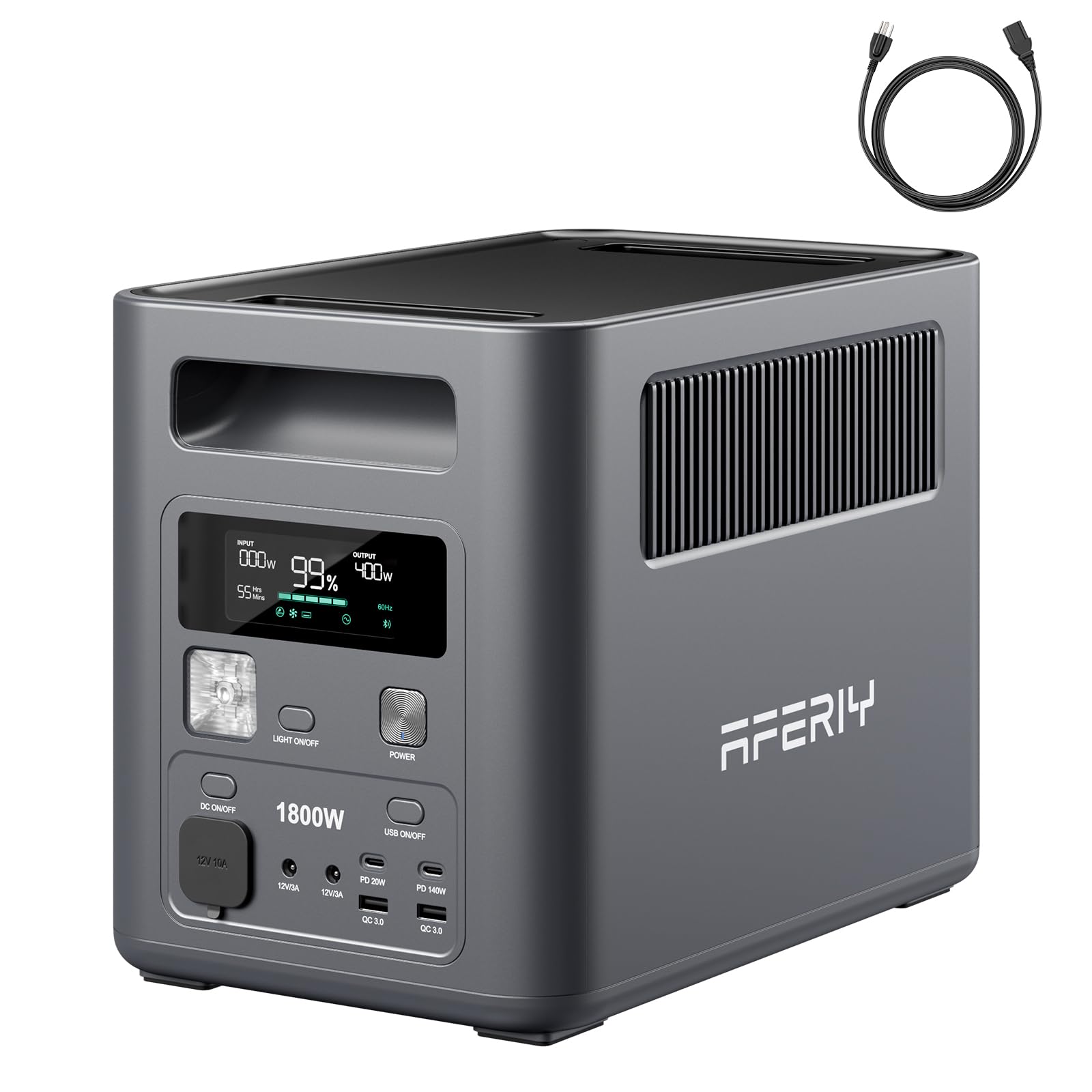
The AFERIY Nomad1800-A hits a sweet spot that few generators in this price range manage: it packs 1024Wh of LiFePO4 capacity rated for over 4000 cycles into a 25.6-pound chassis that is 16% smaller and 25% lighter than competitors with similar specs. The 1800W pure sine wave inverter handles most camping appliances, and the 140W USB-C PD port charges a MacBook Pro in under an hour without a brick. The built-in <10ms UPS switchover means your CPAP or laptop won’t blink during a grid hiccup, and the unit runs below 30dB in normal use — quieter than a refrigerator.
On the solar side, the Nomad1800-A supports up to 500W of solar input via its MC4-to-XT60 connection. Real-world testing shows a 200W panel replenishes the battery from empty in about two hours of strong sun. The smart app lets you monitor battery status and set charge schedules remotely, and the LED light panel includes steady, SOS, and strobe modes — a useful bonus for campsite security. The unit charges from 0-80% in 55 minutes via AC, and the AC+solar dual input can hit 80% in just 35 minutes, which is class-leading for this capacity tier.
One minor downside: the included solar cable is an MC4-to-XT60 adapter that works with most portable panels, but you need to supply the panels separately. The plastic ABS enclosure feels solid, but the unit lacks the rubberized bumpers found on pricier competitors like the GROWATT. Still, for a durable, long-lasting generator that balances weight, capacity, and price, the AFERIY is a top-tier choice for weekend car campers and extended off-grid stays alike.
Why it’s great
- 4000+ cycle LiFePO4 battery lasts over a decade
- Weighs only 25.6 lbs despite 1024Wh capacity
- 140W USB-C output charges laptops at full speed
Good to know
- Solar panels not included in the base kit
- No integrated handle strap for one-handed carry
2. Jackery Explorer 1000 v2

Jackery’s Explorer 1000 v2 is the refined evolution of the brand that arguably popularized the portable power station category. This v2 model upgrades the battery to LiFePO4 (rated for 4000 cycles to 70% capacity), adds a 100W USB-C PD port, and shrinks the footprint to 23.8 pounds — nearly a pound lighter than the AFERIY despite a slightly larger 1070Wh capacity. The 1500W inverter (3000W surge) runs a microwave, electric kettle, or toaster without breaking a sweat, and the three pure sine wave AC outlets are spaced far enough apart to fit bulky plugs.
The standout feature is ChargeShield 2.0, Jackery’s proprietary charging algorithm that defaults to a 1.7-hour top-up to preserve battery health but can be switched to a 1-hour emergency mode via the app. Real-world tests confirm the unit ran a 1370W microwave for five minutes, consuming just 12% of the battery. For a CPAP user camping overnight, the 1070Wh capacity runs a ResMed AirSense 11 for roughly 28 hours — meaning a weekend trip rarely needs a recharge. The built-in LED light doubles as a campsite lantern.
The downside is solar input: the Explorer 1000 v2 maxes out at 200W solar input, which means a full recharge from empty takes roughly 5-6 hours under ideal sunlight. Competitors like the AFERIY and BLUETTI AC180 support 500W input, cutting that time by more than half. Additionally, the Jackery app is required for the 1-hour emergency charging mode; the unit defaults to the longer cycle if the app isn’t used. For campers who mostly charge at home and only solar-top-off on sunny days, this is a minor inconvenience.
Why it’s great
- Lightweight 23.8 lbs with foldable handle for easy carry
- ChargeShield 2.0 extends battery lifespan beyond 4000 cycles
- Quiet overnight charging mode at 30 dB
Good to know
- Solar input limited to 200W (slower solar recharge)
- App needed for fastest AC charging speed
3. BLUETTI AC70

The BLUETTI AC70 is the ideal form factor for the minimalist camper who doesn’t want to lug a 25-pound brick. At 22.5 pounds and 768Wh, it fits neatly in a duffel bag and still delivers a 1000W inverter with 2000W power lifting for startup surges. The LiFePO4 battery is rated for 3000+ cycles, and the unit can be fully charged in 1.5 hours via AC — or in 1.9-2.4 hours with a 500W solar array. The XT-60 solar input connector is more robust than the older 7909 style and handles higher current without overheating.
For a CPAP camper, the AC70 is a perfect match: a ResMed AirSense 11 draws roughly 30W with humidity off, giving you over 25 hours of runtime on a single charge. The 100W USB-C PD port charges a MacBook Pro 16 at full speed, and the four AC outlets (two on the front, two on the left side) provide flexible device layout. The integrated Bluetooth app connects reliably at 100+ feet and shows real-time input, output, and estimated runtime — a level of detail missing from budget units. The fan is whisper-quiet even under moderate load, making it suitable for sleeping quarters.
The main trade-off is capacity: 768Wh is enough for a weekend trip with careful power management, but anyone running a portable fridge (40-80W draw) plus kitchen appliances will drain it in under a day. The AC70 lacks expansion battery support, so what you buy is what you get. The plastic enclosure feels solid but doesn’t have the impact-absorbing rubber bumpers of pricier units. For a lightweight, fast-charging generator that prioritizes portability over brute capacity, the AC70 is an excellent choice.
Why it’s great
- Lightest unit at 22.5 lbs with solid 768Wh capacity
- 500W solar input for fast off-grid replenishment
- Reliable Bluetooth app with accurate runtime estimation
Good to know
- No expansion battery support for future capacity upgrades
- Plastic case lacks protective rubber bumpers
4. LIBRIDS Portable Power Station C600
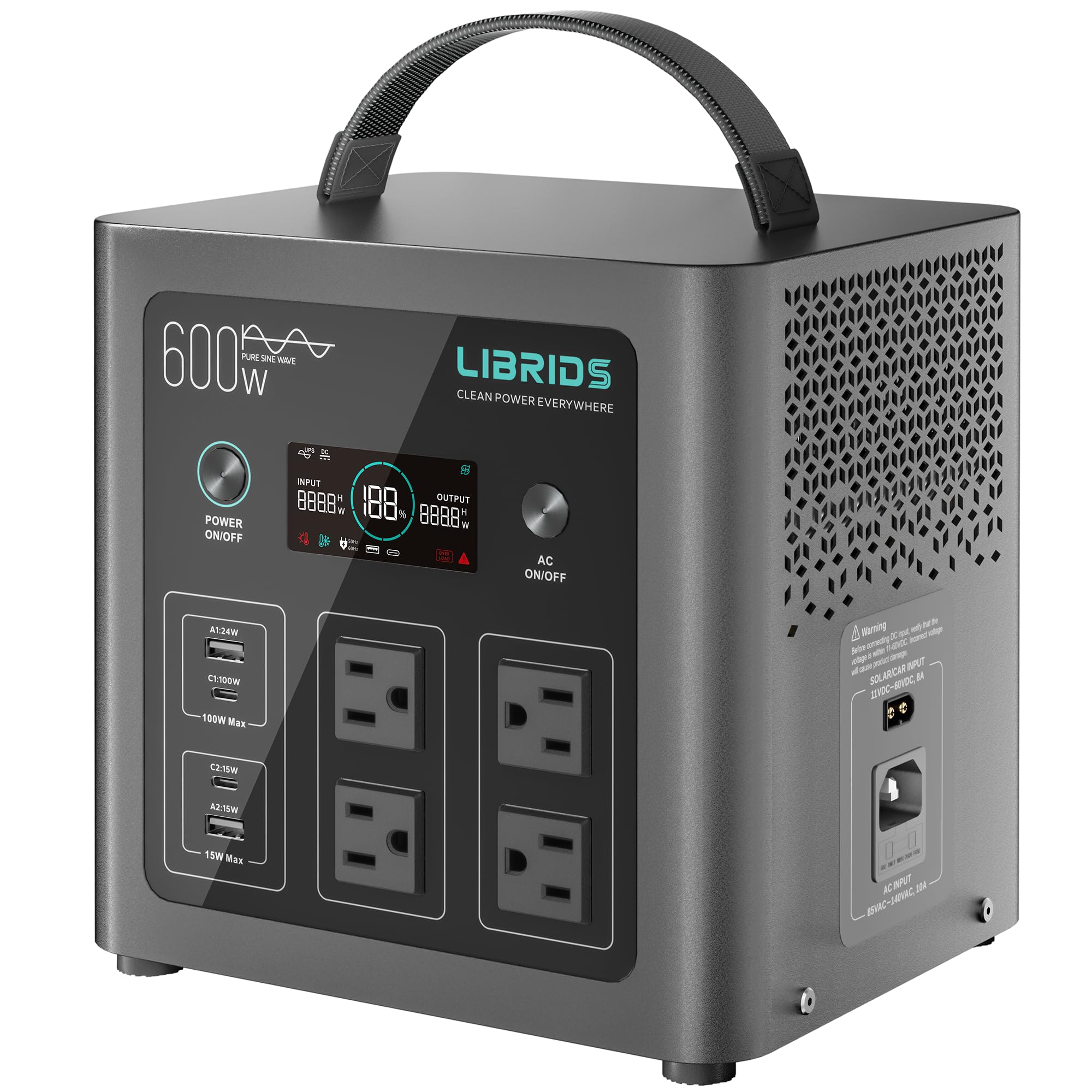
The LIBRIDS C600 proves that budget-friendly doesn’t have to mean low-quality. This 640Wh LiFePO4 generator features an automotive-grade battery rated for 4000+ cycles, a 600W pure sine wave inverter (1200W surge) via PowerRaise technology, and a metal enclosure that improves heat dissipation far better than the plastic shells of many competitors. The <10ms UPS backup means it can keep a WiFi router or CPAP running seamlessly during an outage, and the 1.5-hour AC full charge is competitive for this capacity class.
For a solo camper or one-bag minimalist, the C600 handles the essentials: a phone, tablet, camera batteries, and a 12V cooler for 24+ hours without breaking a sweat. The 100W USB-C port charges a laptop, and the four AC outlets provide enough flexibility for a small coffee maker or electric skillet for brief use. The bright LCD screen shows real-time input and output wattage, battery percentage, and estimated runtime — information that helps you manage power draw intelligently in the field.
The 600W inverter is the biggest limitation: it can’t run a full-size refrigerator, microwave, or space heater. You’re restricted to low-draw devices and appliances under 600W sustained. The unit also lacks app connectivity, so all monitoring is done via the onboard screen. For a first-time buyer who wants to dip into solar power without a large investment, the LIBRIDS C600 offers strong build quality and long battery lifespan at a very accessible price point.
Why it’s great
- Metal enclosure for better heat management and durability
- 4000+ cycle LiFePO4 battery with 5-year warranty
- Fast 1.5-hour AC recharge from empty
Good to know
- 600W inverter limits appliance compatibility
- No Bluetooth or smartphone app control
5. GROWATT INFINITY 2000 Pro
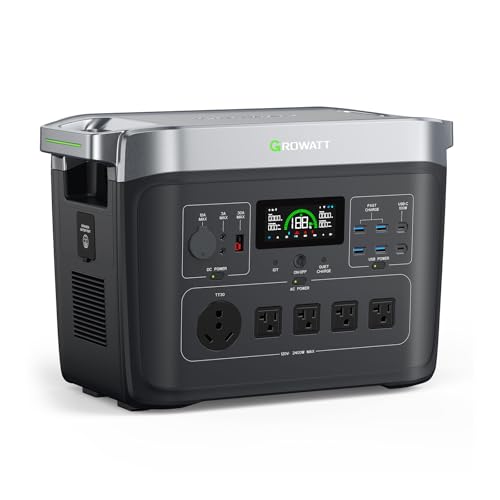
The GROWATT INFINITY 2000 Pro is built for campers who don’t let cold weather stop them. Its exclusive Cold Start technology allows the LiFePO4 battery to charge and discharge normally at temperatures as low as -22°F — a spec that virtually no other portable generator in this class can match. The 2048Wh capacity and 2400W inverter (4000W surge) provide enough power to run a space heater, small refrigerator, CPAP, and lights simultaneously for a full weekend. The unit supports expansion to 6144Wh with two additional batteries, making it a viable base-station for extended off-grid stays.
The INFINITY 2000 Pro includes a NEMA TT-30 port for direct RV hookup and a 30A Anderson port for high-current DC devices, a feature set usually found only on much more expensive units. The AC charging input is 1800W, which fills the 2048Wh battery from empty in about 90 minutes. The built-in WiFi and Bluetooth app gives you remote monitoring, load scheduling, and firmware updates. The physical design is thoughtful: rubber bumpers on all four corners, a sturdy handle, and a compact footprint (12.2 x 9.72 x 17.99 inches) for its capacity class.
Quality control has been a concern in some user reports: a small number of units arrived with firmware issues that prevented standalone operation without grid power. GROWATT’s customer support has been criticized for slow response times on warranty claims. Additionally, the plastic enclosure, while rugged, lacks the premium feel of an aluminum chassis. For campers who need reliable power in freezing conditions and are comfortable navigating occasional support hiccups, the INFINITY 2000 Pro offers exceptional cold-weather performance.
Why it’s great
- Operates down to -22°F, unmatched for winter camping
- TT-30 and Anderson ports for direct RV integration
- Expandable to 6144Wh capacity
Good to know
- Reports of quality control and support delays
- Heavier at 26 lbs without expansion battery
6. Anker SOLIX C1000 + 200W Panel

The Anker SOLIX C1000 kit is the rare all-in-one solution that doesn’t compromise on panel quality. The included 200W monocrystalline solar panel features an IP67 waterproof rating, adjustable stand with four angle settings (30° to 80°), and 23% conversion efficiency — roughly 1.5x higher than budget panels. The C1000 power station itself packs 1056Wh of LiFePO4 capacity with an 1800W inverter that can surge to 2400W via SurgePad technology.
The 80% recharge in 43 minutes (58 minutes to full) via AC is the fastest in its capacity class. The 11 output ports include six AC outlets, two USB-C (one 100W PD), and two USB-A QC 3.0 ports, providing plenty of flexibility for group camping. The Anker app works reliably for switching between charging modes (including the UltraFast recharge toggle) and monitoring real-time stats. The 10-year lifespan rating at 3000 cycles to 80% capacity is backed by Anker’s solid reputation for battery management.
One notable quirk: the solar panel and power station ship separately, and the panel may arrive up to a week later depending on inventory. A few users reported a strong chemical odor from the solar panel on first use; Anker has since revised the panel design to address this. The C1000 is not weatherproof (only the solar panel is IP67), so you’ll need to keep the power station dry in rain. For campers who want a turnkey kit with premium panel performance, this is hard to beat.
Why it’s great
- IP67 waterproof solar panel survives rain and dust
- UltraFast AC recharge: 0-80% in 43 minutes
- 2400W surge handles startup loads on fridges and pumps
Good to know
- Power station is not weatherproof (dry use only)
- Solar panel may ship separately with potential delay
7. BLUETTI AC180 + 200W Panel

The BLUETTI AC180 earns its place as a high-output workhorse for serious camping setups. With 1152Wh of LiFePO4 capacity and an 1800W inverter that can lift to 2700W with a tap in the app, it powers microwaves, electric kettles, and even small power tools without hesitation. The 1440W AC input (via a single cable — no bulky power brick) fills the battery from empty in exactly one hour, which is remarkably fast for the capacity. The included 200W solar panel uses a standard MC4-to-XT60 connector and delivers a full charge in 4.8-9.6 hours depending on sun conditions.
The port layout is generous: four 1800W pure sine wave AC outlets, two USB-A, two USB-C (one 100W PD), a 12V/10A car port, and a wireless charging pad on top — the latter being a rare and appreciated bonus for topping off earbuds or a phone overnight. The ≤10ms UPS switchover is fast enough for sensitive electronics, and the unit operates at whisper-quiet fan noise levels. In real-world use, the AC180 ran a portable washing machine for two hours while only dropping 30% of the battery, and it kept a fridge running for over 14 hours in a power outage test.
The trade-off is weight: at 35-40 pounds, the AC180 is one of the heavier units in its capacity class. The fan, while quiet under normal load, becomes audible when sustaining 800W+ output for extended periods. The Bluetooth app provides good control but requires the phone for advanced features like boosting surge power. For car campers and RV owners who don’t need to hike the generator to a site, the BLUETTI AC180 delivers unbeatable charging speed and output versatility.
Why it’s great
- 1440W AC input = full charge in 1 hour
- 2700W surge handles high-startup appliances
- Wireless charging pad on top for convenience
Good to know
- Heavy at 35-40 lbs, less portable for hiking
- Fan becomes audible under sustained high loads
8. EF ECOFLOW DELTA 2 Max + 220W Panel
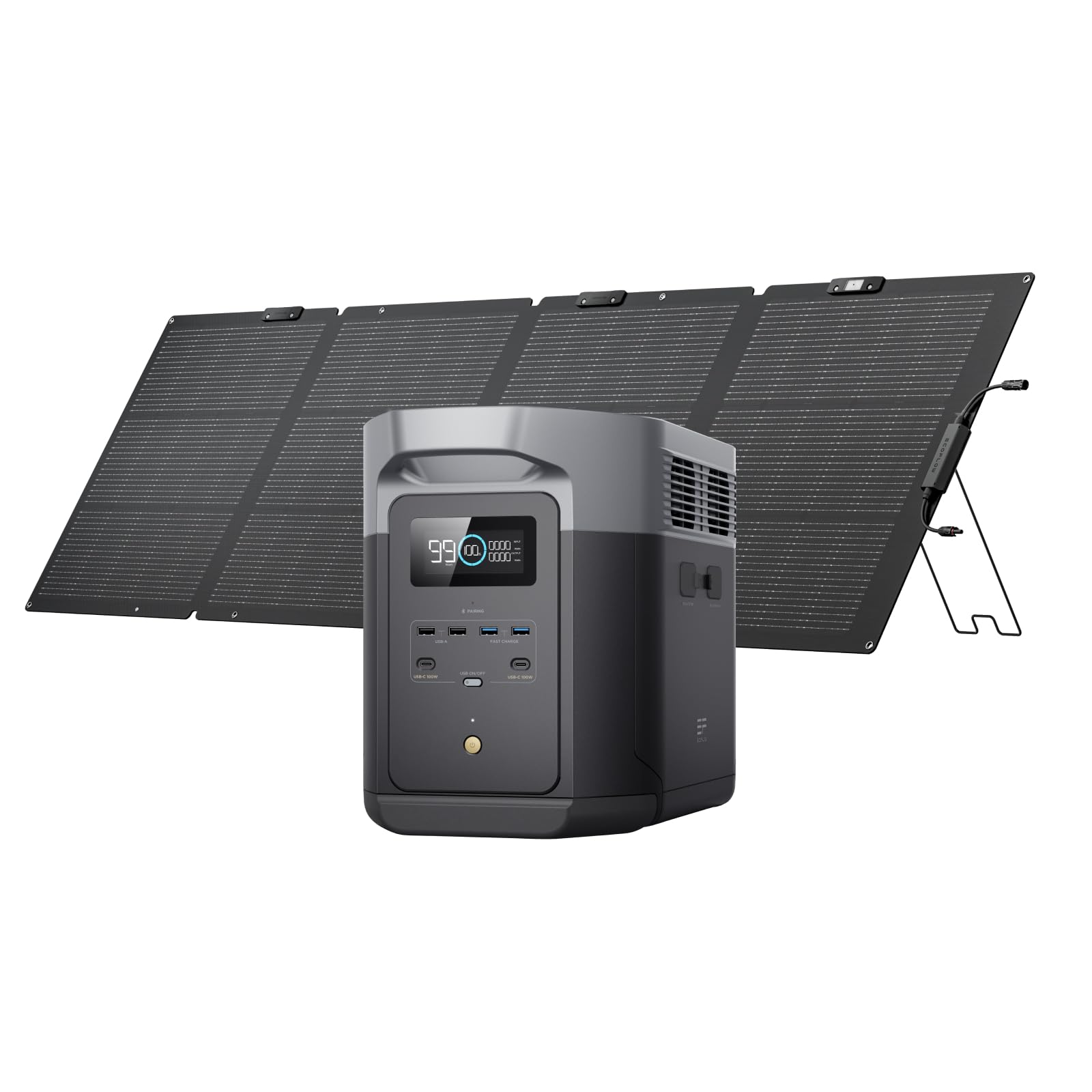
The EcoFlow DELTA 2 Max is the most future-proof generator on this list. Its 2048Wh LiFePO4 battery can be expanded up to 6kWh with two extra batteries, making it suitable for extended off-grid living or whole-house backup. The 2400W inverter (3400W with X-Boost) powers 99% of home appliances, including refrigerators, washing machines, and air conditioners within its wattage range. The dual charging capability — 1000W solar input plus 1000W AC input simultaneously — fills the unit 0-80% in just 43 minutes, a world-leading speed for the capacity class.
The 220W solar panel included in this kit is a monocrystalline unit that outputs a genuine 140-160W in full sun, and users have reported achieving over 190W with reflective groundsheets. The panel folds into a compact carry case with a built-in stand. The DELTA 2 Max includes 15 output ports: six 120V AC outlets, four USB-A, two USB-C (one 100W PD), a 12V car port, and two DC 5521 ports. The 30 dB quiet mode is barely audible in a quiet bedroom, perfect for overnight RV use. The EcoFlow app is one of the most polished in the category, offering real-time monitoring, charge scheduling, and firmware updates.
The 71-pound weight (power station alone) makes it a car/RV-only proposition — this isn’t a unit you’ll carry to a hike-in campsite. The solar panel on its own is relatively compact, but the total kit takes up significant trunk space. Some users noted that the solar charging from the 220W panel alone (without expansion) is slow for the 2048Wh battery, taking over two days in overcast conditions. For serious overlanders or home backup users who value expandability and speed, the DELTA 2 Max is the benchmark.
Why it’s great
- Expandable from 2kWh to 6kWh with plug-and-play batteries
- Dual AC+solar charging hits 80% in 43 minutes
- 30 dB quiet mode for overnight RV or bedroom use
Good to know
- 71 lbs — not portable for hike-in camping
- Solar panel alone takes over 2 days to fully charge battery
9. OSCAL PowerMax 6000 + 4x500W Panels
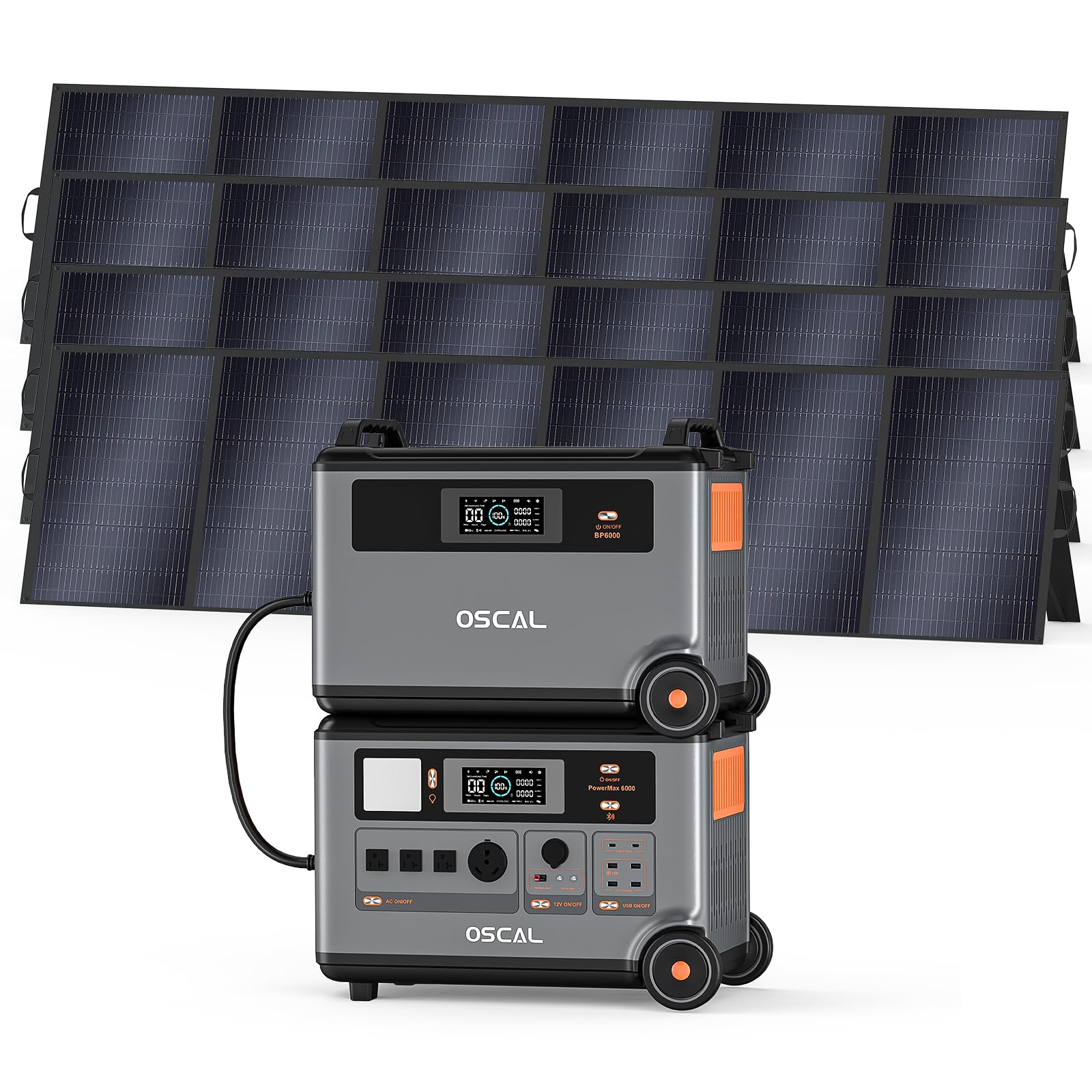
The OSCAL PowerMax 6000 is the nuclear option for camping solar generators — a 7200Wh, 6000W system with 120/240V split-phase output that can power an entire RV, travel trailer, or even a small cabin. The kit includes four 500W monocrystalline solar panels (2000W total solar input), making it a truly self-sufficient off-grid solution. The 2200W bidirectional inverter charges the battery from empty in just 1.44 hours via AC, and the 2400W solar input can fully recharge in under 3.5 hours of peak sun. The EPS (uninterruptible power supply) switches in 5-8ms, seamless for sensitive electronics.
The PowerMax 6000 is built around an eight-layer BMS with overcharge, over-discharge, over-voltage, over-current, short-circuit, and temperature protections. The LiFePO4 cells are rated for 3500 cycles, and the manufacturer claims a service life of up to 25 years — though that depends heavily on usage patterns and storage conditions. The smart control app (Smart Life) provides remote monitoring and charge scheduling. The unit’s 14 output ports include four 120V AC outlets and two 240V outlets, the latter enabling EV charging at Level 1 speeds — a unique capability in this category.
The obvious drawback is size and cost: the full system weighs well over 100 pounds with four panels, and it’s intended for base-camp or RV setups where you drive directly to the site. Some user reports indicate the inverter struggles with the startup surge of motors larger than 3/4 HP (air compressors, certain pumps), triggering a BMS shutdown that requires a manual reset. Customer support has been described as slow, relying on email tickets. For organized group camping or home backup with serious power demands, the OSCAL is unmatched in raw capacity — but it’s overkill for a solo weekend trip.
Why it’s great
- 7200Wh capacity with 6000W sustained output
- 120/240V split-phase for RV and EV charging
- Includes four 500W panels for full solar self-sufficiency
Good to know
- Very heavy and bulky — not portable for hike-in camping
- May struggle with startup surge from large motors
FAQ
Can a 600W camping solar generator run a coffee maker?
How long does a 1000Wh generator power a CPAP machine?
What solar panel wattage do I need for my camping generator?
Is it safe to charge a LiFePO4 generator in cold weather?
Can I leave my camping solar generator plugged in 24/7?
Final Thoughts: The Verdict
For most campers, the winner among the camping solar generator options is the AFERIY Nomad1800-A because it offers the best balance of lightweight portability, high cycle life, and rapid dual charging for a price that undercuts many competitors. If you need powerful surge capability and fast AC charging in a complete all-in-one kit, grab the Anker SOLIX C1000 with the 200W panel. And for serious off-grid or RV setups that demand expandable capacity and quiet overnight operation, nothing beats the EF ECOFLOW DELTA 2 Max.

Mo Maruf
I created WellFizz to bridge the gap between vague wellness advice and actionable solutions. My mission is simple: to decode the research and give you practical tools you can actually use.
Beyond the data, I am a passionate traveler. I believe that stepping away from the screen to explore new environments is essential for mental clarity and physical vitality.