Our readers keep the lights on and my smoothie glass nicely filled. As an Amazon Associate, I earn from qualifying purchases.
Nothing ruins a pristine campsite faster than the drone of a gas generator. A camping power station changes the game by delivering silent, fume-free electricity to run your fridge, charge your devices, and keep your lights on—all without disturbing the peace. But with capacities ranging from 220Wh to over 3000Wh and chemistries varying from standard lithium to advanced LiFePO4 and semi-solid cells, picking the wrong one means either running out of power by dinner or lugging a 70-pound brick you never fully use.
I’m Mohammad Maruf — the founder and writer behind WellFizz. I analyze battery chemistries, inverter efficiencies, solar input specs, and real-world customer feedback on hundreds of units to find the ones that actually deliver on their runtime promises.
No matter if you’re powering a CPAP through the night or keeping a portable fridge cold for a week straight, choosing the best camping power station means matching capacity to your gear and charging speed to your schedule.
How To Choose The Best Camping Power Station
Selecting the right camping power station comes down to three variables: how much energy your gear consumes, how quickly you need to recharge, and whether you plan to use solar panels. Ignoring any one of these leads to either wasted money or a dead battery at the worst possible moment.
Capacity (Watt-Hours) vs. Output (Watts)
Watt-hours (Wh) tell you how much total energy the battery stores—think of it as the fuel tank size. A 300Wh unit can run a 30W camping fridge for about 10 hours, while a 2000Wh unit can run that same fridge for nearly three days. Meanwhile, the inverter wattage determines what you can power at once: a 300W inverter runs a laptop and a fan, but a 1500W inverter is needed for a portable electric grill. Always calculate your total load before buying.
Battery Chemistry: LiFePO4 vs. Standard Lithium-Ion
LiFePO4 (lithium iron phosphate) batteries last 3000 to 4000 charge cycles before dropping to 80% capacity, compared to roughly 500 cycles for standard lithium-ion. They also handle higher temperatures better and include built-in BMS protection against overcharge and short circuits. For a camping power station that stays reliable for years of weekend trips, LiFePO4 is the clear winner.
Solar Input and Recharge Speed
Not all green charging is created equal. A power station with 200W MPPT solar input can fully recharge in 6–8 hours with two 100W panels, while a station with only 40W input can take multiple sunny days. Fast AC charging (under 2 hours) is becoming standard on mid-range and premium units, which is critical if you need to top up between campsite moves.
Port Weight and Form Factor
A 2048Wh station that weighs 39 pounds is easier to load into an SUV than one that weighs 56 pounds. Look for models with built-in handles or wheels if you plan to move the station frequently. For backpacking or canoe-camping, a sub-5-pound unit with 220Wh capacity might be all you need for phones and lights.
Quick Comparison
On smaller screens, swipe sideways to see the full table.
| Model | Category | Best For | Key Spec | Amazon |
|---|---|---|---|---|
| Jackery Explorer 2000 v2 | LiFePO4 | Premium all-around camping & home backup | 2042Wh / 39.5 lbs / 30dB silent mode | Amazon |
| DABBSSON 2000L | Semi-Solid | Long runtime & high safety | 2048Wh / 41 lbs / 1 hr AC full charge | Amazon |
| BLUETTI Elite 100 V2 | LiFePO4 | Compact 1kWh with four AC outlets | 1024Wh / 25 lbs / 70 min full charge | Amazon |
| Anker SOLIX C2000 Gen 2 | LiFePO4 | Fast recharge & expandable capacity | 2048Wh / 41.7 lbs / 58 min full charge | Amazon |
| BLUETTI AC70 | LiFePO4 | Mid-range 768Wh for road trips | 768Wh / 1000W inverter / 500W solar input | Amazon |
| EF ECOFLOW DELTA 3 Ultra Plus | LiFePO4 | Maximum power & expandable to 11kWh | 3072Wh / 3600W output / 25dB quiet | Amazon |
| LIBRIDS C600 | LiFePO4 | Entry-level 640Wh with fast AC charge | 640Wh / 8.3×6.9×8.2″ / 1.5 hr charge | Amazon |
| Apowking HP200L | Standard Lithium | Budget-friendly with included solar panel | 220Wh / 5 lbs / 40W panel included | Amazon |
In‑Depth Reviews
1. Jackery Explorer 2000 v2

The Jackery Explorer 2000 v2 uses advanced CTB (Cell-to-Body) technology to pack 2042Wh into a frame that’s 41% lighter and 34% smaller than typical 2kWh stations—weighing just 39.5 pounds. Its LiFePO4 battery delivers over 4000 cycles and a 10-year lifespan, while the pure sine wave inverter provides 2200W continuous power across three AC ports. During real-world testing, users powered a full-size fridge for over 21 hours on a single charge.
Charging versatility is a standout feature: AC fast charging takes the unit from 0 to 80% in 66 minutes, and an emergency super charging mode via the app hits 100% in 102 minutes. Solar charging at 400W tops off the battery in about 6 hours, and the silent charging mode runs at under 30dB—quiet enough for a tent site. The built-in light offers dim, bright, and SOS modes, which is a thoughtful touch for campsite emergencies.
Users report the 20ms UPS switchover works flawlessly during flickering grid power, and the Bluetooth app lets you monitor battery percentage and control output ports remotely. It’s also UL1778 certified for uninterrupted power systems, meaning it can sit between your RV shore power and your sensitive devices without worry.
Why it’s great
- Exceptional power-to-weight ratio at 39.5 lbs for 2kWh class
- Silent 30dB charging mode ideal for overnight camping
- 20ms UPS switchover protects sensitive electronics
Good to know
- Solar input limited to 400W maximum
- Heavier than premium models despite weight reduction
2. DABBSSON Portable Power Station 2000L
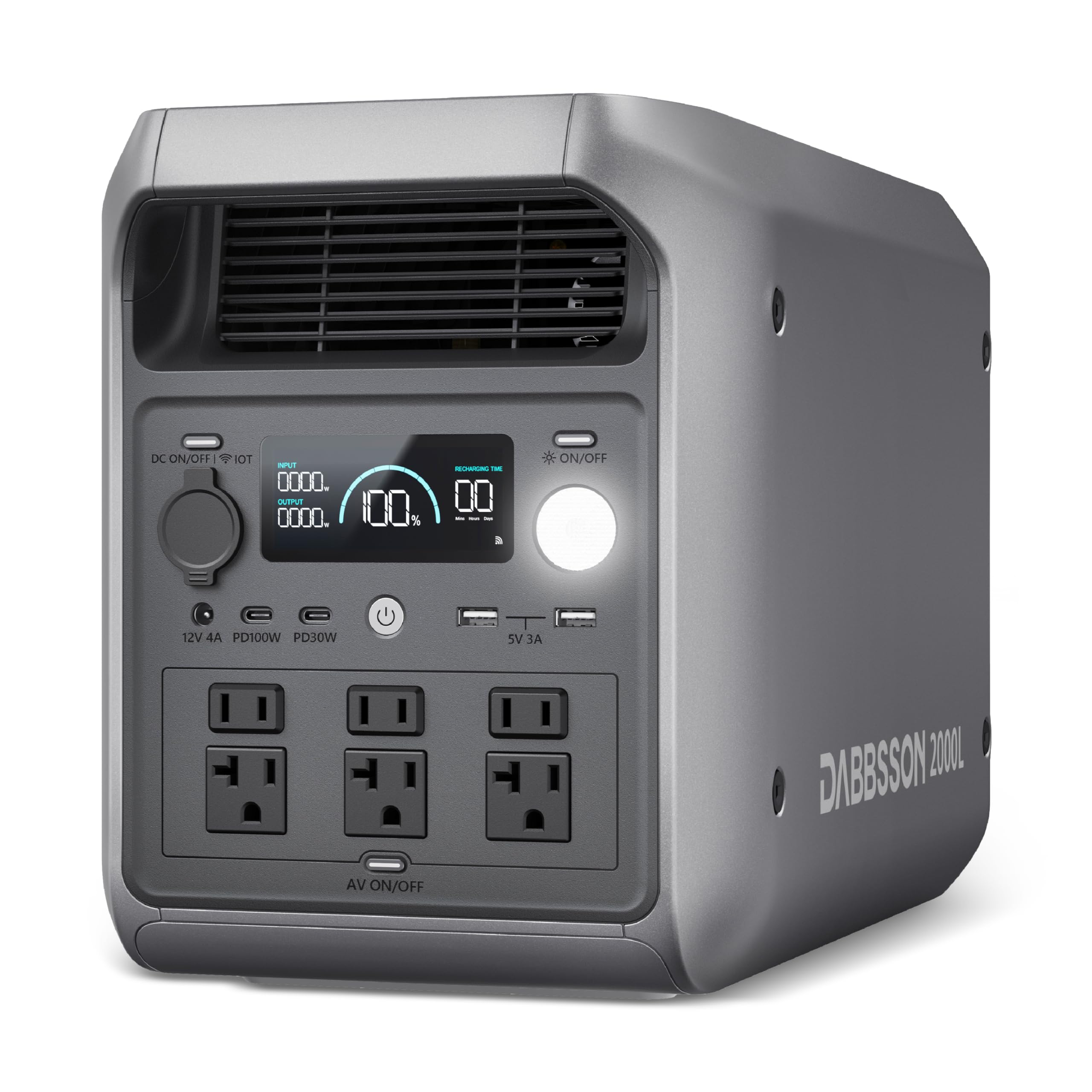
The DABBSSON 2000L is one of the first widely available camping power stations to use semi-solid LiFePO4 cells, which offer higher energy density and improved thermal stability compared to standard cylindrical or prismatic cells.
With a 2200W rated output and 3300W Power Boost surge, this unit can handle heavy loads like portable electric grills, refrigerators, and power tools. The six AC outlets and full port set let you run multiple devices simultaneously without adapter juggling. AC charging hits full capacity in just one hour—one of the fastest times in the 2kWh class—while 800W MPPT solar input recharges in roughly 3–4 hours under direct sun.
Users highlight the <15ms EPS switchover as a lifesaver for computers and network equipment during outages. The Dabbsson app adds remote monitoring via Wi-Fi or Bluetooth, letting you adjust charging speed and set schedules from inside the tent or cabin. The UL94-V0 flame-retardant housing and built-in full-range safeguards address common concerns about battery safety in confined camping spaces.
Why it’s great
- Semi-solid electrolyte provides superior thermal safety vs standard LFP
- 1-hour full AC charge is class-leading for 2kWh capacity
- 6 AC outlets eliminate need for external power strips
Good to know
- Outer plastic housing feels less premium than metal-frame competitors
- App interface could be more intuitive for first-time users
3. BLUETTI Elite 100 V2
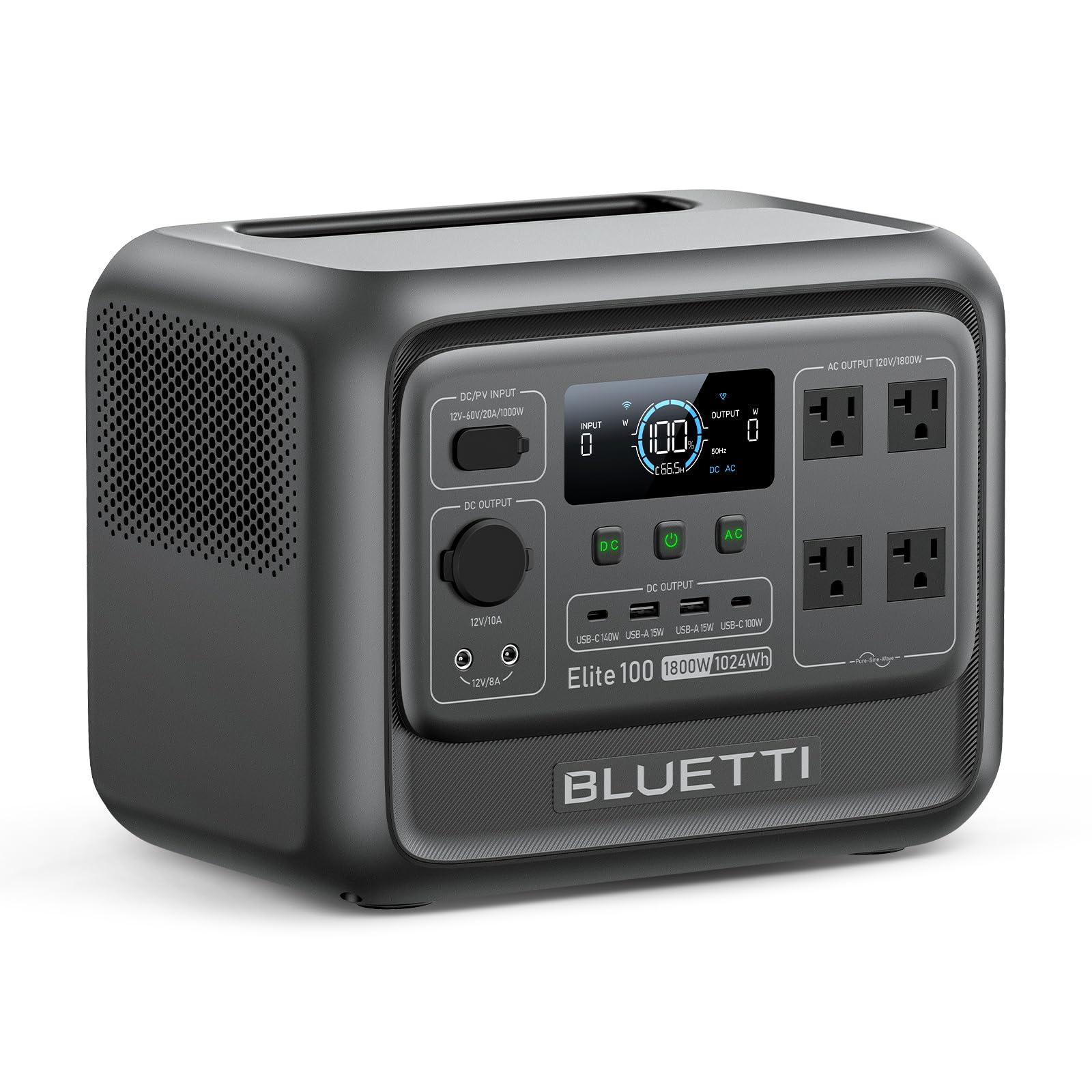
The BLUETTI Elite 100 V2 crams 1024Wh into a frame that’s 35% smaller and 30% lighter than its predecessor, weighing only 25 pounds. This makes it one of the most portable mid-capacity LiFePO4 stations on the market, ideal for car camping, RV trips, and tailgating where space is at a premium. Its 1800W inverter handles four AC outlets simultaneously, with a 2700W lifting power for startup surges on small motors.
TurboBoost AC charging refills the battery from empty to full in just 70 minutes via 1200W input, while 1000W solar input can top it up in about 2 hours with sufficient panels. The hidden carry handle makes one-handed transport easy, and the forward-facing port arrangement means you don’t have to access cables from behind the unit. Noise levels stay at library-grade 30dB under moderate loads.
Owner feedback emphasizes the Elite 100 V2’s ability to run a mini fridge, guitar amplifier, and CPAP machine with zero noise interference. The UPS switchover under 10ms protects laptops and routers during power flickers. Some users note the lack of a built-in light and wireless charger, but the price-to-capacity ratio is hard to beat for a 1kWh station.
Why it’s great
- 35% smaller footprint than comparable 1kWh stations
- 1800W inverter with 4 AC outlets runs multiple devices
- 70-minute AC full recharge is fast for its class
Good to know
- No built-in flashlight or wireless charging pad
- App setup can be clunky when connecting via Bluetooth
4. Anker SOLIX C2000 Gen 2
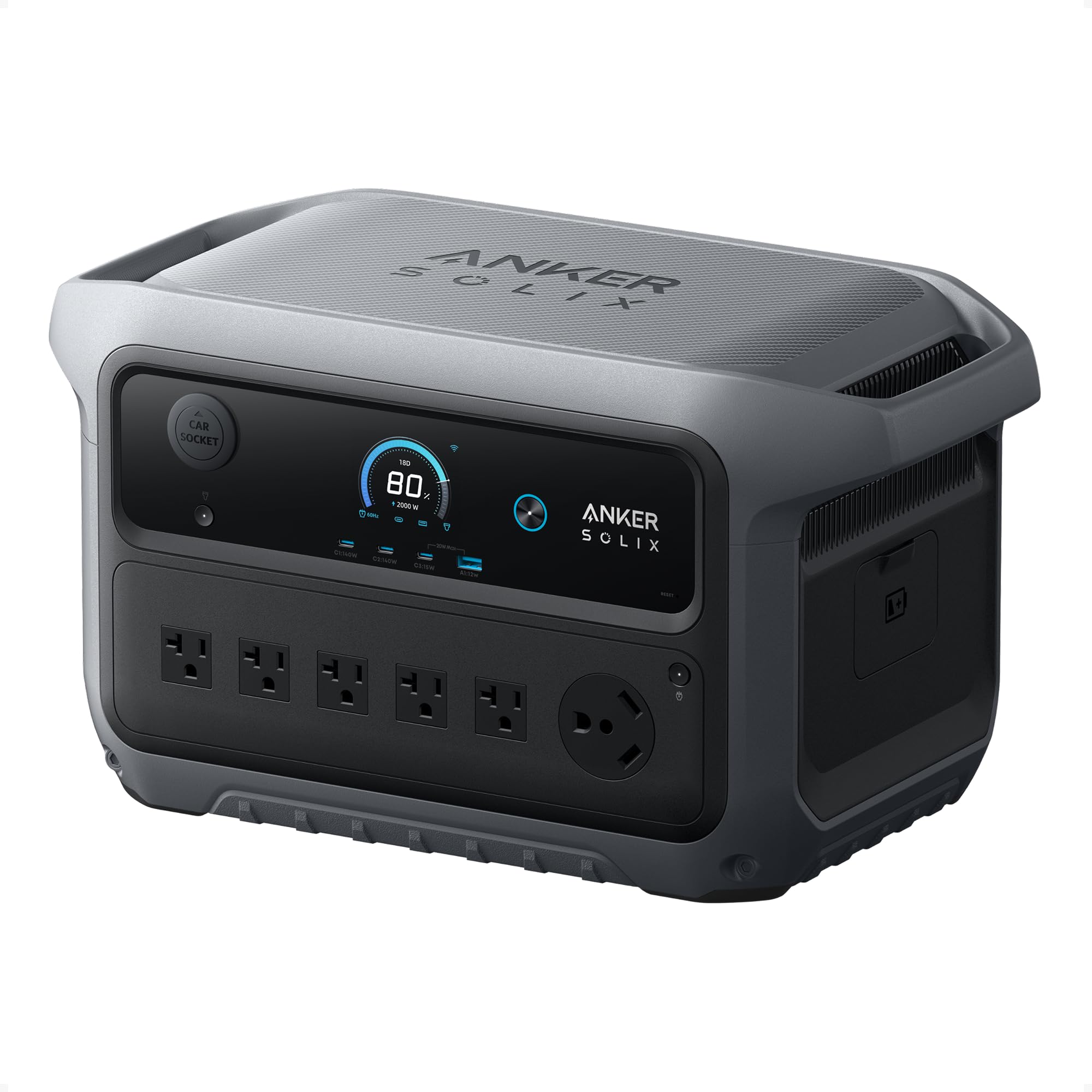
The Anker SOLIX C2000 Gen 2 is engineered for recharging speed above all else: it goes from 0 to 100% in just 58 minutes via AC input, making it the fastest 2kWh station in this lineup. Its 2400W rated output (4000W peak) means you can run demanding loads like window AC units and RV appliances, and the expandable capacity reaches 4kWh with an optional expansion battery—doubling your fridge runtime to 64 hours.
Standby power draw is a remarkable 9W, significantly lower than competitors that burn 15–25W when idle. This matters for camping trips where every watt-hour counts. The 800W UltraFast alternator charging is a game-changer for overlanders: it charges the station from your vehicle’s 12V socket 8 times faster than standard car charging, reaching 100% in about 3 hours while driving between campsites.
Customer reports confirm the C2000 Gen 2 keeps a car fridge running for 5–7 days during extended trips, and the companion app provides accurate usage tracking and remote control. The unit is also 25% lighter and 29% smaller than its direct competitors, sitting at 18.1 x 9.8 x 10.1 inches—a compact footprint that slides easily under a truck seat or camper bench.
Why it’s great
- 58-minute full AC charge is the fastest in the 2kWh segment
- Ultra-efficient 9W standby power consumption
- 800W alternator charging for rapid vehicle top-ups
Good to know
- No built-in light or physical manual included
- Slower solar recharge when panels are undersized
5. BLUETTI AC70

The BLUETTI AC70 sits at 768Wh with a 1000W inverter, offering enough juice for 2–3 days of phone charging, laptop use, and small appliance operation. Its power lifting mode allows up to 2000W surge, so you can start small induction cooktops or full-size coffee makers briefly. AC charging from 0 to 80% takes just 45 minutes and reaches full in 1.5 hours—a speed that rivals many more expensive units.
Solar input capacity is 500W via XT-60 connectors, which users describe as more robust than the older 7909 connectors found on previous-generation power stations. In real-world conditions, a 200W solar panel can deliver 150W continuously, bringing the station to full charge in about 5 hours of peak sun. The unit’s 22.5-pound weight makes it manageable for one-handed carrying, and the bright display shows input and output power in real time.
Musicians particularly value the AC70 for powering 100W guitar amplifiers and pedalboards for 8 hours while consuming less than 60W AC draw. CPAP users report running their devices for 7 hours with only 24% battery drain. The BLUETTI app gives you remote control and monitoring, and the 3000+ cycle LiFePO4 battery ensures the unit will still work well after a decade of weekend trips.
Why it’s great
- 45-minute 0-80% charge speed rivals premium models
- 500W solar input with durable XT-60 connectors
- Light enough at 22.5 lbs for easy campsite relocation
Good to know
- No wireless charging or built-in light
- Fan noise increases noticeably under sustained high loads
6. EF ECOFLOW DELTA 3 Ultra Plus
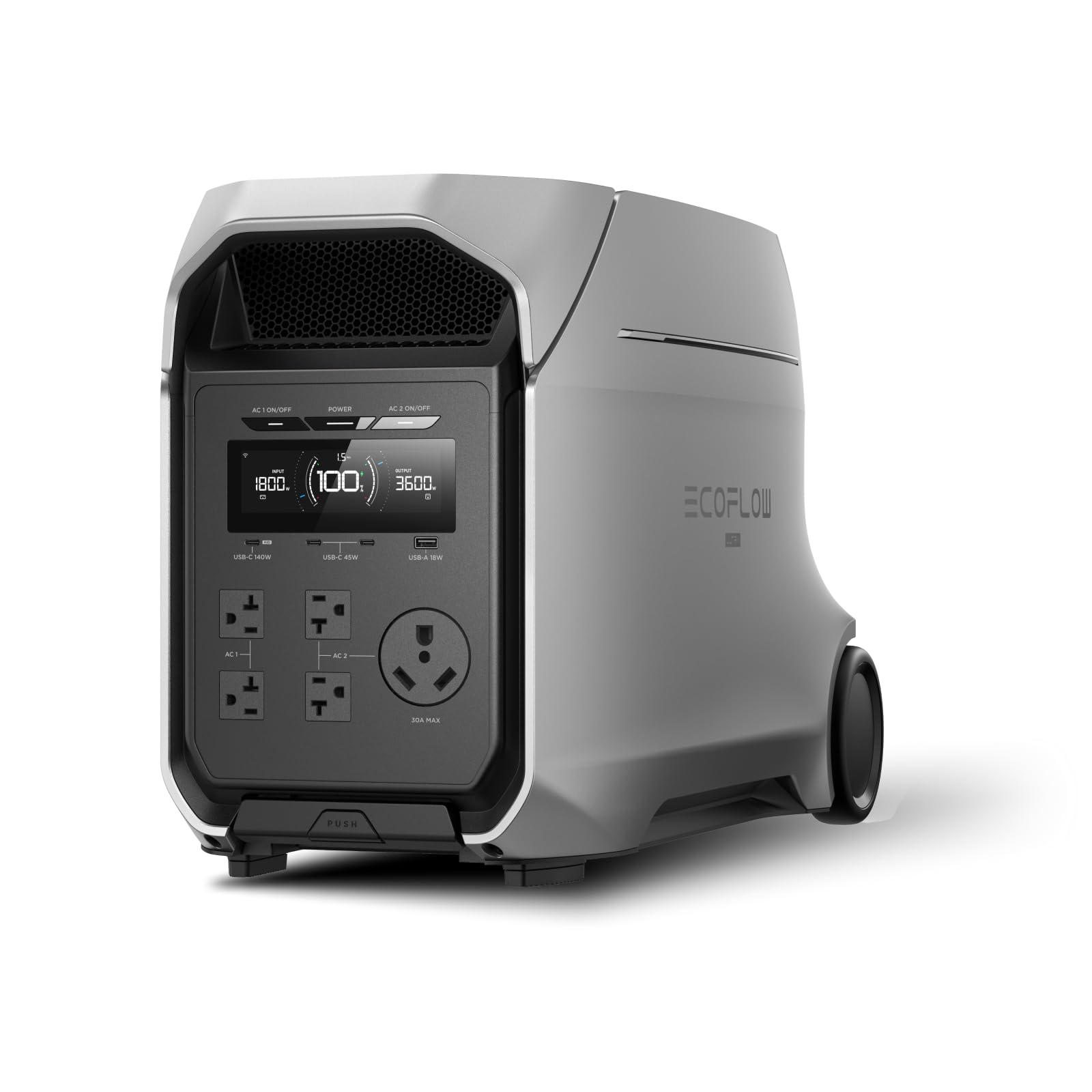
The EF ECOFLOW DELTA 3 Ultra Plus is a full-home backup solution disguised as a portable power station. With 3072Wh of internal LiFePO4 capacity, a 3600W continuous inverter (7200W surge), and expandability up to 11kWh with extra batteries, it can power an entire RV or run critical home circuits for days. The unit weighs 74 pounds and includes a telescoping handle and wheels for mobility, so it rolls like luggage rather than requiring a lift.
X-Quiet 3.0 technology keeps noise levels at 25dB—barely a whisper—making it suitable for indoor use during storms or for overnight camping. The 10ms UPS switchover is instantaneous enough to protect sensitive medical equipment and servers. Six charging methods cover every scenario: AC wall outlet, solar panels (up to 2400W), car charging, EV station, generator, and the optional EcoFlow Smart Generator.
Users consistently note the pure sine wave output is “basically a perfect sinusoidal wave” when measured with an oscilloscope, indicating extremely clean power for audio gear and precision electronics. The Storm Guard feature automatically charges the battery to 100% when severe weather is forecast, and the app gives you port priority scheduling so you can reserve power for essential devices first. It’s the most expensive unit here, but for extended off-grid living, nothing else comes close.
Why it’s great
- 3072Wh base capacity expandable to 11kWh for multi-day off-grid
- 3600W continuous output handles RV AC and well pumps
- 25dB whisper-quiet operation and 10ms UPS protection
Good to know
- 74-pound weight requires wheels even for repositioning
- Overkill for weekend camping if you don’t need high wattage
7. LIBRIDS Portable Power Station C600
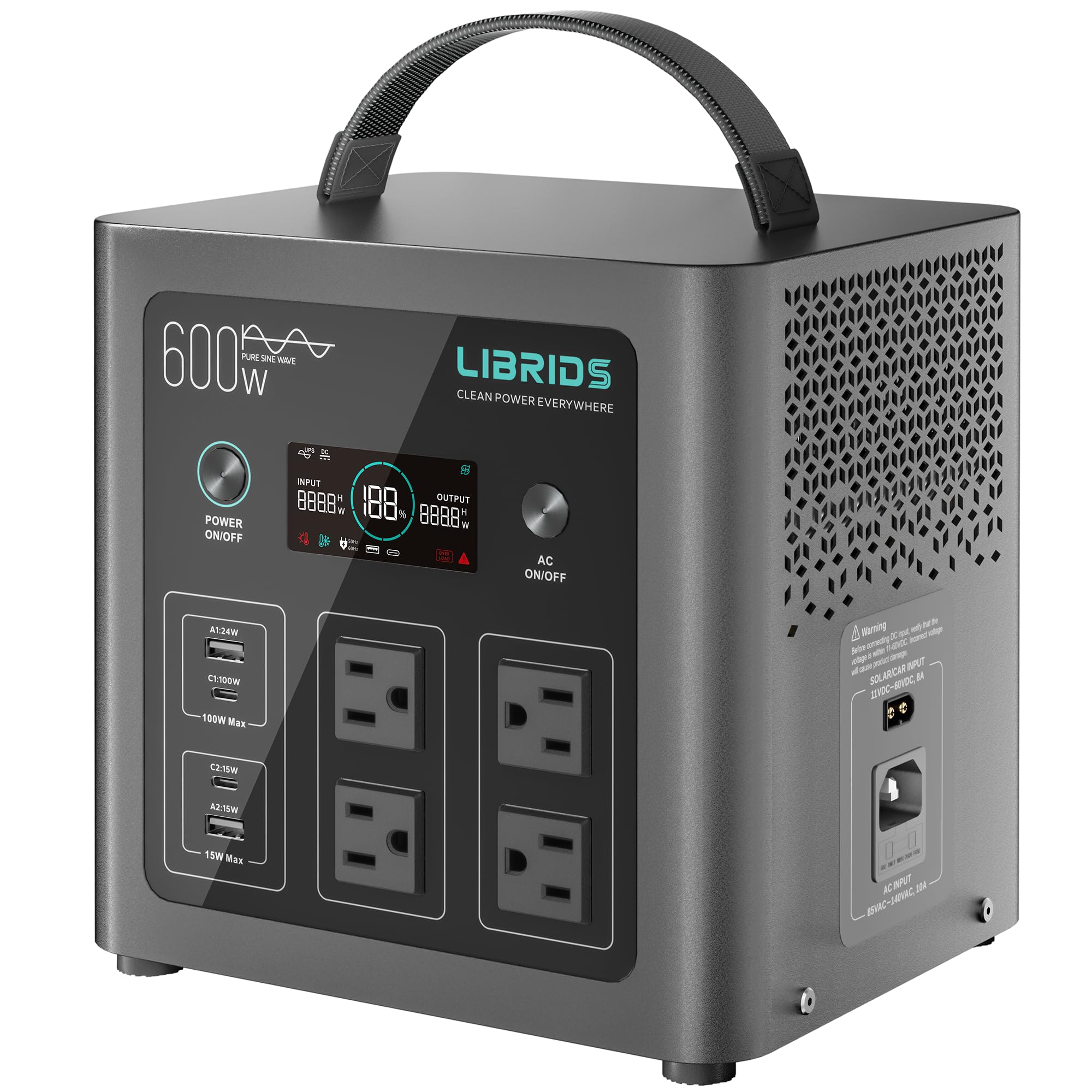
The LIBRIDS C600 offers 640Wh of LiFePO4 capacity with a 600W inverter that peaks at 1200W via PowerRaise technology, making it an excellent entry point for budget-conscious campers who still want modern battery chemistry. It charges from empty to full in just 1.5 hours via AC, which is impressive for this price tier, and the metal enclosure improves heat dissipation compared to all-plastic competitors.
The eight output ports include four AC outlets and four USB ports, letting you power up to eight devices simultaneously. The 10ms UPS switchover is fast enough to keep WiFi routers and CPAP machines running without interruption—a feature typically reserved for more expensive units. The smart LCD screen shows real-time battery percentage, input wattage, and output wattage so you can track your consumption at a glance.
Customer reviews highlight the C600’s real-world performance with CPAP machines: one user ran a Resmed Airsense 11 for 7 hours using only 24% battery drain. Another reported powering LED fishing lights for 6 hours straight while simultaneously charging phones and running a portable fan. The five-year warranty provides peace of mind, and the compact 8.3 x 6.9 x 8.2-inch footprint slides into a camping gear tote easily.
Why it’s great
- LiFePO4 with 4000+ cycle life at a budget-friendly entry price
- 10ms UPS switchout safeguards CPAP and networking gear
- Metal frame improves durability and thermal performance
Good to know
- 600W inverter limits high-power devices like electric grills
- Solar input may be lower than mid-range alternatives
8. Apowking Portable Solar Powered Generator HP200L

The Apowking HP200L is the lightest and most compact option in this guide at just 5 pounds and 8.5 x 6.7 x 4.1 inches, making it the only truly packable choice for backpacking, kayak camping, or short overnight trips where every ounce matters. Its 220Wh lithium-ion battery powers small devices like phones, tablets, LED string lights, and a laptop for a full weekend, and the included 40W monocrystalline solar panel lets you recharge passively during the day.
The panel’s 24% conversion efficiency is decent for its class, though multiple customer reviews note that solar charging is “very, very slow”—expect 8 hours or more from a panel that small to fully recharge the station. More practically, users recommend upgrading to a 60W panel for usable solar performance. The built-in LED light across the entire back of the unit provides a surprisingly bright area light for late-night campsite tasks.
With seven output ports including dual 110V AC outlets and multiple USB-A ports, the HP200L can charge up to seven devices simultaneously. The pure sine wave inverter ensures clean power for sensitive electronics. Some users also experienced warranty replacement from the company, suggesting responsive customer service for an entry-level product. It’s not for running a fridge or CPAP, but for phone and light charging, it’s a compact start.
Why it’s great
- Ultralight 5-pound design fits in a backpack
- 40W solar panel included for passive campsite recharging
- Pure sine wave inverter protects phone and laptop batteries
Good to know
- Solar charging is very slow with included 40W panel
- 220Wh capacity won’t run CPAP or mini fridge overnight
FAQ
How many watts of solar panels do I need for a camping power station?
Can a camping power station run a portable refrigerator?
What is the difference between pure sine wave and modified sine wave?
How long does a camping power station hold its charge when not in use?
Is it safe to use a camping power station inside a tent?
Final Thoughts: The Verdict
For most users, the best camping power station winner is the Jackery Explorer 2000 v2 because it combines the lightest weight in its class with a decade-long LiFePO4 lifespan and silent 30dB operation that won’t disturb your campsite neighbors. If you want the fastest recharging in the 2kWh class, grab the Anker SOLIX C2000 Gen 2 with its 58-minute AC charge and ultra-low 9W standby draw. And for extended off-grid living where you need maximum capacity and expandability, nothing beats the EF ECOFLOW DELTA 3 Ultra Plus with its 3600W output and room to scale up to 11kWh.

Mo Maruf
I created WellFizz to bridge the gap between vague wellness advice and actionable solutions. My mission is simple: to decode the research and give you practical tools you can actually use.
Beyond the data, I am a passionate traveler. I believe that stepping away from the screen to explore new environments is essential for mental clarity and physical vitality.