Our readers keep the lights on and my smoothie glass nicely filled. As an Amazon Associate, I earn from qualifying purchases.
The appeal of an instant camera is tactile: you press the shutter, and within moments a physical photograph slides out, something you can hold, pin to a wall, or slip into a journal. But not all print-on-demand cameras deliver the same sharpness, color accuracy, or long-term durability. The market splits between models that rely on analog chemical development and those using ink-free thermal dye-sublimation or ZINK technology, and each path demands a careful look at film costs, print resolution, and battery life.
I’m Mohammad Maruf — the founder and writer behind WellFizz. My approach to reviewing photo-printing gear focuses on measurable output quality: granularity in highlights, shadow retention, exposure consistency across varied lighting, and the real-world cost per print.
Whether you want crisp pocket prints for scrapbooking, a party camera that doubles as a Bluetooth printer, or something your child can operate without frustration, this guide covers the top contenders to help you find the right cameras that print photos for your specific needs.
How To Choose The Best Cameras That Print Photos
Selecting a print-in-camera device involves more than just picking a color you like. The chemistry of the film, the availability of replacement cartridges, and the way the camera handles exposure all determine whether you end up with a stack of treasured images or a pile of disappointing blanks.
Film Format and Cost Per Print
Every instant camera locks you into a specific film ecosystem. Instax Mini film (used by the Fujifilm Instax Mini 12 and Mini 41) costs roughly – per shot and produces credit-card-sized prints. Polaroid Go film is slightly more expensive per square inch. ZINK-based devices like the Canon Ivy 2 and Kodak Smile+ use 2×3” sticky-back paper that doubles as a sticker, with a lower per-print cost but smaller image area. Dye-sublimation models such as the myFirst Camera Insta Lux offer lab-quality prints but require proprietary refill packs.
Exposure Control and Low-Light Performance
Entry-level models rely on fully automatic exposure — you point and shoot, and the camera decides flash intensity and shutter speed. More advanced units like the Polaroid Flip incorporate sonar autofocus and a four-lens hyperfocal system, giving you sharper results in dim bars, evening gatherings, or backlit outdoor scenes. If you shoot indoors often, prioritize a model with a built-in flash that adjusts power based on subject distance.
Digital Hybrid Features: Preview and Phone Printing
Some cameras (the Kodak Smile+, Canon Ivy 2, and myFirst Camera Insta Lux) let you preview images on your phone before printing, which eliminates wasted shots. Bluetooth or WiFi connectivity also enables printing from your existing smartphone gallery — a feature worth having if you want to print high-res photos taken with a phone camera rather than the built-in lens.
Quick Comparison
On smaller screens, swipe sideways to see the full table.
| Model | Category | Best For | Key Spec | Amazon |
|---|---|---|---|---|
| Polaroid Flip | Analog Instant | Serious analog photographers | Sonar autofocus + 4-lens system | Amazon |
| myFirst Camera Insta Lux | Dye-Sublimation | Lab-quality prints for journaling | WiFi phone printing + 5MP dual lens | Amazon |
| Fujifilm Instax Mini 41 | Analog Instant | Classic look and reliable auto-exposure | Built-in selfie mirror + parallax correction | Amazon |
| Kodak Smile+ | ZINK / Hybrid | Filter effects and smartphone printing | 10MP + rotating filter lens + microSD | Amazon |
| Canon Ivy 2 | ZINK Printer | Phone-only printing with sticky-back paper | Bluetooth 5.0 + peel-and-stick backing | Amazon |
| Fujifilm Instax Mini 12 Holiday Bundle | Analog Instant | Beginners and gift-giving | Auto flash + close-up mode + album | Amazon |
| Polaroid Go Gen 2 | Analog Instant | Ultra-compact pocket carry | 20MP sensor + double-exposure mode | Amazon |
In‑Depth Reviews
1. Polaroid Flip Instant Camera + Film Bundle
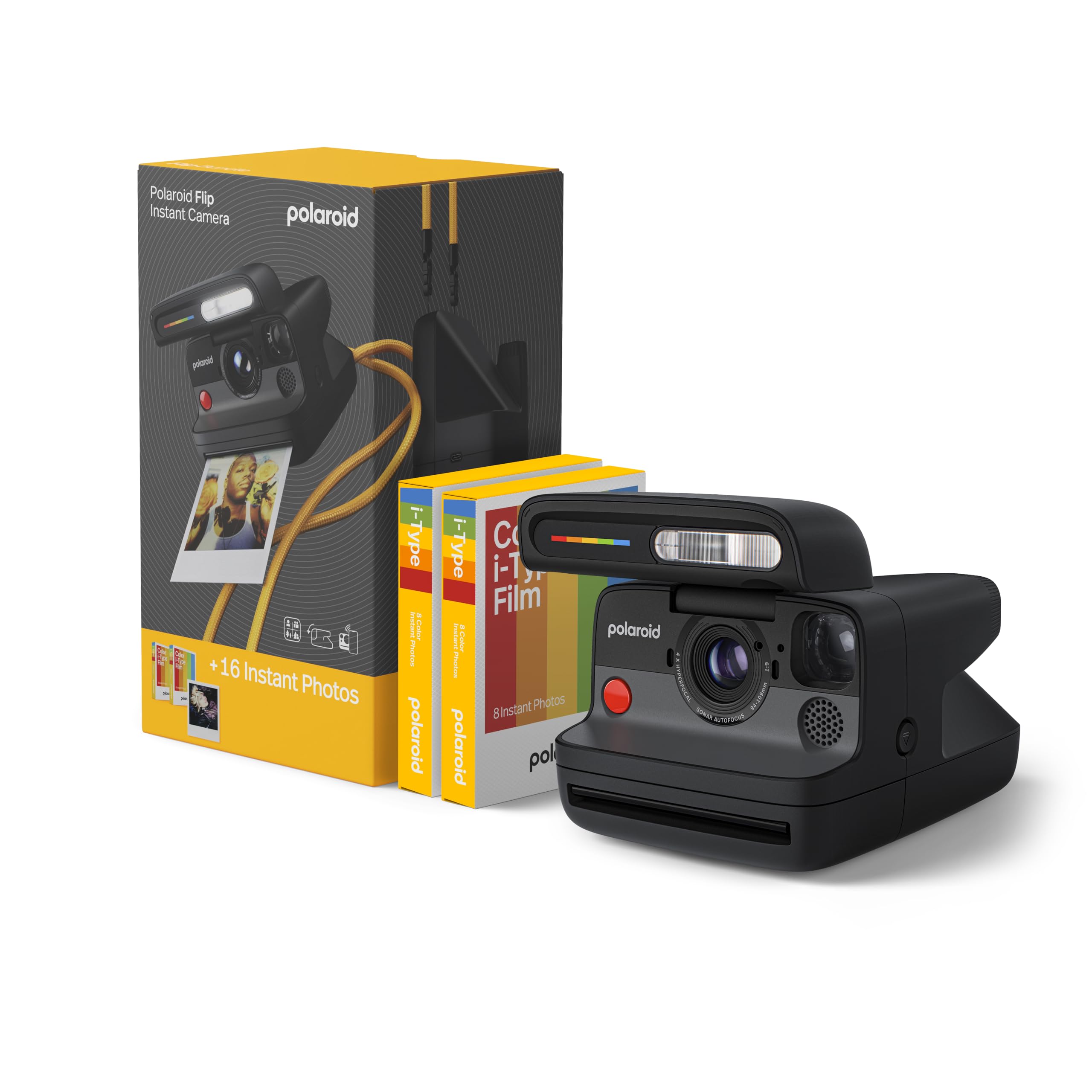
The Polaroid Flip represents a serious step up in instant-camera engineering. Its hyperfocal four-lens system uses sonar waves to measure subject distance, then selects the optimal lens for focus — unaffected by ambient light levels. The integrated flash is the most powerful Polaroid has built into a consumer camera, with adaptive power adjustment for subjects up to 4.5 meters away. Combined with scene analysis that alerts you to over- or underexposure through the viewfinder LED, the Flip gives you far more control without sacrificing the analog experience.
This bundle includes color film for 16 photos, and the camera accepts both i-Type and Polaroid 600 film packs. The lid-based flash design leverages extra space for stronger output, and the tripod mount adds versatility for long exposures or group shots. Users report that learning the lighting nuances — especially when using flash in mixed environments — is part of the charm, and the companion Bluetooth app offers additional exposure guidance.
Film costs are notably higher than Instax Mini formats, and some users encounter inconsistent development if the film pack is old or poorly stored. But for anyone who values sharp, well-exposed analog prints and wants the most advanced Polaroid body available, the Flip justifies its position at the top of the list with genuine optical innovation.
Why it’s great
- Sonar autofocus locks focus in total darkness
- Four-lens hyperfocal system delivers sharper portraits and landscapes
- Most powerful Polaroid flash with adaptive distance control
Good to know
- Film is expensive — expect + per print
- Requires active learning of exposure and flash settings for best results
2. myFirst Camera Insta Lux
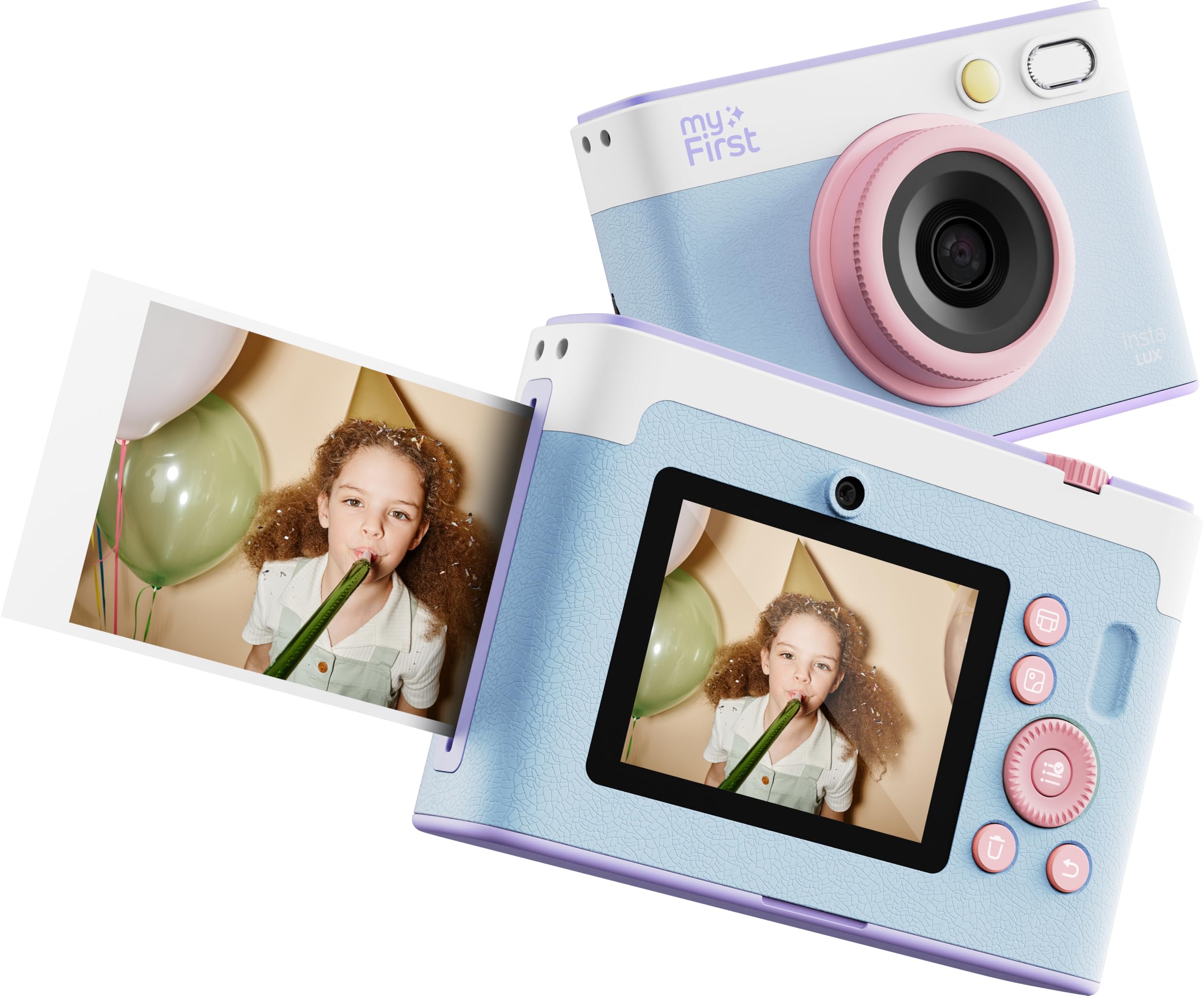
Unlike most instant cameras that rely on analog chemical development, the myFirst Camera Insta Lux uses dye-sublimation printing to produce lab-quality color photos with sharp details and true-to-life hues. The 5MP dual-lens camera and smart exposure system ensure crisp, balanced shots in a variety of lighting conditions — a notable advantage over toy-grade kids cameras that produce muddy, low-res prints.
The Insta Lux also functions as a portable WiFi photo printer: you can connect your smartphone and print high-resolution images from your camera roll, which effectively doubles its utility for scrapbooking, journaling, and travel. The built-in filters and frames provide creative flexibility, and the ability to preview images on screen before printing eliminates wasted paper.
Some users feel the camera body and replacement paper are priced higher than comparable ZINK-based competitors. The instruction manual could also be clearer for first-time setup. But for households that want a device suitable for both children and adults — one that prints genuine high-definition color rather than grainy instant film — the Insta Lux delivers a rare combination of print quality and smart connectivity.
Why it’s great
- Dye-sublimation prints are sharp, fade-resistant, and color-accurate
- WiFi phone printing expands its use beyond the built-in camera
- Screen preview saves paper by avoiding unwanted shots
Good to know
- Replacement paper is expensive compared to Instax film
- Setup instructions could be more detailed
3. Fujifilm Instax Mini 41
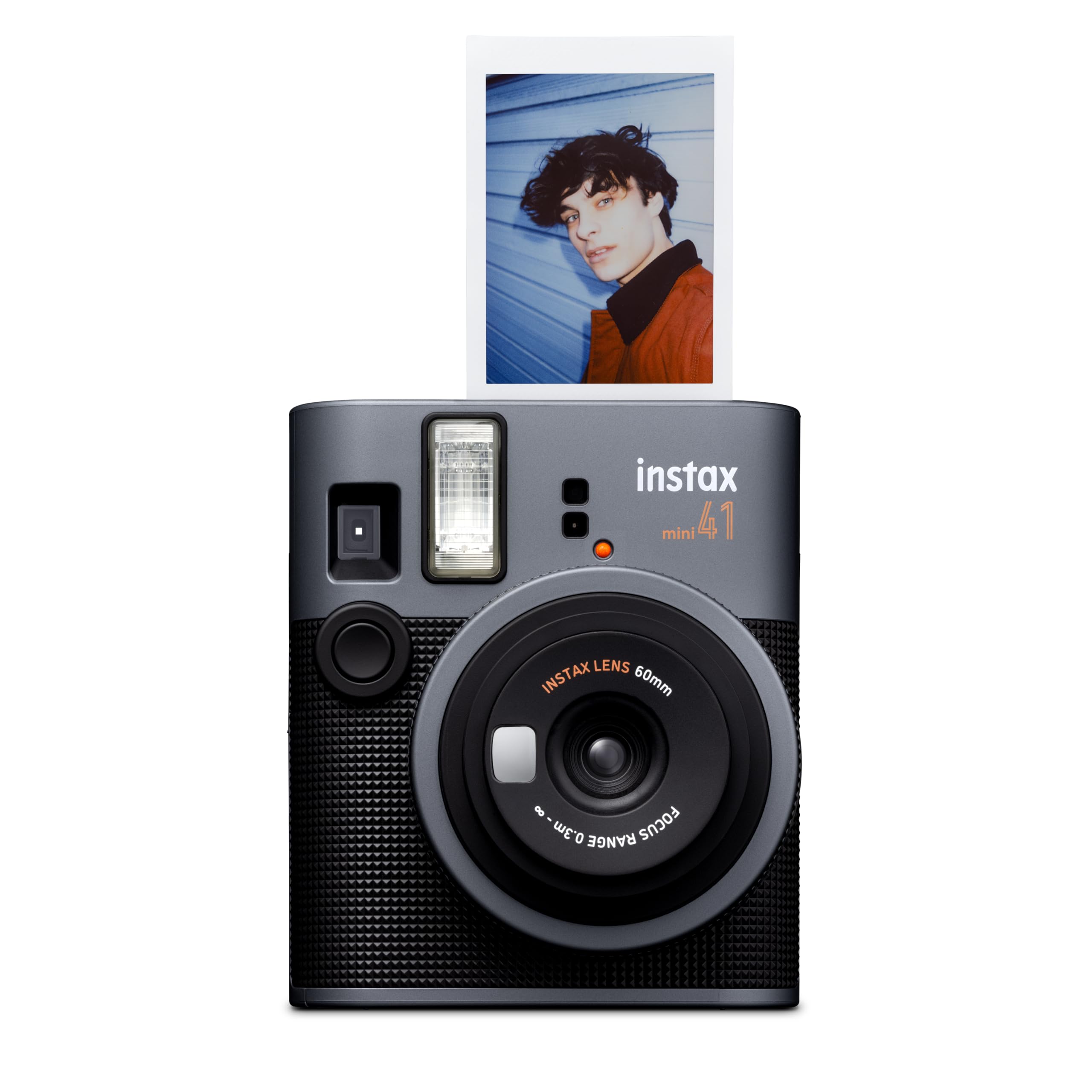
The Instax Mini 41 refines Fujifilm’s trusted formula with a sleek black body, automatic exposure, and a built-in selfie mirror with parallax correction. The twist-lens operation powers the camera on and off while selecting between normal and close-up mode, making it one of the most intuitive point-and-shoot instant cameras available. Prints measure 2” x 3” and develop fully in roughly 90 seconds.
Image quality is reliably bright thanks to the automatic flash control that compensates for low light without washing out subjects. The optical viewfinder includes a target spot, and the close-up mode shifts the frame to correct parallax, ensuring your selfies are centered. Reviewers consistently note the retro aesthetic and sturdy plastic build, with many praising the lower film cost compared to Polaroid packs.
The Mini 41 lacks Bluetooth connectivity, digital preview, or any hybrid features — it is purely an analog instant camera. If you want to print from your phone or preview shots before committing to paper, this model isn’t equipped. But for classic instant photography with reliable exposure and minimal fuss, the Mini 41 earns its spot as a top mid-range contender.
Why it’s great
- Classic analog operation with reliable auto-exposure and flash
- Built-in selfie mirror with parallax correction for accurate framing
- Film cost per shot is lower than Polaroid equivalents
Good to know
- No Bluetooth, digital preview, or phone printing support
- Exposure can run slightly bright in mixed lighting
4. Kodak Smile+ 2-in-1 Digital Instant Print Camera

The Kodak Smile+ is a 2-in-1 device that functions both as a digital instant print camera and a Bluetooth photo printer. Its standout feature is the rotating lens knob that cycles through standard, retro, and star filter effects — a tactile way to stylize shots without post-processing. The camera captures 10MP images and prints them instantly on 2×3” ZINK paper with a peel-and-stick backing.
When connected to a smartphone via Bluetooth, the companion app lets you edit photos with text, stickers, borders, and filters before printing. A microSD card slot allows you to save all captured images digitally, which is useful for archiving or reprinting later. The ZINK technology requires no ink cartridges — color crystals embedded in the paper are activated by heat during printing.
Low-light performance is the camera’s primary limitation. Shots taken in dim conditions, even during daylight in shadowed areas, can appear blurry or color-streaked. Some users also report difficulty loading new paper and occasional jams. If you prioritize filter effects and smartphone integration over low-light sharpness, the Smile+ offers the broadest creative toolkit in its price tier.
Why it’s great
- Rotating filter knob adds retro, standard, and star effects in-camera
- Bluetooth printing from phone with full editing suite in the app
- MicroSD slot saves all images for digital backup
Good to know
- Poor low-light performance — blurry results in dim settings
- Paper loading can be finicky and prone to jams
5. Canon Ivy 2 Mini Photo Printer

The Canon Ivy 2 is a dedicated ZINK photo printer — not a camera with a built-in printer. You pair it with your smartphone via Bluetooth 5.0 and use the Canon Mini Print app to select, edit, and print 2×3” photos. The pocket-sized chassis is smaller than most instant cameras, and the peel-and-stick backing makes each print a ready-to-use sticker for laptops, journals, or scrapbooks.
Print quality is notably improved over the original Ivy, with optimized skin tones, better contrast, and sharper details. The app includes brightness, filter, and border adjustments so you can tweak the image before committing to paper. No ink cartridges are needed, and a single USB-C charge supports printing multiple packs of ZINK paper.
Some users observe a slight blue tint in prints, which may be paper-related rather than a hardware flaw. The printer cannot connect two devices simultaneously — you must disconnect and reconnect when switching phones. If your goal is printing photos from your phone rather than capturing images with a built-in camera, the Ivy 2 is one of the most portable and affordable solutions available.
Why it’s great
- Extremely compact — fits in most pockets
- Peel-and-stick backing ideal for journaling and crafting
- Improved color science over the original Ivy model
Good to know
- Some prints show a slight blue color cast
- Only one phone can be connected at a time via Bluetooth
6. Fujifilm Instax Mini 12 Holiday Bundle
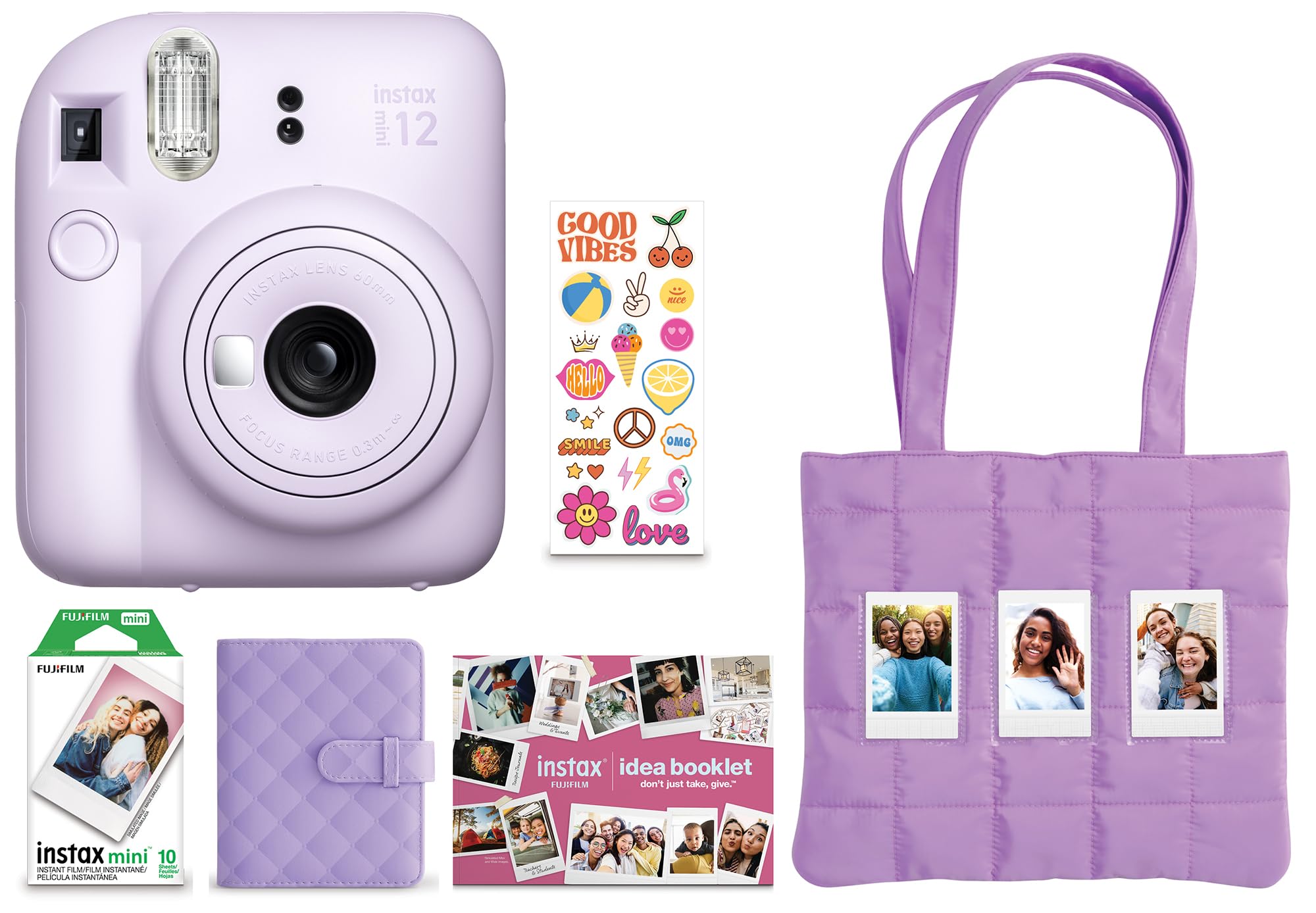
The Instax Mini 12 is Fujifilm’s most accessible instant camera, and this Holiday Bundle amplifies its value with a 10-pack of film, a sticker sheet, a printed photo album that holds up to 64 mini prints, a quilted tote bag with three film pockets, and an idea booklet. The camera itself features the same twist-to-turn-on operation, built-in selfie mirror, close-up mode with parallax correction, and automatic exposure with flash control that made the Mini 11 a bestseller.
Print quality is bright and consistent for a fully automatic camera. The flash prevents washed-out faces, and the close-up mode delivers well-framed selfies. The bundle includes all the accessories a beginner needs to start shooting immediately, including AA batteries. The compact design is lightweight enough for kids, and the tote bag makes carrying film and the camera together convenient.
There are no exposure overrides, no Bluetooth, and no way to preview shots before printing — this is a pure analog point-and-shoot. The film is widely available, and replacement packs are affordable compared to Polaroid options. For a child’s first instant camera, a party guest book camera, or an unfussy gift, this bundle provides everything out of the box.
Why it’s great
- Bundle includes film, album, tote bag, sticker sheet, and batteries
- Simple twist-lens operation perfect for beginners and kids
- Compact, lightweight body easy to carry in small bags
Good to know
- No manual exposure control or digital preview
- Best results require good lighting — indoor performance is limited
7. Polaroid Go Generation 2 Mini Instant Camera + Film Bundle

The Polaroid Go Generation 2 is the smallest instant camera in Polaroid’s lineup, measuring just over four inches wide and fitting comfortably in most pockets, totes, or even a jacket breast pocket. Despite the compact size, the Gen 2 model delivers improved image quality through a larger aperture range, a more precise light sensor, and refined exposure settings that produce clearer, brighter prints than the original Go.
Creative tools include double-exposure mode for superimposing two images and a self-timer for hands-free group shots. The built-in selfie mirror in the viewfinder helps frame close-ups accurately. The camera uses Polaroid Go film (smaller than standard Polaroid film), and a full charge lasts for approximately 15 film packs — enough for extended trips without needing to recharge.
The trade-off for this portability is film size: Go prints are significantly smaller than Instax Mini or standard Polaroid prints, and some users find the development time longer with less consistent contrast than expected. The included 16-photo film bundle gets you started, but replacement Go film is less widely stocked than Instax cartridges. If absolute pocketability is your priority and you accept the smaller print format, the Polaroid Go Gen 2 is a uniquely miniaturized instant camera.
Why it’s great
- Smallest Polaroid instant camera — truly pocketable
- Double-exposure and self-timer expand creative options
- Single charge supports about 15 film packs
Good to know
- Go film is smaller than Instax Mini and less widely available
- Contrast and development time can be inconsistent
FAQ
What is the difference between ZINK and Instax film?
Can I print photos from my phone using these cameras?
Why do my instant photos look dark or washed out?
Final Thoughts: The Verdict
For most users, the cameras that print photos winner is the Polaroid Flip because its sonar autofocus and four-lens system produce sharper, better-exposed prints than any other analog instant camera in its class. If you want lab-quality color prints with the ability to print directly from your phone, grab the myFirst Camera Insta Lux. And for a simple, affordable, and well-bundled entry point — perfect for kids or party guests — nothing beats the Fujifilm Instax Mini 12 Holiday Bundle.

Mo Maruf
I created WellFizz to bridge the gap between vague wellness advice and actionable solutions. My mission is simple: to decode the research and give you practical tools you can actually use.
Beyond the data, I am a passionate traveler. I believe that stepping away from the screen to explore new environments is essential for mental clarity and physical vitality.