Our readers keep the lights on and my smoothie glass nicely filled. As an Amazon Associate, I earn from qualifying purchases.
Nothing tanks a professional Zoom meeting faster than a grainy, laggy, poorly lit video feed. Your laptop’s built-in webcam was never designed for the high-stakes clarity modern remote work demands, leaving you looking washed out and unprofessional. Upgrading to a dedicated camera is the single highest-impact change you can make to your video call presence, but the market is flooded with options promising specs that don’t always translate to real-world performance.
I’m Mohammad Maruf — the founder and writer behind WellFizz. I’ve spent countless hours analyzing lens quality, sensor performance, autofocus speed, microphone clarity, and software ecosystem compatibility across the leading options to separate genuine meeting-ready hardware from overhyped marketing.
Whether you’re a remote executive, a freelancer, or a team lead upgrading your entire department, choosing among the best cameras for zoom meetings means weighing resolution against low-light performance, audio capture against field-of-view, and plug-and-play reliability against advanced features like AI tracking.
How To Choose The Best Cameras For Zoom Meetings
Selecting the right webcam for professional video conferencing requires looking past resolution numbers. A true meeting-ready camera balances sensor sensitivity, autofocus speed, audio quality, and a field of view that frames you naturally without showing your entire room.
Resolution and Sensor Quality
While 4K offers stunning detail, most Zoom calls cap out at 1080p. A camera with a high-quality 1/2.8-inch sensor and strong low-light performance will produce a cleaner, more flattering 1080p image than a cheap 4K sensor fighting to gather light. Prioritize sensor size and pixel binning technology for professional skin tones and balanced exposure.
Autofocus and Field of View
Phase-detection autofocus (PDAF) locks onto your face instantly and stays locked even as you lean forward to gesture. A 78 to 80-degree field of view is the sweet spot: narrow enough to exclude distracting background clutter, wide enough to show natural hand movements. Avoid ultra-wide 90+ degree lenses unless you have a dedicated studio space.
Microphone Technology
Dual omnidirectional microphones with AI-based noise cancellation can dramatically reduce keyboard clatter and ambient chatter. However, for any serious meeting environment, a dedicated external microphone still beats any built-in webcam mic. If audio is your primary concern, look for cameras with stereo mics and rated pickup distances of at least 9 feet.
Quick Comparison
On smaller screens, swipe sideways to see the full table.
| Model | Category | Best For | Key Spec | Amazon |
|---|---|---|---|---|
| OBSBOT Tiny SE | AI PTZ | Dynamic presenters & trainers | 1080p@100fps, AI tracking | Amazon |
| Logitech HD Pro C920 | 1080p Classic | Reliable everyday conferencing | 15 MP interpolated, 78° FOV | Amazon |
| NexiGo N660P Pro | 4K Distortion-Free | Crisp 4K with 3D noise reduction | 4K@30fps, 80° FOV | Amazon |
| EMEET C60E | Dual-Camera 4K | Streamers with hybrid zoom needs | 11X digital zoom, dual lens | Amazon |
| Anker PowerConf C200 | 2K Mid-Range | Low-light conference rooms | 2K / 1440p, 65-95° FOV | Amazon |
| Microsoft Modern Webcam | HDR 1080p | Teams-native plug & play | 1080p HDR, fixed focus | Amazon |
| N newline 4K | Budget 4K | Value-focused 4K streaming | 4K@30fps, PDAF autofocus | Amazon |
In‑Depth Reviews
1. OBSBOT Tiny SE

The OBSBOT Tiny SE is a specialized tool for anyone who moves while presenting. Its 1/2.8-inch stacked CMOS sensor with Dual Native ISO delivers exceptionally clean 1080p video at up to 100 frames per second — far smoother than standard 30fps webcams. The AI-driven PTZ gimbal tracks your face, upper body, or hands with minimal latency, making it ideal for live demonstrations and virtual training sessions where you need to gesture freely.
Gesture control adds a layer of convenience: a raised palm locks tracking, and a pointed finger controls zoom. The Staggered HDR and 12-bit dynamic color range ensure balanced exposure even in mixed lighting environments. At under 2 grams, the camera is tiny but the gimbal base keeps it stable on any monitor.
The built-in microphone is adequate for a quiet room, but the real value here is the tracking and frame rate performance. For standard sit-down meetings, the tracking may feel overly active; you can disable it via software. This camera excels when you need to be the center of attention without staying glued to your chair.
Why it’s great
- Industry-leading 1080p@100fps video for ultra-smooth motion
- Accurate AI body-part tracking and gesture controls
- Excellent low-light performance with HDR
Good to know
- Internal microphone is not pro-grade; external mic recommended
- AI tracking can be distracting for static meetings
- Software glitches may require occasional restart
2. Logitech HD Pro Webcam C920

The Logitech C920 is the benchmark that every other meeting webcam is measured against. Its true 1080p resolution, Carl Zeiss-certified optics, and automatic low-light correction produce a consistently flattering image across a wide range of environments. The 78-degree field of view frames one person perfectly without showing too much of the surrounding office or home.
Dual omnidirectional microphones capture clear stereo audio, though they tend to pick up room reverb in hard-walled spaces. The H.264 encoding ensures smooth streaming without bogging down your CPU, which is critical for long Zoom calls where system resources are shared with presentations and screen sharing.
Build quality is robust: the universal clip attaches securely to any monitor thickness, and the 1.5-meter USB cable gives good placement flexibility. The autofocus has a slight latency, but for static meeting participants it locks on reliably. This is the safest, most proven pick for anyone who just wants their video calls to work without fiddling with settings.
Why it’s great
- Proven, reliable 1080p image quality with strong low-light correction
- Durable construction and universal mounting clip
- H.264 encoding reduces CPU load during calls
Good to know
- Autofocus can be slow in low contrast scenes
- 15 MP still resolution is interpolated, not true 15 MP
- No privacy shutter included (must buy separately or modify)
3. NexiGo N660P Pro
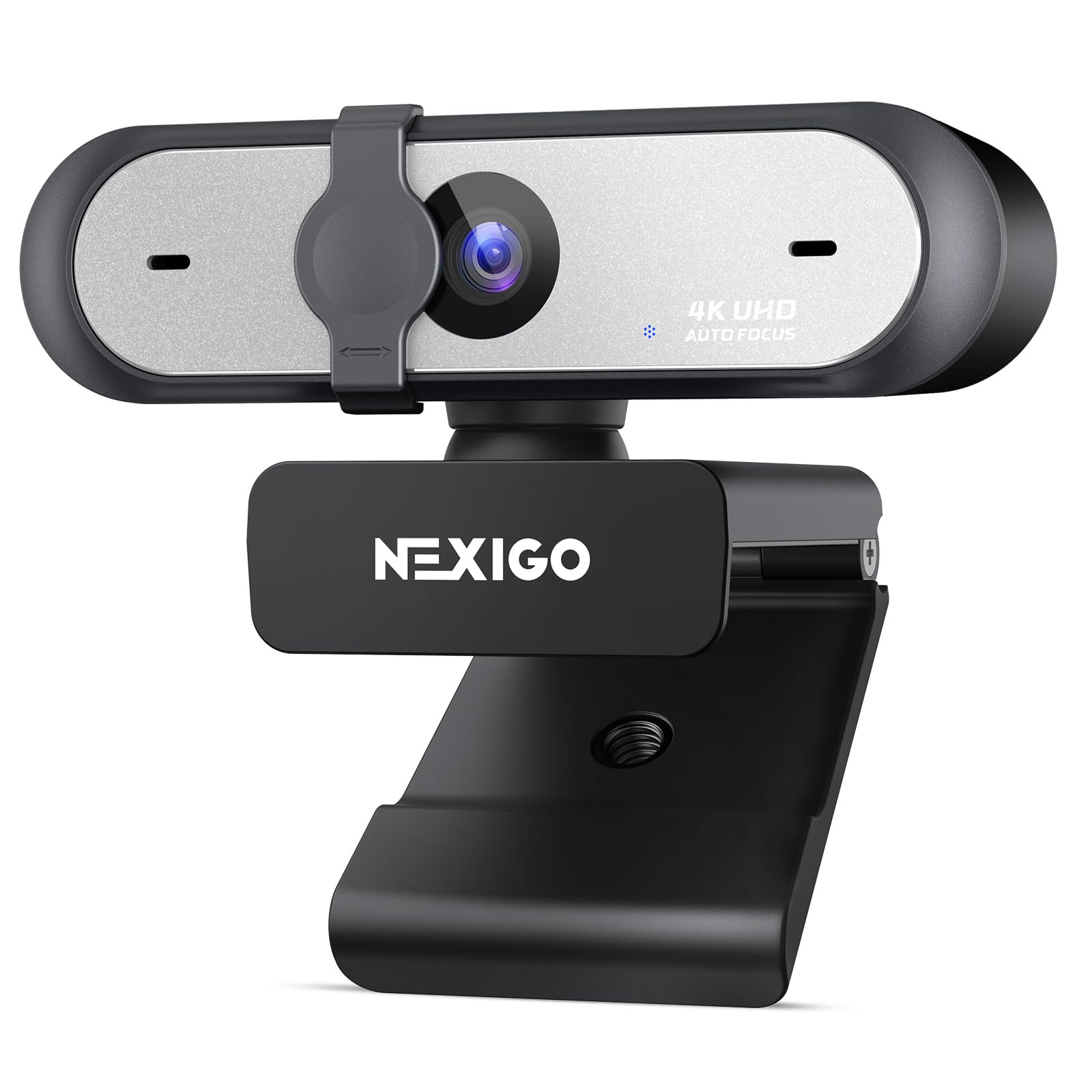
The NexiGo N660P Pro stands out for its precision-engineered, distortion-free lens that preserves natural facial proportions without any fisheye effect. At 4K resolution with 30fps, it delivers exceptional detail for product demos and high-resolution screen sharing. The integrated 3D Noise Reduction (3DNR) actively identifies and removes visual grain in real time, resulting in a clean, professional image even in moderately lit spaces.
Audio performance is handled by dual noise-canceling microphones that effectively isolate your voice from background keyboard and fan noise. The 80-degree field of view is ideal for single-person framing, naturally excluding messy backgrounds without needing a blur filter. The NexiGo software enables 4X digital zoom and fine exposure control.
An external sliding privacy shutter provides physical security between calls, and the 360-degree swivel mount with a 1/4-inch tripod thread offers versatile positioning. At 4K30fps, the image is noticeably sharper than 1080p webcams, though most Zoom calls will downscale it. The real-world benefit is the superior color science and noise handling at 1080p, making this a future-proof upgrade.
Why it’s great
- Distortion-free lens preserves natural face proportions
- 3D Noise Reduction delivers clean, grain-free video
- External sliding privacy shutter for security
Good to know
- Internal mic quality is decent but not for podcast-level audio
- Privacy flip cover may loosen slightly over time
- 4K only at 30fps; 1080p at 60fps for smoother motion
4. EMEET C60E Dual-Camera 4K
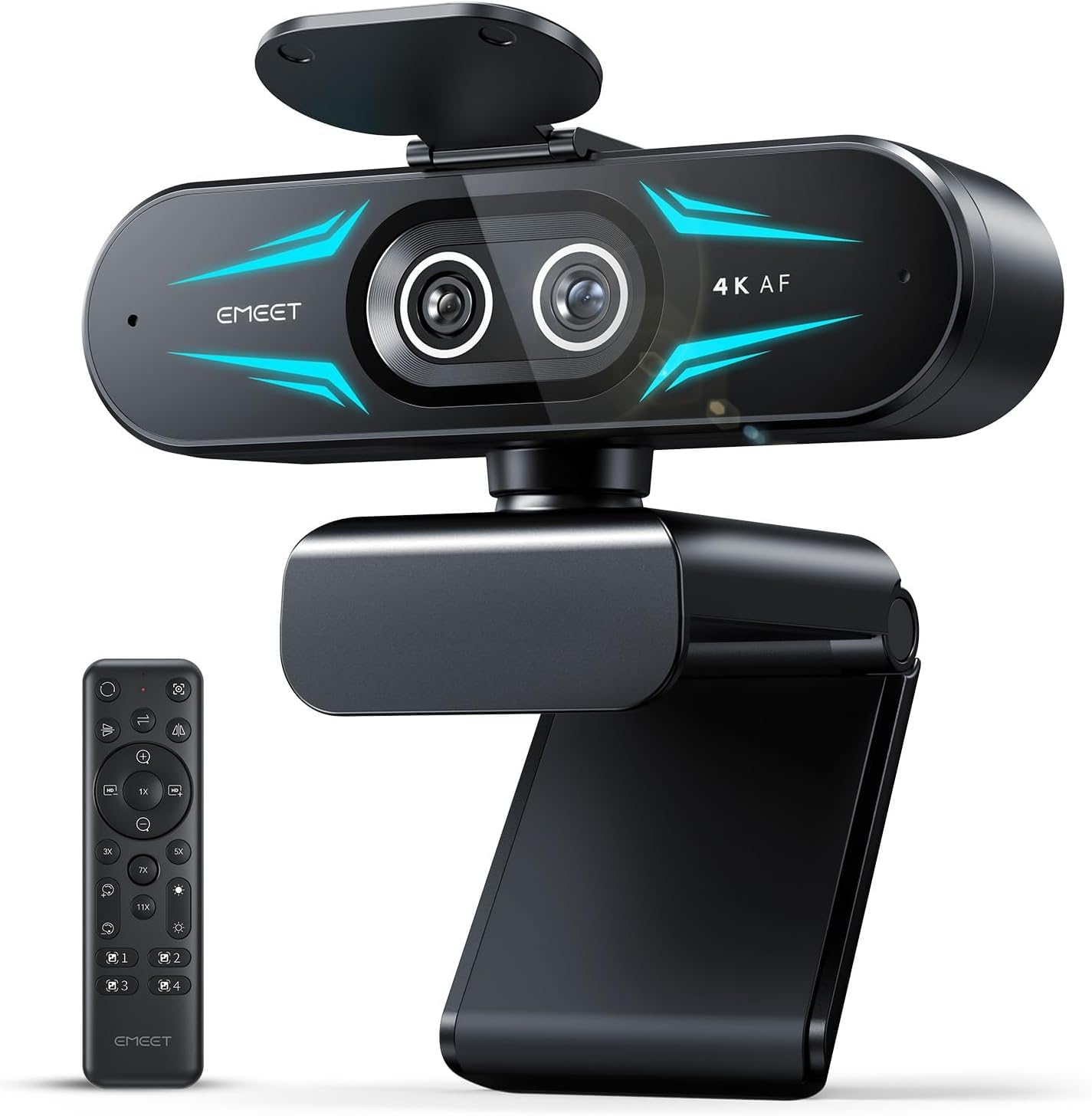
The EMEET C60E introduces a genuinely novel concept to the webcam category: a dual-camera system sharing a single 1/2.8-inch CMOS 4K sensor. A wide-angle lens captures the full scene, while a telephoto camera delivers close-up detail at a recommended distance of 13.8 inches. This makes it exceptional for product reviews, teaching, and any scenario where you switch between showing your face and a detailed object.
The 11X hybrid zoom uses PDAF autofocus to keep transitions smooth and stable. A dedicated remote control lets you switch between cameras and adjust zoom without interrupting your flow, and the EMEET STUDIO software enables fine-tuning of brightness, focus, and the RGB lighting accents. The RGB glow is more than cosmetic — it functions as an active status indicator and adds a modern aesthetic for streamers.
Audio is handled by two omnidirectional microphones with a 9.8-foot pickup radius. The included USB 2.0 cable supports plug-and-play on Windows and macOS, and the 1/4-inch tripod mount adds flexibility. Note that zoom is not supported in 4K or 60fps modes. For standard meetings, this is overkill, but for anyone who needs camera-switching capability, it is a unique tool.
Why it’s great
- Innovative dual-camera system for scene and close-up switching
- 11X hybrid zoom with fast PDAF autofocus
- Includes remote control and customizable RGB lighting
Good to know
- Zoom disabled in 4K and 60fps modes
- Internal mic is adequate but not pro-grade
- Remote requires batteries (not included)
5. Anker PowerConf C200

The Anker PowerConf C200 bridges the gap between budget 1080p webcams and premium 4K units with its sharp 2K (1440p) resolution. The higher pixel count translates to noticeably crisper video than 1080p, while avoiding the processor overhead of full 4K. Its standout feature is software-selectable field of view: 65, 78, or 95 degrees, allowing you to tightly frame your face or include a small conference table.
AI-powered noise cancellation on the dual microphones filters out ambient office noise effectively. Low-light correction is genuinely impressive — the lens gathers enough light to maintain a clean image in dim settings without heavy grain, making it a strong option for home offices without dedicated lighting. The built-in privacy cover slides easily over the lens between calls.
Setup is truly plug-and-play on macOS and Windows, and the Anker software provides basic controls for zoom and exposure. The autofocus can blur slightly in very dark environments but recovers quickly once light improves. For the price, this camera delivers the best balance of resolution, low-light performance, and flexibility in the mid-range tier.
Why it’s great
- 2K resolution hits a sweet spot between sharpness and CPU efficiency
- Adjustable FOV (65/78/95°) suits different desk setups
- Excellent low-light performance for dark home offices
Good to know
- Autofocus struggles in very dim conditions
- Anker software lacks advanced features like login saving
- Small form factor may feel less stable on thick monitors
6. Microsoft Modern Webcam

The Microsoft Modern Webcam is engineered specifically for the Teams ecosystem, with certified compatibility that guarantees trouble-free integration. Its 1080p sensor with HDR delivers balanced exposure and accurate skin tones even when your background contains bright windows or dark corners. The fixed-focus lens (covering 0.4m to 1.5m) eliminates autofocus hunting, ensuring your face is always sharp without any delay.
An integrated privacy shutter physically blocks the lens when not in use, and a usage indicator light shows when the camera is active. The compact design clips securely onto laptops and monitors, and the updatable firmware ensures long-term compatibility with evolving operating systems. Audio is handled by a single noise-canceling microphone that works well for one-on-one calls.
Where this webcam excels is simplicity: it is truly plug-and-play on Windows 11 without any third-party drivers. The main limitation is the fixed focus — if you frequently hold up documents or whiteboards, you will need to lean into the 1.5-meter range. For the vast majority of desk-based meetings, however, this focus range is perfectly adequate and more reliable than cheap autofocus systems.
Why it’s great
- Teams certified for guaranteed compatibility
- HDR imaging handles mixed lighting gracefully
- Fixed focus eliminates autofocus hunting in meetings
Good to know
- Fixed focus range limits close-up document sharing
- Internal microphone may not pick up in larger rooms
- Not 4K; true 1080p with no interpolation
7. N newline 4K Webcam with PDAF

The N newline 4K Webcam proves that entry-level pricing doesn’t mean sacrificing core features. Featuring a 1/2.5-inch Sony sensor, it delivers genuine 4K resolution at 30fps and 1080p at 60fps. The phase-detection autofocus (PDAF) locks onto your face in under one second and maintains focus as you move, which is impressive at this level. Auto light correction balances shadows and highlights to keep your face well-exposed even with a window behind you.
Dual microphones with noise reduction capture clear audio within a 9.8-foot range, filtering out moderate background noise. The 79-degree field of view is ideal for single-person framing, and the built-in privacy cover physically blocks the lens when not in use. Setup is standard USB plug-and-play with broad compatibility across Windows, macOS, and major meeting software including Zoom and Teams.
Build quality is solid with a durable clip and joint. The main trade-off at this price point is the less sophisticated image processing compared to premium models — colors are slightly less saturated in low light, and the sensor is more prone to noise in dark rooms. For well-lit home offices and daytime meetings, however, this is a tremendous value that outperforms many mid-range 1080p cameras.
Why it’s great
- Genuine 4K resolution with fast PDAF autofocus
- Auto light correction handles backlight well
- Excellent value for 4K meeting capability
Good to know
- Image noise increases noticeably in low light
- Color saturation is less vibrant than premium competitors
- Dual mics are good but not class-leading
FAQ
Is 4K worth it for Zoom meetings if the platform only supports 1080p?
Why does my webcam autofocus keep hunting during meetings?
Do I need a separate microphone with a meeting webcam?
Final Thoughts: The Verdict
For most users, the best cameras for zoom meetings winner is the Logitech C920 because it delivers proven, reliable 1080p quality and wide compatibility at a reasonable price. If you want advanced AI tracking for dynamic presentations, grab the OBSBOT Tiny SE. And for a budget-friendly 4K upgrade that still handles autofocus well, nothing beats the N newline 4K.

Mo Maruf
I created WellFizz to bridge the gap between vague wellness advice and actionable solutions. My mission is simple: to decode the research and give you practical tools you can actually use.
Beyond the data, I am a passionate traveler. I believe that stepping away from the screen to explore new environments is essential for mental clarity and physical vitality.