Our readers keep the lights on and my smoothie glass nicely filled. As an Amazon Associate, I earn from qualifying purchases.
The hunt for a capable camera under is a battle between inflated marketing specs and real optical performance. You’ll see “4K” and “64MP” plastered across product titles, but the sensor size, lens quality, and processing power inside a camera are fundamentally different from what drives a true body. The decision isn’t simply about which one has the highest number — it is about which combination of sensor, zoom, and feature set actually delivers usable images in the situations you shoot most often.
I’m Mohammad Maruf — the founder and writer behind WellFizz. I’ve spent years tracking digital imaging hardware, cross-referencing stated specs against real-world capture performance, and parsing user reports across hundreds of camera models to separate genuine value from spec-sheet fluff.
This guide breaks down nine distinct models that compete for the title of best camera under 300, ranking them by how their real-world output matches their advertised capabilities for beginners, vloggers, and casual photographers.
How To Choose The Best Camera Under 300
At this price ceiling, every dollar spent should go toward either lens quality or sensor performance. You cannot have both a 50X zoom range and a true 1-inch sensor for under — manufacturers must trade one for the other. Understanding where each camera cuts its corner determines whether it fits your primary use case.
Optical vs. Digital Zoom
Optical zoom uses physical glass to magnify the scene without losing detail. Digital zoom crops into the center of the sensor and enlarges the pixels, causing visible softness at modest magnification. A camera with 10X optical zoom will outresolve a 50X digital zoom every time. For this category, a real optical zoom range between 10X and 50X is the most meaningful spec to check before buying.
Sensor Size and Megapixel Density
Entry-level cameras in this bracket typically use 1/2.3-inch or smaller sensors. A higher megapixel count on the same tiny sensor actually means smaller individual pixels, which collect less light and introduce noise in dim conditions. A 16MP or 20MP sensor with larger individual photosites often delivers cleaner low-light images than a 64MP sensor on the exact same physical footprint.
Video Resolution and Stabilization
“4K” at the budget end can mean a low bitrate file that looks softer than 1080p from a higher-end model. Look for cameras that offer 4K at 30 frames per second with optical image stabilization (OIS) rather than electronic-only stabilization. OIS compensates for hand shake by moving the lens assembly, preserving resolution. Electronic stabilization crops the frame and may degrade sharpness.
Battery System
Many budget cameras rely on generic lithium-ion packs, but some models — particularly the Kodak AZ255 — run on standard AA batteries. AA-powered cameras are convenient for extended trips where recharging is not possible, but they offer lower shot counts per set. Proprietary lithium packs typically provide between 250 and 400 shots per charge and charge faster via USB-C.
Quick Comparison
On smaller screens, swipe sideways to see the full table.
| Model | Category | Best For | Key Spec | Amazon |
|---|---|---|---|---|
| Canon EOS Rebel T7 Kit | DSLR | Learning photography fundamentals | 24.1MP APS-C sensor, 18-55mm lens | Amazon |
| Canon PowerShot SX530 HS | Superzoom | Distant wildlife and action shots | 50X optical zoom (24-1200mm) | Amazon |
| Kodak PIXPRO AZ255-BK | Superzoom | Value optical zoom on AA batteries | 25X optical zoom, 16MP CMOS | Amazon |
| Minolta 64MP Digital Camera | Travel Zoom | Macro and 4K video in one body | 10X optical zoom, 4K UHD | Amazon |
| Aboobu 8K Digital Camera | Vlogging Bundle | All-in-one kit for beginners | 8K video, 88MP, WiFi, 64GB card | Amazon |
| XNSIAKXA 8K Digital Camera | Vlogging Bundle | WiFi sharing and dual lenses | 8K video, 88MP, 360° mode dial | Amazon |
| NBDDIGITAL 5K 64MP Camera | Compact Travel | Silent scrolling for quiet shoots | 4K/30fps video, 16X digital zoom | Amazon |
| Saneen 4K WiFi Camera | Vlogging Bundle | 4-inch touchscreen vlogging | 4K video, 64MP, front/rear lenses | Amazon |
| Canon PowerShot SX740 HS Bundle | Compact Superzoom | Pocketable 40X zoom with 4K | 40X optical zoom, 20.3MP, 4K | Amazon |
Pricing for the SX740 HS bundle exceeds the stated budget ceiling—it is included as a reference for the highest tier of compact zoom performance.
In‑Depth Reviews
1. Canon EOS Rebel T7 DSLR Kit (EF-S 18-55mm f/3.5-5.6 IS II)

The Canon EOS Rebel T7 sits at the top of this list because it is the only body here with a true APS-C sensor — roughly 25 times the surface area of the 1/2.3-inch sensors used in the budget compacts. That larger sensor captures more light, menghasilkan dramatically better dynamic range, and produces noticeably cleaner images in low-light conditions. Paired with the EF-S 18-55mm f/3.5-5.6 IS II kit lens, it gives you a genuine interchangeable-lens platform you can grow into.
The 9-point autofocus system and the optical viewfinder are dated compared to modern mirrorless bodies, but for a beginner learning composition and manual exposure, the viewfinder experience remains superior to composing on an LCD at arm’s length. It records 1080p Full HD video at 30fps, not 4K, but the video quality from the larger sensor is notably richer than 4K footage from the tiny sensors found in the entry-level bundles.
Battery life is excellent — the LP-E10 pack typically lasts over 500 shots per charge, more than double what most compact cameras in this bracket deliver. The included 18-55mm lens provides a 29-88mm equivalent field of view, which covers standard landscapes, portraits, and walk-around photography. You will need to purchase an SD card separately, but the long-term flexibility of the EF lens mount makes this the most future-proof choice under .
Why it’s great
- Large APS-C sensor offers professional-grade image quality and depth of field control
- Interchangeable lens system allows upgrades and specialized lenses later
- Optical viewfinder helps beginners learn exposure without screen glare
- Excellent battery life — over 500 shots per charge
Good to know
- No 4K video recording — 1080p only
- LCD is fixed (non-articulating) and non-touch sensitive
- Live View autofocus is slow; use the viewfinder for fast shooting
2. Canon PowerShot SX530 HS (Renewed)

The SX530 HS packs a 50X optical zoom (24-1200mm equivalent) that lets you frame subjects impossible to reach with the kit lenses of the DSLR or the mid-range zoom compacts. The 16MP CMOS sensor paired with the DIGIC 4+ processor produces vibrant, well-exposed images in decent light, though the 1/2.3-inch sensor will show noise above ISO 800. The optical image stabilizer is essential at the telephoto end — at 1200mm, even subtle hand movement shakes the frame dramatically without stabilization.
Built-in WiFi and NFC allow wireless image transfer to your phone via the Canon Camera Connect app, which works reliably for sharing to social media without a computer. It records 1080p Full HD video at 30fps using a dedicated record button, and the zoom lens can be adjusted during recording (the lens motor noise will be audible in quiet environments). The 3-inch LCD has 461,000 dots, which is sharp enough for framing but difficult to see in direct sunlight.
Battery life is average — one NB-6L pack lasts roughly 200-250 shots, so carrying a spare is recommended for full-day outings. The renewed units often include extra accessories, but you will need to buy an SD card separately. For safari trips, sporting events, or any scenario where you cannot physically move closer, the 50X range of the SX530 HS is the defining advantage in this price tier.
Why it’s great
- 50X optical zoom (24-1200mm) covers wide landscape to extreme telephoto
- Built-in WiFi and NFC for effortless phone transfers
- Dedicated movie button with zoom during recording
Good to know
- 1/2.3-inch sensor limits low-light performance above ISO 800
- SD card not included in the package
- Renewed unit may have cosmetic wear; verify seller return policy
3. Kodak PIXPRO AZ255-BK

The Kodak PIXPRO AZ255-BK stands out for offering 25X optical zoom (24-600mm equivalent) at a price point typically reserved for digital zoom-only models. The 16MP CMOS sensor produces sharp, color-accurate images in good light, and the optical image stabilization helps steady the frame at the telephoto end. It records 1080p Full HD video with stereo audio, and the 3-inch LCD provides a clear compositional view despite average sunlight legibility.
What makes this model unusual is its power source — it runs on four AA batteries rather than a proprietary lithium pack. This is a genuine advantage for international travel or extended camping trips where USB recharging is not accessible. The downside is lower total energy density: a fresh set of alkaline AAs yields roughly 200-250 shots, and rechargeable NiMH AAs are strongly recommended to avoid the cost and waste of disposables.
The build is lightweight plastic, but the grip is sufficiently deep for comfortable one-handed shooting. The macro mode focuses as close as 3cm, and the scene modes include portrait, landscape, and night portrait. Auto-exposure is reliable in most conditions, though the contrast-detection autofocus can hunt in dim lighting. An SD card is not included, so factor that into your total cost.
Why it’s great
- 25X optical zoom at a very accessible price point
- AA battery system perfect for travel without recharging access
- Macro mode captures clear detail at close range
Good to know
- AA batteries deliver lower total shot count than lithium packs
- No SD card included; purchase separately
- Autofocus hunts in low light
4. Minolta 64MP Digital Camera

The Minolta 64MP camera delivers the best balance of optical zoom and 4K video in this price bracket. Its 10X optical zoom (27-270mm equivalent) covers everyday shooting needs, and the 64MP CMOS sensor produces high-resolution stills that withstand aggressive cropping. The 4K UHD video at 30fps captures significantly more detail than the 1080p-only competition, and the 3-inch articulating LCD can be tilted upward for waist-level shots or low-angle compositions.
Macro mode is a standout feature — the lens focuses as close as 1cm, revealing textures and details invisible to the naked eye. The anti-shake system works well for handheld macro shots, though a tripod still yields the sharpest results at maximum magnification. Face detection, time-lapse, and burst mode are included, and the built-in WiFi allows remote camera control from a smartphone, which is useful for group shots or wildlife setups.
The package includes a 32GB SD card, a carrying case, a rechargeable lithium battery, and a USB charger, making it ready to shoot out of the box. The mode selector wheel is somewhat easy to bump out of position, so a quick check before each shot is wise. Battery life is adequate at roughly 250-300 shots per charge. For users who want both 4K video and legitimate optical zoom in one package, this is the strongest contender.
Why it’s great
- True 4K video resolution at 30fps with optical zoom
- 1cm macro mode reveals extreme close-up detail
- Articulating LCD improves framing flexibility
- Complete kit includes SD card, case, and battery
Good to know
- Mode selector wheel turns easily and can shift unintentionally
- No optical viewfinder; rely on LCD only
- Some units have reported autofocus failure after a few months
5. Aboobu 8K Digital Camera
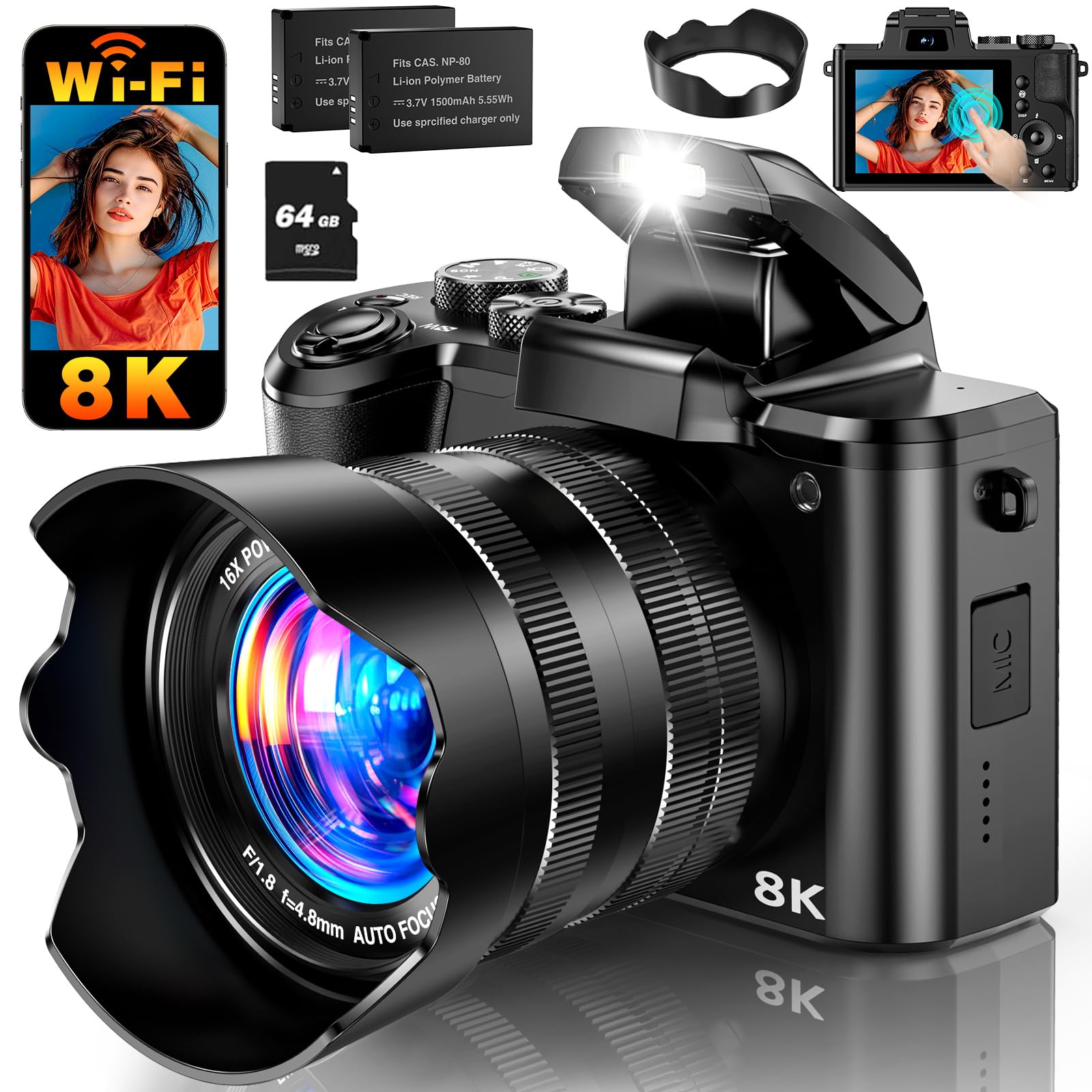
The Aboobu 8K camera enters the market as a complete vlogging starter kit that includes a 64GB memory card, two batteries, a lens hood, a carrying bag, and a cleaning cloth — everything you need to begin shooting immediately. It claims 8K UHD video resolution and an 88-megapixel sensor, though real-world output is closer to interpolated 4K quality given the 1/2.5-inch sensor size. The 16X digital zoom is purely electronic and introduces noticeable softness beyond 4X.
The dual-lens design allows switching between the rear main sensor and a front-facing selfie lens, which is convenient for vloggers who want to frame themselves without guessing. The 3.2-inch IPS touchscreen is responsive, and the 360-degree rotary dial makes mode selection intuitive for beginners — switching between time-lapse, slow motion, filters, and portrait mode takes a single twist. The 6-axis anti-shake stabilization smooths out walking footage reasonably well for a body at this price.
Battery life from the included two packs is good — you can easily shoot across a full day by swapping once. The WiFi function via the iSmart DV2 app enables direct transfer to your phone, though transfer speeds are slower than a wired connection. For absolute beginners who want one box with every accessory included, this kit offers the easiest path to immediate shooting, even if the 8K spec is more marketing than measurable reality.
Why it’s great
- Complete kit with 64GB card, two batteries, bag, and accessories
- Dual-lens system for point-and-shoot selfie vlogging
- Intuitive 360-degree rotary dial for fast mode switching
Good to know
- Advertised 8K resolution is interpolated, not native
- 16X digital zoom degrades image quality beyond moderate crop
- WiFi transfer is noticeably slower than USB connection
6. XNSIAKXA 8K Digital Camera
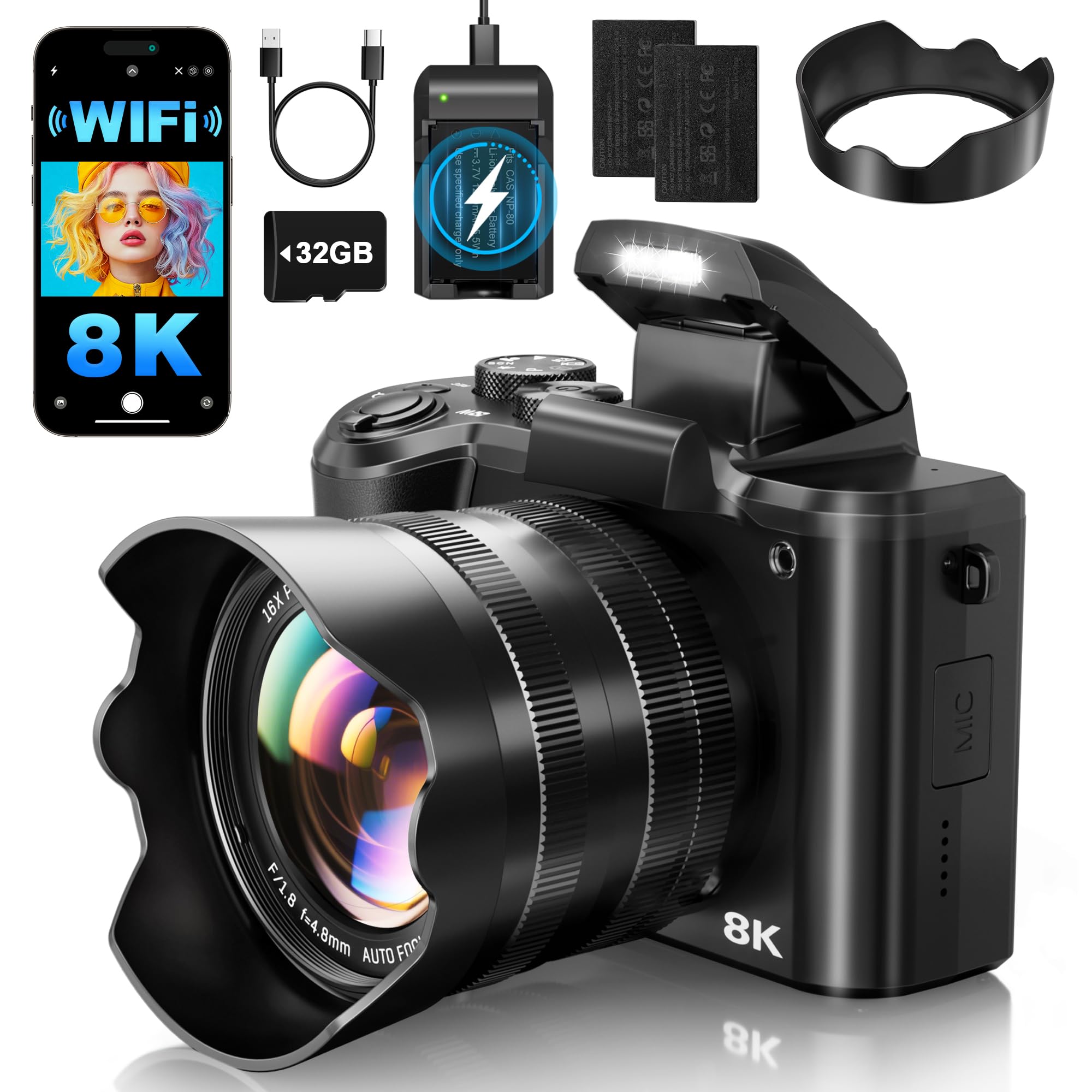
The XNSIAKXA shares a similar sensor and feature set with the Aboobu above but differentiates itself with a more robust autofocus system that includes phase detection, face detection, and eye detection across 79 points. In practice, this means faster and more accurate focus tracking for moving subjects, which matters when shooting kids or pets. The 8K video and 88MP still claims carry the same interpolation caveat, but the 6-axis stabilization and 16X digital zoom perform on par with the Aboobu.
The dual-lens setup includes a front-facing selfie lens with a 3.2-inch IPS touchscreen, and the included 360-degree rotary dial offers modes for time-lapse, slow motion, filters, portrait, landscape, and auto. The package includes a 32GB SD card, two large-capacity batteries, a charging stand, a lens hood, and a camera bag. The charging stand is a thoughtful addition — it keeps the batteries topped up and doubles as a desk cradle.
Battery life is rated at 150 minutes of continuous use, which aligns with typical bundle cameras in this segment. The WiFi app integration works for basic photo transfer but can be finicky to pair initially. For buyers who prioritize fast autofocus tracking and a charging stand over slightly higher accessory count, the XNSIAKXA is the better-engineered of the two 8K entry-level bundles.
Why it’s great
- 79-point autofocus with phase, face, and eye detection
- Charging stand for convenient battery management
- Dual-lens selfie design with responsive touchscreen
Good to know
- 8K and 88MP specs are interpolated, not native resolution
- WiFi pairing process can be unreliable initially
- Battery life at 150 minutes is average for the category
7. NBDDIGITAL True 5K 64MP Camera
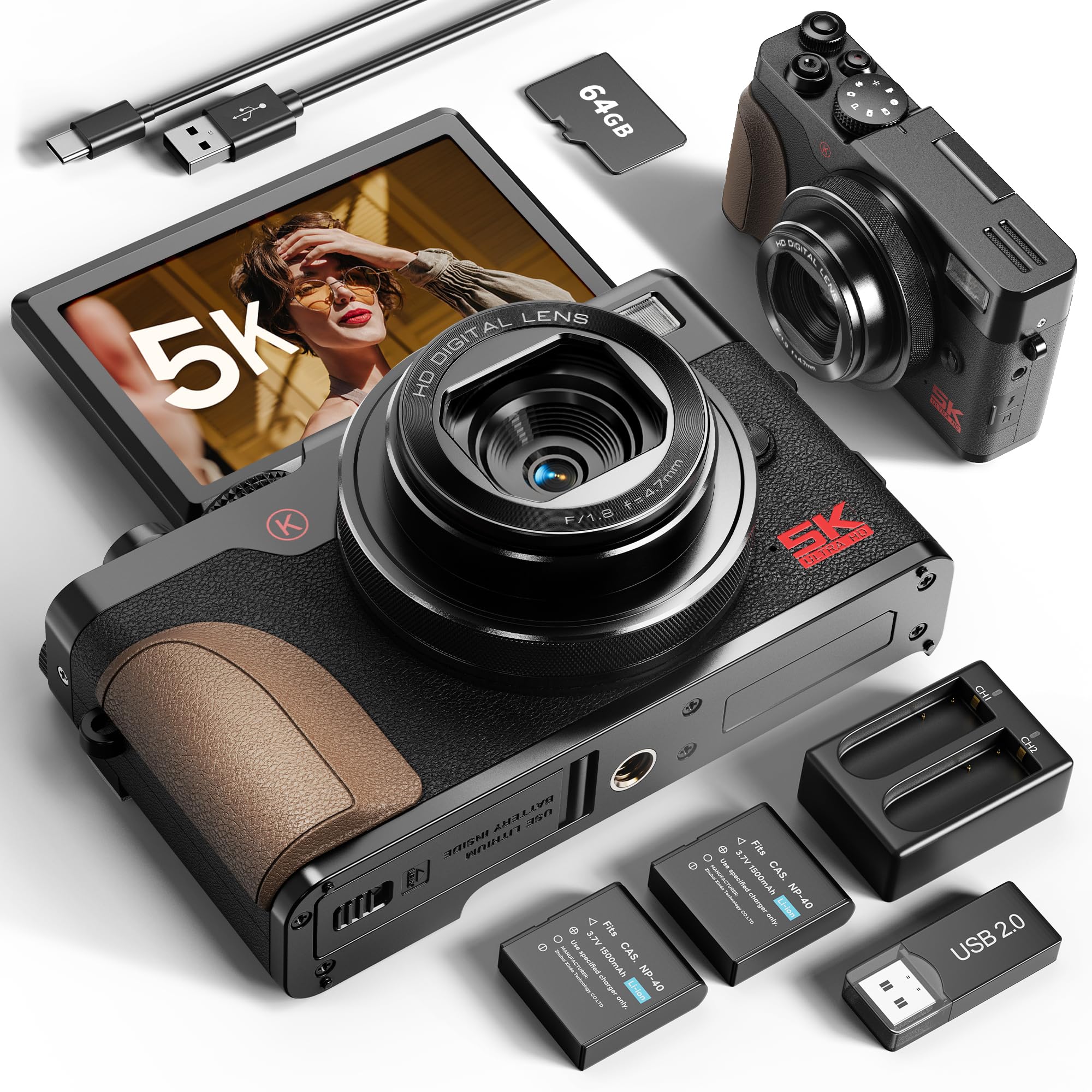
The NBDDIGITAL camera takes a different approach than the other bundle cameras by omitting a front-facing selfie lens in favor of a higher-quality primary sensor. At 121 grams, it is the lightest body in this roundup, and the patented silent scroll wheel replaces traditional zoom buttons — eliminating the click noise that can ruin quiet video recordings. The 4K/30fps video produces sharp footage that holds up well for casual YouTube use.
The 16X digital zoom and anti-shake system deliver stable footage for handheld shooting, and the eight dedicated scene modes (sports, portrait, night, etc.) intelligently adjust exposure for different conditions. The built-in 2500mAh battery is high-capacity for a camera this size — NBDDIGITAL claims over 300 photos per charge, and user reports confirm all-day run times for moderate use. USB-C charging at twice the speed of removable battery solutions is a practical convenience.
The design philosophy is deliberately no-frills: no flash, no front-facing lens, and no WiFi. The included 32GB TF card and USB-C cable get you started immediately, but you will need to format the card in-camera before first use — a step not clearly explained in the manual. For users who want a lightweight, discreet camera for street photography or quiet events, the silent zoom wheel and compact form factor make this a unique option.
Why it’s great
- Patented silent scroll wheel for noiseless zoom operation
- Ultra-light 121-gram body for easy all-day carry
- USB-C fast charging with 2500mAh high-capacity battery
Good to know
- No front-facing screen or flash for selfies
- No WiFi — image transfer requires cable connection
- Initial card formatting step is not well documented
8. Saneen 4K 64MP WiFi Touch Screen Camera

The Saneen 4K camera distinguishes itself with the largest display in this comparison — a 4.0-inch IPS touchscreen that makes framing and reviewing footage more comfortable than the 3-inch panels on most competitors. The dual-lens design includes a front-facing selfie lens with an easy switch, and the 4K/30fps video recording is complemented by resolution options down to 360p for storage flexibility. The photo resolution range from 64MP down to 8MP lets you choose between file size and quality.
The 3000mAh battery is the largest capacity of any camera reviewed here, delivering noticeably longer run times. Users report shooting hundreds of photos across a full day without needing to recharge. The camera also doubles as a webcam via USB connection, and the pause function lets you stop and resume recording into the same video file — a useful feature for vloggers who need to skip segments without creating multiple clips. WiFi and HDMI output provide additional sharing and display options.
Image quality is average for the 1/2.3-inch sensor class — acceptable for social media but the 4K footage softens noticeably in low light. The contrast-detection autofocus with only 9 focus points is slower and less precise than the phase-detection systems found in DSLRs and high-end compacts. For beginners focused on vlogging and casual recording who prioritize a large touchscreen and long battery life, the Saneen delivers solid real-world usability.
Why it’s great
- 4.0-inch touchscreen is the largest display in the comparison
- 3000mAh battery provides all-day shooting on a single charge
- Webcam mode and pause function for vlogging flexibility
Good to know
- 4K video quality drops significantly in low-light conditions
- Contrast-detection autofocus is slower than phase-detection systems
- Advertised 64MP photos are interpolated, not native resolution
9. Canon PowerShot SX740 HS Bundle
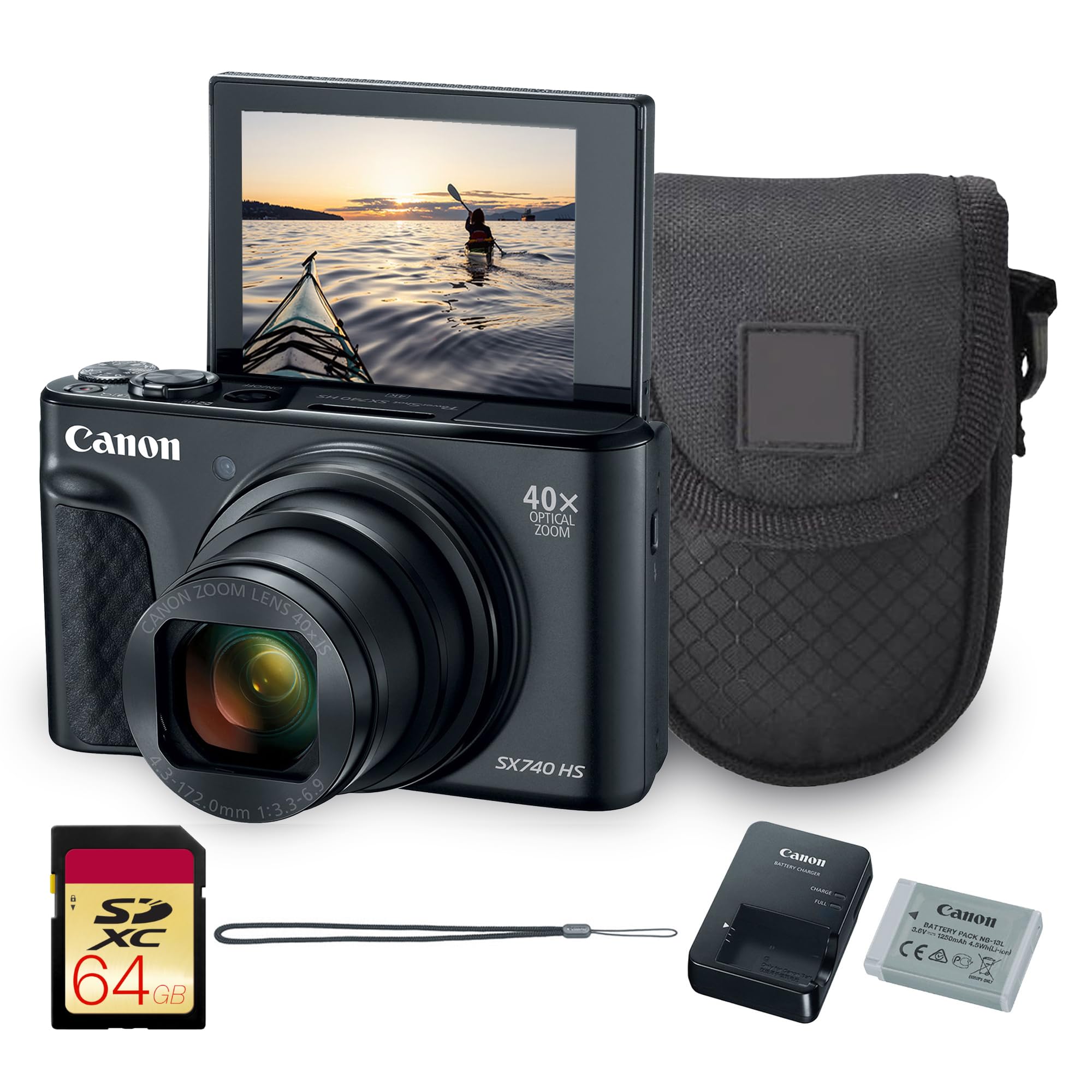
The Canon PowerShot SX740 HS sits at a higher price point than the ceiling of this guide, but it is included as a reference model because it represents the absolute ceiling of what a compact point-and-shoot can deliver before stepping into interchangeable-lens territory. Its 20.3MP CMOS sensor paired with the DIGIC 8 processor produces genuinely sharp 4K UHD video at 30fps with 5-axis stabilization — the footage is noticeably more stable and detailed than any of the budget 4K competitors.
The 40X optical zoom lens (24-960mm equivalent) retracts into a body small enough to slide into a jacket pocket, making it the most portable superzoom available. The autofocus system is a hybrid contrast/phase hybrid, which locks on quickly and tracks subjects reliably. WiFi and Bluetooth connectivity via the Canon Camera Connect app provide fast wireless transfers and remote control from a smartphone. The 3-inch LCD has 922,000 dots — double the resolution of the budget screens — and is much easier to see outdoors.
Battery life is excellent for a compact: the NB-13L pack delivers roughly 265 shots per CIPA standard, but real-world usage often yields over 300 shots per charge. The bundle includes a soft case and a 64GB memory card, so it arrives ready to shoot. The primary drawback is cost — it dramatically exceeds the budget. For creators who can stretch their budget, the SX740 HS will produce superior image quality, far better stabilization, and a more durable shooting experience than any budget bundle under .
Why it’s great
- 40X optical zoom in a true pocket-sized body
- Authentic 4K UHD video with 5-axis stabilization
- Hybrid autofocus is fast and reliable in good light
- Bundle includes soft case and 64GB memory card
Good to know
- Price exceeds the budget by a significant margin
- International models cannot be registered for Canon US warranty
- Fixed LCD — no articulation for vloggers
FAQ
Is it worth buying a camera with 8K video under ?
What does the “64MP” in budget camera specs actually mean?
Should I buy a renewed Canon PowerShot like the SX530 HS?
Is the Canon EOS Rebel T7 still a good choice in 2025?
What is the real-world difference between the Kodak AZ255 and the Canon SX530 HS?
Final Thoughts: The Verdict
For most users, the best camera under 300 winner is the Canon EOS Rebel T7 DSLR Kit because its APS-C sensor delivers image quality that is two to three stops better in low light than any compact camera in this price range, and the EF lens mount provides a clear upgrade path as your skills grow. If you want 50X optical zoom to capture distant wildlife or sports, grab the Canon PowerShot SX530 HS. And for a budget-friendly entry point with AA battery versatility, nothing beats the Kodak PIXPRO AZ255-BK for value-conscious travelers.

Mo Maruf
I created WellFizz to bridge the gap between vague wellness advice and actionable solutions. My mission is simple: to decode the research and give you practical tools you can actually use.
Beyond the data, I am a passionate traveler. I believe that stepping away from the screen to explore new environments is essential for mental clarity and physical vitality.