Our readers keep the lights on and my smoothie glass nicely filled. As an Amazon Associate, I earn from qualifying purchases.
The line between a snapshot and a portfolio-worthy image is rarely the photographer — it’s the gear. Landing the right camera under a thousand dollars means navigating a battleground of sensor sizes, autofocus algorithms, and lens ecosystems, where a single wrong spec can lock you out of the style you’re chasing for years.
I’m Mohammad Maruf — the founder and writer behind WellFizz. I analyze mirrorless and DSLR systems from Canon, Sony, Nikon, Panasonic, and OM System, weighing real-world performance against market data to separate genuine upgrades from marketing noise.
After reviewing dozens of models, the best camera under 1000 pool reveals that sensor technology and autofocus speed determine your ceiling, not megapixels or brand name alone.
How To Choose The Best Camera Under 1000
Buying in this range means you have access to both entry-level DSLRs and advanced mirrorless bodies. The right choice depends on whether you prioritize video features, autofocus speed, or the path to a full-frame upgrade later.
Sensor Size and Megapixels
Almost every model under uses an APS-C sensor. That’s a good thing — it balances low-light performance and depth-of-field control without the cost of full-frame glass. A 24-megapixel APS-C sensor delivers more than enough resolution for large prints and heavy cropping. Don’t chase megapixels beyond 24; image processing and dynamic range matter far more.
Autofocus System and Coverage
Phase-detection autofocus with face and eye tracking is the standard you want. Look for at least 100 autofocus points for smooth coverage. The best units in this price range offer real-time tracking for people and animals, which matters whether you’re shooting a running toddler or a street portrait.
Video Capabilities and Crop Factor
4K video is common now, but many cameras crop the sensor to achieve it — reducing the field of view by 1.5x or more. If video is a priority, seek models that oversample 4K from a 6K readout or offer full-frame 4K without a crop. Also check for a microphone jack; built-in mics on budget models rarely sound good.
Lens System and Upgrade Path
Your first lens matters, but the ecosystem matters more. Canon’s RF mount and Sony’s E-mount offer the widest selection of affordable third-party lenses from Sigma and Tamron. Nikon’s Z mount is catching up but with fewer budget options. Micro Four Thirds (Panasonic and OM System) has the most compact lenses but a smaller sensor that struggles in very low light.
Quick Comparison
On smaller screens, swipe sideways to see the full table.
| Model | Category | Best For | Key Spec | Amazon |
|---|---|---|---|---|
| Sony Alpha a6400 | Mirrorless | Fast action & autofocus | 425 phase-detect AF points | Amazon |
| Canon EOS R50 | Mirrorless | Beginners & vloggers | Dual Pixel AF II with eye tracking | Amazon |
| Canon EOS RP + 24-105mm | Full-Frame Mirrorless | Full-frame entry | 26.2MP full-frame CMOS sensor | Amazon |
| Panasonic LUMIX G85 | Mirrorless | Stabilized video & travel | 5-axis IBIS (in-body stabilization) | Amazon |
| Nikon Z 30 | Mirrorless | Vlogging & streaming | Unlimited 4K 30p recording | Amazon |
| OM SYSTEM E-M10 Mark IV | Mirrorless | Compact travel & selfies | Flip-down selfie screen | Amazon |
| Canon EOS R100 | Mirrorless | Budget entry mirrorless | Dual Pixel CMOS AF (143 zones) | Amazon |
| Canon EOS Rebel T7 | DSLR | Budget-friendly learning | Built-in Wi-Fi & NFC sharing | Amazon |
| Canon EOS 2000D / Rebel T7 Renewed | DSLR | Renewed budget starter | 24.1MP APS-C sensor | Amazon |
| Canon EOS 2000D / Rebel T7 Bundle | DSLR | Bundle with accessories | 20-piece accessory bundle | Amazon |
In‑Depth Reviews
1. Sony Alpha a6400 + 16-50mm Lens

The Sony a6400 sits at the top of the under- tier because it delivers autofocus performance that rivals cameras costing twice as much. The 425 phase-detection points cover nearly the entire frame, and Real-time Eye AF for both humans and animals locks onto a subject in 0.02 seconds — a figure that translates to fewer missed shots in real-world use.
The 24.2-megapixel APS-C Exmor sensor with front-end LSI produces clean images up to ISO 3200, and the oversampled 4K video (2.4x oversampling from a 6K readout) delivers sharp footage with minimal moiré. The 180-degree tiltable touchscreen flips up for vlogging, though it doesn’t face forward for selfie framing without blocking the hot shoe.
Battery life is rated at 410 shots per charge — acceptable for a mirrorless body — and the E-mount ecosystem gives you access to affordable Sigma and Tamron lenses. The kit 16-50mm f/3.5-5.6 OSS II lens is compact but optically average; many users replace it quickly with a prime.
Why it’s great
- Lightning-fast 0.02s autofocus with real-time tracking
- Excellent 4K video quality with 2.4x oversampling
- Compact body with extensive lens ecosystem
Good to know
- No in-body image stabilization (relies on lens OSS)
- Screen tilts up but blocks hot shoe when flipped
- Kit lens is optically average
2. Canon EOS R50 + 18-45mm Lens Kit
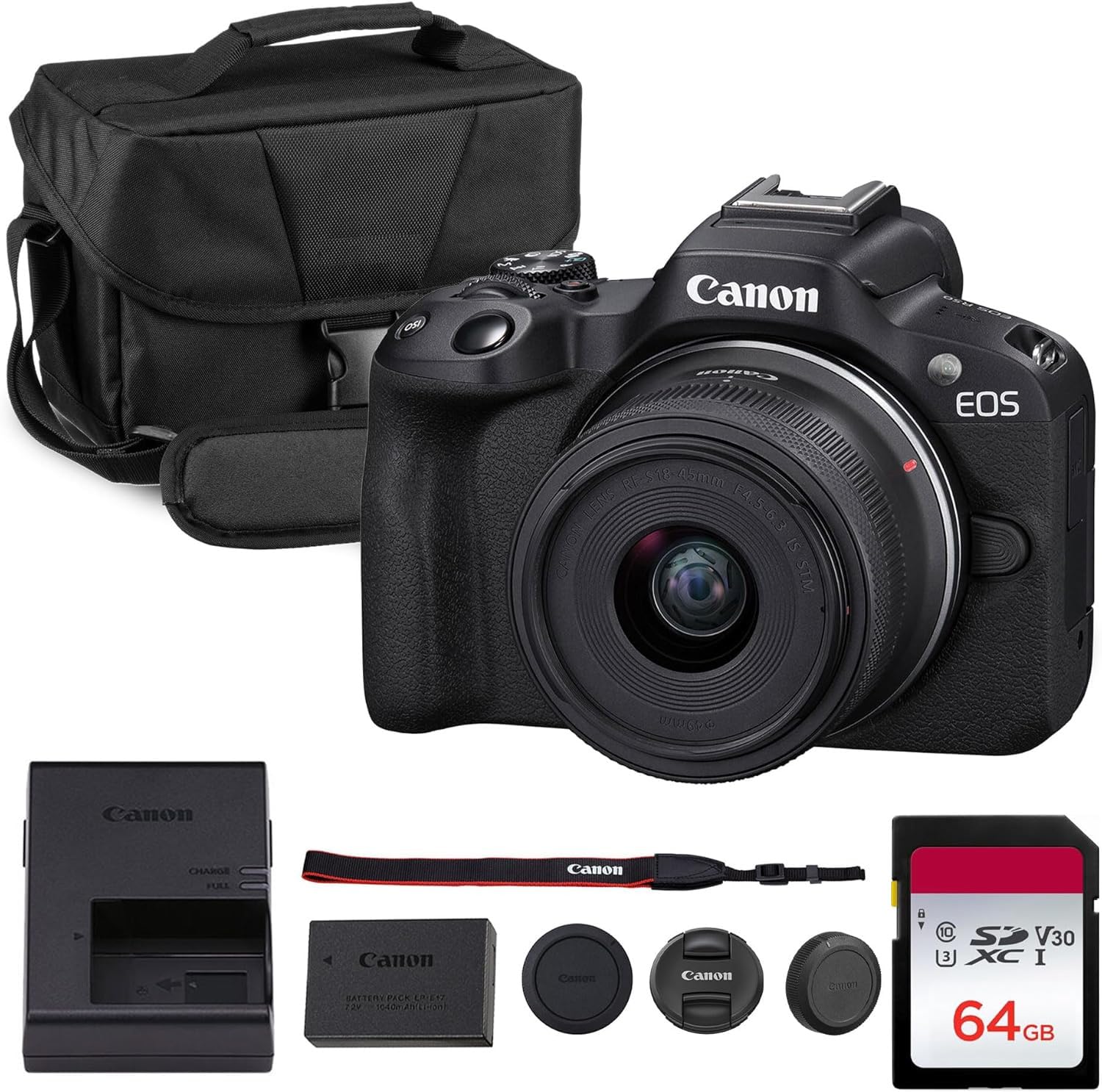
The Canon EOS R50 is the lightest RF-mount camera at just 12.3 ounces, making it a strong contender for everyday carry. Its 24.2-megapixel APS-C sensor pairs with the DIGIC X processor (borrowed from Canon’s higher-end R-series) to deliver Dual Pixel AF II with face, eye, and animal detection that sticks to subjects during 4K video recording.
Video shooters will appreciate the oversampled 4K at 30p with no crop, plus vertical video mode for social media content. The vari-angle touchscreen flips out to the side — a thoughtful design for vloggers who want to monitor their framing without blocking the lens. The kit 18-45mm f/4.5-6.3 IS STM lens features optical stabilization but has a slow maximum aperture that limits low-light performance.
Creative Assist mode guides beginners through exposure and color adjustments without needing to understand manual mode terminology. The R50 lacks a built-in flash and uses the older LP-E17 battery (rated for 310 shots), but USB-C charging softens the impact of carrying a spare.
Why it’s great
- Excellent Dual Pixel AF II with subject tracking
- Compact body with vari-angle touchscreen
- Vertical video mode and no-crop 4K
Good to know
- Kit lens aperture is slow (f/4.5-6.3)
- No built-in flash
- Battery life of 310 shots per charge
3. Canon EOS RP + RF24-105mm F4-7.1 STM Lens

The Canon EOS RP is the most affordable full-frame mirrorless camera on the market, and it changes the calculation for photographers who need wider dynamic range and shallower depth of field than APS-C can offer. The 26.2-megapixel full-frame CMOS sensor delivers noticeable improvements in low-light noise performance and background separation, especially when paired with fast RF primes.
The RF 24-105mm f/4-7.1 IS STM kit lens provides a versatile zoom range equivalent to what APS-C shooters get from an 18-55mm, but with optical image stabilization rated at up to 5 stops. Autofocus uses Canon’s Dual Pixel CMOS AF with 4,779 manually selectable points, and the vari-angle touchscreen works well for waist-level or overhead compositions.
4K video is present but with a significant 1.7x crop factor and limited to 24p — this camera prioritizes still photography over video. The battery life is 250 shots per charge (typical for a compact full-frame), so spare batteries are essential for a full day of shooting.
Why it’s great
- Full-frame sensor for better low-light and bokeh
- Lightweight body for a full-frame system
- Wide range of RF lenses and EF adapter compatibility
Good to know
- 4K video has a 1.7x crop and limited to 24p
- Battery life of only 250 shots
- Continuous shooting at 4 fps limits action use
4. Panasonic LUMIX G85 + 12-60mm Lens

The Panasonic LUMIX G85 is a video-first mirrorless camera built around a 16-megapixel Micro Four Thirds sensor with no low-pass filter, which boosts fine detail resolution by about 10% compared to earlier 16MP MFT sensors. The standout feature is the 5-axis in-body image stabilization (IBIS), which works in concert with the kit 12-60mm Power O.I.S. lens to produce smooth handheld footage even when walking slowly.
The G85 supports 4K video at 30p with the full sensor width, and its 4K Photo mode lets you extract 8-megapixel stills from video at up to 30 fps — useful for capturing split-second moments. The magnesium-alloy body is weather-sealed, an unusual feature at this price point, and the 2.36M-dot OLED electronic viewfinder is bright and responsive.
Autofocus uses contrast detection (49 points) rather than phase detection, which means it hunts more in low light compared to Sony or Canon rivals. The kit 12-60mm lens is sharp in the center but suffers from corner softness, and battery life is rated at 320 shots per charge.
Why it’s great
- Best-in-class 5-axis IBIS for handheld video
- Weather-sealed magnesium-alloy body
- 4K Photo mode for extracting still frames
Good to know
- Contrast-detect AF hunts in low light
- 16MP sensor is lower resolution than APS-C rivals
- Kit lens has corner softness
5. Nikon Z 30 + 16-50mm VR Lens

Nikon designed the Z 30 specifically for content creators and vloggers, stripping away the electronic viewfinder to keep the body compact and the price accessible. The 20.9-megapixel DX-format sensor delivers sharp stills and video, and the hybrid autofocus system with 209 phase-detect points includes eye-detection for humans and pets that works reliably in well-lit conditions.
The Z 30 records unlimited 4K at up to 30p with no recording time limit, and oversampling from the full sensor width produces clean footage. The flip-out touchscreen faces forward and shows a red REC light for confidence monitoring. USB-C connectivity allows for power delivery during long streaming sessions, and the camera works as a plug-and-play webcam in Full HD 60p.
The kit NIKKOR Z DX 16-50mm f/3.5-6.3 VR lens is remarkably compact and includes vibration reduction (VR) for stabilized handheld footage. The lack of a viewfinder is a dealbreaker for some stills photographers, and the Z-mount lens library is still smaller than Sony’s E-mount or Canon’s RF mount.
Why it’s great
- Compact body with flip-out front-facing screen
- Unlimited 4K 30p recording with oversampling
- USB-C power delivery and webcam functionality
Good to know
- No electronic viewfinder
- Smaller native Z-mount lens selection
- Battery life is 330 shots per charge
6. OM SYSTEM E-M10 Mark IV + 14-42mm EZ Lens

The OM SYSTEM E-M10 Mark IV is one of the smallest interchangeable-lens cameras available, and its retro-styled body paired with the 14-42mm f/3.5-5.6 EZ pancake lens fits inside a jacket pocket. The 20-megapixel Micro Four Thirds sensor is paired with a 5-axis in-body stabilization system rated for 4.5 shutter speed steps of compensation — enough to shoot sharp handheld exposures at 1/4 second.
The flip-down monitor activates a dedicated selfie mode when rotated downward, complete with face-detection autofocus and an instant film art filter for a nostalgic look. The camera includes 16 art filters in total, and the 4K video at 30p is usable but lacks a microphone jack, which limits audio upgrade options for video shooters.
Autofocus uses contrast detection with 121 points — adequate for casual shooting but not competitive with Sony or Canon hybrid systems for tracking fast-moving subjects. The Micro Four Thirds lens ecosystem is mature and compact, but the 2x crop factor means lenses like a 25mm f/1.8 behave like a 50mm full-frame equivalent.
Why it’s great
- Extremely compact and pocketable body
- Excellent 4.5-stop IBIS for low-light handheld shots
- Flip-down selfie mode with art filters
Good to know
- No microphone jack for external audio
- Contrast-detect AF is slower for action
- 2x crop factor affects wide-angle lens choice
7. Canon EOS R100 + RF-S18-45mm F4.5-6.3 IS STM

The Canon EOS R100 is the smallest and lightest body in Canon’s R-series, weighing just 12.3 ounces. It’s designed explicitly for users migrating from smartphones or old point-and-shoots, with a guided user interface called “Creative Assist” that explains exposure settings in plain language.
The 24.1-megapixel APS-C sensor and DIGIC 8 processor deliver good image quality in good light, and Dual Pixel CMOS AF covers up to 143 zones with human face and eye detection. The R100 shoots 4K video at 24 fps and Full HD at 60 fps, and the DIGIC 8 processor enables 120 fps slow-motion at HD resolution.
Continuous shooting reaches 6.5 fps with One-Shot AF, but drops to 2.5 fps with continuous tracking. The camera lacks a touchscreen (the 3-inch LCD is fixed), and the flash hot shoe is not compatible with Canon’s Speedlite EL series — only older EX-series flashes work. Battery life is 290 shots per charge.
Why it’s great
- Smallest and lightest R-series body
- User-friendly Creative Assist guide interface
- Dual Pixel AF with face and eye detection
Good to know
- No touchscreen, fixed LCD display
- 4K limited to 24 fps
- Limited flash compatibility
8. Canon EOS Rebel T7 + 18-55mm Lens Kit
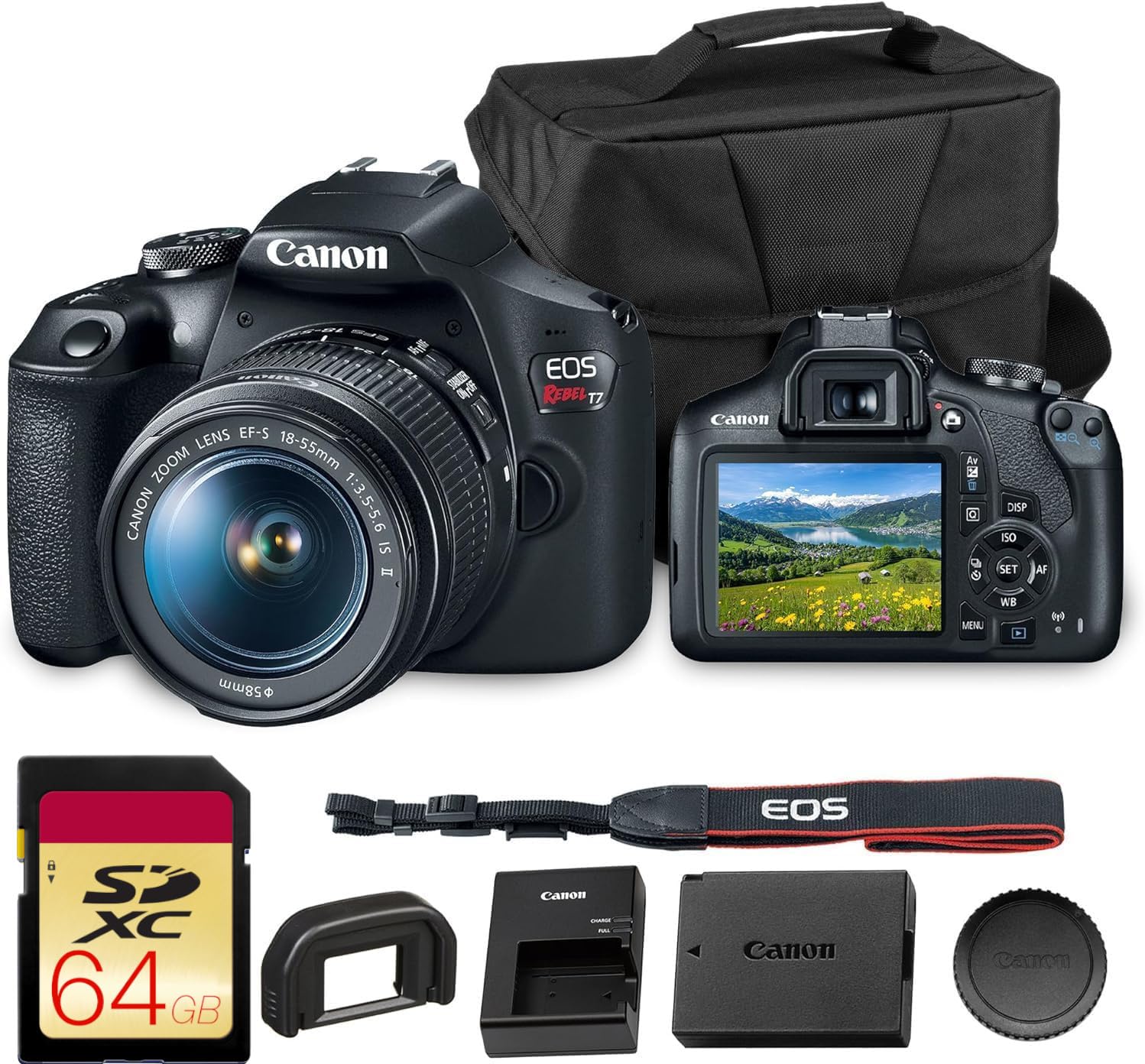
The Canon EOS Rebel T7 (known as the EOS 2000D outside North America) is a straightforward DSLR that removes every complexity that can overwhelm new photographers. Its 24.1-megapixel APS-C sensor is paired with a DIGIC 4+ processor, an older chipset that limits video to Full HD 1080p at 30 fps but handles still images with solid color accuracy.
The optical viewfinder provides a battery-free, lag-free view of your subject — an advantage for users who find EVF refresh rates dizzying. The 9-point autofocus system with a single cross-type center point is dated, so you’ll rely on center-point AF and recompose for most shots. Built-in Wi-Fi and NFC work with Canon’s Camera Connect app for image transfer and remote shutter control.
The kit includes a shoulder bag and 64GB SD card, giving beginners everything needed out of the box. The 18-55mm f/3.5-5.6 DC III lens is optically modest but covers the standard zoom range. The Rebel T7 shoots at 3 fps continuous, which limits action photography.
Why it’s great
- Optical viewfinder for real-time framing
- Includes bag and memory card in kit
- Simple operation for absolute beginners
Good to know
- Slow 3 fps burst rate
- 9-point AF is very limited by modern standards
- No 4K video capability
9. Canon EOS 2000D / Rebel T7 Bundle (Renewed)

This renewed bundle of the Canon EOS 2000D (Rebel T7) offers the same 24.1-megapixel APS-C sensor and DIGIC 4+ processor as the new unit at a significant discount. The bundle includes a 64GB memory card, an LED video light, a tripod, and a carrying case — enough gear to start shooting immediately without additional purchases.
The camera itself features a 9-point AF system with a single cross-type center point, ISO range of 100-6400 (expandable to 12800), and optical viewfinder. The EF-S 18-55mm f/3.5-5.6 DC III lens provides a 28.8-88mm equivalent focal length range. The EOS Webcam Utility turns it into a streaming camera via USB.
The renewed condition means you’re buying a pre-owned unit that has been inspected, cleaned, and tested by the seller. Users report minor cosmetic wear but full functionality. The LED video light is basic but useful for close-up video work. The tripod is lightweight and suited for stationary tabletop use.
Why it’s great
- Full accessory bundle (card, light, tripod, case)
- Renewed pricing makes it very budget-friendly
- Works as a USB webcam for streaming
Good to know
- 9-point AF system is very basic
- 3 fps burst rate limits action photography
- Renewed unit may have cosmetic blemishes
10. Canon EOS 2000D / Rebel T7 20-Piece Bundle (Renewed)

This renewed bundle expands the Rebel T7 starter kit with a wider selection of accessories, including a telephoto zoom lens, a wide-angle lens, a tripod, a carrying case, and multiple memory cards. The total value of the bundle accessories is significantly higher than buying the camera alone.
The camera body and 18-55mm kit lens are identical to the standard Rebel T7 — 24.1MP APS-C sensor, 9-point AF, 3 fps burst, ISO up to 6400 (12800 expanded). The added telephoto lens extends your reach for wildlife or sports, and the wide-angle adapter lets you capture broader landscapes or architecture interiors.
The tripod is a “Gripster” flexible-leg model that wraps around poles or tree branches for creative angles. Wi-Fi with NFC enables remote control via the Camera Connect app, though the app interface feels dated. Note that the included flash is a hammerhead-style hot-shoe flash, which provides more power and bounce capability than the built-in pop-up flash.
Why it’s great
- 20-piece bundle with telephoto and wide-angle lenses
- Hammerhead flash offers better bounce lighting
- Flexible tripod works around obstacles
Good to know
- Bundle lenses are optically basic
- No external microphone input
- Renewed condition may vary
FAQ
Can I shoot professional portraits with a camera under ?
Which autofocus system is best for running kids or pets?
Is the Canon EOS RP’s full-frame sensor worth the trade-offs in video?
Should I buy a DSLR or mirrorless for my first camera?
How important is a lens kit lens vs. buying body-only?
Final Thoughts: The Verdict
For most users, the best camera under 1000 is the Sony Alpha a6400 because its autofocus speed and 4K video quality are unmatched at this price point. If you want full-frame low-light performance and shallow depth of field, grab the Canon EOS RP. And for budget-conscious beginners who need a complete kit, nothing beats the value of the Canon EOS 2000D Renewed Bundle.

Mo Maruf
I created WellFizz to bridge the gap between vague wellness advice and actionable solutions. My mission is simple: to decode the research and give you practical tools you can actually use.
Beyond the data, I am a passionate traveler. I believe that stepping away from the screen to explore new environments is essential for mental clarity and physical vitality.