Our readers keep the lights on and my smoothie glass nicely filled. As an Amazon Associate, I earn from qualifying purchases.
Finding a capable interchangeable-lens camera that delivers sharp, professional-looking images without breaking the bank is the central challenge for every aspiring photographer. The ceiling forces a critical choice between an older DSLR with robust ergonomics or a modern mirrorless system with advanced autofocus and 4K video, all while balancing the need for a versatile kit lens and future lens investments. This guide cuts through the noise to help you pick the right tool for your specific photography goals.
I’m Mohammad Maruf — the founder and writer behind WellFizz. My research focuses on analyzing sensor performance, autofocus systems, and lens ecosystem value across the sub- mirrorless and DSLR market to identify which cameras truly deliver professional-grade results without exceeding the budget.
After evaluating over a dozen models based on sensor size, autofocus speed, video capabilities, and lens system depth, these are the top contenders for the camera under $1000 for photography that balance image quality with real-world usability.
How To Choose The Best Camera Under $1000 For Photography
Staying under a thousand dollars requires smart trade-offs. You want the largest sensor and the most modern autofocus system your budget allows, but the kit lens, battery life, and future upgrade path matter just as much. Here are the key factors to weigh.
Sensor Size and Resolution
APS-C sensors, measuring roughly 22x15mm, dominate this price tier by offering a large step up from the tiny sensors in smartphones and point-and-shoots. They deliver better low-light performance, more dynamic range, and that desirable background blur (bokeh) you cannot get from a phone. Full-frame sensors (36x24mm) occasionally appear in this price range but usually come with older technology or a weaker kit lens, so the trade-off is not always worth it. Resolution between 20 and 26 megapixels is the sweet spot — enough for large prints and cropping without creating unnecessarily large files.
Autofocus System and Speed
The number of autofocus points and the type of technology (contrast detection versus phase detection) directly determine how well the camera tracks moving subjects. Older DSLRs like the Nikon D60 offer only 3 to 9 points, which feels frustratingly limited for anyone shooting kids, pets, or sports. Modern mirrorless cameras with 425 or more phase-detection points and real-time eye/face tracking make it dramatically easier to nail focus on a moving person or animal. A camera with under 50 AF points will struggle in dynamic scenarios, while one with over 200 points gives you confidence in action shots.
Kit Lens Quality and Versatility
The lens that comes in the box often makes the difference between a camera that sits on the shelf and one that goes everywhere. A standard 18-55mm or 16-50mm zoom offers a useful everyday range — wide enough for landscapes, tight enough for portraits. Look for lenses with image stabilization (often labeled VR, OSS, or IS) to reduce blur from shaky hands. Beware of bundles that pad the kit with cheap accessories like low-quality telephoto converters and filters — these are often more trouble than they are worth. A solid kit lens combined with one fast prime (like a 35mm f/1.8) is a better long-term investment than a bag full of mediocre glass.
Quick Comparison
On smaller screens, swipe sideways to see the full table.
| Model | Category | Best For | Key Spec | Amazon |
|---|---|---|---|---|
| Sony Alpha a6400 | Mirrorless | Fast Action & Hybrid | 425 phase-detection AF points | Amazon |
| Canon EOS R50 (Bundle) | Mirrorless | Vlogging & All-Around | 24.2MP APS-C, 4K oversampled | Amazon |
| Canon EOS R50 (Kit) | Mirrorless | Beginner Value | Dual Pixel AF II, vari-angle touchscreen | Amazon |
| Nikon Z50 II (Two Lenses) | Mirrorless | Travel & Versatility | 20.9MP DX sensor, two VR lenses | Amazon |
| Sony ZV-E10 (Bundle) | Mirrorless | Content Creators | 24.2MP, side flip-out screen | Amazon |
| Canon EOS R100 (Bundle) | Mirrorless | Budget Entry | 24.2MP, 4K 24p video | Amazon |
| Panasonic LUMIX G85 | Mirrorless | Stabilization & Video | 5-axis IBIS, 4K video | Amazon |
| Canon EOS Rebel T7 | DSLR | Traditional Use | 24.1MP, 9-point AF | Amazon |
| Nikon D60 | DSLR | Pure Learning Tool | 10.2MP, 3 AF points | Amazon |
| Canon EOS RP (Full Frame) | Mirrorless | Full-Frame Quality | 26.2MP full-frame sensor | Amazon |
| Sony Alpha 6700 | Mirrorless | Pro-Level APS-C | 26MP, AI autofocus, 4K 120p | Amazon |
In‑Depth Reviews
1. Sony Alpha a6400

The Sony Alpha a6400 combines a 24.2-megapixel APS-C Exmor sensor with a front-end LSI and an autofocus system that locks on in 0.02 seconds, making it the fastest-focusing camera in this class. Its 425 phase-detection points cover nearly the entire frame, and Real-time Eye AF for humans and animals ensures you almost never miss focus on a moving subject. The 11 fps continuous shooting with AF/AE tracking handles sports, pets, and fast-moving kids effortlessly, and the 180-degree tiltable touchscreen makes self-recording and vlogging practical without external monitors.
Video quality is exceptional for the price, with 4K capture using 2.4x oversampling and full pixel readout without binning, producing sharp, detailed footage. The E PZ 16-50mm f/3.5-5.6 OSS II kit lens provides a standard 24-75mm equivalent range with optical stabilization, which is enough for daily shooting but not optically stunning. The body is compact, lightweight at 403 grams, and built around the Sony E-mount, which offers a vast library of native lenses and third-party options from Sigma and Tamron across every budget.
Battery life is adequate for photos but drains faster when shooting 4K video, so picking up a spare NP-FW50 battery is a practical move. The menu system is less intuitive than Canon’s, requiring some setup time to customize the function buttons and Fn menu to your liking. The micro USB port (no USB-C) feels dated, but the combination of speed, autofocus reliability, and lens ecosystem makes the a6400 the most capable all-rounder you can buy under .
Why it’s great
- Lightning-fast 0.02s autofocus with 425 phase-detection points
- Oversampled 4K video with full pixel readout and no binning
- Compact body with a mature E-mount lens system
Good to know
- Kit lens is functional but unremarkable — budget for a prime lens
- Micro USB charging instead of modern USB-C
- Menus require initial setup and learning curve
2. Canon EOS R50 (Premium Bundle)
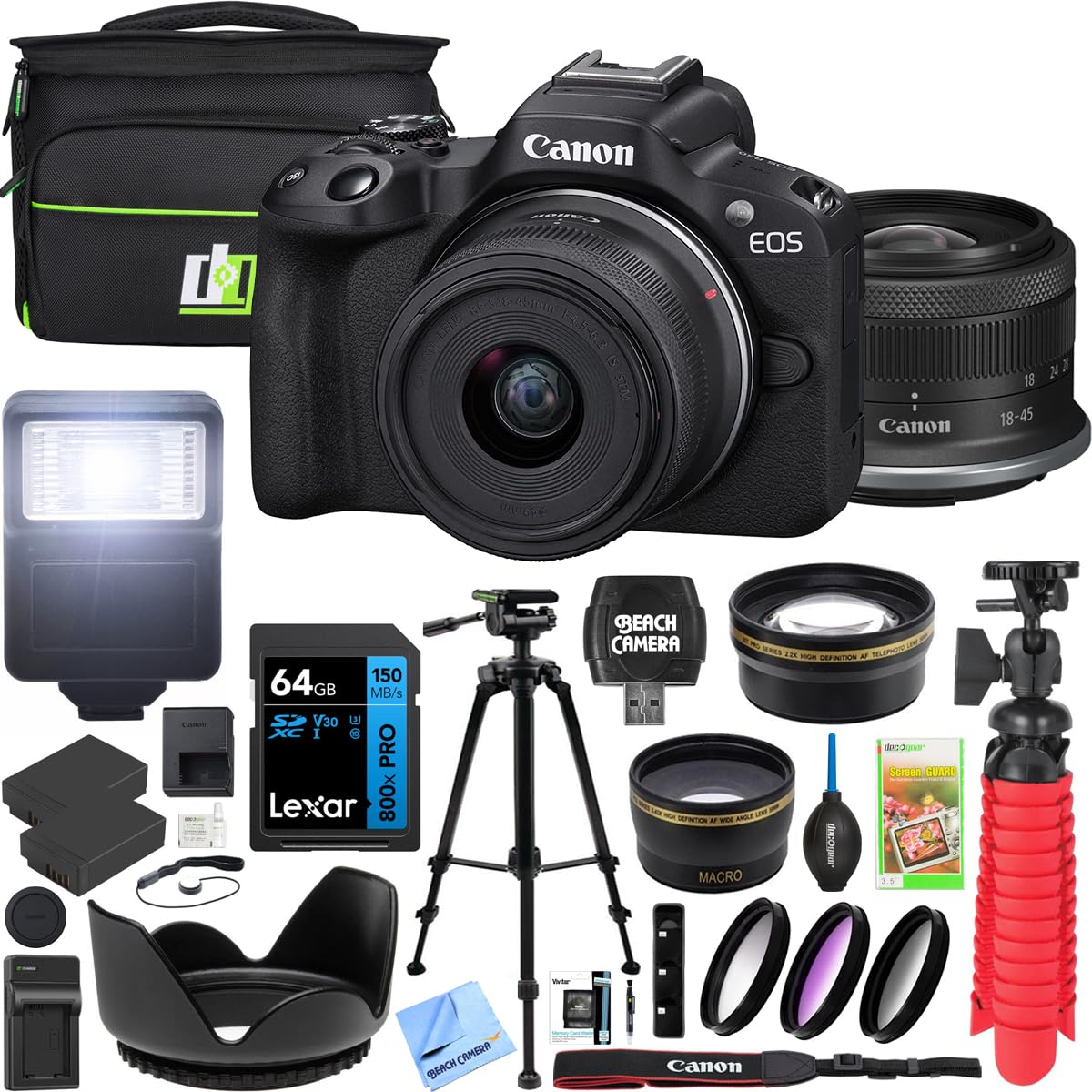
Canon’s EOS R50 brings the power of their RF mount and Dual Pixel CMOS AF II into a compact, beginner-friendly body. This premium bundle includes the camera body, an RF-S 18-45mm f/4.5-6.3 IS STM lens, a Deco Gear travel bag, a spare battery and charger, a full-size tripod, a vlogging grip tripod, a hot shoe flash, a 64GB Lexar SDXC card, a filter kit, a wide-angle and telephoto lens attachment, a tulip lens hood, and a cleaning kit — everything a new photographer needs to start shooting the day the box arrives.
The 24.2-megapixel APS-C sensor pairs with the DIGIC X processor to deliver 4K uncropped video oversampled from 6K, creating footage with impressive detail and color depth. The 651 phase-detection AF points with subject tracking (people, animals, vehicles) make this a highly capable camera for both portraits and moving subjects. The electronic viewfinder and vari-angle touchscreen work well in bright conditions and awkward angles, and the built-in flash adds flexibility for indoor shots without needing to buy external lighting immediately.
Bundle accessories vary in quality — the wide-angle and telephoto lens attachments are budget-grade and may introduce softness at the edges, but the core camera and lens are genuine Canon hardware with a full USA warranty. Some users report the spare battery is third-party and lacks compatibility with the Canon charger, which is worth checking on arrival. For someone starting from zero who wants a complete kit with a modern mirrorless system, this bundle eliminates the stress of piecing together accessories.
Why it’s great
- Uncropped 4K oversampled from 6K with Dual Pixel AF II
- 651 AF points with subject detection for people/animals/vehicles
- Comprehensive bundle with bag, tripod, flash, and spare battery
Good to know
- Attached lenses are budget quality — replace if image sharpness is critical
- Spare battery may be generic and not work with Canon charger
- Bundle accessories can vary per order batch
3. Canon EOS R50 (Standard Kit)
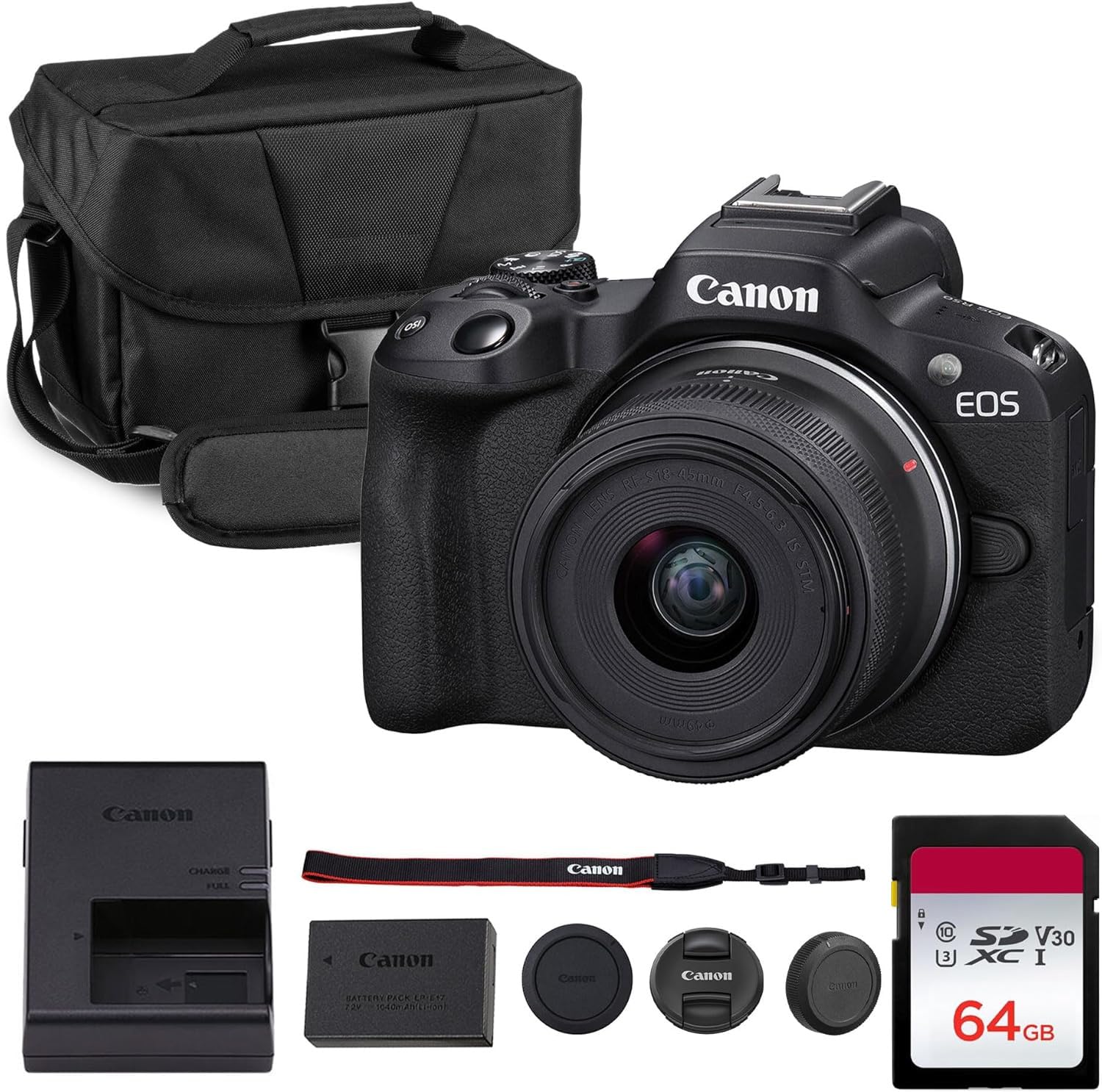
The standard Canon EOS R50 kit includes the camera body, RF-S 18-45mm f/4.5-6.3 IS STM lens, battery, charger, neck strap, and a 64GB SDXC memory card. This is the same core camera as the bundle above but without the extra accessories, which makes it a cleaner purchase if you already own a bag, tripod, and filters. The camera itself is lightweight at 375 grams and remarkably easy to use for beginners, with guided Creative Assist modes that explain settings in plain language before you switch to manual control.
Dual Pixel CMOS AF II covers 99% of the sensor area with phase-detection points, delivering fast, quiet, and reliable autofocus for both stills and video. The 4K 30p footage is oversampled from 6K and looks clean with good dynamic range, and the vari-angle touchscreen makes overhead shots, low-angle compositions, and vlogging effortless. The RF mount gives you access to Canon’s growing library of RF-S lenses and full-frame RF lenses, though native RF-S options are still limited compared to Sony’s E-mount collection.
The kit lens has a slow maximum aperture of f/4.5-6.3, which limits its performance in low light without pushing ISO. Many users report that adding a budget-friendly RF 50mm f/1.8 prime dramatically improves portrait quality and indoor usability. This camera is built for the user who values ease of use, video features, and a modern lens system over raw speed — an excellent entry point into mirrorless photography.
Why it’s great
- Excellent beginner-friendly interface with Creative Assist mode
- Dual Pixel AF II with near-full-sensor coverage
- Compact and lightweight body with vari-angle touchscreen
Good to know
- Kit lens is slow (f/4.5-6.3) — low-light performance requires a fast prime
- Native RF-S lens selection is still growing
- No in-body stabilization — relies on lens-based IS
4. Nikon Z50 II (Two-Lens Kit)

Nikon’s Z50 II is a compact DX-format mirrorless camera that ships with two VR lenses — a NIKKOR Z DX 16-50mm f/3.5-6.3 VR for everyday shooting and a NIKKOR Z DX 50-250mm f/4.5-6.3 VR for telephoto reach — giving you a combined 24-375mm equivalent range right out of the box. The 20.9-megapixel sensor is smaller than the competition’s 24MP offerings, but its larger-than-smartphone physical size delivers excellent color science and dynamic range, especially in golden-hour light. The 31 built-in Picture Control presets let you shoot with specific looks applied in real time, and you can download additional presets from the Nikon Imaging Cloud.
Autofocus uses a hybrid system with 231 phase-detection points and subject detection for people, dogs, cats, birds, and vehicles, including dedicated modes for birds-in-flight and airplanes. The 4K 60p video with in-camera 120p slow-motion in Full HD, built-in electronic VR, and a product review mode for vlogging make it surprisingly capable for video work. The body includes a built-in flash and a Night Portrait mode that creates natural-looking slow-shutter flash portraits, which is rare in this price bracket.
The two-lens kit adds weight and complexity — you need to swap lenses to switch from wide to telephoto, which is less convenient than a single superzoom but delivers better optical quality at each focal length. Battery life is adequate, but the flip-out LCD drains power faster, and Nikon’s SnapBridge app for wireless sharing can be finicky on initial setup. For travelers and landscape photographers who want a complete focal range without buying extra glass, this kit offers premium versatility that other single-lens kits cannot match.
Why it’s great
- Two-lens kit covers 16-250mm (24-375mm equivalent) range
- 31 built-in Picture Control presets with cloud downloading
- Built-in flash and dedicated bird/airplane autofocus modes
Good to know
- Only 20.9MP resolution compared to 24MP+ competitors
- SnapBridge app connectivity can be inconsistent
- Flip-out LCD drains battery — carry a spare
5. Sony ZV-E10 Bundle

The Sony ZV-E10 is purpose-built for content creators, combining a 24.2MP APS-C Exmor sensor with features specifically designed for vlogging and social media: a side flip-out touchscreen, a directional 3-capsule microphone with a windscreen, Background Defocus mode, Face Priority AE, and Soft Skin Effect. This bundle piles on accessories including two 64GB SD cards, an LED video light, a 50-inch tripod, a steady grip pod, a 40.5mm filter kit, wide-angle and telephoto lens attachments, a macro kit, two batteries with a travel charger, and a camera bag — everything a creator needs for on-the-go shooting without stopping to charge or organize gear.
The camera supports 4K 30p and Full HD 120p slow-motion, with the ability to shoot up to 11 fps in stills mode and real-time Eye AF and tracking for both people and animals. The 425-point Fast Hybrid AF system is inherited from the a6400, making autofocus performance essentially identical. The built-in product showcase mode uses face/eye priority to instantly focus on an object brought in front of the lens, which is invaluable for unboxing and review videos. The USB-C port and standard microphone and headphone jacks make it easy to connect external mics and monitors.
The battery life is limited — expect around 80 minutes of continuous video recording — so the two-battery bundle is essential. The 16-50mm power zoom lens is compact but has a slow aperture and noticeable barrel distortion at the wide end. This is a renewed (refurbished) model, which means it typically performs like new but comes in a generic box with minimal paperwork. For the creator who wants a dedicated camera for YouTube, live streaming, and everyday content with great AF and a full accessory kit, this is a practical and budget-conscious solution.
Why it’s great
- Vlogging-specific features: flip-out screen, mic windscreen, product showcase mode
- 425-point Fast Hybrid AF with real-time Eye Tracking
- Massive accessory bundle includes two batteries and LED light
Good to know
- Renewed unit — condition is generally excellent but packaging is minimal
- Kit lens is soft and slow — upgrading to a Sigma or Tamron prime is recommended
- Battery life is short — the second battery in the bundle is essential
6. Canon EOS R100 Bundle

The Canon EOS R100 is the most affordable entry into the RF mirrorless ecosystem, and this bundle packages it with a RF-S 18-45mm f/4.5-6.3 IS STM lens plus a comprehensive accessory set: a 64GB SD card, a digital slave flash, a full-size tripod, a tabletop tripod, wide-angle and telephoto lens attachments, a three-filter kit (UV, CPL, FLD), a camera bag, a memory card reader, screen protectors, and cleaning tools. The 24.2-megapixel APS-C sensor with DIGIC 8 processor delivers solid stills for its price, and the 143 AF zones from Dual Pixel CMOS AF provide reliable focus for everyday photography.
4K 24p video is available but with a crop factor that makes wide-angle shooting tighter, and Full HD 60p is suitable for standard content. The 2.36m-dot OLED electronic viewfinder is clear and usable, and the 3-inch 1040k-dot LCD screen is functional for composition review. The R100 is small and lightweight, making it easy to carry for long walks or travel, and the RF mount keeps the door open for better lenses when your skills and budget grow. The built-in flash provides basic light fill for indoor shooting without external gear.
The bundle accessories are a mixed bag — the wide-angle and telephoto attachments are low-quality plastic that introduces distortion and softness, and the flash is a basic manual unit without TTL metering. The camera itself lacks in-body stabilization, so shooting in low light requires a steady hand or tripod. The R100 feels like a gateway camera — it gets you into the RF system affordably, but serious photographers will quickly want a faster lens and a body with IBIS and uncropped 4K. It is best suited for absolute beginners who want to learn on a modern mount without spending heavily.
Why it’s great
- Cheapest entry into the Canon RF mirrorless system
- Good 24.2MP sensor with Dual Pixel CMOS AF
- Comprehensive bundle with bag, tripod, flash, and filters
Good to know
- 4K video has a significant crop factor
- Bundle accessories are basic quality — replace them over time
- No in-body stabilization and no uncropped 4K
7. Panasonic LUMIX G85

The Panasonic LUMIX G85 is a Micro Four Thirds mirrorless camera that stands out for its class-leading 5-axis in-body image stabilization, which works with lens-based OIS to produce exceptionally smooth handheld footage and sharp stills at slow shutter speeds. Its 16-megapixel sensor lacks a low-pass filter, which boosts fine detail resolution by about 10% compared to older 16MP sensors, making images punchier and more detailed than the resolution number suggests. The magnesium alloy body with weather sealing gives it a durable, premium feel that rivals more expensive cameras, and the large, ergonomic grip makes long shooting sessions comfortable.
4K video recording at 3840×2160 is supported across the full sensor width, and the 4K Photo mode lets you extract 8-megapixel stills at 30 fps with Post Focus — meaning you can change the focus point after capturing the image. The kit lens is the 12-60mm Power O.I.S., which covers a 24-120mm equivalent range with effective dual stabilization. The OLED live viewfinder has 2.36 million dots and is bright and responsive, and the 3-inch touch-enabled LCD tilts for high and low-angle shooting.
Autofocus is contrast-detect with Depth from Defocus technology, which works well in good light but can hunt and become sluggish in low-light conditions, especially during 4K video recording. The 16MP sensor limits the resolution for heavy cropping compared to 24MP APS-C cameras, and battery life is mediocre at best. The lens mount is Micro Four Thirds, which offers a massive selection of compact, affordable lenses from Panasonic, Olympus, Sigma, and others. The G85 is the right choice if stabilization, build quality, and video features matter more than maximum megapixels or fast tracking AF.
Why it’s great
- 5-axis IBIS plus lens OIS for incredibly smooth handheld shooting
- Weather-sealed magnesium alloy body with excellent ergonomics
- 4K Photo with Post Focus — change focus after capture
Good to know
- Contrast-detect AF hunts in low light and during 4K video
- 16MP sensor limits crop flexibility compared to 24MP APS-C
- Mediocre battery life — carry a spare for full-day shoots
8. Canon EOS Rebel T7

The Canon EOS Rebel T7 is a traditional DSLR that uses an optical viewfinder and a tried-and-true 24.1-megapixel APS-C CMOS sensor with an ISO range of 100–6400 (expandable to 12800). It is paired with the EF-S 18-55mm f/3.5-5.6 IS II lens, which includes optical image stabilization to reduce blur from shaky hands. The 9-point autofocus system with AI Servo AF is basic by modern standards but works reliably for stationary subjects and slow-moving scenes, and the optical viewfinder provides a bright, lag-free view that some traditionalists still prefer over electronic viewfinders.
Built-in Wi-Fi and NFC allow quick image transfer to a smartphone for sharing, and the camera can be turned into a high-quality webcam using Canon’s EOS Utility Webcam Beta Software. Battery life is excellent — rated for around 500 shots per charge — because the optical viewfinder draws no power, making the T7 a dependable companion for full-day events and travel where charging opportunities are scarce. The body is lightweight at 475 grams, and the Canon EF/EF-S lens ecosystem is the largest on the market, with affordable used lenses available worldwide.
The 9-point AF system covers a small area in the center of the frame, making it frustrating to track subjects that move off-center, especially for sports or active kids. The 3-fps continuous shooting is slow compared to mirrorless cameras that shoot at 11 fps or more, and video is limited to Full HD 1080p at 30 fps with no 4K option. Beginners who want to learn the fundamentals of exposure, aperture, and shutter speed on a budget-friendly, long-lasting platform will appreciate the T7, but those who need speed, focus accuracy, or modern video features should look at mirrorless options in the same price bracket.
Why it’s great
- Optical viewfinder with no lag and excellent battery life
- Massive Canon EF/EF-S lens selection at affordable prices
- Lightweight body with built-in Wi-Fi and webcam software
Good to know
- Only 9 AF points — very limited for moving subjects
- No 4K video and slow 3 fps continuous shooting
- Optical viewfinder offers no exposure preview
9. Nikon D60

The Nikon D60 is an older DSLR that emphasizes simplicity and the core fundamentals of photography. Its 10.2-megapixel DX-format CCD sensor produces images with vibrant color rendering and acceptable noise up to ISO 800, and the included AF-S DX NIKKOR 18-55mm f/3.5-5.6G VR lens includes vibration reduction to steady handheld shots. The camera has no live view, no movie mode, and a 3-point autofocus system — specifications that would be considered prehistoric today but force the user to master manual exposure, focus, and composition skills that translate directly to any more advanced camera.
Continuous shooting at 3 fps, a 2.5-inch LCD screen with automatic orientation detection, and an active dust reduction system with airflow control are the only modern concessions. The body is lightweight and ergonomic, with a shutter that fires instantly with zero delay, unlike many compact cameras of its era. Battery life is excellent because the optical viewfinder draws no power and there are no power-hungry video functions. The 12-bit NEF (Nikon raw) files provide good editing latitude, though the older format is not universally supported by all software.
Autofocus only works with AF-S lenses — older screw-drive AF lenses will not autofocus on this body, and the 3-point system covers only a tiny strip in the center of the frame. The lack of live view means you are limited to the optical viewfinder, which requires proper eye alignment and is challenging for users who wear glasses. The 10.2-megapixel resolution limits print sizes to about 11×14 inches before quality degrades. The D60 is a niche choice for complete beginners who want an undiluted learning experience or for collectors wanting a time capsule of mid-2000s DSLR engineering — not a practical tool for modern photography workflows.
Why it’s great
- Forces mastery of manual exposure, focus, and composition
- Excellent battery life and instant shutter response
- VR kit lens reduces blur for handheld shooting
Good to know
- Only 3 AF points and no live view — extremely limited for modern use
- No 4K video, no video at all, and no wireless connectivity
- 10.2MP resolution limits cropping and large prints
10. Canon EOS RP

The Canon EOS RP is the cheapest full-frame mirrorless camera on the market, pairing a 26.2-megapixel full-frame CMOS sensor with the RF mount and a RF 24-105mm f/4-7.1 IS STM kit lens that covers a versatile 24-105mm range with up to 5 stops of optical image stabilization. The full-frame sensor delivers noticeably better low-light performance, shallower depth of field, and wider dynamic range than any APS-C camera under , making it a compelling choice for portrait, landscape, and travel photographers who prioritize image quality over speed.
The Dual Pixel CMOS AF with 4779 selectable AF positions provides fast, accurate focusing for both stills and video, with excellent face and eye detection. The body is compact and lightweight at only 485 grams, with a comfortable grip, a vari-angle touchscreen, and an electronic viewfinder with 2.36 million dots. Video capture supports 4K 24p (with a 1.6x crop) and Full HD 60p, and clean HDMI output allows use as a high-quality webcam. The RF mount is compatible with Canon’s growing line of RF lenses, as well as EF and EF-S lenses via an adapter, giving access to decades of used glass.
The 4K video crop factor reduces the wide-angle field of view, and the sensor readout speed is slow enough that rolling shutter is noticeable in fast panning shots. The autofocus system is reliable but not as sticky as the R50’s Dual Pixel AF II for very fast-moving subjects, and the burst rate of 5 fps (with AF) is slower than competing APS-C mirrorless cameras. The RP is a serious image-quality upgrade for photographers who have outgrown APS-C sensors and are willing to accept slower burst speeds and cropped 4K in exchange for the superior look of a full-frame sensor.
Why it’s great
- True full-frame sensor for superior low-light and shallow depth of field
- Lightweight body with vari-angle touchscreen and excellent AF
- RF mount with EF/EF-S lens compatibility via adapter
Good to know
- 4K 24p video has a 1.6x crop factor — not ideal for wide shots
- Slow 5 fps burst rate with AF for moving subjects
- Sensor readout is slow — noticeable rolling shutter in video
11. Sony Alpha 6700

The Sony Alpha 6700 is Sony’s premium APS-C mirrorless camera, built around a 26-megapixel back-illuminated Exmor R sensor and a dedicated AI processing chip that enables the most advanced subject recognition in its class, including real-time tracking for humans, animals, birds, insects, cars, and trains. The 759 phase-detection AF points cover almost the entire sensor, and the combination of AI-based subject recognition and fast sensor readout delivers reliable focus even in challenging lighting and fast movement scenarios. The body is compact and well-built with a deep grip, an electronic viewfinder with high refresh rate, and a fully articulating touchscreen for vlogging and multi-angle compositions.
Video capabilities are pro-grade: 4K 60p oversampled from 6K in 4:2:2 10-bit color with Long GOP or All Intra compression, plus 4K 120p for smooth slow-motion footage. The inclusion of S-Log3 and S-Cinetone color profiles, LUT handling, and a focus breathing compensation feature makes this camera suitable for serious filmmaking without external recorders. The BIONZ XR processor keeps performance responsive and enables 11 fps continuous shooting with full AF/AE tracking. The E-mount gives access to Sony’s extensive lens lineup and a wide selection of affordable third-party lenses from Sigma, Tamron, and Samyang.
The menu system remains Sony’s weakest point — dense, layered, and unintuitive, requiring significant setup time to configure the function buttons and the Fn menu for quick access. There is no built-in flash, so low-light indoor shooting will require an external unit or fast prime lens. The camera can overheat when recording 4K 60p for extended periods in hot weather (around 50 minutes at 88°F), which is a limitation for event coverage in warm climates. For hybrid shooters who want best-in-class autofocus, high-bit-rate video options, and strong stills performance in a compact body, the A6700 is the most capable APS-C camera available, though its price pushes it to the ceiling of the sub- search threshold.
Why it’s great
- Dedicated AI processor for best-in-class subject recognition and tracking
- 4K 60p oversampled from 6K with 4:2:2 10-bit and 4K 120p
- 26MP BSI sensor with excellent dynamic range and noise control
Good to know
- Complex menu system requires careful initial setup
- No built-in flash — external unit needed for indoor use
- May overheat after ~50 minutes of 4K 60p in hot weather
FAQ
Is an older full-frame camera better than a newer APS-C under ?
Should I buy a mirrorless or a DSLR under ?
How many megapixels do I actually need for photography?
Is the kit lens included with these cameras good enough to start?
Final Thoughts: The Verdict
For most users, the camera under $1000 for photography winner is the Sony Alpha a6400 because its 0.02-second autofocus with 425 phase-detection points, oversampled 4K video, and vast E-mount lens ecosystem offer unparalleled versatility at this price ceiling. If you want a complete all-in-one kit with spare batteries, tripod, and bag so you can start shooting the same day, grab the Canon EOS R50 Premium Bundle. And for video-focused creators who need top-tier stabilization and a dedicated AI processor for subject tracking, nothing beats the Sony Alpha 6700 — though its price sits right at the budget limit.

Mo Maruf
I created WellFizz to bridge the gap between vague wellness advice and actionable solutions. My mission is simple: to decode the research and give you practical tools you can actually use.
Beyond the data, I am a passionate traveler. I believe that stepping away from the screen to explore new environments is essential for mental clarity and physical vitality.