Our readers keep the lights on and my smoothie glass nicely filled. As an Amazon Associate, I earn from qualifying purchases.
The mirrorless revolution is now, and the choice between a compact vlogging tool, a versatile workhorse, or a full-frame powerhouse can make or break your creative flow. Spec sheets blur together when every brand claims superior autofocus and 4K, but the real difference lies in sensor architecture, lens ecosystem depth, and how the body handles in your hands across a long day of shooting.
I’m Mohammad Maruf — the founder and writer behind WellFizz. I spend my time dissecting camera specifications, from readout speeds and bit depths to stabilization algorithms and crop factors.
After analyzing the market, I’ve distilled the options into a guide that pinpoints the exact best camera to buy for beginners, hybrid shooters, and content creators who need reliable performance without the guesswork.
How To Choose The Best Camera To Buy
The right camera hinges on your primary use — static photography, fast-moving video, or hybrid work. Understanding the core specs lets you avoid the trap of buying more megapixels than you need while missing the features that actually matter.
Sensor Size and Low-Light Capabilities
A larger sensor — like a full-frame or APS-C — gathers more light, giving you cleaner images at high ISO and better background separation. Micro Four Thirds sensors offer portability and a deep lens ecosystem but require faster glass for dim conditions.
Autofocus System and Tracking Performance
Phase-detection autofocus points spread across the frame provide reliable subject tracking, especially with eye/face detect for people and animals. The number of points and their coverage percentage determine how well the camera holds focus during burst shooting or 4K recording.
Image Stabilization and Video Features
In-body image stabilization (IBIS) compensates for hand shake across all lenses, a major advantage for handheld video. If 4K 60p or 10-bit color depth matters, check for crop factors and recording time limits that can frustrate long shoots.
Quick Comparison
On smaller screens, swipe sideways to see the full table.
| Model | Category | Best For | Key Spec | Amazon |
|---|---|---|---|---|
| DJI Osmo Pocket 3 Creator Combo | Pocket Gimbal | Vloggers & Travelers | 1-inch CMOS / 3-Axis Mech Stabilization | Amazon |
| Sony a7 III | Full-Frame Mirrorless | Hybrid Stills & Video | 24.2MP BSI / 693 AF Points | Amazon |
| Canon EOS R50 | APS-C Mirrorless | Beginner Photography | 24.2MP APS-C / 651 AF Points | Amazon |
| Panasonic LUMIX G85 | Micro Four Thirds | Budget Hybrid Video | 16MP / 5-Axis IBIS | Amazon |
| Sony Alpha 7 IV | Full-Frame Mirrorless | Pro-Level Hybrid | 33MP BSI / 4K 60p 10-bit | Amazon |
| Canon EOS R100 | APS-C Mirrorless | Entry-Level Travel | 24.1MP APS-C / 143 AF Zones | Amazon |
| Xtra Muse Pocket Gimbal | Pocket Gimbal | Budget Vlogging | 1-inch CMOS / 4K 120fps | Amazon |
| Nikon D7500 | DSLR | Action & Wildlife | 20.9MP APS-C / 51 AF Points | Amazon |
| Sony ZV-E10 Bundle | APS-C Mirrorless | Content Creator Starter | 24.2MP APS-C / 425 AF Points | Amazon |
| Nikon Z 6II | Full-Frame Mirrorless | Low-Light Hybrid | 24.5MP BSI / Dual Card Slots | Amazon |
| OBSBOT Tail Air NDI | PTZ Streaming | Live Streaming & Church | 4K PTZ / AI Tracking | Amazon |
In‑Depth Reviews
1. DJI Osmo Pocket 3 Creator Combo
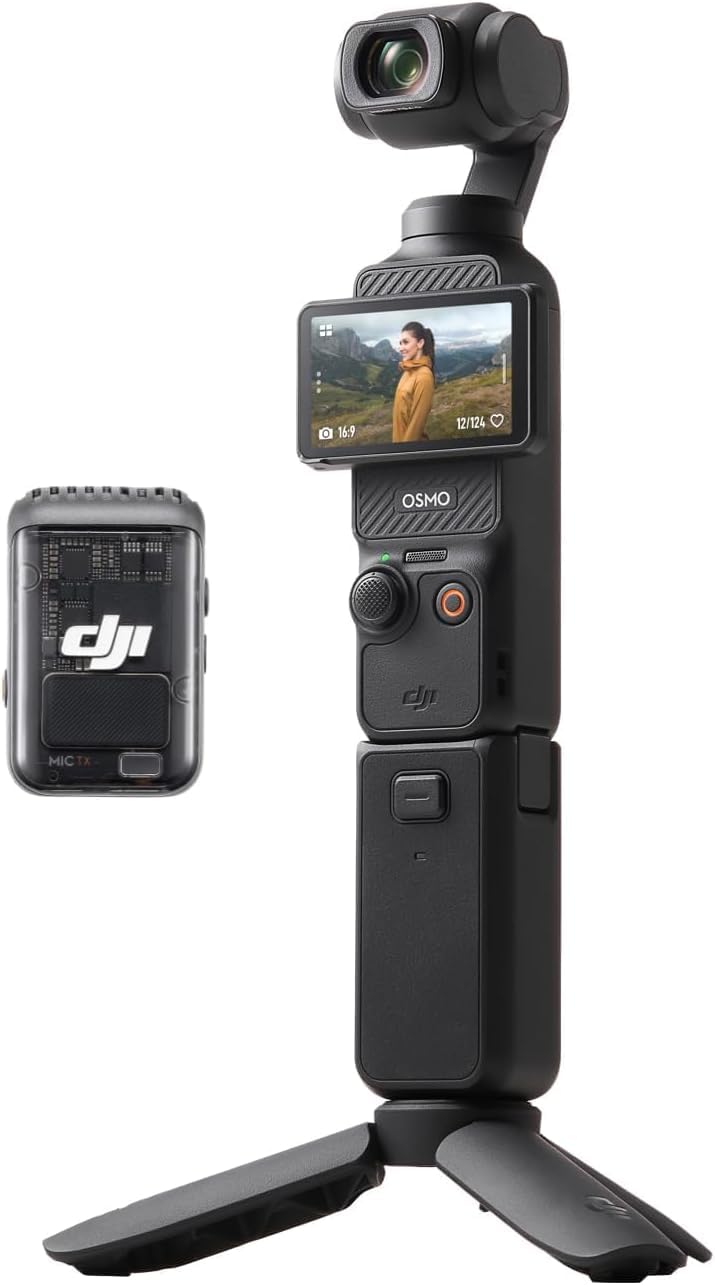
The DJI Osmo Pocket 3 sets the benchmark for pocket gimbal cameras with its 1-inch CMOS sensor capturing 4K footage at 120fps. The 3-axis mechanical stabilization eliminates the need for a separate gimbal, making it a true grab-and-go solution for vloggers and travelers who demand smooth handheld footage without the bulk. The rotating 2-inch touchscreen transitions seamlessly between horizontal and vertical shooting, which is critical for social media creators.
ActiveTrack 6.0 keeps subjects locked in frame even during dynamic movement, and the built-in D-Log M 10-bit color profile enables professional post-production grading. The Creator Combo adds the DJI Mic 2 transmitter, a battery handle, a wide-angle lens, and a mini tripod, making it a complete kit out of the box. The 166-minute battery life covers a full day of intermittent shooting.
Low-light performance is notably strong thanks to the fast f/1.8 lens, and the direct connectivity to DJI Mic 2 transmitters simplifies audio sync. The only compromise is the fixed lens system, which limits optical zoom range, but for everyday content creation the quality is unmatched in this form factor.
Why it’s great
- Exceptional 3-axis mechanical stabilization outperforms electronic solutions
- Creator Combo includes essential accessories and wireless mic
- 10-bit D-Log M color depth for flexible grading
Good to know
- Fixed lens limits optical zoom flexibility
- Gimbal assembly is delicate and requires careful handling
2. Sony a7 III Full-Frame Mirrorless

The Sony a7 III remains a defining full-frame mirrorless camera thanks to its 24.2MP back-illuminated sensor that delivers 15 stops of dynamic range and clean images up to ISO 204,800. The 693 phase-detection points cover 93% of the frame, providing reliable tracking for both stills and video that competes with cameras costing considerably more. The 10fps burst with AE/AF tracking makes it viable for action and event photography.
In-body image stabilization compensates for up to five stops of shake, and the 4K 30p video from the full-width readout is sharp with minimal rolling shutter. The NP-FZ100 battery is rated for approximately 710 shots per charge, a huge leap over earlier Sony models. Dual UHS-II card slots give flexibility for backup or overflow during long shoots.
The menu system is dense but highly customizable once configured, and the kit lens provides a decent starting point for exploring the vast Sony E-mount ecosystem. The a7 III is an ideal entry point into full-frame for hybrid shooters who need professional image quality and reliable autofocus without jumping to the highest price tier.
Why it’s great
- Excellent dynamic range and low-light performance from BSI sensor
- Industry-leading phase-detect AF with wide coverage
- Exceptional battery life for a mirrorless camera
Good to know
- Menu system can feel cluttered without customization
- Kit lens is adequate but limits the sensor’s full potential
3. Canon EOS R50 with 18-45mm Lens

The Canon EOS R50 packs the 24.2MP APS-C sensor and DIGIC X processor from higher-end R-series bodies into a compact, lightweight chassis ideal for beginners stepping up from smartphone photography. The 651-point Dual Pixel CMOS AF II provides reliable human, animal, and vehicle detection, making it simple to capture sharp images without advanced technique. The 3-inch vari-angle touchscreen enables creative angles for selfies or low-angle shots.
4K video is capped at 30p with no crop factor, and the vertical video mode caters directly to social media creators. The 15fps electronic shutter burst rate captures fast action, and the RF-S 18-45mm kit lens offers a versatile starting zoom range with optical stabilization. The included 64GB memory card and shoulder bag bundle provide everything needed to start shooting immediately.
Battery life is decent for a compact mirrorless, and the menu interface is beginner-friendly with guided modes. The R50 is a strong entry point into the Canon RF ecosystem, allowing for future lens upgrades as skills develop.
Why it’s great
- Lightweight and highly portable for everyday carry
- Excellent beginner-friendly menu with guided modes
- No-crop 4K video and vertical recording for social media
Good to know
- Electronic viewfinder has a standard 2.36m-dot resolution
- Battery life is acceptable but not class-leading
4. Panasonic LUMIX G85 with 12-60mm Lens

The Panasonic LUMIX G85 delivers class-leading 5-axis in-body image stabilization that works across all lenses, making it one of the best entry-level options for handheld video on a budget. The 16MP Micro Four Thirds sensor omits the low-pass filter for sharper fine detail, and the 4K QFHD video recording supports 4K Photo and Post Focus modes. The 12-60mm kit lens provides a 24-120mm equivalent range with optical stabilization that pairs with the IBIS for ultra-smooth footage.
The magnesium alloy front frame with weather sealing gives the G85 a robust feel uncommon at this level, and the electronic viewfinder (2360K dots) combined with the 3-inch tilt-touch LCD offers flexible compositions. The Dual I.S. 2 system integrates lens and body stabilization seamlessly, and the microphone jack allows external audio capture for video projects.
Autofocus performance in low light can struggle during 4K recording compared to phase-detect systems, and the 49 contrast-detect points require contrasty subjects for reliable tracking. The G85 remains a favorite for value-conscious video shooters who prioritize stabilization and build quality over ultimate autofocus speed.
Why it’s great
- Exceptional 5-axis IBIS paired with lens OIS for stabilized video
- Weather-sealed magnesium alloy body at an accessible price
- 4K Photo and Post Focus modes add creative flexibility
Good to know
- Contrast-detect AF struggles in dim lighting during video
- Micro Four Thirds sensor has less dynamic range than APS-C
5. Sony Alpha 7 IV Full-Frame

The Sony Alpha 7 IV marks a significant step forward with its 33MP full-frame back-illuminated sensor paired with the BIONZ XR processor, offering 8x more processing power than its predecessor. This camera delivers 4K 60p in 10-bit 4:2:2 with full pixel readout, and 7K oversampled 4K 30p provides exceptional sharpness and color detail. The S-Cinetone color profile brings professional filmic tones straight out of camera, ideal for hybrid shooters who need consistent video and stills.
The 693-point phase-detection AF with real-time Eye AF for humans, animals, and birds is fast and sticky even in challenging lighting conditions. The 3-inch vari-angle touchscreen and 3.69m-dot electronic viewfinder offer high-resolution composition, and the dual card slots (CFexpress Type A and UHS-II SD) ensure secure backup for paid work. In-body stabilization compensates for 5.5 stops, enhancing handheld versatility.
The a7 IV’s stills resolution allows for significant cropping without losing detail, and the low-light performance at high ISO is among the best in its class. It is larger than the a7 III but balances well with full-frame G Master lenses. The a7 IV is a serious tool for those ready to transition into professional or serious semi-professional work.
Why it’s great
- 7K oversampled 4K video delivers stunning detail at 30p
- 33MP resolution offers ample cropping flexibility for stills
- S-Cinetone color profile elevates video quality immediately
Good to know
- 4K 60p uses a slight 1.5x crop factor
- Body is larger and heavier than the a7 III
6. Canon EOS R100 with 18-45mm Lens

The Canon EOS R100 is the smallest and lightest body in the EOS R series, making it an extremely portable entry point for users who want interchangeable lens capability without the bulk. The 24.1MP APS-C sensor combined with the DIGIC 8 processor delivers reliable image quality and 4K video at 24fps, plus Full HD at 60fps and 120fps HD for slow-motion. The dual pixel CMOS AF covers 143 zones with human and animal detection, ensuring sharp focus in most scenarios.
The 18-45mm kit lens provides a practical zoom range for everyday photography and travel, and the optical image stabilization at up to 4 stops helps in dim conditions. Optical zoom is 1x, but the 6.5fps continuous burst rate in One-Shot AF captures action adequately for beginners. The intuitive interface and Wi-Fi/Bluetooth connectivity simplify sharing to a smartphone.
This camera lacks the vari-angle screen found on the R50, and the 4K resolution is limited to 24fps, but for those on a budget who need a dedicated camera for learning composition and exposure, the R100 offers excellent value. It is a true no-frills mirrorless that prioritizes portability and simplicity.
Why it’s great
- Extremely compact and lightweight for a mirrorless body
- Reliable dual pixel AF with animal and vehicle detection
- Good optical stabilization in the kit lens
Good to know
- 4K video is limited to 24fps
- Screen is fixed and not articulating
7. Xtra Muse Pocket Gimbal Camera

The Xtra Muse offers a compelling alternative for budget-conscious creators who want the core features of a pocket gimbal camera at a lower entry point. Its 1-inch CMOS sensor captures 4K video at 120fps for smooth slow-motion playback, and the built-in 3-axis gimbal stabilizer eliminates the need for external stabilization gear. The 2-inch touchscreen supports both horizontal and vertical framing, and the Master Follow function keeps subjects centered automatically.
The 10-bit X-Log color mode provides 1 billion colors for grading flexibility, and the battery life averages 161 minutes, sufficient for day trips. Face and object tracking work reliably in good light, and the USB-C connectivity simplifies file transfer. The included carrying bag, wrist strap, and 1/4-inch threaded handle provide essential accessories for mounting and transport.
Low-light performance is decent but not on par with the DJI Pocket 3, and the digital zoom tops out at 2x. The camera also relies on microSD storage with UHS Speed Class 3 requirements for 4K recording. For new vloggers testing the waters, the Xtra Muse delivers remarkable stabilization at a lower cost.
Why it’s great
- Excellent 3-axis gimbal stabilization for smooth footage
- 4K 120fps video capability and 10-bit color profile
- Compact design with responsive touchscreen interface
Good to know
- Low-light performance is not as strong as premium competitors
- Relies on microSD cards with high write-speed requirements
8. Nikon D7500 with 18-140mm Lens

The Nikon D7500 brings the imaging engine and metering system from the flagship D500 into a more accessible DSLR body. The 20.9MP APS-C sensor with no optical low-pass filter delivers crisp images with excellent dynamic range, and the 51-point AF system includes 15 cross-type sensors for reliable tracking in both stills and 4K video. The 8fps continuous shooting with a deep buffer captures action sequences effectively.
The 18-140mm VR lens offers a versatile 27-210mm equivalent range for travel, wildlife, and events, with built-in vibration reduction for handheld use. The 3.2-inch tilting touchscreen LCD facilitates low and high-angle shooting, and the 4K UHD time-lapse feature simplifies in-camera video creation. The weather-sealed chassis provides durability for outdoor conditions.
DSLR size and weight are noticeable compared to mirrorless alternatives, and the live-view autofocus during video recording is slower than phase-detect mirrorless systems. The D7500 is a strong choice for photographers who prefer optical viewfinders and need a durable, fast-shooting body for action and wildlife without moving to the full-frame format.
Why it’s great
- Fast 8fps burst with deep buffer for action sequences
- Versatile 18-140mm VR lens covers wide-to-tele range
- Weather-sealed body with robust construction
Good to know
- Heavier and bulkier than equivalent mirrorless options
- Live-view AF for video is not as responsive as mirrorless systems
9. Sony ZV-E10 Deluxe Bundle

The Sony ZV-E10 is purpose-built for content creators with its 24.2MP APS-C sensor, 425-point Fast Hybrid AF with real-time Eye AF, and a side flip-out touchscreen that stays visible during self-filming. The directional 3-capsule microphone with included windscreen provides clear audio without an external mic, and the Background Defocus function instantly creates shallow depth of field for vlogs. The 4K 30p video and Full HD 120p slow-motion cover key social media formats.
This deluxe bundle extends the value with a 128GB memory card, .43x wide-angle and 2x telephoto lenses, a tripod, filter kit, lens hood, grip, spare battery and charger, and Movavi editing software. The 16-50mm power zoom lens is compact and retractable, making the entire kit easy to pack for travel vlogging. The headphone and microphone ports enable professional monitoring.
The ZV-E10 lacks in-body image stabilization, so handheld footage relies on the lens OIS or a gimbal. Battery life is moderate, but the spare battery in the bundle mitigates this. This bundle is an all-in-one solution for aspiring YouTubers and podcasters who need a versatile camera without piecemeal accessory purchases.
Why it’s great
- Creator-focused features like Background Defocus and Product Showcase
- Comprehensive bundle covers lenses, audio, and software
- Side flip-out screen ideal for self-filming and vlogging
Good to know
- No in-body image stabilization; relies on lens OIS
- Battery life is moderate and benefits from included spare
10. Nikon Z 6II Full-Frame

The Nikon Z 6II excels in low-light scenarios with its 24.5MP back-illuminated full-frame sensor and 3.5x buffer improvement over the original Z 6. The 273-point phase-detect AF system with eye/face detection for humans and animals provides reliable autofocus across the frame, while the 14fps continuous shooting captures fast-moving subjects. The dual card slots (one CFexpress/XQD and one UHS-II SD) offer flexibility and immediate backup for important work.
In-body stabilization compensates for up to 5 stops, allowing handheld shooting in very dim conditions where tripods would be impractical. The 4K UHD 60p video uses full pixel readout without crop, delivering exceptional video quality for hybrid shooters. The compact body with intuitive controls integrates well with Nikon’s growing Z lens lineup, and the vertical battery grip option extends shooting time for long assignments.
The Z 6II’s AF tracking can occasionally lose fast-moving subjects in challenging contrast, and the native Z lens library, while expanding, is smaller than Sony’s E-mount. For photographers who prioritize build quality, ergonomics, and low-light stills performance, the Z 6II remains a compelling full-frame choice.
Why it’s great
- Excellent low-light performance with BSI sensor and 5-stop IBIS
- Dual card slots for professional redundancy
- No-crop 4K 60p video with full pixel readout
Good to know
- AF tracking can be inconsistent with fast, erratic subjects
- Native Z lens ecosystem is still maturing
11. OBSBOT Tail Air NDI 4K PTZ Camera

The OBSBOT Tail Air is a specialized PTZ streaming camera that brings AI tracking to multi-camera setups without the complexity of traditional systems. Its 4K resolution with 320-degree horizontal and 180-degree vertical rotation covers large spaces, and the AI tracking supports humans, animals, and objects with gesture control for hands-free operation. The 4x digital zoom maintains detail during close-ups, and the camera supports NDI for network-based streaming, reducing cable clutter.
Connectivity options include Micro HDMI, USB-C, Ethernet, and Wi-Fi, with support for RTMP, RTSP, and VISCA protocols for integration with OBS, YouTube, Facebook, and Twitch. The OBSBOT Start companion app provides full control over AI director presets, exposure, and color settings. A multi-camera setup with multiple Tail Air units enables seamless angle switching for professional broadcasts.
Critical reliability concerns surface from user reports of battery failure after 13 months, with the unit becoming non-functional once the non-removable battery dies. The camera’s primary value is for controlled environments where consistent power via USB-C or Ethernet is available. For churches, classrooms, and streamers needing automated AI tracking, the Tail Air delivers unique functionality but demands careful power management.
Why it’s great
- AI tracking for humans, animals, and objects with gesture control
- NDI support simplifies network-based multi-camera streaming
- Compact PTZ design with 320-degree rotation
Good to know
- Non-removable battery failure renders camera useless after 12-13 months
- Battery must be functional even for AC-powered use
FAQ
Is it worth buying a camera with 4K 60p or just 30p is enough?
Do I need a full-frame camera as a beginner, or can I start with APS-C?
How important is in-body stabilization versus lens stabilization for video?
Final Thoughts: The Verdict
For most users, the best camera to buy winner is the DJI Osmo Pocket 3 Creator Combo because it delivers outstanding stabilization, 4K 120fps video, and a complete content creation kit in a pocket-friendly form factor. If you want interchangeable lenses and full-frame depth, grab the Sony a7 III. And for beginners who need a simple entry into mirrorless photography, nothing beats the Canon EOS R50.

Mo Maruf
I created WellFizz to bridge the gap between vague wellness advice and actionable solutions. My mission is simple: to decode the research and give you practical tools you can actually use.
Beyond the data, I am a passionate traveler. I believe that stepping away from the screen to explore new environments is essential for mental clarity and physical vitality.