Our readers keep the lights on and my smoothie glass nicely filled. As an Amazon Associate, I earn from qualifying purchases.
A camera light bulb isn’t just a bulb—it’s the gatekeeper of color accuracy, shadow control, and exposure consistency in your frame. Pick a dim, off-color bulb, and hours of editing won’t save the skin tones or product details you’re trying to capture.
I’m Mohammad Maruf — the founder and writer behind WellFizz. I analyze lighting hardware specs, CRI data, and lumen output from hundreds of product tests to separate what actually works for photo and video work from what merely fills a socket.
Whether you’re lighting a softbox for portrait photography or balancing ambient light for product shots, choosing the right camera light bulb means paying attention to color temperature, brightness, and build quality to avoid flickering, harsh shadows, or color casts that ruin your footage.
How To Choose The Best Camera Light Bulb
Continuous lighting bulbs for cameras fall into a specific zone: they must deliver daylight-balanced color (5500K), produce consistent output without flicker, and run cool enough to keep your talent comfortable and your softbox safe. Here’s what to check before you buy.
Color Temperature: Always 5500K Daylight
A camera light bulb that strays from 5500K will force you to fiddle with in-camera white balance or correct it in post. Daylight-matched bulbs blend seamlessly with window light and flash, giving you a reliable baseline for skin tones and product colors.
Brightness: Lumens Over Wattage
Wattage tells you power draw, not light output. Look at lumens—a solid entry point is around 5000 to 6000 lumens for a two-light softbox setup. More lumens let you shoot at lower ISO or stop down your aperture without introducing noise.
CRI: The Color Accuracy Metric
Color Rendering Index (CRI) measures how faithfully a bulb renders colors compared to natural daylight. Aim for CRI of 80 at minimum, but 85 to 90 is where you’ll see noticeably truer reds, greens, and skin tones in your footage.
Quick Comparison
On smaller screens, swipe sideways to see the full table.
| Model | Category | Best For | Key Spec | Amazon |
|---|---|---|---|---|
| AQIRUI 135W | Premium CFL | High-output studio setups | 6000 Lumens, CRI 85 | Amazon |
| EMART 105W | Mid-Range CFL | Softbox kits & video lighting | 5800 Lumens, CRI 80-85 | Amazon |
| Generic 85W CFL | Premium CFL | Accurate color reproduction | 6000 Lumens, CRI 90 | Amazon |
| Skytex 135W | Mid-Range CFL | Photo studio & video lighting | 5500K, CRI 65 | Amazon |
| RIUVAO LED Corn | Budget LED | Versatile indoor/outdoor lighting | 5000 Lumens, CRI 80 | Amazon |
In‑Depth Reviews
1. AQIRUI 135W Photography Light Bulb

The AQIRUI 135W CFL bulb puts out 6000 lumens at 5500K, delivering enough light to overpower ambient spill in most small to mid-size studios. The CRI rating of 85 ensures skin tones and product textures stay true without a heavy tint, making it a strong contender for portrait and tabletop photography. Each bulb threads into a standard E27 socket, fitting traditional softboxes and reflective umbrellas without adapters.
Users report the bulb survived multiple accidental drops thanks to its aluminum heat sink and robust internal construction. The 8000-hour rated lifespan means you won’t be swapping bulbs every few sessions, and the flicker-free operation keeps video footage stable even at higher shutter speeds. The package includes two bulbs, giving you a matching pair for key-and-fill lighting right out of the box.
Customer service responsiveness also stands out—one reviewer noted a defective unit was replaced within 48 hours. When you factor in the brightness, color accuracy, and durability, this set is the most complete overall offering for serious amateurs and working photographers alike.
Why it’s great
- 6000-lumen output at 5500K matches daylight perfectly
- Durable aluminum housing and shockproof foam packaging
- Replacement support resolves defects fast
Good to know
- One user reported a bulb failing early (immediately replaced)
- Beam angle is narrower than some alternatives at 30 degrees
2. EMART Full Spectrum 105W CFL

The EMART 105W CFL delivers a solid 5800 lumens with a 5500K color temperature, falling just short of the AQIRUI peak but still providing ample light for product photography and video interviews. Its CRI range of 80 to 85 is adequate for most non-critical color work, and users consistently praise the “soft no shadow” output that eliminates harsh highlights on reflective surfaces. The spiral design runs cool even during extended sessions, which is a major plus for enclosed softboxes that trap heat.
One standout note from long-term buyers is longevity—several users report these bulbs lasting five-plus years in regular studio use. The E26/E27 base fits standard softbox sockets and reflector dishes, and the bulb stays completely silent during operation, so no buzzing hum creeps into your audio track. At this brightness level and price point, it’s a pragmatic choice for anyone building a budget-friendly lighting kit without sacrificing short-term reliability.
Keep in mind that these bulbs are physically large—nearly 9 inches long—so they require softboxes with enough depth to house them. Also, the CRI at the lower end (80) means you may see slight color shifts when compared to premium bulbs side by side, though most users find the output perfectly acceptable for e-commerce and social media content.
Why it’s great
- Proven longevity exceeding five years in some studio setups
- Cool running temperature safe for enclosed softboxes
- Silent, flicker-free performance for video
Good to know
- Large 9-inch length may not fit compact lighting modifiers
- CRI can dip to 80, acceptable but not premium-grade
3. Generic 85W Daylight CFL Bulb

This 85W CFL bulb punches above its wattage with a CRI of 90—the highest in this comparison—making it the go-to choice for anyone who obsesses over color fidelity. At 6000 lumens and 5500K, it outputs nearly as much light as the 135W bulbs while drawing less power, a testament to its efficient phosphor coating and spiral design. Videographers shooting fabric, paint, or cosmetic swatches will appreciate how accurately reds and blues separate without post-production tweaks.
Buyers who paired these with older reflectors, including 40-year-old Smith Victor units, report seamless compatibility thanks to the E26/E27 base. The bulb runs cool enough for long shoots and the 8000-hour rated lifespan gives you years of reliable service under normal studio use. The foam padding in the packaging is also well-reviewed—no shattered bulbs upon arrival, even in less-than-gentle shipping conditions.
The trade-off is output: at 85W actual draw, you get 6000 lumens, which is excellent per watt but slightly less raw photon output than the 135W options. For large sets or subjects far from the light source, you may need to bring the bulb closer or add a second unit. But if color accuracy is your north star, this bulb’s CRI 90 edge makes it a clear specialist pick.
Why it’s great
- CRI 90 delivers exceptional color accuracy for critical work
- High 6000-lumen output despite lower 85W draw
- Fits vintage reflectors and modern softboxes alike
Good to know
- Total brightness is lower than 135W equivalents
- Brand is listed as generic, so warranty support is less defined
4. Skytex 135W CFL Daylight Bulb
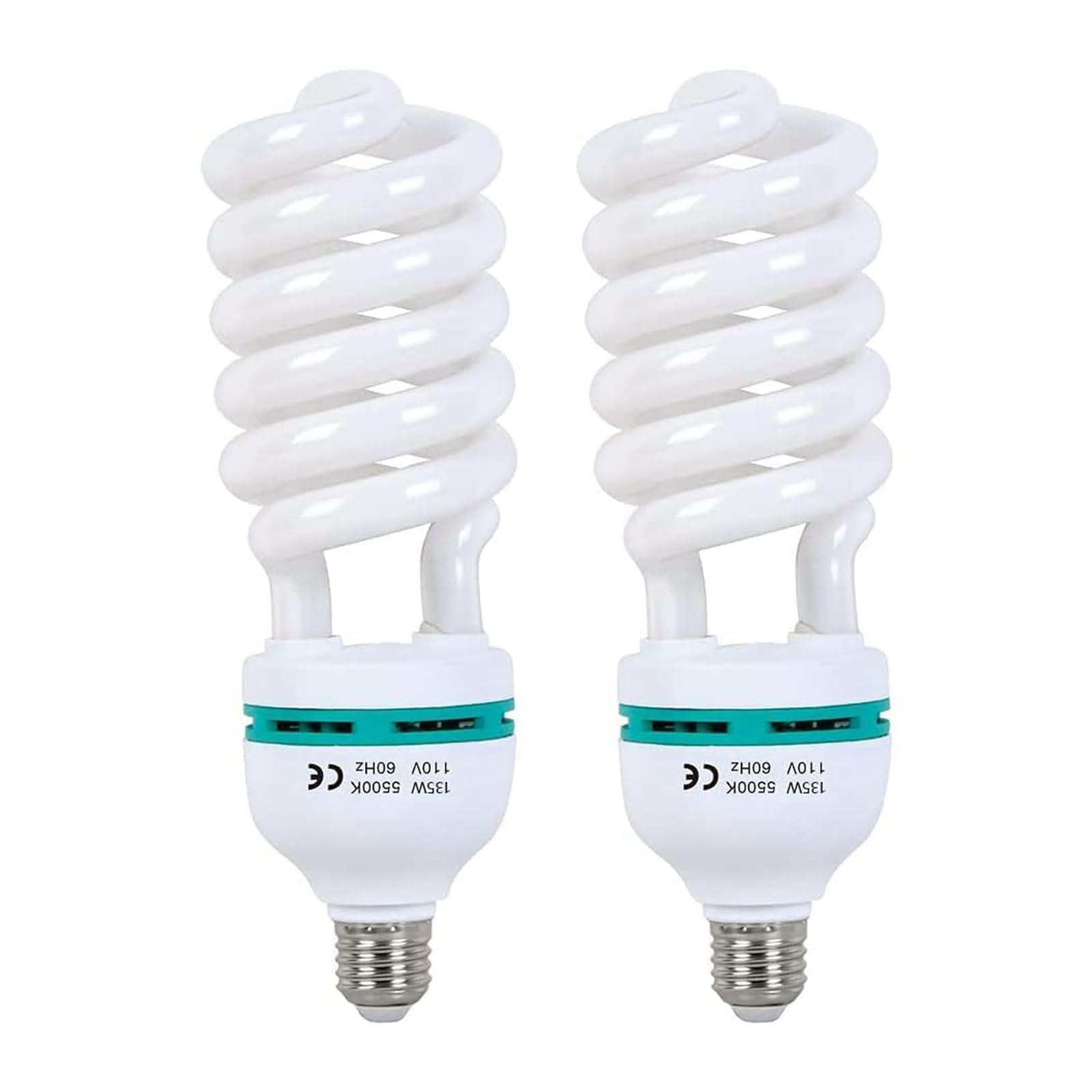
The Skytex 135W CFL is a straightforward, high-wattage workhorse for studio lighting. It outputs a 5500K daylight color temperature at 135W, giving you plenty of punch for lighting larger softboxes or bouncing off ceilings to create soft, even fill. The spiral shape spreads light evenly through the modifier, and the bulb operates quietly without introducing audible hum into your recordings.
Several reviewers have used these bulbs for over two years without degradation in brightness or color shift, suggesting good internal ballast quality. The 200W incandescent equivalent rating means you’re getting more than enough output for most portrait and product setups, and the E27 base makes installation a drop-in affair. As a mid-range option, it delivers reliable daylight-balanced light without any frills.
One area where the Skytex falls short is CRI—the spec sheet lists 65, which is noticeably lower than the other options here. That means colors won’t render as accurately, which could be a dealbreaker for product photography or any shoot where precise color matching matters. Also, the bulb runs hot after extended use, so you’ll want to give it a cooldown period before handling.
Why it’s great
- High 135W output for bright, broad illumination
- Longevity reported by users exceeding two years of regular use
- Silent operation for video shoots
Good to know
- CRI of 65 is low—colors may appear washed out
- Runs hot; requires caution when handling after use
5. RIUVAO LED Corn Bulb 300W Equivalent

The RIUVAO LED corn bulb takes a different approach—it’s an LED, not CFL, and it’s designed for both indoor and outdoor use with an IP67 waterproof rating. At 5000 lumens and 5000K color temperature, it’s slightly warmer than the 5500K standard, which can work for general ambient lighting but may not match existing daylight-balanced studio kits. The 360-degree beam angle makes it excellent for illuminating entire rooms or driveways, but less ideal for directional softbox use.
Buyers have praised its brightness for garage, courtyard, and large living room applications, noting that it transforms dark spaces into well-lit areas. The 37,000-hour lifespan far outlasts CFL options, and the energy draw of only 40W means it’s extremely efficient. The E26/E27 base gives you broad compatibility with existing fixtures, and the one-piece sealed shell provides genuine weather resistance for outdoor fixtures.
However, there are important caveats for photography use. One customer flagged that the claimed 5000-lumen output may be overstated—real-world brightness seems closer to 1200 lumens in independent checks. Combined with the 5000K color temperature (off the 5500K standard), this bulb is best reserved for non-critical room lighting or as a low-cost ambient fill rather than a primary studio light source.
Why it’s great
- IP67 waterproof rating for outdoor and damp environments
- Extremely long 37,000-hour lifespan
- Low power draw at only 40W for 360-degree illumination
Good to know
- Lumen output may be inflated—performs dimmer than rated
- 5000K color temperature doesn’t match standard 5500K daylight
- Not ideal as a primary studio light for color-critical work
FAQ
Can I use a regular LED bulb for photography lighting?
What does 5500K color temperature mean for video?
How many lumens do I need for a softbox setup?
Final Thoughts: The Verdict
For most users, the camera light bulb winner is the AQIRUI 135W because it balances high 6000-lumen output, a solid CRI of 85, and genuine durability for active studio use. If you need the most accurate color reproduction, grab the Generic 85W CFL with its CRI 90 rating. And for a reliable, budget-conscious start, the EMART 105W offers proven longevity and flicker-free performance that won’t disappoint.

Mo Maruf
I created WellFizz to bridge the gap between vague wellness advice and actionable solutions. My mission is simple: to decode the research and give you practical tools you can actually use.
Beyond the data, I am a passionate traveler. I believe that stepping away from the screen to explore new environments is essential for mental clarity and physical vitality.