Our readers keep the lights on and my smoothie glass nicely filled. As an Amazon Associate, I earn from qualifying purchases.
That first lens purchase defines your entire photography journey. Choosing wrong means fighting with blurry shots, missed moments, and a lens that lives in your bag. Choose right, and you unlock the images you bought the camera for in the first place. The decision is a single spec—focal length, aperture, and mount compatibility—that either matches your camera body or ruins your shot.
I’m Mohammad Maruf — the founder and writer behind WellFizz. I’ve spent hundreds of hours analyzing technical specs, reading verified buyer reports, and comparing optical performance across the most common beginner lens categories to separate the real tools from the marketing fluff.
Whether you shoot portraits on a Canon Rebel, street scenes on a Sony A6000, or landscapes on a Nikon Z50, the best camera lens for beginners is the one that pairs the right focal length with the correct mount and aperture for your specific camera system.
How To Choose The Best Camera Lens For Beginners
Three numbers decide everything: the mount, the focal length, and the aperture. Beginners often overpay for fancy glass they cannot use because the lens simply does not fit their camera. Here is how to avoid that mistake.
Match the mount to your camera brand
Canon EF‑S lenses only fit Canon DSLRs. Sony E‑mount lenses only fit Sony mirrorless bodies. Nikon Z lenses only fit Nikon Z series cameras. Micro Four Thirds lenses work on Olympus and Panasonic bodies. A lens that does not physically click onto your camera is a paperweight. Check the product description for compatibility before you click buy.
Choose between prime and zoom
A prime lens has a single fixed focal length (like 50mm, 40mm, or 25mm). It forces you to move your feet for composition, which trains your eye faster than any zoom. A zoom lens covers a range of lengths (like 16‑50mm or 18‑55mm) for convenience. Beginners learn faster on a prime, but many prefer the flexibility of a zoom for general travel and family shots.
Understand aperture and low‑light capability
The aperture number (f/1.8, f/2, f/3.5‑5.6) tells you how much light the lens lets in. A lower number means brighter images in dim conditions and more background blur (bokeh) in portraits. A f/1.8 lens collects about four times more light than a f/3.5 kit zoom. For indoor family gatherings, evening street photography, or any handheld shot without a flash, a wider aperture is the single most important spec.
Know your sensor size
A 50mm lens on a full‑frame camera gives a classic natural view. The same 50mm lens on an APS‑C sensor (Canon Rebel, Sony A6000 series, Nikon DX) behaves like an 80mm lens — tighter, more portrait‑oriented. On a Micro Four Thirds body, 25mm gives the same 50mm full‑frame equivalent. Beginners who ignore this end up with a lens that is too wide or too narrow for their intended shots.
Quick Comparison
On smaller screens, swipe sideways to see the full table.
| Model | Category | Best For | Key Spec | Amazon |
|---|---|---|---|---|
| Canon EF 50mm f/1.8 STM | Prime | Budget portraits & low‑light | STM motor, 7‑blade aperture | Amazon |
| Nikon Z 40mm f/2 | Prime | Everyday walkaround | 40mm f/2, 9‑blade diaphragm | Amazon |
| Panasonic LUMIX 25mm f/1.7 | Prime | MFT all‑around prime | 125g, 47° angle of view | Amazon |
| Sony FE 50mm f/1.8 | Prime | Full‑frame Sony portraits | Double‑gauss, 7‑blade bokeh | Amazon |
| YONGNUO YN50mm f/1.8N | Prime | Nikon budget prime | Gold‑plated contacts, 7.2 oz | Amazon |
| Yongnuo YN25mm f/1.7M | Prime | MFT budget prime | STM stepper motor, 0.2 kg | Amazon |
| VILTROX 9mm f/2.8 | Prime | Ultra‑wide APS‑C | 113.8° FOV, 0.13m MFD | Amazon |
| Canon EF‑S 18‑55mm f/3.5‑5.6 IS STM | Zoom | Entry‑level kit zoom | 4‑stop IS, 0.25m MFD | Amazon |
| Sony SELP1650 16‑50mm | Zoom | Compact Sony kit zoom | Power zoom, 4.09 oz | Amazon |
In‑Depth Reviews
1. Canon EF 50mm f/1.8 STM Lens

This is the lens that teaches you photography. The 50mm focal length is a standard prime, meaning it matches what the human eye naturally sees on a full‑frame body, and behaves like an 80mm portrait lens on Canon’s APS‑C bodies. The f/1.8 aperture lets in significantly more light than the variable f/3.5‑5.6 of kit zooms, which translates to sharp indoor shots, silky bokeh, and usable photos at dusk without a flash.
The STM stepping motor delivers near‑silent autofocus during video recording, a major upgrade from the older Canon 50mm f/1.8 II version that sounded like a sewing machine. The metal mount replaces the plastic flange of the previous generation, so this lens survives years of swapping between bodies. Center sharpness is excellent from f/2.8 onward, and the 0.35m minimum focus distance lets you fill the frame with smaller subjects.
Corner softness is noticeable when shooting wide open at f/1.8, but for portraits where the subject sits in the center third of the frame, that flaw rarely matters. There is no image stabilization, so keep shutter speeds above 1/80s for handheld shots. The 49mm filter thread is standard and affordable for adding a UV or polarizer.
Why it’s great
- Silent STM autofocus for video and stills
- Excellent center sharpness at f/2.8 and above
- Metal mount improves durability over older versions
- Beautiful background blur from 7‑blade circular aperture
Good to know
- No image stabilization
- Soft corners when shooting wide open at f/1.8
- Focus‑by‑wire manual ring lacks hard stops
- Lens hood sold separately
2. Nikon NIKKOR Z 40mm f/2
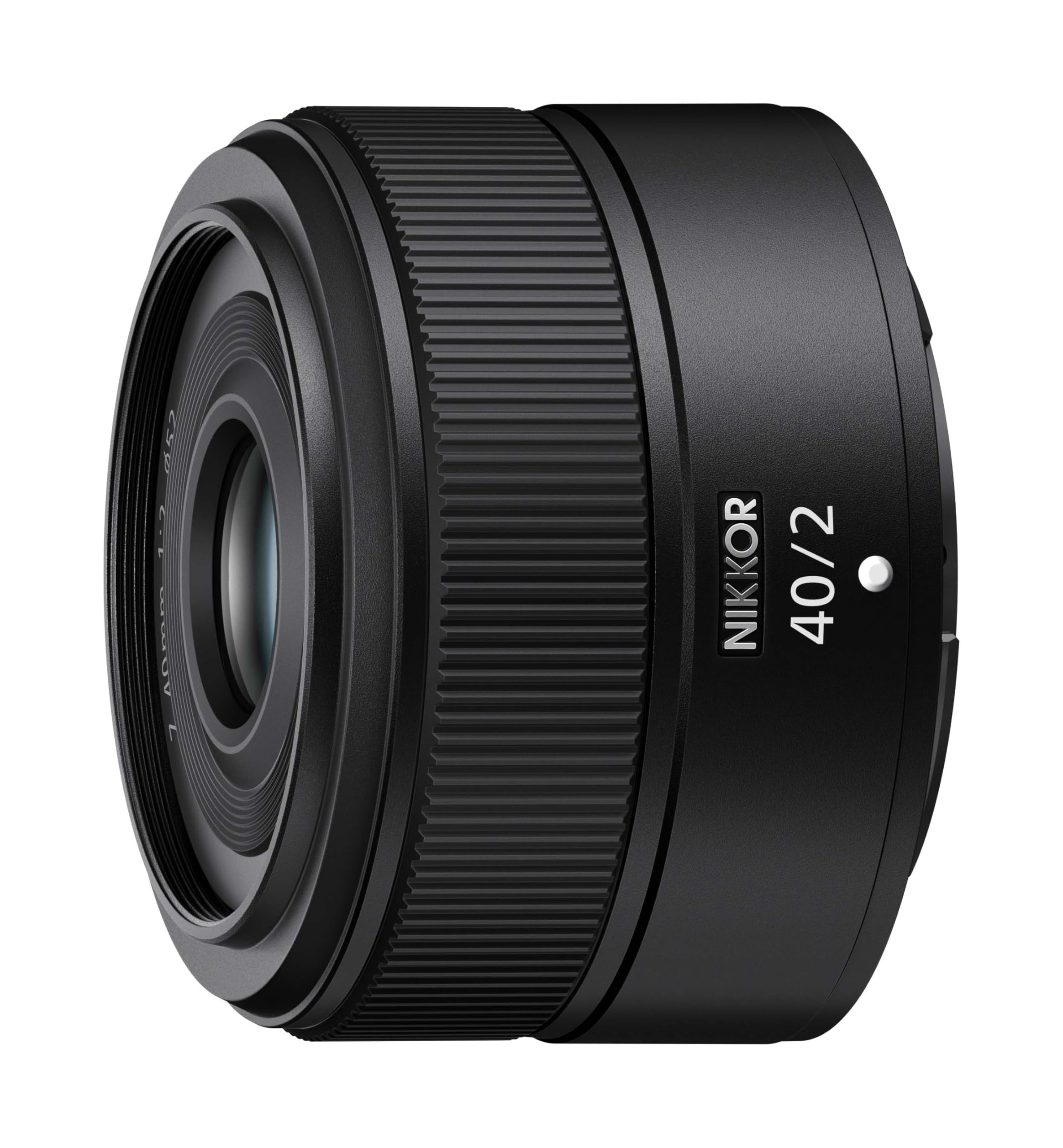
The 40mm focal length sits in a sweet spot between the classic 35mm and 50mm perspectives. On a Nikon Z full‑frame body, the 40mm gives a slightly wider view than a standard 50mm, making it more forgiving for street photography and indoor environmental portraits. On DX‑format Z cameras like the Z50, the effective field of view jumps to 60mm, which still works well for portraits with a bit of background context.
The f/2 aperture is one‑third stop slower than f/1.8, but the real‑world difference is negligible for most shooting scenarios. The 9‑blade rounded diaphragm produces smooth, natural bokeh that avoids the harsh polygonal shapes cheaper lenses create. The custom control ring lets you adjust aperture, ISO, or exposure compensation without taking your eye off the viewfinder, a feature usually reserved for higher‑end glass.
Build is plastic but the lens feels solid in hand at 170g. The compact design pairs perfectly with the Z5, Z6, and Z7 series without throwing off the balance. Autofocus is quick and quiet, and the lens suppresses focus breathing during video recording. The 52mm filter thread is small and cheap to accessorize. No optical image stabilization is included, but Nikon Z bodies with in‑body stabilization compensate well.
Why it’s great
- Versatile 40mm walkaround focal length
- Smooth, natural bokeh from 9‑blade aperture
- Customizable control ring for aperture or ISO
- Lightweight and compact for daily carry
Good to know
- Plastic construction despite premium price position
- No included lens hood
- No image stabilization
- Not weather‑sealed
3. Panasonic LUMIX G 25mm f/1.7 ASPH
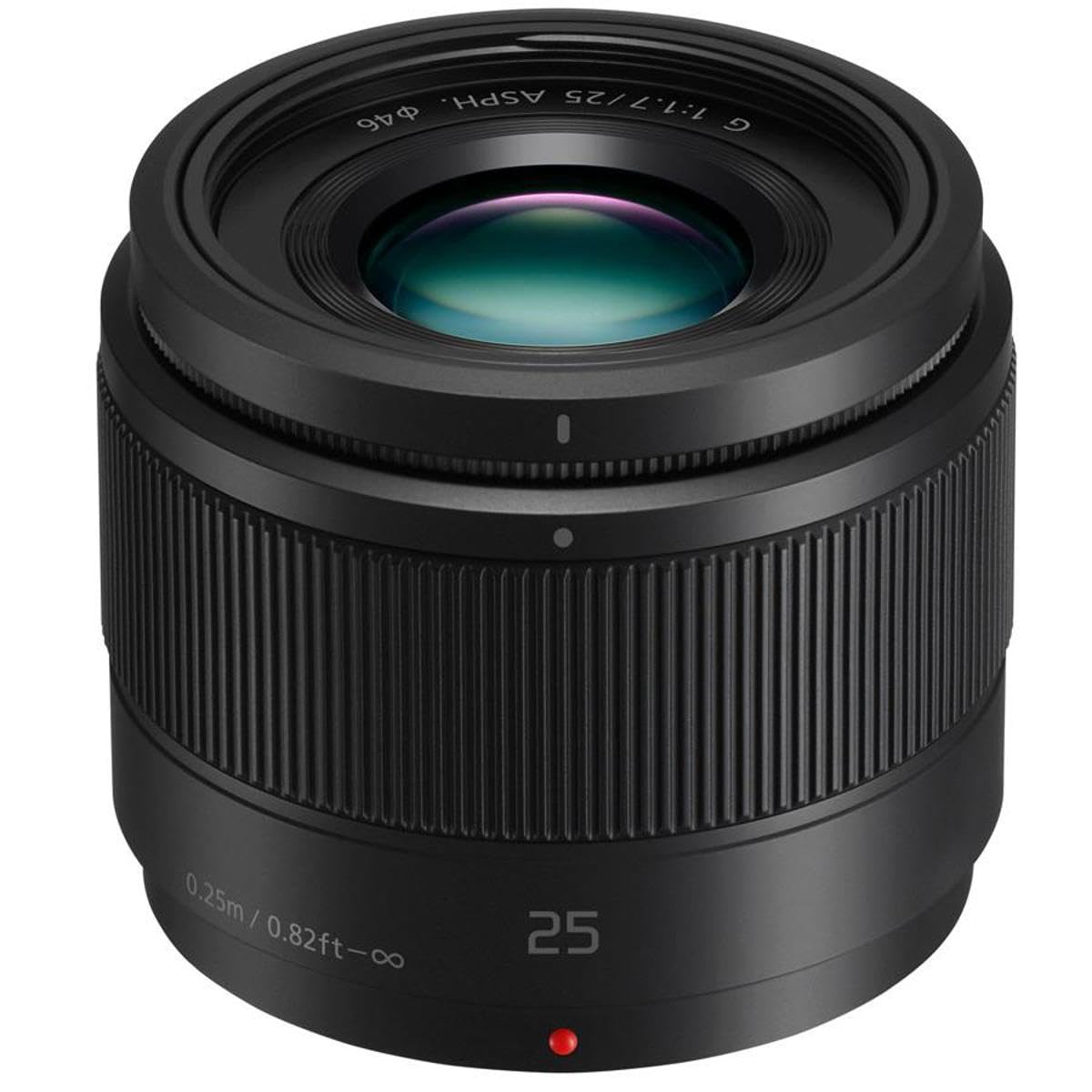
On the Micro Four Thirds system, 25mm gives the exact 50mm full‑frame equivalent that has been the standard prime focal length for decades. This lens was practically designed to be the first and only lens for a Panasonic G85, Olympus E‑M10 Mark IV, or similar MFT body. The f/1.7 aperture is bright enough for indoor available‑light shooting and produces a creamy background separation that instantly elevates snapshots into something that looks deliberate.
The optical construction uses two aspherical lenses and one ultra‑high refractive index element to control spherical aberration and keep the image sharp across the frame. At 125g and barely 2 inches long, it disappears on any MFT body, making it a zero‑excuses everyday companion. The stepping motor autofocus is quiet and smooth for both photo and video, and the filter thread is a standard 46mm.
The biggest limitation is the maximum aperture relative to Micro Four Thirds depth of field. At f/1.7, the equivalent depth of field is roughly f/3.4 on full‑frame, so you still need to compose carefully to throw backgrounds completely out of focus. The lens does not have optical stabilization, but most Olympus bodies have in‑body stabilization that covers this gap. Build quality leans toward plastic, but for the price and weight, the trade‑off is fair.
Why it’s great
- True 50mm equivalent on Micro Four Thirds bodies
- Extremely light and compact for daily carry
- Quiet stepping motor works well for video
- Sharp at f/2 and beyond with good bokeh
Good to know
- No optical image stabilization
- Depth of field at f/1.7 is moderate on MFT
- Plastic build can feel less substantial
- Lens hood sold separately
4. Sony FE 50mm f/1.8 Standard Lens

Sony’s entry‑level full‑frame prime does exactly what a beginner needs: it fits every E‑mount body from the original NEX‑5 all the way to the A7RV and A9 series. The 50mm f/1.8 combination is the classic portrait and low‑light formula, and the double‑gauss optical design suppresses field curvature and distortion better than simpler triplet designs found in ultra‑budget lenses. Colors are vibrant and contrast is punchy straight out of camera.
The 7‑blade circular aperture creates a smooth bokeh that is noticeably better than the older Sony 50mm f/1.8 (SEL50F18) non‑FE version. The lens is compact at 6.6 ounces and balances well on both the A7C and the larger A7R series bodies. Autofocus is fast and accurate in good light but can hunt in very dim conditions — a trade‑off common across all budget Sony primes. Sharpness in the center frame is excellent even at f/1.8, and the aspherical element controls coma for cleaner night shots.
The all‑plastic barrel is the main complaint from users who expect more heft at this price level from a major brand. There is no weather sealing, no AF/MF switch on the barrel, and no optical image stabilization. Sony users who shoot on bodies with in‑body stabilization will not miss the OIS, but A6xxx series APS‑C users should note that this lens behaves like a 75mm equivalent on their cameras, which is tighter for general walkaround use.
Why it’s great
- Excellent center sharpness at f/1.8
- Vibrant color and contrast straight from the lens
- Universal E‑mount compatibility for all Sony cameras
- Light and well‑balanced on full‑frame bodies
Good to know
- Plastic construction feels less premium
- No weather sealing or AF/MF switch
- Autofocus can struggle in very low light
- No optical image stabilization
5. YONGNUO YN50mm f/1.8N Standard Prime Lens

For Nikon DSLR shooters who cannot justify the price of the Nikkor 50mm f/1.8G or f/1.4G, the YONGNUO YN50mm f/1.8N delivers the same optical formula — 50mm on full‑frame, roughly 75mm on APS‑C DX bodies — at a fraction of the cost. The gold‑plated metal contacts improve signal conductivity and resist corrosion, which is a thoughtful detail for a lens in this price bracket. The metal mount is another surprising upgrade over the plastic bayonets found on some budget lenses from the same era.
Sharpness in the center is comparable to the Nikkor 50mm f/1.8G when stopped down to f/4. The f/1.8 aperture is usable for portraits and low‑light shots, though contrast drops slightly wide open. Autofocus works reliably on Nikon bodies from the D40 through the D3xxx and D5xxx series, and EXIF data transmits correctly so you can track your aperture and shutter settings in post‑processing. The 58mm filter thread matches many common filters.
The autofocus motor is audible — not silent like STM or ultrasonic designs — so this lens is not ideal for video recording where microphone pickup is a concern. There is no manual focus override while in AF mode, and the lens lacks any form of image stabilization or weather sealing. For still photography of stationary subjects, the performance exceeds the price by a wide margin. For fast action or quiet environments, look elsewhere.
Why it’s great
- Metal lens mount and gold‑plated contacts for durability
- Excellent center sharpness when stopped to f/4
- Budget entry to 50mm f/1.8 portraits for Nikon users
- Compatible with full‑frame and APS‑C Nikon DSLRs
Good to know
- Audible autofocus motor not suitable for video
- No manual focus override in AF mode
- No image stabilization or weather sealing
- Contrast is softer wide open at f/1.8
6. Yongnuo YN25mm f/1.7M Auto Focus Prime Lens

The Micro Four Thirds system has long needed a true budget 25mm f/1.7, and Yongnuo delivers one that undercuts the Panasonic 25mm f/1.7 by a noticeable margin while offering the same 50mm full‑frame equivalent field of view. The f/1.7 aperture is bright enough for indoor shooting, and the 7‑blade aperture produces reasonably smooth bokeh for the price. The lens supports both auto and full‑time manual focus, a feature that some budget primes omit.
The STM stepper motor is a surprising inclusion at this price level. It delivers fast, quiet autofocus that works on both Olympus and Panasonic MFT bodies. On a Panasonic G85 or Olympus E‑M10 Mark IV, the focus is snappy enough for family events and street photography, though the motor can hunt slightly in extremely low contrast scenes. The lens is light at 0.2 kg and features a metal mount, which is rare for this price tier. The multicoated optics help reduce flare compared to older Yongnuo designs.
Build quality leans plasticky, and some units have reported minor inconsistencies in exposure accuracy across a burst of shots. The focus ring is smooth but lacks the dampened feel of more expensive glass. Some users have reported that the lens can feel loose on the mount if the locking pin is not fully engaged, so check the fit during installation. For hobbyists and content creators on a tight budget, this lens opens up the prime shooting experience that MFT bodies are known for.
Why it’s great
- Budget entry to 50mm equivalent on MFT bodies
- Quiet STM autofocus for photos and video
- Metal mount improves durability over plastic designs
- Full‑time manual focus override in AF mode
Good to know
- Plastic barrel feels less premium
- Inconsistent exposure reported on some units
- Focus ring lacks dampened feel
- Can feel loose on mount if not fully locked
7. VILTROX 9mm f/2.8 E‑Mount APS‑C Lens
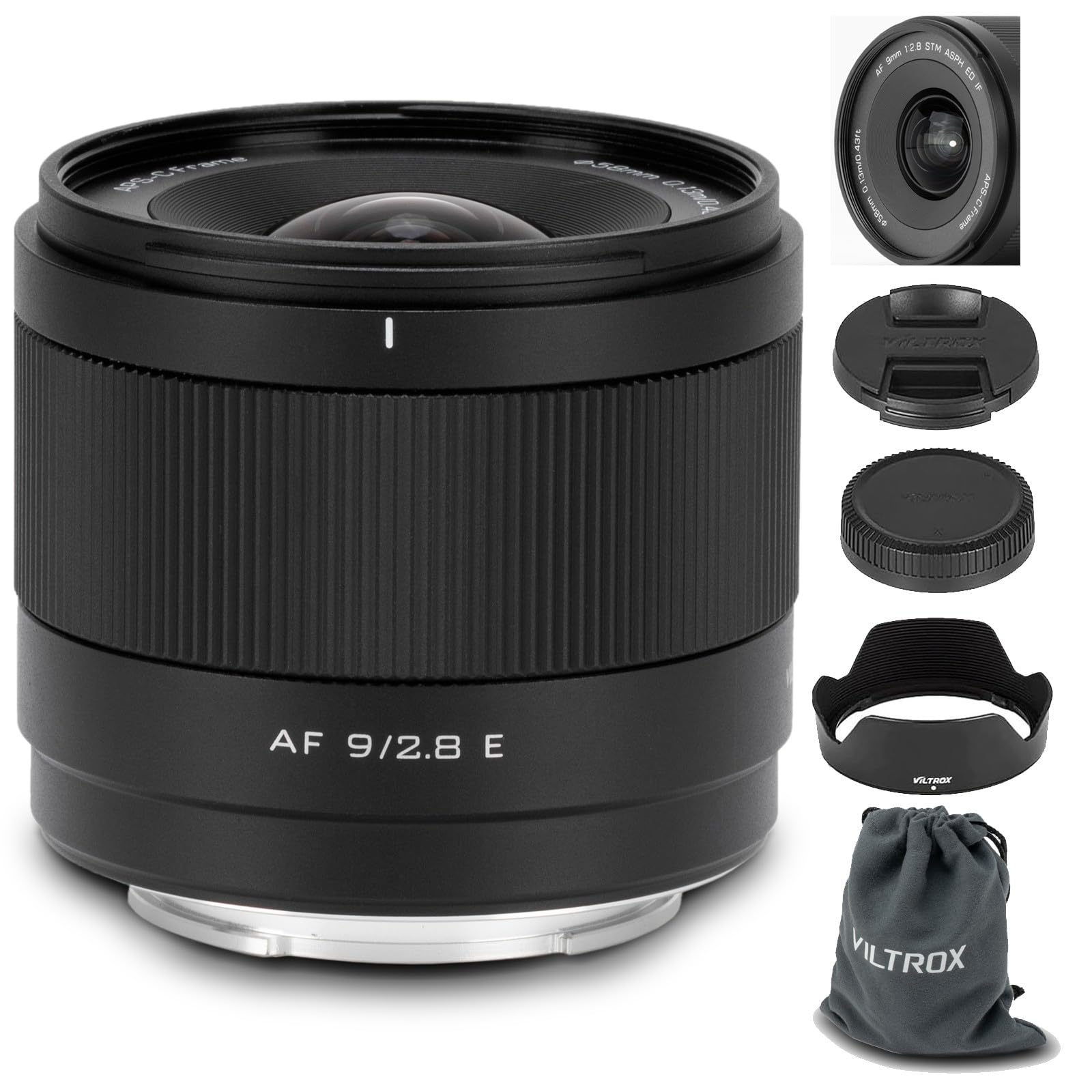
Most beginners start with a standard or portrait prime, but content creators and vloggers need a different tool. The VILTROX 9mm f/2.8 gives Sony APS‑C users a 13.5mm full‑frame equivalent field of view — that is 113.8 degrees of wide‑angle coverage, enough to fit a full group selfie or an entire room interior without stitching. The f/2.8 aperture is modest for low‑light compared to f/1.8 primes, but it is excellent for daytime vlogging and interior real estate shots where depth of field matters.
The optical construction uses 13 elements in 11 groups, including two aspherical elements for distortion control, three extra‑low dispersion elements for chromatic aberration suppression, and three high‑refractive index elements for edge‑to‑edge sharpness. The result is a lens that keeps corners reasonably sharp even at f/2.8, which is unusual for an ultra‑wide at this price. The STM lead screw focus motor is quiet enough for video but does produce an audible hum that onboard microphones can pick up in silent rooms. The minimum focus distance of 0.13m lets you get dramatically close to foreground subjects while keeping the background expansive.
The lens is compact at 175g, making it an easy addition to a Sony ZV‑E10 or A6700 kit bag. Autofocus supports eye and face detection on compatible Sony bodies, which is critical for vloggers who walk toward the camera. The built‑in lens hood and front cap are included. The main trade‑offs are the lack of weather sealing, the audible autofocus noise, and the fact that f/2.8 is not as bright as the prime lenses aimed at low‑light still photography. For its specific role — wide video and architecture — it is unmatched in this price tier.
Why it’s great
- Extreme 113.8° FOV perfect for vlogging and interiors
- Excellent edge‑to‑edge sharpness for an ultra‑wide
- Lightweight at 175g for all‑day carry
- Eye/face autofocus support for video creators
Good to know
- f/2.8 aperture is less capable in dim light
- Autofocus motor produces audible hum
- No weather sealing for outdoor use in rain
- Not compatible with full‑frame Sony bodies
8. Canon EF‑S 18‑55mm f/3.5‑5.6 IS STM

The classic Canon kit zoom in its most refined form. The 18‑55mm range covers wide to short telephoto, making it a versatile single lens for travel, family gatherings, and walkaround shooting. The 4‑stop optical image stabilization allows sharp handheld shots at 1/15s, which is a meaningful advantage in dim interiors compared to non‑stabilized primes. The STM stepping motor keeps autofocus silent during video, a major upgrade over the older non‑STM versions that clicked and whirred on every focus pull.
The minimum focusing distance of 0.25m across the zoom range lets you get reasonably close to subjects, useful for food photography and tabletop detail shots. The variable aperture — f/3.5 at 18mm, f/5.6 at 55mm — is the lens’ biggest limitation. It struggles in low light compared to any f/1.8 prime, and the background blur at 55mm is modest even with careful composition. Sharpness in the center is decent at mid‑apertures, but corners are soft and contrast is mediocre compared to even a budget prime.
The plastic mount is the most common complaint. Over years of daily use, the bayonet can wear faster than metal mounts, especially if you swap lenses frequently. The lens extends when zooming, which changes the balance point and can make panning feel less stable. If you buy this lens expecting it to be your forever lens, you will outgrow it within six months. If you buy it as the affordable stepping stone to learn focal lengths before investing in a prime, it serves its purpose perfectly.
Why it’s great
- 4‑stop image stabilization for sharp handheld shots
- Silent STM autofocus works well for video
- Versatile 18‑55mm zoom covers wide to short tele
- Short 0.25m minimum focus distance
Good to know
- Variable f/3.5‑5.6 aperture struggles in low light
- Plastic mount is less durable over time
- Soft edges and moderate contrast compared to primes
- Lens extends during zoom, changing balance
9. Sony SELP1650 16‑50mm Power Zoom Lens (Renewed)

The Sony 16‑50mm power zoom is the slimmest kit zoom on the market at just over 4 ounces. When collapsed, it measures roughly 1.2 inches, which lets a Sony A6000 or A5100 slide into a coat pocket. The power zoom rocker on the barrel enables smooth, quiet zoom transitions during video — a feature that standard twist‑to‑zoom lenses cannot replicate. The optical image stabilization built into the lens helps steady handheld video and stills, though it is rated for about 3 stops rather than the 4 stops found on the Canon kit zoom.
The optical quality is typical of a compact kit zoom: the center is acceptably sharp from f/5.6 to f/11, but edges are soft and chromatic aberration is visible in high‑contrast scenes like tree branches against sky. The 16mm wide end is noticeably wider than the 18mm on Canon’s kit zoom, which is useful for tight indoor spaces and landscape photography. The 50mm end behaves like a 75mm equivalent on APS‑C bodies, making it workable for casual portraits.
The lens is designed exclusively for Sony E‑mount APS‑C cameras and will not fit A‑mount or full‑frame bodies without heavy vignetting. The power zoom mechanism requires battery power to operate, which means the lens stays at its collapsed length when the camera is off and extends when powered on — a minor nuisance if you want to keep a low profile. The renewed version offers a meaningful discount over new stock, and verified reviews report that units arrive in near‑mint condition. For the absolute lightest walkaround zoom that still includes stabilization, this is the only option in the Sony ecosystem at this price level.
Why it’s great
- Ultra‑compact collapsed size for pocket carry
- Power zoom lever enables smooth video transitions
- Built‑in optical image stabilization
- Wider 16mm end compared to standard 18mm kit zooms
Good to know
- Optical quality is average — soft edges and visible CA
- Power zoom requires battery power to extend
- Not compatible with full‑frame or A‑mount Sony cameras
- Renewed units may have cosmetic wear
FAQ
Should I buy a prime or a zoom as my first lens?
Buy a prime for image quality and learning composition. A 50mm f/1.8 (or 25mm f/1.7 on MFT) forces you to move your feet and think about framing, which accelerates your growth faster than any zoom. If you need versatility for travel or family events where you cannot reposition easily, start with a stabilized zoom like the Canon 18‑55mm IS STM or Sony 16‑50mm power zoom, then add a prime when your budget allows.
What does the crop factor mean for my camera?
Every lens has an optical focal length, but the sensor size determines how much of that image the camera captures. A full‑frame sensor uses the entire image circle. An APS‑C sensor crops 1.5x (Nikon, Sony) or 1.6x (Canon), making a 50mm lens behave like a 75mm or 80mm lens. A Micro Four Thirds sensor crops 2x, making a 25mm lens behave like a 50mm lens. When reading reviews, look for the equivalent field of view for your specific camera system, not just the numbers printed on the lens.
Can I use a full‑frame lens on my APS‑C camera?
Yes, full‑frame lenses like the Canon EF 50mm f/1.8 STM or Sony FE 50mm f/1.8 work perfectly on APS‑C bodies as long as the mount is compatible. The lens projects a larger image circle than the sensor needs, so you get the same center sharpness but a tighter field of view due to crop factor. You can also use APS‑C lenses on full‑frame cameras, but the camera may automatically switch to crop mode, reducing megapixel count, or you may see heavy vignetting in the corners.
Why does my kit lens produce blurry backgrounds for portraits?
Kit zooms have variable apertures of f/3.5‑5.6, which means the maximum aperture narrows as you zoom in. At 55mm and f/5.6, the depth of field is deep — everything from a few feet in front of your subject to several feet behind stays in focus. To get the blurred background (bokeh) typical of professional portraits, you need a wider aperture (f/1.8 or f/2) and a longer focal length. The solution is a 50mm f/1.8 prime for Canon and Nikon users, or a 35mm f/1.8 for Sony APS‑C shooters.
How important is image stabilization in a beginner lens?
Important only if your camera body lacks in‑body stabilization. If you shoot a Canon Rebel, Nikon D3500/D5600, or Sony A6000 series, stabilization inside the lens helps you shoot at slower shutter speeds without blur. If you shoot an Olympus, Panasonic, or Sony A7III‑series body with IBIS, lens stabilization is redundant. Prime lenses typically trade stabilization for wider apertures. Zoom lenses often include stabilization because their slower apertures force slower shutter speeds, making shake more likely.
Final Thoughts: The Verdict
For most users, the best camera lens for beginners winner is the Canon EF 50mm f/1.8 STM because it combines silent autofocus, a proven focal length, and a budget‑friendly price that unlocks professional‑grade portraits and low‑light performance. If you shoot Nikon Z mirrorless, grab the Nikon Z 40mm f/2 for its versatile walkaround perspective and compact build. And for Micro Four Thirds users, nothing beats the Panasonic LUMIX 25mm f/1.7 as the single lens that transforms an Olympus or Panasonic body into an everyday powerhouse.

Mo Maruf
I created WellFizz to bridge the gap between vague wellness advice and actionable solutions. My mission is simple: to decode the research and give you practical tools you can actually use.
Beyond the data, I am a passionate traveler. I believe that stepping away from the screen to explore new environments is essential for mental clarity and physical vitality.