Our readers keep the lights on and my smoothie glass nicely filled. As an Amazon Associate, I earn from qualifying purchases.
A camera for video interviews lives or dies by its ability to lock focus on a speaker’s face, capture clean dialog, and run for the duration of a conversation without overheating or cutting out. Autofocus speed, microphone input quality, and reliable 4K recording define the difference between a professional-looking sit-down and a frustrating technical exercise.
I’m Mohammad Maruf — the founder and writer behind WellFizz. Over years of analyzing video production gear, I’ve come to measure interview cameras by their dual-pixel or phase-detection autofocus systems, their support for external XLR or 3.5mm lavalier inputs, and their ability to maintain consistent exposure across dynamic lighting conditions without requiring a full crew to operate.
Whether you are recording podcast episodes, remote client calls, or documentary-style conversations, the ideal camera for video interviews balances sensor size with portability and provides the connectivity you need to capture high-quality audio without a second operator managing the shot.
How to choose the ideal camera for interview work
An interview camera must juggle three priorities that consumer camcorders often treat as optional: reliable subject tracking, external audio support, and the ability to keep the subject in focus while they move naturally. Start by understanding the features that make or break a sit-down production.
Autofocus reliability during conversation
Phase-detection autofocus (PDAF) is the gold standard for interview work because it can track a subject’s face even when they shift in their seat or look down at notes. Contrast-detection systems hunt and pulse, which ruins the clean cut you need for post‑production. Look for cameras that offer face‑detection or eye‑tracking AF and a configurable AF speed setting—this lets you avoid the robotic snap‑to‑focus that feels unnatural in a dialog scene.
Audio input flexibility
No built‑in microphone delivers interview‑grade sound, no matter how clever the noise cancellation claims are. A 3.5mm jack gets you a basic lavalier or shotgun, but dual XLR inputs—like those on purpose‑built video recorders—let you capture two lavaliers simultaneously without an external mixer. If your workflow relies on wireless lapel mics, verify the camera supports a line‑level input rather than only a consumer‑grade plug‑in‑power connection.
4K resolution and sensor size
Interviews often end up cropped for social clips or reframed in editing to hide a stray movement. A 1‑inch or larger sensor gives you enough resolution to punch in without losing sharpness. At least 4K UHD at 24 or 30 fps is the baseline; 10‑bit color depth helps if you need to match footage from a second camera or grade for a consistent brand look. Avoid cameras that overheat in sustained 4K recording—interview setups can run thirty to sixty minutes without a break.
Quick Comparison
On smaller screens, swipe sideways to see the full table.
| Model | Category | Best For | Key Spec | Amazon |
|---|---|---|---|---|
| Sony FX30 | Cinema | Multi‑cam pro interviews | 6K oversampled 4K | Amazon |
| DJI Osmo Pocket 3 | Compact | On‑the‑go solo interviews | 3‑axis stabilization | Amazon |
| Canon VIXIA HF G70 | Camcorder | Long‑form sit‑downs | 20x optical zoom | Amazon |
| Blackmagic Micro Studio G2 | Studio | Broadcast‑style production | 12‑bit Blackmagic RAW | Amazon |
| OBSBOT Tail Air | PTZ | Untracked solo speaker | AI object tracking | Amazon |
| Sony FDR-AX43 | Camcorder | Run‑and‑gun event coverage | Balanced OIS gimbal | Amazon |
| Zoom Q8n-4K | Audio‑First | Podcast/interview audio | Dual XLR + phantom | Amazon |
| Logitech Mevo Start | Streaming | Live interview streaming | Wireless + LTE | Amazon |
| PERGEAR 4K PTZ | PTZ | Large‑room auto tracking | 30x hybrid zoom | Amazon |
| Canon PowerShot V10 | Compact | Ultra‑portable vlog style | 1‑inch CMOS | Amazon |
| TONGVEO PTZ | PTZ | Budget conference room | 12x optical zoom | Amazon |
In‑Depth Reviews
1. Sony FX30

The Sony FX30 is a Super 35 cinema camera that punches far above its weight for interview productions. Its 6K oversampled 4K output delivers exceptional sharpness, and S‑Cinetone color science produces pleasing skin tones right out of the box — a huge time saver when you need to deliver a finished interview without a full color grade.
The reliable phase‑detection autofocus with real‑time Eye AF locks onto a subject’s face and stays there, even if the talent turns to gesture at a screen. The dual base ISO (base 800 and base 3200) means you can shoot in a dimly lit office or a controlled studio without noise creeping into the skin shadows.
Active cooling prevents overheating during hour‑long recordings, and the full‑size HDMI port makes it easy to feed a clean signal to an external recorder or monitor. The NP‑FZ100 battery lasts roughly 80 minutes of continuous 4K, so a grip extension or external USB‑C power is advisable for longer interview sessions.
Why it’s great
- Phase‑detection AF with Eye Tracking stays locked on a speaker’s face
- Active cooling enables uninterrupted 4K interview recording
- S‑Cinetone delivers broadcast‑ready skin tones without grading
Good to know
- Requires an external mic adapter or XLR handle for professional audio inputs
- Battery life is moderate; a USB‑C power bank is recommended for all‑day shoots
2. DJI Osmo Pocket 3

The DJI Osmo Pocket 3 is the most portable interview camera that still delivers professional 4K quality. The 1‑inch CMOS sensor captures clean footage even in dim conference rooms, and the 3‑axis mechanical stabilization means you can hold the camera in your hand for a walk‑and‑talk interview without distracting bounces.
ActiveTrack 6.0 locks onto your subject and keeps them centered even as they move—this is especially useful for solo creators who want to set the camera on a tripod and join the conversation. The 2‑inch rotatable touchscreen flips to vertical quickly for social‑clip repurposing.
The Creator Combo includes the DJI Mic 2 transmitter, which pairs wirelessly and provides clean lapel audio without cables. At 4K/120fps, you can slow down a reaction clip for emphasis. The small body means the battery is built‑in, and you’ll need a power bank for multi‑hour shoots, but the trade‑off in size is worth it for run‑and‑gun interviewers.
Why it’s great
- ActiveTrack 6.0 keeps a moving subject perfectly framed during a dialogue
- Included wireless mic transmitter captures interview‑ready audio
- 3‑axis gimbal eliminates the need for a bulky tripod in mobile setups
Good to know
- Battery is non‑removable; a power bank is necessary for long recording blocks
- The gimbal is delicate — a small bump can knock the calibration off axis
3. Canon VIXIA HF G70

The Canon VIXIA HF G70 is a traditional camcorder built for long interview sessions where you need optical reach and reliable recording. The 20x optical zoom lets you frame a tight medium shot from across a conference table without moving the camera, and the DIGIC DV6 processor keeps 4K video sharp at 30 fps.
The UVC livestreaming feature is a standout for hybrid interview workflows: connect via USB to a PC or Mac and stream directly to Zoom or Teams in 1080p HD without a capture card. The 8‑blade aperture creates a smoother bokeh in background separation, which helps isolate the subject from a busy office environment.
Dual SD card slots provide instant backup recording, a must‑have for client‑facing interviews where card failure is not an option. The camcorder body is larger than mirrorless options, but the ergonomic grip and built‑in lens hood make handheld operation comfortable over a full hour.
Why it’s great
- UVC streaming mode acts as a high‑quality webcam for remote interviews
- Dual SD card slots record simultaneously for immediate backup
- 20x optical zoom provides framing flexibility without compromising image quality
Good to know
- Low‑light performance becomes soft above ISO 1600
- HDMI out is limited to 1080p, not 4K, for external monitoring
4. Blackmagic Micro Studio Camera 4K G2

The Blackmagic Micro Studio Camera 4K G2 is a purpose‑built live production camera that integrates seamlessly with ATEM switchers for multi‑camera interview setups. The MFT lens mount gives you access to a wide range of optics, and the dual native ISO of 400 and 3200 provides 13 stops of dynamic range to handle high‑contrast interview lighting.
Recording in 12‑bit Blackmagic RAW gives the editor enormous latitude to recover shadows and adjust white balance in post — a safety net when lighting changes between interview segments. The carbon composite body is incredibly light, making it easy to mount on a jib or a compact tripod for an overhead interview angle.
The lack of a built‑in screen means you’ll need an external monitor or a Blackmagic Video Assist for framing. The 12G‑SDI output carries 4K video and tally information, but the camera relies on a separate power source — an NP‑F battery lasts under 30 minutes, so an AC adapter or a V‑mount plate is required for extended interviews.
Why it’s great
- 12‑bit Blackmagic RAW provides massive color grading flexibility for interviews
- 12G‑SDI input/output with tally integration works natively with broadcast switchers
- Light carbon fiber body is easy to position in tight studio setups
Good to know
- No built‑in display or viewfinder — requires an external monitor
- Battery life is very short; AC or V‑mount power is recommended for long recording sessions
5. OBSBOT Tail Air

The OBSBOT Tail Air is a compact PTZ camera with a 4K sensor and an AI tracking system that follows people, animals, or objects with surprising accuracy. For an interview where the speaker paces or gestures widely, the Tail Air keeps them centered without a human operator — the 320° horizontal and 180° vertical rotation covers almost any room layout.
NDI support (license key required) allows you to send the video feed over a standard Ethernet network to a PC or ATEM switcher, which simplifies cable management in a studio environment. The small size — smaller than a soda can — means it can be placed discreetly on a bookshelf or desk without becoming a visual distraction.
The companion app (Obsbot Start) provides full manual control over exposure, white balance, and ISO, so you can dial in the look before the interview begins. Multiple Tail Air units can be synchronized for a multi‑angle production. The battery life is around 2.5 hours, but the unit also runs on USB‑C power for all‑day use.
Why it’s great
- AI tracking follows a moving speaker smoothly without a dedicated operator
- NDI‑ready for networked multi‑camera interview setups
- Extremely compact form factor fits into tight or unobtrusive positions
Good to know
- NDI license key is an additional purchase, not included in the box
- Some units have reported battery degradation that can render the camera inoperable
6. Sony FDR-AX43

The Sony FDR-AX43 is a 4K Handycam with a Balanced Optical SteadyShot system that acts like a built‑in gimbal. For interviews shot handheld — walking alongside a subject in a park or following a speaker through a trade show floor — this stabilization keeps the frame steady without the weight of external gear.
The 20x optical zoom and Clear Image Zoom (30x for 4K, 40x for HD) let you capture a wide establishing shot and push into a tight medium without moving. The 1/2.5‑inch Exmor R sensor performs well in good light but does introduce noise in darker interview environments, so consider adding a key light.
The camera offers a 3.5mm mic input, which accommodates a basic shotgun or lavalier. WiFi and NFC connectivity allow remote control via smartphone, useful when the camera is placed on a tripod across the room. The battery sticks out noticeably from the back, but the larger capacity provides extended recording time.
Why it’s great
- Balanced Optical SteadyShot delivers gimbal‑like stabilization for mobile interviews
- 20x optical zoom allows flexible framing without lens changes
- WiFi remote control is useful for locked‑off tripod interview setups
Good to know
- Low‑light performance is not as clean as larger‑sensor mirrorless cameras
- No internal memory — a UHS‑I SD card is required before first use
7. Zoom Q8n-4K

The Zoom Q8n-4K puts audio recording at the center of the interview workflow. Its dual XLR inputs with +48V phantom power let you plug two professional microphones — such as a pair of Shure SM58s for a two‑person interview — and record each on a separate track without an external audio interface.
The 150° wide‑angle lens captures the full interview scene, and the interchangeable capsule system allows you to swap from the built‑in stereo mic to a shotgun capsule for more focused dialog pickup. Video quality is limited to 4K at 30 fps, and the 1/2.3‑inch sensor is grainy in low light, so prioritize well‑lit interview environments.
Webcam mode turns the Q8n into a high‑quality USB camera for live streaming interviews, and the flip‑out screen helps with framing when the camera is placed at a low or high angle. The 70‑minute internal battery is modest, but USB‑C power delivery keeps it running through longer sessions.
Why it’s great
- Dual XLR inputs with phantom power capture two independent interview audio tracks
- Interchangeable capsules adapt the camera’s sound character to the room
- Webcam mode streams high‑quality video plus audio directly to a computer
Good to know
- Video quality degrades noticeably in low‑light interview settings
- No optical zoom — changing framing relies on the lens’s preset field‑of‑view widths
8. Logitech Mevo Start

The Logitech Mevo Start is a wireless streaming camera designed for live interview broadcasts. It streams in 1080p HD over Wi‑Fi or LTE (via your smartphone’s hotspot), which lets you go live from a location without a hardwired internet connection — ideal for field interviews or remote podcast tapings.
The Auto‑Director mode uses AI to switch between wide, medium, and close‑up shots based on motion detection, which simulates a multi‑camera production with a single unit. Up to three Mevo Start cameras can be linked for true multi‑angle switching, all controlled from the Mevo app.
The 6‑hour internal battery covers a full day of remote interviews, and the built‑in microphone is surprisingly usable for a compact body. A 3.5mm aux input allows an external lavalier. The app‑based control can feel limiting for manual operators, and 4K is absent — but for live streaming interviews, the trade‑off is acceptable.
Why it’s great
- Wireless and LTE streaming enables live interviews from almost any location
- Auto‑Director automatically frames the speaker for a single‑operator live show
- 6‑hour battery life handles extended streaming without external power
Good to know
- Limited to 1080p — no 4K recording or streaming
- App‑based control restricts manual exposure and focus adjustments during a live interview
9. PERGEAR 4K PTZ
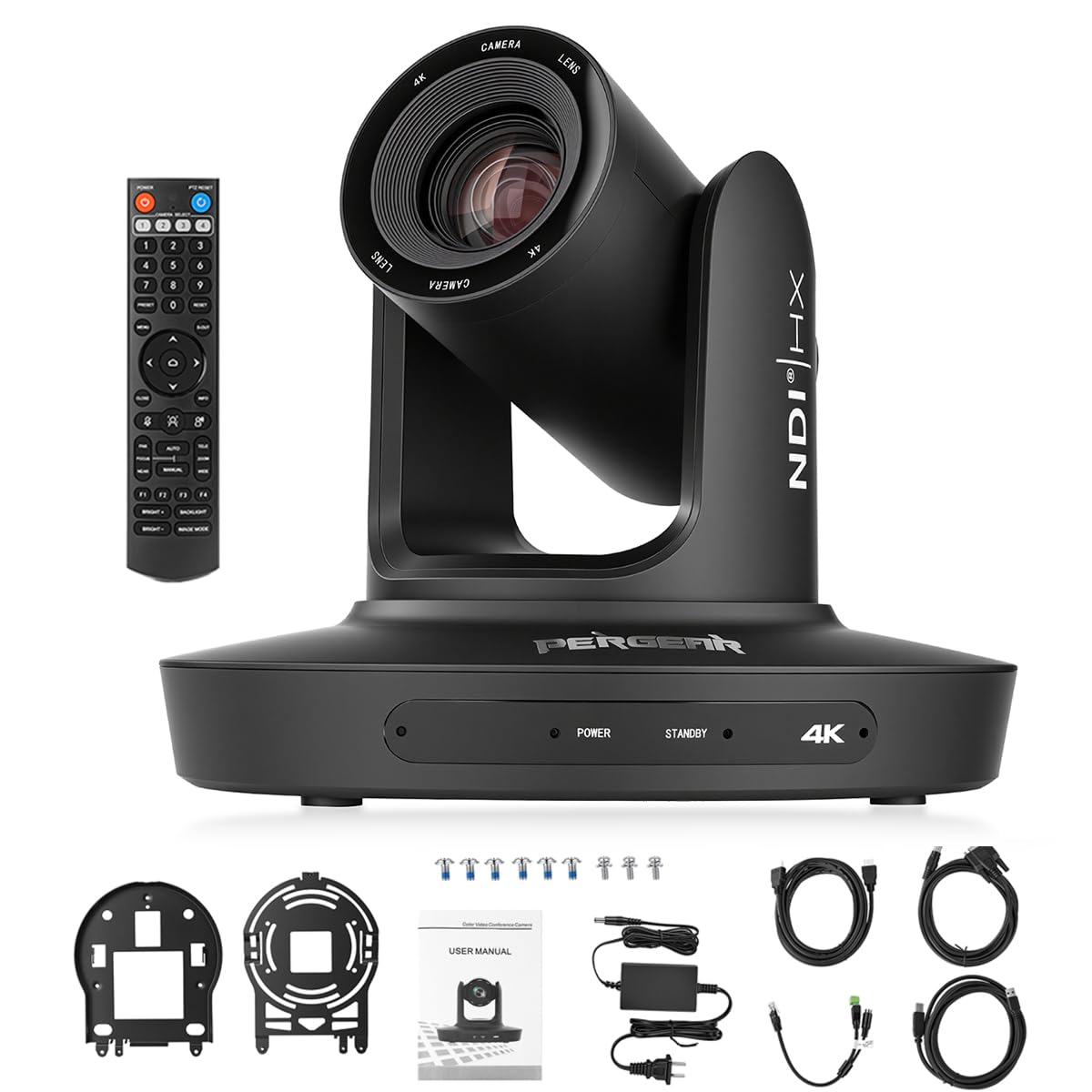
The PERGEAR 4K PTZ conference camera offers a 30x hybrid zoom (20x optical + intelligent processing) that captures crisp detail from across a large conference room or lecture hall. The AI auto‑tracking can follow a single speaker or intelligently switch between multiple people, making it suitable for panel‑style interviews.
The built‑in 4‑microphone array with noise cancellation picks up voices up to 6 meters away, which reduces the need for external microphones in small to medium rooms. The camera supports USB 3.0, HDMI, and LAN connectivity, and it works with NDI, ONVIF, and RTMP protocols for integration into a professional streaming pipeline.
Low‑light performance is improved over earlier PTZ models thanks to a sensor with advanced noise reduction. The camera does require good lighting for the AI auto‑tracking to lock onto faces reliably — dim backlit rooms can confuse the subject detection.
Why it’s great
- 30x hybrid zoom provides excellent reach for large‑room interview setups
- Built‑in 4‑mic array with noise cancellation covers up to 6 meters of audio
- NDI and RTMP support integrate directly into a live streaming workflow
Good to know
- AI tracking depends on adequate lighting — dim environments reduce lock‑on reliability
- The 4‑mic array is not a replacement for a dedicated lavalier in noisy rooms
10. Canon PowerShot V10

The Canon PowerShot V10 is a pocket‑sized vlogging camera with a 1‑inch back‑illuminated CMOS sensor that punches above its size for interview footage. The 19mm wide‑angle lens captures the subject and their environment, which is useful for sit‑down interviews in tight spaces like a coffee shop or home office.
The built‑in stand folds forward or backward to prop the camera up on a table, eliminating the need for a separate tripod in a pinch. The front‑facing flip screen lets the subject see themselves during the interview, which can reduce anxiety about framing. Stereo microphones with a third center channel filter background noise reasonably well.
4K recording is capped at 30 fps with 8‑bit color, and there is no optical zoom — only a digital crop. Battery life is a weak point at roughly 35–40 minutes of continuous 4K recording, so you will need a USB‑C power bank for any interview that runs longer than a short segment.
Why it’s great
- Compact enough to slide into a pocket for portable interview setups
- Flip‑up screen and built‑in stand allow tripod‑free tabletop interviews
- 1‑inch sensor provides better low‑light performance than smartphone cameras
Good to know
- No optical zoom limits framing to a fixed wide angle
- Battery life is short — external power is required for interviews longer than 40 minutes
11. TONGVEO PTZ Conference Camera
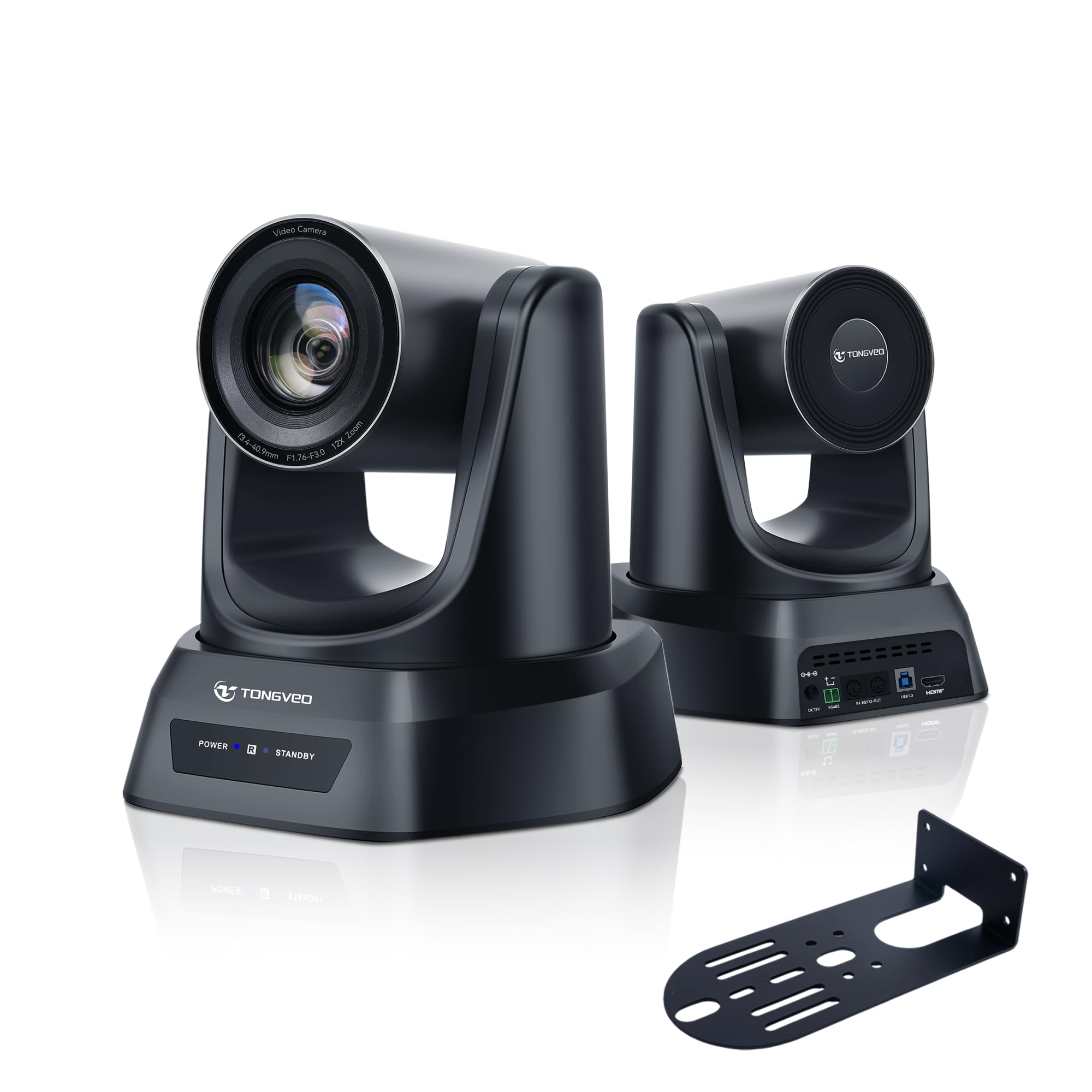
The TONGVEO PTZ conference camera brings AI auto‑tracking and 12x optical zoom to an entry‑level price point. For a small church, classroom, or budget‑conscious interview studio, it offers an excellent 75.4° field of view and 1080p at 60 fps — a smooth frame rate that captures natural speaker motion without stutter.
The camera supports simultaneous HDMI and USB 3.0 output, so you can send the feed to a monitor for the speaker and a computer for recording or streaming simultaneously. Up to 255 preset positions let you save different framing angles for a multi‑guest interview and recall them instantly with the included IR remote.
Image quality, particularly color accuracy and white balance, is noticeably better than a Logitech webcam according to verified users. The remote control is functional but clunky, with single‑axis pan/tilt/zoom that takes practice to operate smoothly. There is no built‑in microphone, so you must supply your own audio source.
Why it’s great
- 12x optical zoom at 1080p/60fps provides smooth, detailed footage for a modest investment
- AI auto‑tracking keeps the speaker framed without manual adjustment
- Simultaneous HDMI and USB 3.0 output supports flexible monitoring and recording
Good to know
- No built‑in microphone — an external audio solution is required
- The IR remote control offers slow, single‑axis movement that is not ideal for live switching
FAQ
Why is a microphone input non‑negotiable for interview cameras?
What is the minimum 4K frame rate I should accept for interview recordings?
Does a larger sensor always mean better interview footage?
Final Thoughts: The Verdict
For most users, the camera for video interviews winner is the DJI Osmo Pocket 3 because it combines a 1‑inch sensor, reliable ActiveTrack autofocus, built‑in wireless mic, and true 3‑axis stabilization in a body that fits in a jacket pocket — making it the most versatile interview camera for solo creators and small teams. If you need broadcast‑ready color science and dual card slots for paid client work, grab the Sony FX30. And for live streaming interviews where remote connectivity and multi‑camera switching matter most, nothing beats the Logitech Mevo Start.

Mo Maruf
I created WellFizz to bridge the gap between vague wellness advice and actionable solutions. My mission is simple: to decode the research and give you practical tools you can actually use.
Beyond the data, I am a passionate traveler. I believe that stepping away from the screen to explore new environments is essential for mental clarity and physical vitality.