Our readers keep the lights on and my smoothie glass nicely filled. As an Amazon Associate, I earn from qualifying purchases.
Creating smooth, professional-looking vertical video can feel like a constant battle against shaky hands and awkward setups. The right equipment doesn’t just capture footage; it captures confidence, letting you focus on your story instead of your grip. This guide cuts through the noise to analyze the tools that truly excel for vertical formats, from stabilizing gimbals to purpose-built cameras.
I’m Mohammad Maruf — the founder and writer behind WellFizz. Over years of analyzing video tech markets, I’ve developed a method for breaking down complex specifications to reveal which features actually translate to better, more reliable content for creators. My research focuses on real-world performance data and how gear integrates into a creator’s actual workflow.
Whether you’re a solo vlogger or building a professional reel, this deep dive will equip you with the knowledge to choose a tool that makes stunning vertical video feel effortless. best camera for vertical video selection is less about the highest price tag and more about matching the right stabilization and sensor to your creative flow.
How To Choose The Best Camera For Vertical Video
Your choice depends largely on whether you’re starting from scratch or enhancing an existing kit. For many, a dedicated gimbal is the most impactful upgrade, transforming any capable camera into a vertical video powerhouse. If you’re buying a camera body, prioritize features that support a fluid, mobile shooting style.
Stabilization is Non-Negotiable
For vertical video, stabilization is arguably more important than megapixels. You have three main types: in-body image stabilization (IBIS) inside the camera, optical stabilization (OIS) in the lens, and external 3-axis gimbals. Gimbals offer the most dramatic smoothing for walking shots, while IBIS/OIS are essential for reliable handheld moments when a gimbal isn’t practical. The best setups often combine them.
The Native Vertical Advantage
Look for gimbals with a dedicated “native vertical” or “portrait” mounting arm. This allows you to physically mount your camera in a vertical orientation, using the full sensor area for optimal video quality. It’s a superior method to simply cropping a horizontal video in post, which reduces resolution and can introduce awkward stabilization issues.
Autofocus & Ergonomics for Solo Creators
When you’re filming yourself or fast-moving subjects, reliable autofocus with eye or face tracking is crucial. For cameras, look for modern phase-detection systems. For gimbals, consider models with built-in AI tracking sensors that can follow a subject without extra accessories. Also, consider weight and grip comfort; a tool you enjoy holding is one you’ll use more often.
Quick Comparison
On smaller screens, swipe sideways to see the full table.
| Model | Type | Best For | Key Feature | Amazon |
|---|---|---|---|---|
| DJI RS 3 Mini | Gimbal | Travel & lightweight kits | Ultra-light, native vertical | Amazon |
| FeiyuTech SCORP 2 | Gimbal | AI tracking & gesture control | Built-in AI sensor | Amazon |
| ZHIYUN Weebill 3E | Gimbal | High payload value | 3kg capacity, 16h battery | Amazon |
| Sony Alpha a6700 | Camera | Premium hybrid shooting | AI AF, 4K 120p | Amazon |
| Canon EOS R50 | Camera | Beginner creators | Guides & vertical video tools | Amazon |
| Panasonic S5II | Camera | Pro video in compact body | Phase Hybrid AF, Active I.S. | Amazon |
| FeiyuTech SCORP-C2 | Gimbal | Heavier DSLR setups | 7.7 lb payload, OLED screen | Amazon |
| Sony Alpha a6400 | Camera | Established vlogging | Reliable Real-time Eye AF | Amazon |
| Panasonic LUMIX G85 | Camera | Budget 4K with stabilization | 5-Axis Dual I.S. | Amazon |
| Canon EOS M50 (Renewed) | Camera | Entry-level value | 4K, Dual Pixel AF | Amazon |
| Nikon Z 7II | Camera | High-resolution stills & video | 45.7MP, Vertical Grip ready | Amazon |
In‑Depth Reviews
1. DJI RS 3 Mini Gimbal Stabilizer

The DJI RS 3 Mini stands out as a masterclass in intelligent engineering for mobile creators. Its defining trait is an ultra-lightweight 795-gram frame that doesn’t sacrifice a robust 2 kg payload, making it the ideal travel companion for mirrorless cameras. The physical fatigue reduction during long shoots is a game-changer, directly impacting your willingness to shoot more content.
Switching to vertical video is brilliantly simple with its native vertical shooting arm. You just remount the quick-release plate, and you’re ready to capture full-sensor vertical footage without any digital cropping or awkward rebalancing. The Bluetooth shutter control ensures you maintain full command over your camera for starting and stopping recordings wirelessly, which is perfect for solo operators.
While it’s designed for smaller camera setups, its performance within that scope is exceptional. The 3rd-gen stabilization algorithm delivers smooth, professional-looking footage that can elevate the production value of any social media content. It represents a mid-range investment that delivers premium stability and workflow efficiency in a remarkably portable package.
Why it’s great
- Exceptionally lightweight and portable for all-day use.
- True native vertical mounting for optimal video quality.
- Reliable Bluetooth control minimizes cable clutter.
- DJI’s proven stabilization algorithm offers buttery-smooth results.
Good to know
- Best suited for mirrorless cameras and lighter lens combinations.
- Requires the DJI Ronin app for initial setup (note availability on Android).
- Manual axis locks and pro features are simplified compared to larger RS models.
2. FeiyuTech SCORP 2 Gimbal Stabilizer

The FeiyuTech SCORP 2 is a feature-packed contender that brings advanced AI tracking directly into the gimbal’s hardware. Its integrated AI sensor eliminates the need for additional tracking modules, allowing you to activate subject follow with a simple “OK” gesture. This hands-free control is incredibly powerful for solo creators who need to frame themselves or track a moving subject without assistance.
Its vertical filming setup is equally impressive, utilizing a quick-installation system with an anti-off slider that securely mounts to the vertical arm. The 1.3-inch touchscreen paired with a multifunction control knob provides precise control over gimbal movement and electronic lens zoom, offering a tactile and responsive shooting experience. The ability to connect to the Feiyu app unlocks further customization and even somatosensory remote control using your phone.
This gimbal is for the creator who wants smart automation without compromising on manual control. It handles a solid payload and offers a compelling mix of innovative tech and practical design at a competitive mid-range point, making it a strong alternative to more established brands.
Why it’s great
- Built-in AI tracking sensor works reliably without extra gear.
- Intuitive gesture control for starting/stopping track and recording.
- Robust quick-release system for fast vertical/horizontal switching.
- Feature-rich touchscreen and control knob interface.
Good to know
- The non-removable handle may limit some shooting configurations.
- Battery life may decrease slightly when using the AI tracking feature with heavy payloads.
- App connectivity is required to access the full suite of advanced functions.
3. ZHIYUN CINEPEER Weebill 3E Gimbal

The ZHIYUN Weebill 3E is a powerhouse of value, offering one of the highest payload capacities in its class—up to 3 kg—while maintaining a compact, A4-sized footprint. This makes it a fantastic choice for creators using full-frame mirrorless cameras with larger lenses, like a standard 24-70mm f/2.8, who still want a portable stabilization solution.
It supports native vertical shooting with the same simple plate-mounting approach, ensuring your vertical content is captured with full quality. A standout feature is its potential for a “2.5 Sling Mode,” which, with the separate purchase of a sling grip and wrist rest, can reduce physical fatigue by over 50% during extended low-angle shooting sessions. The promised 16-hour maximum battery life is also a major asset for all-day shoots.
It’s crucial to note that the package only includes a Panasonic control cable. Users with Canon, Sony, or other camera brands will need to purchase the appropriate cable separately to enable full Bluetooth shutter control. This is a key specification to check before purchasing to ensure full functionality.
Why it’s great
- Excellent payload capacity for heavier camera kits at a mid-range point.
- Outstanding potential battery life supports long shooting days.
- Ergonomic design with optional sling mode for fatigue reduction.
- Compact folding size relative to its strength.
Good to know
- Only includes a Panasonic control cable; others must be bought separately.
- The sling grip and wrist rest for the fatigue-reducing mode are separate purchases.
- Initial balancing might have a learning curve for beginners.
4. Sony Alpha a6700 Mirrorless Camera

The Sony a6700 represents the apex of APS-C hybrid performance, packing pro-level video features into a compact body ideal for dynamic vertical video creation. Its dedicated AI processing unit enables Real-time Recognition autofocus that reliably tracks people, animals, and various subjects, even when they move quickly through the frame—a critical feature for engaging social content.
For video, it’s exceptionally capable, offering 4K 60p footage oversampled from 6K for incredible detail, and can even shoot 4K at 120p for stunning slow motion. The 10-bit 4:2:2 color depth and S-Log3 profiles provide ample flexibility for professional color grading. When paired with a gimbal, its sensor-shift stabilization works in tandem to provide an extra layer of smoothness.
This is a premium investment for the serious creator who demands top-tier autofocus and video quality without stepping up to a larger full-frame system. Its compact size makes it a perfect partner for gimbals like the DJI RS 3 Mini, creating a ultra-portable yet supremely powerful vertical video kit.
Why it’s great
- Best-in-class AI-powered Real-time Recognition autofocus.
- High-quality 4K 60p (6K oversampled) and 4K 120p slow-motion video.
- Compact, travel-friendly body with a vastly improved grip.
- Robust 10-bit color and professional video profiles.
Good to know
- A premium-tier investment.
- The included 16-50mm kit lens is functional but benefits from upgrading for low-light.
- Battery life is adequate but carrying spares is recommended for long shoots.
5. Canon EOS R50 Mirrorless Camera Kit
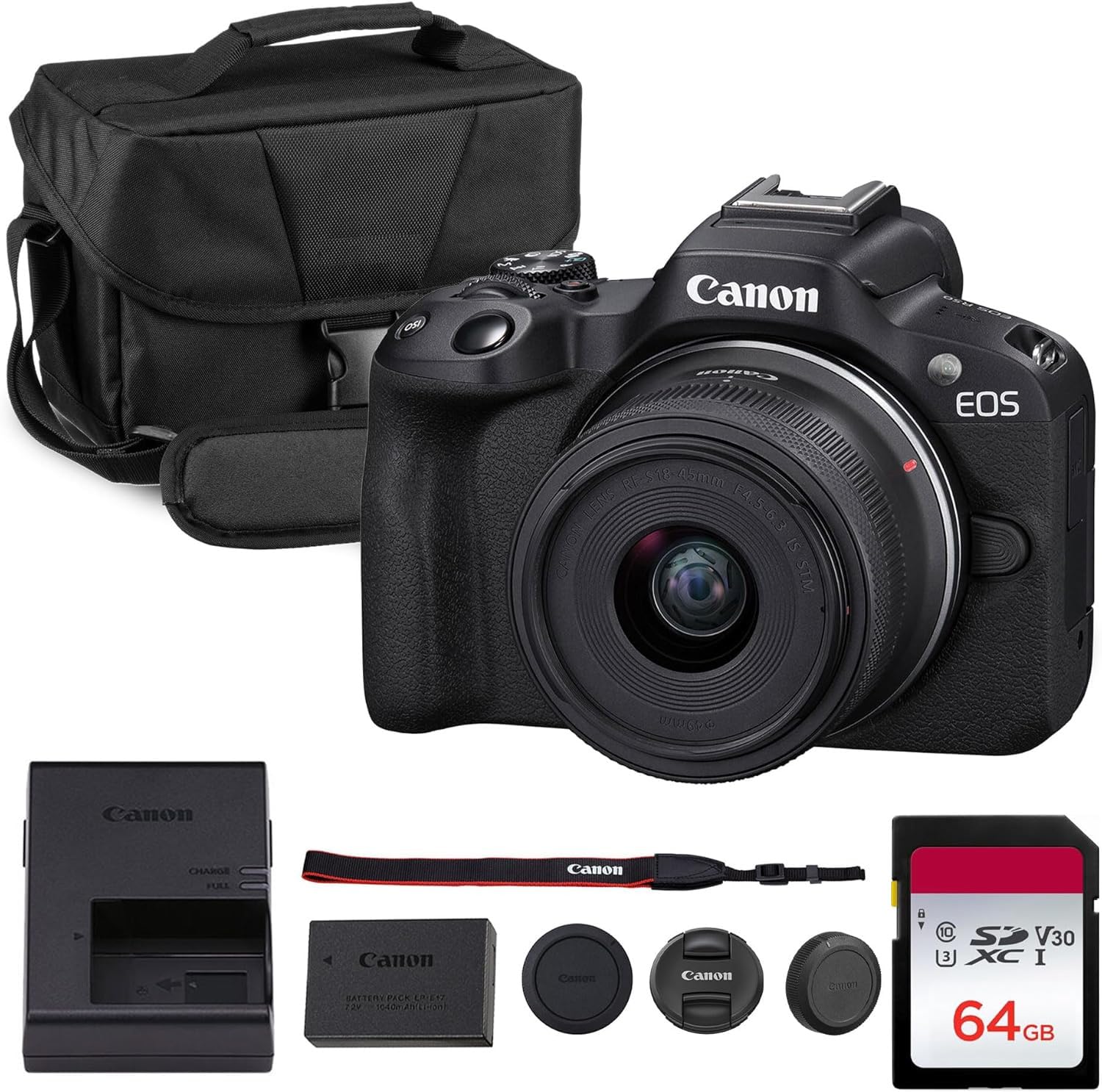
The Canon EOS R50 is arguably the most beginner-friendly camera designed with the modern content creator in mind. It doesn’t just capture photos and video; it guides you through the process. Features like Creative Assist provide in-camera explanations and guides, demystifying settings and helping you learn as you create, which is invaluable for those new to interchangeable lens cameras.
For vertical video, it has social-ready tools baked in, making it simple to shoot and share content formatted for platforms like TikTok and Instagram Reels. Its oversampled 4K video is sharp, and Canon’s reliable Dual Pixel CMOS AF II ensures subjects stay in focus. The included versatile 18-45mm RF-S lens covers a useful range for daily content, from vlogs to portraits.
Lightweight and easy to use, the R50 removes technical barriers, allowing new creators to focus on storytelling. It’s a fantastic entry point into the Canon RF ecosystem, offering a clear growth path as skills advance, all at a mid-range price point that includes a lens and useful accessories.
Why it’s great
- In-camera guides (Creative Assist) are excellent for learning.
- Built-in tools simplify shooting and sharing vertical video.
- Lightweight, compact, and very easy to start using immediately.
- Reliable Dual Pixel autofocus and good 4K video quality.
Good to know
- The kit lens has a variable, slower aperture, limiting low-light performance.
- Lacks in-body image stabilization (IBIS), relying on lens IS or a gimbal for smooth video.
- A more entry-level build quality compared to higher-end models.
6. Panasonic LUMIX S5II Mirrorless Camera
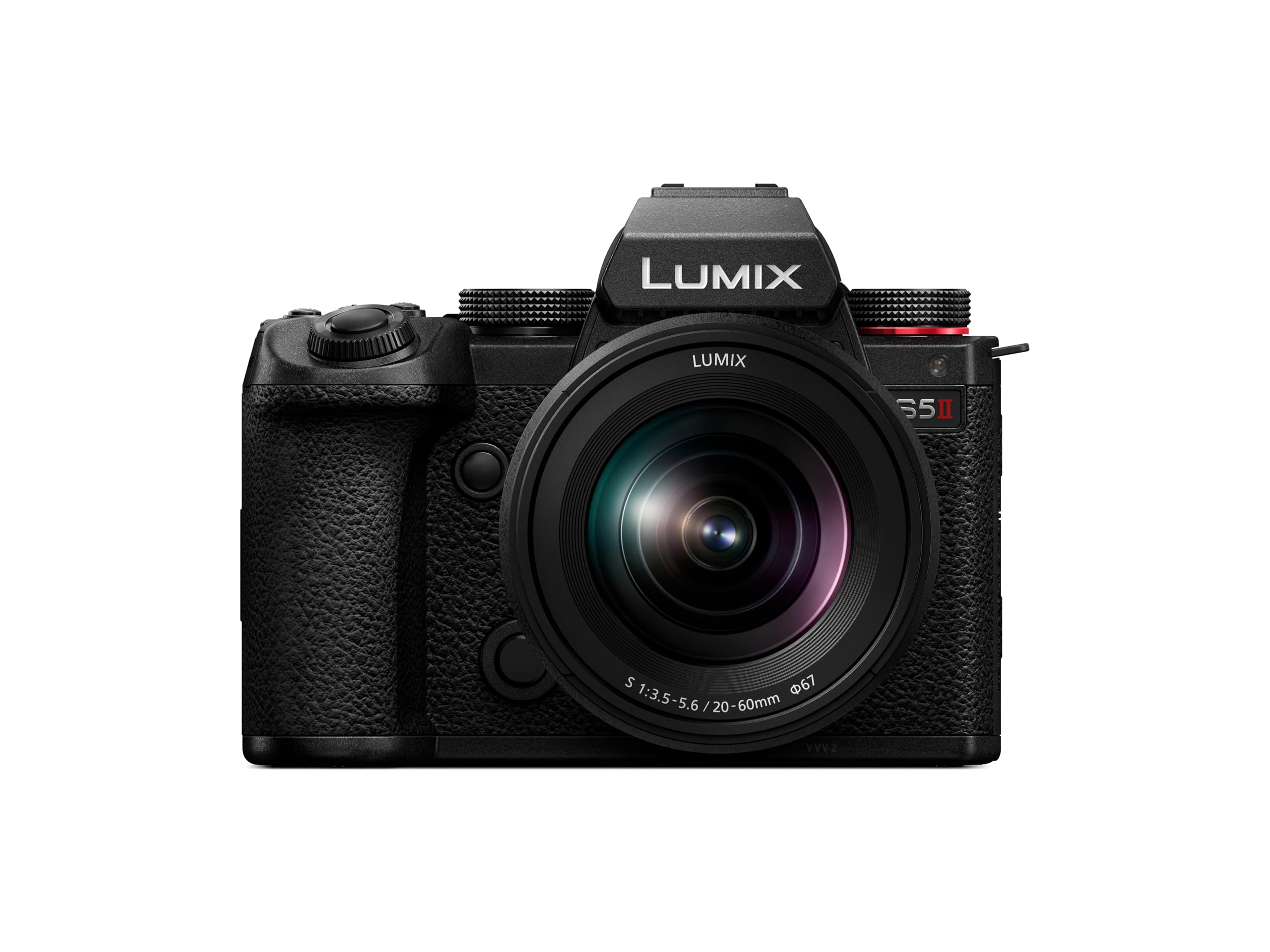
The Panasonic LUMIX S5II is a full-frame game-changer, finally combining Panasonic’s renowned video color science and stabilization with a fast, reliable Phase Hybrid Autofocus system. This addresses the single biggest historic concern for Panasonic users and makes it a formidable tool for dynamic vertical video where precise focus is non-negotiable.
Its video capabilities are outstanding for a camera in this form factor, offering unlimited 6K 30p open-gate recording (perfect for flexible cropping to vertical) and 4K 60p, all in 10-bit 4:2:2 color. The new Active I.S. technology is specifically optimized for stabilizing walking shots, a common scenario for vertical content creators. The inclusion of a fan allows for these demanding recordings without overheating.
This is a premium, professional-grade tool that delivers cinema-level features in a relatively compact body. It’s for the creator who wants full-frame image quality, incredible dynamic range from V-Log, and robust autofocus in a package that still pairs well with a capable gimbal.
Why it’s great
- Excellent Phase Hybrid Autofocus combined with pro video features.
- Active I.S. provides superb stabilization for handheld walking videos.
- Unlimited recording and open-gate 6K for flexible framing.
- Full-frame sensor with superb color science and dynamic range.
Good to know
- A significant premium investment.
- Battery life can be a constraint during long video sessions; a grip is recommended.
- The full-frame system inherently means larger, often more expensive lenses.
7. FeiyuTech SCORP-C2 AI Tracking Gimbal
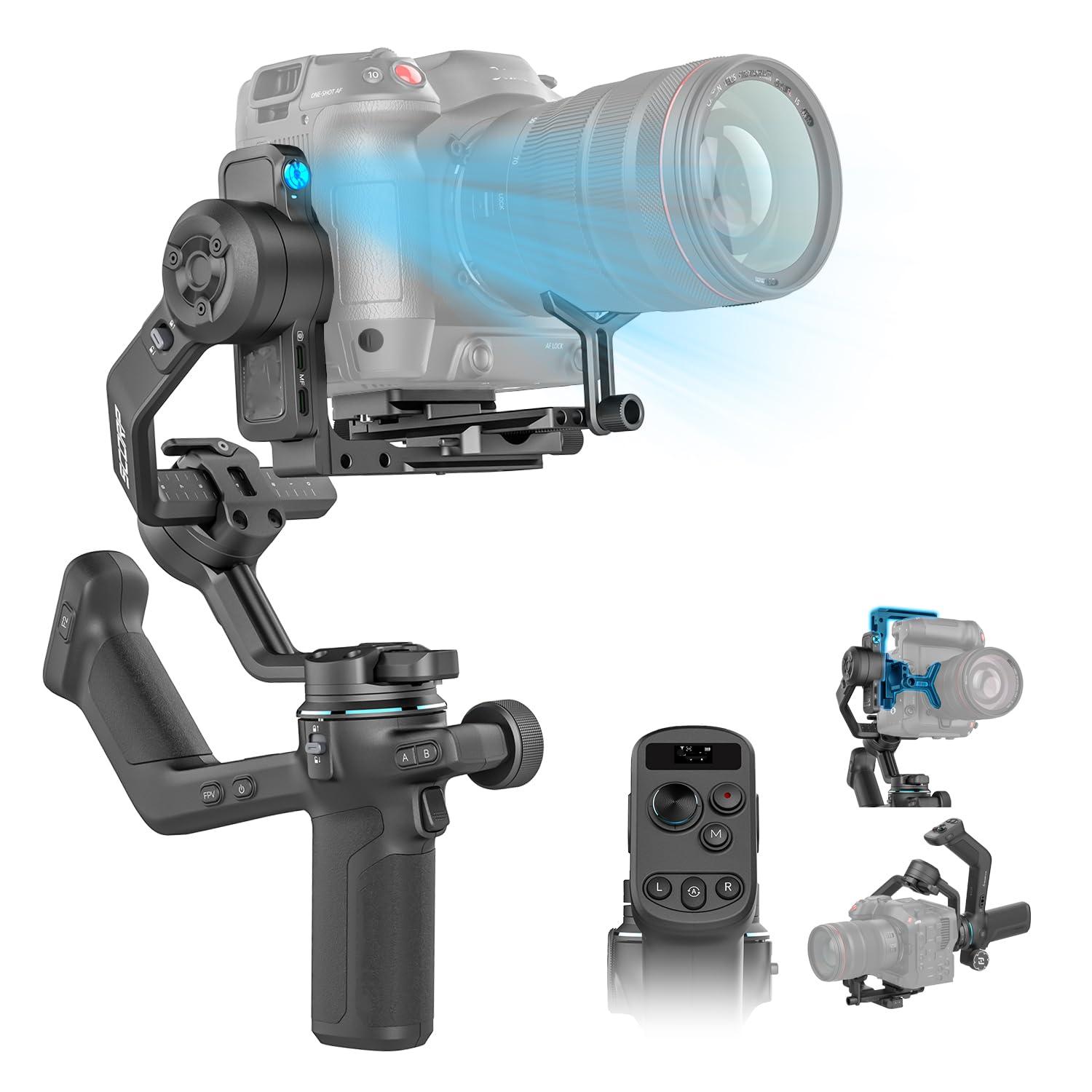
The FeiyuTech SCORP-C2 is the muscle car of this gimbal lineup, boasting an upgraded maximum payload of 7.72 lbs. This expanded capacity makes it compatible with heavier DSLR and full-frame mirrorless setups that would overwhelm smaller gimbals. If your camera kit is on the larger side, this model provides the necessary strength without jumping to a much more expensive professional rig.
It retains the valuable built-in AI tracking sensor found in the SCORP 2, enabling gesture-controlled subject tracking—a huge benefit when handling a larger setup solo. The integrated handle grip and upgraded OLED display contribute to a more streamlined and informative user experience. The quick-release plate design is also improved for easier balancing of heavier cameras.
This gimbal fills a specific niche for creators with substantial gear. It offers a compelling set of smart features and high strength at a price point that sits between mid-range and premium, representing strong value for those who need its specific capabilities.
Why it’s great
- High payload capacity handles DSLRs and heavy mirrorless combos.
- Built-in AI tracking eliminates the need for extra accessories.
- Sturdy, integrated handle design and clear OLED screen.
- Strong value for the level of power and features offered.
Good to know
- Heavier and bulkier than gimbals designed for mirrorless cameras.
- Balancing a heavy setup can be more fiddly and time-consuming.
- The app interface and some controls have a learning curve.
8. Sony Alpha a6400 Mirrorless Camera

The Sony a6400 remains a cornerstone in the creator camera world thanks to its proven and highly reliable Real-time Eye Autofocus and Tracking. This system, while preceding the newer AI processors, is exceptionally fast and accurate for both human and animal subjects, making it a trusted tool for vloggers and content creators who need to stay in sharp focus.
Its compact APS-C form factor is ideal for gimbal use, and its 4K video quality is excellent. The flip-up 180-degree screen is designed perfectly for solo creators to monitor themselves while filming. While it lacks in-body stabilization, this makes pairing it with a gimbal like the DJI RS 3 Mini almost a necessity for smooth vertical video, resulting in a fantastic combined system.
As a renewed or used option, the a6400 can offer tremendous value, providing professional-grade autofocus performance at a more accessible point. It’s a workhorse that has earned its reputation through consistent, dependable performance.
Why it’s great
- Extremely reliable and fast Real-time Eye AF and tracking.
- Compact, lightweight body perfect for gimbal mounting.
- Flip-up screen is ideal for framing yourself while recording.
- Can be a great value, especially when found renewed.
Good to know
- Lacks in-body image stabilization (IBIS).
- Battery life is mediocre, so spare batteries are essential.
- The flip-up screen can be blocked by a microphone mounted on the hot shoe.
9. Panasonic LUMIX G85 Mirrorless Camera

The Panasonic LUMIX G85 is a standout budget-friendly option that delivers a feature set often missing in its price range: in-body 5-axis image stabilization combined with lens-based OIS for effective Dual I.S. This means you can capture noticeably smoother handheld video right out of the box, which is a massive advantage for vertical shooting before you even add a gimbal.
It shoots 4K video and includes helpful features like 4K Photo modes for extracting high-quality stills from video. The included 12-60mm lens provides a versatile 24-120mm full-frame equivalent range, perfect for everything from wide vlogging shots to closer portraits. The body is also weather-sealed, adding a layer of durability for outdoor creators.
While its contrast-detect autofocus isn’t as snappy as modern phase-detect systems, especially in low light, its stellar stabilization and video quality make it an incredible value proposition for creators on a tight budget who prioritize smooth footage.
Why it’s great
- Excellent 5-axis in-body stabilization combined with lens OIS.
- Great value, offering 4K video and weather sealing.
- Versatile kit lens covers a wide range of focal lengths.
- Articulating touchscreen is useful for various angles.
Good to know
- Autofocus (especially in video) can hunt in low-light situations.
- Smaller Micro Four Thirds sensor compared toAPS-C alternatives.
- No headphone jack for audio monitoring.
10. Canon EOS M50 Mirrorless Camera (Renewed)

The Canon EOS M50, especially in its renewed form, represents a compelling entry point for budget-conscious creators looking to step up from smartphone video. It packs a 24.1MP APS-C sensor and Canon’s excellent Dual Pixel CMOS AF with Eye Detection, providing focus performance that far exceeds its price class for photos and HD video.
It does shoot 4K video, though with a significant crop and without Dual Pixel AF in that mode, making it less ideal for 4K vlogging. For Full HD and slow-motion HD (120p), however, it’s a very capable performer. Its compact size and flip-out touchscreen make it user-friendly, and the EF-M lens system, while not as expansive as RF, has some excellent compact lenses.
As a renewed product, it offers the core technology of a capable beginner camera at a significantly more accessible point. It’s a smart choice for someone who wants to learn the basics of interchangeable lens cameras and produce solid vertical video for social media, with the understanding that its 4K has limitations.
Why it’s great
- Excellent Dual Pixel AF performance in HD and for photos.
- Compact, lightweight body with a fully articulating touchscreen.
- Renewed models offer substantial savings for a proven camera.
- Good image quality from its APS-C sensor.
Good to know
- 4K video mode has a heavy crop and uses slower contrast-detect AF.
- Digital stabilization only; lacks in-body or gimbal-level smoothness.
- The EF-M lens mount is not being actively developed by Canon.
11. Nikon Z 7II Mirrorless Camera

The Nikon Z 7II is a premium full-frame camera built for photographers and hybrid shooters who demand ultra-high resolution. Its 45.7MP sensor captures stunning detail, making it ideal for creators who want to crop into their vertical videos or pull high-quality stills from their footage without compromising quality.
For vertical video work, its compatibility with a dedicated vertical battery grip is a significant ergonomic advantage, providing a more natural and stable hold when shooting in portrait orientation for extended periods. It offers 4K UHD 60p video and robust in-body image stabilization to smooth out handheld shots. The dual card slots offer reliability for important shoots.
This camera sits at the premium end of the spectrum and is best suited for creators whose work heavily prioritizes breathtaking still photography alongside very competent video. It’s a tool for those who need the absolute best image quality and are building a professional kit around the Nikon Z lens ecosystem.
Why it’s great
- Exceptional 45.7MP resolution for cropping and detail.
- Vertical grip compatibility improves portrait-mode ergonomics.
- Robust build quality, dual card slots, and effective IBIS.
- Excellent color science and dynamic range.
Good to know
- A premium investment focused on high-resolution stills.
- Autofocus, while good, may not match the tracking speed of Sony or Canon’s latest.
- Battery life can be a consideration for long video recording sessions.
Understanding the Specs
Payload (Gimbals)
This is the maximum weight a gimbal’s motors can effectively stabilize. It’s critical to add your camera body and heaviest lens weight, then choose a gimbal with a payload at least 20-30% higher for optimal performance and battery life. Underloading can cause jitters, while overloading will fail.
Sensor Size (Cameras)
Larger sensors (Full-Frame, APS-C) generally provide better low-light performance and shallower depth of field. For vertical video, a larger sensor also means more resolution when you crop to a 9:16 aspect ratio, preserving video quality. Micro Four Thirds sensors offer a size/weight advantage and great stabilization.
Stabilization Type
Gimbal (3-Axis): Mechanical stabilization for ultra-smooth motion, best for walking shots and dynamic movement. IBIS (In-Body): Sensor-shift stabilization inside the camera, good for static or slow-moving handheld shots. OIS (Optical): Stabilization within the lens. Combining IBIS and OIS (Dual I.S.) often yields the best handheld results.
Native Vertical Shooting
A gimbal feature where you physically mount the camera on a vertical arm. This uses the sensor’s full width to capture vertical video, offering the highest possible quality and stability. It’s superior to cropping horizontal video later, which reduces resolution and can introduce unwanted rolling shutter effects.
FAQ
Do I need a gimbal if my camera has in-body stabilization?
What’s better for vertical video: cropping or native shooting?
Can I use any camera on a vertical video gimbal?
Is a full-frame camera necessary for vertical video?
Final Thoughts: The Verdict
For most people, the best camera for vertical video winner is the DJI RS 3 Mini because it delivers professional stabilization in an ultra-portable package, making exceptional vertical video accessible and sustainable for long shoots. If you want intelligent, hands-free tracking, grab the FeiyuTech SCORP 2. And for the beginner creator seeking an all-in-one guided experience, nothing beats the Canon EOS R50. Your choice ultimately hinges on pairing the right stabilizing force with a camera that fits your creative ambition.

Mo Maruf
I created WellFizz to bridge the gap between vague wellness advice and actionable solutions. My mission is simple: to decode the research and give you practical tools you can actually use.
Beyond the data, I am a passionate traveler. I believe that stepping away from the screen to explore new environments is essential for mental clarity and physical vitality.