Our readers keep the lights on and my smoothie glass nicely filled. As an Amazon Associate, I earn from qualifying purchases.
Specs are compiled from manufacturer listings and verified buyer reviews and can change over time — please confirm the key details on the product page before buying.
The hardest part about buying a camera for photos isn’t choosing between brands—it’s deciding which type of sensor and lens system actually matches how you shoot. A 30.4-megapixel full-frame DSLR can capture details a phone simply cannot, but a compact 60x zoom point-and-shoot gets you closer to a bird than any interchangeable lens ever will when you are on a hike. This guide walks you through eleven cameras that each solve a different real-world photography problem, from family portraits to wildlife trips, so you land on the one worth your money.
I’m Mohammad Maruf — the founder and writer behind WellFizz. This guide is built by comparing the manufacturers’ published specifications and the patterns across verified customer reviews, so you get each pick’s real strengths and trade-offs instead of marketing spin.
Whether you are stepping up from a smartphone or upgrading a pro kit, the best camera for photos is the one whose sensor size, autofocus speed, and lens range fit the subjects you actually shoot, not the specs you see in an ad.
Our Picks at a Glance

How To Choose The Best Camera For Photos
The real decisions come down to sensor size, autofocus capability, continuous shooting speed, and lens ecosystem compatibility.
Sensor Size: The Foundation of Image Quality
A full-frame sensor (roughly the size of a 35mm film frame) collects more light per pixel than the smaller APS-C or Micro Four Thirds sensors found in many beginner and compact models. A larger sensor collects more light, delivering cleaner low-light images and greater background blur control. If you shoot indoors, at dusk, or want creamy portrait bokeh, a full-frame camera is worth the money.
Autofocus Points and Technology
Autofocus points are tiny sensors that detect your subject and lock focus across the frame. More points with wider coverage let you track a running child or a flying bird across the frame. Phase-detection autofocus (the type in most DSLRs and mirrorless cameras today) is faster than contrast-detection because it measures distance directly. For action and wildlife, hundreds of phase-detection points with eye-tracking lock onto fast-moving subjects instantly. For still portraits and landscapes, a simpler system with nine or eleven points still works beautifully.
Continuous Shooting Speed (Frames Per Second)
Measured in frames per second (fps), this spec tells you how many photos the camera can capture in one second while holding the shutter button. A number like 3 fps is fine for posed pictures, but anything moving—kids, pets, sports—benefits from 6 fps or higher. The trade-off is that faster shooting fills your memory card and battery quicker, so consider how often you actually chase motion.
Quick Comparison
| Model | Best For | Sensor / Megapixels | Autofocus Points | Continuous Shooting | Amazon |
|---|---|---|---|---|---|
| Canon EOS 5D Mark IV★ Best Overall | Professional full-frame stills | Full-Frame 30.4MP | 61 | 7.0 fps | Amazon |
| Panasonic LUMIX FZ80DBest Value Superzoom | Wildlife zoom on a budget | 1/2.3″ 18.1MP | 39 | — | Amazon |
| Canon EOS Rebel T7 BundleTop Pick for Beginners | Beginner DSLR with accessories | APS-C 24.1MP | 9 | 3 fps | Amazon |
| Canon EOS R100 | Compact mirrorless for beginners | APS-C 24.1MP | 143 | 6.5 fps | Amazon |
| Nikon D3200 | Entry-level Nikon with Guide mode | DX 24.2MP | 11 | 4 fps | Amazon |
| Panasonic LUMIX TZ/ZS99 | Travel pocket zoom | 1/2.3″ (likely) 20.3MP | 19 | — | Amazon |
| OM SYSTEM Olympus E-M10 Mark IV | Stylish compact with stabilization | Micro Four Thirds 20.3MP | 121 | — | Amazon |
| Canon EOS RP Kit | Entry-level full-frame mirrorless | Full-Frame 26.2MP | — | — | Amazon |
| Sony Alpha a7 III | Full-frame hybrid king | Full-Frame 24.2MP | 693 | 10 fps | Amazon |
| Nikon D850 | Pro high-resolution DSLR | Full-Frame 45.7MP | 153 | 9 fps | Amazon |
| Sony Alpha 7 IV | Pro-level mirrorless for all-rounders | Full-Frame 33MP | 693 | — | Amazon |
In‑Depth Reviews
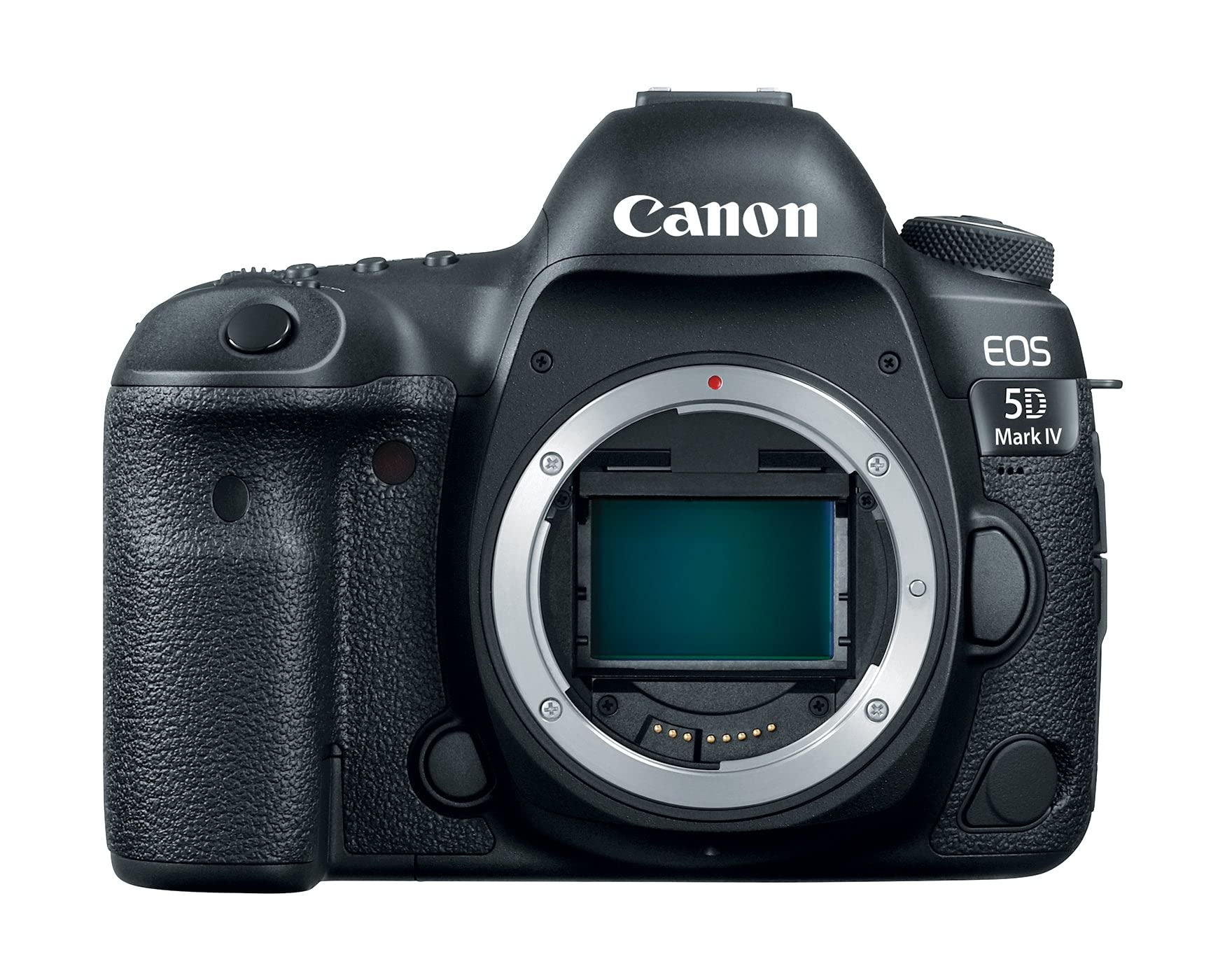
1. Canon EOS 5D Mark IV Digital SLR Camera (Body Only)
Our pick — over 4.5★ from 850+ verified ratings; the strongest balance of quality and price.
The 30.4-megapixel workhorse that pro wedding shooters trust for every job.
This is the camera that makes you feel like you can point it at anything and come away with a keeper. The full-frame CMOS sensor (30.4MP) and the DIGIC 6+ processor team up to deliver images you can crop aggressively or print large. The autofocus has 61 points—a 6.8x gap over the Rebel T7’s 9 points—and the Dual Pixel CMOS AF means focus in live view is just as snappy as through the optical viewfinder. Owners notice this immediately, describing the autofocus as flawlessly tracking moving subjects with servo mode.
Continuous shooting hits 7.0 fps, which is more than 2x faster than the Rebel T7’s 3 fps, so you can capture a sprinting dog or a bride’s bouquet toss without guessing the peak moment. The ISO range runs natively from 100 to 32000 and expands up to 102400. As buyers put it: “Dynamic range improved, close to Sony, still behind Nikon D810 but excellent low-light/high ISO performance.” The touchscreen is responsive, and built-in Wi-Fi lets you drop images to your phone via the Canon Camera Connect app quickly.
The honest trade-off is the fixed LCD. It does not tilt or flip out, so shooting from a low angle means lying on the ground or guessing the frame. The 4K video is Motion JPEG, which creates enormous files compared to modern codecs. But if your priority is still photography—portraits, landscapes, events—the Mark IV still feels like a professional tool that will not let you down years from now.
Why the pros reach for it
- Quality is the most-praised aspect in the reviews — over 75 owners call it out as exceptional.
- 61-point autofocus with Dual Pixel CMOS AF locks onto subjects fast and stays locked in servo mode.
- 7.0 fps continuous shooting handles action without the noise of a high-end sports body.
- 30.4MP full-frame sensor gives you room to crop while keeping detail intact.
The corner it cuts
- Fixed LCD screen makes low-angle and overhead shots a guessing game.
- 4K video uses Motion JPEG, creating massive file sizes that slow down editing.
- Heavier than mirrorless alternatives if you carry it all day.
The professional’s camera: If you shoot paid work, family events, or just want a body that can handle every scenario from a dimly lit church to a bright beach, this is the one to build your kit around.
Something to consider: If a tilting screen is non-negotiable for your shooting angles, the fixed display here might frustrate you on the daily — that is the single point where newer mirrorless bodies have moved ahead.
2. Panasonic LUMIX FZ80D Point and Shoot Digital Camera
A 60x optical zoom that reaches birds at a football field’s distance, all in one body.
This is the camera for the person who wants to photograph wildlife, moon craters, or a stage performer without spending thousands on a telephoto lens. The 60x optical zoom (20-1200mm equivalent) is the headline feature, and the POWER O.I.S. (Optical Image Stabilizer) works hard to keep those long shots steady despite hand shake. The 2,360K-dot electronic viewfinder (0.74x magnification) makes it usable even in bright sunlight where a rear LCD washes out.
The 18.1MP sensor is smaller than the 24.1MP on the Rebel T7—a 33% gap in resolution—so low-light detail is a trade-off. But the 4K Photo feature lets you pull an 8-megapixel still from a 4K video burst, which can save a shot when timing is everything. The Post Focus feature lets you choose your focus point after you snap the picture, a rare trick at this price. Owners who use it for bird identification report that the autofocus locks onto hawks in flight quickly, and the live viewfinder is “crucial in sunlight.” The recurring note is that noise and low-light quality hold it back.
Compared to the Nikon D3200 or the Canon R100, the FZ80D does not offer interchangeable lenses, so your zoom range is fixed. This is a specialist tool for reach, not for all-around low-light mastery.
For the reach-obsessed shooter: The 60x zoom and effective stabilization let you capture subjects that other cameras at this price cannot touch. Just know that after sunset, the smaller sensor means you will see grain earlier than you would on a DSLR or mirrorless camera.
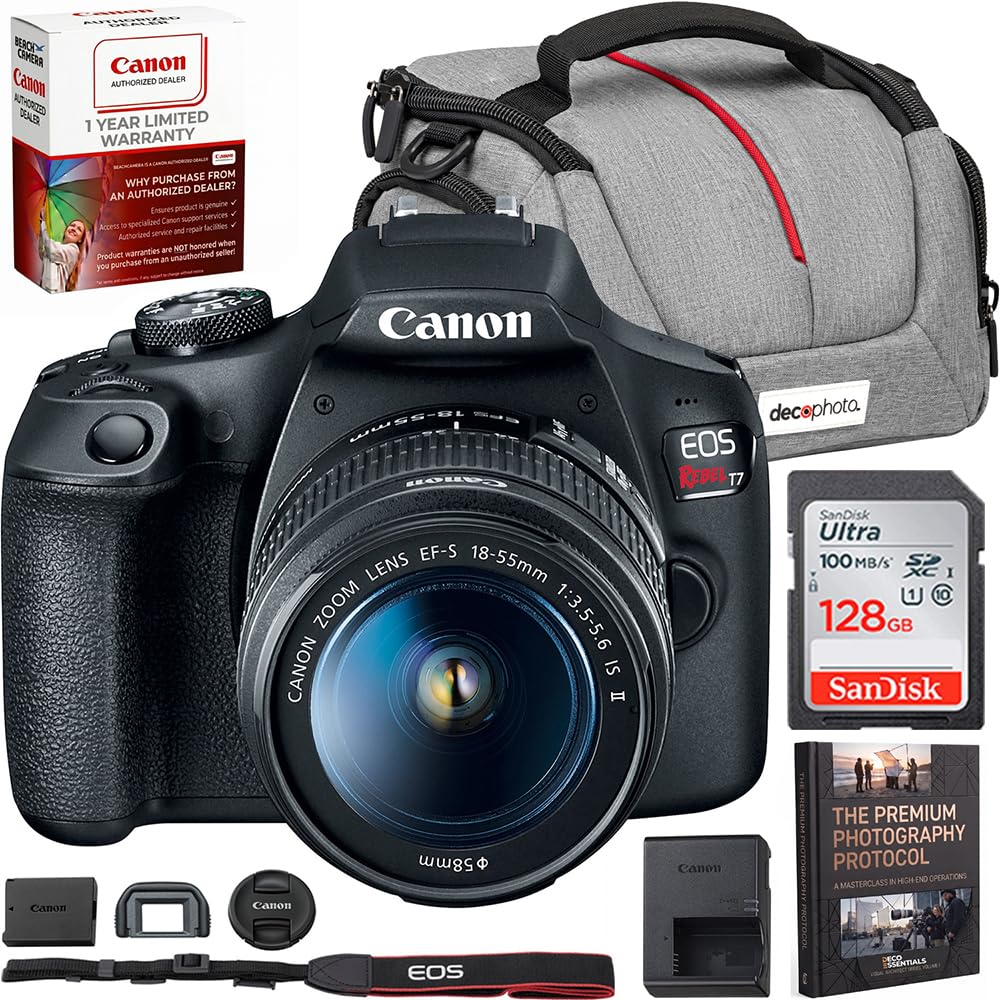
3. Canon EOS Rebel T7 DSLR Camera with 18-55mm Lens Bundle
The bundle that gives beginners everything they need to start shooting seriously.
If you are ready to move past your phone and learn the craft, this kit makes the transition nearly frictionless. The 24.1MP APS-C sensor and DIGIC 4+ processor capture vibrant, detailed images that look professional compared to a smartphone. The 9-point autofocus system with a center cross-type point is basic by pro standards, but for portraits and landscapes it locks on reliably. The Scene Intelligent Auto mode handles tricky lighting so you can concentrate on composition before diving into manual controls.
The bundle includes a 128GB SanDisk memory card and a padded camera bag, which removes the two most annoying post-purchase surprises. Built-in Wi-Fi and NFC connect to the Canon Camera Connect app so you can transfer pictures to your phone and share them instantly. The 3 fps continuous shooting speed is slow compared to the 7 fps of the 5D Mark IV—a 2.3x gap—but it is adequate for learning. What wins owners over is the value: quality is the top-cited aspect, and value for money runs a close second in the reviews.
The main caveat is the battery. A few buyers report that the included LP-E10 runs through its charge surprisingly fast, with one noting it drained after only eight photos on a full charge, which could be a defective unit rather than a pattern. The kit lens (18-55mm f/3.5-5.6) is a capable starter, but you will eventually want a faster prime for indoor shots. That said, this is the easiest way to get a real DSLR system in your hands with everything you need for day one.
The starter kit that actually delivers: The 24.1MP sensor produces photos that look fantastic on social media and prints, and the included 128GB card and bag mean zero extra shopping trips. The honest limit is the 3 fps burst — it will not catch a fast-moving toddler in perfect sequence every time.
4. Canon EOS R100 Mirrorless Camera with RF-S18-45mm Lens Kit

Canon’s smallest EOS R body with a 143-zone autofocus that punches above its price.
The R100 is the lightest and smallest camera in Canon’s mirrorless R series, which means it slips into a purse or small sling bag where the Rebel T7 would feel bulky. The 24.1MP APS-C sensor matches the Rebel T7’s resolution, but the autofocus is dramatically different: 143 AF zones with Dual Pixel CMOS AF that covers a wide area, plus human face and eye detection. That is over 15 times the autofocus coverage of the T7’s 9 points, so tracking a moving subject through the frame is much easier.
Continuous shooting hits 6.5 fps with One-Shot AF, more than double the T7’s 3 fps and nearly matching the 5D Mark IV’s 7 fps. The DIGIC 8 processor handles 4K video at up to 24 fps, though the 4K mode has a crop factor. The RF-S 18-45mm kit lens is compact and includes optical image stabilization at up to 4 stops of shake correction, meaning handheld shots at slower shutter speeds stay sharp. Owners love the “crisp” image quality and find the camera surprisingly powerful for its size.
The catch is battery life — owners note it can drain within a day of casual shooting, and Canon does not include a dedicated charger in the box (the battery charges inside the camera via USB). A few units have also reportedly stopped working, which is a reliability flag even if it is not a majority experience. For a beginner who values portability and modern autofocus over optical viewfinder tradition, this is the smarter choice than a bulkier DSLR.
Why it wins as a travel companion
- 143-zone Dual Pixel CMOS AF with eye detection tracks people and animals reliably.
- 6.5 fps burst is fast enough for kids and pets without the bulk of a pro body.
- Smallest and lightest EOS R body — genuinely easy to bring everywhere.
- RF lens mount opens a path to Canon’s excellent mirrorless glass lineup.
The trade-offs to know
- Battery life is modest; carry a spare or a USB power bank for a full day of shooting.
- No dedicated battery charger in the box — you charge via the camera itself.
- A small number of owners reported units that stopped working, creating a reliability concern worth noting.
A compact for the modern beginner: If you want the autofocus smarts and portability of a mirrorless system without spending premium money, the R100 delivers. Plan on buying a small spare battery and a USB charger adapter to avoid being caught flat.
5. Nikon D3200 24.2 MP CMOS Digital SLR with 18-55mm Lens

A 24.2MP Nikon with a built-in Guide mode that teaches you photography as you shoot.
For the person who wants to learn photography from the ground up, the D3200 includes a beginner-friendly Guide mode that walks you through settings instead of leaving you lost in menus. The 24.2MP DX-format CMOS sensor and EXPEED 3 processor deliver crisp, color-true images that hold up well against much newer cameras. The 11 AF points with 3D tracking are enough for portraits and casual action, and 4 fps continuous shooting is a step faster than the Rebel T7’s 3 fps.
The ISO range runs 100-6400 natively, expandable to 12800, which is competitive for low-light shooting at this tier. Owners consistently praise the fast shutter speed and impressive battery life, reporting 300-500 photos per event day without recharging. A nice touch is the twin IR remote receivers, so you can trigger the shutter from the front or back of the camera without buying an extra accessory. Full HD 1080p video at 24p is standard for the era.
The honest difference between the D3200 and the Canon R100 is autofocus technology — the D3200 has 11 phase-detection points while the R100 has 143 zones. The D3200 also lacks built-in Wi-Fi, so transferring photos to your phone requires a separate wireless module (sold separately). The viewfinder is on the small side, and the plastic body feels less premium than the metal-alloy builds of higher-end Nikons. But as a teaching tool that grows with you, it still holds up today.
For the learner who wants to understand exposure: Guide mode in the menus teaches you real photography concepts, and the sensor delivers excellent image quality for the price. The missing Wi-Fi is the single biggest inconvenience — you will need a card reader or the optional WU module to share pictures quickly.
6. Panasonic LUMIX TZ/ZS99 Point and Shoot Camera

A 24-720mm LEICA lens that folds down to pocket size for the traveler who refuses to miss a shot.
If your photography happens while you are on the move—city streets, concert crowds, mountain trails—the ZS99’s 30x optical zoom (24-720mm equivalent) is an incredible tool that fits in a jacket pocket. The LEICA DC lens is the same optics pedigree found in much more expensive cameras, and the 1,840k-dot tiltable touchscreen lets you compose from above your head or below your waist without lying on the ground. The 4K Photo mode captures bursts at 30 fps so you can extract the perfect 8-megapixel frame from a sequence.
The 30x zoom and 60x Intelligent Zoom beat the FZ80D’s 60x reach at full telephoto, but the 1/2.3-inch sensor is small — meaning image quality suffers in low light compared to the APS-C cameras in this guide. Image quality is the most-discussed aspect, and it is marked as MIXED by owners, with some calling the results poor in dim conditions. The autofocus uses a hybrid system with 19 points, which is fine for daytime landscapes but struggles for moving subjects at full zoom.
USB Type-C charging means you can top up from the same cable you use for your phone. Built-in Bluetooth v5.0 connects to the Panasonic Image App for quick transfers. The camera has no flash, so night shots rely on high ISO or a steady surface. This is a zoom-first tool for the traveler who prioritizes reach and pocketability over low-light mastery.
The right travel companion for daylight adventures: The 30x LEICA zoom and tiltable screen make it incredibly versatile for capturing scenes you cannot get with a phone. If your evenings involve anything dimmer than a street-lit square, the small sensor will push you toward grainy photos — that is the honest limit of the compact zoom formula.
7. OM SYSTEM Olympus E-M10 Mark IV Silver

A retro-styled body with 5-axis in-body stabilization that turns any lens into a low-light shooter.
The E-M10 Mark IV stands out because of the 5-axis in-body image stabilization (IBIS) that compensates for up to 4.5 shutter speed steps of shake. That means you can hand-hold a 1-second exposure and get a sharp image — something the larger-sensor cameras here would struggle with unless they had IBIS. The 20.3MP Micro Four Thirds sensor is smaller than APS-C, but the stabilization makes up for it in real-world handheld shooting. Owners confirm that the stabilization “eliminates the need for a tripod” in many situations.
The body is compact and lightweight—almost pocketable with the 14-42mm kit lens—and the flip-down monitor with a dedicated selfie mode is a clever touch. The 121 contrast-detection autofocus points are fast and accurate for most subjects, and the 16 Art Filters (including a new Instant Film effect) add a fun, creative layer. Quality is the top-cited positive aspect, with owners calling it a “solid device that takes great photos without much fuss.”
The catch is the Micro Four Thirds lens format — it has a 2x crop factor (a 14-42mm lens becomes a 28-84mm equivalent), so wide-angle shooting requires specific lenses. A small number of owners mention issues with the camera not recognizing the lens, which is a reliability flag. If you want a stylish, lightweight camera with stabilization that can shoot one-handed at night, this is a unique option in this list.
The compact that punches above its sensor size: The 5-axis stabilization is the real story here — it lets you shoot in conditions where larger cameras need a tripod. Just plan for the smaller sensor’s dynamic range limits in harsh contrast, and consider it a creative tool rather than a pixel-counting workhorse.
8. Canon EOS RP Full-Frame Mirrorless + RF24-105mm Lens Kit

The most affordable way to get a full-frame sensor and Canon’s RF lens mount in one kit.
The EOS RP is the gateway to full-frame photography without the traditional price penalty. The 26.2MP full-frame CMOS sensor gives you that shallow depth-of-field look and clean high-ISO performance that APS-C cameras like the R100 and Rebel T7 cannot quite match. The RF 24-105mm F4-7.1 IS STM kit lens includes up to 5 stops of optical image stabilization, so you can shoot handheld in dimmer conditions than the non-stabilized lenses on other kits.
The Dual Pixel CMOS AF is the same class-leading system from the 5D Mark IV, providing fast and smooth autofocus in both stills and video. The body is compact for a full-frame camera, and owners upgrading from older Canon DSLRs like the T3i report a noticeable jump in low-light capability and detail. The vari-angle touchscreen is a welcome upgrade over the 5D Mark IV’s fixed screen. Camera quality and image quality are the two top-cited positives, with buyers describing “stunning image quality” and praising the build.
Autofocus receives mixed feedback — some find it amazing, others report it is a bit slow to lock on. Battery life is also a mixed point, with some owners noting it runs short per charge compared to DSLR rivals. The kit lens is sharp in the center at f/8 and beyond but soft at the edges wide open. For someone who wants the full-frame look for portraits or travel and plans to eventually invest in higher-end RF glass, this is the smart entry point.
The full-frame starting line: The 26.2MP sensor and Dual Pixel AF deliver pro-level image quality in a light body. The standard advice from owners is to budget for a spare battery and plan for a faster prime lens if you shoot indoors often.
9. Sony Alpha a7 III Mirrorless Camera with 28-70mm Lens

The 24.2MP full-frame mirrorless that redefined what an all-rounder could do.
The a7 III remains the benchmark for a reason. The 24.2MP back-illuminated full-frame sensor has 15-stop dynamic range and 14-bit uncompressed RAW files, meaning you can pull shadow detail out of near-darkness without banding. The 693 phase-detection autofocus points cover 93% of the frame, and the Real-time Eye AF for humans and animals is famous for locking onto an eye and staying there even as the subject turns. Combined with 10 fps continuous shooting with AE/AF tracking, this camera captures action that stuns owners.
The 5-axis in-body image stabilization works with any lens you mount, including vintage glass via an adapter. The ISO range stretches from 50 all the way to 204,800, and buyers consistently report that low-light performance is “great” and “perfect for photography.” The kicker is the battery life — the NP-FZ100 battery lasts long enough that many owners say a spare is unnecessary for a day of non-pro shooting. Image quality is the top-cited positive by a wide margin, with over 80 owners singling it out.
The menu system is the recurring frustration — Sony’s menus are dense and not the most intuitive. The kit 28-70mm lens is decent but does not let the sensor show its full potential; most owners recommend upgrading to a faster prime or zoom. If you want a single camera that does portraits, landscapes, sports, and video well, this is still the crowd favorite after years on the market.
Why it still leads the mid-range mirrorless pack
- 693 phase-detection AF points with 93% frame coverage — the best in its class for tracking moving subjects.
- 10 fps continuous shooting with no blackout is ideal for sports and wildlife.
- 15-stop dynamic range and high ISO performance that owners call “incredible.”
- Battery life is excellent; most owners do not need a spare for day trips.
Where it shows its age
- Sony’s menu system is intentionally complex and takes time to learn.
- The included 28-70mm kit lens is mediocre for the sensor’s capability.
- 4K video has a crop factor in some modes, though most buyers here prioritize stills.
The all-arounder for serious enthusiasts: If you shoot a mix of portraits, landscapes, and action and want the best autofocus and dynamic range in the sub- mirrorless world, the a7 III is still the safe bet. The menu is the only real barrier — spend an hour with it and you are set.
10. Nikon D850 FX-Format Digital SLR Camera Body

A 45.7-megapixel full-frame DSLR that rivals medium format for resolution without sacrificing speed.
The D850 is a camera for the photographer who demands the highest possible detail — think studio portraits, landscape prints that cover a wall, or commercial work where every pore of a product needs to be visible. The back-illuminated (BSI) full-frame sensor has no optical low-pass filter, which means it resolves maximum sharpness without the risk of moiré patterns. The 153-point autofocus system is one of the best ever put in a DSLR, and the 9 fps continuous shooting at full resolution with full AF performance is astonishing for a 45.7MP body.
Image quality is the single most-cited positive by a landslide — over 140 owners call it out, often using words like “shockingly good” and “studio-quality.” The ISO 64 native setting gives cleaner files than most cameras can manage at ISO 100. The tilting touchscreen and focus shift shooting mode make it easy to do focus stacking for macro and product work without buying extra gear. The 8K and 4K time-lapse movies are a bonus for those who want video flexibility.
The weight is the first thing you notice — this is a heavy camera, especially compared to mirrorless alternatives like the Sony a7R series. The video autofocus is poor by modern mirrorless standards, and the Snapbridge Wi-Fi setup is cumbersome per owners. The D850 is not for beginners; it chews through memory with 45.7MP files and demands high-end glass to show its full potential. For the professional who needs resolution and build toughness, it is still considered one of the best DSLRs ever made.
The detail monster for professionals: The 45.7MP sensor and 153-point AF make this the definitive tool for commercial and landscape work. The honest burden is file size and weight — you need fast cards, big hard drives, and comfortable straps to use it daily.
11. Sony Alpha 7 IV Full-frame Mirrorless Interchangeable Lens Camera

A 33MP full-frame sensor with Sony’s latest processor that does everything from portraits to 4K video.
The a7 IV takes the formula of the a7 III and refines it with a higher-resolution 33MP sensor, the next-generation BIONZ XR processor, and improved codecs for video. The 693 phase-detection points and 425 contrast-detection points cover the frame with the same impressive speed as the a7 III, but the real-world tracking accuracy for human eyes and animals feels more sticky and reliable. The 7K oversampling for 4K 30p means the video downscales from more than enough pixels to create incredibly sharp footage with no pixel binning.
The 33MP resolution is a balance — more detail than the a7 III’s 24.2MP for cropping, but smaller files than the D850’s 45.7MP, which keeps storage manageable. The S-Cinetone color profile borrowed from Sony’s cinema cameras gives video a filmic look straight out of the camera. Owners consistently praise the image quality, fast autofocus, and “amazing customization options.” The build quality is excellent, and the dual card slots (CFexpress Type A and SDXC) give professionals flexibility.
The battery life meets expectations but does not match the a7 III’s legendary endurance. A small number of customers note performance issues with the camera freezing, though this is not a majority experience. The 4K 60p mode has a slight crop factor, which matters if you shoot a lot of video at that frame rate. For the photographer who wants a modern, high-resolution body that also excels at video, the a7 IV is the most balanced hybrid on this list.
What makes it a modern hybrid leader
- 33MP full-frame sensor with 7K oversampled 4K video that looks stunning.
- 693-point AF with reliable eye tracking for humans and animals.
- Dual card slots (CFexpress Type A SDXC) for professional workflow.
- S-Cinetone color profile delivers cinematic video without grading.
The compromises in an already-great body
- Battery life is good but not the class leader like the a7 III.
- 4K 60p video has a crop factor that changes your lens reach.
- A small share of reviewers point out occasional freezing — worth firmware checking.
The refined all-rounder for hybrid shooters: The 33MP resolution hits the balance for both photo detail and video flexibility. If you shoot equal parts stills and video and want the best Sony build today, this is the natural upgrade over the a7 III.
Understanding the Specs
Full-Frame vs Crop Sensor
A full-frame sensor is roughly the size of a 35mm film frame, which means each pixel on a full-frame sensor is physically larger than the pixels on a smaller APS-C or Micro Four Thirds sensor at the same megapixel count. Larger pixels capture more light, which gives you cleaner images in dim conditions and more control over the blurred background (bokeh) behind your subject. An APS-C sensor is smaller but still much larger than a smartphone sensor — it is a great middle ground for image quality, portability, and lens cost. The three sensor sizes you will see in this guide are full-frame (Canon 5D Mark IV, Sony a7 III, Nikon D850, Canon EOS RP, Sony a7 IV), APS-C (Canon Rebel T7, Canon R100, Nikon D3200), and Micro Four Thirds (OM SYSTEM E-M10 Mark IV).
Autofocus Points and Coverage
Autofocus points are the tiny sensors on the camera that detect contrast or phase difference to lock focus on your subject. More points generally mean wider coverage across the frame, so you can focus on a subject at the edge of the frame without recomposing. Phase-detection points (used in DSLRs and most mirrorless cameras) measure the distance to your subject directly and are faster than contrast-detection points (which hunt for contrast). The number of points varies hugely — the Nikon D3200 has 11 points, while the Sony a7 III has 693 points covering 93% of the frame. For portraits and landscapes, fewer points work fine. For sports and wildlife, a dense grid of phase-detection points with eye-tracking is a transformative upgrade.
FAQ
Is a full-frame camera worth it over APS-C for photos?
How many megapixels do I actually need for good photos?
Should I buy a DSLR or a mirrorless camera in 2025?
What does 60x optical zoom actually mean in real-world reach?
Can I use my old DSLR lenses on a newer mirrorless camera?
How does in-body image stabilization (IBIS) help my photos?
Is it better to buy a camera body only or with a kit lens?
How important is continuous shooting speed (fps) for photography?
What is the practical difference between 4K and Full HD video on a photo camera?
Final Thoughts: The Verdict
For the majority of shoppers, the camera for photos winner is the Canon EOS 5D Mark IV because its 30.4MP full-frame sensor, 61-point autofocus, and 7.0 fps shooting cover every scenario from portraits to action without a single weak link in still photography. If you want a modern hybrid with the best autofocus system and 10 fps burst, grab the Sony Alpha a7 III. And for the beginner who wants a complete kit with zero extra shopping, the Canon EOS Rebel T7 Bundle is the one to reach for. Every camera on this list earns its place by solving a specific real-world need — the right one for you is the one whose sensor size and lens compatibility match the photos you actually want to take.
How We Picked
We do not accept paid placement. Every pick is matched to a real buyer and a real use-case; we do not hands-on test units.
Sources & Methodology
Specifications: manufacturer listings and product documentation. Review insights: verified customer reviews, as of July 2026. Pricing: not shown on this page (it changes often); check the current price via the retailer link.
As an Amazon Associate, WellFizz earns from qualifying purchases. This does not affect which products we feature.
Related Guides

Mo Maruf
I created WellFizz to bridge the gap between vague wellness advice and actionable solutions. My mission is simple: to decode the research and give you practical tools you can actually use.
Beyond the data, I am a passionate traveler. I believe that stepping away from the screen to explore new environments is essential for mental clarity and physical vitality.