Our readers keep the lights on and my smoothie glass nicely filled. As an Amazon Associate, I earn from qualifying purchases.
Buying your first real camera on a limited budget means balancing sensor size, lens compatibility, and autofocus performance against the all-too-real risk of buyer’s remorse. The difference between a camera that holds you back and one that helps you grow often comes down to a handful of specs that aren’t on the front of the box.
I’m Mohammad Maruf — the founder and writer behind WellFizz. I’ve spent years analyzing sensor performance, stabilisation systems, and real-world image quality across dozens of models to help budget-conscious photographers make informed gear decisions.
Whether you are a beginner finding your feet or a shooter looking for a capable second body, the best camera for photography on a budget delivers sharp results without sacrificing the features that help you improve your craft.
How To Choose The Best Camera For Photography On A Budget
The budget camera market is crowded with tempting deals, but the cheapest body often leads to expensive compromises. Knowing which specs to prioritise keeps you from spending twice later.
Sensor size versus megapixel count
APS-C sensors strike the best balance between image quality and cost. A 24-megapixel APS-C sensor captures more light per pixel than a 20-megapixel Micro Four Thirds sensor, which means cleaner images in dim conditions. Ignore the megapixel race — anything above 16MP is enough for large prints.
In-Body Image Stabilisation (IBIS) changes everything
IBIS lets you hand-hold at shutter speeds two to four stops slower than you normally could. This is critical for budget shooters who can’t afford fast prime lenses. Without IBIS, a 50mm f/1.8 lens becomes much harder to use in low light.
Autofocus point coverage and subject tracking
A camera with 49 or more autofocus points and face/eye detection makes capturing sharp shots of moving subjects far easier. Older 9-point systems require you to focus and recompose, which is slow and often misses the moment. Look for hybrid or phase-detect systems that cover most of the frame.
Lens ecosystem and upgrade path
A budget camera body is a temporary home. The lenses you buy now should work on your next body. Canon’s RF-S mount, Sony’s E-mount, and Nikon’s Z-mount have thriving lens options from third-party manufacturers like Sigma and Tamron. Proprietary mounts with limited lens support can become dead ends.
Quick Comparison
On smaller screens, swipe sideways to see the full table.
| Model | Category | Best For | Key Spec | Amazon |
|---|---|---|---|---|
| Panasonic LUMIX G85 | Mirrorless | Stabilised handheld shots | 16MP Micro Four Thirds + IBIS | Amazon |
| Canon EOS R100 (Lens Kit) | Mirrorless | Entry-level RF system | 24.1MP APS-C + Dual Pixel AF | Amazon |
| Canon EOS M50 (Renewed) | Mirrorless | Compact vlogging and stills | 24.1MP APS-C + Eye AF | Amazon |
| Canon EOS R100 (Double Lens) | Mirrorless | Two-lens travel kit | 24.1MP APS-C + 143 AF zones | Amazon |
| Canon EOS Rebel T7 Bundle | DSLR | Big accessory kit bundle | 24.1MP APS-C + 9-point AF | Amazon |
| Nikon D3000 | DSLR | Extreme entry-level DSLR | 10.2MP DX + 11-point AF | Amazon |
| Sony Alpha ZV-E10 | Mirrorless | Vlog and hybrid shooting | 24.2MP APS-C + 425 AF points | Amazon |
| Canon EOS R100 Bundle | Mirrorless | Complete starter kit | 24.1MP APS-C + Dual Pixel AF | Amazon |
| Nikon Z50 II | Mirrorless | Subject tracking and presets | 20.9MP APS-C + 231 AF points | Amazon |
| Canon EOS RP | Full-Frame | Affordable full-frame entry | 26.2MP Full-Frame + Dual Pixel AF | Amazon |
| Canon EOS R8 | Full-Frame | Lightweight full-frame power | 24.2MP Full-Frame + 1053 AF zones | Amazon |
In‑Depth Reviews
1. Panasonic LUMIX G85

The G85 is the rare budget camera where the headline feature — five-axis in-body image stabilisation — actually transforms what you can shoot. Hand-holding a 60mm equivalent at 1/8th of a second and getting a sharp frame is not a gimmick; it’s a real advantage when you cannot afford a tripod or fast glass. The 16-megapixel Micro Four Thirds sensor lacks a low-pass filter, which gives it noticeably sharper fine detail than older 16MP sensors in the same class.
The magnesium-alloy body includes weather sealing, a feature usually reserved for cameras costing twice as much. The 12-60mm Power O.I.S. kit lens covers a useful range from wide-angle to short telephoto, and its optical stabilisation works in tandem with the IBIS for even smoother handheld video. Autofocus relies on contrast detection with 49 zones, which is reliable in good light but hunts noticeably in dim interiors during 4K recording.
Battery life is the main compromise — expect around 300 shots per charge, which is below average for the mid-range tier. The tilt-and-touch LCD is responsive for menu navigation and focus point selection. For photographers who shoot a mix of stills and video and want stabilisation above all else, the G85 remains a compelling choice years after launch.
Why it’s great
- Class-leading in-body image stabilisation works with any lens
- Weather-sealed magnesium body feels premium
- Sharp 16MP sensor with no low-pass filter
Good to know
- Autofocus hunts in low light during 4K video
- Below-average battery life for its class
- No headphone jack for video monitoring
2. Canon EOS R100

Canon’s smallest and lightest EOS R-series body packs a 24.1-megapixel APS-C sensor and the company’s excellent Dual Pixel CMOS AF into an entry-level body that weighs just over 350 grams with the kit lens. The 18-45mm retractable zoom is compact enough to slip into a jacket pocket, making this the most portable option among the mirrorless cameras reviewed here. The DIGIC 8 processor enables continuous shooting at 6.5 frames per second with One-Shot AF, enough for casual action and pet photography.
The autofocus system covers 143 zones with human face and eye detection, a feature set that used to be exclusive to much more expensive bodies. The menu system includes a beginner-friendly “Guide” mode that explains each setting in plain language. The lack of in-body stabilisation is the biggest omission — you will need stabilised lenses or a monopod for sharp shots in dim light at the long end of the zoom.
The fixed rear screen is a clear cost-saving measure; it does not tilt or articulate, which makes waist-level shooting and high-angle shots awkward. Video recording reaches 4K at 24 frames per second, with a noticeable crop factor. For photography-focused beginners who value modern autofocus and a tiny body, the R100 delivers where it counts.
Why it’s great
- Dual Pixel CMOS AF with face and eye detection
- Lightest body in the EOS R series
- High-quality 24.1MP APS-C sensor
Good to know
- No in-body image stabilisation
- Fixed, non-articulating LCD screen
- 4K video is cropped and limited to 24p
3. Canon EOS M50 (Renewed)

The M50 brought Dual Pixel CMOS AF to the EF-M mount and remains a popular choice for budget-conscious shooters even as Canon shifts its mirrorless focus to the RF system. The 24.1-megapixel APS-C sensor produces images that are nearly indistinguishable from Canon’s newer APS-C bodies in good light, and the Eye Detection AF works reliably for portrait work. The built-in OLED electronic viewfinder with 2.36 million dots provides a clear view for composing in bright sunlight.
The EF-M lens ecosystem is where the deal gets tricky. Canon has released only a handful of native EF-M lenses, and third-party support is limited. A simple adapter unlocks the massive library of Canon EF and EF-S lenses, but that adds bulk and cost. The 4K video mode is functional but introduces a heavy 1.6x crop and relies on contrast detection rather than Dual Pixel AF, making it less useful for serious videography.
Build quality feels solid for the price point, with a compact body that fits small hands well. The vari-angle touchscreen flips out to the side, which benefits vloggers and self-portrait shooters. For photographers willing to adapt lenses and accept the EF-M mount’s limited future, the renewed M50 delivers excellent autofocus and image quality at a sharp price.
Why it’s great
- Dual Pixel CMOS AF with Eye Detection
- Sharp 24.1MP APS-C sensor
- Compact size with vari-angle touchscreen
Good to know
- Limited native EF-M lens selection
- 4K video is heavily cropped
- Not weather-sealed
4. Canon EOS R100 (Double Lens Kit)
This bundle pairs the R100 body with both the 18-45mm standard zoom and the 55-210mm telephoto zoom, covering a full-frame equivalent range of roughly 29mm to 336mm. That single kit handles everything from wide landscapes to distant wildlife and compressed portraits without needing to buy another lens. The 24.1-megapixel APS-C sensor and DIGIC 8 processor deliver the same image quality as the single-lens R100 kit, with the same Dual Pixel CMOS AF spanning 143 zones.
The 55-210mm lens includes optical image stabilisation, which partially compensates for the body’s lack of IBIS when shooting at the long end. Continuous shooting reaches 6.5 frames per second in One-Shot AF, adequate for tracking a runner at a park. The body remains the smallest and lightest in the EOS R series, making the full kit easy to pack for trips where you want reach without carrying multiple heavy primes.
The fixed rear screen is the same limitation as the single-lens kit, and the 55-210mm’s variable aperture of f/5-7.1 means you need good light to keep shutter speeds high. For photographers who want a complete travel kit out of one box and value reach over low-light performance, this double-lens R100 bundle offers serious range at a low entry point.
Why it’s great
- Two-lens kit covers wide to telephoto range
- Telephoto lens has optical stabilisation
- Exceptional portability for the focal length range
Good to know
- Fixed, non-tilting LCD screen
- Telephoto lens is slow in low light
- No in-body image stabilisation in camera body
5. Canon EOS Rebel T7 Bundle
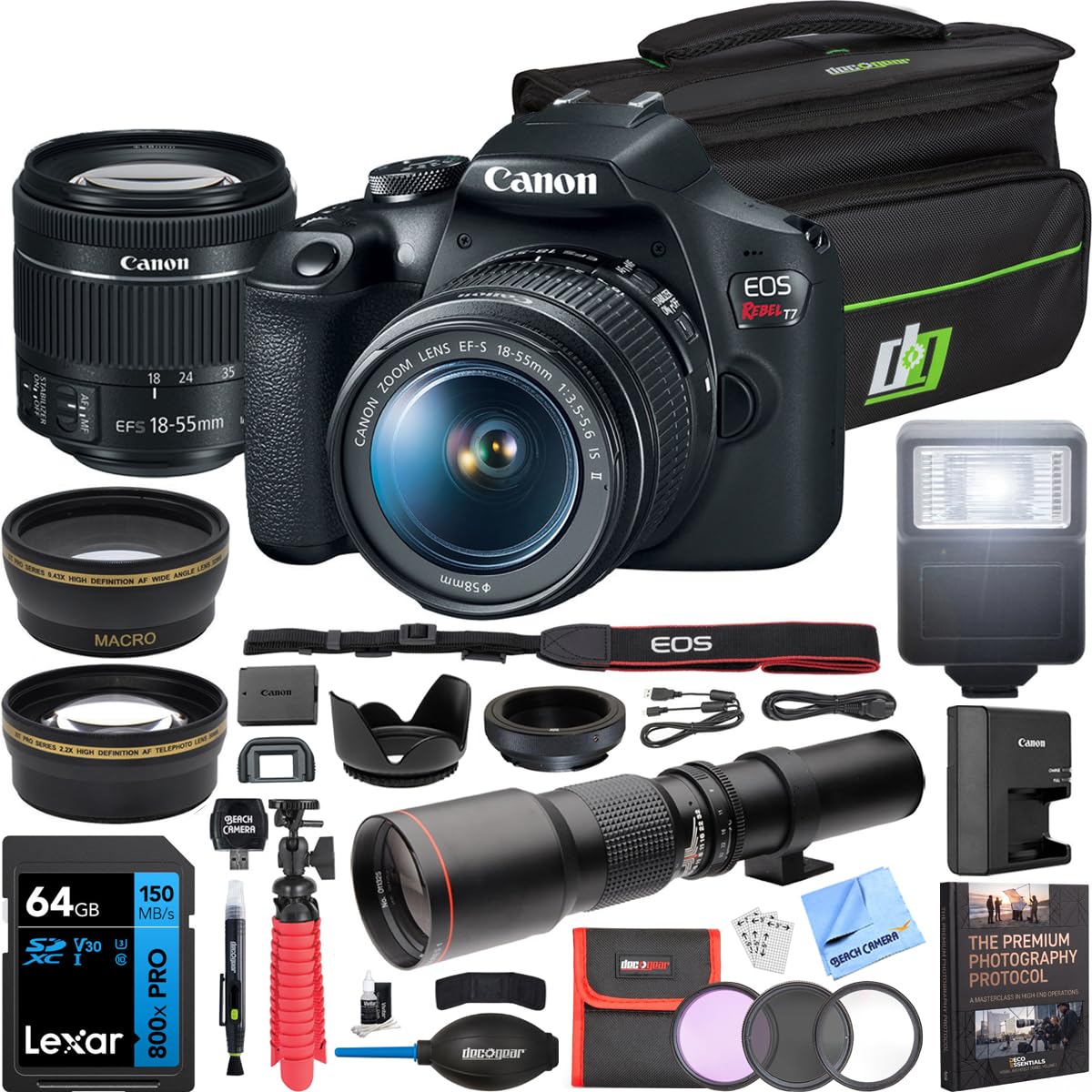
The Rebel T7 is Canon’s entry-level DSLR workhorse, and this bundle buries you in accessories: a 500mm preset telephoto lens, wide-angle and telephoto screw-on adapters, a hot-shoe flash, tripod, bag, 64GB memory card, and several filter types. The camera itself uses a 24.1-megapixel APS-C sensor paired with the aging DIGIC 4+ processor, which limits continuous shooting to just 3 frames per second and lacks modern features like touchscreen or 4K video with continuous autofocus.
The 9-point autofocus system feels dated after using any of the mirrorless options on this list. You will need to use the centre point and recompose for off-centre subjects, which slows down your workflow. The optical viewfinder offers 95% coverage, so the edges of your frame will appear slightly wider in the final image than what you saw while shooting. Full HD video at 1080p is usable for casual clips but lacks the resolution and detail of modern 4K cameras.
The accessory-quality telephoto and wide-angle converters add versatility but degrade image sharpness noticeably, especially at the edges. The included 500mm preset lens is fun for moon shots and distant wildlife but is soft wide open. For beginners who want a complete bundle to experiment with different types of photography right away, this kit provides the most gear per dollar, even if the accessories are budget-tier.
Why it’s great
- Massive 13-item accessory kit included in the box
- Canon EF/EF-S lens ecosystem with huge used market
- Simple DSLR ergonomics with optical viewfinder
Good to know
- 9-point AF system is slow by modern standards
- Battery drains quickly, some units report very short life
- Third-party accessories degrade image quality
6. Nikon D3000

The Nikon D3000 is a decade-old entry-level DSLR that still finds buyers because of its legendary build quality and the excellent Guide mode, which teaches aperture, shutter speed, and ISO through hands-on examples rather than a manual. The 10.2-megapixel DX-format sensor is low by modern standards, but for web sharing, social media, and prints up to 8×10 inches, it delivers enough resolution. The 18-55mm VR kit lens includes Nikon’s Vibration Reduction, providing about three stops of stabilisation for handheld shots.
The camera lacks live view, video recording, and any wireless connectivity. You compose entirely through the optical viewfinder, which forces you to learn exposure fundamentals rather than relying on an electronic preview. The 11-point autofocus system is basic but snappy in good light, and the 3-frame-per-second burst is enough for static subjects. The D3000 only autofocuses with AF-S lenses that have a built-in motor, which limits your used-lens options.
ISO performance tops out at 1600 and shows visible noise beyond 800, so this camera lives in well-lit scenes. The battery life is excellent, easily lasting 500 shots per charge because the camera is purely optical with no power-hungry EVF. For someone who wants to learn photography fundamentals without digital crutches and has a very tight budget, the D3000 is a functional, tank-like starting point.
Why it’s great
- Guide mode actively teaches photography basics
- Excellent battery life for long shooting days
- Very durable build quality
Good to know
- 10.2MP sensor is low resolution by current standards
- No live view or video capability at all
- Limited to AF-S lenses for autofocus
7. Sony Alpha ZV-E10
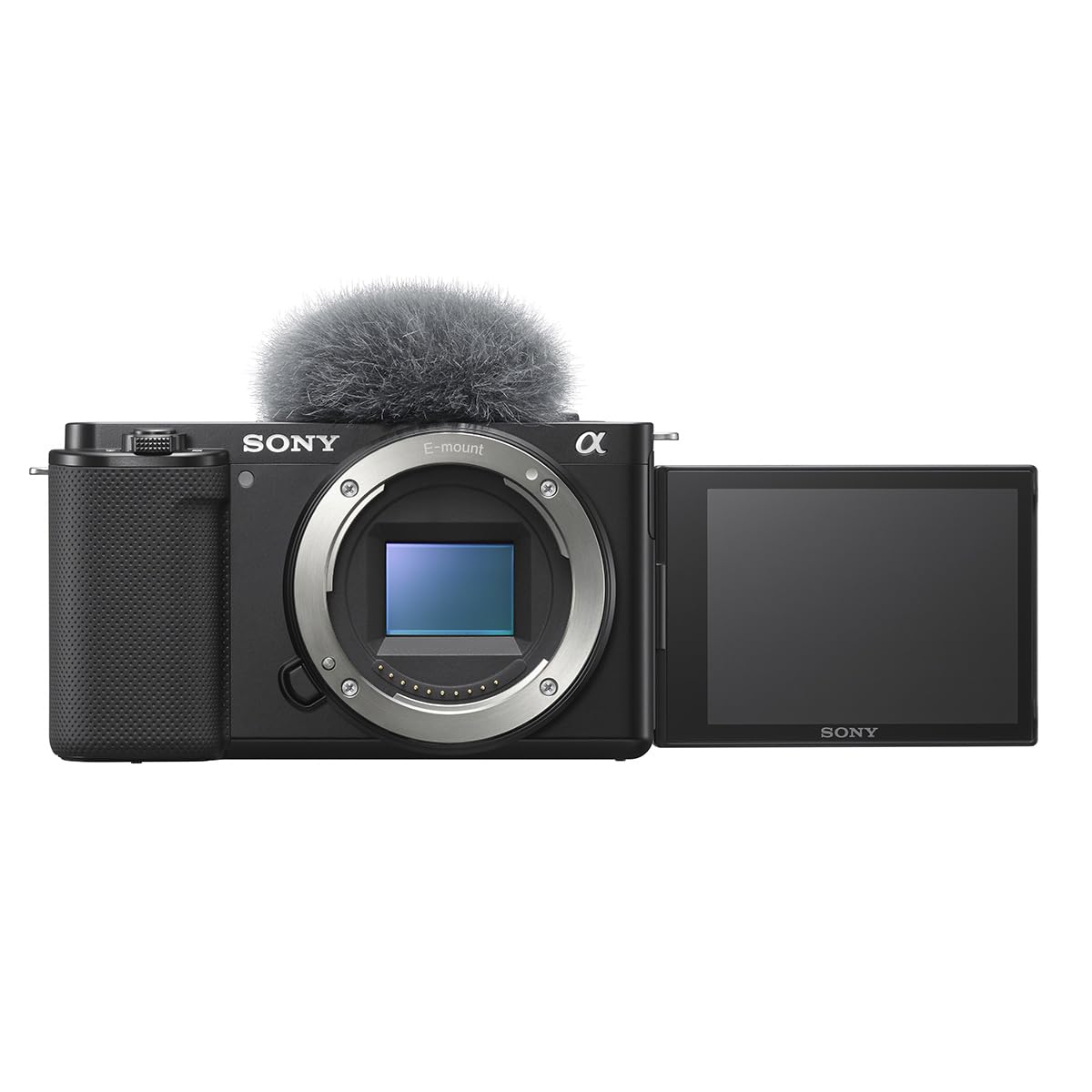
The ZV-E10 takes the 24.2-megapixel APS-C sensor from Sony’s a6000 series and wraps it in a body designed specifically for content creators. The 425 phase-detection autofocus points cover almost the entire frame, and Real-Time Eye AF for humans and animals works so reliably that you rarely need to touch the focus ring. The Product Showcase mode transitions focus smoothly from your face to an object held in front of the lens, which is a genuine time-saver for review and tutorial videos.
Video quality stands out: 4K is oversampled from 6K with full pixel readout and no pixel binning, delivering noticeably sharper footage than the cropped 4K from the Canon R100 or M50. The articulating screen flips out and rotates 270 degrees, and the built-in directional microphone with a windscreen captures better audio than any built-in mic on the other cameras here. The Background Defocus button instantly toggles the aperture to its widest setting for shallow depth of field.
The lack of in-body image stabilisation is the most serious compromise — you need stabilised lenses or a gimbal for smooth handheld video. The battery is rated for about 440 shots, and the small LCD with limited brightness makes outdoor framing difficult in strong sunlight. For hybrid shooters who prioritise video alongside photography, the ZV-E10’s autofocus and 4K quality set a high standard at a mid-range price.
Why it’s great
- 425-point phase-detection AF with Real-Time Eye Tracking
- 4K oversampled from 6K for exceptional detail
- Product Showcase mode and directional microphone
Good to know
- No in-body image stabilisation
- Average battery life for the class
- Small LCD is hard to see in bright sun
8. Canon EOS R100 Bundle (Bag & Card)
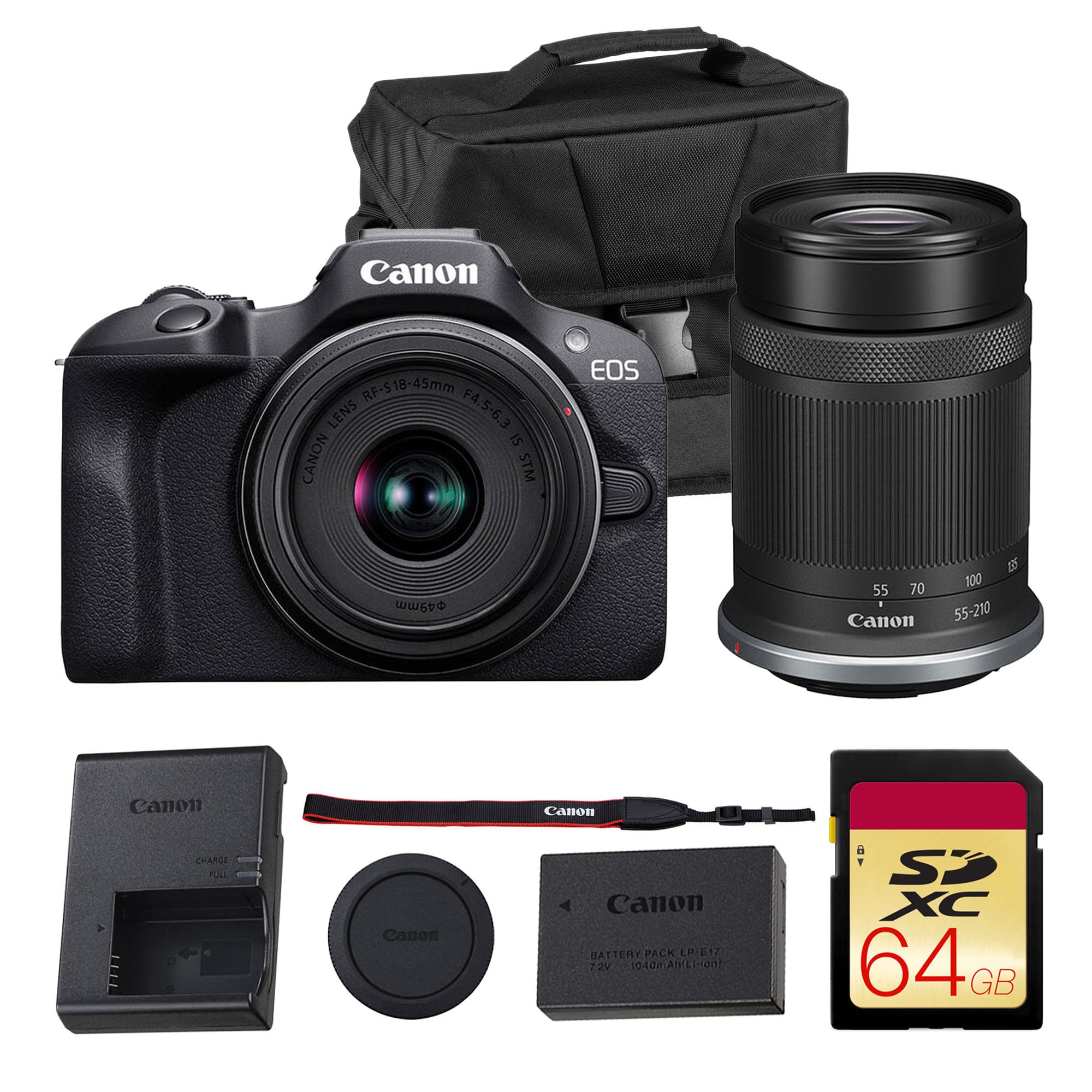
This bundle adds a shoulder bag and a 64GB memory card to the dual-lens R100 kit, making it a true grab-and-go package for beginners who do not want to shop for accessories separately. The camera and lens combination is identical to the double-lens R100 kit: the 24.1-megapixel APS-C sensor, DIGIC 8 processor, Dual Pixel CMOS AF with face and eye detection, and the same 18-45mm and 55-210mm lenses. Image quality and autofocus performance are identical to the standard dual-lens configuration.
The shoulder bag is a basic padded model that fits the camera with one lens attached and the second lens in a side pocket. It is not a rugged, all-weather bag, but it protects the gear during everyday carry and organised storage. The 64GB SD card provides enough space for about 3,000 JPEG fine images or roughly 40 minutes of 4K video, eliminating the need for an immediate accessory purchase after unboxing.
The R100’s fixed screen remains the main operational limitation, and the included bag takes up more space than a slim case. For first-time buyers who want everything in one shipment and value convenience above all, this bundle removes the friction of separate accessory purchases and delivers a capable two-lens kit from the moment the box opens.
Why it’s great
- Includes bag and memory card for out-of-box readiness
- Two-lens kit covers wide to telephoto
- Dual Pixel CMOS AF with subject detection
Good to know
- Fixed LCD screen limits shooting angles
- Bag is basic, not weather-resistant
- Camera body has no IBIS
9. Nikon Z50 II

The Z50 II is Nikon’s most compelling APS-C mirrorless body for budget shooters, using the same EXPEED 7 processor found in the flagship Z9 to drive a 20.9-megapixel DX-format sensor. The 231-point hybrid autofocus system detects and tracks nine subject types including birds, dogs, cats, vehicles, and airplanes with dedicated modes that improve accuracy. The Picture Control button gives you 31 built-in presets that apply colour and tone adjustments live, and you can download custom presets from Nikon Imaging Cloud directly to the camera.
4K video reaches 60p with full pixel readout, and in-camera 1080p slow motion at 120 frames per second is useful for dramatic clips. The built-in electronic VR stabilises handheld footage, though it is not as effective as mechanical IBIS. The body includes a built-in flash and an OLED viewfinder with 2.36 million dots. Nikon’s SnapBridge app transfers images to your phone automatically in the background, which is more reliable than most Wi-Fi implementations.
Battery life is rated at approximately 280 shots per charge, which is low even for the mirrorless category. There is only one SD card slot, and the camera lacks in-body sensor cleaning, meaning dust spots on the sensor require manual cleaning. For photographers who shoot wildlife, pets, or children and want Nikon’s advanced subject detection without paying full-frame prices, the Z50 II offers a focused set of high-end AF features.
Why it’s great
- EXPEED 7 processor with class-leading subject detection
- 31 built-in Picture Control presets for instant styles
- 4K 60p video with minimal crop
Good to know
- Below-average battery life
- Single SD card slot
- No in-body sensor cleaning
10. Canon EOS RP

The EOS RP is the cheapest way to enter Canon’s full-frame RF system, using a 26.2-megapixel sensor that delivers noticeably better dynamic range and high-ISO performance than any APS-C camera in this guide. The 24-105mm f/4-7.1 IS STM kit lens includes up to five stops of optical stabilisation, compensating for the body’s lack of IBIS. The Dual Pixel CMOS AF system works reliably for both stills and video, with eye detection that tracks subjects across most of the frame.
Build quality is solid and lightweight at just 485 grams for the body. The vari-angle touchscreen flips out for waist-level and high-angle compositions, and the electronic viewfinder shows 100% coverage with a 2.36-million-dot OLED panel. The RF lens mount gives you access to Canon’s growing native lens lineup as well as adapted EF and EF-S lenses, though EF-S lenses force an APS-C crop mode that reduces resolution to about 10 megapixels.
Video features are limited compared to the ZV-E10 or Z50 II — 4K recording is cropped to 1.6x and maxes out at 24p, with noticeable rolling shutter. The LP-E17 battery is the same small cell used in entry-level bodies, offering around 250 shots per charge. For photographers upgrading from a smartphone or an older DSLR who want full-frame image quality at the most affordable price point, the RP delivers a genuine sensor upgrade.
Why it’s great
- Full-frame sensor with excellent dynamic range
- Kit lens has 5-stop optical image stabilisation
- Lightest Canon full-frame body available
Good to know
- 4K video is cropped with rolling shutter issues
- Battery life is below average
- Kit lens is soft at the edges wide open
11. Canon EOS R8

The R8 is the budget-conscious photographer’s gateway to the same sensor and processor found in Canon’s professional R6 II. The 24.2-megapixel full-frame CMOS sensor coupled with the DIGIC X processor delivers uncropped 4K video at 60fps oversampled from 6K, and the Dual Pixel CMOS AF II system covers 1053 zones with subject detection for humans, animals, and vehicles including aircraft, trains, and horses. Rolling shutter is dramatically reduced compared to the RP.
The body weighs just 461 grams, making it the lightest full-frame camera in Canon’s current lineup. The 0.39-inch OLED EVF has a 120fps refresh rate and 2.36 million dots, providing a smooth, lag-free view for tracking fast action. The vari-angle LCD touchscreen with 1.62 million dots is sharp and responsive. The RF 24-50mm f/4.5-6.3 kit lens is compact and affordable but optically modest, with a narrow aperture that limits low-light performance.
Battery life is the most compromised aspect — the LP-E17 cell is rated for around 220 shots, which is the lowest of any camera reviewed here. The kit lens has a retracting mechanism that some reviewers find fragile, and the narrow f/stop range makes it unsuitable for dim interiors without a flash. For photographers who want full-frame image quality, fast and accurate autofocus, and advanced video features in the smallest possible package, the R8 is the most capable body in this price range.
Why it’s great
- Full-frame 24.2MP sensor with DIGIC X processor
- Uncropped 4K 60fps oversampled from 6K
- 1053 AF zones with deep learning subject detection
Good to know
- Battery life is very poor at ~220 shots
- Kit lens has narrow aperture and fragile mechanism
- Not weather-sealed
FAQ
Is a 16-megapixel sensor enough for printing large photos?
Why does the Nikon D3000 have no video mode?
Does in-body image stabilisation matter for photography?
Should I buy a kit lens or a body-only camera plus a prime lens?
How many autofocus points do I really need as a beginner?
Final Thoughts: The Verdict
For most users, the best camera for photography on a budget winner is the Panasonic LUMIX G85 because its five-axis in-body image stabilisation and weather-sealed body deliver real-world photographic advantages at a price point where few competitors offer either feature. If you want Canon’s excellent Dual Pixel CMOS AF and the smallest possible mirrorless body, grab the Canon EOS R100. And for full-frame image quality that unlocks better low-light performance and shallower depth of field, nothing beats the Canon EOS RP in this budget range.

Mo Maruf
I created WellFizz to bridge the gap between vague wellness advice and actionable solutions. My mission is simple: to decode the research and give you practical tools you can actually use.
Beyond the data, I am a passionate traveler. I believe that stepping away from the screen to explore new environments is essential for mental clarity and physical vitality.