Our readers keep the lights on and my smoothie glass nicely filled. As an Amazon Associate, I earn from qualifying purchases.
A music video lives or dies on its dynamic range and color science—not just resolution. Your talent performs under mixed lighting on a stage, in a dimly lit studio, or against a bright window, and the camera must hold detail in both the shadows and the highlights without introducing banding or noise. Choosing the wrong sensor or codec means losing that emotional impact in post-production.
I’m Mohammad Maruf — the founder and writer behind WellFizz. I’ve spent over a decade analyzing camera hardware, codec pipelines, and lens ecosystems to help creators match the right imaging tool to their specific production workflow and budget reality.
After evaluating dozens of bodies across Canon, Sony, Blackmagic, Nikon, and DJI on sensor architecture, bit depth, frame rates, log profiles, and practical battery life, these are the contenders that define the best camera for music videos in today’s market.
How To Choose The Best Camera For Music Videos
Music video production demands a camera that captures rich, gradable footage in unpredictable lighting scenarios. You need reliable autofocus for a performer moving toward the lens, high bit depth for color grading in post, and a codec that won’t crush your storage budget. The wrong choice here means spending hours fixing skin tones or fighting noise.
Dynamic Range and Log Profiles
Your music video’s look starts with the sensor’s latitude. Cameras offering 13+ stops of dynamic range with a flat log profile (S-Log, V-Log, Blackmagic RAW, N-Log) preserve highlight detail in backlit glamour shots and retain shadow separation in moody, dimly lit scenes. Without a log mode, you clip highlights quickly and introduce visible noise when boosting shadows in post. For serious grading, 10-bit or 12-bit internal recording is non-negotiable.
Autofocus and Lens Ecosystem
Fast, reliable autofocus with face and eye tracking allows you to pull sharp, moving shots of the artist without a dedicated focus puller. Sony and Canon lead here with phase-detection systems that lock onto a moving subject even when the lighting changes suddenly. A deep lens ecosystem (native and adapted) also matters more than megapixels because the glass defines the texture and depth of the final image.
Audio Inputs and Monitoring
If you record sync sound on set, you need a camera with a clean preamp, a headphone jack, and preferably a professional input like mini-XLR with phantom power. 32-bit float audio recording, as seen on the Nikon RED Z Cinema, eliminates clipping worries entirely. Without these inputs, you are forced to double-system sound, adding complexity to every take.
Form Factor and Rigging
A compact body is great for gimbal work, but a body with multiple 1/4-20 mounting points, a robust cage ecosystem, and a full-size HDMI port lets you build a dedicated video rig. Cameras with active cooling (internal fans) can record in high frame rates continuously, while smaller bodies may overheat during extended takes. Consider your shooting style: handheld, gimbal, or tripod-based.
Quick Comparison
On smaller screens, swipe sideways to see the full table.
| Model | Category | Best For | Key Spec | Amazon |
|---|---|---|---|---|
| Canon EOS M200 | Mirrorless | Vlogging B-roll | 24.1MP APS-C, Eye AF | Amazon |
| DJI Osmo Pocket 3 | Gimbal Camera | Gimbal B-Roll | 1″ CMOS, 4K/120fps, 3-Axis | Amazon |
| Canon EOS M200 | Mirrorless | Vlogging B-roll | 24.1MP APS-C, Eye AF | Amazon |
| Blackmagic Pocket 4K | Cinema Camera | Studio Music Videos | MFT, 13 Stops DR, BRAW | Amazon |
| Canon EOS RP | Full-Frame Mirrorless | Hybrid Shooting | FF 26.2MP, 4K 24fps | Amazon |
| Sony a7 III | Full-Frame Mirrorless | All-Rounder | FF 24.2MP, 4K 30fps | Amazon |
| Blackmagic Pocket 6K Pro | Cinema Camera | Pro Music Videos | S35, 13 Stops, Int. NDs | Amazon |
| Nikon RED Z Cinema | Cinema Camera | High-End Production | FF 6K, 32-bit Float | Amazon |
| Canon EOS R5 | Full-Frame Mirrorless | High-Res Hybrid | FF 45MP, 8K RAW | Amazon |
| Nikon Z 8 | Full-Frame Mirrorless | Pro Hybrid | FF 45.7MP, 8K/60p | Amazon |
| Canon Rebel T7 | DSLR | Entry-Level Teaching | 24.1MP APS-C, 1080p | Amazon |
| Sony FX30 | Cinema Line | Solo Creator | S35, 4K 120fps, S-Cinetone | Amazon |
In‑Depth Reviews
1. Blackmagic Design Pocket Cinema Camera 4K

For serious music video work that demands a cinematic look straight out of the camera, the Blackmagic Pocket 4K delivers a 4/3″ sensor with a native 4096 x 2160 resolution and an impressive 13 stops of dynamic range. This latitude means you can recover detail from the darkest corners of a stage and the brightest highlights of a spotlight without introducing banding or noise. The dual-gain ISO up to 25,600 keeps the image clean in the low-light environments typical of music video sets.
Recording in 12-bit Blackmagic RAW or Apple ProRes to CFast 2.0, SD, or external SSD via USB-C gives you the flexibility to choose between storage efficiency and maximum post-production latitude. The included DaVinci Resolve Studio activation key removes the cost barrier for professional color grading. The built-in stereo microphone and support for external mics via mini-XLR or 3.5mm input means you can capture scratch audio or sync sound without a separate recorder for simple shoots.
The 5-inch LCD display eliminates the need for an external monitor in most studio scenarios, though the battery life is limited to about 30 minutes, making a gimbal or v-mount solution essential for all-day shoots. The lack of in-body stabilization and continuous autofocus means this camera shines when you control the environment with tripods, gimbals, and manual focus pulls—the standard approach for narrative music video work.
Why it’s great
- 13 stops of dynamic range captures highlight and shadow detail essential for dramatic lighting setups.
- Blackmagic RAW and ProRes recording in 12-bit allows extreme grading flexibility in DaVinci Resolve.
- Active MFT mount offers a huge ecosystem of affordable, fast prime lenses perfect for music video visuals.
Good to know
- Battery life is under an hour; external power is necessary for extended production days.
- No in-body stabilization and no continuous autofocus require a gimbal or a dedicated focus puller.
- The viewfinder is absent; relying on the LCD screen can be difficult in direct sunlight.
2. Sony FX30 Cinema Line

The Sony FX30 is built specifically for video-first creators who need cinema-level features without a cinema-level learning curve. Its 20.1MP Exmor R APS-C sensor delivers a 14+ stop dynamic range with dual base ISO, giving you clean images at high sensitivity for dimly lit music video sets. The S-Cinetone color science produces film-like skin tones and saturated reds straight out of the camera—a significant time-saver in post-production.
Active cooling allows the FX30 to record 6K oversampled 4K footage continuously without overheating, a critical feature for long performance takes. The autofocus system with 495 phase-detection points locks on to a moving performer with minimal hunting, and the LUT support in-camera means your director of photography can monitor a finished look on set. The full-size HDMI port and dual SD/CFexpress card slots simplify rigging and backup workflows.
Battery life is decent at around one to two hours of continuous shooting, but the NP-FZ100 battery is shared across the Sony ecosystem, so you can stock up without proprietary formats. The body is lightweight and rugged, perfect for gimbal work, but the menu system remains dense enough to require a learning session before your first shoot. For a dedicated music video camera that provides 90% of the FX3’s image quality at roughly half the price, this is a powerful value proposition.
Why it’s great
- Active cooling system enables unlimited 4K recording with no overheating, crucial for long takes.
- S-Cinetone color profile delivers a convincing cinematic look with minimal grading effort.
- Reliable 495-point phase-detection autofocus tracks performers confidently in complex lighting.
Good to know
- APS-C sensor offers a narrower field of view compared to full-frame for equivalent lenses.
- Battery life is adequate but not exceptional; a battery grip is recommended for all-day shoots.
- Menu system is complex; expect to spend time configuring before the first shoot.
3. Sony a7 III

The Sony a7 III remains a go-to workhorse for creators who need a full-frame sensor with excellent low-light performance and reliable autofocus for moving talent. Its 24.2MP back-illuminated CMOS sensor provides 15 stops of dynamic range and clean ISO up to 51,200, allowing you to shoot in moody, dimly lit music video sets without visible noise. The 693 phase-detection autofocus points covering 93% of the frame lock onto a performer’s eye and hold it even during rapid movement.
4K video is oversampled from the 6K sensor readout, delivering sharp, detailed footage. The 4K/30fps limit means you won’t get slow-motion above 30fps in 4K, but you can shoot 1080p at 120fps for smooth 4x slowdowns. The S-Log3 profile gives you enough latitude to grade your music video’s color palette in post, though it is 8-bit, which can introduce banding in sky or fog backgrounds if pushed hard. The NP-FZ100 battery lasts for around 710 shots, making it practical for all-day location shoots.
The kit lens (28-70mm f/3.5-5.6) is functional for establishing shots but lacks the wide aperture needed for shallow depth-of-field close-ups of the artist. Pairing the a7 III with a fast prime like the Sigma 35mm f/1.4 unlocks its full creative potential for music videos. The in-body stabilization helps with handheld gimbal-like shots, but for dedicated video work, you will want a proper gimbal. It is a safe, versatile choice for a hybrid shooter who does both photo and video on the same project.
Why it’s great
- Full-frame sensor with excellent high-ISO performance for low-light music video sets.
- Fast, reliable autofocus with eye tracking for moving talent and dynamic shots.
- Great battery life from the NP-FZ100, supporting full-day shoots without frequent swaps.
Good to know
- 4K video is limited to 30fps, restricting slow-motion capabilities in high resolution.
- 8-bit internal recording reduces latitude for heavy color grading and can show banding in gradients.
- Kit lens is slow; a fast prime lens is recommended for the shallow depth of field music video look.
4. DJI Osmo Pocket 3 Creator Combo

The DJI Osmo Pocket 3 is a pocket-sized gimbal camera that excels at capturing smooth, dynamic B-roll and lifestyle shots for music videos. Its 1-inch CMOS sensor records 4K resolution at up to 120fps, giving you the slow-motion capabilities needed for dreamy, lyrical sequences. The built-in 3-axis mechanical stabilization replaces the need for a separate gimbal for most run-and-gun scenarios, keeping your handheld footage steady as you walk through a location shoot.
The 2-inch rotatable touchscreen switches between horizontal and vertical shooting instantly, which is ideal for creating content for TikTok and Instagram Reels as part of a music video promotional campaign. The included DJI Mic 2 transmitter captures high-quality audio synced directly with the video, removing the need for a separate audio recorder in simple setups. The ActiveTrack 6.0 tracking keeps you center frame while jumping or dancing, perfect for dynamic solo performer shots.
The pocketable form factor limits the lens to a fixed wide-angle, so you cannot achieve the shallow depth of field or telephoto compression typical of cinematic music videos. The small sensor also has less dynamic range than larger mirrorless or cinema cameras, making it less forgiving in high-contrast stage lighting. As a B-roll and social-media companion camera, it is incredibly useful, but it cannot serve as the primary A-cam for a cinematic music video production.
Why it’s great
- Built-in 3-axis stabilization gives smooth gimbal-quality footage without extra rigging.
- 4K up to 120fps enables high-quality slow-motion for lyrical, artistic sequences.
- Rotatable screen and included DJI Mic 2 are perfect for quick social media content creation.
Good to know
- Fixed wide-angle lens prevents shallow depth of field and telephoto compression.
- Sensor is smaller than APS-C or full-frame, resulting in less dynamic range and low-light performance.
- Fragile gimbal head requires careful handling and a protective case when not in use.
5. Blackmagic Design Pocket Cinema Camera 6K Pro

The Blackmagic Pocket 6K Pro is a dedicated cinema camera designed for music video directors who need professional control over exposure and color. Its Super 35 sensor records at a native 6144 x 3456 resolution with 13 stops of dynamic range, and the built-in 2, 4, and 6-stop ND filters allow you to shoot wide open in bright conditions without needing a matte box or screw-on filter. This is a huge time-saver when you are moving between locations with varying light levels.
Recording is handled through Blackmagic RAW or Apple ProRes to CFast 2.0, SD, or an external SSD via USB-C, giving you flexible storage options. The 5-inch HDR LCD display tilts to any angle, making it easy to frame shots from extreme low or high positions without an external monitor. The Canon EF lens mount opens access to a vast ecosystem of affordable, high-quality cine lenses and vintage glass that can add unique character to a music video look.
Battery life with the included NP-F570 is better than the 4K model, but you still should plan for external power for full-day productions. The camera lacks in-body stabilization, so all handheld shots require a gimbal or rigging for smooth movement. The Pro’s XLR audio input with phantom power lets you capture professional sound from boom or lav mics, eliminating the need for a separate audio recorder for most dialogue- or performance-driven scenes.
Why it’s great
- Internal ND filters save time and money by eliminating the need for external filter systems.
- Super 35 sensor with 13 stops of dynamic range provides a deeply cinematic, film-like image.
- Active Canon EF mount supports a wide range of affordable cine and vintage lenses for unique looks.
Good to know
- No in-body stabilization makes gimbal use mandatory for smooth handheld or walking shots.
- Battery life, while improved, still requires a v-mount solution for a full production day.
- No continuous autofocus system; manual focus is expected and required for critical sharpness.
6. Canon EOS R5

The Canon EOS R5 is a high-resolution hybrid camera that produces stunning 8K RAW video for music video productions needing maximum detail and cropping flexibility. The 45MP stacked full-frame CMOS sensor and DIGIC X processor deliver phenomenal low-light performance and a dynamic range that handles aggressive color grading in post. The Dual Pixel CMOS AF II with 1,053 AF points covers nearly 100% of the frame, locking onto a performer’s eye with exceptional speed and accuracy even in dim or backlit conditions.
Internal 8K RAW and 4K up to 120fps recording gives you the flexibility to reframe or stabilize your shot in post without losing resolution—a massive advantage for music video editors. The in-body image stabilization provides up to 8 stops of correction, allowing credible handheld gimbal-like shots for dynamic dance sequences. The overheat concerns around 8K recording are real but often overstated; for music video takes under 30 minutes, it is rarely an issue.
The body is dense and solid, with an articulating touchscreen and dual card slots (CFexpress Type B and SD). The battery life of around 650 shots is acceptable for a mirrorless of this power, but you will want multiple battery changes on a full production day. The R5 is unquestionably a premium investment, but for a hybrid shooter who also works in high-resolution stills, it is the most versatile single-camera solution available for music video production.
Why it’s great
- 8K RAW and 4K/120fps internal recording provide extreme crop flexibility and smooth slow-motion.
- Dual Pixel CMOS AF II with 1,053 AF points offers nearly 100% frame coverage and reliable eye tracking.
- Excellent in-body stabilization enables credible handheld shots for dynamic performance capture.
Good to know
- Overheating can occur during extended 8K recording; monitor temperatures on long takes.
- Premium price point makes it a significant investment; more affordable cinema options exist for video-only work.
- Battery life is moderate; multiple spare batteries or a battery grip are recommended for full-day shoots.
7. Nikon RED Z Cinema

The Nikon RED Z Cinema camera merges RED’s renowned color science with Nikon’s engineering in a compact body that records 6K full-frame REDCODE RAW (R3D NE) footage. This sensor delivers 15+ stops of dynamic range and dual-base ISO, giving the grading team maximum latitude to craft a music video’s color palette from unsaturated desolation to vibrant neon pop. The 32-bit float audio recording removes clipping worries entirely—you can record at any level without needing an audio mixer.
The extra-large 4-inch DCI-P3 touchscreen monitor swivels for flexible framing, and the ultra-light 1.18-pound body integrates seamlessly with cages, gimbals, and control grips for long handheld shoots. The RED R3D file format is a raw codec with industry-standard color space, but it requires very fast, large CFexpress Type B storage and powerful editing hardware. The camera boots fast and does not require a black shading calibration on every start like older RED models.
No optical or electronic viewfinder is included, and the camera relies entirely on the monitor for composition. It also lacks a built-in charger; you must buy one separately. The Z Cinema is a pure video cinema tool, not a hybrid stills camera, so if your work also requires high-resolution stills, a Z8 or EOS R5 would serve better. For a dedicated music video production that demands RED color at a lower price than a Komodo or V-Raptor, this is a compelling new option.
Why it’s great
- RED color science and REDCODE RAW .R3D file format allow extreme grading flexibility.
- 32-bit float audio recording eliminates the need for a separate audio mixer or levels monitoring.
- Ultra-light body at 1.18 pounds integrates effortlessly into gimbal and cage rigs.
Good to know
- Requires very fast, expensive CFexpress Type B media and powerful hardware for editing R3D files.
- No electronic viewfinder and no built-in charger; you must purchase both separately.
- Purely a video camera; no high-resolution stills capability for hybrid shooting needs.
8. Canon EOS RP

The Canon EOS RP is the most accessible way to enter full-frame mirrorless shooting for music video production without a large investment. Its 26.2MP full-frame CMOS sensor delivers excellent low-light performance and shallow depth-of-field capability for establishing shots of the artist. The Dual Pixel CMOS AF with Eye Detection AF locks onto a performer quickly and reliably, which is a massive upgrade from older DSLRs for dynamic video work.
Video capture is limited to 4K at 24fps with a significant crop factor, which reduces the effective field of view. The camera also has a 30-minute recording limit, requiring a restart for longer takes. The 1080p footage, however, is very clean and detailed, making the RP a strong option for music videos scored to slower, cinematic singles. The lightweight body (about 1 pound) makes it easy to rig on a gimbal for long handheld takes.
Battery life is solid, often lasting three-plus hours on a single charge, and the RP shares the LP-E17 battery with lower-end Canon DSLRs, so spares are affordable. The RF 24-105mm f/4-7.1 kit lens is versatile for establishing shots and walking B-roll, but its variable aperture limits performance in low light, so a fast RF prime like the 35mm f/1.8 is a worthwhile upgrade for the music video look. The RP is a capable, lightweight option for the budget-conscious video creator.
Why it’s great
- Full-frame sensor at an accessible price point provides shallow depth of field and good low-light capability.
- Dual Pixel CMOS AF with Eye Detection AF is reliable for tracking moving talent.
- Lightweight body at roughly one pound is easy to stabilize on a gimbal for handheld shots.
Good to know
- 4K video has a significant crop factor and is limited to 24fps with a 30-minute recording limit.
- Kit lens has a slow variable aperture; a fast prime is needed for a shallow depth-of-field music video look.
- No in-body stabilization, so gimbal rigging is recommended for smooth handheld footage.
9. Canon EOS M200

The Canon EOS M200 is a compact mirrorless camera designed for vloggers and social media content creators who need a portable, easy-to-use body for music video B-roll and short-form clips. The 24.1MP APS-C CMOS sensor with Dual Pixel CMOS AF delivers clear, sharp footage with reliable eye detection autofocus that keeps a performer’s face in focus even when moving through a scene. The tilt-up touchscreen rotates 180 degrees for selfie framing, making it easy to capture the artist’s perspective.
4K video and 4K time-lapse modes give you enough resolution for short clips and social sharing, and the built-in Bluetooth and Wi-Fi allow fast image transfer to your phone for quick edits. The EF-M 15-45mm f/3.5-6.3 kit lens is compact and versatile, but its slow variable aperture limits low-light performance. The M200 is also compatible with Canon’s EF-M lens line, which includes the sharp EF-M 22mm f/2 prime for better low-light work.
The battery life is typical for a mirrorless camera of this size, but you should carry a spare for a full day of shooting. The lack of a headphone jack means you cannot monitor audio during recording, and the 4K max frame rate is 24fps, which may be limiting for fast-paced performance scenes. This camera is a cost-effective entry point for someone dipping their toes into dedicated camera work beyond a smartphone, but it is not a primary A-cam for a polished music video production.
Why it’s great
- Compact and lightweight body is easy to carry for spontaneous B-roll and social media clips.
- Reliable Dual Pixel CMOS AF with eye detection keeps subjects sharp during movement.
- 180-degree tilt-up screen and Wi-Fi connectivity make it simple for self-filming and sharing.
Good to know
- Kit lens is slow and performs poorly in low light; a fast prime lens is recommended.
- No headphone jack prevents audio monitoring during video recording.
- 4K video is limited to 24fps, restricting creative slow-motion options.
10. Nikon Z 8

The Nikon Z 8 is a professional-grade hybrid camera that excels for music video directors who need extreme resolution and frame rate flexibility. Its 45.7MP stacked BSI CMOS sensor with the EXPEED 7 processing engine delivers internal 8K/60p and 4K/120p recording in 12-bit N-RAW and ProRes RAW. This gives your post-production team massive cropping power and the ability to slow-motion any action sequence without losing detail.
The autofocus system, developed using deep learning, detects and tracks people, animals, and vehicles with 493 phase-detection points and a -9 EV sensitivity. This allows you to focus on a performer’s eye in almost total darkness. The in-body stabilization is rated for up to 6 stops, giving you stable handheld footage for dance sequences and gimbal-like repositioning. The robust build and dual card slots (CFexpress Type B and SD) provide professional reliability.
There are documented overheating issues when recording 8K for extended periods in hot climates, so monitor your temperatures carefully. The battery life is decent for the standard hybrid user, but for continuous video recording, a battery grip or external battery is advisable. The camera is slightly heavier than the EOS R5, but it feels solid and well-balanced in the hand. For a hybrid shooter who also does high-res photography, this is a flagship tool.
Why it’s great
- Internal 8K/60p and 4K/120p in 12-bit N-RAW and ProRes RAW provide extreme flexibility in post.
- Deep-learning AF system with 493 phase-detection points tracks performers in near-darkness.
- In-body stabilization works well for smooth handheld footage, reducing gimbal dependency.
Good to know
- Software-based video autofocus can be inconsistent in complex lighting; a fast native lens helps.
- Overheating can occur during extended 8K recording in hot climates or direct sunlight.
- Battery life for video is moderate; a battery grip is recommended for full production days.
11. Canon EOS Rebel T7 DSLR Kit
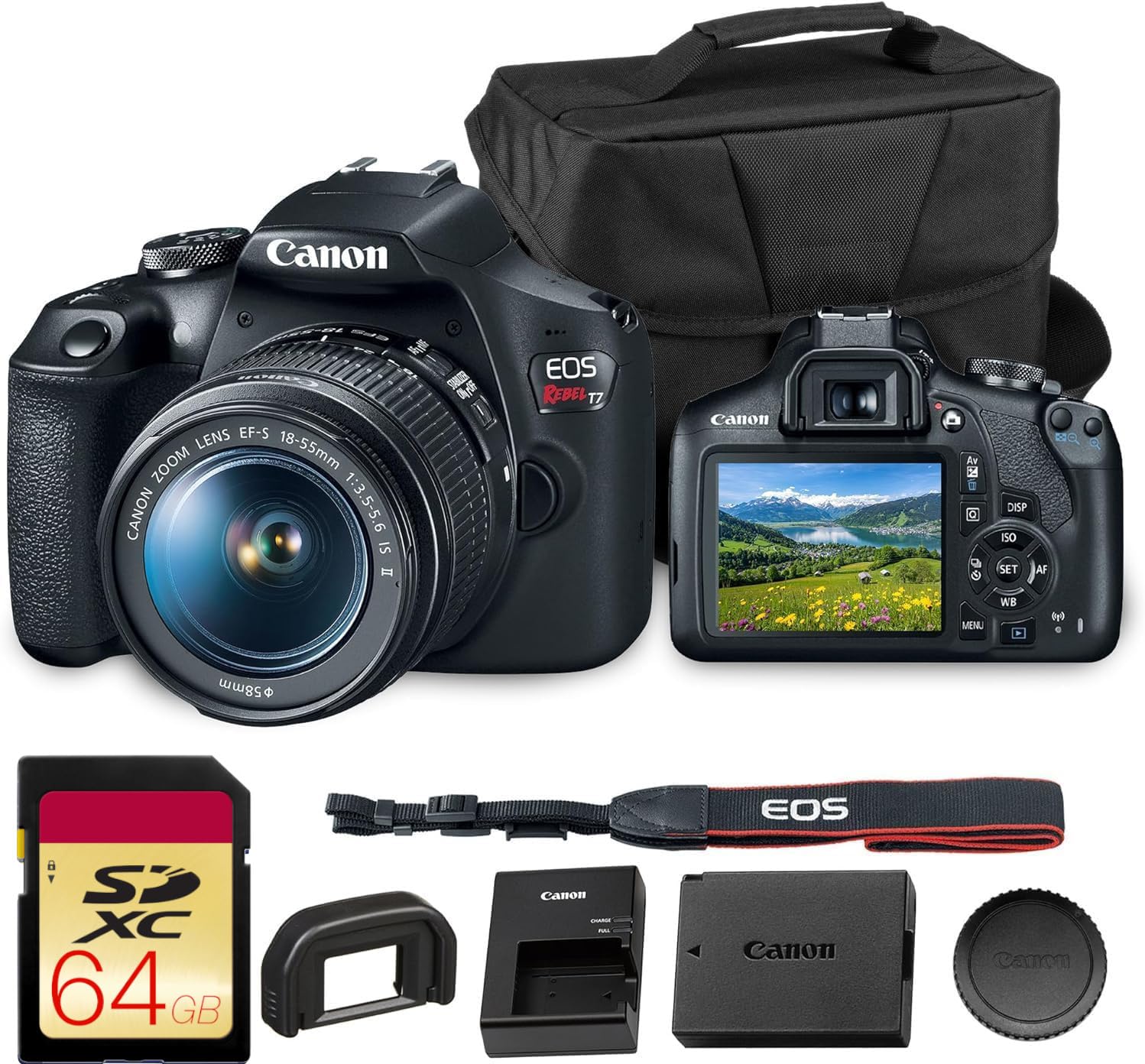
The Canon Rebel T7 is the most cost-effective entry point for a beginner learning the basics of video production for music videos. Its 24.1MP APS-C CMOS sensor and DIGIC 4+ processor produce clean 1080p video at 30fps, which is sufficient for practice projects and straightforward performance videos where the priority is sound and lighting rather than high-resolution detail. The built-in Wi-Fi and NFC allow quick sharing of clips to a phone for social media teasers.
The optical viewfinder and DSLR battery life are significant advantages for long, slow production days where you need to leave the camera running without constant battery swaps. The included 18-55mm kit lens and shoulder bag make this a complete starter package for someone who does not own any camera gear yet. The 9-point autofocus system is slow and limited by modern standards, so you will need to rely on manual focus or stationary subjects for sharp video.
Video quality is limited to 1080p at 30fps, with no slow-motion or 4K option, which restricts the creative frame-rate flexibility for music videos. The microphone input is a 3.5mm jack, but there is no headphone port for monitoring audio, which may result in unusable sound on location. This camera is a teaching tool and a first step into the ecosystem, not a tool for professional music video production. It is best suited for a student or total beginner.
Why it’s great
- Excellent battery life compared to mirrorless cameras, supporting long days of teaching or practice.
- Complete kit with lens, bag, and accessories provides an all-in-one start for beginners.
- Familiar DSLR optical viewfinder approach is educational for learning the fundamentals of exposure and composition.
Good to know
- Video is limited to 1080p at 30fps with no slow-motion or 4K option.
- 9-point autofocus system is slow and not reliable for tracking moving talent in video.
- No headphone jack for audio monitoring; camera cannot monitor audio during recording.
FAQ
What is the best camera for low-light music video shooting?
Do I need a cinema camera for music videos, or can I use a mirrorless?
What lens is best for shooting music videos?
Why is dynamic range important for music videos?
Can I use a DJI Osmo Pocket 3 as my main music video camera?
Final Thoughts: The Verdict
For most music video creators, the best camera for music videos winner is the Blackmagic Pocket 4K because it delivers a sensor with 13 stops of dynamic range and 12-bit Blackmagic RAW recording at a price that unlocks professional color grading latitude without a production-level budget. If you want reliable autofocus and the flexibility of a full-frame sensor, grab the Sony a7 III. And for a dedicated cinema body with internal ND filters and a Super 35 sensor that nails the film look, nothing beats the Blackmagic Pocket 6K Pro.

Mo Maruf
I created WellFizz to bridge the gap between vague wellness advice and actionable solutions. My mission is simple: to decode the research and give you practical tools you can actually use.
Beyond the data, I am a passionate traveler. I believe that stepping away from the screen to explore new environments is essential for mental clarity and physical vitality.