Our readers keep the lights on and my smoothie glass nicely filled. As an Amazon Associate, I earn from qualifying purchases.
Shooting in dim venues, candlelit rooms, or at twilight often separates serious photographers from casual users. The difference between a grainy, unusable image and one packed with detail comes down to sensor design and processing—not just a fast lens. For anyone who frequently works in challenging light, choosing the right body is the single most important decision you’ll make.
I’m Mohammad Maruf — the founder and writer behind WellFizz. I’ve spent years analyzing sensor architectures, backside-illumination technologies, and noise-reduction engines across hundreds of camera specifications, so you don’t have to dig through datasheets to find what actually matters in the dark.
Whether you’re shooting indoor events, astrophotography, or nighttime street scenes, the right body determines whether your keeper rate climbs or collapses. That is why this guide isolates the most capable bodies on the market to help you find the best camera for low light that fits your needs and budget.
How To Choose The Best Camera For Low Light
Low-light camera performance isn’t about a single spec. It’s a combination of sensor technology, processing power, stabilization, and lens compatibility. Below are the key factors to weigh before committing to a body.
Sensor Size and Technology
Full-frame sensors gather more light per pixel than smaller formats, which directly reduces noise at higher ISOs. A backside-illuminated (BSI) architecture stacks the photodiodes closer to the light source, improving light capture efficiency. For the darkest scenes, a BSI full-frame sensor with large individual pixels delivers the cleanest shadow detail.
Image Stabilization (IBIS)
In-body image stabilization lets you handhold at shutter speeds two to seven stops slower than you normally could, effectively boosting low-light capability without raising ISO. Better IBIS systems use five-axis compensation that corrects pitch, yaw, roll, and translational movement, making them indispensable for handheld work in dim environments.
Autofocus in Dim Light
Phase-detection autofocus with dedicated low-luminance sensitivity ratings is crucial. Look for bodies that advertise AF down to -4 EV or lower. Hybrid systems that combine phase and contrast detection tend to maintain lock in darker conditions than pure contrast-based systems, especially when tracking moving subjects.
High ISO Image Quality
Raw noise performance above ISO 6400 is the real test. Cameras with larger pixel pitches and advanced noise-reduction pipelines produce usable files at ISO 12800 and beyond. Check sample images at high ISO rather than relying on the spec sheet’s maximum ISO number, which often includes extended settings with heavy noise reduction.
Quick Comparison
On smaller screens, swipe sideways to see the full table.
| Model | Category | Best For | Key Spec | Amazon |
|---|---|---|---|---|
| Nikon Z 6II | Mirrorless | Versatile Hybrid Shooting | 24.5MP BSI Sensor, -4.5EV AF | Amazon |
| Sony Alpha 7 III | Mirrorless | Best All-Round Low Light | 24.2MP BSI Sensor, 693 AF Points | Amazon |
| Canon EOS R5 | Mirrorless | High-Resolution & 8K Video | 45MP Stacked BSI Sensor | Amazon |
| Sony Alpha 7 IV | Mirrorless | 33MP Hybrid Workflow | 33MP BSI Sensor, BIONZ XR | Amazon |
| Nikon Z 7II | Mirrorless | Ultra-High Resolution Landscape | 45.7MP BSI Sensor, 493 AF Points | Amazon |
| Fujifilm X-S20 | Mirrorless | APS-C All-Rounder with Video | 26.1MP X-Trans, 7-Stop IBIS | Amazon |
| Panasonic LUMIX S9 | Mirrorless | Compact Full-Frame Travel | Full-Frame Sensor, Open Gate | Amazon |
| Canon EOS RP | Mirrorless | Entry-Level Full Frame | 26.2MP Full Frame, RF Mount | Amazon |
| Panasonic LUMIX G85 | Mirrorless | Budget Video & Travel | 16MP MFT, 5-Axis Dual IS | Amazon |
| Fujifilm X-T30 III | Mirrorless | Compact Everyday Carry | 26.1MP X-Trans, Film Sims | Amazon |
| Leica Q3 | Compact | Premium Street & Travel | 60MP BSI Sensor, f/1.7 Lens | Amazon |
In‑Depth Reviews
1. Nikon Z 6II

The Z 6II strikes an ideal balance between resolution and noise control. Its 24.5MP backside-illuminated sensor captures clean files up to ISO 12800 with minimal luminance noise, making it one of the most reliable options for dim wedding receptions or nighttime cityscapes. The dual EXPEED 6 processors handle the data pipeline efficiently, keeping buffer clears fast even during continuous bursts.
The in-body stabilization delivers up to 5 stops of correction, which pairs beautifully with adapted F-mount lenses via the FTZ adapter. The 273 phase-detection autofocus points maintain lock down to -4.5 EV, so you can focus in near-pitch-black conditions where many competitors hunt. The magnesium alloy body is weather-sealed, giving you confidence in damp or dusty environments.
Dual card slots (CFexpress/XQD and UHS-II SD) provide flexibility and backup security for paid assignments. The only real knock is that the rear screen does not fully articulate, which can frustrate vloggers. But for pure low-light stills and hybrid video work, the Z 6II remains a powerhouse that justifies its place at the top of this list.
Why it’s great
- Excellent high-ISO noise performance for a 24MP sensor
- Reliable AF in extreme low light with -4.5 EV rating
- Dual card slots for professional backup
Good to know
- Battery life is average; a spare is recommended
- Rear screen is tilting only, not fully articulating
2. Sony Alpha 7 III

The a7 III set the benchmark for affordable full-frame low-light capability when it launched, and it remains extremely relevant. The 24.2MP Exmor R BSI sensor delivers class-leading dynamic range of 15 stops, allowing you to push shadows several stops in post before noise becomes objectionable. At ISO 6400, the files are remarkably clean with well-controlled color noise.
The 693 phase-detection AF points cover 93% of the frame, and the Real-time Eye AF works reliably in dim indoor lighting. The 5-axis IBIS provides 5 stops of shake reduction, letting you handhold at 1/8th of a second with a wide lens. Battery life is exceptional for a mirrorless body—about 710 shots per charge—which is a massive advantage on long event shoots.
The kit lens (28-70mm f/3.5-5.6) is adequate for daylight but will limit low-light performance. Budget for a fast prime like the 35mm f/1.8 or 50mm f/1.8 to unlock the sensor’s true potential. The menu system is dense and takes time to learn, but the image quality per dollar ratio is still difficult to beat in 2024.
Why it’s great
- Outstanding dynamic range for shadow recovery
- Top-tier battery life for all-day shoots
- Fast and accurate phase-detection AF coverage
Good to know
- Complex menu system can be confusing
- Kit lens limits low-light performance; budget for primes
3. Canon EOS R5

The R5 proves that high resolution and low-light capability can coexist. Its 45MP stacked BSI CMOS sensor reads out data incredibly fast, which not only enables 20fps silent shooting but also reduces rolling shutter in video. At ISO 6400, the R5 retains impressive detail with fine luminance noise that cleans up easily in post, rivaling lower-resolution competitors.
The Dual Pixel CMOS AF II with 1,053 AF points covers the entire frame and includes Eye Control AF, letting you select focus points just by looking at them through the viewfinder. In practice, the system locks on in candlelit rooms where many cameras give up. The 5-axis IBIS provides up to 8 stops of correction with select RF lenses, making handheld low-light shooting remarkably stable.
Video shooters benefit from 8K RAW and 4K up to 120fps internal recording, though heat management can limit long recording sessions in hot environments. The body is weather-sealed and built like a tank, and the EVF is one of the best on the market. If resolution, speed, and low-light stills are your priorities, the R5 delivers without compromise.
Why it’s great
- Excellent high-ISO performance for a 45MP sensor
- Best-in-class autofocus with Eye Control
- 8 stops of IBIS for incredibly stable handheld shots
Good to know
- Can overheat during extended 8K video recording
- Battery life is shorter than Z6II or A7III
4. Sony Alpha 7 IV

The a7 IV occupies a sweet spot with its 33MP BSI sensor and BIONZ XR processor, offering a meaningful resolution bump over the a7 III without the file-size burden of 45MP bodies. High ISO performance is excellent, with clean files up to ISO 12800 and usable shadow detail at 25600. The 7K oversampled 4K 30p video yields exceptional sharpness with minimal moiré.
The 693 phase-detection AF points inherit Sony’s Real-time Eye Tracking, which works seamlessly in dimly lit portrait sessions or indoor sports. The fully articulating touchscreen makes it much easier than the a7 III to shoot from awkward angles. Dual card slots (CFexpress Type A and SD) give professional flexibility.
The S-Cinetone color profile provides rich, filmic video color straight out of camera, reducing grading time. Battery life is strong at over 2000 shots per charge in power-saving mode. The main tradeoff is that the 4K 60fps mode introduces a 1.5x crop, and the buffer depth is shallower than the a7 III. But as a hybrid low-light tool, the a7 IV is hard to fault.
Why it’s great
- 33MP gives more cropping flexibility than 24MP bodies
- No crop 4K 30p from 7K oversampling
- Excellent battery life for a high-res mirrorless
Good to know
- 4K 60fps has a 1.5x crop factor
- Buffer depth not as deep as a7 III
5. Nikon Z 7II

The Z 7II targets photographers who need every pixel for large prints and commercial work. Its 45.7MP BSI sensor resolves staggering detail, but still maintains usable noise performance up to ISO 6400. At base ISO, the dynamic range is class-leading, allowing extreme shadow pulls without banding. The 493 phase-detection AF points offer decent low-light confidence, though not quite as tenacious as the Sony competition.
The 5-axis IBIS provides 5 stops of stabilization, which helps counteract the higher resolution’s sensitivity to shake. The EVF is a 3.69M-dot OLED that’s sharp and bright even in dim conditions. Dual card slots (CFexpress/XQD and UHS-II SD) give you flexibility and redundancy.
The built-in intervalometer and focus shift shooting modes are excellent for astrophotography and macro. Battery life is fairly standard for a high-res body, so packing spares is wise. The Z 7II works wonderfully with adapted F-mount glass via the FTZ adapter. If you regularly crop heavily or print large, the Z 7II’s resolution advantage in good light is undeniable, though it trades a stop of low-light headroom compared to the Z 6II.
Why it’s great
- Extreme detail from 45.7MP sensor
- Excellent dynamic range at base ISO
- Built-in intervalometer for timelapses
Good to know
- High ISO noise is more visible than 24MP competitors
- AF not as reliable in very low light as Sony
6. Fujifilm X-S20

The X-S20 brings Fujifilm’s excellent color science and X-Trans sensor into a body that prioritizes video and stills equally. The 26.1MP X-Trans CMOS 4 sensor paired with the X-Processor 5 delivers impressive high-ISO results for an APS-C sensor—usable files up to ISO 6400 with film-grain-like noise that many photographers find pleasing. The 7-stop IBIS is a class leader, letting you shoot handheld at absurdly slow shutter speeds.
The subject detection AF identifies animals, birds, cars, and people, and performs well indoors under mixed lighting. The new Vlog mode makes it simple for content creators to transition from product shots to selfie-style clips. The 6.2K 30p video with 4:2:2 10-bit color is a fantastic value for the form factor.
The deep handgrip is genuinely comfortable, and the NP-W235 battery delivers about 750 shots per charge. The main limitations are the single SD slot and lack of weather sealing—be cautious in rain or dusty environments. The X-S20 proves that APS-C can still be a serious low-light contender when backed by strong sensor and stabilization technology.
Why it’s great
- 7-stop IBIS is exceptional for the class
- Film simulations produce great SOOC results
- 6.2K 30p 10-bit video in a compact body
Good to know
- No weather sealing for outdoor use
- Single SD card slot only
7. Panasonic LUMIX S9

The S9 is Panasonic’s answer to the demand for a travel-friendly full-frame body that doesn’t sacrifice image quality. Its full-frame sensor produces clean, rich files with good dynamic range, and the IBIS system is effective enough to eliminate the need for a gimbal in most social media projects. The LUMIX Lab app provides ultra-fast Wi-Fi transfers, making it ideal for quick sharing.
Open Gate recording captures the full sensor area, allowing you to reframe in post for different aspect ratios—a huge plus for creators who post across multiple platforms. The body is incredibly compact, especially paired with the compact 18-40mm zoom. Colors are pleasing straight out of camera.
The major tradeoff is the lack of a hotshoe, meaning you cannot mount an external flash or microphone. There is no built-in flash, and the optional grip is almost a necessity for comfortable handling with larger lenses. If portability and social media integration are your priorities and you don’t need flash accessories, the S9 is a compelling, pocketable full-frame option.
Why it’s great
- Extremely compact full-frame body for travel
- Open Gate video capture for multi-platform posting
- Fast Wi-Fi transfer via LUMIX Lab app
Good to know
- No hotshoe for external flash or microphone
- Needs aftermarket grip for comfortable handling
8. Canon EOS RP

The EOS RP is the most accessible path to a full-frame sensor. Its 26.2MP CMOS sensor is not BSI, so it doesn’t match the a7 III or Z6II in high-ISO noise, but it still delivers a clear step up in depth and shadow detail over APS-C. The RF mount gives you access to Canon’s excellent lens roadmap, including the incredibly fast RF 50mm f/1.2 L.
The Dual Pixel CMOS AF is fast and reliable in moderate light, though it does hunt in very dim scenes compared to phase-detection-only systems. The vari-angle touchscreen is great for vlogging, and the menu system is one of the most intuitive on the market. The body is lightweight and comfortable for long shoots.
4K video has a 1.6x crop and uses contrast-detect AF, which limits its usefulness for serious videographers. The battery life is below average, so budget for a spare. If your goal is to get into the full-frame world on a budget and you shoot mostly stills, the RP offers genuine full-frame image characteristics at a price that’s hard to argue with.
Why it’s great
- Lowest cost entry to a full-frame sensor
- Intuitive Canon menu system
- Access to the RF lens ecosystem
Good to know
- Not BSI sensor; higher ISO noise than competitors
- Poor 4K video with crop and contrast AF
9. Panasonic LUMIX G85

The G85 proves that budget-friendly doesn’t have to mean unusable in low light. The 16MP Micro Four Thirds sensor lacks the light-gathering area of full-frame, but Panasonic’s class-leading Dual Image Stabilization (IBIS plus lens OIS) lets you shoot at dramatically slower shutter speeds. In practice, this means you can handhold at 1/4 second and keep shots sharp.
The 5-axis IBIS works with both photo and video, making the G85 a strong choice for handheld 4K filming in dim environments. The body is weather-sealed and built with a magnesium alloy frame, offering durability far beyond its price point. The OLED live viewfinder is crisp and bright.
The main limitation is the Micro Four Thirds sensor, which shows noise above ISO 3200 more visibly than larger formats. The autofocus can be sluggish in low light for 4K video as well. But for the price, you get a weather-sealed body with superb stabilization and a versatile kit lens. For beginners or travel vloggers on a strict budget, the G85 is an incredible value.
Why it’s great
- Class-leading IBIS for handheld low-light shots
- Weather-sealed magnesium alloy build
- Great value for the price point
Good to know
- Smaller sensor shows noise above ISO 3200
- Autofocus hunts in low light for video
10. Fujifilm X-T30 III

The X-T30 III is the camera for photographers who want gorgeous out-of-camera colors and a compact, retro-inspired body. The 26.1MP X-Trans sensor delivers excellent JPEGs with Fujifilm’s legendary film simulations—Provia, Velvia, Classic Chrome—that often eliminate the need for post-processing. The AI-powered subject detection autofocus does a solid job tracking faces and eyes indoors.
The body is remarkably light and small, making it the perfect everyday carry that you’ll actually bring with you. The Auto mode intelligently selects settings, allowing beginners to get sharp, well-exposed images in lower light without manual tweaking. The FUJINON 13-33mm kit lens provides a useful wide-to-normal range.
Low-light noise is comparable to other APS-C sensors—clean up to ISO 6400 with visible grain above that. The lack of in-body image stabilization means you’ll need to rely on lens OIS or a tripod in very dim conditions. For photographers who prioritize portability and color science over ultimate noise performance, the X-T30 III is a joy to shoot.
Why it’s great
- Beautiful film simulations for SOOC images
- Very compact and lightweight for daily carry
- AI-powered subject detection AF works well
Good to know
- No in-body image stabilization
- No built-in flash
11. Leica Q3
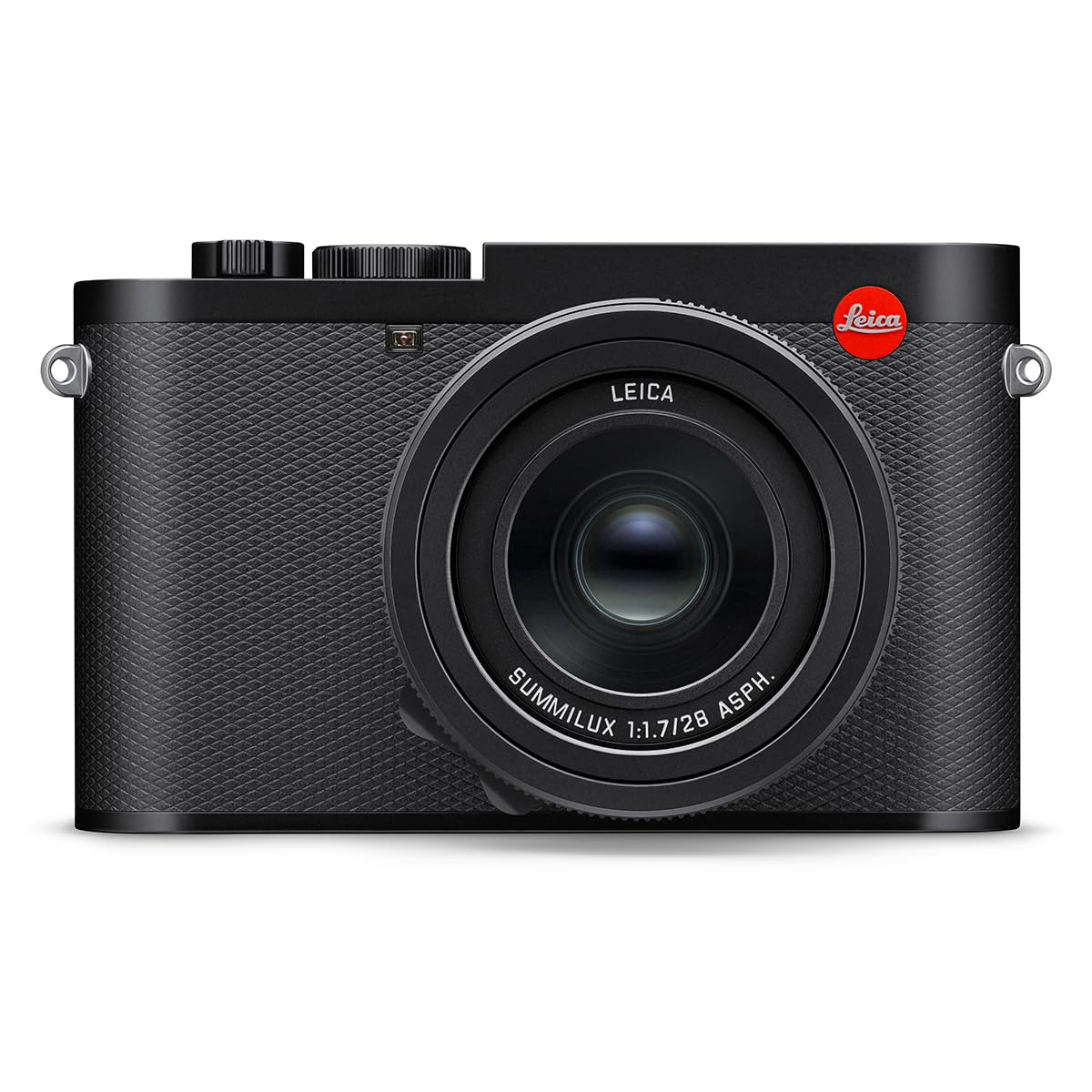
The Leica Q3 is the ultimate expression of a fixed-lens, full-frame compact. Its 60MP BSI CMOS sensor uses Triple Resolution Technology, letting you shoot at 60MP, 36MP, or 18MP to balance resolution and file size. Paired with the Summilux 28mm f/1.7 ASPH lens, it offers incredible sharpness and light-gathering ability. The hybrid autofocus system combines phase and contrast detection for quick, accurate locking even in dim conditions.
The Maestro IV processor with 8GB of memory handles everything smoothly, and the digital zoom options extend the effective focal length up to 90mm for framing flexibility. The body is compact and beautifully constructed, making it a joy for street photography and travel. Colors and micro-contrast are distinctive Leica—files have a richness that is hard to define but immediately recognizable.
The Q3 is not a system camera; you cannot swap lenses or add a flash easily. The digital zoom is a crop, not a true optical zoom. And the price is undeniably premium. But for the photographer who values one outstanding lens and sensor combination in a form factor that disappears into a bag, the Q3 delivers a low-light image quality that few cameras can match.
Why it’s great
- 60MP BSI sensor with class-leading detail
- Exceptional Summilux 28mm f/1.7 lens
- Compact and beautifully built body
Good to know
- No interchangeable lens system
- Premium price point
FAQ
How does sensor size affect low-light performance?
Can I improve my low-light results without buying a new camera?
What does an EV rating of -4.5 mean for autofocus?
Does in-body stabilization reduce motion blur in low light?
Final Thoughts: The Verdict
For most users, the camera for low light winner is the Nikon Z 6II because it offers the best balance of sensor performance, reliable low-light AF, and professional build quality without breaking into the highest price tier. If you want best-in-class battery life and a massive third-party lens ecosystem, grab the Sony Alpha 7 III. And for uncompromising resolution with still-strong low-light handling, nothing beats the Canon EOS R5.

Mo Maruf
I created WellFizz to bridge the gap between vague wellness advice and actionable solutions. My mission is simple: to decode the research and give you practical tools you can actually use.
Beyond the data, I am a passionate traveler. I believe that stepping away from the screen to explore new environments is essential for mental clarity and physical vitality.