Our readers keep the lights on and my smoothie glass nicely filled. As an Amazon Associate, I earn from qualifying purchases.
You need a camera with reliable autofocus that won’t hunt, stabilization that smooths out walking shots, and a sensor that handles mixed lighting without turning your skin tone into a muddy mess. This guide cuts through the marketing noise to find the body and lens combos that actually deliver the crisp, smooth, and color-accurate footage Reels viewers reward with a full watch.
I’m Mohammad Maruf — the founder and writer behind WellFizz. I’ve spent hundreds of hours analyzing sensor readout speeds, stabilization accuracy, autofocus hit rates, and bit-depth specifications across the current market to isolate which camera bodies and kits solve the specific challenges of short-form vertical video production.
Your next upload deserves hardware that keeps up with your creativity. Keep reading to find my curated analysis of the top contenders for the best camera for instagram reels, broken down by real-world shooting scenarios and technical merit.
How To Choose The Best Camera For Instagram Reels
Selecting a camera for Reels isn’t about buying the most expensive body. It’s about matching three specific hardware capabilities to the type of content you shoot most. Overlooking any one of these three pillars results in footage that looks fine on the back of the camera but falls apart after export and upload.
Autofocus Reliability and Tracking
Reels involve movement — dancing, walking toward the lens, quick transitions, or product showcases. A camera with slow or inconsistent autofocus will produce unusable clips where the subject drifts in and out of sharpness. Look for phase-detection AF with real-time eye tracking. Contrast-detect-only systems hunt too much for fast-moving content. Sony’s Real-Time Eye AF and Canon’s Dual Pixel CMOS AF II are industry benchmarks for Reels work. Cameras that rely solely on contrast detection, even with decent resolution, will frustrate you during action sequences.
Stabilization Capability
Handheld Reels are the norm, especially for outfit-of-the-day, cooking, or travel content. In-body image stabilization (IBIS) combined with lens-based optical stabilization (OIS) creates the smoothest results. Gimbal-based stabilization (like on the DJI Osmo Pocket 3) eliminates the need for external rigs entirely. Electronic stabilization alone, common on budget action cameras, introduces crop and jello effect. For walking shots, prioritize a body with 5-axis IBIS or a dedicated gimbal camera.
Frame Rate and Recording Limits
Flexibility in post-production requires 4K at 60fps minimum. This allows you to slow footage to 50% speed for smooth motion effects. Higher frame rates like 4K 120fps give you 4x slow-motion without resolution loss. Many cameras also impose thermal recording limits — overheating during a long take ruins a shoot. Look for cameras with passive cooling or advertised recording times of 30 minutes or more in 4K. The ability to shoot 4K 60fps uncropped (not windowed from a smaller sensor area) is a premium differentiator.
Quick Comparison
On smaller screens, swipe sideways to see the full table.
| Model | Category | Best For | Key Spec | Amazon |
|---|---|---|---|---|
| DJI Osmo Pocket 3 Creator Combo | Gimbal Camera | Ultra-smooth walk-and-talk vlogs | 1-inch CMOS, 4K 120fps | Amazon |
| DJI Osmo Nano Standard Combo | Action Camera | On-the-go POV and sports Reels | 1/1.3″ sensor, 4K 60fps | Amazon |
| Xtra Muse Vlogging Camera | Gimbal Camera | Budget-friendly gimbal video | 1-inch CMOS, 4K 120fps | Amazon |
| Canon EOS R100 Kit | Mirrorless | Entry-level interchangeable lens | 24.1MP APS-C | Amazon |
| Panasonic LUMIX G85 Kit | Mirrorless | Stabilized video with kit lens | 16MP MFT, 5-Axis IBIS | Amazon |
| Insta360 X5 | 360 Action Camera | Invisible selfie stick 360 Reels | 8K 360°, dual 1/1.28″ sensors | Amazon |
| OM SYSTEM E-M10 Mark IV Kit | Mirrorless | Compact travel mirrorless with selfie mode | 20MP MFT, 5-Axis IBIS | Amazon |
| Sony ZV-1 | Compact Vlog Camera | All-in-one vlogging with bokeh switch | 20.1MP 1-inch, 24-70mm f/1.8-2.8 | Amazon |
| Sony Alpha a6400 Body | Mirrorless | Fast AF for action and real-time eye tracking | 24.2MP APS-C, 425 phase-detect points | Amazon |
| Canon EOS R8 Body | Mirrorless | Full-frame entry for pro-level Reels | 24.2MP full-frame, 4K 60p | Amazon |
| Nikon Z 8 Body | Professional Mirrorless | Highest resolution and 8K flexibility | 45.7MP full-frame, 8K 60p | Amazon |
In-Depth Reviews
1. DJI Osmo Pocket 3 Creator Combo

The Osmo Pocket 3 remains the gold standard for Reels creation because its 1-inch CMOS sensor and true 3-axis mechanical gimbal eliminate the need for any post-production stabilization — your walking shots come out usable directly from the card. The 4K 120fps recording gives you four times slow-motion headroom, and the 2-inch rotatable touchscreen switches between horizontal and vertical framing instantly without any accessory or camera flip. The Creator Combo includes the DJI Mic 2 transmitter, so your audio matches the visual quality immediately out of the box.
ActiveTrack 6.0 locks onto your face and keeps you centered even during spinning or jumping movements, which is invaluable for solo creators who don’t have a dedicated operator. The included battery handle extends runtime significantly, and the wide-angle lens attachment gives a more cinematic field of view for establishing shots. The 10-bit D-Log M color profile lets you grade footage without banding, a feature usually reserved for cameras costing three times as much.
The physical limitations are the fixed lens (no interchangeable optics) and the fragile gimbal head that demands careful handling. It also lacks weather sealing, so rainy shoots require protection. But for pure Reels output — stabilization, slow-motion, color depth, and audio in one pocket-sized unit — this combo is currently unmatched.
Why it’s great
- Mechanical gimbal eliminates walking shake completely.
- Rotating touchscreen for native vertical framing.
- Built-in DJI Mic 2 for pro audio.
Good to know
- Gimbal head is fragile — requires a protective case.
- No lens interchangeability limits creative range.
2. Sony ZV-1

The Sony ZV-1 is purpose-built for content creators, and its stacked 1-inch Exmor RS sensor with DRAM enables fast readout that minimizes rolling shutter during pans. The integrated 24-70mm f/1.8-2.8 Zeiss Vario-Sonnar T lens covers the most useful focal range for talking-head and product Reels, with the f/1.8 aperture at the wide end providing genuine background defocus. The one-touch bokeh switch and Product Showcase Setting instantly pull focus from your face to an object held up to the lens, which is perfect for makeup, tech, or food reviews.
The side flip-out 3-inch touchscreen makes framing easy, and the forward-directional onboard microphone with the detachable windscreen captures clean audio without an external mic in many indoor scenarios. Hybrid autofocus with 425 phase-detection points delivers real-time eye tracking that rivals much more expensive bodies. The HLG and S-Log2/S-Log3 picture profiles allow color grading flexibility for creators who want a cinematic look.
The main trade-offs are the fixed lens (you cannot switch optics) and the small body that feels cramped for users with larger hands. Battery life is approximately two hours of continuous recording, and USB power delivery during shooting is recommended for longer sessions. Overheating can occur during extended 4K recording in warm environments.
Why it’s great
- One-touch bokeh and product showcase transition.
- Excellent real-time eye autofocus.
- Built-in directional mic with windscreen.
Good to know
- No interchangeable lens system.
- Overheating possible during extended 4K recording.
3. DJI Osmo Nano Standard Combo (128GB)
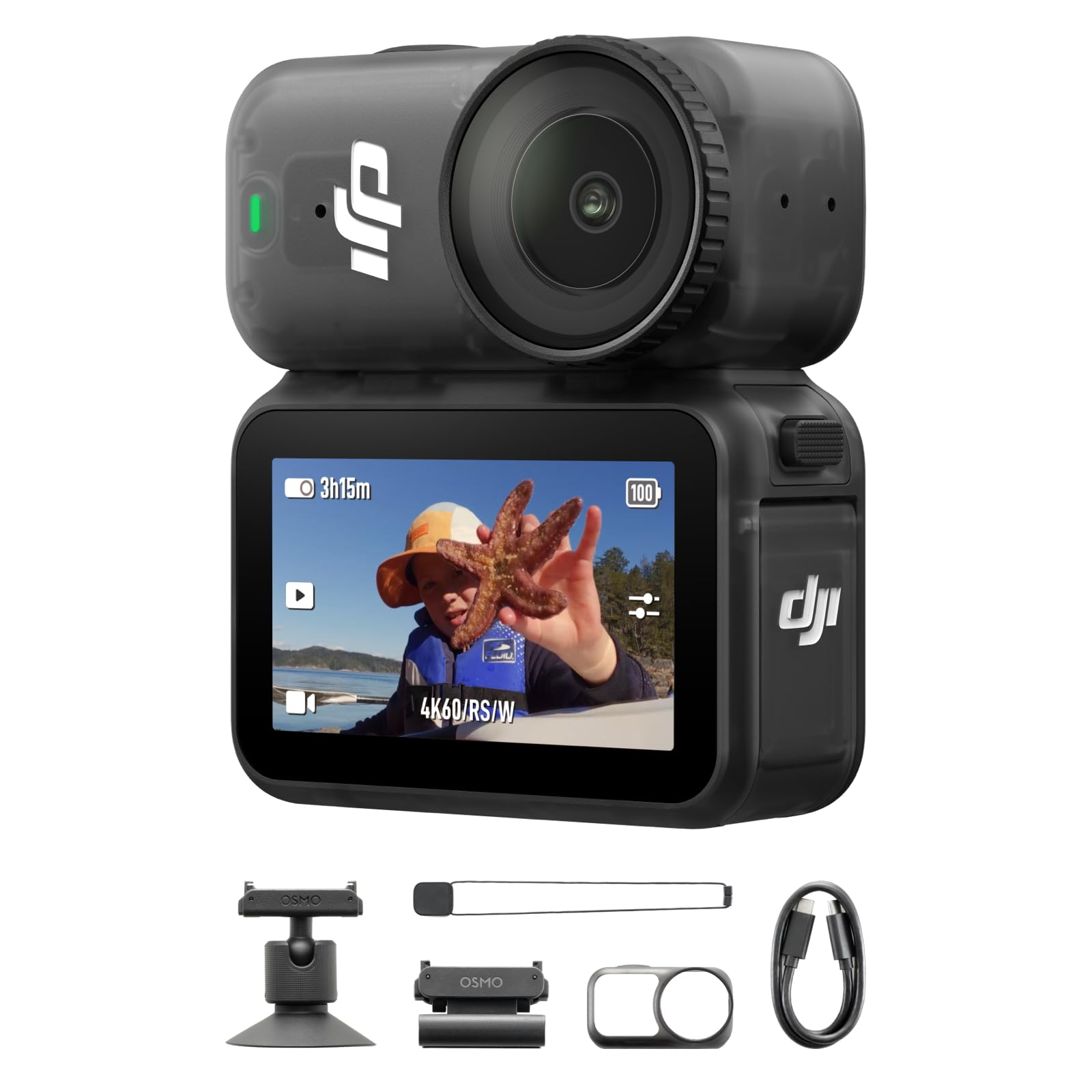
The Osmo Nano is DJI’s smallest 4K camera, and its 1/1.3-inch sensor with a 143-degree ultra-wide field of view captures immersive first-person POV shots that feel natural for Reels. The magnetic mount system lets you attach the camera to hats, lanyards, or bike helmets instantly, and the 10-bit D-Log M color depth preserves highlight and shadow detail for grading. The 200-minute rated battery with the Vision Dock makes it practical for all-day event coverage or travel vlogging where constant charging isn’t possible.
Built-in 128GB storage means you can record immediately without hunting for a memory card, and the microSD expansion slot adds capacity if needed. direct microphone connectivity via OsmoAudio supports DJI Mic 2 and Mic Mini transmitters for clean audio without dongles. IPX4 splash resistance with the Vision Dock adds confidence for outdoor shoots in light rain or near water.
The downside is the lack of a viewfinder or built-in screen on the camera body itself — you rely on the smartphone app for framing, which adds friction during quick Reels setups. The compact size also means the battery is internal and cannot be hot-swapped easily. The dock drains battery when left attached even in standby mode.
Why it’s great
- Ultra-compact with magnetic mounting system.
- 128GB built-in storage for immediate use.
- 200-minute battery life with Vision Dock.
Good to know
- No built-in screen for framing.
- Dock drains battery even when camera is off.
4. Xtra Muse Vlogging Camera

The Xtra Muse delivers a 1-inch CMOS sensor with a built-in 3-axis gimbal at a price point significantly below the DJI Pocket 3, making it the strongest budget-friendly gimbal camera for Reels. The 4K 120fps recording capability and 2-inch touchscreen with vertical shooting mode mean you can produce slow-motion clips and native vertical output without any cropping or post-processing. The Master Follow mode keeps you centered in the frame while moving, useful for dance or walking Reels where you cannot monitor the composition.
The 10-bit X-Log color grading mode supports up to one billion colors, giving you latitude to adjust exposure and color temperature in post-production without introducing visible artifacts. The 161-minute battery life covers a full day of casual shooting, and the included handle with a 1/4-inch thread allows tripod mounting out of the box. The carrying bag and wrist strap make it easy to transport without a dedicated case.
The main compromise is the autofocus system, which is reliable in good light but hunts more noticeably than the DJI Pocket 3 in dim conditions. The app ecosystem is less polished, and some DJI Pocket 3 accessories fit physically but do not function electronically. The gimbal lock mechanism requires care during insertion to avoid wear over time.
Why it’s great
- 1-inch sensor with 3-axis gimbal at low price.
- 4K 120fps with 10-bit X-Log color.
- Vertical shooting via rotating touchscreen.
Good to know
- Autofocus hunts in low light.
- App less refined than DJI ecosystem.
5. Sony Alpha a6400 Body

The a6400’s 0.02-second autofocus acquisition with Real-Time Eye AF for humans and animals makes it the sharpest-tracking APS-C mirrorless camera in its price tier for Reels. The 425 phase-detection points covering 84% of the sensor ensure your subject stays locked even during erratic movement, which is critical for product tosses, dance transitions, and fast-paced storytelling. The 180-degree flip-up touchscreen is designed explicitly for self-recording, and the 11fps continuous shooting with raw capture gives you still-frame options from video sequences.
The 4K video is oversampled from the full sensor width, delivering more detail than typical line-skipped capture. No recording time limit exists for 4K, removing the 29-minute ceiling found on earlier Sony bodies. The compact body weighs approximately 403g with battery and card, making it easy to pair with gimbals for stabilized Reels work. The E-mount system offers the widest range of affordable third-party lenses from Tamron and Sigma.
The major drawbacks are the lack of in-body image stabilization (relying entirely on lens OIS) and the subpar menu system that requires time to learn. The 4K 30fps cap (no 60fps in 4K) limits slow-motion options unless you shoot in 1080p 120fps. The touchscreen functionality is limited to focus, not menu navigation or playback.
Why it’s great
- Industry-leading autofocus speed and tracking.
- No 4K recording time limit.
- Extensive E-mount lens ecosystem.
Good to know
- No 4K 60fps recording option.
- No in-body stabilization — lens OIS needed.
6. Panasonic LUMIX G85 Kit

The Panasonic G85 delivers class-leading 5-axis dual image stabilization (IBIS plus lens OIS) that produces handheld footage comparable to a gimbal in many walking scenarios, making it an outstanding value for Reels creators who prefer not to use external stabilization gear. The 16-megapixel Micro Four Thirds sensor with no low-pass filter resolves fine detail well, and the 12-60mm Power O.I.S. kit lens covers a versatile range from wide to short telephoto. The 4K QFHD video (3840 x 2160) allows 4K Photo and Post Focus features that let you select the focus point after shooting.
The magnesium alloy build with weather sealing adds durability for outdoor shoots, and the tilt-and-touch LCD with a 2360K-dot OLED viewfinder provides clear composition in bright sunlight. The contrast-detect autofocus with DFD technology is usable for video but lacks the phase-detect speed of Sony or Canon rivals. The 4K video quality is excellent in good light, though the 4K autofocus performance in low light is noticeably slower.
The compact Micro Four Thirds lens system keeps the total kit weight low, but the sensor is the smallest among competing mirrorless systems, so dynamic range and low-light noise performance fall behind APS-C and full-frame bodies. The included kit lens is optically adequate but not sharp enough for critical pixel-peeping.
Why it’s great
- Outstanding 5-axis dual stabilization.
- Weather-sealed magnesium alloy body.
- Versatile 12-60mm kit lens included.
Good to know
- Contrast-detect AF hunts in low light.
- Smaller MFT sensor limits dynamic range.
7. Insta360 X5

The Insta360 X5 is the only camera on this list that captures 360-degree footage, which opens up creative Reels possibilities impossible with traditional lenses — the invisible selfie stick effect produces sweeping third-person shots that look like a drone operator is following you. The dual 1/1.28-inch sensors shoot 8K 30fps 360 video with a triple AI chip design that processes advanced noise reduction for cleaner low-light clips. FlowState Stabilization with 360-degree Horizon Lock keeps footage level even during full camera rotations, eliminating the need for a gimbal.
The new replaceable lens system is a major durability upgrade — scratched lenses can be swapped in seconds, extending the camera’s lifespan significantly. The 4-mic array with an advanced Wind Guard prioritizes voice clarity during outdoor vlogging, and the InstaFrame mode outputs a ready-to-share flat video immediately without manual reframing. The 208-minute battery life is excellent for action cameras.
The learning curve is real — editing 360 footage requires time investment, and the file sizes at 8K are massive, demanding high-speed SD cards and significant storage. The stitching seam between the two lenses is occasionally visible in close-up shots. This camera is not a replacement for conventional video shooting; it is a specialized tool for a specific Reels aesthetic.
Why it’s great
- Invisible selfie stick effect for cinematic third-person shots.
- Replaceable scratch-resistant lenses.
- Excellent stabilization without a gimbal.
Good to know
- Steep learning curve for 360 editing.
- Massive file sizes at 8K resolution.
8. OM SYSTEM E-M10 Mark IV Kit

The E-M10 Mark IV offers a 20-megapixel Live MOS sensor with 5-axis in-body stabilization rated at 4.5 shutter speed stops of compensation, which makes it exceptionally capable for handheld Reels shooting with non-stabilized lenses. The flip-down monitor with dedicated selfie mode auto-activates when the screen is tilted down, streamlining the setup for vertical video. The compact Micro Four Thirds body paired with the retractable 14-42mm EZ pancake lens fits into many jacket pockets, making it a capable travel companion for spontaneous Reels creation.
The 16 Art Filters, including Instant Film, give you creative looks directly in-camera without editing, which speeds up Reels production for creators who want a distinct aesthetic. The 121 contrast-detect autofocus points are adequate for well-lit scenes, and the in-camera panorama stitching is useful for establishing wide shots. The Bluetooth always-on connection enables quick image transfer to your phone for instant Reels uploads.
The contrast-detect autofocus lacks the speed and reliability of phase-detect systems, especially in lower light or during subject movement. The 4K video is limited to 30fps, and the bit depth is 8-bit, reducing color grading flexibility. The OI Share app wireless transfer is noticeably slower than competitors, which can be frustrating when you need to upload immediately.
Why it’s great
- Excellent 5-axis stabilization for handheld shooting.
- Flip-down monitor with dedicated selfie mode.
- Compact enough for jacket pocket travel.
Good to know
- Contrast-detect AF struggles in low light.
- No 4K 60fps and 8-bit video only.
9. Canon EOS R100 Kit

The Canon EOS R100 is the lightest and smallest body in the EOS R series, making it an accessible entry point for photographers transitioning to mirrorless for Reels. The 24.1-megapixel APS-C CMOS sensor paired with the DIGIC 8 processor delivers 4K video at up to 24fps, which matches the cinema frame rate for a filmic look. The Dual Pixel CMOS AF covers 143 zones with human face and eye detection, providing smooth focus transitions that are usable for talking-head Reels.
The kit includes the RF-S18-45mm F4.5-6.3 IS STM lens with optical image stabilization and a compact retractable design. The camera’s simple graphical interface is beginner-friendly, and Wi-Fi connectivity enables quick transfers to a smartphone for editing and uploading. The continuous shooting rate of 6.5 fps with One-Shot AF is adequate for capturing reference stills from video sequences.
The 4K 24fps cap is restrictive — you cannot create slow-motion clips from 4K footage, as 60fps or higher is required for that. The 4K video also introduces a crop factor, reducing the field of view. The LCD is fixed, meaning self-framing is difficult without an external monitor or careful positioning in front of a mirror. No external microphone input is present, limiting audio quality options.
Why it’s great
- Smallest and lightest EOS R mirrorless body.
- Smooth Dual Pixel CMOS AF for video.
- Beginner-friendly interface.
Good to know
- 4K limited to 24fps and has crop factor.
- Fixed LCD — no self-framing capability.
10. Canon EOS R8 Body

The EOS R8 brings a full-frame 24.2-megapixel sensor with Dual Pixel CMOS AF II covering 100% of the frame with 1,053 AF zones, giving you the most accurate subject detection and tracking in this price range. The uncropped 4K 60p video is oversampled from 6K, producing sharper and more detailed footage than line-skipped alternatives. The Canon Log 3 profile enables 10-bit color grading with wide dynamic range, matching the look of higher-end cinema cameras for Reels that demand a professional grade.
The camera body is the lightest full-frame RF-mount camera at approximately 461g, making it feasible for gimbal use despite its larger sensor. The vari-angle 3-inch touchscreen supports high and low angle compositions. 40fps electronic shutter shooting with full AF is available for capturing perfect stills from video sequences. UVC/UAC support turns it into a plug-and-play webcam for livestream Reels.
The downsides include the lack of in-body image stabilization, so you must rely on stabilized RF lenses for smooth handheld footage. Battery life is poor (roughly 360 shots or one hour of 4K video), necessitating spares for all-day shoots. The single UHS-II SD card slot offers no backup recording option. The 6fps mechanical shutter is slow compared to electronic burst rates.
Why it’s great
- Full-frame uncropped 4K 60p oversampled from 6K.
- Canon Log 3 with 10-bit color depth.
- Ultra-reliable Dual Pixel CMOS AF II tracking.
Good to know
- No IBIS — lens stabilization required.
- Short battery life for extended shooting.
11. Nikon Z 8 Body

The Nikon Z 8 is a professional hybrid camera with a 45.7-megapixel stacked CMOS sensor and the EXPEED 7 processor, capable of capturing internal 8K 60p and 4K 120p video. For Reels creators, this means you can shoot 8K footage and crop to vertical in post-production while retaining 4K resolution, essentially giving you a built-in virtual pan-and-scan effect from a single wide shot. The deep-learning AF algorithm detects and tracks subjects down to -9 EV, and can identify people, pets, birds, cars, trains, and planes with 3D tracking.
The internal recording options include 12-bit N-RAW and ProRes RAW, providing maximum flexibility for color grading and dynamic range retention. The continuous shooting speeds of 20, 30, 60, and 120 fps with full AF give you unlimited options for freezing action or creating hyper-lapse sequences. The shutterless design eliminates mechanical wear and vibration during recording. The body is weather-sealed to professional standards for shooting in adverse conditions.
The massive file sizes from 45.7MP photo and 8K video require high-speed CFexpress Type B cards and significant storage, increasing overall system cost. The body is heavy (approximately 910g with battery) compared to other options on this list, tiring for extended handheld use. The learning curve for the highly customizable interface is steep — expect to invest time in configuration.
Why it’s great
- 8K 60p internal for cropping to 4K vertical.
- Advanced deep-learning AF with object detection.
- Shutterless design and weather-sealed build.
Good to know
- Expensive storage requirements for 8K/45MP.
- Heavy body — less comfortable for extended handheld work.
FAQ
Can I use an action camera as my primary Reels camera?
Do I need a gimbal for Reels, or can I rely on IBIS?
Why is 4K 60fps recommended over 4K 30fps for Reels?
Does sensor size matter when uploading to Instagram Reels?
What microphone setup should I use for Reels with these cameras?
Final Thoughts: The Verdict
For most users, the best camera for instagram reels winner is the DJI Osmo Pocket 3 Creator Combo because its 1-inch sensor, native vertical output, mechanical gimbal, and included DJI Mic 2 deliver premium Reels results without any rigging or post-production stabilization. If you want interchangeable lenses and full-frame dynamic range but can accept a gimbal requirement, the Canon EOS R8 is a phenomenal choice for its 4K 60p oversampled from 6K, Canon Log 3, and excellent autofocus. And for creators who need the ultimate in resolution flexibility and professional color science, the Nikon Z 8 provides 8K capture and a stacked sensor that future-proofs your Reels production for years.

Mo Maruf
I created WellFizz to bridge the gap between vague wellness advice and actionable solutions. My mission is simple: to decode the research and give you practical tools you can actually use.
Beyond the data, I am a passionate traveler. I believe that stepping away from the screen to explore new environments is essential for mental clarity and physical vitality.