Our readers keep the lights on and my smoothie glass nicely filled. As an Amazon Associate, I earn from qualifying purchases.
Bringing back a blurry shot of a mountain peak is a specific kind of heartbreak. You carried the weight, braved the wind, and stood at the overlook—only for the camera to miss every detail that made the view worth the climb. That is the real problem with hiking photography: the trail is rough, the light is unpredictable, and a smartphone often lacks the ruggedness to survive the trip, let alone deliver a sharp frame. A dedicated camera built for the backcountry needs to balance weight, battery endurance, stabilization, and environmental sealing so you stop worrying about the gear and start remembering the view.
I’m Mohammad Maruf — the founder and writer behind WellFizz. I spend my research hours studying real-world trail conditions, comparing stabilization systems, battery life claims, and weather-sealing specs across the toughest compact camera bodies on the market to find the ones that actually survive the hike and deliver the shot.
What follows is a rigorous look at what makes a camera earn its place in a pack, whether you need a dedicated point-and-shoot with optical zoom or a compact mirrorless that handles rain like a pro. This guide will help you find the right camera for hiking so you can focus on the trail ahead and come home with crisp, vivid memories instead of blurry regrets.
How To Choose The Best Camera For Hiking
A camera that thrives on the trail must balance four things: durability, stabilization, battery endurance, and the right lens for the landscape. Hikers rarely carry a tripod, so every ounce of motion smoothing or stabilizing hardware counts. A camera that can survive a splash, a drop onto scree, or a freezing summit breeze is not a luxury—it is a necessity for anyone who wants a single device to last multiple seasons. The choices below target those priorities without wasting weight on features that only matter in a studio.
Ruggedness and environmental sealing
A camera destined for the trail must handle dust, rain, and the occasional tumble down a rocky slope. Look for an IP rating or a manufacturer’s claim of waterproofing to a specific depth—15 meters is ideal for river crossings and submerged shots—along with shockproof ratings that confirm a drop from at least 1.5 meters. Freezeproof construction to -10° C ensures the electronics keep firing when your fingers are numb.
Stabilization technology
Handheld footage on a moving trail almost always introduces shake, so built-in stabilization is the single most important spec after durability. Optical image stabilization inside the lens or sensor-shift stabilization inside the body is preferable to digital cropping because it preserves resolution. For action cameras, look for electronic stabilization that corrects 360-degree roll-axis shakes to keep the horizon level even if you are running or biking down the trail.
Battery life and cold-weather endurance
A full-day hike can exceed eight hours, and a camera that dies after 60 minutes of recording is useless for sunrise-to-sunset treks. Action cameras typically quote 1-4 hours of continuous recording depending on resolution, while smaller point-and-shoot batteries often last 2 hours. The real variable is cold: lithium-ion cells lose capacity below freezing, so a camera rated to operate at -10° C (14° F) or a manufacturer’s cold-resistant battery chemistry is worth the premium.
Lens versatility and zoom range
An ultrawide fixed lens (18-19mm equivalent) is great for sweeping landscapes but forces you to physically move closer for detail shots, which is not always safe on a steep trail. A compact camera with 4x or 5x optical zoom (28mm to 100mm equivalent) gives you the flexibility to frame a distant peak or a wildflower without changing position, which also saves time and energy.
Quick Comparison
On smaller screens, swipe sideways to see the full table.
| Model | Category | Best For | Key Spec | Amazon |
|---|---|---|---|---|
| OM SYSTEM OM-5 Mark II w/14-150mm | Mirrorless | Serious hikers & landscape photographers | Weather-sealed body w/ 5-axis stabilization | Amazon |
| Insta360 X5 Essentials Bundle | 360° Action | Immersive 360° trail & POV shots | Waterproof to 15m; 208-min battery | Amazon |
| Canon PowerShot V1 | Compact Hybrid | Vloggers & fast-moving hikers | Built-in 16-50mm f/2.8-4.5 zoom | Amazon |
| OM SYSTEM Olympus Tough TG-7 | Rugged Compact | Wet, dirty, high-impact adventures | Waterproof 15m, 4x optical zoom | Amazon |
| DJI Osmo Action 6 Enhanced | Action Cam | High-res 8K & all-weather shooting | Variable f/2.0–f/4.0, 4-hour battery | Amazon |
| GoPro HERO13 Black | Action Cam | High-frame-rate & lens-mod flexibility | 5.3K60 video, 27MP stills | Amazon |
| GoPro Hero Black Compact | Action Cam | Budget entry-point for trail action | Waterproof to 10m w/ HyperSmooth | Amazon |
| Canon PowerShot V10 | Compact Vlog | Ultra-portable vlogging & quick clips | Fixed 19mm f/2.8, 1″ CMOS sensor | Amazon |
| Xtra Muse Pocket Gimbal Cam | Gimbal Cam | Stabilized vlogging without a tripod | Built-in 3-axis gimbal, 4K/120fps | Amazon |
| DJI Osmo Action 5 Pro Hiking Combo | Action Cam | Extended battery & hands-free vlogging | 8-hr battery (2 batts) w/ subject tracking | Amazon |
| PENTAX WG-90 | Rugged Compact | Close-up macro & all-weather durability | Waterproof to 14m w/ 6-LED macro ring | Amazon |
In‑Depth Reviews
1. OM SYSTEM OM-5 Mark II w/M.ZUIKO Digital 14-150mm f4.0-5.6 II
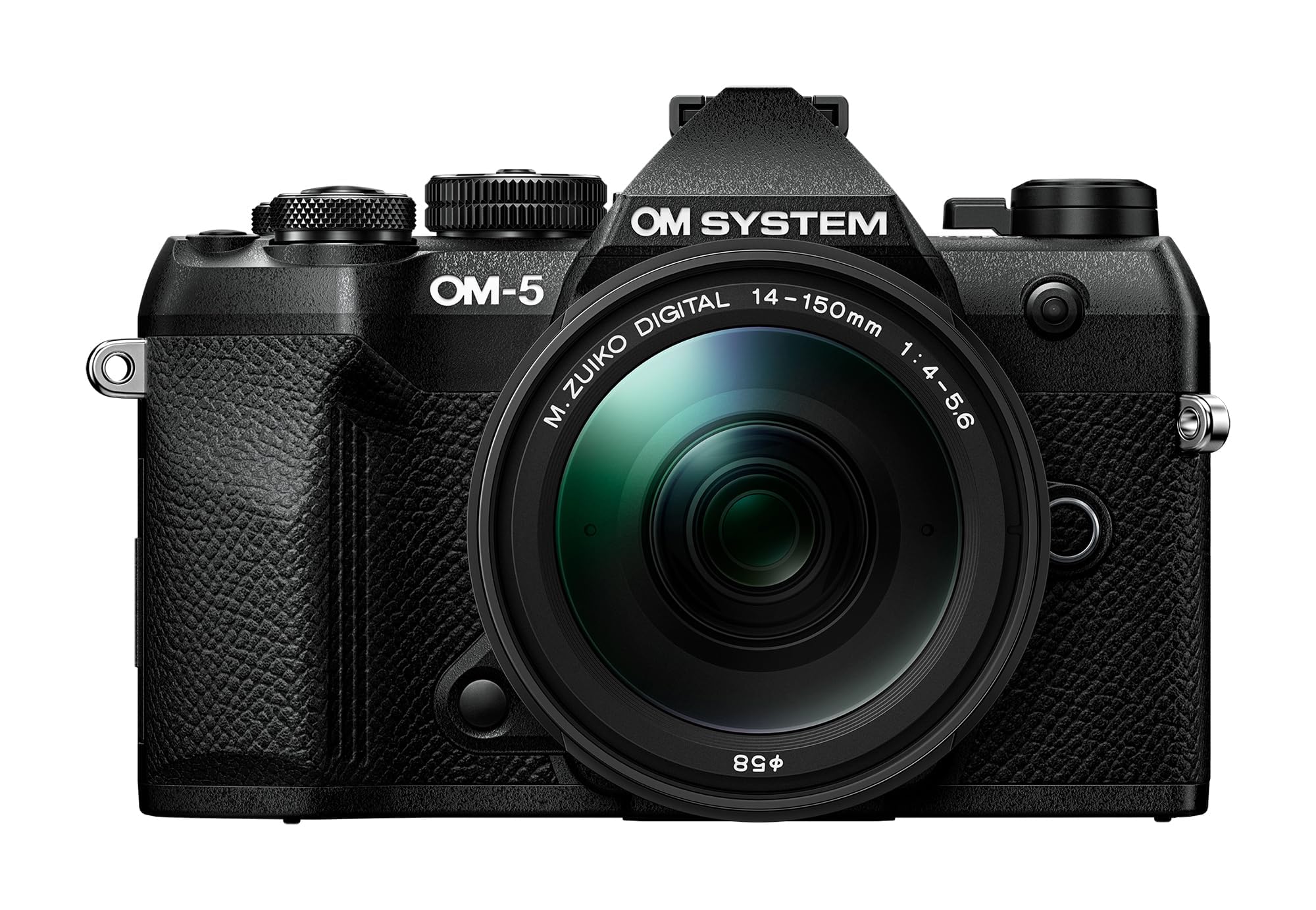
The OM-5 Mark II coupled with the 14-150mm f4.0-5.6 II is the closest thing to a do-it-all hiking camera system that still fits in a compact bag. The weather-sealed body shrugs off rain, dust, and freezing temperatures, so you never have to second-guess pulling it out during a sudden squall on a ridgeline. The 5-axis in-body image stabilization is rated up to 7.5 stops, which means sharp handheld shots at shutter speeds that would blur on almost any other body without a tripod.
At 14mm (28mm full-frame equivalent) the lens captures wide landscapes, while the 150mm end pulls in distant peaks or wildlife without forcing you to swap glass. The computational photography button unlocks focus bracketing and in-camera stacking, a real advantage for detailed macro shots of trailside mushrooms or flowers. The battery lasts comfortably through a full day of shooting, though you will want a spare if you plan on extended video recording.
The micro Four Thirds sensor delivers excellent dynamic range for the size, but those chasing shallow depth of field for portrait-style trail shots will need a faster prime lens. The menu system has improved over earlier OM models, but it remains dense enough that a first-time user should budget an evening to learn the button layout.
Why it’s great
- Outstanding weather sealing for all-season hiking
- 5-axis IBIS eliminates the need for a tripod on most shots
- Long 10.7x zoom range covers wide landscapes to distant details
Good to know
- Micro Four Thirds sensor limits shallow depth-of-field compared to full-frame
- Included kit lens aperture slows to f/5.6 at telephoto
2. Insta360 X5 Essentials Bundle

The Insta360 X5 challenges the idea that a hiking camera needs to be aimed. Its dual 1/1.28-inch sensors capture everything around you at once, so you never miss a glance over your shoulder at the fog rolling in behind you. The 8K30fps 360° footage means you can frame and reframe each shot after the hike using the excellent Insta360 app—a huge time saver when the trail moves faster than your composition skills.
The new Wind Guard on the 4-mic array makes a real difference for voice clarity when you are vlogging in gusty ridgeline conditions. FlowState Stabilization and 360° Horizon Lock keep the horizon level even when you are scrambling up a boulder field, and the Invisible Selfie Stick effect gives you a third-person perspective without adding weight to your pack. Battery life reaches 208 minutes in moderate conditions, and fast charging to 80% in 20 minutes is a lifesaver for multi-day trips.
The learning curve is real: editing 360° footage takes more effort than a standard flat video, and the smartphone app is the primary editing tool rather than a desktop application. The replaceable lens guards are a welcome addition for trail durability, but the lens caps are still easy to misplace mid-trail.
Why it’s great
- Shoots in all directions simultaneously—no aiming needed
- Excellent in-app reframing for quick social-media sharing
- Long battery life and fast charging for full-day hikes
Good to know
- Editing 360° footage requires more time than standard video
- Low-light quality lags behind single-sensor action cameras
3. Canon PowerShot V1

The Canon PowerShot V1 targets the hybrid hiker who wants both stills and video from a single compact body. The built-in 16-50mm f/2.8-4.5 zoom lens covers the most useful focal range for trail photography—wide enough for sweeping vistas, long enough for compressed mountain layers. The 1.4-type 22.3MP sensor delivers excellent dynamic range for the form factor, and the active cooling fan allows extended 4K recording sessions without overheating, a rarity in compact cameras.
Canon Log 3 recording with 10-bit color depth gives serious color-grading flexibility for hikers who edit later. The hybrid autofocus with 100 detection points locks onto subjects quickly, whether you are tracking a marmot across the rocks or letting the camera maintain focus on your face during a selfie. The large grip is a welcome ergonomic improvement over the G7X series when operating with gloves.
The fixed lens lacks optical stabilization, so the electronic IS does a decent job smoothing out micro-jitters but cannot match a gimbal-stabilized action cam for active trail running. The SD card slot sits behind the battery door, making hot swaps on the trail inconvenient without a tripod or a flat surface to rest the camera.
Why it’s great
- Versatile zoom range in a compact body
- Active cooling fan for long 4K recording on the trail
- Canon Log 3 for professional color grading
Good to know
- No optical stabilization in the lens
- SD card slot under the battery door hinders quick swaps
4. OM SYSTEM Olympus Tough TG-7 Black

The Olympus Tough TG-7 is the camera you hand to someone who says they will “be careful” and then immediately drops the gear into a creek. Waterproof to 15 meters, shockproof from 2.1 meters, and crushproof to 100 kgf—this is the most physically durable dedicated camera on this list. The F2.0 lens paired with a back-illuminated CMOS sensor performs respectably in bright light, and the variable macro system captures subjects as close as 1 centimeter from the lens, making it a go-to for trailside insect and lichen photography.
The five underwater modes, including Underwater Microscope and Underwater HDR, make this the top choice for hikers who cross rivers, dive in lakes, or shoot through waterfall spray. The 4K movie recording at up to 30 fps is paired with a 120 fps high-speed mode for slow-motion captures of splashes or wildlife. The battery lasts about two hours of continuous use, which is typical for a compact of this size, and it charges via USB-C in the field.
The small sensor limits low-light performance—anything beyond ISO 800 shows noticeable noise, and the auto mode tends to underperform in mixed lighting. The controls are numerous and small, so users with larger fingers may need to spend time memorizing the button layout. The menu system is dense and feels dated compared to modern touchscreen interfaces.
Why it’s great
- Extreme environmental durability—waterproof, shockproof, freezeproof
- Excellent macro and underwater shooting modes
- Optical zoom in a rugged point-and-shoot body
Good to know
- Small sensor struggles in low light above ISO 800
- Controls and menu are dense for first-time users
5. DJI Osmo Action 6 Enhanced Combo
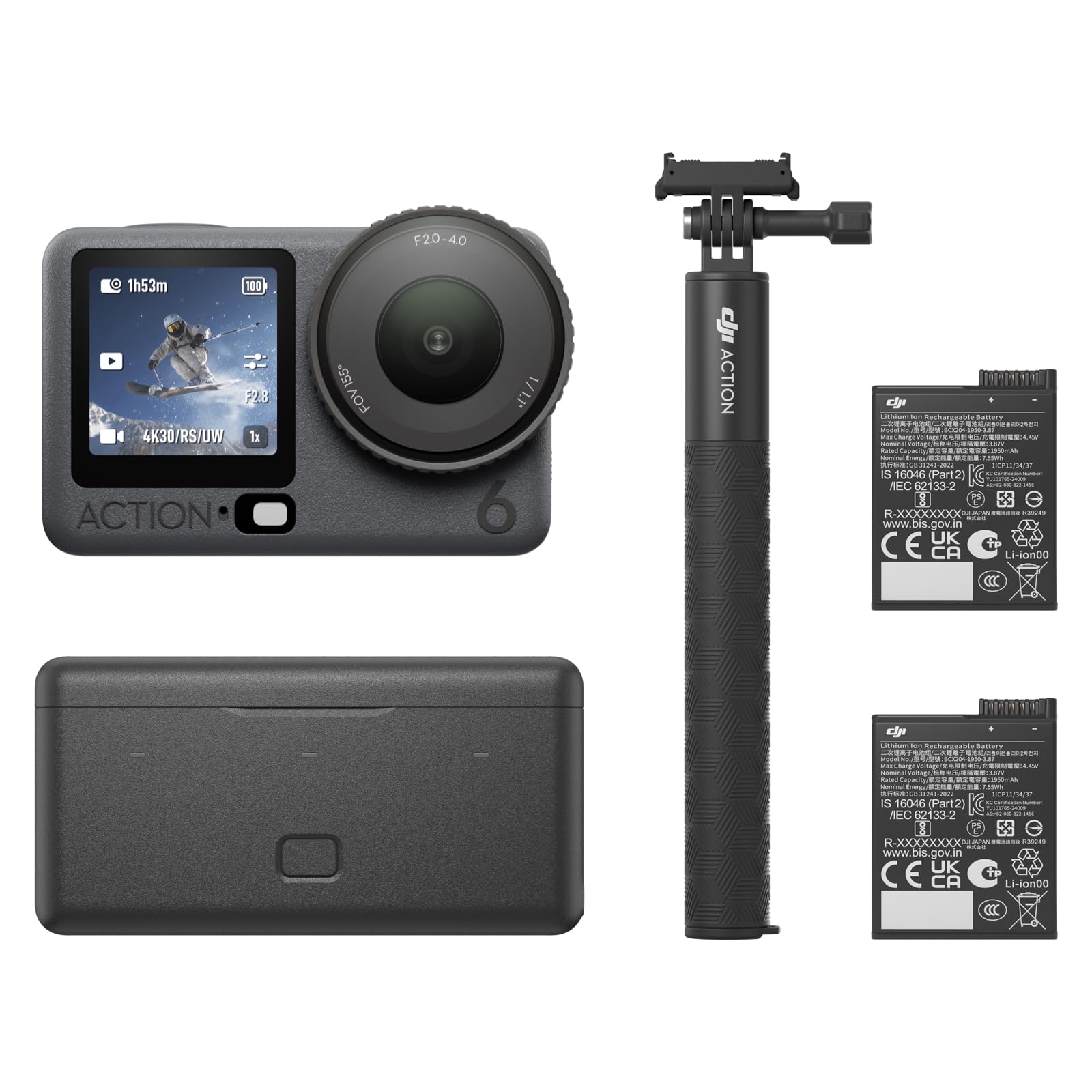
The DJI Osmo Action 6 pushes the action-camera envelope with a 1/1.1-inch square sensor and a variable aperture (f/2.0 to f/4.0) that adapts to changing trail lighting without needing a filter change. The mechanical iris lets you control depth of field and exposure in a way that fixed-aperture action cameras cannot, which means sunrise summit shots and shadowed forest floor scenes both get proper treatment. 8K video at up to 30 fps gives you vast cropping flexibility for social media reframing without losing detail.
RockSteady 3.0 and HorizonSteady keep footage smooth during trail runs, and the bundled Enhanced Combo includes two 1950mAh Extreme Batteries plus a multifunctional battery case that doubles as a power bank. The 50GB of internal storage is a genuine safety net when you forget a microSD card. The magnetic quick-release mount system makes it fast to swap between a backpack strap mount and a handlebar mount on a mountain bike.
The new 1/1.1-inch sensor is very slightly larger than the Action 5’s, but the difference is marginal for straight horizontal framing; the real advantage appears when you need to reframe or shoot vertical for social media. The front OLED touchscreen is bright enough for use in full sun, but the aftermarket waterproof case (sold separately for deep diving) blocks touch input except for limited menu navigation.
Why it’s great
- Variable aperture gives exposure control unavailable on fixed-aperture action cams
- 8K resolution offers massive reframing flexibility
- 50GB internal storage and dual batteries for all-day trail coverage
Good to know
- Additional waterproof case needed for dives beyond 20 meters
- Touchscreen navigation limited when using underwater housing
6. GoPro HERO13 Black

The GoPro HERO13 Black delivers best-in-class 5.3K60 video with 91% more resolution than 4K, so you can crop into the frame to reframe on social media without sacrificing sharpness. The HB-Series lens system auto-detects attached mods—Ultra Wide Lens, Macro Lens, or ND filters—and adjusts settings accordingly, saving you from digging into menus mid-trail. HyperSmooth stabilization continues to set the bar for electronic smoothing, making handheld trail-run footage look gimbal-stabilized.
Burst Slo-Mo captures video slowed to 13x normal speed, which reveals details like water droplets exploding off a paddle that would be invisible in real time. The Enduro battery is cold-weather-optimized, delivering up to 79 minutes of continuous recording at 5.3K, which improves significantly if you drop to lower resolutions. The rugged waterproof design handles submersion to 10 meters without a housing, and the water-repelling lens cover cut down on lens flare during backlit forest shots.
The 5.3K high-speed clips eat storage quickly—a 256GB card fills faster than you might expect if you leave the camera running on burst mode. The Quik app is decent for quick edits, but serious users will want a desktop editor. The price sits at the premium end of the action-camera spectrum once you add the Lens Mods.
Why it’s great
- Industry-leading stabilization makes handheld trail video look smooth
- HB-Series lens system offers creative versatility
- Best-in-class 5.3K resolution for cropping flexibility
Good to know
- High-resolution high-frame-rate recording consumes storage quickly
- Lens mods are an additional investment for full creative range
7. GoPro Hero Black Compact

The entry-level GoPro Hero Compact brings the stable HyperSmooth stabilization found in higher-end models to a more accessible form factor, making it a strong choice for casual hikers who want smooth footage without the premium price tag. It captures 4K30 video and 12MP stills—enough for sharing on social media—and weighs just three ounces, so it disappears into a hip pocket or chest mount. The 50-in-1 accessory kit included in this bundle adds a head strap, chest mount, and selfie stick, covering almost every mounting need for a day on the trail.
Voice control with eight commands in 11 languages works reliably for hands-free operation when your hands are full with hiking poles. The USB-C charging is standard, and the battery provides roughly one hour of 4K recording, which is enough for a summit push but may require a portable charger for full-day adventures. The bundled 64GB microSD card gets you started immediately without a separate purchase.
The lack of a rear touchscreen preview window means you rely on the app for framing, which adds friction if you want to compose a shot on the fly. The digital zoom caps out at 2x and introduces noticeable noise—best left unused. The one-hour battery life at highest settings demands careful power management on long hikes.
Why it’s great
- HyperSmooth stabilization at a budget-friendly price point
- Very lightweight—easy to carry all day
- Comprehensive accessory bundle included
Good to know
- No rear preview screen; relies on app for framing
- Battery life limited to roughly one hour at 4K
8. Canon PowerShot V10

The Canon PowerShot V10 is the smallest camera on this list that still uses a 1-inch sensor, giving it a noticeable image quality advantage over typical smartphone sensors without asking you to carry a dedicated camera body and lens. The built-in folding stand is an ingenious touch for trailside vlogging or group shots—it flips out front or back to support the camera on a rock or table, eliminating the need for a tripod. The fixed 19mm f/2.8 wide-angle lens (35mm equivalent) captures plenty of landscape and is forgiving enough for selfie-style vlogging at arm’s length.
The retractable front-facing flip-LCD is a clear signal that this is designed for vloggers, and the three internal microphones deliver surprisingly good stereo audio for a camera this small. Image stabilization has improved with firmware updates, though it still cannot match the step-change smoothing of an action camera’s electronic stabilization. The 4K video at up to 30 fps is sharp, and the 14 movie color filters let you bake a specific look into the footage without post-processing.
Battery life is the biggest limitation—you can expect about 1 to 2.5 hours depending on resolution and screen usage, so a USB-C power bank is almost mandatory for a full day on the trail. There is no lens cover, so the front element is exposed to trail dust and scratches unless you buy a third-party protector. The fixed wide-angle lens means you cannot zoom in on distant peaks; you must crop in post, limiting resolution.
Why it’s great
- Pocketable size with a proper 1-inch sensor
- Built-in folding stand for hands-free trail vlogging
- Great audio quality from three internal microphones
Good to know
- Short battery life requires a power bank for full-day use
- Fixed wide-angle lens—no zoom capability
9. Xtra Muse Pocket Gimbal Camera

The Xtra Muse builds a 3-axis gimbal directly into a pocket-sized camera body, giving hikers and vloggers mechanical-level stabilization without lugging a separate gimbal mount. The 1-inch CMOS sensor records 4K video up to 120 fps, which allows for two-times slow motion in straight 4K or four-time slow motion if you drop to 1080p. The Master Follow mode uses face and object tracking to keep you centered in the frame automatically, which works well for solo hikers who set the camera on a rock and walk past it for a cinematic tracking shot.
The 161-minute battery life is generous for a device this size, and the included 1/4-inch threaded handle lets you attach it to standard tripods or selfie sticks. The 2-inch touchscreen is responsive and large enough for framing, though it is a fingerprint magnet in direct sunlight. The 10-bit X-Log color mode gives editors latitude for color grading, which is impressive at this price point.
The autofocus system works well in good light but hunts noticeably in deep forest shade or at twilight. The gimbal motor can be heard on the audio track if you are recording sound with the internal mic in a quiet environment—an external mic solves this but adds a wire. The camera does not have a waterproof rating, so it is best kept in a dry bag during creek crossings.
Why it’s great
- Built-in gimbal provides mechanical stabilization without extra gear
- 4K120fps capability for smooth slow-motion trail footage
- Master Follow mode keeps you in frame automatically
Good to know
- Gimbal motor noise picked up by internal mic in quiet settings
- Not waterproof—requires dry bag near water
10. DJI Osmo Action 5 Pro Hiking Combo
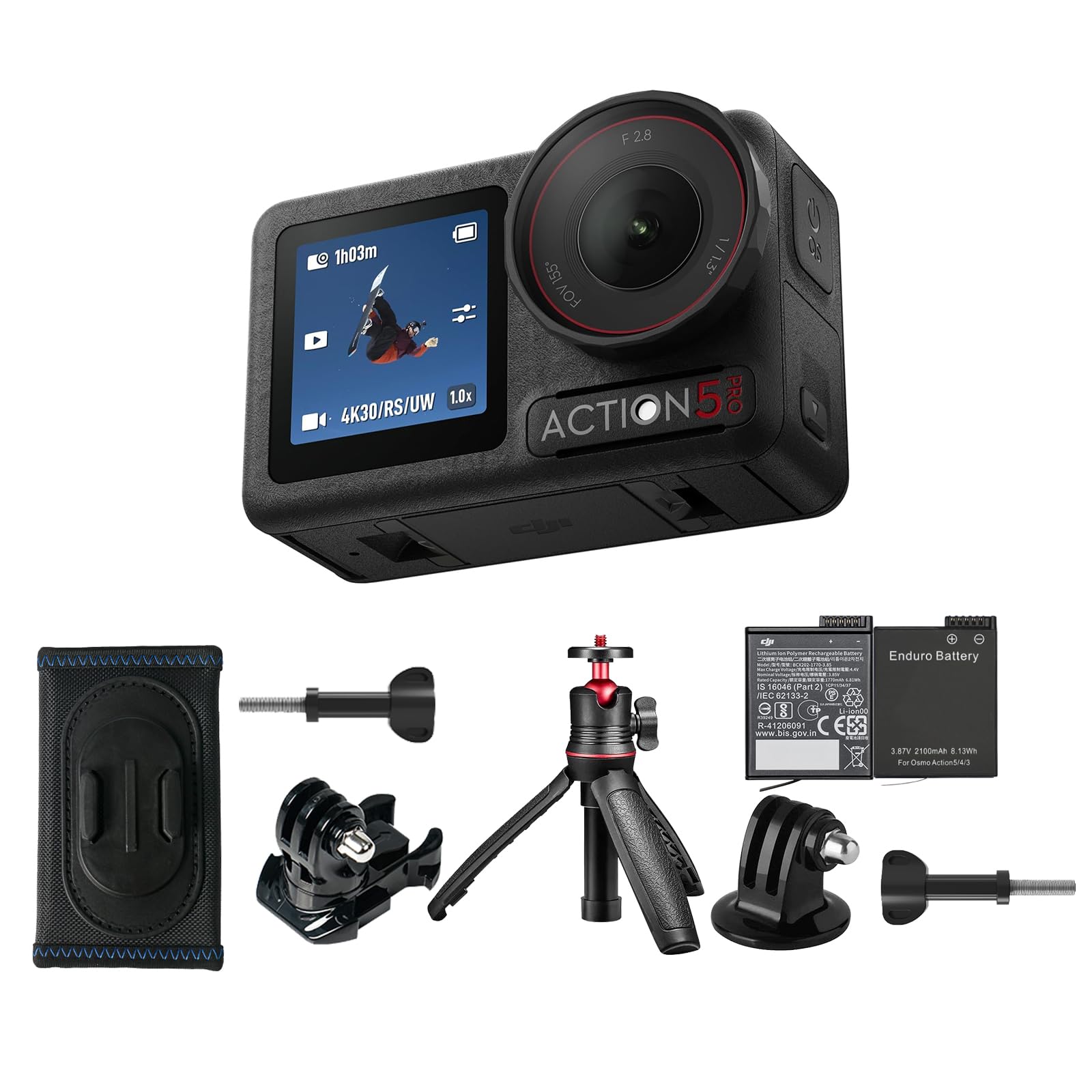
The DJI Osmo Action 5 Pro Hiking Combo is built specifically around the needs of a backcountry hiker: two batteries that together deliver up to eight hours of total recording, plus a backpack strap mount and a mini extension rod. The 1/1.3-inch sensor outputs 4K/120fps footage with a 13.5-stop dynamic range—this is class-leading exposure latitude for an action camera, meaning you can retain detail in both bright sky and shadowed rock face. The subject tracking locks onto a hiker and keeps them centered in the frame even during fast movement over uneven terrain.
The IP68 rating allows underwater use to 20 meters without a housing, and the cold-resistant battery chemistry operates reliably down to -20° C. The color temperature sensor automatically white-balances footage when moving from forest shade to exposed ridge, saving time in post-production. The dual OLED touchscreens (front and rear) are bright enough to remain visible in direct sun, which is critical for framing shots on a bright trail.
The zoom range is entirely digital and degrades quickly past 2x, so this is a fixed wide-angle camera in practice. The included accessories like the mini extension rod and backpack clamp work well, but the third-party batteries and SD card included in some bundles are low-quality and should be replaced. The 4-hour battery per cell drops to about 3 hours in very cold conditions.
Why it’s great
- Eight hours of total battery life from two included batteries
- Class-leading 13.5-stop dynamic range for high-contrast scenes
- Cold-resistant battery works reliably below freezing
Good to know
- Digital zoom is poor past 2x—no optical reach
- Bundled third-party accessories vary in quality
11. PENTAX WG-90
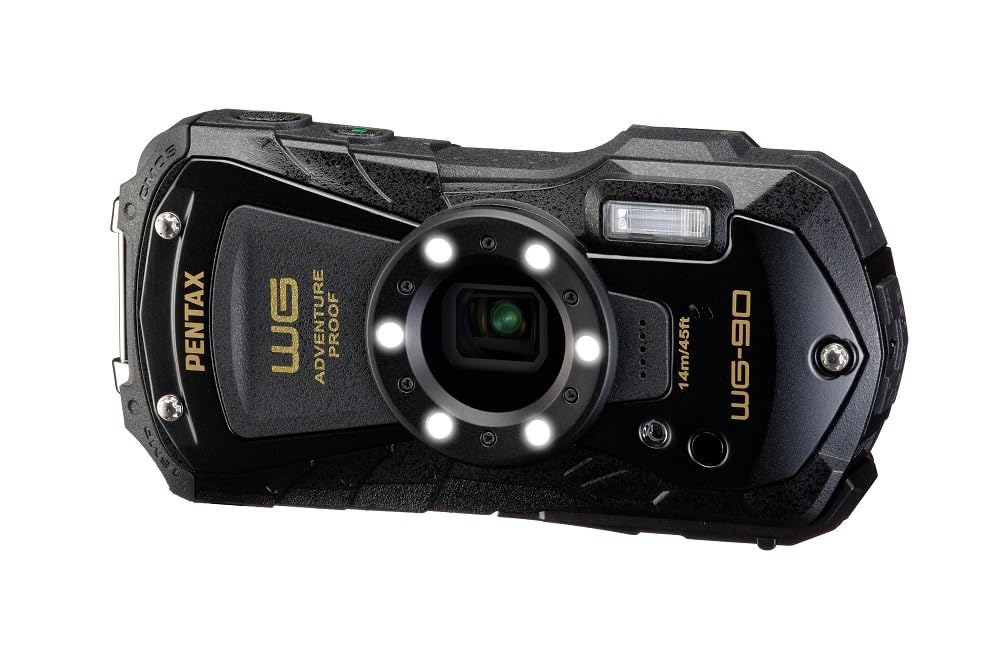
The PENTAX WG-90 is built to be the toughest dedicated trail camera under many conditions, with a heavy-duty construction that withstands submersion to 14 meters, drops from 1.6 meters, and freezing temperatures down to -10° C. What sets it apart from other rugged compacts is the six-LED macro ring encircling the lens barrel, which provides shadowless illumination for extreme close-ups of small subjects—perfect for documenting trailside fungi, insects, or geological details that larger cameras would need a ring flash to capture.
The 5x optical zoom lens covers 28mm wide-angle to 140mm telephoto equivalence, giving real reach without resorting to digital cropping. The Digital Microscope mode captures details invisible to the naked eye, and the Underwater shooting mode optimizes color and contrast based on real underwater image data. The triple anti-shake protection helps reduce blur in low-light handheld macro shots, and the outdoor-view LCD setting boosts brightness enough to frame shots in harsh midday sun.
The 16-megapixel CMOS sensor is small, so image quality in low light falls off quickly above ISO 800—this is a daylight trail camera. The auto mode tends to produce flat, underexposed images, so shooting in Program or Manual mode yields far better results. The instruction manual is famously sparse, so expect to experiment with settings on a practice hike before a critical trip.
Why it’s great
- Extreme ruggedness—waterproof, shockproof, freezeproof
- Six-LED macro ring for professional-quality close-ups on the trail
- 5x optical zoom provides real telephoto reach
Good to know
- Small sensor limits low-light performance
- Auto mode produces flat images; manual settings required
FAQ
What is the most important feature in a camera specifically for hiking?
Should I buy an action camera or a rugged point-and-shoot for hiking?
How long should a hiking camera battery last in cold weather?
Can a smartphone replace a dedicated hiking camera?
Final Thoughts: The Verdict
For most hikers who want the best balance of image quality, durability, and lens versatility, the camera for hiking winner is the OM SYSTEM Olympus Tough TG-7 because its rugged build, optical zoom, and underwater capability make it the most versatile companion for unpredictable trail conditions. If you want the creative freedom of 360-degree reframing and are willing to invest more editing time, grab the Insta360 X5. And for a lightweight, vlog-first shooter with a gimbal built right in, nothing beats the Xtra Muse Pocket Gimbal Camera.

Mo Maruf
I created WellFizz to bridge the gap between vague wellness advice and actionable solutions. My mission is simple: to decode the research and give you practical tools you can actually use.
Beyond the data, I am a passionate traveler. I believe that stepping away from the screen to explore new environments is essential for mental clarity and physical vitality.