Our readers keep the lights on and my smoothie glass nicely filled. As an Amazon Associate, I earn from qualifying purchases.
The difference between a camera that ends up on a shelf and one that ends up in your hand every morning often comes down to a single choice: the balance between image quality and portability. For daily life, you don’t need a cinema rig or a studio tool — you need a camera that disappears into a small bag or jacket pocket, starts up before the moment passes, and delivers files that feel worth keeping.
I’m Mohammad Maruf — the founder and writer behind WellFizz. I’ve spent years analyzing sensor performance, lens ecosystems, and ergonomic trade-offs across hundreds of mirrorless, DSLR, and compact bodies to find the cameras that actually reward being carried every day.
This guide cuts through the spec sheets to focus on what matters when you’re shooting for yourself, not for a client. Whether you value a pocket-friendly prime or a versatile zoom, you’ll find a real-world champion among the top options for the camera for everyday use.
How To Choose The Best Camera For Everyday Use
For daily carry, specs like ‘highest resolution’ or ‘fastest burst rate’ are less important than handling, size, and lens versatility. Focus on these three criteria.
Size and Portability
A camera that stays home doesn’t take any pictures. Look for a body that slips into a small crossbody bag or a puffy jacket pocket. Compact mirrorless bodies like the OM SYSTEM E-M10 Mark IV or the Ricoh GR IIIx are benchmarks here, while a traditional DSLR like the Nikon D5600 still offers a manageable size when paired with a compact kit zoom. For a dedicated everyday camera, the weight under 500 grams is a strong target to keep in mind.
Image Stabilization
In-body image stabilization (IBIS) is the single most impactful feature for real-world daily shooting. It allows you to shoot at shutter speeds three to four stops slower without blur, which matters during golden hour walks or indoor family gatherings. The Panasonic G85 and OM SYSTEM E-M10 Mark IV offer excellent IBIS, while the Panasonic LUMIX FZ80D relies on lens-based stabilization, which is still effective but less versatile with different lenses.
Lens Ecosystem and Autofocus
An everyday camera should come with a lens that covers the classic 24mm to 50mm-equivalent range at a minimum, and it should focus quickly and quietly. The Canon EOS R100 and Nikon Z50 II offer the powerful RF and Z lens ecosystems, respectively, with fast Dual Pixel or hybrid phase-detect autofocus. For a fixed-lens approach, the Ricoh GR IIIx’s 40mm-equivalent lens and high-speed hybrid AF deliver a unique, portable experience.
Quick Comparison
On smaller screens, swipe sideways to see the full table.
| Model | Category | Best For | Key Spec | Amazon |
|---|---|---|---|---|
| Sony a7 III | Full-Frame Mirrorless | All-round hybrid pro performance | 24MP Full-Frame BSI Sensor | Amazon |
| Nikon Z50 II (Two-Lens Kit) | APS-C Mirrorless | Versatile walkaround with telephoto reach | 20.9MP APS-C / 4K 60p | Amazon |
| Ricoh GR IIIx | Fixed-Lens Compact | Pocketable street & social photography | 24MP APS-C / 40mm f/2.8 | Amazon |
| Sony Alpha a6400 | APS-C Mirrorless | Fast AF for action and family | 24.2MP APS-C / 425 AF Points | Amazon |
| OM SYSTEM E-M10 Mark IV | Micro Four Thirds Mirrorless | Compact travel with exceptional IBIS | 20MP MFT / 4.5-Stop IBIS | Amazon |
| Nikon Z 30 | APS-C Mirrorless | Vlogging and casual video-first use | 20.9MP APS-C / 4K 30p | Amazon |
| Canon EOS R100 | APS-C Mirrorless | Beginner-friendly RF system entry | 24.1MP APS-C / 6.5 FPS | Amazon |
| Panasonic LUMIX G85 | Micro Four Thirds Mirrorless | Stabilized 4K hybrid in a compact body | 16MP MFT / 5-Axis IBIS | Amazon |
| Nikon D5600 | DX DSLR | Classic DSLR experience with vari-angle touch | 24.2MP DX / 39 AF Points | Amazon |
| Canon EOS Rebel T7 | DSLR Kit | Affordable starter with included accessories | 24.1MP APS-C / Built-in Wi-Fi | Amazon |
| Panasonic LUMIX FZ80D | Superzoom Bridge | Long-range wildlife and sports on a budget | 18.1MP 1/2.3″ / 60x Zoom | Amazon |
In‑Depth Reviews
1. Sony a7 III (Full-Frame Mirrorless)

The Sony a7 III remains the benchmark for an everyday camera that can handle professional work without hesitation. Its 24.2MP full-frame BSI sensor delivers excellent dynamic range and low-light performance, and the 693-point phase-detection AF system covers most of the frame, making it simple to track moving subjects.
The kit lens (28-70mm f/3.5-5.6) is a dependable starting point, and the battery life is exceptional at roughly 710 shots per charge. The body is weather-sealed, though not rugged enough for extreme environments. The menu system is dense, but once configured, the physical controls and custom button layout allow for fast operation.
For someone moving up from an entry-level mirrorless or DSLR, the a7 III provides a massive leap in image quality without requiring a separate video rig. The full-frame depth of field and high ISO performance open up creative options for daily shooting that crop-sensor cameras simply cannot match.
Why it’s great
- Excellent full-frame dynamic range and high ISO performance
- Industry-leading battery life for a mirrorless body
- Fast and reliable 693-point phase-detection AF
Good to know
- Menu system is deep and can feel complex at first
- Kit lens is functional but not optically exceptional
2. Nikon Z50 II (Two-Lens Kit)

The Nikon Z50 II is a refined take on the travel-friendly mirrorless formula. Its 20.9MP DX (APS-C) sensor delivers lifelike colors and solid detail, and the inclusion of two lenses — a 16-50mm standard zoom and a 50-250mm telephoto zoom — covers a wide range of daily subjects from portraits to distant wildlife.
The 231-point hybrid AF system reliably tracks people, animals, and vehicles, and the 4K 60p video with built-in electronic stabilization makes it a capable hybrid shooter. The built-in flash and the easy-to-use Picture Control presets help beginners get great-looking results out of the box. The flip-out touchscreen is helpful for selfies and vlogging.
Battery life is decent for a mirrorless body, but the flip-out screen can be power-hungry. The kit lenses are optically good, but upgrading to faster primes will reveal the sensor’s full potential. For someone who wants one body to handle everything from family gatherings to day hikes, the Z50 II is a smart mid-range choice.
Why it’s great
- Two-lens kit covers wide-angle to telephoto
- Accurate hybrid AF with animal and bird detection
- Color presets make creative shooting simple
Good to know
- Kit lenses are decent but not as sharp as prime upgrades
- Flip-out screen drains battery faster than expected
3. Ricoh GR IIIx

The Ricoh GR IIIx is the ultimate everyday carry camera for anyone who prioritizes portability above all else. Its 24.2MP APS-C sensor and fixed 40mm-equivalent f/2.8 GR lens produce stunningly sharp images that rival larger mirrorless bodies, all in a body that fits in a standard pants pocket.
Startup time is about 0.8 seconds, and the hybrid AF system is quick for street and social photography. The in-body stabilization (IBIS) helps keep shots sharp in low light, and the film simulations add a creative touch. The battery life is the biggest compromise — plan on carrying at least one spare, as a single charge may not last a full day.
There is no built-in flash, no tilt screen, and no zoom lens. These omissions are intentional trade-offs for its tiny size. If your definition of everyday use includes spontaneous documentation without any gear hassle, the GR IIIx is the most liberating camera on this list.
Why it’s great
- Exceptional image quality in a truly pocketable body
- Sharp 40mm f/2.8 lens with natural perspective
- Quick startup and reliable hybrid AF
Good to know
- Battery life is short; spare batteries essential
- No flash, no tilt screen, no zoom
4. Sony Alpha a6400

The Sony Alpha a6400 is built for speed. Its 0.02-second autofocus with Real-time Eye Tracking and 425 phase-detection points makes it arguably the fastest-focusing APS-C camera for everyday use, especially for photographing children or pets.
It captures 24.2MP stills at up to 11 frames per second with continuous AF, and the 4K video is oversampled from the full sensor width, delivering exceptionally sharp footage. The 180-degree tiltable screen is ideal for vlogging, and the E-mount lens ecosystem offers options at every price point.
Battery life is okay for stills but drains quickly during video recording. The menu system, like all Sony cameras, requires a learning curve. For photographers who value fast, accurate AF above all else and want a compact body that excels in mixed-use scenarios, the a6400 is a top-tier performer.
Why it’s great
- Exceptionally fast 0.02s autofocus with real-time tracking
- Excellent 4K video from oversampled readout
- Wide E-mount lens selection
Good to know
- Battery life is average, especially for video
- Menu system is deep and takes time to master
5. OM SYSTEM E-M10 Mark IV

The OM SYSTEM E-M10 Mark IV is a charming Micro Four Thirds camera that balances size, value, and image quality. Its 20MP Live MOS sensor paired with the 14-42mm EZ pancake lens creates a nearly pocketable setup that can still achieve beautiful results with 4.5 stops of in-body stabilization.
The flip-down monitor with a dedicated selfie mode and the built-in 16 Art Filters, including a nostalgic Instant Film effect, make it a genuinely fun camera to use. The 121-point contrast-detection AF is fast enough for most daily situations, and the 4K video is a nice bonus.
It doesn’t include an external charger, and the battery is not USB-C rechargeable, which is a minor inconvenience. The kit lens is decent for casual use, but upgrading to an OM System 12-45mm f/4 PRO lens noticeably improves sharpness. For a beginner or someone wanting a lightweight, retro-styled camera that encourages creativity, the E-M10 Mark IV is a strong contender.
Why it’s great
- Excellent 4.5-stop in-body stabilization
- Compact and stylish design with fun art filters
- Good value for an interchangeable-lens mirrorless
Good to know
- No external charger included; no USB-C charging
- Wi-Fi app can be slow
6. Nikon Z 30

The Nikon Z 30 is designed from the ground up for creators who want a simple, lightweight solution for both photos and video. The 20.9MP DX sensor delivers sharp, vibrant stills, and the 209-point hybrid AF includes reliable eye tracking for people and pets.
The built-in stereo microphone with adjustable sensitivity and a red REC light make it ideal for vlogging and live streaming. It can stream over USB-C at Full HD 60p, and the 4K 30p over HDMI is excellent for home studio setups. The Z 30 is the most compact Nikon Z body, and it doesn’t include a viewfinder, which keeps the weight and size down.
The lack of a viewfinder is a significant omission for traditional photographers who prefer eye-level framing. The kit lens (16-50mm f/3.5-6.3 VR) is versatile but not the sharpest. For someone moving from a smartphone to a dedicated camera for social media content and casual photography, the Z 30 is a smart, focused choice.
Why it’s great
- Compact and lightweight design for all-day carry
- Excellent video features with easy streaming
- Reliable eye-tracking autofocus
Good to know
- No electronic viewfinder
- Can overheat during long streaming sessions
7. Canon EOS R100

The Canon EOS R100 is the lightest and most affordable entry point into Canon’s RF mirrorless system. The 24.1MP APS-C sensor paired with the DIGIC 8 processor yields excellent image quality with natural bokeh, and the Dual Pixel CMOS AF covers 143 zones with human and animal detection.
The RF-S 18-45mm f/4.5-6.3 IS STM lens is compact and has optical stabilization, making it a good everyday kit for beginners. The 4K video is limited to 24 fps, which is fine for cinematic clips but not great for fast action. The simple GUI with a custom quick menu makes it easy to learn.
Battery life is decent for a day of casual shooting, but no external charger is included. The R100 is the smallest body in the EOS R series, which is excellent for portability. For someone who wants a modern mirrorless camera with a clear upgrade path into the RF lens ecosystem, the R100 is a compelling mid-range entry point.
Why it’s great
- Lightest and smallest EOS R body for easy carry
- Dual Pixel CMOS AF with human and animal detection
- Beginner-friendly interface with fast 6.5fps shooting
Good to know
- 4K video is limited to 24 fps
- No external charger included
8. Panasonic LUMIX G85

The Panasonic LUMIX G85 is a rugged Micro Four Thirds camera that punches above its weight in stabilization. The 5-axis in-body stabilization works with the 12-60mm Power O.I.S. lens for exceptionally steady handheld shots and 4K video.
Its 16MP sensor lacks a low-pass filter, which provides a noticeable 10% boost in fine detail. The 49-point contrast-detect AF is reliable in good light, though it can hunt in very dark conditions. The magnesium alloy body is weather-sealed, which is a rare and valuable feature at this level for everyday use in unpredictable weather.
The kit lens (12-60mm f/3.5-5.6) offers a versatile range from wide-angle to short telephoto. The battery life could be better, and wireless connectivity via the app can be finicky. For someone who wants a well-built, stabilized camera for outdoor daily adventures, the G85 is a fantastic value.
Why it’s great
- Class-leading 5-axis IBIS for photo and video
- Weather-sealed magnesium alloy body
- Excellent value for a stabilized mirrorless system
Good to know
- Autofocus can struggle in very low light
- Battery life is below average
9. Nikon D5600

The Nikon D5600 is a classic DSLR that offers a comfortable, tactile shooting experience for daily use. Its 24.2MP DX sensor with an ISO range up to 25600 produces clean, sharp files, and the 39-point phase-detection AF system is responsive for a wide range of subjects.
The 3.2-inch vari-angle touchscreen is excellent for composing shots from awkward angles, and SnapBridge Bluetooth/Wi-Fi makes transferring photos to a smartphone simple. The 18-55mm VR kit lens is optically good and stabilized. It records Full HD 1080p video at 60fps, which is still practical for social media.
It is heavier than mirrorless alternatives, and it lacks USB charging. The single command dial makes manual exposure adjustments slower than on higher-end models. For the photographer who prefers the optical viewfinder and handling of a traditional DSLR, the D5600 is a capable and affordable option for everyday shooting.
Why it’s great
- Comfortable DSLR ergonomics with optical viewfinder
- Excellent 24.2MP sensor for clean high-ISO images
- Vari-angle touchscreen for creative angles
Good to know
- Heavier and bulkier than mirrorless competitors
- No USB charging and only one command dial
10. Canon EOS Rebel T7
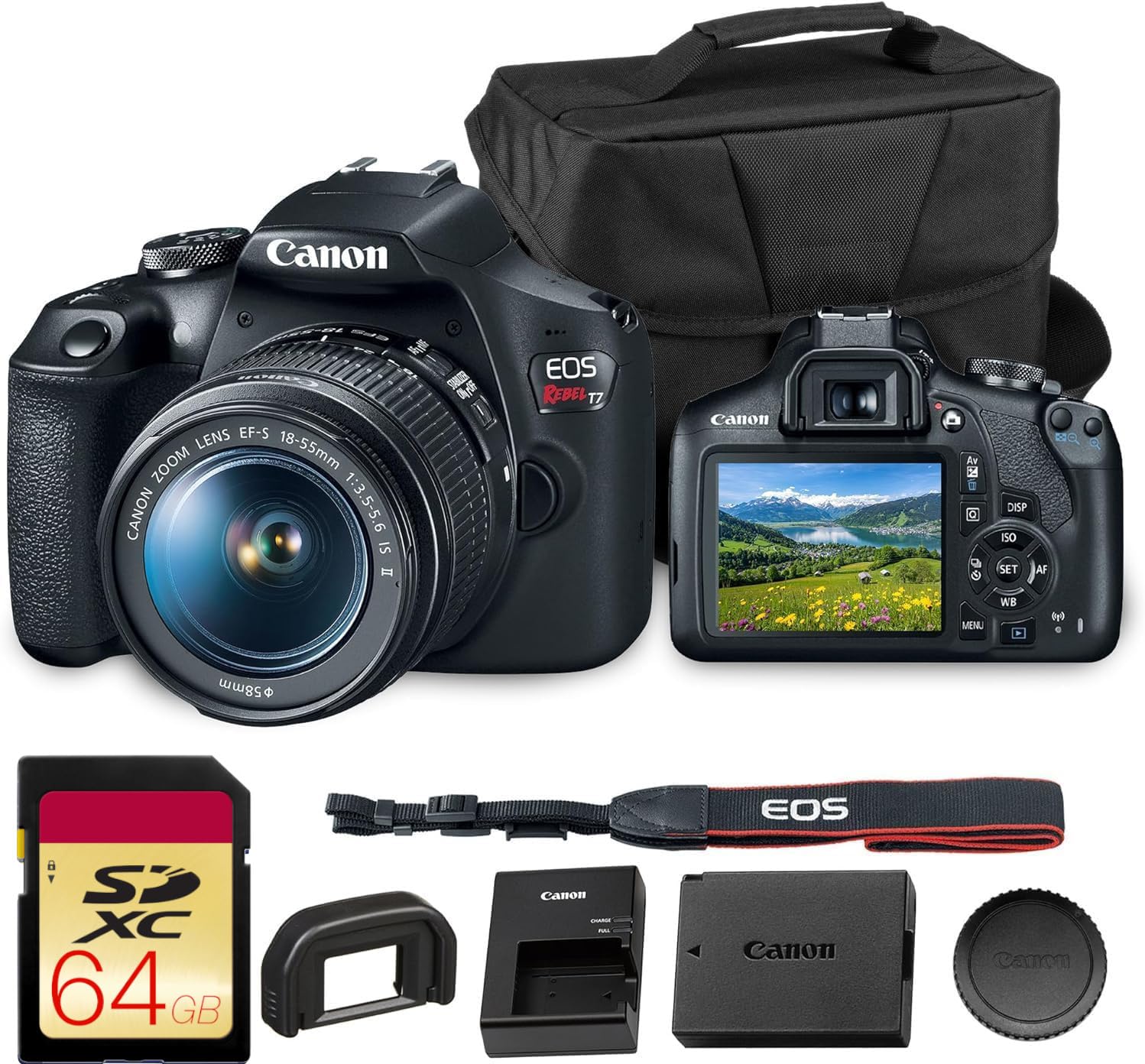
The Canon EOS Rebel T7 is a tried-and-true budget-friendly DSLR that is perfect for absolute beginners. Its 24.1MP APS-C sensor and DIGIC 4+ processor deliver solid image quality, and the 9-point hybrid AF is simple but effective for casual use.
The included kit bundle with a shoulder bag and 64GB SD card means you can start shooting right away. Built-in Wi-Fi and NFC make it easy to share photos to your smartphone. It is user-friendly and includes a built-in flash for low-light situations.
The 9-point AF system is dated compared to modern mirrorless cameras, and the continuous shooting speed is limited. The video is only 1080p at 30fps. For someone on a tight budget who wants a genuine DSLR experience with Canon’s ecosystem, the Rebel T7 kit is an excellent entry-level option for learning the fundamentals.
Why it’s great
- Excellent value kit with bag and memory card
- Simple, beginner-friendly interface with built-in guide
- Good image quality for an entry-level DSLR
Good to know
- 9-point AF system is outdated and limited
- Video is limited to 1080p at 30fps
11. Panasonic LUMIX FZ80D

The Panasonic LUMIX FZ80D is a superzoom bridge camera with a staggering 60x optical zoom (20-1200mm equivalent), making it a unique option for everyday use if your daily subjects include wildlife, sports, or distant landscapes. The Power O.I.S. stabilization helps keep long shots steady.
It records 4K video and offers 4K Photo mode at 30fps for extracting high-resolution frames. The camera is lightweight and features USB-C charging, which is convenient for travel. The 3-inch touch LCD and OLED viewfinder help with framing in bright conditions.
The major compromise is the small 1/2.3-inch sensor, which struggles in low light and can’t match the image quality of cameras with larger sensors. The autofocus can also be slow at full telephoto. For a budget-friendly option that puts versatility above every other spec, the FZ80D is hard to beat.
Why it’s great
- Incredible 60x zoom range for a compact body
- Power O.I.S. stabilization for steady telephoto shots
- USB-C charging for convenient travel power
Good to know
- Small sensor leads to poor low-light performance
- Autofocus can struggle at maximum zoom
FAQ
What sensor size is best for an everyday camera?
Is it worth getting a camera with IBIS for everyday use?
Should I buy a kit zoom lens or a fixed prime lens for my first everyday camera?
How many megapixels do I need for everyday photos?
Final Thoughts: The Verdict
For most users, the best camera for everyday use winner is the Sony a7 III because its full-frame image quality, class-leading battery life, and robust autofocus system make it a tool that can handle years of daily photography and grow with you. If you want a more portable hybrid that prioritizes video and vlogging, grab the Nikon Z 30. And for pure pocketability and the joy of a stunning fixed-lens camera, nothing beats the Ricoh GR IIIx.

Mo Maruf
I created WellFizz to bridge the gap between vague wellness advice and actionable solutions. My mission is simple: to decode the research and give you practical tools you can actually use.
Beyond the data, I am a passionate traveler. I believe that stepping away from the screen to explore new environments is essential for mental clarity and physical vitality.