Our readers keep the lights on and my smoothie glass nicely filled. As an Amazon Associate, I earn from qualifying purchases.
Aerial photography changes the way you see the world, but the gap between a decent drone shot and a professional frame comes down to gimbal stability, sensor size, and intelligent flight logic. You don’t need a cinema rig to capture cinematic footage — you need a drone that understands how to keep the horizon level while you focus on the composition. The market now offers everything from palm-sized follow-me cameras to full-frame 6K monsters, and navigating that landscape requires knowing exactly which specs translate to real image quality.
I’m Mohammad Maruf — the founder and writer behind WellFizz. I’ve spent years analyzing drone camera systems, comparing gimbal performance, transmission protocols, and sensor specifications to separate marketing claims from measurable results.
Whether you’re a weekend hiker wanting hands-free tracking or a real estate pro needing publish-ready 4K HDR, this guide breaks down the options. Here is the definitive analysis of the best camera for drone photography so you can select the one that fits your creative workflow and budget.
How To Choose The Best Camera For Drone Photography
Selecting the right camera drone isn’t just about comparing sensor megapixels. You need to evaluate the entire imaging chain — from the gimbal’s mechanical precision to the transmission system’s ability to deliver a real-time, artifact-free feed. Here are the key factors that separate a capable aerial camera from a frustrating toy.
Prioritize the Gimbal Over the Sensor
A 48MP sensor is useless if every frame is blurred by vibration or wind. The gimbal is the single most important component for drone photography. A 3-axis mechanical gimbal physically stabilizes the camera across pitch, roll, and yaw, keeping the horizon level even during aggressive maneuvers. Cheaper drones rely solely on electronic image stabilization (EIS), which crops the frame and can introduce warping artifacts. For serious photography, a 3-axis brushless gimbal is non-negotiable.
Sensor Size and Aperture
A larger sensor captures more light, which directly translates to better dynamic range, cleaner shadows, and reduced noise in low-light conditions. A 1/2-inch CMOS sensor is common in the mid-range, while premium options like the 1-inch Sony CMOS sensor found in the Autel EVO 2 Pro V3 provide a noticeable jump in image quality. The aperture also matters — an f/1.8 lens lets in more light than an f/2.8, giving you more flexibility during golden hour or overcast days.
Transmission Range and Bitrate
You can’t frame a shot you can’t see. Real-time video transmission quality depends on the transmission protocol. Wi-Fi-based systems are prone to interference and limited range, while digital transmission systems (like DJI OcuSync or Autel Skylink) offer low-latency, high-bitrate feeds up to 10 km or more. For photography, a stable 1080p feed is essential for accurate composition. Also check the video bitrate — 100 Mbps or higher ensures your footage retains detail during fast motion and complex scenes.
Flight Time and Battery Ecosystem
A single battery typically offers 25–35 minutes of real-world flight time. For a productive shooting session, you’ll want at least two batteries, and ideally three. Pay attention to whether the drone supports fast charging and whether the batteries are smart batteries with over-discharge protection. Some bundles include a charging hub that can charge multiple batteries simultaneously, dramatically reducing downtime in the field.
Weight and Regulatory Compliance
Drones under 249 grams are exempt from FAA registration and Remote ID requirements in the United States. This makes them significantly easier to travel with and operate legally. However, lighter drones are more affected by wind, so you need to balance portability with stability. If you plan to fly in coastal or mountainous areas, a slightly heavier drone with a more powerful motor system may perform better.
Quick Comparison
On smaller screens, swipe sideways to see the full table.
| Model | Category | Best For | Key Spec | Amazon |
|---|---|---|---|---|
| Potensic ATOM 2 Fly More Combo | Mid-Range | All-around with built-in display | 48MP Sony CMOS, 3-axis gimbal, 10km transmission | Amazon |
| DJI Flip (RC-N3) | Mid-Range | Portable cinematic starter | 1/1.3-inch CMOS, 4K/60fps HDR, 31-min flight | Amazon |
| Autel EVO 2 Pro V3 | Premium | Professional 6K with 1-inch sensor | 1-inch Sony CMOS, 6K HDR, 360° obstacle avoidance | Amazon |
| Holy Stone Sentinel HS600D | Mid-Range | Wind-resistant 8K photos | 1/2-inch Sony CMOS, 8K photo, Level-6 wind resistance | Amazon |
| Bwine F7GB2 Pro | Mid-Range | High-altitude farm/villa patrol | 4K, 3-axis gimbal, 2000m altitude, L6 wind resistance | Amazon |
| HOVERAir X1 PRO | Mid-Range | Action/adventure self-flying camera | 4K/60fps, 42km/h follow, 192g, OmniTerrain | Amazon |
| DJI Neo 2 Fly More Combo | Mid-Range | Gesture-control walkaround shooting | 4K, omnidirectional obstacle sensing, palm takeoff | Amazon |
| Holy Stone HS790 | Mid-Range | Long-range beginner cinematography | 6K photo, 4K video, 30,000ft transmission | Amazon |
| Ruko 4K UHD Drone | Mid-Range | 8K photo budget-friendly bundle | 48MP sensor, 3-axis gimbal, 96-min total flight | Amazon |
| Bwine F7MINI | Mid-Range | Sub-249g with built-in screen controller | 48MP, 3-axis gimbal, 96-min flight, 6km transmission | Amazon |
| HOVERAir X1 | Entry-Level | Pocket follow-me autonomous vlogger | 2.7K/30fps, 125g, palm takeoff, 32GB internal | Amazon |
In‑Depth Reviews
1. Potensic ATOM 2 Fly More Combo with RC PTD 1
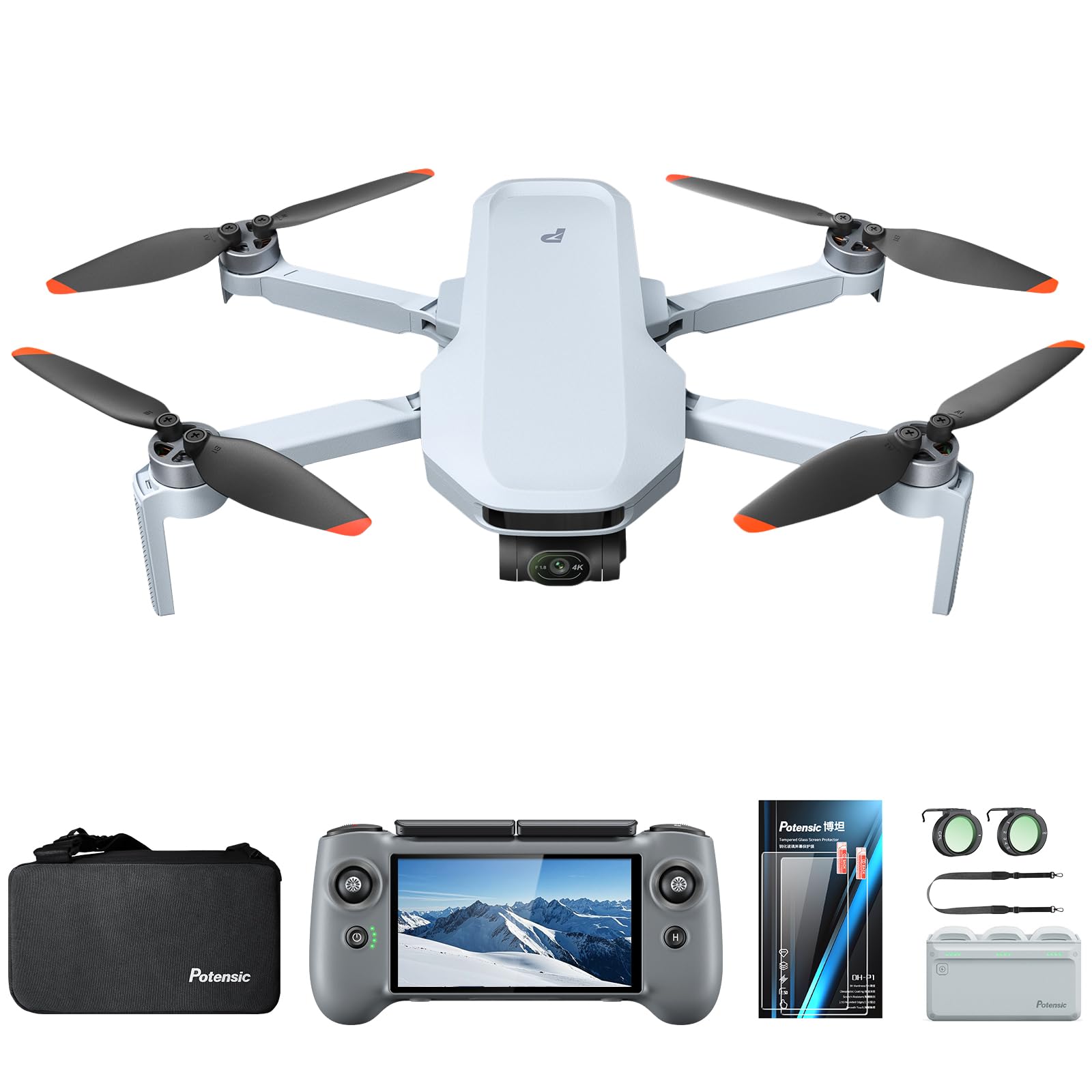
The Potensic ATOM 2 Fly More Combo is the most complete package in the mid-range segment. It pairs a 1/2-inch Sony CMOS sensor capable of 48MP photos and 4K/30fps HDR video with a genuine 3-axis mechanical gimbal, ensuring your frames stay level and stable even in moderate wind. The included ND and CPL filters give you immediate creative control over exposure and reflections, something rarely seen at this tier.
The real game-changer is the PTD 1 remote controller with its built-in 5.5-inch 1920×1080 FHD touchscreen that hits 700 nits of brightness — no phone required, no incoming calls interrupting your flight. The PixSync 4.0 transmission system delivers a 1080p/30fps live feed at up to 10 km, and the charging hub fully charges all three batteries in 1.3 hours. The drone itself weighs under 249 grams, keeping it FAA-exempt and travel-friendly.
AI tracking modes including Spotlight, Follow, and Parallel work reliably for tracking subjects during hikes or bike rides. The inclusion of vertical shooting (2.7K) and Dolly Zoom video modes makes this a versatile tool for social media creators. The only real limitation is the lack of omnidirectional obstacle avoidance — you get forward-facing sensors and a downward vision system, but side and rear protection are absent.
Why it’s great
- Built-in FHD touchscreen controller eliminates phone dependency
- ND and CPL filters included for cinematic exposure control
- Under 249g, FAA‑exempt, and total 96 minutes of flight time
- Reliable AI tracking with Spotlight and Parallel modes
Good to know
- No omnidirectional obstacle avoidance — only forward and downward sensors
- Maximum video resolution is 4K/30fps, not 60fps
- Controller screen can be reflective; matte protector recommended
2. DJI Flip (RC-N3)

The DJI Flip brings a larger 1/1.3-inch CMOS sensor to the sub-249g category, and that extra surface area translates directly into better dynamic range and cleaner low-light performance compared to most competitors using 1/2-inch sensors. Shooting 4K at 60fps with HDR gives you the flexibility to slow down footage in post without losing smoothness, and the 48MP stills are genuinely detailed enough for high-resolution prints.
DJI’s subject tracking is class-leading. The Flip maintains focus on a moving subject reliably, whether they’re hiking, cycling, or just walking through a crowd. The full-coverage carbon fiber propeller guards add a layer of safety for close-range shooting, and the palm takeoff/landing feature makes it incredibly easy to deploy without a flat surface. The 31-minute max flight time is decent for a single battery, but you’ll likely want at least one extra for extended sessions.
The RC-N3 remote controller does not have a built-in screen, so you’ll need to mount your smartphone. This is a minor inconvenience compared to the image quality you get, but it’s worth noting if you prioritize an all-in-one controller. The Flip also lacks side and rear obstacle avoidance — only forward-facing sensors are present — so manual piloting near obstacles requires care.
Why it’s great
- Larger 1/1.3-inch sensor delivers superior dynamic range
- 4K/60fps HDR video for smooth slow-motion capability
- Excellent subject tracking and palm takeoff for quick deployment
- Under 249g, FAA‑exempt, and carbon fiber propeller guards
Good to know
- Remote controller requires a smartphone — no built-in display
- Only forward obstacle avoidance, no side or rear sensors
- Extra batteries and a case are needed for full utility
3. Autel Robotics EVO 2 Pro V3

The Autel EVO 2 Pro V3 is a dedicated aerial cinematography tool. It houses a true 1-inch Sony CMOS sensor that captures 6K HDR video at up to 30fps and 20MP stills in 12-bit DNG RAW format. The adjustable aperture (f/2.8 to f/11) gives you precise control over depth of field and exposure without needing ND filters, and the Moonlight Algorithm 2.0 pushes the maximum ISO to 44,000 for usable low-light footage.
The 360-degree omnidirectional obstacle avoidance system uses 12 computer vision sensors and two sonar sensors, making it one of the safest drones to fly in complex environments. The Autel Smart Controller SE features a 6.4-inch OLED touchscreen with 2,000 nits of brightness, making it readable even in direct sunlight. The Skylink 2.0 transmission system offers 15 km range with tri-band frequency hopping — rock-solid signal integrity even in urban areas.
The EVO 2 Pro V3 carries a weight of 1,191 grams, well above the FAA-exempt threshold, so you will need to register it and comply with Remote ID requirements. The 40-minute flight time is generous, and the rugged bundle includes a hard case, three batteries, and a charging hub. The learning curve is steeper than consumer drones, and the gimbal is sensitive to rough landings — use the included gimbal clamp every time you transport it.
Why it’s great
- 1-inch Sony CMOS with 6K HDR and adjustable aperture
- 12-bit DNG RAW for extensive post-production flexibility
- 360° omnidirectional obstacle avoidance with 12 sensors
- Smart Controller SE with 6.4-inch OLED screen (2,000 nits)
Good to know
- Over 249g — requires FAA registration and Remote ID
- Higher price point reflecting professional-grade components
- Steep learning curve for beginners; gimbal requires careful handling
4. Holy Stone Sentinel HS600D

The Holy Stone Sentinel HS600D leans heavily into build quality and wind resistance. Its 603-gram reinforced frame and powerful motors, combined with a 3-axis gimbal and EIS, keep footage smooth in conditions up to Level-6 wind — roughly 25 to 31 mph. The 1/2-inch Sony CMOS sensor captures 8K photos and 4K HDR video, and the f/1.8 aperture helps in lower light, though the lack of manual exposure controls limits creative flexibility.
The 20,000-foot (6 km) wired-relay transmission system is impressively stable and low-latency, avoiding the interference issues common with Wi-Fi-based drones. The two included 3,500 mAh batteries provide up to 80 minutes of total flight time. Beginner safety features like one-button takeoff/landing, smart return-to-home, altitude limits, and multi-sensor positioning (GPS + TOF + optical flow) make it approachable for new pilots.
The controller does not have a built-in screen, so you’ll need to use your smartphone as the display. Some users report that the camera tends to overexpose in bright conditions and that there is no RAW format support for stills, which limits post-processing options. The drone also lacks side obstacle sensors, though the forward and downward sensors work reliably for most flying scenarios.
Why it’s great
- Excellent Level-6 wind resistance for gusty conditions
- 8K photo resolution with 4K HDR video capture
- Stable wired-relay transmission up to 20,000 feet
- Beginner-friendly with GPS, TOF, and optical flow positioning
Good to know
- No built-in controller display — requires a smartphone
- No RAW photo format; limited manual exposure controls
- Lacks side and rear obstacle avoidance sensors
5. Bwine F7GB2 Pro

The Bwine F7GB2 Pro is built for high-altitude environments where thinner air and stronger winds challenge lighter drones. Its 1806 brushless motors and Level-6 wind resistance allow stable flight at up to 2,000 meters (6,562 feet), with a control range of approximately 10,000 feet. The detachable 4K camera with a 3-axis gimbal and 120-degree FOV delivers smooth, wide-angle footage, and the 5x digital zoom is useful for framing distant subjects.
The 75-minute total flight time comes from three 2,600 mAh smart batteries that are UL 2054 certified for safety. GPS features include follow-me, waypoint, orbit, and auto return-to-home on low battery or signal loss. The F7GB2 Pro also includes a built-in Remote ID module that complies with FAA regulations — an important detail for legal flying.
The remote controller does not have a built-in screen, and the phone holder can feel flimsy. Battery life per charge is around 15–20 minutes under normal flying, which is solid but not exceptional. Some users note that the camera feed can lag slightly at the edge of the range, and the app’s social media sharing features are somewhat gimmicky. The carrying case is a hard shell that offers good protection.
Why it’s great
- Certified for flight up to 2,000m altitude with Level-6 wind resistance
- Three UL 2054-certified smart batteries — 75 total minutes
- Built-in FAA Remote ID compliance for legal operation
- Detachable 4K camera with 3-axis gimbal and 120° FOV
Good to know
- Remote controller has no built-in display; phone mount feels basic
- Battery life per charge is 15–20 minutes under normal flight
- Camera feed can experience slight lag at maximum range
6. HOVERAir X1 PRO

The HOVERAir X1 PRO is designed as a flying action camera rather than a traditional drone. Weighing just 192 grams and folding down to a pocketable size, it prioritizes quick deployment and hands-free operation. The two-axis gimbal with EIS and horizon leveling keeps footage watchable, though it lacks the yaw stability of a full three-axis system. The 104-degree FOV lens captures a wide perspective suitable for sports and outdoor adventures.
The follow speed of up to 42 km/h (26 mph) with a top burst of 60 km/h makes it one of the fastest tracking drones available. The OmniTerrain capability allows it to fly over snow, water, and cliffs without issue. Rear Time-of-Flight collision detection provides braking when obstacles are detected, and the 15+ automated flight modes include Hover, Follow, Zoom Out, Orbit, and Dolly Track — all accessible via voice command or a single button press.
Footage quality is 4K at 60fps horizontally and 2.7K at 60fps vertically, which is sufficient for social media content. The 32GB internal storage is expandable via microSD up to 1TB. However, the lack of a traditional remote controller means you rely entirely on the app for manual control, which can be limiting for precise framing. The battery life is around 16 minutes in active flight, so the two-battery kit is almost essential.
Why it’s great
- Extremely portable (192g) with folding design and OmniTerrain capability
- High follow speed of 42 km/h for tracking fast-moving activities
- Rear ToF collision detection and 15+ automated flight modes
- Voice control and palm takeoff for true hands-free operation
Good to know
- Two-axis gimbal (plus EIS) — less stable than a 3-axis system
- No traditional remote control — manual control only via app
- Battery life around 16 minutes; multi-battery bundle recommended
7. DJI Neo 2 Fly More Combo
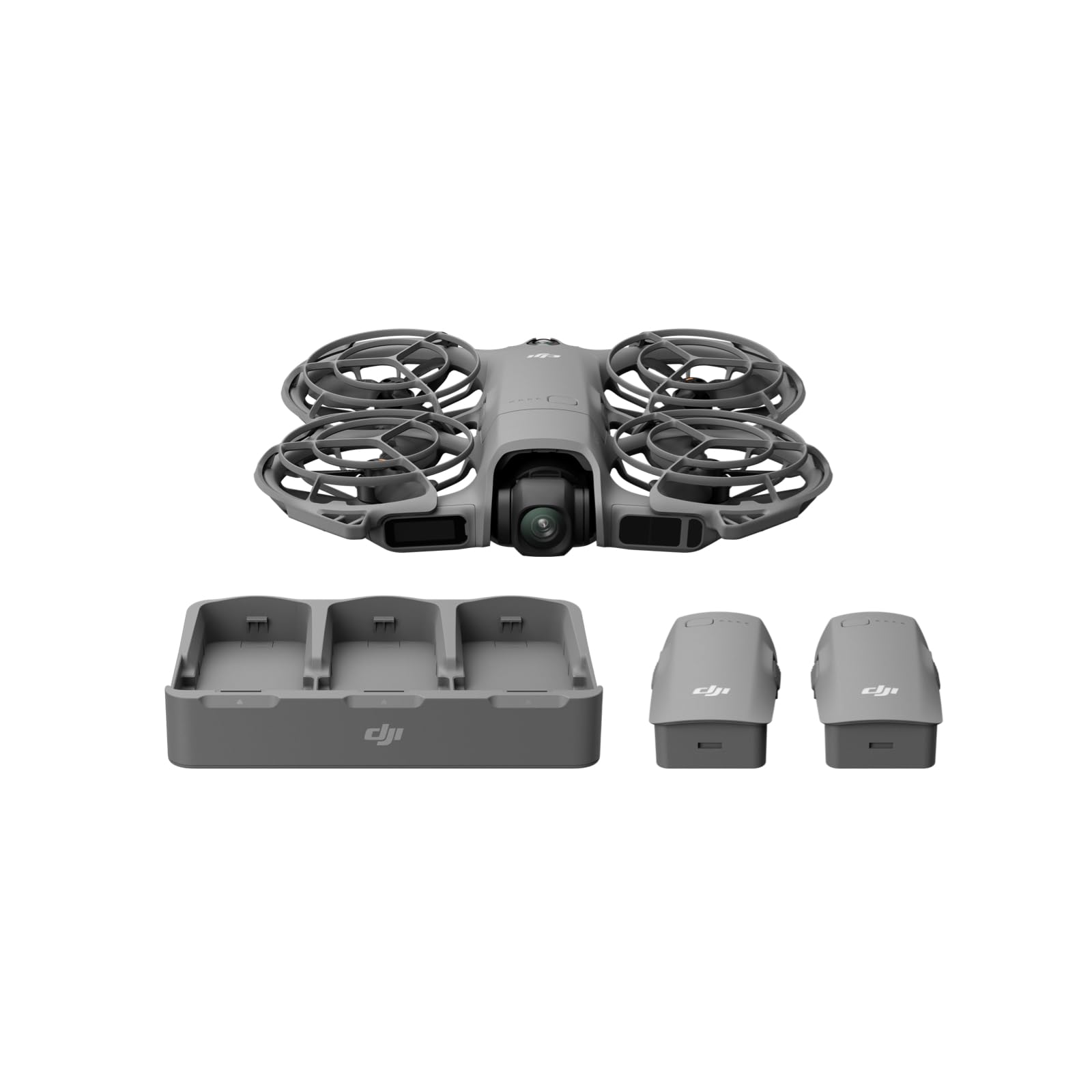
The DJI Neo 2 Fly More Combo offers an impressive feature set at a compelling price point. It supports gesture control and palm takeoff/landing, making it highly accessible for users who want to capture themselves without needing a separate camera operator. The ActiveTrack system keeps subjects centered in the frame reliably, and the omnidirectional obstacle sensing provides a safety net that’s rare at this price tier.
Image quality reaches 4K resolution, and the 12MP stills are clean in good light. The C0 certification (under 249g with full-coverage propeller guards) means it remains FAA-exempt, and the three-battery Fly More bundle extends total flight time significantly. The lack of a gimbal is the most notable omission — the Neo 2 relies on electronic stabilization, which works well for casual shots but introduces rolling shutter artifacts during fast pans.
The drone is operable entirely without a remote controller via the DJI Fly app, but for more precise control, you can connect a Bluetooth controller. Some users report occasional wobble in gusty conditions due to the absence of mechanical stabilization. The propeller guards are effective but create some drag, reducing flight time slightly compared to unguarded designs. Overall, it’s an excellent entry point for social media content creators.
Why it’s great
- Gesture control and palm takeoff for truly hands-free operation
- Omnidirectional obstacle sensing for safer automated flights
- C0 certified with full propeller guards — FAA-exempt
- Three-battery Fly More Combo extends total flight time
Good to know
- No mechanical gimbal — relies on electronic stabilization
- Image quality acceptable but not on par with gimbal-equipped drones
- Propeller guards create drag, reducing max flight time slightly
8. Holy Stone HS790
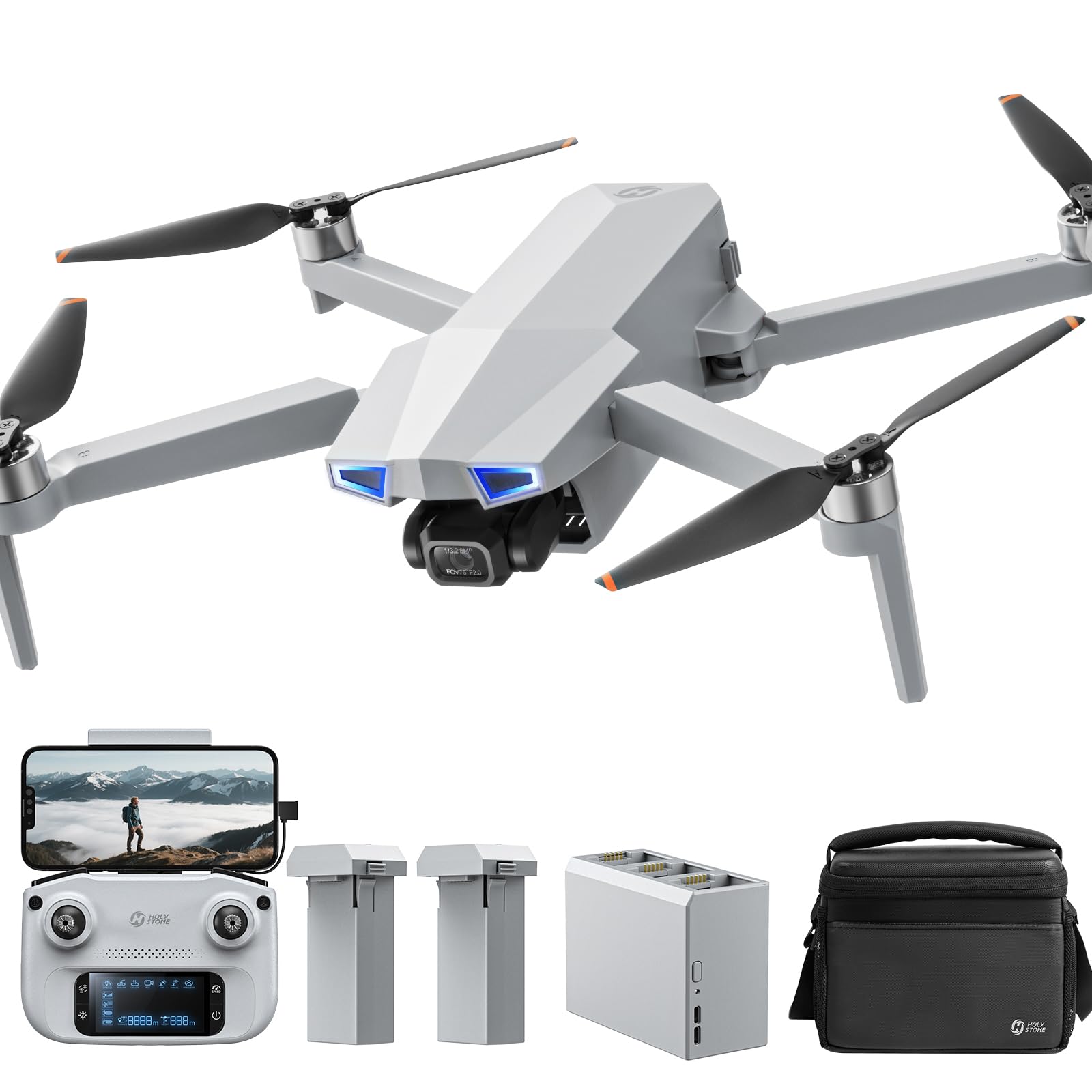
The Holy Stone HS790 emphasizes range and battery flexibility. Its Wi-Fi repeater-based transmission system claims up to 30,000 feet (9 km) of real-time 4K video streaming, which is generous for the price point. The two 3,200 mAh intelligent batteries provide up to 60 minutes of total flight, and the smart PD charging hub doubles as a power bank — a thoughtful addition for field use.
The 3-axis brushless gimbal delivers stable 4K/30fps footage, and the camera can capture 6K still photos. The built-in Remote ID compliance satisfies FAA requirements, and GPS smart modes including Follow Me, Waypoint, and Orbit make it easy to execute cinematic shots. The Night Mode feature enhances visibility during twilight flights, though low-light image quality is average due to the smaller sensor.
The HS790’s 1506 brushless motors provide stable, quiet flight, and the foldable design packs into a carrying case. However, some users report that the app can be buggy — the alternative HT FLY app is recommended for better performance. The gimbal struggles slightly during rapid directional changes, and the follow-me mode lacks distance customization. The controller also lacks a built-in screen, so a phone is required.
Why it’s great
- Class-leading 30,000ft transmission range for long-distance exploration
- PD fast charging hub doubles as a portable power bank
- Built-in Remote ID compliance, GPS smart modes, and Night Mode
- Stable 3-axis gimbal with 4K/30fps and 6K photo capture
Good to know
- App stability issues; HT FLY version recommended over default app
- Gimbal struggles during fast turns and aggressive maneuvers
- No built-in controller display — smartphone required
9. Ruko 4K UHD Drone for Adults

Ruko’s entry into the sub-249g category combines a 48MP 1/2-inch CMOS sensor with a genuine 3-axis brushless gimbal and EIS, delivering footage that holds up well against more expensive options. The 8K photo mode is achieved through pixel binning and interpolation — real-world resolution is more like 48MP stills, but the results are crisp in good light. The 4K/30fps video is smooth and well-stabilized thanks to the gimbal.
The three-battery kit yields 96 minutes of total flight time, which is generous at this price. The R2 digital transmission system provides a reliable 20,000-foot range without the interference typical of Wi-Fi drones. Beginner-friendly features include one-button takeoff/landing, three auto-return safety triggers, and a built-in beeper for locating the drone. The AI takeoff/landing system uses quadruple intelligent positioning (GPS, barometric, TOF, optical flow) for precise hovering.
Customer reviews consistently highlight Ruko’s responsive support — multiple reports of defective units being replaced quickly. The joysticks are sensitive, which can be a challenge for absolute beginners, and there is no side obstacle avoidance. The carrying case included in the bundle offers good protection, and the spare parts package saves you from buying individual replacements later. The lack of RAW photo support limits editing flexibility.
Why it’s great
- 48MP sensor with 3-axis gimbal for stable, high-resolution imagery
- 96-minute total flight time across three intelligent batteries
- R2 digital transmission with 20,000ft range — low interference
- Excellent customer support and comprehensive bundle with case
Good to know
- No RAW photo capture — JPEG only, limiting post-processing
- Joysticks are sensitive; may require practice for precise control
- No side obstacle avoidance — only forward and downward sensors
10. Bwine F7MINI
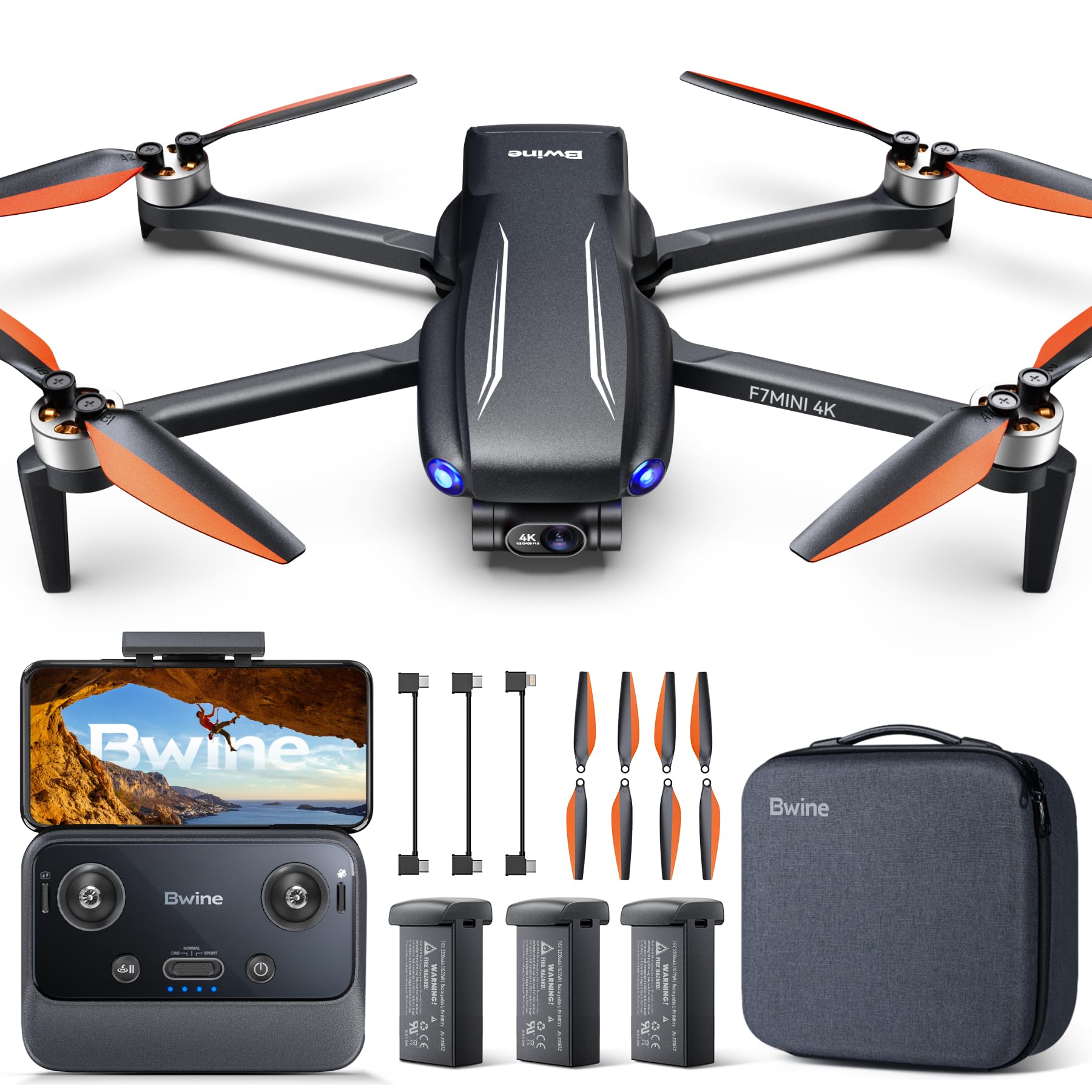
The Bwine F7MINI stands out in the sub-249g segment because its remote controller includes a built-in 5.5-inch HD touchscreen, eliminating the need to connect your smartphone. The 48MP 1/2-inch CMOS sensor with f/1.8 aperture captures 8K photos and 4K/30fps video, and the 3-axis stabilized gimbal keeps footage steady even in Level-5 wind conditions. The 1503 brushless motors provide a top speed of 31 mph with solid wind resistance.
Total flight time reaches 96 minutes from three high-density batteries (32 minutes each), and PD 3.0 fast charging reduces downtime. The 20,000-foot (6 km) wired digital transmission offers low-latency video with strong anti-interference. Smart GPS features include auto return-to-home, dynamic home point, follow, orbit, waypoint flight, and automatic cruise. The 120dB locator buzzer is genuinely loud enough to find the drone in tall grass.
The built-in controller screen is responsive but has limited brightness — it can be hard to see in direct sunlight. The gimbal performs well but introduces subtle motor noise that may be audible in quiet environments. Despite the 8K claim, real-world photo resolution is more consistent with 48MP interpolation. The F7MINI is beginner-friendly with one-button takeoff/landing and three flight speeds, but experienced pilots may find the app’s manual controls limited.
Why it’s great
- Remote controller with built-in 5.5-inch touchscreen — no phone needed
- Under 249g, FAA-exempt with 96-minute total flight time
- 3-axis gimbal with strong wind resistance up to Level 5
- Smart GPS modes and 120dB locator buzzer for recovery
Good to know
- Controller screen struggles with visibility in bright sunlight
- Gimbal produces subtle motor noise in quiet environments
- 8K photo claims are interpolated; effective resolution is 48MP
11. HOVERAir X1 Drone (Combo Plus)

The HOVERAir X1 is the lightest drone in this guide at just 125 grams — lighter than many smartphones and fully exempt from FAA registration. It’s designed as an autonomous follow-me camera, launching from your palm with a single click. The triple stabilization system (EIS-based) produces smooth 2.7K/30fps video and 1080P HDR footage, sufficient for social media but not for professional printing or broadcast.
Intelligent flight paths include Hover, Follow, Zoom Out, Orbit, Bird’s Eye, and Manual Control. The follow speed of 15 mph is adequate for hiking, cycling, and skateboarding but not for faster activities. The 32GB internal storage is a privacy-focused touch — no need for a microSD card. The fully enclosed design with safety guards makes it safe for close-range shooting, and the built-in 1,050 mAh battery provides approximately 11 minutes of flight per charge.
The Combo Plus includes a battery charging hub and a storage bag, but there is no hard case — some customers have ordered a separate case for protection. The HOVERAir X1 struggles over water and in winds above Level 4 (7.9 m/s), and it lacks obstacle avoidance entirely. The lack of a gimbal is the biggest limitation for serious photography — you’ll see rolling shutter artifacts during quick movements. It’s best viewed as a vlogging companion rather than a true aerial photography tool.
Why it’s great
- Ultra-light 125g design — truly pocketable and FAA-exempt
- Palm takeoff and one-button automated flight modes
- Fully enclosed safety guards for worry-free close-range shooting
- 32GB internal storage with no SD card required
Good to know
- No mechanical gimbal — EIS only, with visible rolling shutter
- Limited to 2.7K/30fps — not suitable for high-resolution work
- No obstacle avoidance; struggles over water and in wind above Level 4
FAQ
Why does a 3-axis gimbal matter more than megapixels for drone photography?
What is the real-world difference between 4K and 6K video for drone footage?
Can a sub-249g drone handle wind well enough for photography?
How does the type of controller affect my drone photography experience?
Final Thoughts: The Verdict
For most users, the best camera for drone photography winner is the Potensic ATOM 2 Fly More Combo because it combines a 48MP Sony sensor, a 3-axis gimbal, a built-in FHD touchscreen controller, and 96 minutes of total flight time in an FAA-exempt package. If you want professional-grade 6K HDR with a 1-inch sensor and omnidirectional obstacle avoidance, grab the Autel EVO 2 Pro V3. And for a hands-free follow-me camera that fits in your pocket and captures 4K/60fps action footage, nothing beats the HOVERAir X1 PRO.

Mo Maruf
I created WellFizz to bridge the gap between vague wellness advice and actionable solutions. My mission is simple: to decode the research and give you practical tools you can actually use.
Beyond the data, I am a passionate traveler. I believe that stepping away from the screen to explore new environments is essential for mental clarity and physical vitality.