Our readers keep the lights on and my smoothie glass nicely filled. As an Amazon Associate, I earn from qualifying purchases.
Specs are compiled from manufacturer listings and verified buyer reviews and can change over time — please confirm the key details on the product page before buying.
You see a shape in the distant treetop. With the wrong camera, that shape stays a frustrating blur — a bird that flew away before you could get a clean look. The right camera for birding brings that distant speck into sharp focus, turns a quick movement into a still frame, and lets you identify the species from a pile of pixels. This guide walks through ten cameras — from compact superzooms to professional mirrorless bodies — helping you match the reach and speed to exactly how and where you bird.
I’m Mohammad Maruf — the founder and writer behind WellFizz. This guide is built by comparing the manufacturers’ published specifications and the patterns across verified customer reviews, so you get each pick’s real strengths and trade-offs instead of marketing spin.
Whether you are starting a feather journal or need to nail an in-flight shot on a pro body, the right camera for birding lives at the intersection of optical reach and autofocus speed — and the ten options below cover that spectrum with very different strengths.
Our Picks at a Glance


How To Choose The Best Camera For Birding
Getting a clear photo of a bird is a race between your camera’s reach and its ability to lock onto a moving target. Here is what to weigh up before you buy.
Optical Zoom Is Everything
Birding lives and dies on focal length. Optical zoom is the lens’s physical ability to magnify a scene — measured in “x” (like 60x) or in millimeters (like 3000mm). Do not confuse this with digital zoom, which simply crops and enlarges a portion of the image, reducing quality. The best cameras for birding lean heavily on a long optical zoom, because you cannot get close to most birds.
Autofocus Speed and Points
Birds move. A camera with a dense grid of autofocus (AF) points (the small sensors that measure distance) can track a tiny bird against a cluttered background. More AF points mean the camera can follow the bird across the frame. Phase-detection AF is typically faster than contrast-detection for moving subjects, which matters during an unpredictable take-off or fly-by.
Sensor Size and Low-Light Performance
Dawn and dusk are prime birding hours, and a larger sensor (APS-C or full-frame) captures more light. A bigger sensor also allows for better separation between the bird and the background (background blur). Superzoom bridge cameras use a smaller 1/2.3-inch sensor to keep the lens compact, which works well in good light but can produce more noise (graininess) as the sun drops.
Quick Comparison
| Model | Best For | Optical Zoom | Megapixels | AF Points | Amazon |
|---|---|---|---|---|---|
| Canon EOS Rebel T7 DSLR Kit★ Best Overall | Entry-level DSLR with long reach (kit lens + 500mm) | 75-300mm (kit) + 500mm preset | 24.1 MP | 9 | Amazon |
| Nikon COOLPIX P95083x Reach | Dedicated 83x superzoom with bird mode | 83x (24-2000mm) | 16 MP | 399 | Amazon |
| Canon PowerShot SX740 HS Bundle | Pocket zoom with travel kit extras | 40x (24-960mm) | 20.3 MP | 1 | Amazon |
| Nikon COOLPIX P1000 | Most powerful zoom (3000mm) for extreme distance | 125x (24-3000mm) | 16 MP | 100 | Amazon |
| Sony Alpha a6700 + 18-135mm | Mirrorless with pro-level AF and high image quality | 18-135mm (kit lens) | 26 MP | 759 | Amazon |
| Canon EOS R3 (Body Only) | Pro-grade sports/wildlife body with eye-control AF | No kit lens | 24.1 MP | 1053 | Amazon |
In‑Depth Reviews
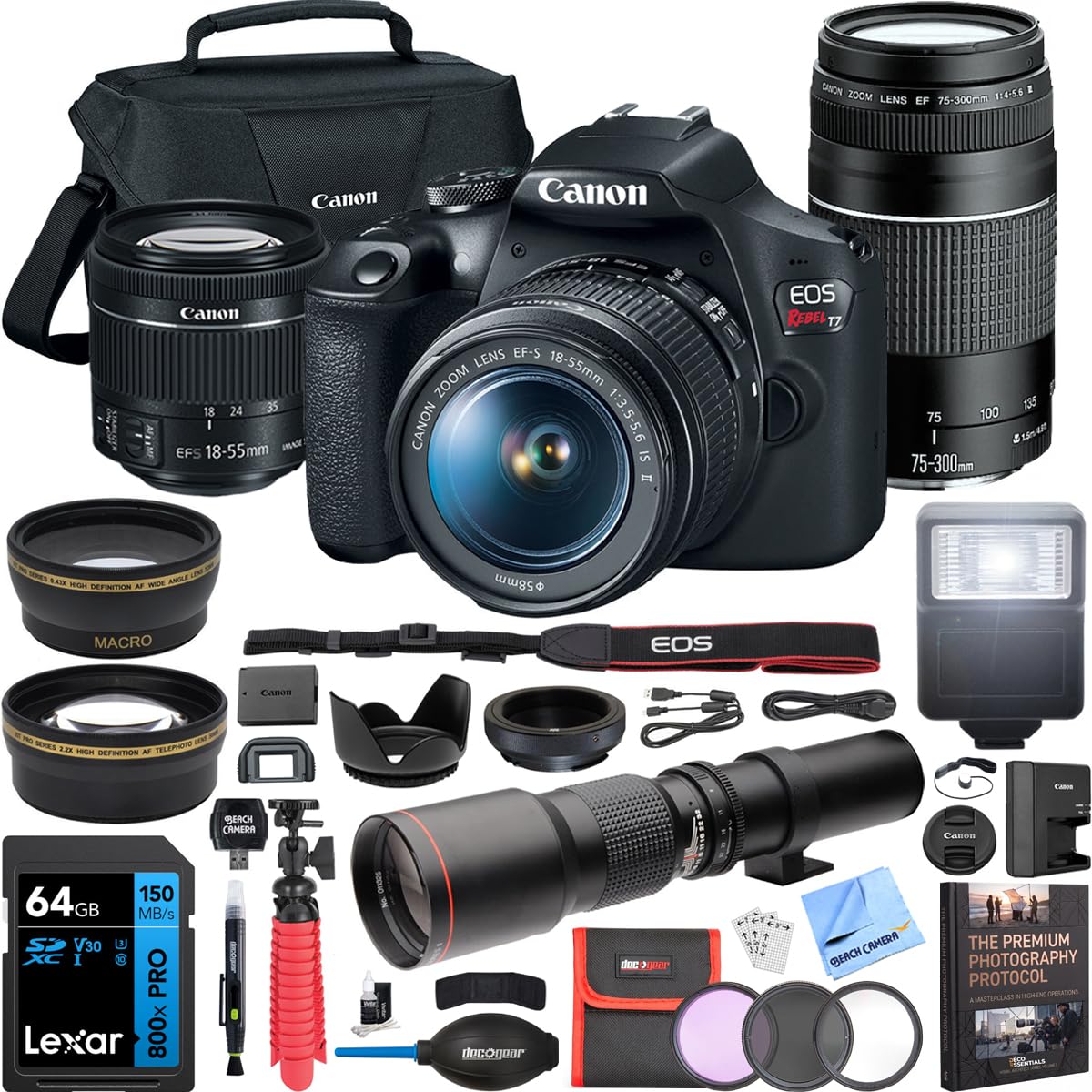
1. Canon EOS Rebel T7 DSLR Camera with EF 18-55mm and 75-300mm Double Zoom Kit Bundle (13 Items)
Our pick — over 4.5★ from 750+ verified ratings; the strongest balance of quality and price.
The DSLR starter kit that brings a 500mm preset telephoto into the frame for serious reach.
Everything about this bundle says “learn without limits.” At its heart is a 24.1 Megapixel CMOS (APS-C) sensor — a larger sensor than any superzoom bridge camera on this list — which means noticeably better quality when the light drops at dusk. The 9-Point AF system and AI Servo AF (continuous autofocus for moving subjects) are entry-level numbers, but paired with the included 500mm Preset f/8 Telephoto Lens, you get genuine reach that outpaces many point-and-shoot options.
The kit throws in a 64GB SDXC memory card, a bag, and a tripod, so you have everything to start shooting the moment it arrives. What wins people over is the value: the bundle stacks a lot of hardware for a single price, and the camera itself is rated highly for its image quality and ease of use. The catch is the continuous shooting speed — at 3.0 fps (frames per second), it is noticeably slower than the 7.4 fps of the Canon PowerShot SX740 HS, so catching a bird in mid-flight takes more patience and careful timing.
A few owners note that the included Wi-Fi works as advertised for remote shooting and wireless printing. The battery life is generally good, though one reviewer noted a single unit that died after 8 photos despite a full charge — a rare defect, but worth a quick in-box test.
Who This Pick Fits Perfectly: A beginner or advanced amateur who wants a traditional DSLR with interchangeable lenses, a large sensor, and an enormous accessory bundle that covers everything from landscape to distant birds.
Who Should Look Elsewhere: Anyone who needs a high burst rate for fast-action bird-in-flight sequences; the 3.0 fps cap here is the main trade-off.
Bottom Line: The Rebel T7 kit package delivers the most hardware for the least compromise in image quality — just know you are trading burst speed for that 24.1MP sensor and the 500mm reach.
2. Nikon COOLPIX B700 Digital Camera
A palm-size zoom that clips 960mm of reach into your jacket pocket.
The SX740 HS is the go-anywhere, take-any-chance option for casual birders. Its 40x Optical Zoom (24-960mm equivalent) with Optical Image Stabilizer and Zoom Framing Assist helps you find and track a moving bird in the frame. The 20.3 Megapixel CMOS sensor and DIGIC 8 Image Processor deliver sharp, vibrant photos, and the 4K Video at 29.97fps captures time-lapse movies. With High-speed Continuous Shooting at up to 7.4 fps — over twice as fast as the Rebel T7’s 3.0 fps — you can fire off a sequence during a take-off.
The 3.0-inch tilt-type LCD flips 180 degrees up for selfie-style vlogging, though it lacks a viewfinder — a real annoyance in bright sunlight when you are trying to frame a distant bird. Owners who shoot in good light consistently praise the image quality and the reach for the size, calling it “excellent for birdwatching, understanding its inherent limitations.” A seasoned birder reported taking over 30,000 photos in two months, finding it “good for ID at long range in good light.”
The autofocus uses a single Contrast Detection point, which is the simplest and slowest system on this list — birds in flight will test it. The NB-13L battery is noted for having longer life than the G7X, but you will still want a spare for a full day out.
Headline Spec: 40x optical zoom and 7.4 fps burst in a body that fits next to your phone — a combination no DSLR kit can match for portability.
Honest Limitation: No viewfinder makes sunny-day aiming guesswork, and the single-point AF struggles with fast-moving birds against busy backgrounds.
Best for: The casual birder who wants a camera that slips into any bag and can ID a bird at moderate distance in good light — no lenses, no fuss.
Not ideal for: Dedicated bird photographers who need a viewfinder, fast action tracking, or reliable low-light performance at the long end of the zoom.
3. Nikon COOLPIX P950 Superzoom Digital Camera
The bridge camera that turns 2000mm into a dedicated setting called “Bird.”
Nikon designed the P950 with exactly one kind of user in mind: someone who wants a long zoom, no lens swaps, and a dedicated Bird Mode on the dial. With 16 Megapixels and an 83x Optical Zoom (24-2000mm equivalent) plus a 166X Dynamic Fine Zoom, it reaches farther than most human eyes can resolve detail. The Dual Detect Vibration Reduction (optical image stabilizer) helps keep the frame steady at the extreme end, and the 3.2-inch Vari-Angle LCD rotates for any angle of composition.
The autofocus has 399 points — a huge step up from the B700’s 19 or the SX740’s 1 — and it makes a real difference when tracking a bird through branches. The dedicated Moon mode is a fun bonus for night shooting, and buyers report that the Bird Mode “is excellent at 300+ yards.” The stabilization is widely described as amazing, though the autofocus accuracy in low contrast is mixed and may benefit from the manual focus wheel.
A P950 owner upgrading from the P900 noted it is a clear improvement, particularly in macro and stabilization. The image quality in good light is very good for a 1/2.3-inch sensor, but the weight is noticeable — it is a chunky bridge camera that requires a strap or a monopod for extended use.
What Owners Love
- 83x optical zoom (2000mm) with excellent stabilization makes far-off birds look close
- Dedicated Bird Mode tune settings instantly for feather detail and motion
- Manual focus wheel helps compensate when autofocus hunts
- Raw format recording for post-processing flexibility
Where It Tests Patience
- Autofocus is mixed in low contrast or dim light — the manual wheel is your backup
- Bulk and weight mean it is not a pocket camera; plan for a bag or strap
- Video capture button placement is awkward during shooting
Grab This If: You want the longest optical zoom you can get without moving into DSLR territory, and you value a dial that sets you up for birding instantly.
skip it if: You need consistent, fast autofocus on moving birds in poor light, or you want a small camera for casual carry.
4. Canon PowerShot SX740 HS Digital Camera with Bag and 64GB Card
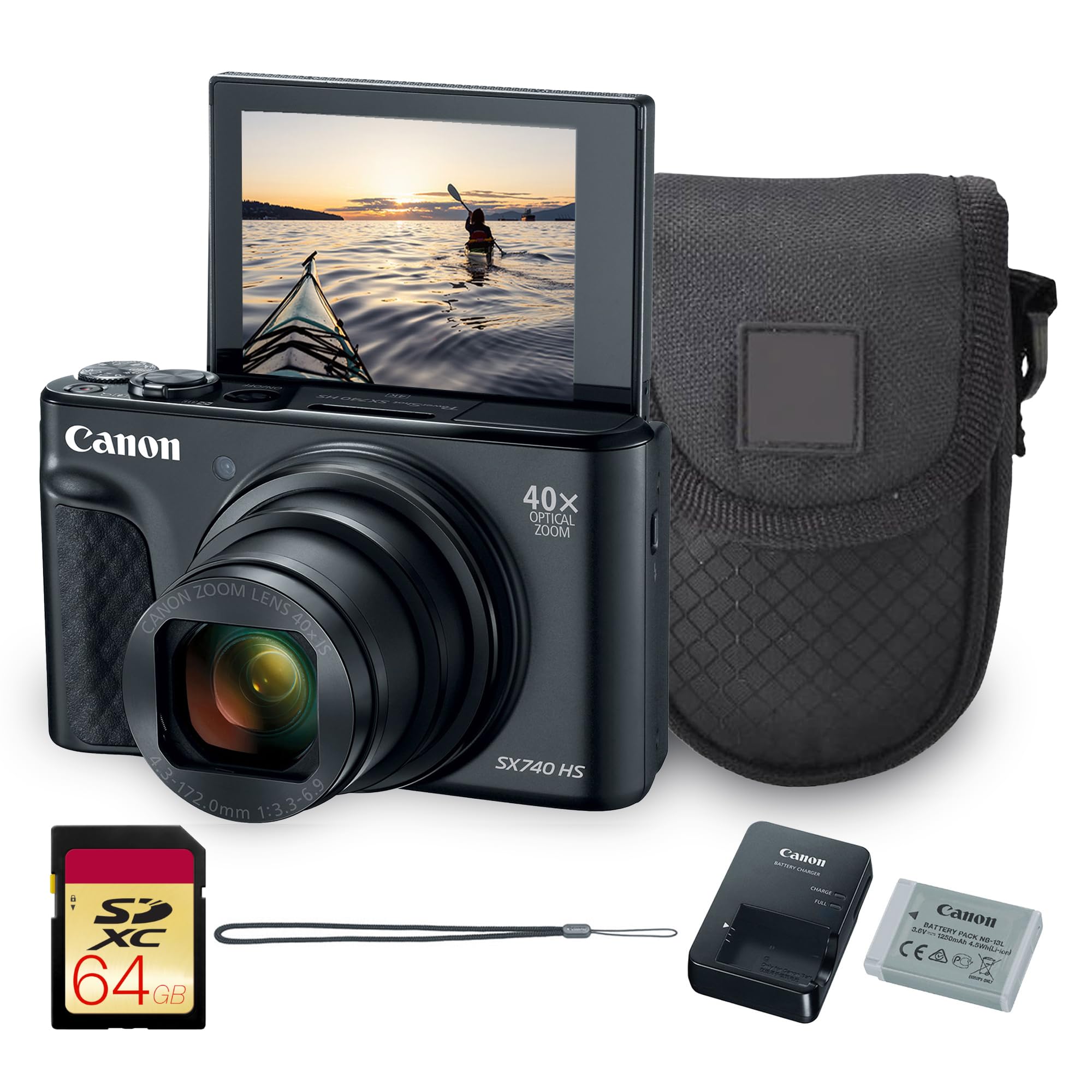
The same pocket-sized 40x zoom as the silver version, now bundled with a travel kit.
This is the same core camera as the SX740 HS reviewed above — a 20.3MP CMOS sensor, 40x optical zoom (24-960mm equivalent), and a DIGIC 8 image processor — but it arrives as a bundle that adds a bag and a 64GB memory card. The built-in 5-axis image stabilization smooths handheld video, and the 4K UHD recording at 30p captures four times the resolution of Full HD. Wi-Fi and Bluetooth connectivity let you transfer images to your phone through the Canon Camera Connect app.
A week-long trip owner reported not needing to recharge once over five days, and the flip screen works well for selfie-style shooting. The quality of the photos is consistently praised as “phenomenal” for such a small body. The recurring concern is that this specific listing ships an international model — several owners mention the serial number cannot be registered on the Canon US website, meaning no US warranty. Verify the warranty status with the seller before you buy if that matters to you.
The single Contrast Detection autofocus point is the same limitation as the silver version: fine for perched birds in good light, but a struggle for fast action.
The Appeal: All the portability of the SX740 HS plus a ready-to-go kit — a bag, a card, and no extra shopping.
The Catch: The international warranty situation is a real headache if you need Canon USA support; confirm the seller’s policy.
Best for: Travelers who want an ultra-compact zoom camera with all the essentials included in one box and are comfortable with third-party warranty coverage.
Look elsewhere if: You need a US warranty, fast autofocus for action, or an electronic viewfinder for bright daylight composing.
5. Nikon COOLPIX P1100 Superzoom Digital Camera
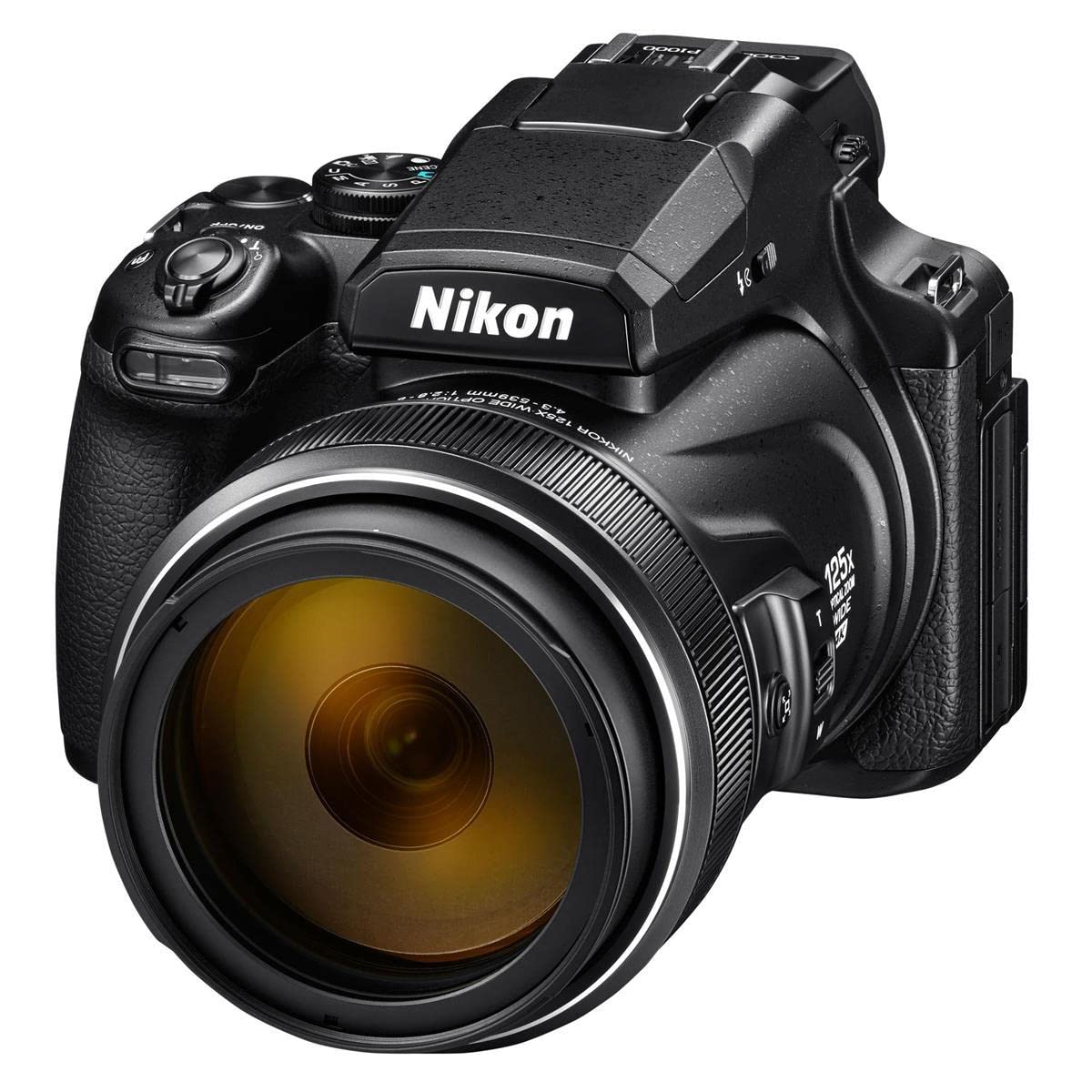
The 3000mm optical zoom that turned a bridge camera into a wildlife legend.
The P1000 sits alongside the P1100 as the longest-reach superzoom you can buy. Its 125x optical zoom (24-3000mm equivalent) is the “most powerful zoom lens ever put on a Nikon Coolpix camera,” and it shows. The 16MP sensor shoots 4K UHD video with HDMI out, an accessory hot shoe, and stereo sound. Dual Detect image stabilization helps keep the 3000mm frame steady, though customers note that beyond approximately 1500mm, a tripod becomes essential to combat heat shimmer and micro-shake.
The image quality is sharp across almost the entire zoom range, and the full manual controls (P, S, A, M modes) give you total creative control. Owners consistently call the zoom “phenomenal” and praise its ability to serve as “an economical, reasonable substitute for an SLR.” It is heavy — the poor weight distribution on the neck strap is a common complaint — and battery life is short, so extra batteries are a must.
The autofocus uses 100 contrast-detect points, which is adequate for slow-moving subjects but “slow but decent” for action. A pro-level birder would outgrow the AF speed and small sensor limits, but for an amateur wanting to identify a bird at 300 yards, it is transformative.
The Party Piece: 3000mm optical zoom that can read a license plate at a mile — for birding, it is the ultimate ID tool at extreme range.
The Real Burden: The size and weight mean it is not a spontaneous grab-and-go camera; it demands a dedicated bag, extra batteries, and often a tripod for the longest shots.
Grab This If: Your priority is absolute maximum focal length for identifying distant birds and you are comfortable carrying a big, heavy camera with extra batteries.
pass on it if: You need a compact camera, fast autofocus for birds in flight, or high image quality in low light — the small sensor and slow AF will frustrate you.


