Our readers keep the lights on and my smoothie glass nicely filled. As an Amazon Associate, I earn from qualifying purchases.
Starting a photography business means your camera is your primary tool, your brand, and your first impression. Choosing between a crop-sensor workhorse, a retro-styled mirrorless, or a full-frame powerhouse is the first serious decision you will make, and getting it wrong costs you both time and sharpness.
I’m Mohammad Maruf — the founder and writer behind WellFizz. I have spent years analyzing camera sensor technology, autofocus systems, and lens ecosystems to identify which models deliver the reliability and image quality required for a fledgling commercial venture.
Whether you are shooting portraits, products, or real estate, this guide breaks down the critical specs and real-world performance of the market’s top contenders to help you find the perfect camera for beginning photography business.
How To Choose The Best Camera For Beginning Photography Business
Your first business camera must balance image quality, autofocus reliability, and lens affordability. The biggest mistake beginners make is prioritizing a flashy body over the lens system and autofocus performance that actually delivers consistent, sharp shots for paying clients.
Sensor Size: APS-C vs. Full-Frame
APS-C sensors (found in the Canon EOS Rebel T7, Nikon D7500, and Sony FX30) offer a lighter body and more affordable lenses, making them ideal for a tight startup budget. Full-frame sensors (Canon EOS RP, Sony a7 III) provide superior low-light performance, shallower depth of field, and higher dynamic range — critical for professional portrait and product work where every stop of light matters.
Autofocus System: Phase-Detection vs. Contrast-Detection
Phase-detection autofocus (PDAF) is faster and more accurate for moving subjects, which is essential for event photography and active children portraits. Contrast-detection AF is slower but more precise for static subjects like product still-life. The number of autofocus points — 9 on the Canon Rebel T7 vs. 693 on the Sony a7 III — directly translates to tracking reliability in the field.
Lens Ecosystem and Kit Lens Quality
A business camera is only as good as the glass in front of it. The Micro Four Thirds system (Panasonic G100, OM System E-M10 Mark IV) offers the widest selection of affordable lenses. Canon RF and Sony E-mount systems have excellent native glass but at a higher cost. The included kit lens — a 12-32mm versus an 18-140mm — dramatically changes your immediate shooting range without buying additional glass.
Quick Comparison
On smaller screens, swipe sideways to see the full table.
| Model | Category | Best For | Key Spec | Amazon |
|---|---|---|---|---|
| Sony a7 III | Full-Frame Mirrorless | Professional portraiture & low-light | 693 phase-detection AF points | Amazon |
| Canon EOS RP | Full-Frame Mirrorless | Budget full-frame entry | RF 24-105mm f/4-7.1 lens | Amazon |
| Nikon D7500 | APS-C DSLR | Versatile all-around business kit | 18-140mm zoom, 51 AF points | Amazon |
| Nikon Z fc | APS-C Mirrorless | Stylish travel + social media content | 209 phase-detection AF points | Amazon |
| FUJIFILM X-T30 III | APS-C Mirrorless | Creative film simulation looks | AI subject detection AF | Amazon |
| Sony FX30 | APS-C Cinema | Video-first content creation | 495 AF points, dual base ISO | Amazon |
| Panasonic LUMIX S9 | Full-Frame Mirrorless | Ultra-compact full-frame travel | 255 AF points, LUT support | Amazon |
| OM System E-M10 IV | Micro Four Thirds | Everyday carry & social content | 5-axis IBIS, 20MP sensor | Amazon |
| Panasonic LUMIX G100 | Micro Four Thirds | Hybrid photo/video with audio | 4K 24/30p, tracking microphone | Amazon |
| Canon EOS Rebel T7 | APS-C DSLR | Budget-friendly bundle starter | 24.1MP, 9 AF points | Amazon |
| Canon EOS R5 | Full-Frame Mirrorless | High-res pro work & 8K video | 45MP, 1053 AF points | Amazon |
In‑Depth Reviews
1. Sony a7 III Full-Frame Mirrorless with 28-70mm Lens

The Sony a7 III is the gold standard for a beginning photography business because it delivers full-frame depth, professional-level autofocus with 693 phase-detection points, and excellent low-light performance — all in a compact body. The 24.2MP back-illuminated sensor captures 15 stops of dynamic range, giving you the latitude to recover highlights and shadows in post-production, a non-negotiable for delivering polished client work.
The kit 28-70mm f/3.5-5.6 lens is reliable and decent for starting out, but many users report a dramatic jump in sharpness when pairing this body with a fast prime like a 35mm f/1.8. The battery life is exceptional, shooting approximately 710 photos per charge, which means fewer interruptions during a real estate shoot or a portrait session.
Real-world feedback confirms this camera outperforms the Canon EOS RP in autofocus speed and the Panasonic S9 in battery endurance. The menu system is deep but rewarding once learned, and the dual SD card slots provide instant backup — a critical feature for any paid shooter.
Why it’s great
- Industry-leading 693-point phase-detection AF tracks subjects reliably.
- Full-frame sensor delivers shallow depth of field and low-light excellence.
- Excellent battery life of ~710 shots per charge reduces downtime.
Good to know
- Kit lens is decent but upgrading to a prime will unlock the sensor’s potential.
- Menu system is complex and requires a learning curve.
- Weather sealing is present but not as robust as higher-end Sony bodies.
2. Canon EOS RP with RF24-105mm Lens Kit

The Canon EOS RP is the most affordable full-frame mirrorless camera that gives you access to Canon’s excellent RF lens system. The 26.2-megapixel sensor offers solid dynamic range and low-light performance that punches above its price bracket, making it a strong candidate for portrait and product photography where skin tones and detail matter.
The included RF 24-105mm f/4-7.1 IS STM lens provides a versatile zoom range from wide-angle to moderate telephoto, with optical image stabilization good for up to 5 stops of shake correction. Users note the lens is sharpest at f/8 and above, and the lack of a physical AF/MF switch on the lens requires navigating the menu to change focus modes.
Customer reviews consistently praise the compact, lightweight body that pairs well with travel and gimbal work. Battery life is adequate for a day of shooting with a spare, and the compatibility with EF/EF-S lenses via an adapter expands your affordable glass options significantly.
Why it’s great
- Entry-level price for full-frame sensor performance.
- RF 24-105mm kit lens is versatile with effective stabilization.
- Compact and lightweight body ideal for travel-based business.
Good to know
- Kit lens has softer corners; sharpens at f/8 and above.
- No physical AF/MF switch on the kit lens — requires menu diving.
- Not ideal for fast-action or sports due to slower burst rate.
3. Nikon D7500 with AF-S DX 18-140mm VR Lens

The Nikon D7500 is a workhorse DSLR that borrows its image processing, ISO performance, and metering system from the flagship Nikon D500. The 20.9MP APS-C sensor delivers class-leading image quality, and the 51-point AF system with 15 cross-type sensors provides fast, accurate tracking that rivals many mirrorless options for still photography.
The bundled 18-140mm f/3.5-5.6G ED VR lens is one of the most practical starter lenses in this list — it covers wide-angle to medium telephoto in a single glass, letting you shoot landscapes, portraits, and details without swapping lenses. The 8 fps continuous shooting and tilting 3.2-inch touchscreen make it versatile for event work.
Owners report excellent battery life, weather-resistant sealing for outdoor shoots, and a sturdy build that survives real-world knocks. The 4K UHD video at 30p is decent, though the camera is eight years old and lacks the modern autofocus wizardry of newer mirrorless bodies. Still, for pure, reliable image quality in a professional form factor, it holds its own.
Why it’s great
- Excellent 18-140mm kit lens covers wide zoom range without changing glass.
- 51-point AF system with cross-type sensors delivers fast, accurate tracking.
- Weather-resistant body suitable for outdoor commercial shoots.
Good to know
- Model is 8 years old; lacks modern mirrorless features like eye-AF for video.
- 4K video has a 1.5x crop factor.
- Heavier than mirrorless alternatives for all-day handheld shooting.
4. Nikon Z fc with 16-50mm Zoom Lens

The Nikon Z fc combines retro analog dials with modern mirrorless technology, making it one of the most enjoyable cameras to shoot with for a beginning business. The 20.9MP DX-format sensor paired with the EXPEED 6 processor delivers sharp, clean colors straight out of camera, reducing editing time for social media and portrait clients.
Its 209-point hybrid autofocus system provides reliable phase-detection AF with eye detection for both photos and video. The fully articulating flip-out screen and 4K UHD recording without a crop make it vlogger-ready for content creators building a brand alongside their photography business.
Real users report that while the kit 16-50mm lens is basic and serviceable, pairing the Z fc with a faster prime lens dramatically improves low-light performance. The camera is lightweight, durable, and survived drops in freezing temperatures according to one reviewer. The SnapBridge app for wireless transfer is useful but has reliability issues, and many recommend using an SD card reader for important shoots.
Why it’s great
- Retro design with analog dials makes shooting intuitive and fun.
- 209-point hybrid AF with eye detection works well for portraits.
- Lightweight and durable body ideal for daily carry.
Good to know
- Wireless photo transfer via SnapBridge app can be unreliable.
- Kit lens is basic; upgrading to faster glass is recommended for low-light.
- Adding a grip accessory improves handling for larger hands.
5. FUJIFILM X-T30 III with XC13-33mm Lens

The FUJIFILM X-T30 III is a compact, creative powerhouse that offers 20 built-in Film Simulations, giving you the ability to deliver unique, stylized looks straight out of camera — a major differentiator for a beginning photography business targeting clients who want an editorial aesthetic without extensive post-processing.
The 26.1MP X-Trans CMOS 4 sensor with AI-powered subject detection autofocus handles a variety of subjects with speed and accuracy. The hybrid AF system combines phase-detection and contrast-detection for reliable focus, and the compact body makes it easy to carry multiple bodies for event work.
Users love the film simulations for everyday shooting, noting that photos look beautiful with minimal editing. The camera connects easily to a smartphone for quick sharing, though the learning curve from more traditional menus may require patience for some beginners. Pairing this with the XC13-33mm lens gives you a capable starter kit for portraits and lifestyle content.
Why it’s great
- 20 Film Simulations deliver unique looks with minimal editing required.
- AI-powered subject detection AF tracks people, animals, and vehicles.
- Remarkably compact and lightweight for a powerful APS-C camera.
Good to know
- Learning curve for menu layout and button placement.
- No in-body image stabilization for video work.
- Battery life is average, requiring spare batteries for full-day shoots.
6. Sony Cinema Line FX30 Super 35 Camera

The Sony FX30 is a dedicated cinema camera that excels for video-heavy content creation businesses, offering S-Cinetone color science, dual base ISO, and over 14 stops of dynamic range. It delivers 90% of the performance of the full-frame FX3 at roughly half the cost, making it a smart investment for a beginning photography business that also prioritizes video.
With 495 phase-detection AF points and legendary Sony autofocus tracking, the FX30 locks onto subjects quickly and reliably. The active cooling system prevents overheating during extended 4K recording sessions, a problem common in smaller mirrorless bodies. The dual card slots (CFexpress Type A and SD) provide professional-level backup and workflow flexibility.
User feedback highlights excellent low-light performance for a Super 35 sensor, intuitive menus, and a rugged build that feels ready for daily production. The battery life is modest at about 1–2 hours, requiring external power for long shoots. It is best suited for content creators, indie filmmakers, and YouTubers building a business around video.
Why it’s great
- S-Cinetone delivers cinematic color straight out of camera.
- Active cooling prevents overheating during long 4K recording.
- Dual card slots provide instant backup for client work.
Good to know
- Battery life is limited to 1–2 hours; external power recommended.
- APS-C sensor may not satisfy clients demanding full-frame depth.
- No in-body image stabilization as effective as dedicated vlogging cameras.
7. Panasonic LUMIX S9 Full-Frame with S 18-40mm Lens

The Panasonic LUMIX S9 packs a full-frame sensor into one of the smallest mirrorless bodies available, making it the ultimate travel and social media content camera for a beginning photography business. Its 24.2MP sensor and LUT support let you apply custom color grades in-camera, reducing time in post-production.
The included S 18-40mm f/4.5-6.3 lens is ultra-compact and collapses into the body for easy packing, but the slow aperture limits low-light performance without a flash — and the S9 has no hotshoe for an external flash, only a cold shoe. The camera features 255 depth-from-defocus AF points and delivers fast, seamless connection to the LUMIX Lab app for quick transfers.
Customers appreciate the unique compact size and the Open Gate recording aspect ratios for multi-platform content. However, many note the need for an aftermarket grip for comfortable one-handed use, and the lack of a flash or external flash compatibility is a significant limitation for product and event photography.
Why it’s great
- Smallest full-frame body for maximum portability and discretion.
- LUT support enables in-camera color grading for consistent brand looks.
- Open Gate recording captures multiple aspect ratios from a single shot.
Good to know
- No hotshoe or built-in flash — cannot mount external flash.
- Aftermarket grip needed for comfortable handling.
- Lenses are expensive due to full-frame L-mount system.
8. OM System Olympus E-M10 Mark IV with 14-42mm Lens

The OM System E-M10 Mark IV is a compact, lightweight Micro Four Thirds camera that offers in-body 5-axis image stabilization capable of 4.5 stops of compensation — making it one of the most stable handheld shooting experiences in this list. The 20MP Live MOS sensor delivers excellent image quality for its size, and the flip-down monitor with dedicated selfie mode is perfect for vlog-style content.
The bundled 14-42mm pancake lens allows the camera to fit in a jacket pocket, making it ideal for street photography, real estate walkthroughs, and social media shoots. The 121-point contrast-detection AF system is reliable for static subjects, but may struggle with fast-moving subjects compared to phase-detection competitors.
Users rave about the portability and the retro-styled body that is both hefty and sturdy. The built-in flash is a welcome bonus for fill light on product shots, though the lack of USB-C charging is a notable inconvenience. The built-in art filters (including Instant Film) offer creative options without requiring editing software.
Why it’s great
- 5-axis IBIS provides excellent stabilization for handheld video and low-light.
- Compact, pocketable kit with 14-42mm pancake zoom lens.
- Built-in flash and creative art filters for quick, unique results.
Good to know
- Contrast-detection AF is slower for fast-moving subjects.
- No USB-C charging — uses proprietary micro-USB connector.
- Micro Four Thirds sensor has less low-light performance than APS-C or full-frame.
9. Panasonic LUMIX G100 with 12-32mm Lens

The Panasonic LUMIX G100 is designed for creators who need excellent audio out of the box, featuring a high-performance microphone with tracking audio that automatically adjusts to record clearly indoors, outdoors, and in crowded environments. The 20.3MP Micro Four Thirds sensor delivers crisp 4K photo and video at 24/30p, with 5-axis hybrid image stabilization for smooth footage.
The small, lightweight body with a 12-32mm kit lens makes it easy to carry for one-handed recording. The camera features iA (intelligent auto) mode for quick results and full manual controls as skills grow. V-Log L recording provides flexibility for color grading in post-production.
Users note the camera produces beautiful photos with great color tones, and the menu system is logical for beginners. A significant limitation is the restrictive 4K video recording time — the camera stops at a maximum limit, which could interrupt longer interviews or recordings. The Micro Four Thirds lens ecosystem is affordable and extensive, making upgrades easy.
Why it’s great
- Built-in microphone with tracking audio captures clear sound automatically.
- Extremely compact and lightweight for all-day shooting.
- V-Log L recording enables professional color grading.
Good to know
- 4K video recording is limited to a maximum time; stops automatically.
- Contrast-detection AF is slower for fast-moving subjects.
- Small sensor size limits low-light performance compared to APS-C.
10. Canon EOS Rebel T7 with 18-55mm Kit & Accessories
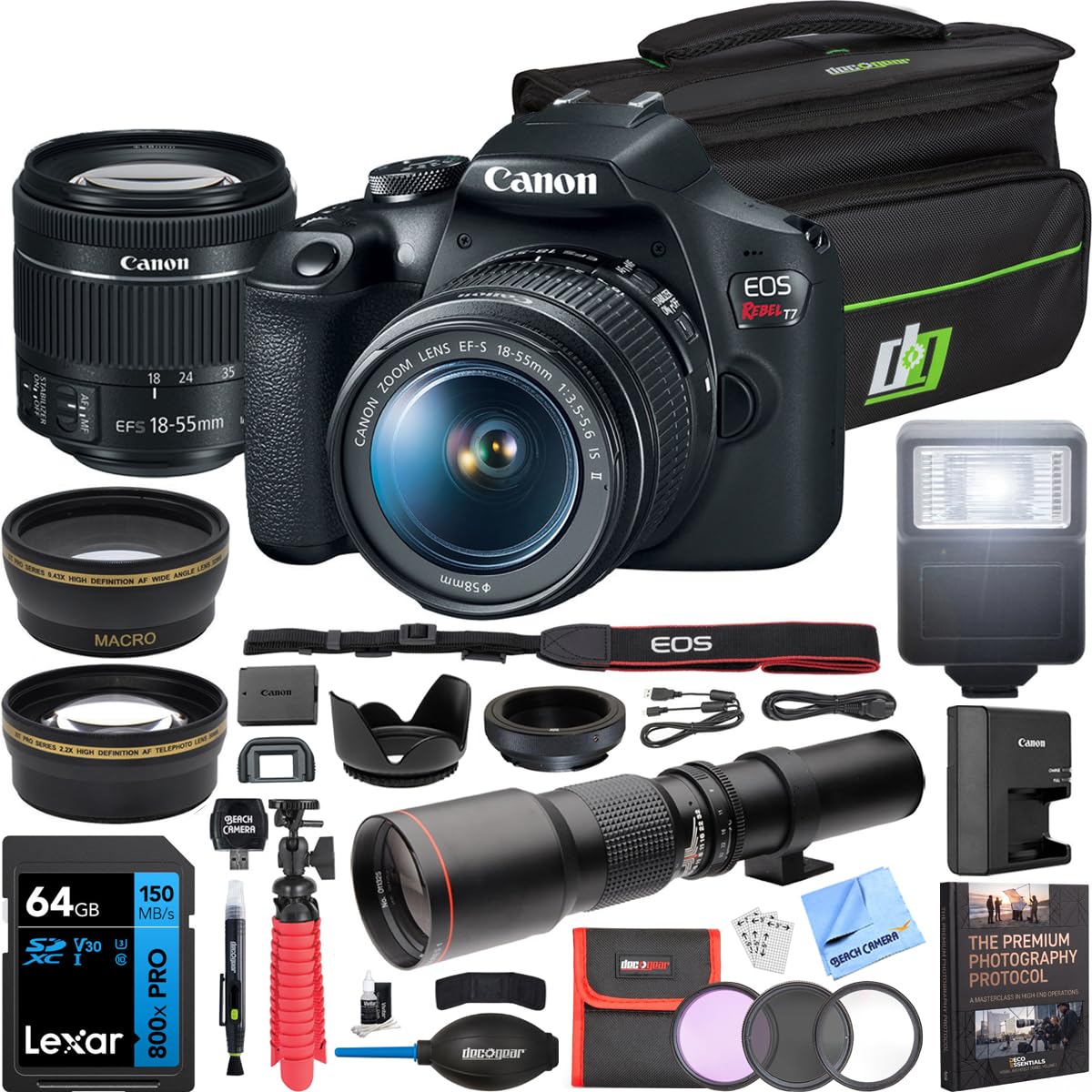
The Canon EOS Rebel T7 is a classic entry-level DSLR that offers a massive bundle of accessories — including a 500mm telephoto lens, flash, tripod, and 64GB memory card — making it an attractive all-in-one starter kit for a beginning photography business on a tight budget. The 24.1MP APS-C sensor captures solid images with good color science typical of Canon.
The 9-point autofocus system is basic compared to modern mirrorless cameras, and the optical viewfinder covers approximately 95% of the frame. The DIGIC 4+ processor is dated, limiting continuous shooting to 3 fps and video to Full HD 1080p. The included 18-55mm IS II lens provides standard zoom range with image stabilization.
User reviews praise the excellent photo quality and value for the price, but consistently flag that the battery drains extremely fast, with one report of it dying after only 8 shots from a full charge. The included camera bag is also reported as too small to hold all accessories. This is the most budget-friendly option but has significant limitations for any growth-oriented business.
Why it’s great
- Massive accessory bundle includes telephoto lens, flash, and tripod.
- 24.1MP APS-C sensor captures quality images with nice color science.
- Canon EF/EF-S lens system offers huge selection of affordable glass.
Good to know
- 9-point AF system is very basic for any professional work.
- Battery life reported as extremely poor — drains fast in real use.
- 3 fps burst rate and Full HD 1080p video are outdated specs.
11. Canon EOS R5 Mirrorless Camera (Body Only)

The Canon EOS R5 is the flagship hybrid mirrorless camera for photographers who demand the highest resolution and video capabilities. Its 45-megapixel full-frame stacked CMOS sensor captures stunning detail, color, and dynamic range suitable for large-format prints and commercial work. The DIGIC X processor powers 8K RAW internal recording and 4K up to 120fps.
The Dual Pixel CMOS AF II system covers 100% of the frame with 1053 AF points and uses deep learning to track people, animals, and vehicles with Eye Control AF that selects focus points based on where you look. The 5-axis in-body image stabilization provides up to 8 stops of correction, making it possible to shoot handheld in extremely low light.
Users report the autofocus is blindingly fast and accurate, and the image quality is unmatched in the Canon lineup. Overheating concerns with 8K recording are largely overblown for real-world use, though the battery life is lower than older DSLR bodies. This camera requires a significant investment in RF lenses to unlock its full potential, making it a long-term investment for a serious photography business.
Why it’s great
- 45MP full-frame sensor delivers incredible detail and dynamic range.
- 1053-point Dual Pixel CMOS AF II with Eye Control for instant focus.
- 8K video and 4K 120fps internal recording for high-end production.
Good to know
- Body-only — requires separate purchase of expensive RF lenses.
- Battery life is lower than traditional DSLRs; carries spare batteries.
- Overheating can occur during extended 8K recording sessions.
FAQ
Do I need a full-frame camera for a beginning photography business?
How many megapixels do I need for professional client work?
Should I buy a DSLR or mirrorless for my first business camera?
What is the most important lens I should buy for my business?
Can I use a camera with a kit lens for paid client work?
Final Thoughts: The Verdict
For most users, the camera for beginning photography business winner is the Sony a7 III because it offers the best balance of full-frame image quality, professional-grade autofocus with 693 phase-detection points, and industry-leading battery life at a mid-range price point. If you want a versatile kit lens that covers wide to telephoto without swapping glass, grab the Nikon D7500 with its excellent 18-140mm lens. And for creators who prioritize compact full-frame portability and in-camera LUT grading, nothing beats the Panasonic LUMIX S9.

Mo Maruf
I created WellFizz to bridge the gap between vague wellness advice and actionable solutions. My mission is simple: to decode the research and give you practical tools you can actually use.
Beyond the data, I am a passionate traveler. I believe that stepping away from the screen to explore new environments is essential for mental clarity and physical vitality.