Our readers keep the lights on and my smoothie glass nicely filled. As an Amazon Associate, I earn from qualifying purchases.
Starting a YouTube channel is an exciting leap, but the gear decisions can quickly turn overwhelming. You want crisp video, reliable autofocus, and decent audio without burning your entire budget or burying yourself in a manual. The market offers everything from pocket-sized gimbals to interchangeable-lens mirrorless bodies, and each path serves a different style of creator.
I’m Mohammad Maruf — the founder and writer behind WellFizz. I’ve spent years analyzing camera hardware, reading thousands of verified buyer reports, and mapping the real-world performance of vlogging rigs across every price tier to separate the hype from the genuinely helpful.
After crunching the specs and user feedback on eleven of the strongest contenders, the camera for beginner youtuber that keeps resurfacing as the most balanced starting point combines a 1‑inch sensor with gimbal-level stabilization in a truly pocketable form.
How To Choose The Best Camera For Beginner Youtuber
Your first YouTube camera doesn’t need to cost a month’s rent, but it must solve three specific problems: keeping you in focus while you move, smoothing out your handheld shots, and sounding decent without a separate recorder. Below are the four specs that separate a usable starter kit from a frustration‑factory.
Sensor Size and Low‑Light Performance
A larger sensor (1‑inch or APS‑C) captures more light, which gives you cleaner footage in the dim living‑room lighting where many beginners start. Avoid cameras with tiny smartphone‑sized sensors if you plan to shoot anywhere besides a perfectly lit desk.
Stabilization: Gimbal vs. In‑Body vs. Digital
Mechanical stabilization — either a built‑in gimbal or in‑body sensor shift — eliminates the nauseating micro‑jitters that make amateur footage obvious. Digital stabilization crops your frame and can introduce warping; prioritize a camera with a physical stabilization system if you walk and talk.
Autofocus That Doesn’t Fight You
Reliable face and eye tracking is non‑negotiable for solo creators. You should be able to step in front of the lens, press record, and trust the camera to keep your eyes sharp — no pulling focus manually while trying to deliver your lines.
Audio Input and On‑Board Mic Quality
A 3.5mm microphone jack gives you the option to add a lapel mic or a shotgun mic later. The built‑in microphone on most cameras is only passable for quiet indoor vlogs; if your video involves wind, crowds, or distance, you will want an external audio path.
Quick Comparison
On smaller screens, swipe sideways to see the full table.
| Model | Category | Best For | Key Spec | Amazon |
|---|---|---|---|---|
| DJI Osmo Pocket 3 Standard | Gimbal Camera | Walk‑and‑talk vlogging | 3‑axis gimbal, 1″ sensor, 4K/120fps | Amazon |
| DJI Osmo Pocket 3 Vlog Combo | Gimbal Camera | Vlogging with wireless audio | Includes DJI Mic Mini, 3‑axis gimbal | Amazon |
| Xtra Muse Pocket Gimbal | Gimbal Camera | Budget gimbal entry | 3‑axis gimbal, 1″ sensor, 10‑bit color | Amazon |
| Sony ZV-1F Ultimate Kit | Compact Point‑and‑Shoot | Beginners wanting a full bundle | 20.1MP 1″ sensor, 4K, flip screen | Amazon |
| Sony ZV-1 | Compact Point‑and‑Shoot | Vloggers who want F1.8 bokeh | ZEISS 24‑70mm F1.8‑2.8 lens, 4K HDR | Amazon |
| Insta360 GO Ultra | Wearable Action Cam | Hands‑free POV vlogs | 53g, magnetic mounts, 4K60 HDR | Amazon |
| Canon EOS R100 | Mirrorless Interchangeable | Photography‑first beginners | 24.1MP APS‑C, 4K/24fps, RF mount | Amazon |
| Canon EOS R50 | Mirrorless Interchangeable | Social‑media ready mirrorless | 24.2MP APS‑C, oversampled 4K, vari‑angle | Amazon |
| Canon EOS 2000D / T7 Bundle | Entry DSLR Bundle | Budget‑conscious traditionalists | 24.1MP APS‑C, Full HD 1080/30p | Amazon |
| Sony ZV‑E10 | Mirrorless Interchangeable | APS‑C upgrade for growing creators | 24.2MP APS‑C, 4K oversampled, 425 AF | Amazon |
| Sony ZV‑E10 II | Mirrorless Interchangeable | Semi‑pro video with interchangeable glass | 26MP APS‑C, 4K/60fps, 759 AF points | Amazon |
In‑Depth Reviews
1. DJI Osmo Pocket 3 Standard
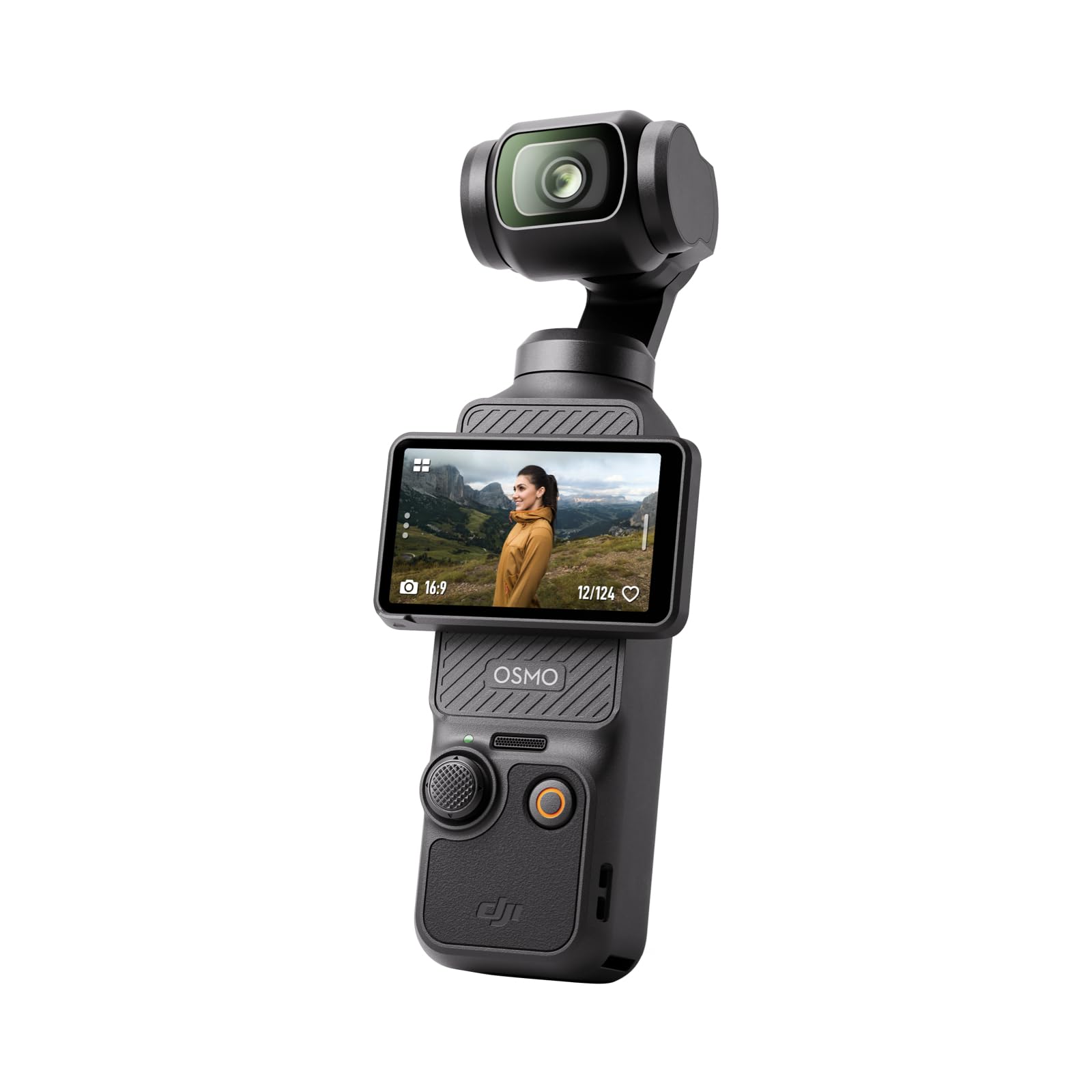
The DJI Osmo Pocket 3 is the benchmark that every competitor tries to undercut. Its 1‑inch CMOS sensor records 4K video at 120fps, which gives you both high‑resolution footage and the ability to create silky‑smooth slow‑motion clips. The 2‑inch rotatable touchscreen flips to portrait orientation instantly, making it a natural fit for YouTube Shorts without any cropping.
The 3‑axis mechanical gimbal is the defining feature here — ActiveTrack 6.0 keeps you centered in the frame while you walk, run, or spin, and the stabilization is good enough that you can leave the tripod at home for most vlogs. Autofocus locks onto your face reliably even in mixed lighting, and the 166‑minute battery life covers a full day of shooting on a single charge.
For beginners, the biggest friction point is the required DJI Mimo app activation; you cannot use the camera past five power‑ons without completing registration. Also, there is no USB‑C charger included, and the gimbal head is fragile if dropped. But for pure video quality and stabilization in a pocket‑sized package, nothing else in this tier matches it.
Why it’s great
- Industry‑leading 3‑axis gimbal stabilization in a true one‑hand form factor.
- 4K/120fps with D‑Log M 10‑bit color for professional‑grade grading.
- ActiveTrack 6.0 facial tracking works flawlessly for solo creators.
Good to know
- Must activate via app or camera becomes unusable after five boots.
- Gimbal mechanism is delicate; a hard drop can mean a full replacement.
- No included USB‑C charger; you must buy a 30W PD adapter separately.
2. Sony ZV‑E10 II

The Sony ZV‑E10 II is the most capable interchangeable‑lens camera on this list for beginners who already know they want room to grow. Its 26MP APS‑C back‑illuminated sensor is roughly ten times larger than a smartphone sensor and three times larger than a 1‑inch compact sensor, which translates to noticeably cleaner footage in dim environments and genuine background blur even with the kit lens.
Real‑time Eye AF with 759 phase‑detection points tracks human, animal, and bird eyes with near‑zero hunting. The Product Showcase Setting pulls focus to an object held near the lens, then snaps back to your face — a killer feature for unboxing or tutorial channels. The S&Q mode lets you shoot 4K at 60fps and HD at 120fps, giving you five‑times slow motion without a separate edit step.
There is no built‑in electronic viewfinder, and the battery life is average for a mirrorless body — plan to carry a spare if you shoot all day. Also, the 16‑50mm power zoom lens is versatile but optically slow at the telephoto end. For a beginner who intends to stay with one platform for several years, the ZV‑E10 II’s E‑mount ecosystem is the most future‑proof path.
Why it’s great
- Large APS‑C sensor delivers genuine shallow depth‑of‑field and excellent low‑light video.
- 759‑point Real‑time Eye AF is class‑leading for autofocus reliability.
- Interchangeable E‑mount lenses allow massive creative flexibility as you improve.
Good to know
- No electronic viewfinder; you must compose via the rear LCD only.
- Battery life is average; expect roughly 1.5–2 hours of mixed recording per charge.
- Kit lens (16‑50mm F3.5‑5.6) is decent but you will eventually want a faster prime.
3. Sony ZV‑E10
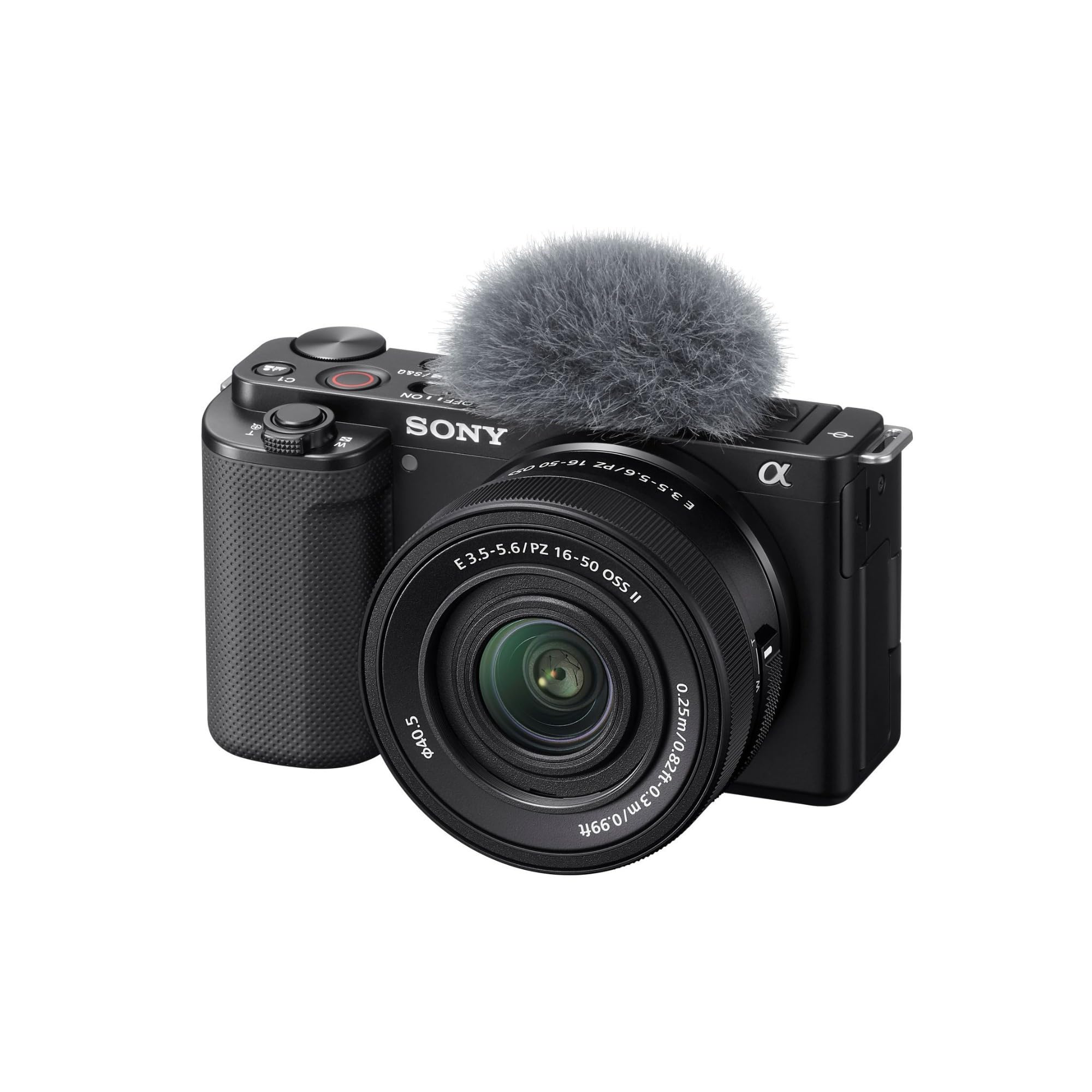
The original Sony ZV‑E10 remains a compelling entry point into the E‑mount system. Its 24.2MP APS‑C sensor oversamples 4K video from a 6K readout — no pixel binning — so your YouTube uploads retain fine detail even after the compression hit. The Background Defocus button is a single‑press toggle that instantly opens the aperture for creamy bokeh then closes it when you need everyone in focus.
USB streaming is plug‑and‑play: one cable turns the ZV‑E10 into a high‑quality webcam for live streams or Zoom calls, which is a major bonus if your YouTube workflow includes live interaction. The Product Showcase Setting and the directional 3‑capsule microphone with a supplied windscreen give you polished audio straight out of the box without buying a separate mic immediately.
The kit lens (16‑50mm F3.5‑5.6 OSS II) is compact but soft in the corners, and you will hit its limitations in low light quickly. Battery life is rated at roughly 440 shots or 80 minutes of continuous video — a spare battery is almost mandatory for a full shoot day. Still, as a first interchangeable‑lens camera for YouTube, this is the value king of the APS‑C segment.
Why it’s great
- Oversampled 4K from 6K readout produces sharper, more detailed video than most rivals.
- One‑cable USB streaming converts the camera into a high‑quality webcam instantly.
- Product Showcase Setting is uniquely useful for review and tutorial channels.
Good to know
- Kit lens is optically average; expect to upgrade to a faster prime for low‑light vlogs.
- Battery life is moderate; a spare NP‑FW50 is essential for longer shoots.
- No in‑body image stabilization — rely on the OSS lens or a tripod for steady shots.
4. DJI Osmo Pocket 3 Vlog Combo
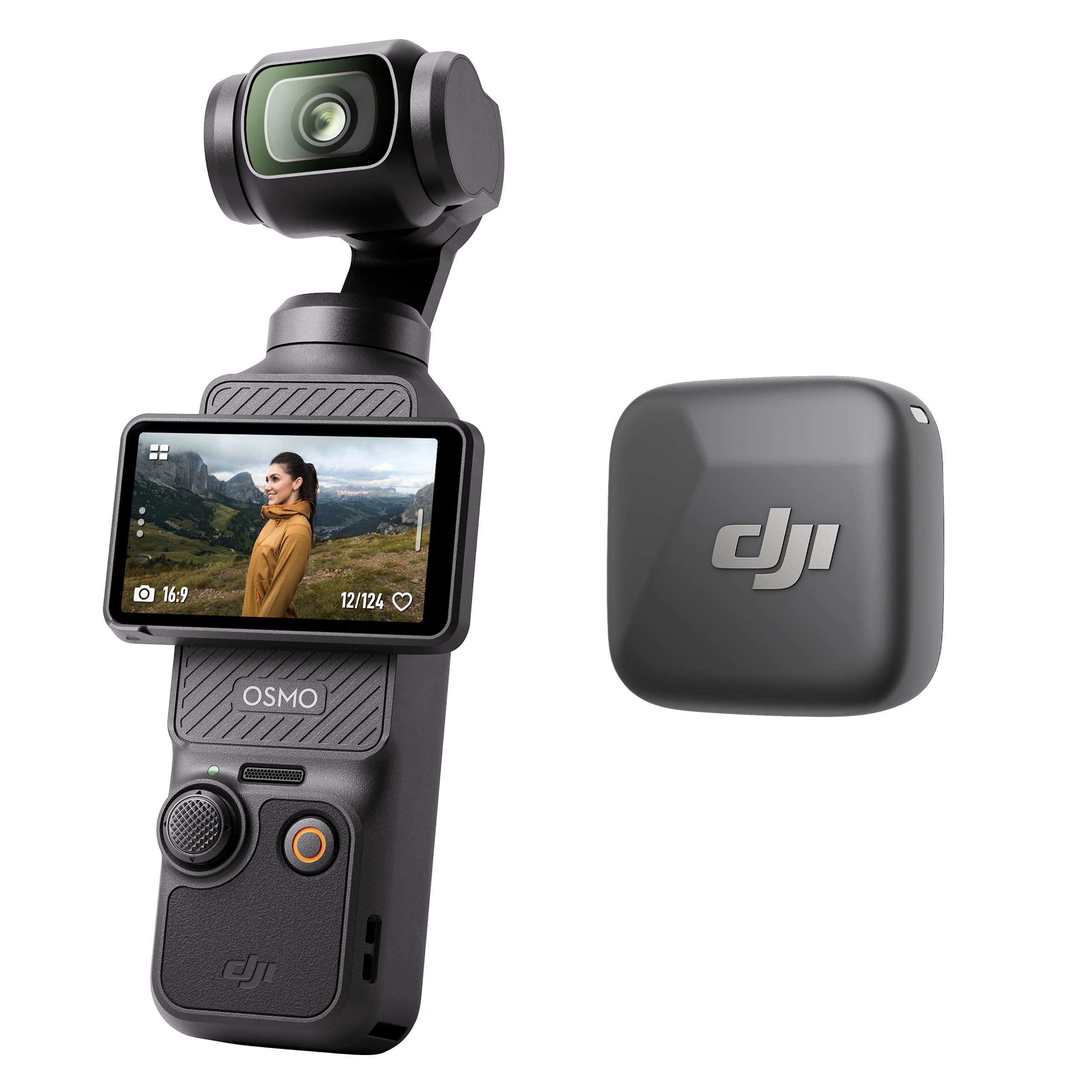
This Vlog Combo version of the Osmo Pocket 3 bundles the standard camera with a DJI Mic Mini transmitter, solving the single biggest pain point of the base model: audio quality. The Mic Mini pairs wirelessly through DJI OsmoAudio so there are no dongles or cables to manage, and the transmitter’s built‑in noise reduction is effective enough for busy streets or windy park vlogs.
Everything that makes the standard Pocket 3 great is here — the 1‑inch sensor, 4K/120fps recording, 3‑axis gimbal, ActiveTrack 6.0, and the rotating 2‑inch touchscreen. The combo adds the mic charging dock, a compact carrying pouch, clip magnets, and a windscreen, so you can start recording with high‑quality audio the moment you open the box.
The premium over the standard model is not trivial, and the Mic Mini is a proprietary accessory — you cannot use third‑party wireless mics without an adapter. Also, the same activation requirement and the lack of a USB‑C charger apply. If you know you will want a wireless mic eventually, the combo saves you a separate purchase and pairing headache.
Why it’s great
- DJI Mic Mini pairs seamlessly with zero setup — no cables, no adapters.
- Rotating 2‑inch screen flips to portrait for YouTube Shorts in under a second.
- Complete out‑of‑box experience: gimbal camera, wireless mic, charging dock, and case.
Good to know
- Mic Mini is proprietary; other wireless mics require a separate adapter.
- Same activation‑gate requirement as the standard Osmo Pocket 3.
- Battery charger for the camera is still not included; needs a 30W PD source.
5. Xtra Muse Pocket Gimbal

The Xtra Muse is the budget‑friendly alternative to the DJI Pocket 3 that still delivers a 1‑inch sensor, 4K/120fps video, and a 3‑axis gimbal in a compact body. Its 10‑bit X‑Log color profile records up to one billion colors, giving you serious grading latitude that is unusual at this tier — ideal for sunrise, sunset, or any high‑contrast scene a beginner YouTuber might film.
The Master Follow feature keeps you centered in the frame as you move, and the face and object tracking works reliably for a solo vlogger propped against a tripod. The 2‑inch touchscreen supports both horizontal and vertical shooting, and the 161‑minute battery life is competitive with the Osmo Pocket 3. The bundle includes a carrying bag, wrist strap, and a 1/4‑inch threaded handle.
Customer reviews note that DJI accessories (like third‑party mounts) fit the Xtra Muse body, but DJI wireless mics do not auto‑connect — a recent firmware update apparently improved this, but it is not as seamless as the DJI ecosystem. Build quality is slightly plasticky compared to the metal‑feel Osmo Pocket 3. For creators on a tighter budget, though, this is the most feature‑dense pocket gimbal camera available.
Why it’s great
- 1‑inch sensor plus 3‑axis gimbal at a price well below the market leader.
- 10‑bit X‑Log color provides professional‑grade grading flexibility.
- DJI accessory compatibility (mounts, tripods) expands your rig without extra cost.
Good to know
- DJI wireless mics may not auto‑connect reliably; verify firmware version before purchase.
- Build materials feel less premium than the Osmo Pocket 3 chassis.
- Some users report the tracking algorithm is slightly less sticky than DJI’s ActiveTrack.
6. Sony ZV‑1F Ultimate Kit

The Sony ZV‑1F offers a fixed 20mm equivalent F2.0 lens that is wide enough for arm’s‑length vlogging without needing a selfie stick. The 1‑inch 20.1MP sensor records 4K video, and the Active Mode image stabilization smooths out walking footage noticeably better than the digital‑only stabilizers on most entry‑level cameras. The Background Defocus button and Product Showcase Setting are both present, mirroring the ZV‑1’s vlogger‑friendly features.
This Ultimate Kit bundles the camera with a SanDisk Extreme Pro 128GB card, a condenser microphone, a U‑grip, a tripod, a UV filter, and Movavi video editing software. For a beginner who has zero accessories, this package removes the guesswork — you can start filming day one without buying a memory card or a basic tripod separately.
The fixed lens cannot zoom optically, so framing tighter shots requires you to physically move closer, which can be a limitation for certain content styles. Battery life is also average; expect roughly 40–50 minutes of continuous 4K recording before needing a recharge. For a grab‑and‑go vlog camera with a complete accessories bundle, this is one of the easiest paths to a first video.
Why it’s great
- Wide 20mm F2.0 lens is ideal for handheld selfie‑style vlogging without a stick.
- Complete bundle includes memory, microphone, tripod, and editing software.
- Active Mode stabilization reduces walking shake better than most digital systems.
Good to know
- Fixed lens has no optical zoom; you must move physically to change framing.
- Battery life is modest — consider a spare for shoots longer than 45 minutes.
- Autofocus uses contrast detection only; it is slower than phase‑detection systems.
7. Sony ZV‑1

The Sony ZV‑1 is the compact that introduced many content creators to the Sony vlog line. Its 20.1MP stacked 1‑inch Exmor RS sensor is paired with a ZEISS Vario‑Sonnar T* 24‑70mm equivalent lens that opens to F1.8 at the wide end — that is a full stop brighter than most 1‑inch competitors, giving you natural background blur and decent low‑light performance without a separate lens purchase.
Fast Hybrid Autofocus with 425 phase‑detection points covers nearly the entire frame, and Real‑time Eye AF tracks human eyes even when you turn your head. The side‑flip 3‑inch LCD works for both selfie and overhead shots, and the forward‑directional onboard microphone with a detachable windscreen captures surprisingly usable audio for quiet indoor vlogs. Pro video features like HLG and S‑Log3/2 give you grading options far beyond what most entry‑level compacts offer.
The ZV‑1 can overheat during extended 4K recording — users report thermal shutdown around 20–30 minutes in warm rooms. It also lacks a headphone jack, so monitoring audio requires an external recorder. The fixed zoom lens (24‑70mm equivalent) is versatile but does not reach telephoto lengths for sports or wildlife. For a compact that punches above its sensor class, the ZV‑1 remains a legend among YouTubers who prioritize a fast lens.
Why it’s great
- F1.8‑2.8 ZEISS zoom lens produces smooth bokeh and strong low‑light video.
- 425‑point Fast Hybrid AF with Real‑time Eye AF is best‑in‑class for compact cameras.
- HLG and S‑Log3/2 enable professional color grading in a pocketable body.
Good to know
- May overheat after 20–30 minutes of continuous 4K recording in warm environments.
- No headphone jack — audio monitoring requires external gear.
- 24‑70mm zoom range is useful but not wide enough for tight indoor selfies.
8. Insta360 GO Ultra
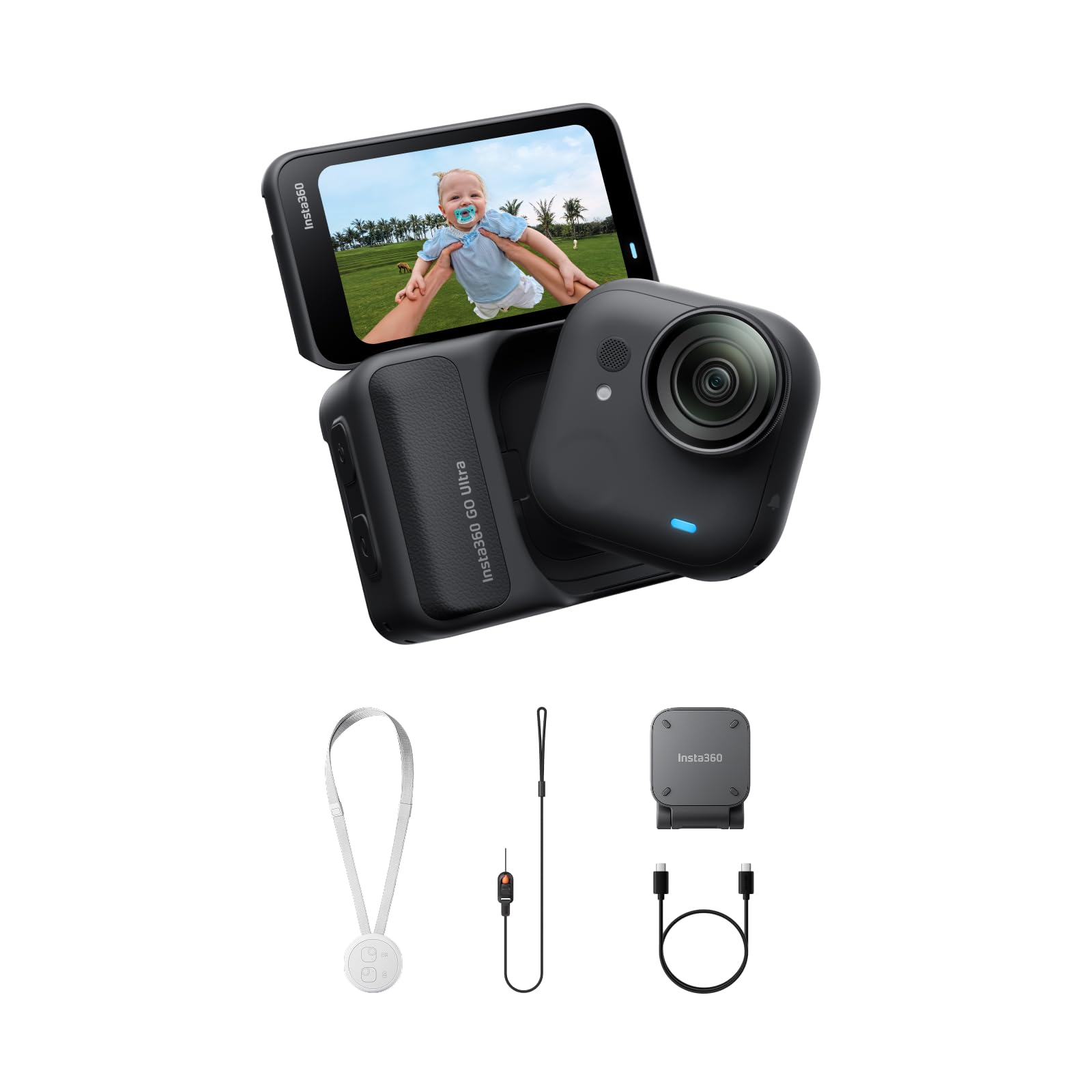
The Insta360 GO Ultra takes a radically different approach: a standalone 4K camera that weighs 53 grams and attaches to your chest, cap, or pendant via strong magnets. This is not a camera you hold — it is a camera you wear. The 1/1.28‑inch sensor with a 5nm AI chip supports 4K60fps video with 4K Active HDR, and the 156° field of view captures an immersive first‑person perspective that is impossible to replicate with a handheld gimbal.
The Action Pod acts as a charging dock and a secondary screen, extending total run time to roughly 200 minutes and adding IPX4 splash resistance. The standalone camera itself is IPX8 waterproof to 33 feet, so you can film while swimming or in heavy rain. FlowState Stabilization with 360 Horizon Lock keeps your POV footage steady even when you are running, cycling, or scrambling over rocks.
The battery life of the standalone camera is only about 45 minutes at 4K30, so the Action Pod is effectively mandatory for a full shoot day. Also, the camera requires a microSD card (not included), and some users report phantom battery drain where the dock loses 10% charge per day when idle. For a niche channel that centers on hands‑on activities, cooking, or outdoor adventures, the GO Ultra creates perspectives no other camera on this list can produce.
Why it’s great
- 53‑gram wearable form factor enables true hands‑free POV footage.
- IPX8 waterproof to 33 feet without a housing — unique among vlog cameras.
- Fast magnetic mounting system lets you attach to metal surfaces instantly.
Good to know
- Standalone battery lasts only ~45 minutes at 4K; the Action Pod is essential for longer shoots.
- Phantom idle drain may deplete both camera and dock over several days of non‑use.
- Requires a high‑speed microSD card; not sold with the bundle.
9. Canon EOS R100

The Canon EOS R100 is the smallest and lightest body in Canon’s EOS R series, making it a painless travel companion for a beginner YouTuber who also values still photography. Its 24.1MP APS‑C sensor paired with the DIGIC 8 processor captures 4K video at up to 24fps and Full HD at up to 120fps for slow‑motion clips. The Dual Pixel CMOS AF covers 143 zones with human face and eye detection, and it works for both stills and video.
The kit includes an RF‑S 18‑45mm F4.5‑6.3 IS STM lens with optical stabilization, so handheld footage is steadier than you would get from a body without I.B.I.S. Creative Assist and Scene Intelligent Auto modes guide absolute beginners through settings without forcing them into manual mode. Wi‑Fi and Bluetooth let you transfer clips directly to your phone for quick uploads.
4K video is capped at 24fps, which means no smooth slow‑motion in 4K, and the 8‑bit color depth limits grading flexibility compared to the 10‑bit Sony ZV‑E10 series. The LCD is a fixed panel (not vari‑angle), so framing overhead or low‑angle selfie shots is awkward. Still, as a gateway into Canon’s RF‑mount lens ecosystem at a accessible price, the R100 is a solid first mirrorless for photo‑first creators branching into video.
Why it’s great
- Smallest and lightest EOS R body — excellent portability for travel vlogs.
- Dual Pixel CMOS AF with face/eye detection works well for both stills and video.
- Optical image stabilization in the kit lens reduces handheld shake without I.B.I.S.
Good to know
- 4K video is limited to 24fps — no 4K/60 or 4K/30 options for smooth motion.
- Fixed LCD panel cannot flip forward for selfie framing or overhead shots.
- 8‑bit color only; less flexibility for grading compared to 10‑bit rivals.
10. Canon EOS R50
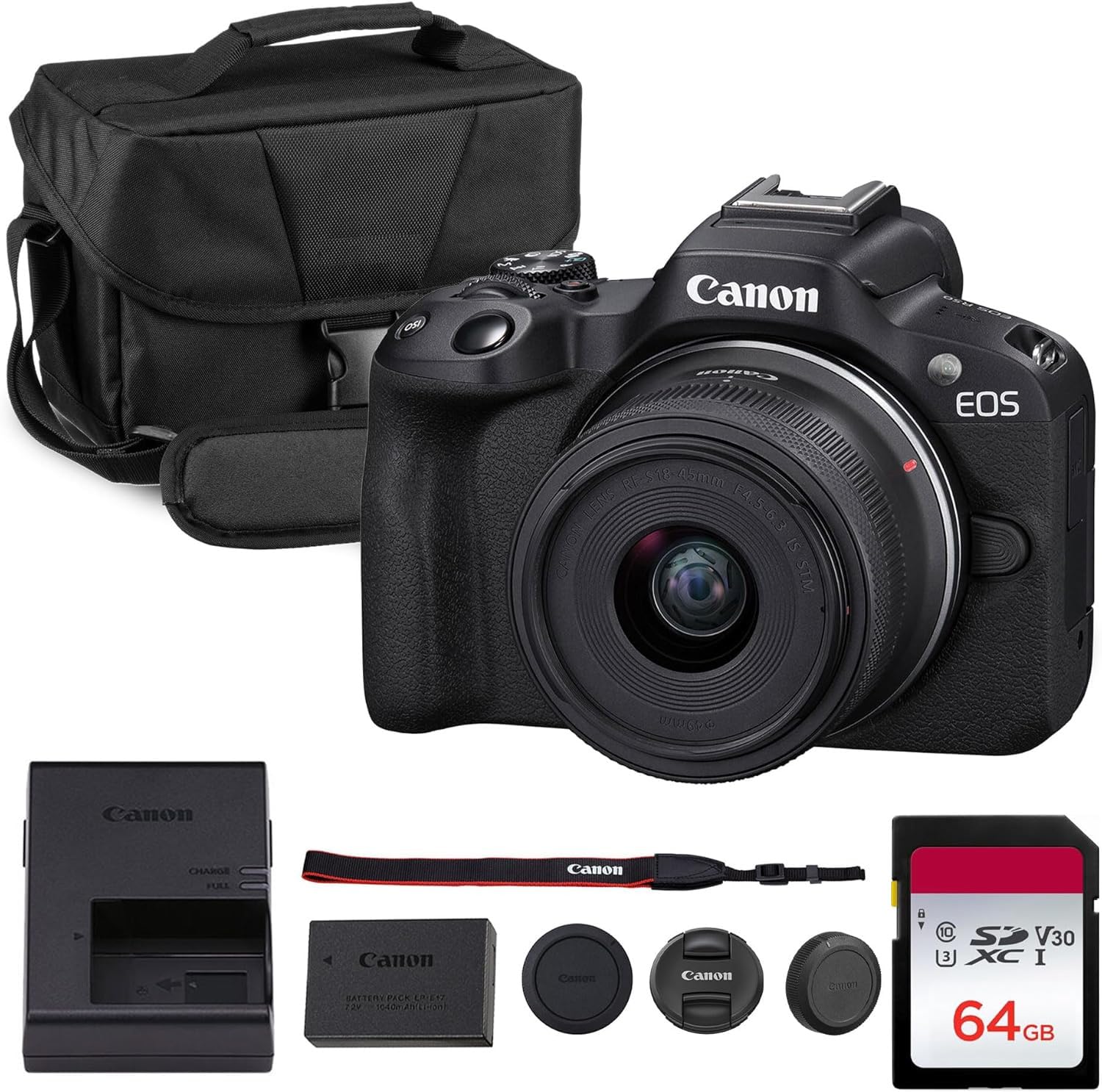
The Canon EOS R50 is a step up from the R100, aimed squarely at creators who want social‑media‑ready video features without moving to a full‑frame budget. It shoots oversampled 4K (captured from a higher resolution then downsampled) for noticeably sharper YouTube footage, and the Dual Pixel CMOS AF II with 99 zones provides reliable human, animal, and vehicle detection. The vari‑angle touchscreen flips out to the side, making it easy to frame yourself even when the camera is on a tripod.
The bundled 18‑45mm F4.5‑6.3 IS STM lens includes optical stabilization, and the body supports UVC/UAC for plug‑and‑play USB streaming — a feature the R100 lacks. Creative Assist and vertical video orientation let you shoot in 9:16 format directly in camera, which saves you from cropping in post for YouTube Shorts or TikTok. The bundle includes a shoulder bag and a 64GB UHS‑I SDXC card, so you can start filming immediately.
4K video maxes out at 30fps (not 60fps), and the kit lens is slow at the telephoto end, so indoor shots without extra light will show noise. There is no in‑body image stabilization; you rely entirely on lens stabilization or a tripod. For a beginner who wants a modern mirrorless with strong video features and a vari‑angle screen, the R50 hits a sweet spot between capability and ease of use.
Why it’s great
- Oversampled 4K produces sharper video than standard 4K capture from this sensor.
- Vari‑angle touchscreen allows flexible framing for vlog selfies and overhead shots.
- Vertical video mode and USB streaming reduce post‑production friction for social platforms.
Good to know
- No 4K/60fps option — limited to 4K/30fps for video capture.
- Kit lens is slow (F6.3 at 45mm); consider a faster prime for indoor vlogging.
- No in‑body stabilization; smooth handheld shots require the OSS kit lens or a gimbal.
11. Canon EOS 2000D / T7 Bundle

The Canon EOS 2000D (also known as the Rebel T7) is the classic entry‑level DSLR that has launched thousands of photography careers. Its 24.1MP APS‑C sensor and DIGIC 4+ processor deliver clean stills, and the optical viewfinder offers a real‑time, zero‑lag shooting experience that mirrorless cameras cannot replicate. The included EF‑S 18‑55mm F3.5‑5.6 DC III zoom lens covers a versatile wide‑to‑standard range for general YouTube filming.
This Essential Bundle goes beyond the body and lens: it includes a 64GB SD card, an LED video light, a Gripster tripod, a carrying case, and a cleaning kit — everything a brand‑new creator needs to shoot their first few videos without buying anything else. Canon’s EOS Webcam Utility software also turns the T7 into a functional webcam via USB, useful for live streams or Zoom meetings.
Video is limited to Full HD 1080p at 30fps — no 4K at all — which is a significant limitation if your channel demands high‑resolution footage. The 9‑point phase‑detect AF system is old and slow compared to modern Dual Pixel systems, and continuous shooting is a sluggish 3fps. For YouTube channels focused on talking‑head content where 1080p is acceptable and the budget is extremely tight, this bundle delivers exceptional value with a proven lens ecosystem.
Why it’s great
- Massive accessory bundle includes lighting, tripod, memory, and case for instant readiness.
- Optical viewfinder provides a lag‑free shooting experience for still photography.
- Canon EF‑S lens ecosystem is huge, affordable, and widely available used.
Good to know
- Video is capped at Full HD 1080/30p — no 4K capture at all.
- 9‑point AF system is noticeably slower and less accurate than modern mirrorless AF.
- Camera is bulkier and heavier than mirrorless alternatives of similar cost.
FAQ
Do I need 4K video for my first YouTube channel?
Is a gimbal camera better than a mirrorless for beginner vlogging?
How much should I spend on my first YouTube camera?
Can I use my smartphone instead of a dedicated camera?
Final Thoughts: The Verdict
For most users, the camera for beginner youtuber winner is the DJI Osmo Pocket 3 because its 3‑axis gimbal, 1‑inch sensor, and 4K/120fps video eliminate the two biggest beginner hurdles — shaky footage and complex setup — in a truly pocketable size. If you want the superior low‑light performance and lens flexibility of an interchangeable‑lens body, grab the Sony ZV‑E10. And for hands‑free POV content that no other camera can replicate, nothing beats the Insta360 GO Ultra.

Mo Maruf
I created WellFizz to bridge the gap between vague wellness advice and actionable solutions. My mission is simple: to decode the research and give you practical tools you can actually use.
Beyond the data, I am a passionate traveler. I believe that stepping away from the screen to explore new environments is essential for mental clarity and physical vitality.