Our readers keep the lights on and my smoothie glass nicely filled. As an Amazon Associate, I earn from qualifying purchases.
Astrophotography is a brutal technical mistress. You are fighting light pollution, Earth’s rotation, thermal noise from your sensor, and the faintest photons that have traveled for millennia. A generic camera body won’t cut it—you need specific sensor sensitivity, reliable long-exposure performance, and the ability to mate with tracking gear that keeps a pinpoint of light locked for minutes at a time. The wrong choice means hours of captured data that turns into mushy, trailed, or noisy garbage during stacking.
I’m Mohammad Maruf — the founder and writer behind WellFizz. I have spent years analyzing the market research, sensor readout speeds, and in-body stabilization architectures that separate a camera built for deep-sky capture from one that will leave you frustrated in a cold field at 3 AM.
This guide breaks down the specific sensor technology, star-tracking compatibility, and low-light noise handling that defines the best camera for astrophotography, with reviews of eleven models that range from smart telescopes to full-frame flagships.
How To Choose The Best Camera For Astrophotography
Selecting a camera for this discipline means prioritizing sensor technology and mechanical stability over megapixel counts and video features. You are optimizing for signal-to-noise ratio in the darkest parts of the frame.
Sensor Type and Size: Full-Frame Dominance
A full-frame sensor collects roughly 2.3 times more light per pixel than an APS-C sensor at the same aperture. For capturing faint nebulae and galaxies, this light-gathering advantage translates directly into shorter exposure times and cleaner stacks. Back-side illuminated (BSI) sensors push this further by moving the wiring layer behind the photodiodes, increasing the fill factor and reducing noise—a spec every astrophotographer should prioritize.
Star Tracker Compatibility: The Mount Matters More Than the Lens
No camera body, regardless of price, can expose a sharp 2-minute image of the Milky Way without tracking. The camera must have a built-in intervalometer or a wired remote port compatible with popular star trackers like the Sky-Watcher Star Adventurer. A camera with a fragile micro-USB port that fails after repeated plugging in is a liability in the field.
Dynamic Range and Noise Performance at High ISO
Astrophotography lives between ISO 800 and ISO 6400. Native dynamic range at these settings determines how much detail you preserve in both the bright core of the Andromeda Galaxy and the faint dust lanes surrounding it. Look for sensors that maintain over 12 stops of dynamic range at ISO 1600—this is the non-negotiable spec for stacking faint targets.
Quick Comparison
On smaller screens, swipe sideways to see the full table.
| Model | Category | Best For | Key Spec | Amazon |
|---|---|---|---|---|
| Sony a7 III | Full-Frame Mirrorless | Deep-sky DSLR-level tracking | 15-stop dynamic range | Amazon |
| Pentax K-1 Mark II | Full-Frame DSLR | Built-in Astro Tracer | 36MP, Pixel Shift + GPS | Amazon |
| Nikon D850 | Full-Frame DSLR | High-res deep-sky composites | 45.7MP BSI sensor | Amazon |
| Canon EOS R5 | Full-Frame Mirrorless | High-res lunar & planetary | 45MP stacked BSI sensor | Amazon |
| Nikon Z6 III | Full-Frame Mirrorless | Low-light video & stacking | EV -10 AF, 6K/60p | Amazon |
| Sony Alpha 7 IV | Full-Frame Mirrorless | Versatile hybrid Astro | 33MP BSI CMOS, S-Cinetone | Amazon |
| Canon EOS R8 | Full-Frame Mirrorless | Budget full-frame for Milky Way | 24.2MP, 4K 60p oversampled | Amazon |
| ZWO Seestar S30 Pro | Smart Telescope | One-tap deep-sky imaging | 4K dual camera, 160mm FL | Amazon |
| DWARFLAB Dwarf 3 | Smart Telescope | Portable all-in-one setup | 3lb, 4K autotracking | Amazon |
| Panasonic LUMIX G85 | MFT Mirrorless | Budget wide-field star trails | 16MP, IBIS, weather-sealed | Amazon |
| Sky-Watcher Star Adventurer 2i | Star Tracker Mount | DSLR tracking platform | Wi-Fi app control, 3min@300mm | Amazon |
In‑Depth Reviews
1. Sony a7 III

The Sony a7 III remains the benchmark for entry-level full-frame astrophotography because its 24.2MP back-side illuminated sensor delivers 15 stops of dynamic range at base ISO and maintains clean, stackable data up to ISO 6400. The 693 phase-detection AF points help nail focus on bright stars for alignment, and the 10 fps continuous shooting is fast enough for lunar sequences.
In the field, the NP-FZ100 battery lasts through an entire night of time-lapse imaging—real-world tests show over 700 shots per charge. The body is weather-sealed against condensation and light drizzle, and the micro-USB port accepts standard intervalometer cables for use with star trackers like the Sky-Watcher Star Adventurer.
This camera’s native ISO 50–204,800 range means you can capture the Orion Nebula core without blowing out the Trapezium cluster, then pull up the faint Running Man nebula in post. Pair it with a fast wide-angle prime like the Sigma 14mm f/1.8 Art and you have a compact rig that competes with dedicated astronomy cameras costing twice as much.
Why it’s great
- BSI sensor provides class-leading photon collection at ISO 1600-6400
- Battery life easily covers 4+ hours of continuous shutter sequences
- Extensive lens ecosystem with native and adapted options for any focal length
Good to know
- Menu system can be complex to navigate in the dark
- Kit zoom lens is too slow for deep-sky; budget for a fast prime
2. Pentax K-1 Mark II

The Pentax K-1 Mark II is the only full-frame DSLR that includes Astro Tracer, a GPS-driven sensor-shift system that moves the sensor to compensate for Earth’s rotation during exposures up to five minutes long. This eliminates the need for an external star tracker for wide-field work, making it the most self-contained astrophotography camera on this list.
Its 36.4MP sensor has no optical low-pass filter, which increases fine detail resolution on star clusters and lunar craters. The Handheld Pixel Shift Resolution mode composites four images for true 36MP color data, though this is less useful for astro than the standard single-shot mode. The magnesium-alloy body is fully weather-sealed and includes dual SD slots for data redundancy during all-night sessions.
The body is heavier than mirrorless alternatives, but that mass actually helps dampen tripod vibrations from wind. The red backlight on the top LCD and the customizable button layout make it practical to operate without a headlamp. For the astrophotographer who wants a complete camera-tracking system without an external mount for wide-angle Milky Way shots, this is the most elegant solution.
Why it’s great
- Built-in Astro Tracer allows 5-min exposures without an external tracker
- AA-filterless sensor captures maximum star sharpness at the pixel level
- Weather sealing and robust build handle harsh night environments
Good to know
- Heavier than mirrorless options; best with a sturdy tripod
- Autofocus system is slower than modern mirrorless competition
3. Nikon D850

The Nikon D850’s 45.7MP back-side illuminated sensor remains one of the highest-resolution full-frame sensors optimized for low-light performance. The no-optical-low-pass-filter design delivers exceptional star sharpness, and the sensor’s 14-bit raw files at full resolution give you massive cropping room for framing targets like the Andromeda Galaxy in post-production.
Continuous shooting at 9 fps with full autofocus is useful for capturing Moon crescents or International Space Station transits, and the tilting touchscreen makes focus magnification easier when aligning on a bright star from an awkward tripod angle. The illuminated buttons and rear control panel are a practical advantage in total darkness compared to non-illuminated mirrorless bodies.
The real strength here is dynamic range at ISO 64—unique for a 45MP sensor—which lets you capture the summer Milky Way arch with almost no read noise in the dark areas. The XQD card slot handles the large file buffer smoothly during burst sequences. For the photographer who wants both landscape detail and deep-sky stacking ability, the D850 is the DSLR gold standard.
Why it’s great
- Native ISO 64 delivers unmatched dynamic range for Milky Way landscapes
- 45.7MP resolution allows aggressive cropping on distant deep-sky targets
- Illuminated controls enable dark-field operation
Good to know
- Large raw files require fast media and ample storage
- No built-in GPS for automatic star-tracking alignment
4. Canon EOS R5

The Canon EOS R5 uses a stacked, back-side illuminated 45MP sensor that reads out at 20 fps with the electronic shutter—fast enough to freeze a lunar occultation frame by frame. The 1,053 AF points cover 100% of the frame, making it trivial to focus on Saturn or Jupiter even before they are visually distinct in the viewfinder.
For planetary and lunar imaging, the 8K video mode oversamples to produce razor-sharp 4K frames that you can extract and stack with software like AutoStakkert. The in-body image stabilization (IBIS) works well for handheld Aurora borealis shots, though it should be disabled when the camera is mounted on a star tracker to prevent interference.
The body is smaller and lighter than the D850, but the Canon RF lens ecosystem is still growing. The overheating concerns during extended 8K recording are less relevant for astro, where you are shooting stills or moderate-length video clips. For the photographer who wants one camera that excels at both terrestrial landscapes and detailed lunar/Solar System imaging, this is the strongest contender.
Why it’s great
- Stacked BSI sensor enables 20 fps electronic shutter for planetary sequences
- 8K video mode provides ultra-high-res frames for lunar stacking
- Eye Control AF and DP AF II make focus effortless
Good to know
- IBIS must be manually disabled for star tracker use
- Battery life is shorter than DSLR competitors
5. Nikon Z6 III

The Nikon Z6 III’s back-side illuminated 24.5MP sensor achieves autofocus detection down to -10 EV, meaning it can lock focus on a star that is barely visible in the viewfinder. This is a game-changer for deep-sky framing: you can set focus once on a bright star, then recompose without needing a Bahtinov mask or digital zoom repetition.
Internal 6K/60p N-RAW recording provides the highest video resolution in this class for time-lapse Milky Way arches, and the 4K/120p mode allows smooth slow-motion star trail clips. The 4000-nit EVF is bright enough to see nebula previews even in moonlit conditions, and the 120 fps refresh rate eliminates blackout during continuous shooting.
The camera features dual card slots (CFexpress Type B and SD), which is rare at this tier, giving you redundancy for all-night data collection. The Z6 III is also one of the few full-frame bodies that handles high-ISO noise cleanly up to 25,600 without aggressive chroma noise suppression, retaining more detail for stacking.
Why it’s great
- -10 EV AF locks focus in near-complete darkness
- 6K N-RAW video provides industry-leading data for extraction
- Dual card slots protect against media failure during long nights
Good to know
- Menu system is less intuitive than competitors for rapid changes
- Smaller native lens library than Sony FE mount
6. Sony Alpha 7 IV

The Sony Alpha 7 IV’s 33MP Exmor R BSI sensor hits a sweet spot between resolution and sensitivity. At ISO 1600, it maintains over 12 stops of dynamic range, preserving both the core and the outer dust lanes of bright galaxies. The 7K oversampled 4K/30p mode delivers exceptionally clean video for time-lapses of the Milky Way core.
Real-time Eye AF for humans and animals is less relevant for astro, but the real-time tracking works well to keep a bright planet like Jupiter centered in the frame during manual tracking. The full articulating touch screen is useful for framing polar alignments when the camera is pointed at Polaris at a steep angle. The larger grip than the a7 III improves comfort during long shooting sessions in cold weather.
Dual card slots (CFexpress Type A and SD) allow you to write raw astro files to a fast card while simultaneously backing up to a larger SD card. The S-Cinetone color profile is designed for video, but it also produces pleasing star trail colors with minimal post-processing. This camera is the best all-rounder for someone who films astro time-lapses during the week and shoots deep-sky stacks on the weekend.
Why it’s great
- 33MP sensor balances resolution and low-light SNR perfectly
- 7K oversampled 4K delivers ultra-clean video for time-lapse
- Articulating screen simplifies polar alignment framing
Good to know
- No full-frame 4K/60p without crop
- CFexpress Type A cards are less common and more expensive
7. Canon EOS R8

The Canon EOS R8 brings the same 24.2MP sensor and DIGIC X processor found in the much more expensive R6 Mark II into a lighter, more affordable body.
The 4K/60p video is oversampled from 6K, extracting extra detail from faint nebula emissions in time-lapse. The 0.39-inch OLED EVF with 120 fps refresh rate provides a lag-free view of star fields even during long exposures. The vari-angle LCD is useful for waist-level framing when the camera is mounted low on a tracking wedge.
The trade-offs are significant: no in-body image stabilization means you must rely on the lens or a tracker for sharp long exposures, and the LP-E17 battery is small, typically lasting only 500 shots. You will need multiple spares for an all-night session. The single SD card slot is a concern for data security.
Why it’s great
- Excellent high-ISO noise performance from the shared R6 II sensor
- Lightest full-frame option for backpacking to dark sky sites
- Oversampled 4K/60p extracts maximum detail from faint targets
Good to know
- No IBIS makes it dependent on a star tracker or sturdy lens
- Small battery requires multiple spares for a full night
8. ZWO Seestar S30 Pro
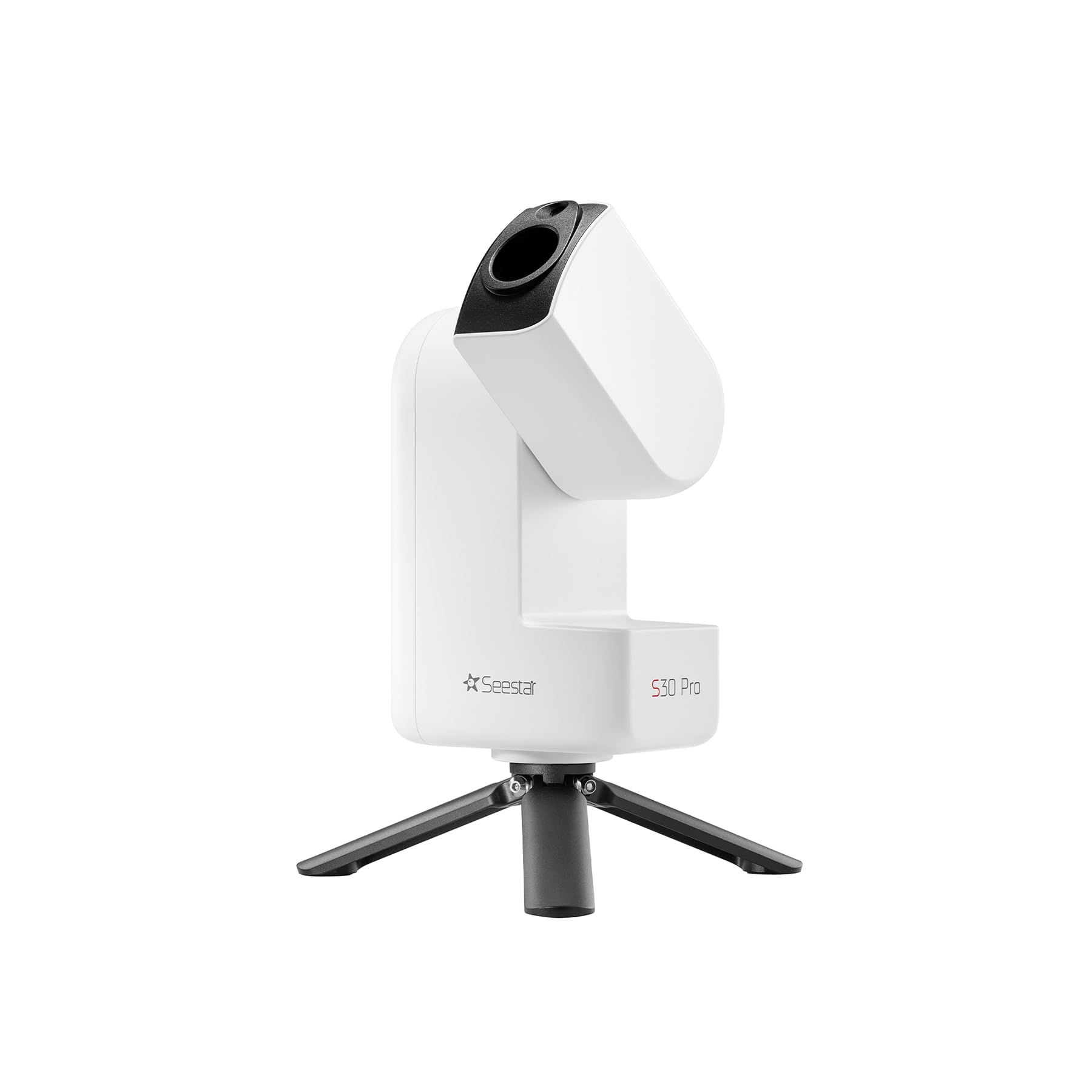
The ZWO Seestar S30 Pro is a dedicated smart telescope that functions as a complete astrophotography camera system out of the box. Its IMX585 telephoto sensor captures deep-sky objects with a 160mm f/5 apochromatic lens that virtually eliminates chromatic aberration, and the integrated automatic GOTO and tracking means you never touch a mount or calibration routine.
The dual-camera system includes a wide-angle IMX586 camera for Milky Way landscapes. The built-in mosaic stitching mode automatically combines multiple frames into 8K panoramas. The brightness filter and IR-cut filter reduce light pollution interference, allowing you to capture nebulae from suburban skies that would drown them out on a conventional camera.
This is not a traditional camera body—it cannot be used for regular photography. But for someone who only wants deep-sky images of galaxies, nebulae, and star clusters without learning the technical workflow of stacking and calibration frames, the S30 Pro delivers finished images directly to your phone or tablet. The 128GB internal storage and anti-dew heater make it suitable for unattended overnight sessions.
Why it’s great
- Fully automatic targeting and tracking removes the steep learning curve
- Built-in light pollution filters reveal nebulae from suburban backyards
- One-tap processing delivers finished stacked images instantly
Good to know
- Not usable as a general-purpose camera for daytime photography
- Limited to the 160mm focal length; no lens interchangeability
9. DWARFLAB Dwarf 3
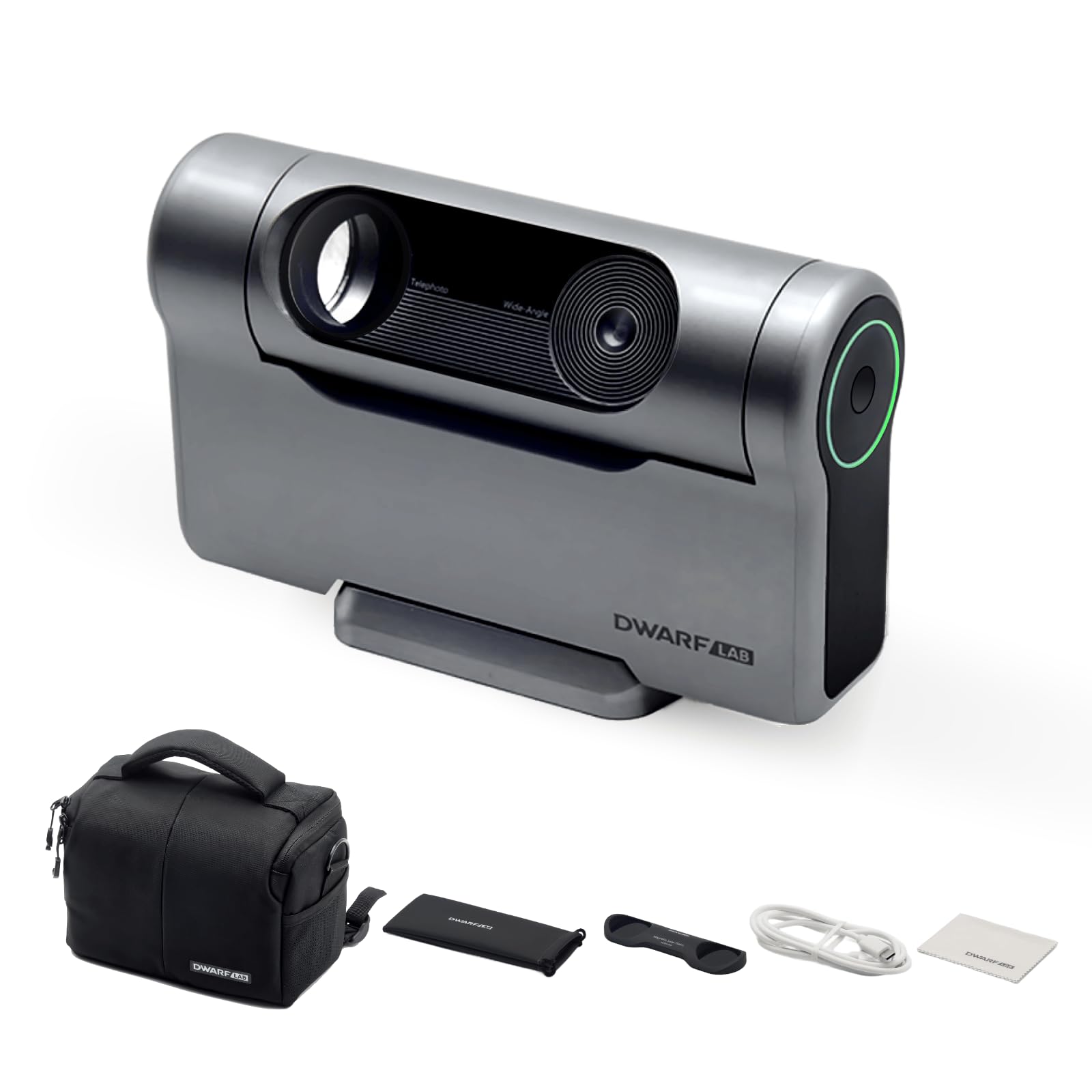
The DWARFLAB Dwarf 3 weighs only 3 pounds and fits inside a standard backpack, making it the most portable astrophotography solution on this list. Its dual-lens imaging system uses a telephoto lens for deep-space objects and a wide-angle lens for Milky Way captures, all controlled through the DWARFLAB app on your smartphone.
The 4K auto-tracking system locks onto celestial objects and maintains alignment even when the mount is jostled, which is crucial for backpacking to remote dark-sky sites. The cloud-powered image processing allows you to stack and enhance photos directly from the app without needing a laptop or desktop software—just press one button and wait for the processed image.
The Dwarf 3 operates in both Alt-Az and EQ modes. EQ mode, when aligned with the celestial pole, enables longer exposures without field rotation. The USB-C power input means you can run it all night from a standard portable power bank. For the traveling astrophotographer or the complete beginner who wants to capture the Ring Nebula on their first night out, this is the most accessible option, though it lacks the resolution and flexibility of a full camera system.
Why it’s great
- Extremely compact and light at 3 lbs for travel to dark sites
- Cloud processing eliminates the need for desktop stacking software
- Dual camera system covers both wide-field and deep-sky imaging
Good to know
- Image quality is limited by the small sensor size
- App can be glitchy with connection drops during long sessions
10. Panasonic LUMIX G85

The Panasonic LUMIX G85 is a Micro Four Thirds camera that can be found at a very entry-level price point, making it accessible for budget-conscious beginners who want to try astrophotography. The 16MP sensor has no low-pass filter, which gives it a slight edge in resolving fine star detail compared to other 16MP MFT sensors. The 5-axis in-body dual image stabilization is effective for 1–2 second handheld shots of the Milky Way arch.
The weather-sealed magnesium alloy body handles the condensation of a humid night better than most budget plastic cameras. The articulating touchscreen and the 2360K-dot OLED viewfinder make it comfortable to use. The 4K photo mode captures bursts at 30 fps, which you can extract frames from for time-lapse sequences.
The limitation is sensor size. The Micro Four Thirds system has a 2x crop factor, meaning a 12mm lens behaves like a 24mm lens, which makes it harder to capture a wide field of view for the Milky Way. Noise performance at ISO 3200 is noticeably worse than any full-frame option on this list. This camera works best as a dedicated wide-field star trail camera, not a deep-sky nebula hunter.
Why it’s great
- Very affordable entry point for learning astrophotography basics
- Weather-sealed body withstands dew and light moisture
- Strong IBIS for short star trail and time-lapse sequences
Good to know
- Small MFT sensor struggles with noise above ISO 1600
- Battery life is poor; carry at least two spares for a night session
11. Sky-Watcher Star Adventurer 2i Pro Pack

The Sky-Watcher Star Adventurer 2i is not a camera—it is a motorized equatorial tracking mount that turns any camera body with a standard tripod thread into a deep-sky rig. Without a tracker, even the best full-frame camera can only expose for about 15–20 seconds at a 14mm focal length before star trailing becomes visible. The Adventurer 2i extends that to multiple minutes, allowing you to capture the faint glow of the Horsehead Nebula with a modest telephoto lens.
The upgraded 2i version adds Wi-Fi control through Sky-Watcher’s SAM Console app, letting you adjust tracking speed and start time-lapse sequences from your phone without touching the mount. The Pro Pack includes the equatorial base, counterweight kit, and latitude adjustment base, so you have everything needed for polar alignment right out of the box. The mount is rated for payloads up to 5 kg, which covers a full-frame camera with a 200mm lens.
The learning curve with polar alignment is real—you need to know where Polaris is and how to adjust the latitude base to align the RA axis within a few arcminutes. The built-in polar scope is small and the illuminator does not fit well with a camera mounted. But once aligned, the Adventurer 2i is incredibly reliable, with battery life around 40 hours. This is the single most important accessory for any serious astrophotographer using a conventional camera body.
Why it’s great
- Transforms any camera into a deep-sky imaging platform
- Wi-Fi app control enables remote operation without cable triggers
- Excellent battery life supports multiple nights of shooting
Good to know
- Requires a sturdy tripod and polar alignment knowledge
- Polar scope illuminator is difficult to use with the camera mounted
FAQ
Why can’t I just use a regular DSLR with a kit lens for astrophotography?
Is a star tracker mount necessary if I have IBIS in my camera?
Final Thoughts: The Verdict
For most users, the best camera for astrophotography winner is the Sony a7 III because it combines a back-side illuminated full-frame sensor with 15 stops of dynamic range, excellent battery life, and the widest lens ecosystem for adapting fast glass. If you want a self-contained tracking system for wide-field work, grab the Pentax K-1 Mark II with its built-in Astro Tracer. And for a plug-and-play deep-sky experience with zero learning curve, nothing beats the ZWO Seestar S30 Pro.

Mo Maruf
I created WellFizz to bridge the gap between vague wellness advice and actionable solutions. My mission is simple: to decode the research and give you practical tools you can actually use.
Beyond the data, I am a passionate traveler. I believe that stepping away from the screen to explore new environments is essential for mental clarity and physical vitality.