Our readers keep the lights on and my smoothie glass nicely filled. As an Amazon Associate, I earn from qualifying purchases.
Choosing the right rig for 4K video recording means navigating sensor sizes, autofocus algorithms, codecs, and stabilization systems — each spec directly dictates whether your footage looks cinematic or amateur. A poor match here can bury you in rolling shutter, crippling crop factors, or overheating shutdowns mid-take.
I’m Mohammad Maruf — the founder and writer behind WellFizz. I’ve spent years dissecting camera specifications across mirrorless, pocket cinema, and hybrid bodies, mapping real-world trade-offs between dynamic range, recording limits, and lens ecosystems so you don’t waste budget on specs that look good on paper but fail on set.
Below I break down the only eleven bodies that genuinely deliver professional-grade 4K video, from a pocketable gimbal camera to a full-frame powerhouse — collectively this is the definitive list of the best camera for 4k video recording you can trust today.
How To Choose The Best Camera For 4K Video Recording
Four key specs define whether a 4K camera will serve your workflow or frustrate you with limits. Ignore marketing fluff and focus on sensor size, bit depth, stabilization, and recording architecture — these directly control your final image quality and editing flexibility.
Sensor Size and Resolution Oversampling
A larger sensor delivers shallower depth of field and better low-light performance, but not all 4K is created equal. Look for cameras that oversample 4K from a higher resolution readout (6K or 7K downsampled to 4K) — this produces sharper, more detailed footage with less aliasing than pixel-binned or line-skipped implementations. Full-frame and APS-C sensors typically offer the best oversampling routes, while Micro Four Thirds at 16MP may use line-skipping that softens fine detail.
Bit Depth, Chroma Subsampling, and Codec
Consumer 4K cameras record at 8-bit 4:2:0, which limits color grading without banding artifacts. For serious post-production, a camera capable of 10-bit 4:2:2 internal recording — ideally in a codec like ProRes or Blackmagic RAW — gives you vastly more latitude to adjust exposure, recover shadows, and grade skin tones. Log gamma profiles (V-Log, C-Log, S-Log, Blackmagic RAW) further extend dynamic range retention.
Stabilization: Optical vs In-Body vs Mechanical
Handheld 4K footage magnifies every micro-shake. In-body image stabilization (IBIS) built into the sensor is the gold standard for walking shots without a gimbal, especially when combined with lens-based OIS. Pure electronic stabilization often crops the frame and degrades resolution. For run-and-gun vlogging, a dedicated gimbal camera like the DJI Osmo Pocket 3 delivers mechanical stabilization that outperforms any built-in IBIS system.
Recording Limits and Thermal Management
Many mirrorless cameras impose 29-minute recording limits for tax classification reasons or shut down due to overheating during 4K/60p capture. Check real-world thermal tests: cameras with active cooling (internal fans) or larger magnesium alloy bodies dissipate heat better than compact plastic shells. If you film interviews, events, or long monologues, choose a body that records unlimited 4K without a timer or thermal throttle.
Quick Comparison
On smaller screens, swipe sideways to see the full table.
| Model | Category | Best For | Key Spec | Amazon |
|---|---|---|---|---|
| DJI Osmo Pocket 3 Creator Combo | Gimbal Camera | Vlogging & travel | 1″ CMOS, 4K/120fps | Amazon |
| Panasonic LUMIX G85 | Mirrorless (MFT) | Value hybrid | 5-Axis IBIS + OIS | Amazon |
| Canon EOS M50 (Renewed) | Mirrorless APS-C | Budget vlogging | Dual Pixel AF, 4K/24p | Amazon |
| Nikon Z 30 | Mirrorless APS-C | Streaming & vlogs | Unlimited 4K/30p | Amazon |
| Blackmagic Pocket 4K Power Bundle | Cinema Camera | Cinematic production | 13 stops DR, RAW | Amazon |
| Canon EOS R8 | Mirrorless Full-Frame | Content creation | Uncropped 4K/60p | Amazon |
| Sony Alpha 6700 | Mirrorless APS-C | Hybrid photo/video | 4K/120p, AI AF | Amazon |
| Sony Alpha 7 IV | Mirrorless Full-Frame | Pro hybrid | 7K oversampled 4K/30p | Amazon |
| Canon EOS 5D Mark IV | DSLR Full-Frame | Professional stills + video | 30.4MP, 4K/30p MJPEG | Amazon |
| Blackmagic Pocket 6K Pro | Cinema Camera | Cinematic & documentary | 6K sensor, internal NDs | Amazon |
| Panasonic HC-X20 | Camcorder | News & events | 1″ sensor, 20x optical zoom | Amazon |
In‑Depth Reviews
1. Sony Alpha 7 IV

The Sony Alpha 7 IV delivers a 33MP full-frame Exmor R sensor that oversamples 4K/30p from a 7K readout, producing pixel-level sharpness without aliasing. You get up to 4K/60p in 10-bit 4:2:2 with full pixel readout across all recording formats — no crops, no compromises. The BIONZ XR processor handles heavy codec loads smoothly, and S-Cinetone color science gives flesh tones a natural, filmic roll-off straight out of camera.
Pairing 693 phase-detection AF points with real-time Eye AF for humans and animals, the A7 IV locks focus reliably even in dimly lit scenes at f/2.8. The 5-axis IBIS provides around 5.5 stops of stabilization, making handheld walking shots usable without a gimbal. Dual card slots (CFexpress Type A / SD) and a fully articulating touchscreen round out a body that is weather-sealed around the magnesium alloy chassis.
Battery life exceeds 2,000 shots per charge in stills mode, and the camera handles unlimited 4K/30p recording without thermal shutdown. The main heat-sensitive limit appears only during sustained 4K/60p capture in high ambient temperatures — the body will throttle after roughly 30 minutes. For hybrid shooters who demand professional stills and video from one body, this is the most balanced full-frame package available.
Why it’s great
- 7K oversampled 4K/30p delivers class-leading detail and no pixel binning.
- Real-time Eye AF is sticky, accurate, and works in challenging lighting.
- Dual card slots with CFexpress Type A support for high-bitrate RAW recording.
Good to know
- 4K/60p uses an APS-C crop; not truly full-frame at higher frame rates.
- 4K/60p can overheat after about 30 minutes in warm conditions.
- Menu system remains dense and somewhat labyrinthine for new users.
2. DJI Osmo Pocket 3 Creator Combo

Don’t let the compact shell fool you — the Osmo Pocket 3 packs a 1-inch CMOS sensor recording 4K at up to 120fps, backed by a genuine 3-axis mechanical gimbal that outperforms every IBIS system on this list for pure stability. The 2-inch rotating touchscreen flips between horizontal and vertical orientation within seconds, making it purpose-built for TikTok, Instagram Reels, and YouTube Shorts without any crop or software rotation.
ActiveTrack 6.0 locks onto a subject and keeps them centered while you move, even during rapid spins or jogs. The Creator Combo bundle adds the DJI Mic 2 transmitter, a wide-angle lens, a battery handle, and a mini tripod — everything needed for talking-head vlogs or run-and-gun interviews. Stereo audio recording captures clear ambiance, and direct connection to two DJI Mic transmitters eliminates wireless interference in crowded environments.
The 1-inch sensor yields noticeably better low-light performance than typical action cameras while remaining pocket-sized. D-Log M 10-bit color allows basic color grading without heavy banding. Battery life runs about 166 minutes on a single charge. The trade-off: the lens is fixed (no interchangeable options) and the gimbal head is fragile compared to a sealed mirrorless body — treat it with care in a bag or backpack.
Why it’s great
- Mechanical 3-axis gimbal eliminates walking shake better than any IBIS camera.
- Flip screen for instant vertical video creation — no crop needed.
- Full Creator Combo includes wireless mic, wide lens, and tripod out of the box.
Good to know
- Fixed lens limits focal length flexibility; no telephoto reach.
- Gimbal mechanism is delicate and can be damaged by drops or heavy pressure.
- Battery is not user-replaceable without the battery handle accessory.
3. Panasonic LUMIX G85

The G85 is the entry-level hybrid that punches well above its sticker with class-leading dual image stabilization — 5-axis in-body IBIS paired with lens-based Power O.I.S. This combination yields handheld gimbal-like footage at a fraction of the weight of full-frame setups. The 16MP Micro Four Thirds sensor omits the low-pass filter, delivering a noticeable boost in fine detail resolving power over older MFT sensors.
4K video is recorded in QFHD 3840×2160 at 30p, and the exclusive Lumix 4K Photo mode grabs 8MP stills at 30fps from video streams — handy for capturing peak action moments. The body features a 2.36M-dot OLED live viewfinder and a fully articulating 3-inch touchscreen, both of which remain bright and usable in direct sunlight. Weather sealing is built into the magnesium alloy chassis, so light rain or dusty conditions won’t stop shooting.
Autofocus is contrast-detection based and can hunt in dim interiors when tracking moving subjects for video. The kit lens — 12-60mm f/3.5-5.6 with OIS — is optically competent but exhibits asymmetrical softness on some copies at the wide end. Battery life runs about 330 shots per charge, below many mirrorless competitors. For videographers on a tight budget who prioritize stabilization above resolution, this is a proven workhorse.
Why it’s great
- 5-axis in-body stabilization combined with lens OIS provides rock-solid handheld 4K.
- Weather-sealed magnesium body for outdoor reliability without bulk.
- Kit lens range (12-60mm) covers wide to short telephoto for versatile framing.
Good to know
- Contrast-detection autofocus hunts in low light and struggles with fast subjects.
- 4K video is capped at 30p — no high frame rate option for slow-motion.
- No headphone jack for real-time audio monitoring during long shoots.
4. Canon EOS R8

The EOS R8 brings Canon’s lightest full-frame RF mount body to the table, weighing just 461 grams with battery and card. The 24.2MP CMOS sensor uses the same core as the EOS R6 Mark II, delivering uncropped 4K/60p oversampled from a 6K readout — detailed, clean, and free of heavy rolling shutter. Canon Log 3 and HDR PQ support are built in, giving colorists a flat gamma profile for grading without investing in an external recorder.
Dual Pixel CMOS AF II covers 100% of the frame horizontally and vertically with 1,053 AF zones, leveraging deep learning for subject detection of people, animals, vehicles, trains, and aircraft. The autofocus is fast, confident, and rarely loses tracking even during rapid panning or low-contrast scenes. The 3.0-inch vari-angle LCD and built-in 2.36M-dot OLED EVF (up to 120fps refresh) offer flexible framing for selfie shooting or overhead angles.
The R8 lacks in-body stabilization — you rely entirely on lens-based IS, which makes handheld walking shots noticeably shakier without a stabilized RF lens. Battery life is its weakest link: roughly 290 shots per CIPA rating, and continuous 4K/60p recording can trigger overheating shutdown at around 30 minutes in warm environments. Single UHS-II SD card slot is another downgrade from the R6 series. Still, for content creators who want uncompromised full-frame 4K quality in a truly compact body, the R8 is a compelling entry point.
Why it’s great
- Uncropped 4K/60p oversampled from 6K readout produces excellent sharpness.
- Lightest full-frame RF body at 461g — ideal for travel and long shooting days.
- Canon Log 3 built-in allows professional color grading without external recorder.
Good to know
- No in-body image stabilization — requires stabilized RF lenses for smooth handheld video.
- Battery life is below average; expect around 30 minutes of continuous recording.
- Single SD card slot limits backup redundancy for paid shoots.
5. Sony Alpha 6700

The Alpha 6700 crams a 26MP APS-C Exmor R BSI sensor into a body barely larger than Sony’s older A6xxx series, but the real story is the dedicated AI processor for subject recognition. The autofocus tracks eyes, heads, and bodies of humans and animals with a stickiness that rivals full-frame flagships — and it works in near darkness thanks to the back-illuminated architecture. 4K/60p is oversampled from 6K, delivering crisp footage, and you can push to 4K/120p with a 1.58x crop for smooth slow-motion.
BIONZ XR processing enables 10-bit 4:2:2 internal recording with Long GOP or All‑Intra compression, plus S‑Log3 and S‑Cinetone color profiles. The 759 phase-detection points cover most of the sensor area, and AI-based Real-time Recognition can identify specific subjects even when they turn away from the lens. The body integrates a 2.36M-dot OLED EVF and a vari-angle touchscreen, plus a full-sized HDMI port for external monitoring.
In-body stabilization is present but rated as moderate — enough for static shots or slow pans, but handheld walking footage still shows micro-jitters that a gimbal would fix. 4K/60p recording in warm outdoor conditions (above 85°F) can trigger overheating after around 50 minutes of continuous take. Battery life is decent around 550 shots per charge, but drains noticeably faster during video recording. For a compact APS-C body that delivers near pro-level autofocus and high-bitrate 4K, the a6700 is a top-tier hybrid tool.
Why it’s great
- AI-based autofocus with dedicated processor tracks subjects with flagship-level precision.
- 4K/120p slow-motion capability in an APS-C form factor.
- 10-bit 4:2:2 internal recording with S-Cinetone and S-Log3 profiles.
Good to know
- IBIS is not strong enough for smooth handheld walking video without a gimbal.
- Overheating during 4K/60p capture occurs in hot ambient conditions after ~50 minutes.
- Sony menu system remains complex; AI features require deep menu diving to configure.
6. Blackmagic Pocket Cinema Camera 4K Power Bundle

The BMPCC 4K is the budget-friendly gateway to genuine cinema-grade 4K capture. The 4/3-inch sensor records native 4096 x 2160 resolution with 13 stops of dynamic range and dual native ISO up to 25,600 — a noise floor that competes with cameras costing two to three times more. Recording options include Blackmagic RAW up to 4K/60fps, ProRes up to 4K/30fps, and support for SD/UHS-II, CFast 2.0, and external SSD via USB-C. Every codec is 12-bit RAW or 10-bit ProRes, giving post-production an enormous grading latitude that 8-bit cameras cannot match.
The included Power Bundle adds two extra LP-E6 batteries and a dual charger, which is essential because the camera chews through batteries — expect about 30–40 minutes per cell during active recording. The 5-inch touchscreen LCD is bright enough for outdoor monitoring but lacks HDR. Canon EF/EF-S lenses can be adapted easily via the MFT mount, opening up decades of affordable glass options. DaVinci Resolve Studio is included, making the color grading workflow seamless.
Autofocus is contrast-detection only and unreliable for tracking moving subjects — this is a manual-focus cinema camera at heart. The small MFT sensor produces deeper depth of field than S35 or full-frame, which can be an advantage or limitation depending on your aesthetic goals. No IBIS means you must rig a gimbal or tripod for smooth motion. For narrative filmmakers, music videos, or studio production where manual focus and external stabilization are standard, the BMPCC 4K delivers image quality that punches dramatically above its price tier.
Why it’s great
- Blackmagic RAW at 12-bit color depth provides unmatched post-production flexibility.
- 13 stops of dynamic range with dual native ISO for clean low-light footage.
- External SSD recording via USB-C enables long takes without expensive CFast cards.
Good to know
- Autofocus is rudimentary; expect to pull focus manually for consistent results.
- Battery life is poor — the Power Bundle’s extra batteries are a necessity.
- Small MFT sensor gives deeper depth of field than S35/full-frame cinema cameras.
7. Nikon Z 30

Nikon stripped out the electronic viewfinder and mechanical shutter to make the Z 30 the lightest Z-series body at just 405 grams — a deliberate design for creators who frame on the flip-out 3-inch touchscreen. The 20.9MP APS-C sensor captures 4K/30p with no recording time limit and no overheating reported in real-world sessions. Eye-tracking autofocus handles people and pets reliably, and the 209-point hybrid AF system keeps focus locked during slow walking shots.
Built-in stereo microphone with adjustable sensitivity includes a windscreen for outdoor recording, and a red tally light on the front signals recording status for selfie shooters. Over USB-C you get plug-and-play 1080p/60p streaming — ideal for Twitch or Zoom — while 4K/30p streaming is available over HDMI. The included 16-50mm f/3.5-6.3 VR kit lens covers standard vlog framing (24mm equivalent on the wide end) and is optically sharp in good light.
The lack of a viewfinder is the main functional compromise — you must rely entirely on the rear screen, which washes out in bright sunlight. In-body stabilization is absent; digital VR crops into the frame to reduce shakes, but sturdy handheld movement still shows micro-vibrations. Battery life is average (roughly 300 shots). For streamers, vloggers, and new video creators who want a simple, lightweight 4K camera that just works without overheating or complex menus, the Z 30 is a focused tool.
Why it’s great
- Unlimited 4K/30p recording with no overheating across a wide range of conditions.
- Plug-and-play 1080p/60p USB-C streaming — no capture card needed for most setups.
- Extremely lightweight body (405g) with a sharp, capable kit zoom lens.
Good to know
- No electronic viewfinder — framing depends entirely on the rear LCD, which is hard to see in sunlight.
- No in-body image stabilization; digital VR crops the frame and reduces quality.
- Kit lens aperture (f/3.5-6.3) limits low-light performance without additional prime lenses.
8. Canon EOS M50 (Renewed)

The M50 is Canon’s most accessible 4K mirrorless body, pairing a 24.1MP APS-C sensor with Dual Pixel CMOS AF for smooth, responsive autofocus during video. The EF-M 15-45mm kit lens covers a useful wide-to-portrait range and utilizes Canon’s familiar color science that produces pleasing skin tones straight out of camera. 4K recording is UHD 24p — enough for cinematic projects but lacking 30p or 60p options, and the absence of C-Log limits dynamic range retention.
The 143-point hybrid autofocus system with Eye Detection AF works reliably for talking-head vlogs and static subjects. The 2.36M-dot OLED EVF is crisp for composition, and the 3-inch vari-angle touchscreen flips forward for selfie framing. Built-in Wi-Fi and a hotshoe for external microphones add basic creator flexibility. HD 120p recording enables smooth 5x slow-motion at 24p playback.
4K capture uses a heavy 1.6x crop that turns your standard wide-angle lens into a telephoto, making wide-angle vlogging shots impractical without Samsung’s 15mm or wider glass. The EF-M lens system offers limited native lens options compared to larger mounts like Sony E or Canon RF. Battery life is around 300 shots per charge, and the plastic body lacks weather sealing. For budget-conscious beginners who prioritize ease of use and great color science over 4K flexibility, the renewed M50 offers strong value for its price.
Why it’s great
- Dual Pixel CMOS AF delivers smooth, reliable video autofocus for the price.
- Canon’s color science produces attractive skin tones with minimal grading.
- Compact and lightweight, with a vari-angle touchscreen for vlogging.
Good to know
- 4K video uses a heavy 1.6x crop — requires very wide lenses for standard framing.
- No C-Log or 10-bit output; limited dynamic range for color grading.
- EF-M lens mount has a small ecosystem with few native third-party options.
9. Canon EOS 5D Mark IV
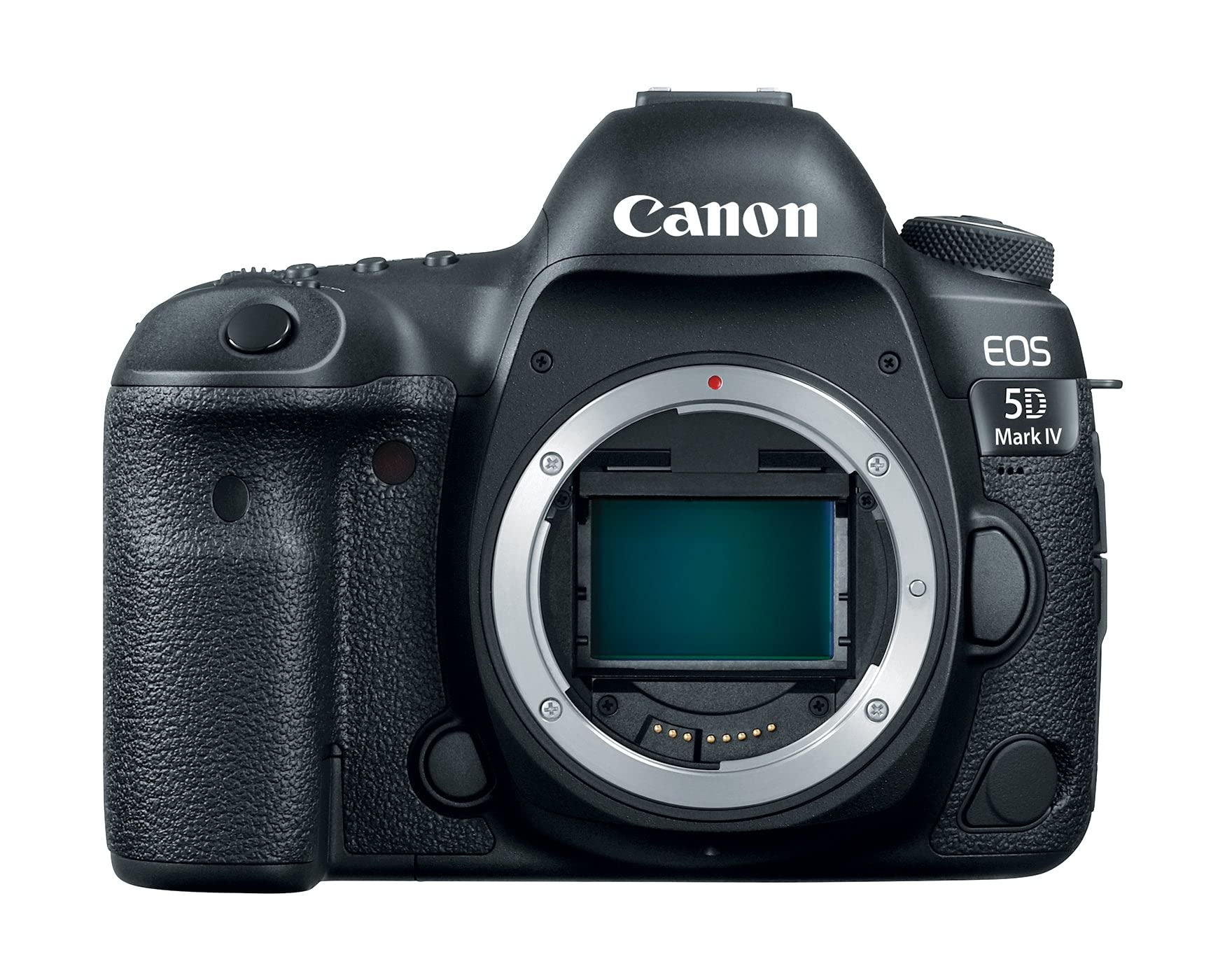
The 5D Mark IV remains a professional workhorse for videographers who need a rugged, battle-tested DSLR with full-frame 30.4MP stills capability and 4K Motion JPEG video at 30p. The DIGIC 6+ processor delivers fast 7fps continuous shooting and solid noise performance up to ISO 3200. Dual Pixel CMOS AF provides smooth, responsive focus during live view and video, which is especially valuable for run-and-gun event coverage where manual focusing isn’t practical.
4K video captures Motion JPEG files that are massive in size — a 30-second clip can exceed 1GB — but the codec is exceptionally robust for keying and color work. The optical viewfinder gives you a clear, lag-free composition experience that mirrorless EVFs still struggle to match for fast-moving subjects. Weather sealing around the magnesium body allows confident shooting in rain or dust. Built-in Wi-Fi and NFC make image transfer straightforward.
The biggest limitation today is the 4K codec: Motion JPEG lacks the compression efficiency of modern H.265 or H.264, meaning huge file sizes and slower workflows. 4K recording also introduces a 1.74x crop factor, turning a wide-angle lens into a portrait lens. The 8-bit 4:2:0 internal 4K capture limits color grading depth. Battery life, however, is exceptional — a single LP-E6N can comfortably last a full day of mixed shooting. For professionals who need an indestructible body with full-frame 4K and superb stills in one package, the 5D Mark IV is still a capable choice.
Why it’s great
- Magnesium alloy build with deep weather sealing for professional outdoor use.
- Dual Pixel CMOS AF provides smooth, reliable contrast during video recording.
- Massive lens compatibility across the entire EF/EF-S ecosystem.
Good to know
- 4K video uses Motion JPEG codec — extremely large files and slow post-production.
- 4K capture imposes a heavy 1.74x crop factor, limiting wide-angle options.
- Internal 4K is 8-bit 4:2:0 only — far less grading headroom than modern mirrorless bodies.
10. Blackmagic Pocket Cinema Camera 6K Pro

The BMPCC 6K Pro steps up to a Super 35 image sensor with native 6144 x 3456 resolution, delivering a wider field of view and shallower depth of field than the MFT-based 4K version. The 13 stops of dynamic range and dual native ISO remain intact, but the big upgrade is the built-in motorized ND filter (2, 4, and 6 stops) — perfect for outdoor cinema shoots where precise exposure control is needed without matte box rigging. Recording options include Blackmagic RAW up to 6K/50fps, ProRes up to 4K/60fps, and USB-C external SSD recording for extended takes.
The adjustable tilt 5-inch HDR LCD screen is bright enough for daylight use and eliminates the need for an external monitor in most scenarios. The full-sized HDMI port enables external recording or monitoring, and the EF lens mount provides direct compatibility with Canon’s extensive EF lineup without needing adapters. The NP-F570 battery (included) provides decent run time, and the body’s carbon fiber polycarbonate construction keeps weight manageable at roughly 2.5 lbs with battery.
Blackmagic RAW files offer unmatched grading latitude, but they require significant storage and processing power. Auto exposure is limited to iris/shutter control — there is no auto ISO in automatic mode, which causes harsh exposure jumps during scenes with changing light. The lack of reliable autofocus means you must manually pull focus or budget for a follow focus system. For cinematographers and documentary filmmakers who prioritize internal ND filters, Super 35 depth of field, and RAW capture, the 6K Pro is a compact powerhouse.
Why it’s great
- Built-in motorized ND filters (2/4/6 stops) eliminate external matte box for outdoor shoots.
- Super 35 sensor provides cinematic depth of field with native 6K resolution.
- Blackmagic RAW internal recording with 13 stops of dynamic range.
Good to know
- Auto exposure lacks auto ISO — lighting changes cause abrupt exposure jumps.
- No reliable autofocus; manual focus is required for consistent results.
- 6K RAW files demand fast storage and powerful post-processing hardware.
11. Panasonic HC-X20

The HC-X20 is a purpose-built camcorder aimed at news, interview, and event professionals who need reliable 4K/60p recording without the complexity of interchangeable lens bodies. The 1-inch MOS sensor (15MP effective) delivers clean 4:2:2 10-bit 4K/60p on SDXC cards, paired with a 24.5mm wide-angle lens that zooms optically at 20x — with i.ZOOM extending to 32x in FHD and 24x in UHD. This integrated zoom is smooth, quiet, and responsive, ideal for documentary and corporate settings where lens swaps are impractical.
5-Axis HYBRID O.I.S. keeps handheld footage steady even at telephoto lengths, and Face Detection AF/AE locks onto subjects automatically. The body includes dual XLR audio inputs with phantom power, a wired remote terminal, and a triple manual ring for iris, focus, and zoom control. Built-in Wi-Fi and Ethernet (via USB-LAN adapter) support live streaming directly from the camera. The ergonomics are designed for shoulder shooting with excellent weight balance over long workdays.
The 1-inch sensor cannot match the shallow depth of field or low-light sensitivity of S35 or full-frame sensors — the HC-X20 relies on its f/2.8 maximum aperture (wide) and electronic NR to manage dim environments. The auto exposure can darken the image in strong overhead light, requiring manual compensation. File sizes at 4:2:2 10-bit are large, demanding fast SD cards. For professionals who need an all-in-one, ergonomic design with built-in XLR and long zoom reach, the HC-X20 is a robust tool that minimizes rigging time.
Why it’s great
- 20x optical zoom with 24.5mm wide-angle in an integrated lens design.
- Dual XLR inputs with phantom power for professional audio without external adapters.
- 5-Axis HYBRID O.I.S. keeps footage stable throughout the zoom range.
Good to know
- 1-inch sensor has limited shallow depth-of-field compared to interchangeable-lens cameras.
- Auto exposure can underexpose in bright overhead lighting, requiring manual corrections.
- Large 4:2:2 10-bit files demand fast, high-capacity SDXC cards for extended recording.
FAQ
Does 4K/60fps matter more than sensor size for video?
Why does 4K on some cameras have a heavy crop factor?
What does 10-bit 4:2:2 mean for my editing workflow?
Is a camcorder better than a mirrorless camera for 4K video?
How important is in-body image stabilization for handheld 4K video?
Final Thoughts: The Verdict
For most users, the best camera for 4k video recording winner is the Sony Alpha 7 IV because it delivers full-frame oversampled 4K with professional autofocus and IBIS in a single balanced body. If you prioritize hassle-free stabilization and pocketability for vlogging, grab the DJI Osmo Pocket 3 Creator Combo. And for pure cinematic RAW capture with internal ND filters, nothing beats the Blackmagic Pocket Cinema Camera 6K Pro.

Mo Maruf
I created WellFizz to bridge the gap between vague wellness advice and actionable solutions. My mission is simple: to decode the research and give you practical tools you can actually use.
Beyond the data, I am a passionate traveler. I believe that stepping away from the screen to explore new environments is essential for mental clarity and physical vitality.