Our readers keep the lights on and my smoothie glass nicely filled. As an Amazon Associate, I earn from qualifying purchases.
Choosing a 360 camera means committing to a workflow where you capture everything and choose your frame later. That freedom is addictive, but it hinges on a handful of critical specs — sensor size, native resolution, stitch quality, and battery endurance — that separate a versatile creative tool from a frustrating toy. Without understanding how these specs interact, you risk buying a camera that forces you into mediocre reframed footage or a stifling proprietary ecosystem.
I’m Mohammad Maruf — the founder and writer behind WellFizz. I’ve spent years dissecting the hardware specifications of action cameras and immersive capture devices, analyzing how real-world variables like sensor readout speed, thermal throttling, and bitrate behavior translate into usable video for creators and adventurers alike.
After reviewing the current market, I’ve compiled the definitive guide to finding the right camera for 360 video — one that matches your creative goals, technical expectations, and budget without compromise.
How To Choose The Best Camera For 360 Video
Selecting the right 360 camera requires you to think about the final output you intend to share — social media clips, YouTube edits, professional reframed projects, or live virtual tours. Each use case demands a different balance of resolution, sensor quality, stabilization, and ecosystem flexibility.
Native Resolution and the Reframing Penalty
A 360 camera captures a full sphere, but most viewers watch a flat 16:9 window. When you reframe a 360-degree video into that window, you effectively crop into the sphere. A camera that shoots native 8K spherical video will yield a sharp, clean 4K reframe. A 5.7K spherical camera drops to approximately 1440p after reframing. If your goal is crisp 4K output for traditional editing, native 8K capture is not optional — it is essential.
Sensor Size Determines Your Shooting Envelope
Most action-style 360 cameras use small 1/2.3-inch or 1/2-inch sensors that struggle in dim light, producing noisy, desaturated footage. A 1-inch sensor equivalent represents a major leap: it gathers significantly more light, delivering usable footage in twilight, indoor settings, and shaded environments. Cameras with dual 1/1.28-inch sensors, like the latest Insta360 X-series, also offer strong low-light performance via computational stacking. Decide where you will shoot most often, and choose your sensor size accordingly.
Stabilization: The Invisible Foundation
360 stabilization is fundamentally different from standard action camera stabilization. Because the camera captures every direction, the gyro data can actively rotate the sphere to keep the horizon locked, even when the camera physically spins. Look for “FlowState” or “360 Horizon Lock” as baseline features. The quality of this stabilization directly determines whether your invisible selfie-stick footage looks cinematic or seasick. There is no replacement for in-camera or post-process gyro-based stabilization in this category.
Battery Life and Workflow
360 video files are massive. A single hour of 8K 360 footage consumes roughly 25-30 GB of space. Camera battery life in 360 mode often drops to 35–60 minutes per charge due to the computational load of stitching and recording dual sensors. Hot-swappable batteries, built-in storage, and fast charging (80% in 20 minutes) are the real differentiators. If you shoot longer events or travel without a laptop, prioritize a camera that offers at least one of these workflow advantages.
Quick Comparison
On smaller screens, swipe sideways to see the full table.
| Model | Category | Best For | Key Spec | Amazon |
|---|---|---|---|---|
| Insta360 X5 Essentials Bundle | Action 360 | Best Action 360 Overall | 8K30fps / Dual 1/1.28″ sensors / 15m waterproof | Amazon |
| DJI Osmo 360 Essential Combo | Action 360 | Best Premium 1-Inch Sensor 360 | Native 8K / 1-inch sensor / 105GB internal storage | Amazon |
| DJI Osmo 360 Standard Combo | Action 360 | Best Value Premium 360 | Native 8K / 1-inch sensor / 190 min battery | Amazon |
| GoPro MAX2 | Action 360 | Best True 8K Spherical with Replaceable Lenses | True 8K spherical / 29MP / replaceable glass lenses | Amazon |
| GoPro MAX 360 (2025) + Accessory Kit | Action 360 | Best Value GoPro 360 Ecosystem | 5.6K30 spherical / 6 mics / 1/4-20 mount | Amazon |
| Xtra 360 Camera | Action 360 | Best Budget 8K with 1-Inch Sensor | 8K / 1-inch sensor equiv / 105GB storage | Amazon |
| AKASO 360 Action Camera Combo | Action 360 | Best Budget 5.7K with AI Tracking | 5.7K / dual 1/2″ 48MP sensors / 128GB card | Amazon |
| TOUCAN 360 Conference Camera | Conference 360 | Best Entry-Level Conference 360 | 1080p / 4 noise-reduction mics / AI tracking | Amazon |
| NexiGo Meeting 360 Ultra (Gen 3) | Conference 360 | Best Multi-Camera Conference System | 8K capture / 8 mics / built-in OS / up to 4 cameras | Amazon |
| Owl Labs Meeting Owl 3 | Conference 360 | Best Mid-Range All-in-One Conference | 1080p HD / 18-ft mic pickup / AI speaker tracking | Amazon |
| Owl Labs Meeting Owl 4+ | Conference 360 | Best Enterprise 4K Conference 360 | 4K UHD / 360° audio / Wi-Fi / Kensington lock | Amazon |
In‑Depth Reviews
1. Insta360 X5 Essentials Bundle

The Insta360 X5 sets a new benchmark for action-oriented 360 capture. Its dual 1/1.28-inch sensors and triple AI chip design deliver noticeably cleaner low-light footage than previous generations — a major pain point for those shooting urban twilight or indoor action sequences. The 8K30fps spherical video ensures that your reframed 4K output retains excellent edge detail and color fidelity, even after aggressive cropping.
The X5 is the first Insta360 model to be fully waterproof to 15 meters without a housing, which simplifies diving, surfing, and rain shooting significantly. The new replaceable lenses are a welcome step forward: a scratch or crack no longer means a full camera replacement. The included 114cm Invisible Selfie Stick produces clean third-person perspective shots with no visible stitching artifacts at the stick boundary.
The battery life at 208 minutes in continuous 360 mode is an aggressive claim; in real-world use, expect about 85-90 minutes of mixed 8K recording per full charge. The Utility Fast Charge Case gets you back to 80% in 20 minutes, which is genuinely useful during a long ski day or bike ride. The Wind Guard on the 4-mic array effectively reduces wind rumble in motovlog or biking scenarios, preserving voice clarity without needing an external mic.
Why it’s great
- Best-in-class low-light 360 performance from dual 1/1.28″ sensors
- Replaceable lenses reduce long-term repair cost
- Waterproof to 15m out of the box
- Fast charging and hot-swappable battery support extended shoots
Good to know
- MicroSD card not included in bundle
- Battery life in 8K mode is shorter than stated under heavy use
- Insta360 app requires account for full editing features
2. DJI Osmo 360 Essential Combo
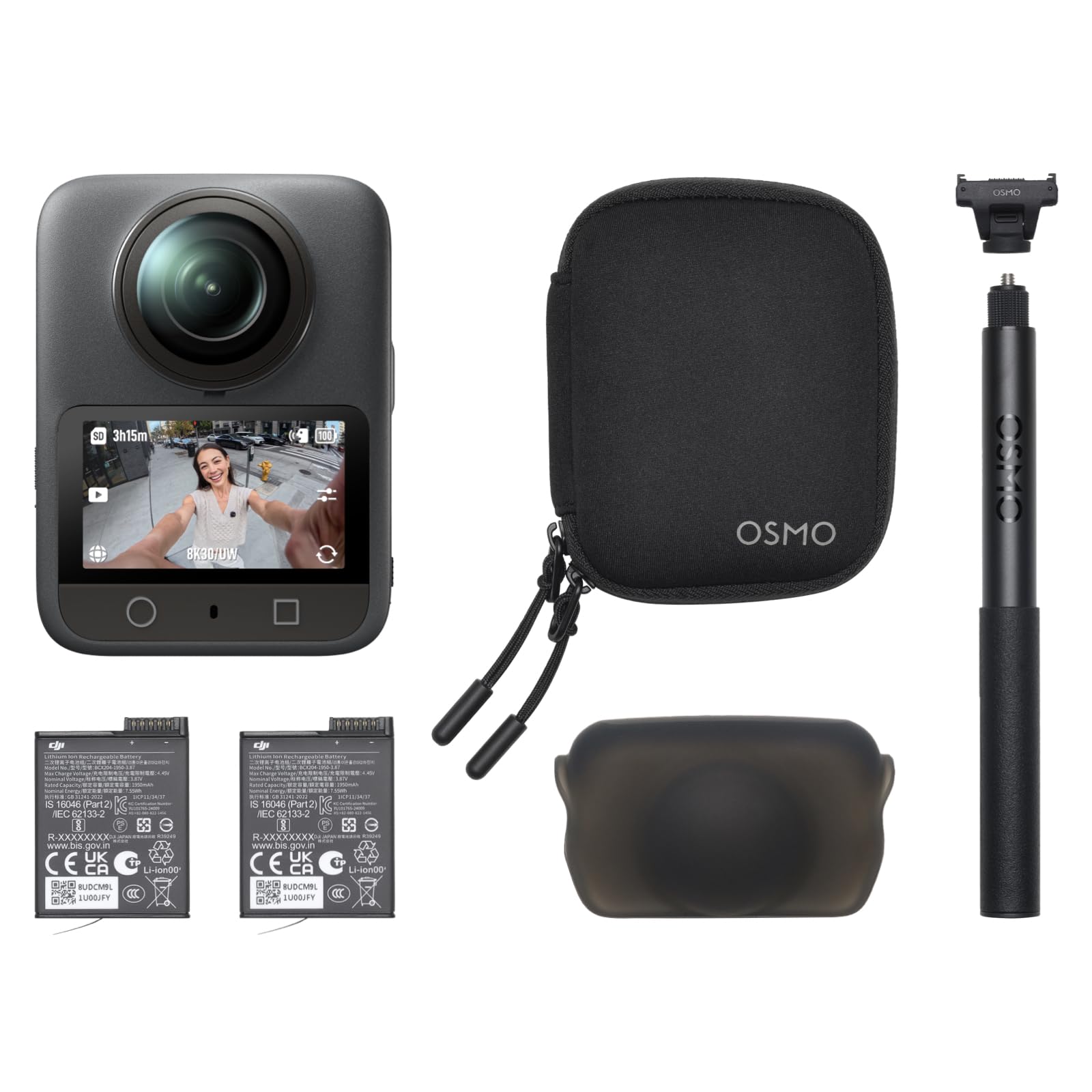
The DJI Osmo 360 Essential Combo delivers native 8K 360 video from a single 1-inch sensor equivalent — a serious advantage for anyone prioritizing dynamic range and color depth over dual-sensor stitching complexity. The 1-inch sensor absorbs roughly 2.7x more light than a 1/2.3-inch sensor, resulting in noticeably cleaner shadows and smoother gradations in golden-hour scenes where lesser cameras posterize the sky.
This combo includes the 1.2m Invisible Selfie Stick Kit and an extra 1950mAh battery, effectively doubling your shooting runtime. The 105GB built-in storage is a genuine convenience: you can hit the trail without packing an SD card, and the camera records directly to internal memory in MP4 format. DJI’s OsmoAudio integration lets you pair up to two DJI microphones directly via Bluetooth with no receiver, which simplifies vlogging and motovlogging audio capture enormously.
The DJI Mimo app handles Pano Dewarp and Pano Pro Color Grading well, but the steeper learning curve for editing 360 footage is real — expect to spend an afternoon familiarizing yourself with the workflow. The magnetic quick-release system works seamlessly with third-party mounts via the 1/4-inch thread. The camera runs cool during extended recording, and the four-microphone array captures spatial audio that shifts perspective with the reframe.
Why it’s great
- Superior low-light performance from 1-inch sensor
- 105GB internal storage means no SD card required
- Direct Bluetooth mic pairing via OsmoAudio
- Invisible selfie stick produces clean third-person shots
Good to know
- DJI Mimo app removed from Google Play; must download from DJI website
- Editing 360 footage has a steeper learning curve than competitors
- No lens replacement option — entire camera replacement if lens damaged
3. DJI Osmo 360 Standard Combo
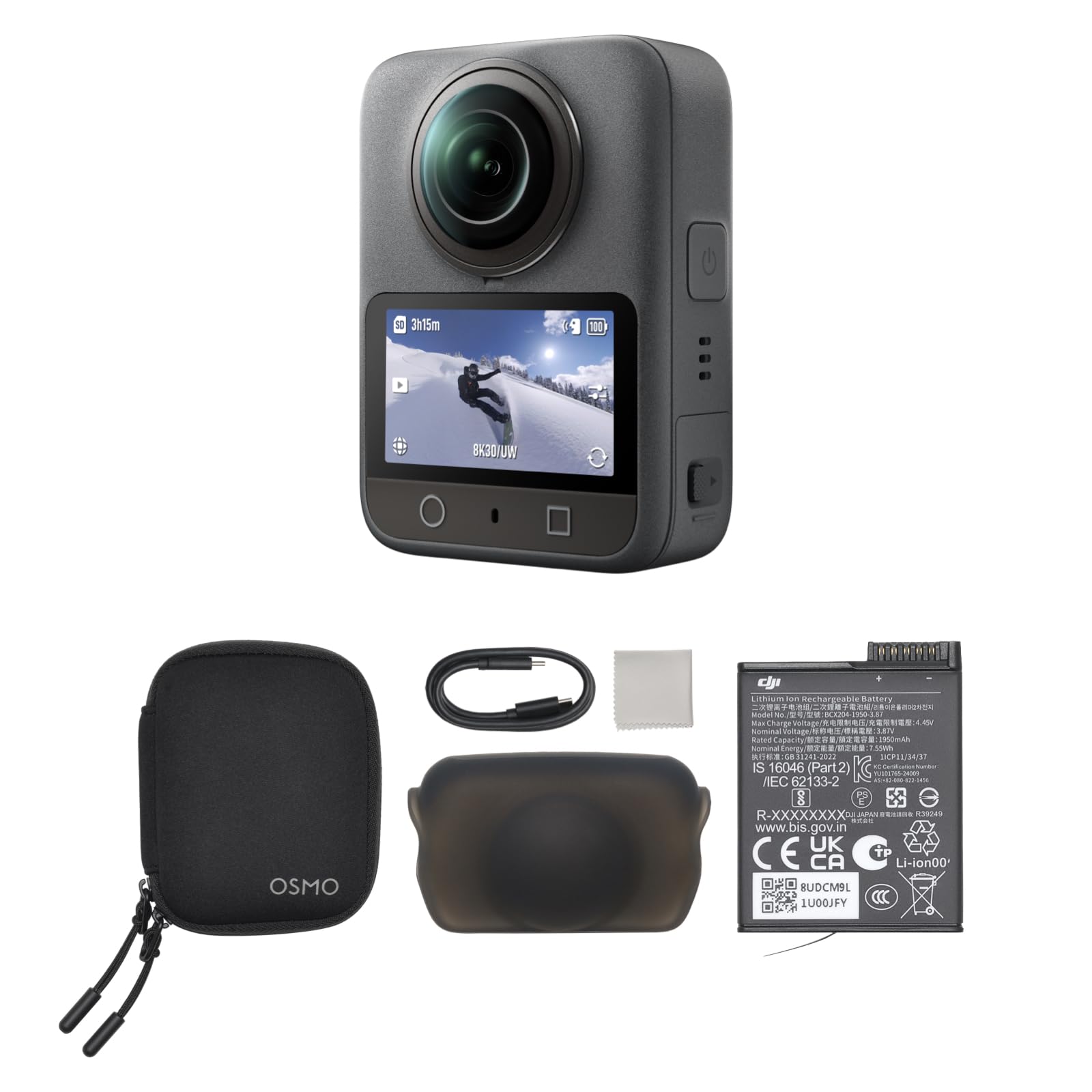
The DJI Osmo 360 Standard Combo distills the same native 8K 360 imaging and 1-inch sensor found in the Essential Combo into a more budget-conscious package. The single battery offers up to 190 minutes of recording in ideal conditions — though real-world 8K recording cuts that to roughly 60–80 minutes per charge. The 105GB built-in storage is present here too, so you never have to worry about buying a memory card.
Video quality is identical to the Essential Combo: sharp 8K spherical with excellent dynamic range and rich color science. The 120MP 360 photo mode produces detailed stills that can be cropped aggressively for social media. The 4K/120fps single-lens Boost mode is surprisingly useful for traditional slo-mo shots when you don’t need 360 capture.
The magnetic quick-release system is faster than any screw mount I’ve used, and the 1/4-inch thread at the base makes it compatible with almost any tripod, monopod, or gimbal on the market. The four microphones with OsmoAudio support allow for wireless transmitter pairing without a receiver. The main trade-off versus the Essential Combo is the single battery — if you shoot long days, you will want to buy spares. The Standard Combo is the smarter pick for someone who wants the best sensor in the segment without paying for extra accessories they may not need.
Why it’s great
- Same 1-inch sensor and 8K video as the more expensive combo
- 105GB built-in storage included
- Excellent dynamic range and color science
- Fast magnetic quick-release mount system
Good to know
- Only one battery included — additional purchase needed for long days
- No invisible selfie stick in the box
- DJI Mimo app must be downloaded outside Google Play
4. GoPro MAX2
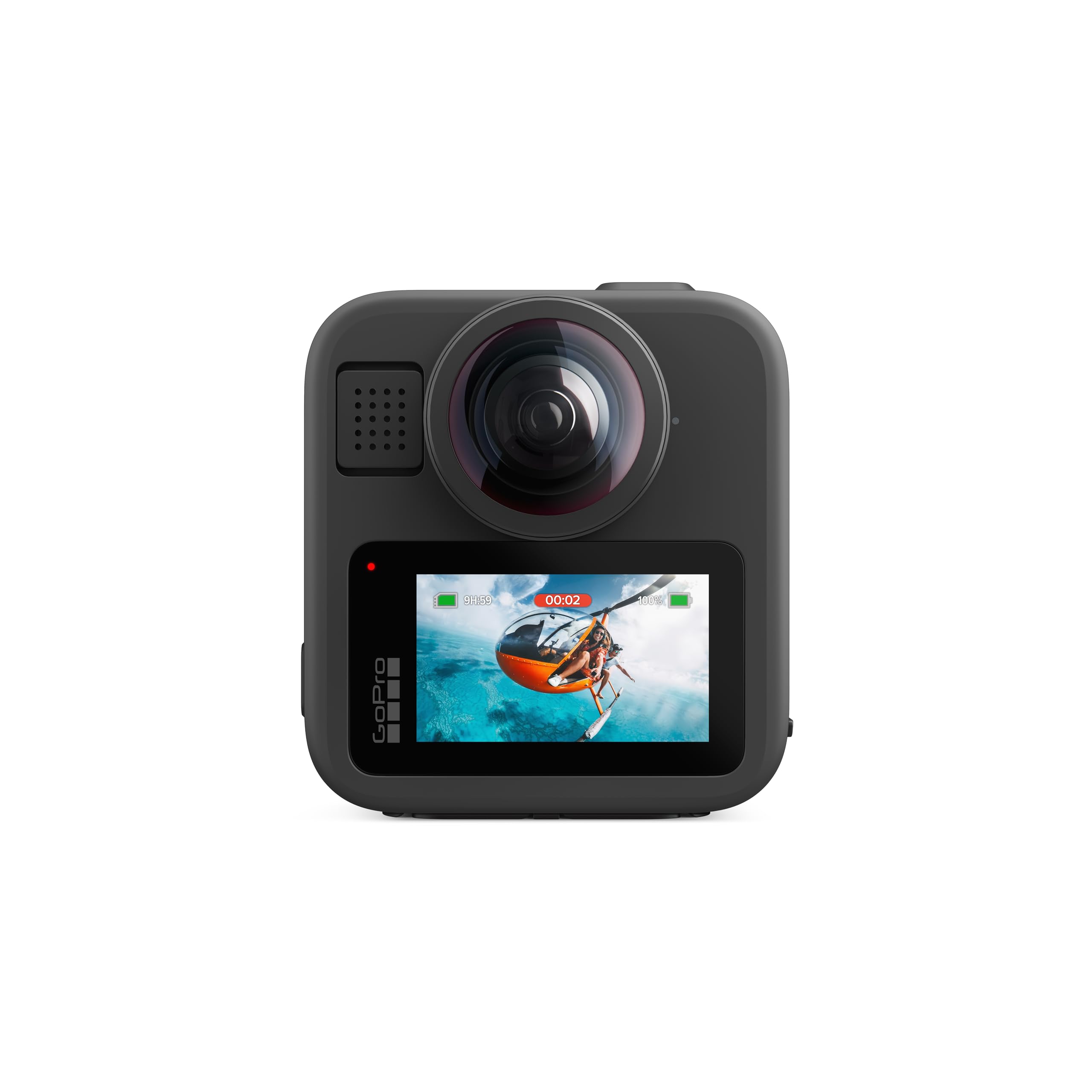
The GoPro MAX2 is the latest iteration of GoPro’s 360 line, delivering True 8K spherical video that resolves up to 21% more detail than the previous generation. The key advancement here is the replaceable glass lenses: if you scratch a lens on a mountain biking crash or a sandy beach drop, you swap it in seconds instead of replacing the entire camera. This is a major durability win for extreme sports shooters who regularly push their gear to the limit.
The 29MP 360 photos capture impressive dynamic range for a dual-lens camera, and the HyperSmooth stabilization combined with full 360 Horizon Lock ensures your footage stays level even during barrel rolls or 360-degree spins. The 6-microphone array delivers genuine ambisonic audio that follows the viewer’s perspective when reframing, producing a more immersive playback than simpler stereo setups.
The MAX2 runs warm during extended 8K recording — some users report noticeable heat after 20 minutes of continuous capture in still air. The waterproofing to 5 meters without a housing is decent but not class-leading. GoPro’s Quik app makes reframing straightforward, but the file sizes are enormous: expect roughly 2–3 GB per minute of 8K spherical footage. The 1960mAh Enduro battery delivers about 45-50 minutes of 8K 360 recording, so hot-swapping is a necessity for longer sessions.
Why it’s great
- Replaceable glass lenses drastically reduce repair costs
- True 8K spherical with excellent detail retention
- HyperSmooth stabilization with 360 Horizon Lock
- Ambisonic 6-mic array for immersive spatial audio
Good to know
- Heats up noticeably during extended 8K recording
- Large file sizes require fast, high-capacity microSD cards
- Battery life around 45-50 minutes in 8K 360 mode
5. GoPro MAX 360 (2025) + 50 Piece Accessory Kit

The GoPro MAX (2025) is a refresh of the popular MAX 360 platform, retaining the 5.6K30 spherical video resolution and adding a 1/4-20 mounting system that opens the camera to mainstream photography gear for cleaner invisible-pole shots. The 50-piece accessory kit included in this bundle provides mounts, clips, and adapters that make it easy to integrate into an existing GoPro ecosystem.
In-camera stitching is one of the MAX’s strongest features: you can offload and edit your 360 clips directly in the GoPro Quik app without needing desktop software. The 6-mic array with advanced wind-noise reduction produces clear audio in windy biking or skiing scenarios. The dual-lens design allows you to switch to single-lens HERO mode for standard 1080p or 1440p video with four digital lens options including Max SuperView.
The image quality at 5.6K is visibly softer than native 8K competitors when reframed to 4K — you will see this difference on larger screens and monitors. The camera is waterproof to 5 meters without a housing. The battery life in 360 mode runs about 55 minutes per charge. For GoPro loyalists upgrading from a standard HERO camera, the MAX offers a gentle introduction to 360 capture without leaving the familiar interface and accessory ecosystem.
Why it’s great
- In-camera stitching simplifies mobile editing workflow
- 50-piece accessory bundle adds huge value
- 1/4-20 mount opens compatibility with photo gear
- GoPro Quik app is intuitive for beginners
Good to know
- 5.6K native resolution limits reframed 4K sharpness
- Larger and heavier than competition
- Battery life in 360 mode is moderate
6. Xtra 360 Camera
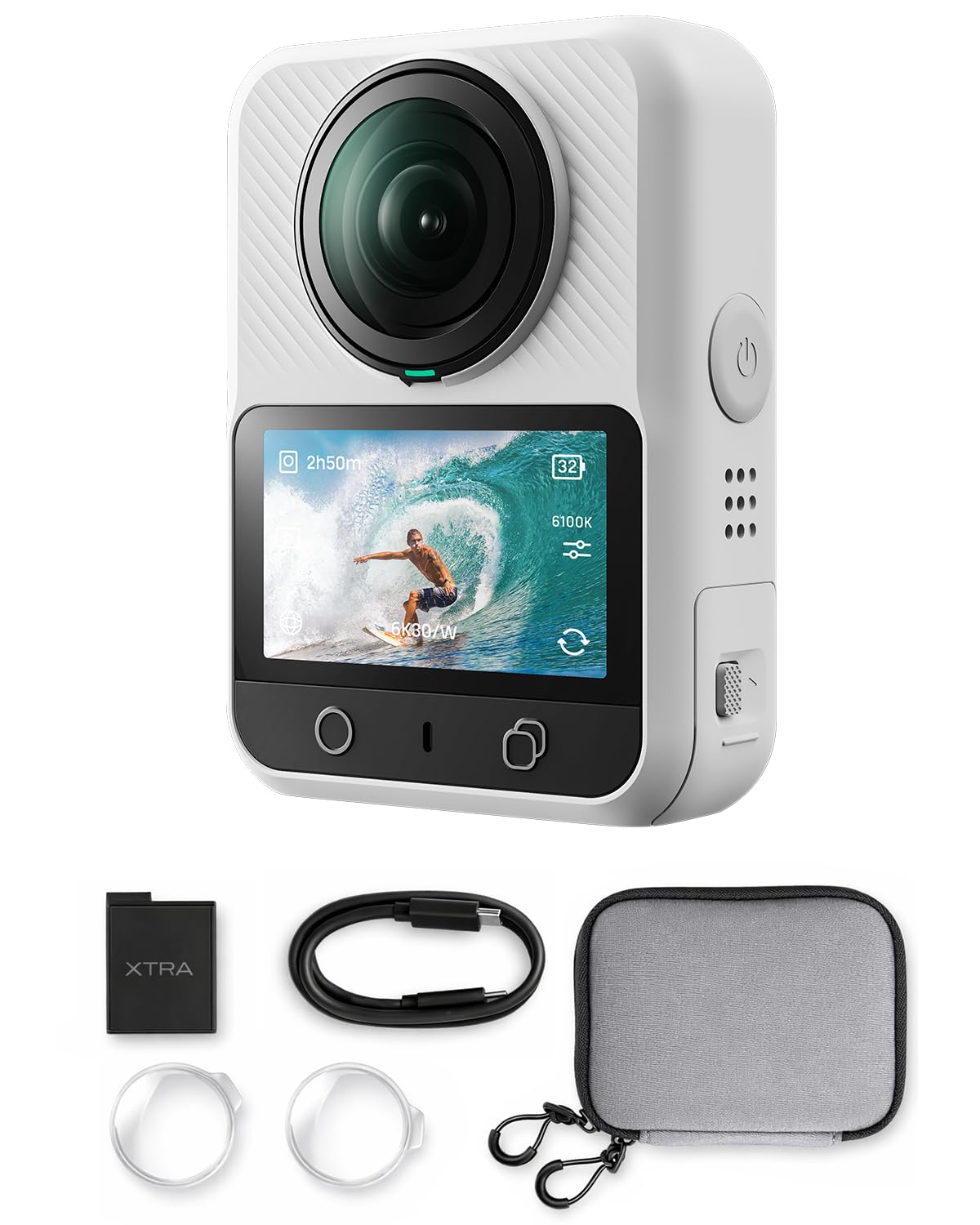
The Xtra 360 Camera disrupts the price-to-performance curve of the entire 360 market. Its 1-inch sensor equivalent is a genuine hardware breakthrough at this price point: it offers substantially better dynamic range and low-light performance than any dual-sensor camera in its tier. The true 8K panoramic video produces sharp, high-contrast images that reviewers have directly compared favorably to the Insta360 X4.
The 105GB built-in storage is physically soldered to the board — no SD card slot is necessary. This convenience also means you cannot expand capacity, so you must manage file transfer discipline. The magnetic quick-release system works smoothly and the camera is waterproof out of the box. The Bullet Time feature works as advertised, producing smooth rotating slo-mo clips that are popular on social media.
The major caveat is the software ecosystem. The Xtra requires proprietary desktop software for full editing — you cannot export individual 360 clips directly to Final Cut Pro or Premiere at this writing. Some users report the software is functional but cumbersome, and it currently lacks the polish of DJI Mimo or Insta360 Studio. If you can tolerate a slightly less refined editing pipeline, the hardware value is unmatched. This is a strong pick for budget-focused creators who prioritize capture quality over workflow speed.
Why it’s great
- 1-inch sensor at a budget price is exceptional value
- True 8K panoramic video rivals premium competitors
- 105GB built-in storage — no SD card needed
- Waterproof design with magnetic quick-release
Good to know
- Proprietary software required for full editing workflow
- Cannot export individual 360 clips to NLEs yet
- Software ecosystem is less polished than established brands
7. AKASO 360 Action Camera Combo
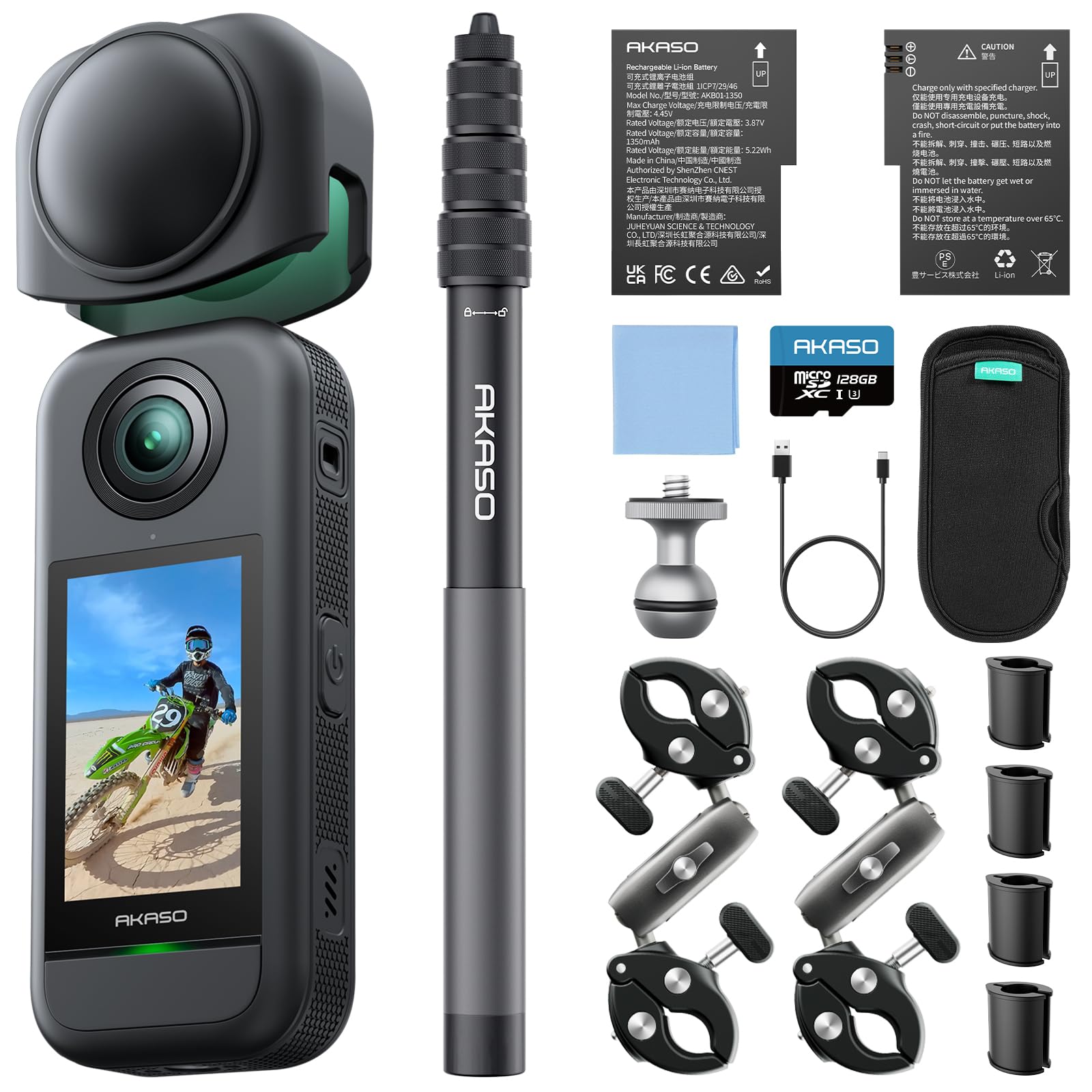
The AKASO 360 is the most aggressive value proposition in the action 360 space. Its dual 1/2-inch 48MP sensors capture 5.7K 360 video, and the combo includes a 128GB microSD card so you can shoot immediately out of the box. The 360-SuperSmooth stabilization and 360-degree Horizon Lock are surprisingly effective for the price point — you get smooth, level footage that would have cost twice as much two years ago.
The AI Subject Tracking works well in well-lit outdoor conditions, automatically keeping a designated subject centered in the reframe. The invisible selfie stick effect removes the pole reliably when using the included mount. The 72MP 360 photo mode produces usable images for social sharing, though fine detail is softer than premium sensors due to the smaller individual pixel size.
The low-light performance is the AKASO’s weakest area: the 1/2-inch sensors produce noticeable noise and color desaturation in dim conditions, consistent with sensor physics. Battery life is around 35 minutes per charge in 360 mode, which is below average — but the combo includes two batteries, partially mitigating the issue. The AKASO 360 Studio editing software is functional but less intuitive than Insta360’s app. For a daytime adventure shooter on a tight budget, this camera delivers impressive capability per dollar.
Why it’s great
- Excellent value for 5.7K 360 capture with included 128GB card
- 360-SuperSmooth and Horizon Lock work well
- AI Subject Tracking is useful for outdoor shooting
- Two batteries included for extended sessions
Good to know
- Low-light performance is poor — avoid for evening or indoor shooting
- Battery life is short at ~35 minutes per charge
- Editing software is less polished than premium competitors
8. TOUCAN 360-Degree Video Conference Camera

The TOUCAN 360 Conference Camera bridges the gap between a standard webcam and a dedicated conference system at an accessible price. Its 360-degree omni-directional lens captures everyone around a table, and the 1080p HD output is clear enough for standard meeting resolution. The built-in Bluetooth speaker provides audio output so you do not need separate speakers for small to medium rooms.
The four noise-reduction microphones pick up voices reliably up to about 12 feet, filtering out air conditioning hum and background chatter reasonably well. AI tracking automatically frames the active speaker, which works well for 6-10 person roundtable meetings. Setup is genuine plug-and-play — USB connection is recognized immediately on Windows, Mac, and even some smart TVs without driver installation.
The 1080p resolution is adequate for meeting rooms but shows its limits on large displays or when zooming into the frame digitally. The speaker volume maxes out at a moderate level that may struggle in large, noisy rooms. The 360-degree view can occasionally frame the laptop screen or monitor rather than the in-room participants, requiring careful placement. For small teams looking to upgrade from laptop cameras without a large equipment budget, the TOUCAN delivers effective hybrid meeting functionality.
Why it’s great
- True plug-and-play setup with no software install required
- AI tracking works well for 6-10 person roundtables
- 360-degree capture covers entire table
- Built-in Bluetooth speaker eliminates need for external audio
Good to know
- 1080p resolution limits digital zoom quality
- Speaker volume is too low for large or noisy rooms
- Microphone not recognized in some smart TV apps
9. NexiGo Meeting 360 Ultra (Gen 3)
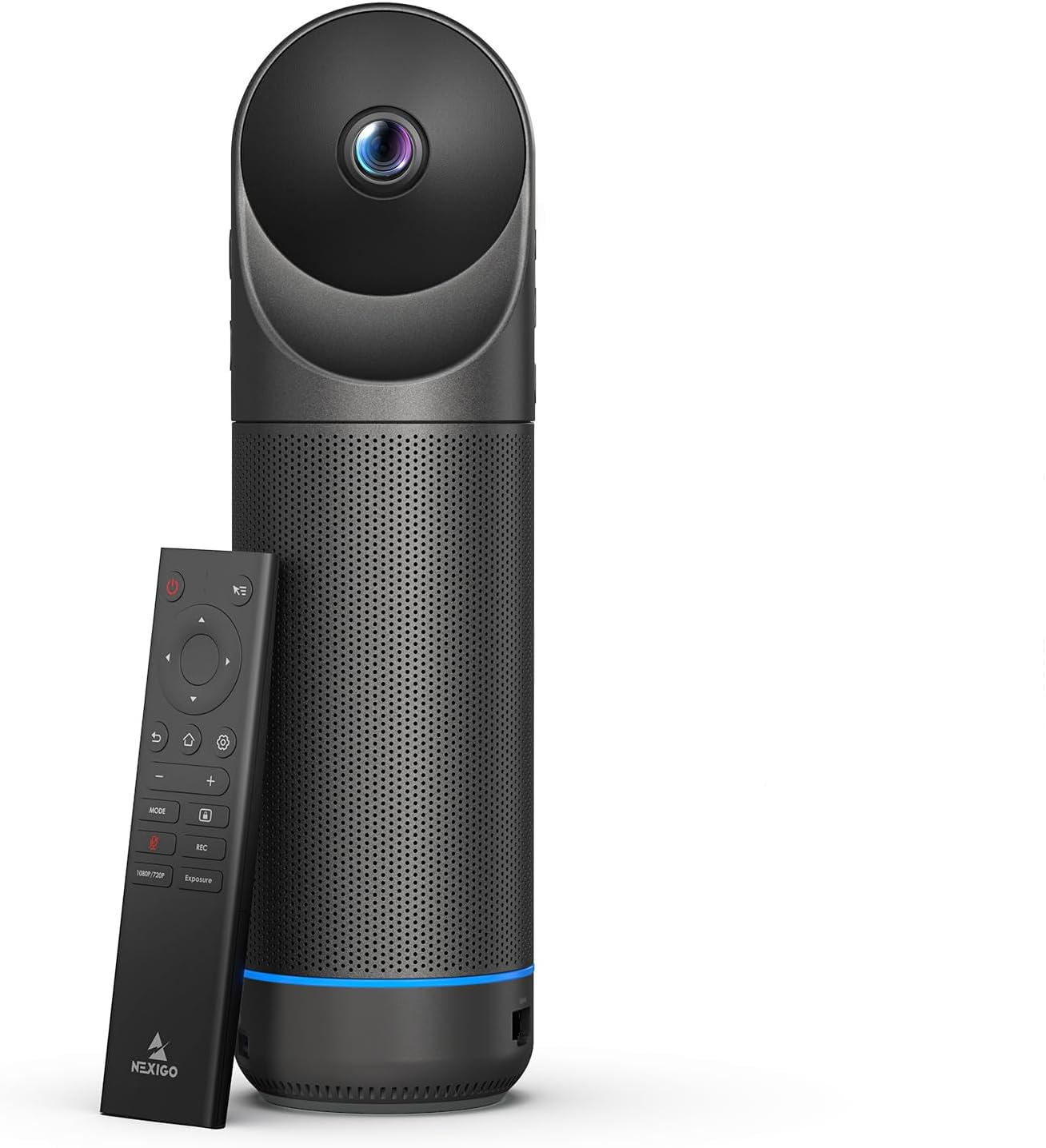
The NexiGo Meeting 360 Ultra Gen 3 is a purpose-built conference camera system designed for medium-to-large meeting rooms. Its dual 195-degree lenses capture a true 360-degree panoramic view at 8K resolution, which is then downscaled to 1080p for streaming — but the higher source resolution allows for lossless digital pan and zoom. The unit integrates up to four additional NexiGo cameras for total room coverage in long-table or U-shaped layouts.
The built-in Android operating system is the standout feature: no computer is required to run video calls. You connect the camera directly to a TV via HDMI, and the App Store gives you access to Zoom, Google Meet, Microsoft Teams, and Skype. The eight omnidirectional microphones pick up audio from up to 18 feet with effective echo cancellation. The AI-powered framing automatically detects and frames active speakers without a person operating the camera.
The 8K source sensor produces visibly sharper digital zooms than conference cameras with lower native resolution. The built-in OS can feel slightly sluggish when switching between apps compared to a dedicated computer. The internal fan is audible in very quiet rooms, though it rarely interferes with voice pickup. For meeting rooms that want to eliminate a dedicated conference PC, the NexiGo Gen 3 is a smart solution that consolidates compute and capture into one device.
Why it’s great
- Built-in OS eliminates need for a conference PC
- Multi-camera support up to 4 units for large rooms
- 8K source sensor enables lossless digital zoom
- AI speaker tracking works reliably in complex layouts
Good to know
- Internal fan noise may be audible in quiet rooms
- Built-in OS can feel sluggish when switching apps
- Requires power outlet and HDMI connection
10. Owl Labs Meeting Owl 3

The Meeting Owl 3 from Owl Labs is the industry reference for plug-and-play all-in-one 360 conference cameras. Its 1080p HD 360-degree video and 18-foot omnidirectional mic pickup create a reliable hybrid meeting experience without any multi-device setup. The proprietary Owl Intelligence System uses both visual and audio cues to automatically focus on and frame the active speaker, switching seamlessly between participants around the table.
Setup is genuinely unbox-to-meeting in under 6 minutes — a single USB-C cable connects to your laptop, and the camera is automatically recognized by Zoom, Teams, Google Meet, and Webex. The Meeting Owl ecosystem allows you to pair a second Owl for larger rooms or add an Expansion Mic to extend audio coverage. The device has a proven track record for durability, with verified reports of surviving multiple desk drops.
The 1080p resolution is the primary limitation. On large monitors or TVs in the meeting room, participant faces appear softer than 4K alternatives. At this price point, the absence of 4K capture is a noticeable gap that the newer Meeting Owl 4+ addresses. The speaker quality is good but not room-filling in large spaces. For medium-sized conference rooms (up to about 12 people in a doughnut configuration) where plug-and-play simplicity trumps absolute resolution, the Meeting Owl 3 remains the most polished solution.
Why it’s great
- Ultra-simple unboxing and setup — truly 6 minutes
- AI speaker detection is fast and accurate
- Proven durability and reliability across years of use
- Ecosystem expandable with second Owl or Expansion Mic
Good to know
- 1080p resolution is dated for large displays
- Speaker volume modest for very large rooms
- Primarily designed for laptop-connected conferencing
11. Owl Labs Meeting Owl 4+

The Meeting Owl 4+ is the premium evolution of Owl Labs’ all-in-one conference camera system, upgrading the video resolution to true 4K UHD while maintaining the same 360-degree form factor. The 4K sensor retains significantly more detail when digitally zooming into individual participants, which is noticeable on modern large-screen displays. The 18-foot 360-degree audio pickup remains best-in-class for a single device.
Enterprise features set the Owl 4+ apart: enterprise WiFi connectivity for centralized management, a built-in Kensington lock slot for physical security in shared spaces, and Power over Ethernet (PoE) support via adapter for simplified cabling. IT administrators can manage fleets of devices remotely through The Nest management tool, with bulk registration and default settings push. The Qualcomm Snapdragon 8250 processor handles the AI speaker tracking and 4K video encoding smoothly.
At this price point, the expectation is zero-compromise performance, and the Owl 4+ largely delivers. The only note is that the digital switching between active speakers can introduce a ~1-second delay during fast-paced conversation, which some teams find slightly noticeable. The unit is heavier than the Owl 3 due to the larger heat sink needed for the 4K sensor. For organizations that run daily hybrid meetings and need enterprise manageability, camera security, and compatibility with every major platform, the Meeting Owl 4+ is the definitive all-in-one 360 solution.
Why it’s great
- True 4K UHD 360 video resolves individual participants clearly
- Enterprise WiFi, Kensington lock, and PoE support
- Centralized fleet management through The Nest
- 18-foot audio pickup with excellent echo cancellation
Good to know
- Speaker switching can lag ~1 second during fast conversation
- Heavier than Meeting Owl 3 due to larger heat sink
- Premium price point requires clear ROI justification
FAQ
What is the minimum spherical resolution I should buy for good 4K reframed video?
How important is the 1-inch sensor in a 360 action camera?
Can I use a 360 camera without the proprietary mobile app?
Do I need a high-end memory card for 8K 360 video?
What is the difference between conference 360 cameras and action 360 cameras?
Final Thoughts: The Verdict
For most users, the camera for 360 video winner is the Insta360 X5 because it delivers the best overall balance of 8K spherical resolution, usable low-light performance, rugged waterproofing, and mature software ecosystem at a competitive price. If you want the superior dynamic range and low-light mastery of a 1-inch sensor, grab the DJI Osmo 360 Standard Combo. And for enterprise-grade 4K conference room solutions, nothing beats the integrated ecosystem and enterprise management features of the Meeting Owl 4+.

Mo Maruf
I created WellFizz to bridge the gap between vague wellness advice and actionable solutions. My mission is simple: to decode the research and give you practical tools you can actually use.
Beyond the data, I am a passionate traveler. I believe that stepping away from the screen to explore new environments is essential for mental clarity and physical vitality.