Our readers keep the lights on and my smoothie glass nicely filled. As an Amazon Associate, I earn from qualifying purchases.
The challenge with shopping for a camcorder on a tight budget is that the label “4K” or “6K” often masks serious compromises in image stabilization, low-light performance, and audio. A spec sheet can say one thing, but real-world footage from a handheld walk through a park or a dimly lit living room tells the real story.
I’m Mohammad Maruf — the founder and writer behind WellFizz. I’ve spent years analyzing consumer video hardware, comparing sensor architectures, stabilization algorithms, and optical vs. digital zoom strategies across budget, mid-range, and premium tiers to identify which models actually hold up for real creators.
Whether you need smooth gimbal footage for vlogging or optical zoom for a child’s soccer game, finding the right best camcorder under $500 means weighing sensor quality, stabilization type, and audio inputs against your specific shooting scenario.
How To Choose The Best Camcorder Under $500
Most buyers in this price range face a single critical decision: prioritize optical zoom and traditional ergonomics, or prioritize gimbal stabilization and pocketability. Neither path is wrong — but each serves a very different shooting style. Here’s how to decide.
Sensor Quality: The 1-Inch Advantage
The single biggest variable in low-light footage is the physical size of the sensor, not the megapixel count. A 1-inch CMOS sensor (found in premium models like the DJI Osmo Pocket 3 and Canon PowerShot V10) gathers significantly more light than the 1/2.3-inch or 1/2.5-inch sensors in most budget camcorders. This translates to cleaner images at dusk, indoors, and in shadowed areas.
Stabilization Type: Gimbal vs. EIS vs. Optical
Three-axis mechanical gimbal stabilization physically moves the lens assembly to counteract hand shake, producing fluid footage even while walking or running. Electronic Image Stabilization (EIS) crops the sensor and compensates digitally — effective for minor motion but degrades image quality and field of view. Optical SteadyShot (found in Sony camcorders) shifts internal lens elements and offers a middle ground that preserves resolution.
Audio Inputs: The Mic Jack Test
Built-in microphones on any camcorder under $500 will pick up handling noise, wind, and room echo. The presence of a 3.5mm external microphone jack is the single most reliable indicator that a manufacturer expected the device to be used for serious content creation. Models without this jack limit you to on-camera audio or workarounds like USB adapters.
Quick Comparison
On smaller screens, swipe sideways to see the full table.
| Model | Category | Best For | Key Spec | Amazon |
|---|---|---|---|---|
| DJI Osmo Pocket 3 | Premium Pocket | Cinematic gimbal vlogging | 1-inch CMOS, 4K/120fps, 3-axis gimbal | Amazon |
| Canon PowerShot V10 | Compact Vlogger | Ultra-portable everyday vlogging | 1-inch sensor, 19mm wide lens, built-in stand | Amazon |
| ORDRO AX65 4K | All-Rounder | Zoom-heavy shooting with accessories | 12x optical zoom, Sony sensor, 100x smart zoom | Amazon |
| Xtra Muse Pocket Gimbal | Gimbal Value | Budget alternative to DJI gimbal | 1-inch CMOS, 4K/120fps, 3-axis gimbal | Amazon |
| ORDRO M5 (Gimbal) | Gimbal Vlogger | Smooth walk-and-talk recording | 5K/30fps, 3-axis gimbal, face tracking | Amazon |
| ORDRO M5 (WiFi) | Connected Gimbal | Wireless streaming vlog setup | 5K/30fps, 3-axis gimbal, WiFi, 120° FOV | Amazon |
| Canon VIXIA HF R600 | Traditional Zoom | Classic camcorder with long zoom | 57x advanced zoom, touchscreen, mic input | Amazon |
| 6K Camcorder 64MP | Starter Kit | Complete beginner content creation bundle | 6K/30fps, IR night vision, 18x digital zoom | Amazon |
| Sony FDR-AX43 | Prosumer Camcorder | Optical zoom with built-in gimbal | 20x optical zoom, Balanced Optical SteadyShot | Amazon |
In‑Depth Reviews
1. DJI Osmo Pocket 3
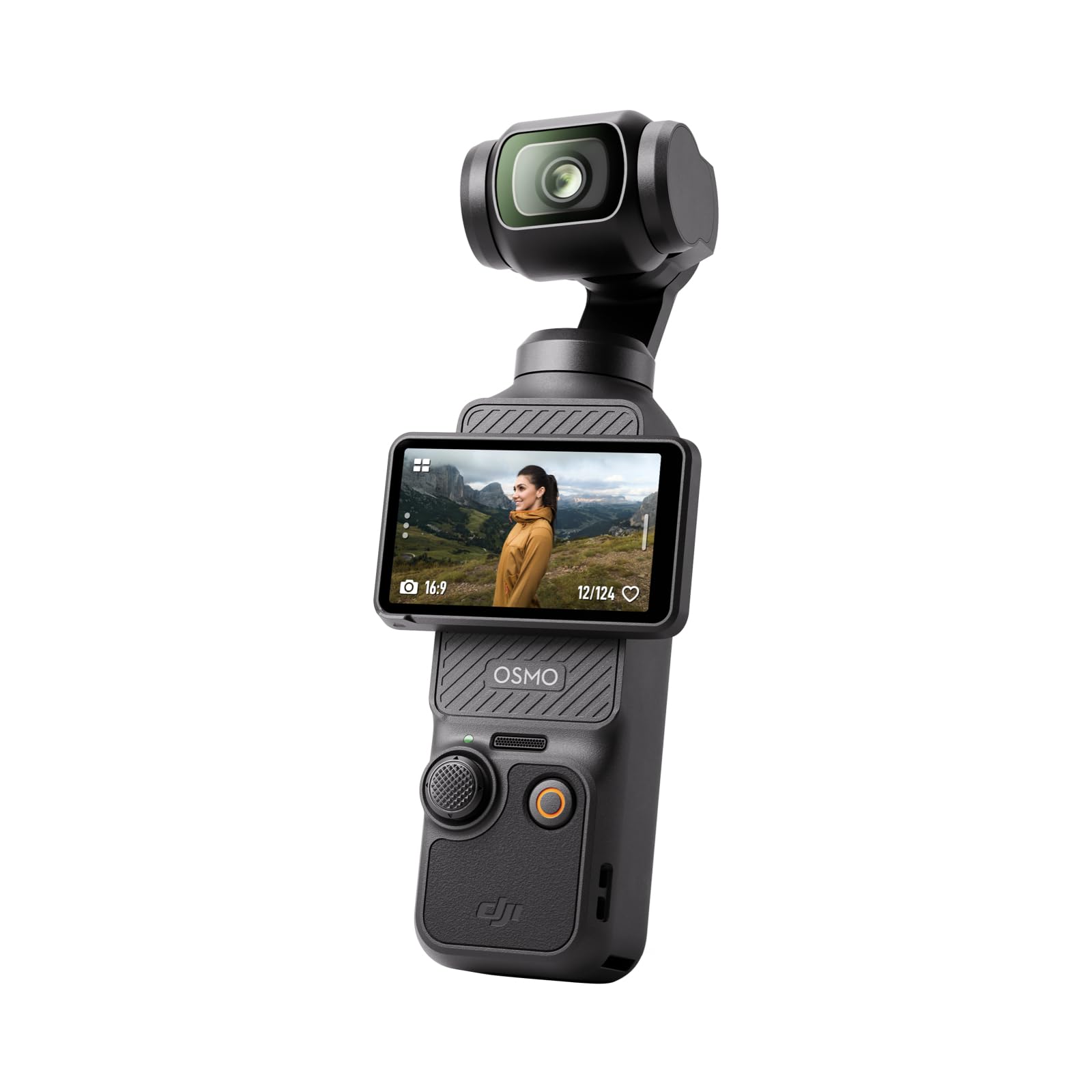
The DJI Osmo Pocket 3 sets the benchmark for pocket camcorders with its 1-inch CMOS sensor and true 3-axis mechanical gimbal stabilization. It records 4K video at 120fps, producing silky slow-motion footage that remains sharp even when you crop in post. The 2-inch rotatable touchscreen makes switching between horizontal and vertical framing effortless for social media creators.
ActiveTrack 6.0 face and object tracking keeps you centered in the frame while walking, and the fast autofocus locks onto subjects reliably in mixed lighting. The built-in stereo microphone is surprisingly good for a device this small, and you can pair it wirelessly with DJI Mic 2 transmitters for pro-level audio. Battery life averages over 2.5 hours of continuous recording.
Where the Pocket 3 falls short is zoom — there is no optical zoom, only digital cropping, which limits its utility for distant subjects like stage performances or wildlife. The initial setup also requires app registration and firmware updates before first use. But for vloggers, travelers, and social media creators who prioritize stabilization, this is the most capable camera under $500.
Why it’s great
- 1-inch CMOS delivers excellent low-light clarity
- 3-axis gimbal eliminates walking shake completely
- Rotatable screen for instant portrait/landscape switch
- Wireless mic support for clean audio
Good to know
- No optical zoom — digital crop only
- Requires app activation before first use
- Protective cover leaves bottom/back exposed
2. Canon PowerShot V10

The Canon PowerShot V10 is built around a 15.2-megapixel 1-inch back-illuminated CMOS sensor paired with a fixed 19mm wide-angle lens. It records 4K at 30fps and Full HD at 60fps, with three image stabilization modes available after a firmware update. The retractable front-facing flip screen and built-in stand make it incredibly easy to set up on a table or counter for hands-free recording.
Audio is a strong suit here — Canon included a stereo microphone pair plus a third center mic for noise reduction, and the auxiliary mic port allows external lavalier or shotgun mics. The body weighs only 211 grams and slips into a jacket pocket or fanny pack without bulk. The USB-C charging is convenient for travel.
The major limitation is the fixed wide-angle lens — there is no zoom capability whatsoever. You cannot pull in distant subjects or vary your framing optically. The battery life is also moderate, typically lasting about 45-60 minutes of continuous 4K recording. For vloggers who film stationary or walking shots and want the comfort of a trusted brand, this is a solid choice.
Why it’s great
- 1-inch sensor excels in low light
- Built-in stand for tabletop recording
- Stereo mic with external jack
- Ultra-light and pocketable
Good to know
- No optical or digital zoom
- Battery life is average at best
- Only 8-bit color depth
3. ORDRO AX65 4K Camcorder
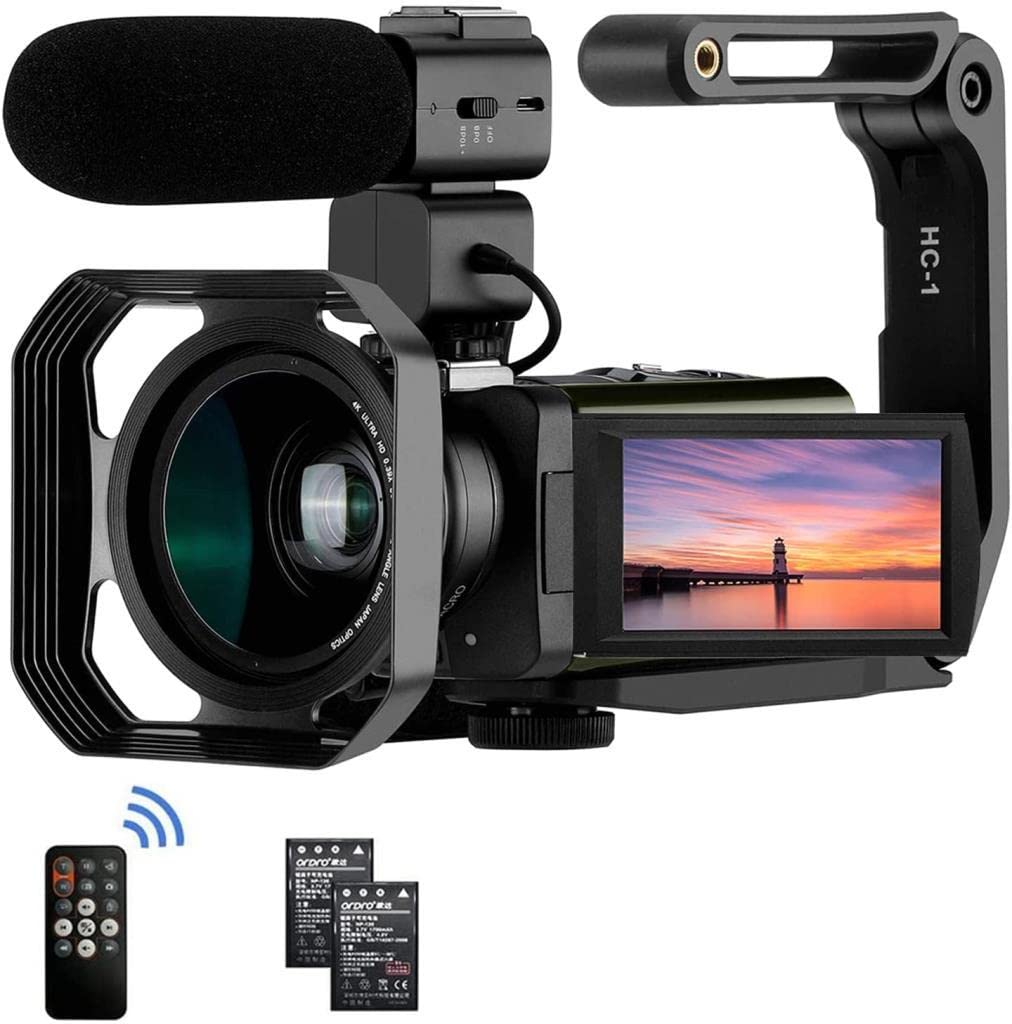
The ORDRO AX65 is one of the few camcorders under $500 that includes genuine 12x optical zoom, letting you capture distant subjects without losing resolution. It uses a 1/3-inch Sony CMOS sensor that performs well in moderate low light, recording 4K at 24fps and 1080p at 60fps. The 3.5-inch IPS touchscreen rotates 270 degrees, making high-angle and selfie shots straightforward.
This model ships with an extensive accessory kit: a wide-angle and macro lens pair, an external microphone, a remote control, a 64GB SD card, and two rechargeable batteries. The hot shoe mount supports an external fill light, and the built-in webcam function works with any USB connection for livestreaming. The anti-shake feature reduces handheld vibration noticeably at moderate zoom levels.
On the downside, the low-light performance with the digital zoom engaged past 12x produces noticeable pixelation and color shift. The recorded audio from the built-in mic is adequate but benefits greatly from the included external microphone. The menu system, while functional, feels slightly dated compared to touch-only interfaces. For users who need reach — sports, stage events, wildlife — this is the most versatile zoom option in the price bracket.
Why it’s great
- True 12x optical zoom preserves detail
- Includes wide-angle, macro, and external mic
- Dual batteries for extended shooting
- Webcam mode for streaming
Good to know
- Digital zoom past 12x degrades quality
- No audio-out port for monitoring
- Menu navigation is a bit sluggish
4. Xtra Muse Vlogging Camera

The Xtra Muse packs a 1-inch CMOS sensor and 3-axis gimbal stabilization into a body that competes directly with the DJI Pocket series at a lower entry point. It records 4K at 120fps, and the 10-bit X-Log color profile allows for serious color grading in post-production. The 2-inch touchscreen is responsive and supports both horizontal and vertical orientation.
Master Follow face and object tracking works reliably in good light, keeping the subject centered even during active motion. The bundle includes a 1/4-inch threaded handle and carrying bag. Battery life is rated at 161 minutes, which is excellent for a gimbal-stabilized camera. Low-light performance is genuinely good — the larger sensor collects noticeably cleaner footage at dusk compared to smaller-sensor alternatives.
The autofocus can hunt occasionally in very low-contrast scenes, and the onboard audio is serviceable but not exceptional. Some users report that DJI wireless mics require a software update to pair correctly. Build quality feels solid for the price, though not as refined as the DJI. For budget-conscious creators who want gimbal stabilization and a 1-inch sensor, this is the strongest value play.
Why it’s great
- 1-inch sensor with 4K/120fps recording
- 10-bit X-Log color for pro grading
- Long battery life over 2.5 hours
- Compact with included carrying case
Good to know
- Autofocus hunts in low contrast
- Internal mic quality is average
- Build not as premium as DJI
5. ORDRO M5 5K Vlogging Camera (Gimbal)

The ORDRO M5 brings 5K/30fps resolution and a 3-axis gimbal together in a handheld form factor designed for walking vlogs. The 3.5-inch rotating touchscreen makes it easy to frame yourself while recording, and built-in IR night vision allows black-and-white recording in complete darkness. The 120-degree wide-angle lens captures a broad field of view without heavy fisheye distortion.
Face tracking works well for a camera in this price tier, keeping the subject roughly centered during movement. The included carrying bag and USB cable make travel straightforward. The M5 accepts microSD cards up to 512GB, giving you plenty of storage for extended shoots. Slow motion and WDR modes add creative flexibility.
Volume levels from the built-in microphone are noticeably low — external wireless mics are essentially required for usable audio. The gimbal has been reported to glitch under heavy trail use, and some users experienced focus loss after extended periods of motion. Battery life averages around 3 hours, which is decent. For casual vloggers who want a gimbal and high resolution without spending premium money, the M5 delivers — but reliability is a concern for heavy daily use.
Why it’s great
- 5K resolution for detailed footage
- 3-axis gimbal smooths walking shots
- IR night vision for dark scenes
- Large 3.5-inch rotatable screen
Good to know
- Built-in microphone volume is very low
- Gimbal can glitch under intensive use
- No WiFi on this version
6. ORDRO M5 5K Video Camera (WiFi)
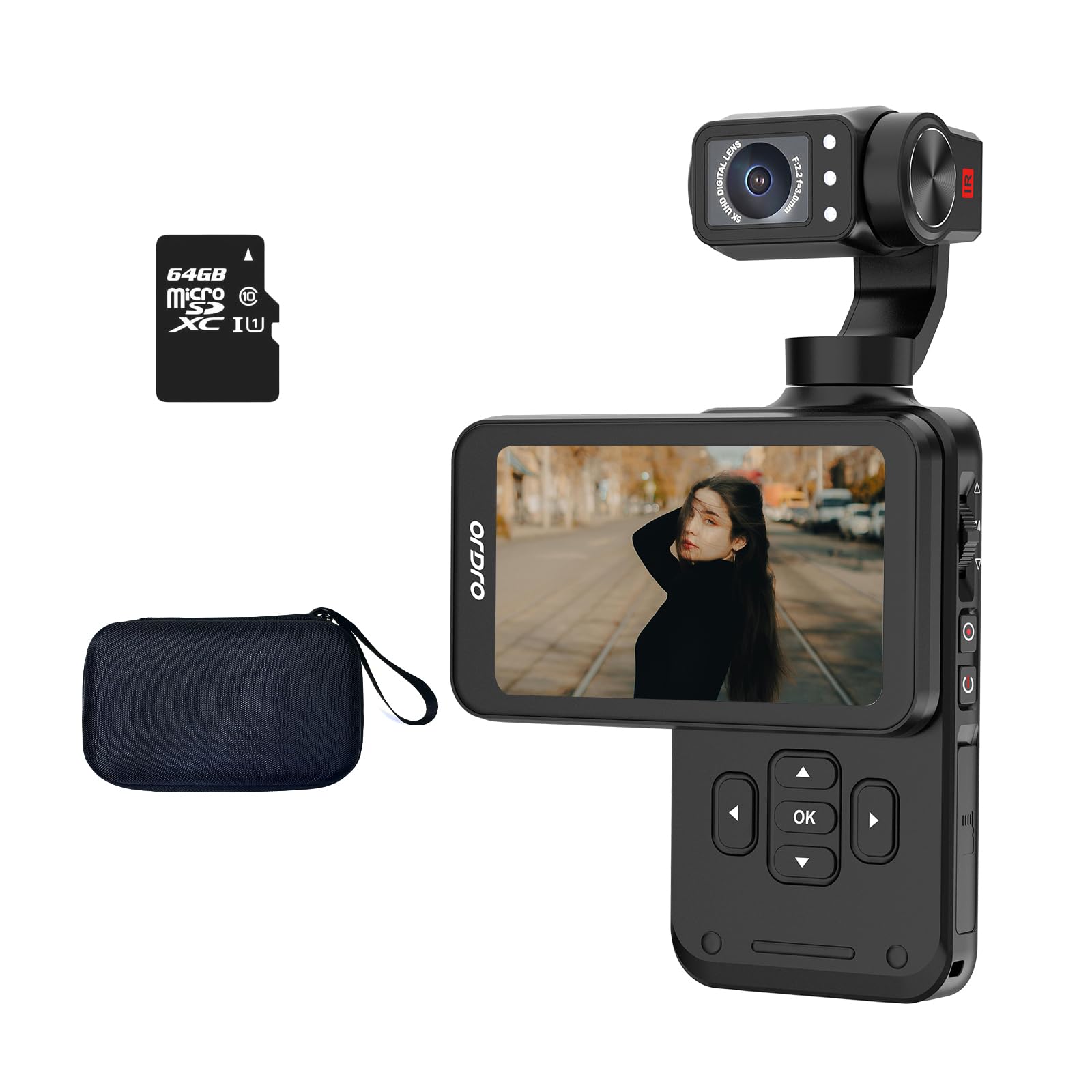
This variant of the ORDRO M5 adds WiFi connectivity to the gimbal-stabilized 5K camera platform, enabling wireless file transfer and remote control from a smartphone or tablet. The same 1/2.5-inch CMOS sensor records 5K at 30fps and 4K at 60fps, with 3-axis stabilization that noticeably smooths handheld footage. The 120-degree field of view provides a natural wide perspective without excessive barrel distortion.
Face tracking locks onto subjects with a simple touch on the 3.5-inch flip screen, and the gimbal follows movement to keep faces centered. IR night vision works for black-and-white recording in total darkness. The packaging includes a battery charger, carrying case, and user manual. Slow motion and time-lapse modes are available for creative projects.
Video quality is noticeably compressed compared to 1-inch sensor cameras — colors appear washed out in mixed lighting, and fine detail is limited. The built-in audio is weak and thin; the external microphone TRSS port is essential for decent sound. Some users reported poor vendor support and return issues. For creators who need wireless connectivity in a gimbal camera, this is a convenient but visibly compromised option.
Why it’s great
- WiFi for remote control and file transfer
- 3-axis gimbal for smooth vlogging
- IR night vision capability
- Flip screen for self-recording
Good to know
- Video quality is soft compared to 1-inch sensors
- Audio is very poor without external mic
- Customer support reliability varies
7. Canon VIXIA HF R600 (Renewed)

The Canon VIXIA HF R600 is a traditional camcorder shape with a 57x advanced zoom lens, making it one of the longest-reaching options under $500. It records Full HD 1080p video — not 4K — but the optical zoom range is genuinely useful for school events, nature observation, and stage recordings where reach matters more than maximum resolution.
The 3-inch capacitive touchscreen offers intuitive menu navigation and playback. A microphone input jack and headphone output jack allow for proper audio monitoring and external mic connections — a rare combination at this price point. The tripod mount socket on the bottom is standard and compatible with any rig. Being a renewed model, it uses SD memory cards (not included) and comes with an AC adapter.
This is an older design without 4K capability, WiFi, or advanced stabilization. The screen can be hard to see in bright sunlight, and the body is not built to survive drops. The renewed condition means cosmetic wear is common — some units arrive with scratches or without manuals. If your priority is long zoom reach in a traditional camcorder body and you can accept HD-only output, this is a functional choice.
Why it’s great
- 57x advanced zoom brings distant subjects close
- Both mic input and headphone output jacks
- Touchscreen interface is responsive
- Compact traditional camcorder ergonomics
Good to know
- Only HD 1080p, no 4K recording
- Screen is dim in direct sunlight
- Renewed unit may show cosmetic wear
8. 6K Camcorder 64MP IR Night Vision

This 6K camcorder from ABJURNJ offers the highest listed resolution in the budget tier, recording at 5760x3240p/30fps and 4K/60fps. The 64MP still photo mode is oversampled but produces detailed images for social media. The 4-inch touchscreen is responsive and rotates 270 degrees, making it easy to compose shots from any angle.
The package is the most complete in this roundup: a 4500mAh battery, handheld stabilizer, external microphone, 2.4G wireless remote, 64GB SD card, lens hood, cleaning cloth, and a padded DV bag. The battery lasts over 4 hours in 6K mode, and recording while charging allows for marathon sessions. The IR night vision captures usable black-and-white footage in near-total darkness.
Image quality, however, does not match the pixel count — the small sensor produces soft detail and compressed dynamic range compared to 1-inch sensor cameras. The 18x digital zoom introduces significant pixelation past halfway. The included microphone improves on the built-in but still sounds thin for serious voice work. For absolute beginners who want every accessory out of the box and don’t mind softer image quality, this is the most inclusive starter package.
Why it’s great
- Complete kit with stabilizer, mic, bag, remote
- 4500mAh battery lasts over 4 hours
- 6K resolution and 64MP photos
- Works as a webcam for streaming
Good to know
- Small sensor limits real-world clarity
- Digital zoom degrades beyond 9x
- Audio is average even with bundled mic
9. Sony FDR-AX43 UHD 4K Handycam

The Sony FDR-AX43 is a true prosumer camcorder with 20x optical zoom and Balanced Optical SteadyShot — a built-in lens-based image stabilization system that rivals gimbal smoothness without the gimbal bulk. It records 4K video using a 1/2.5-inch Exmor R CMOS sensor and BIONZ X processor, producing clean footage with accurate Sony color science. Clear Image Zoom extends reach to 30x in 4K and 40x in HD while maintaining reasonable detail.
Fast Intelligent AF tracks subjects quickly and reliably, and the 26.8mm wide-angle ZEISS Vario-Sonnar T lens captures expansive establishing shots. The camcorder includes WiFi and NFC for remote control via smartphone. The Highlight Movie Maker feature automatically edits clips into short movies. The microphone input jack allows external audio upgrades.
This model typically exceeds the $500 budget cap, but occasional deals bring it within reach. The protruding battery design makes it awkward for selfie stick use, and the camcorder requires an SD card as it has no internal memory. For traditional shooters who need optical zoom, optical stabilization, and brand reliability, the AX43 is the most capable traditional camcorder in this discussion when found on sale.
Why it’s great
- 20x optical zoom with Clear Image extension
- Balanced Optical SteadyShot for smooth video
- Fast Intelligent AF tracks subjects well
- ZEISS lens with accurate color rendering
Good to know
- Usually exceeds budget cap
- Large battery protrudes from rear
- No internal memory — requires SD card
FAQ
Can I use a camcorder under $500 for streaming on Twitch or Zoom?
What external microphone works best with budget camcorders?
How important is optical zoom for vlogging?
Is 6K worth it on a budget camera?
Can these camcorders shoot in low light without a fill light?
Final Thoughts: The Verdict
For most users, the best camcorder under $500 winner is the DJI Osmo Pocket 3 because its 1-inch CMOS sensor, 3-axis gimbal stabilization, and 4K/120fps video produce the highest real-world image quality in any form factor this portable. If you need optical zoom for distant subjects, grab the ORDRO AX65 4K for its 12x reach and complete accessory kit. And for a compact, reliable vlogging camera with a built-in stand and great audio options, nothing beats the Canon PowerShot V10.

Mo Maruf
I created WellFizz to bridge the gap between vague wellness advice and actionable solutions. My mission is simple: to decode the research and give you practical tools you can actually use.
Beyond the data, I am a passionate traveler. I believe that stepping away from the screen to explore new environments is essential for mental clarity and physical vitality.