Our readers keep the lights on and my smoothie glass nicely filled. As an Amazon Associate, I earn from qualifying purchases.
The jump to 4K resolution is only half the battle—the real separator in modern camcorders is how they handle motion. A shaky, jittery 4K image loses all the detail that higher resolution is supposed to deliver, turning a premium spec into a frustrating viewing experience. Whether you’re filming a family event, a vlog, or a commercial project, the interaction between sensor size, stabilization hardware, and frame rate determines whether your footage looks cinematic or like a security camera feed.
I’m Mohammad Maruf — the founder and writer behind WellFizz. Over the last decade I’ve analyzed hundreds of camera specifications, pored over sensor readouts, stabilization patents, and codec performance data to find the gear that actually delivers on its paper promises.
These evaluations focused on real-world metrics like dynamic range, stabilizer architecture, bit depth, and low-light sensitivity. This guide cuts through the marketing gloss to reveal the strongest camcorder 4k options available today, ranked by feature density and mechanical integrity.
How To Choose The Best Camcorder 4K
The 4K camcorder market spans everything from pocket-sized vlog rigs to shoulder-mount cinema bodies. Before you sort by price, you need to lock down three core criteria that affect every frame you shoot.
Sensor Size & Low Light Performance
A 1-inch CMOS sensor captures significantly more light than the 1/2.3-inch sensors found in budget camcorders. This translates to cleaner shadows, less noise at higher ISOs, and a more cinematic depth-of-field when you want to separate your subject from the background. If you plan to shoot indoors, at dusk, or under tree cover, the sensor size should be your first filter.
Stabilization Architecture
Three-axis mechanical gimbals (like the DJI and Xtra Muse designs) physically float the sensor module to cancel out footsteps and hand tremors. Optical SteadyShot and lens-shift systems are lighter but less effective at absorbing rapid micro-jitters. In walking or run-and-gun scenarios, a gimbal-equipped camcorder will produce watchable footage where digital stabilization only creates a cropped, wobbly image.
Recording Bit Depth & Codec Options
10-bit 4:2:2 color recording preserves fine gradations in skies and skin tones, giving you far more room to grade in post without banding. Cameras like the Blackmagic Pocket series offer 12-bit Blackmagic RAW and Apple ProRes, which are the industry standard for color-critical work. Consumer-focused camcorders typically record 8-bit 4:2:0 MP4 files—fine for social media, but limiting if you plan to color correct heavily.
Quick Comparison
On smaller screens, swipe sideways to see the full table.
| Model | Category | Best For | Key Spec | Amazon |
|---|---|---|---|---|
| DJI Osmo Pocket 3 | Vlogging / Pocket | Travel & social media | 1″ CMOS, 3-axis gimbal | Amazon |
| Xtra Muse Pocket Gimbal | Vlogging / Pocket | Budget vlogging | 1″ CMOS, 3-axis gimbal | Amazon |
| Sony FDR-AX43 | Traditional Camcorder | Family events & travel | 20x optical zoom, OIS | Amazon |
| Canon VIXIA HF G70 | Prosumer Camcorder | Documentaries & church | 20x zoom, dual SD slots | Amazon |
| Canon VIXIA HF G70 Bundle | Prosumer Camcorder | All-in-one kit | 20x zoom, dual SD slots | Amazon |
| Blackmagic Pocket 4K | Cinema Camera | Narrative / indie film | MFT mount, 13 stops DR | Amazon |
| Blackmagic Pocket 6K Pro | Cinema Camera | Professional cinema | S35 sensor, internal NDs | Amazon |
| Canon XA70 Pro | Pro Camcorder | Interviews & live events | 1″ sensor, XLR inputs | Amazon |
| Panasonic HC-X20 | Pro Camcorder | News & corporate | 1″ sensor, 20x zoom | Amazon |
In‑Depth Reviews
1. DJI Osmo Pocket 3
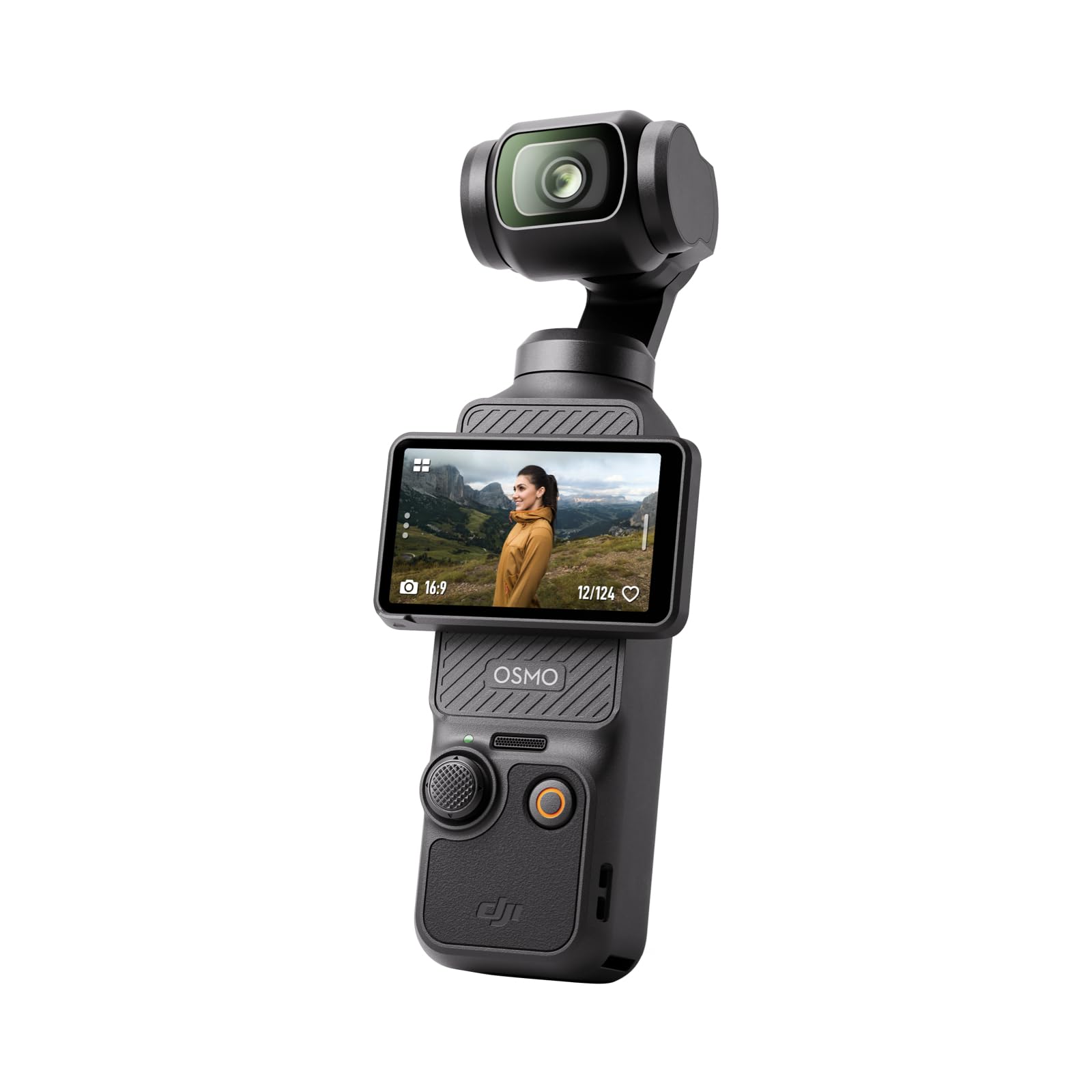
The Osmo Pocket 3 is the gold standard for pocket-sized 4K video. Its 1-inch CMOS sensor delivers clean, detailed footage in mixed light, and the mechanical 3-axis gimbal is so effective that walking shots look like they were filmed on a dolly track. The rotating 2-inch touchscreen instantly switches between horizontal and vertical formats, a smart design choice for multi-platform creators.
ActiveTrack 6.0 locks onto a subject reliably, even through quick spins or sudden movement, making it easy to film yourself without a camera operator. Battery life sits around 166 minutes in practical use, and the fast USB-C charging means you can top up between scenes. The audio from the built-in stereo mics is acceptable for ambient sound, but the connection to DJI Mic 2 transmitters elevates voice clarity to professional levels.
What holds it back from being a true all-rounder is the fixed wide-angle lens — you cannot zoom optically beyond what the sensor crops. For vloggers and travel creators who stay in the wide to medium range, this is a non-issue. For anyone needing reach, a traditional camcorder with optical zoom is a better fit.
Why it’s great
- Outstanding 3-axis mechanical stabilization
- Rotating touchscreen for quick portrait/landscape switch
- 1-inch sensor with solid low-light performance
- ActiveTrack 6.0 tracking locks on reliably
Good to know
- Fixed wide-angle lens with no optical zoom
- Battery is built-in and non-replaceable in field
- Audio quality benefits significantly from external wireless mic
2. Xtra Muse Pocket Gimbal Camera
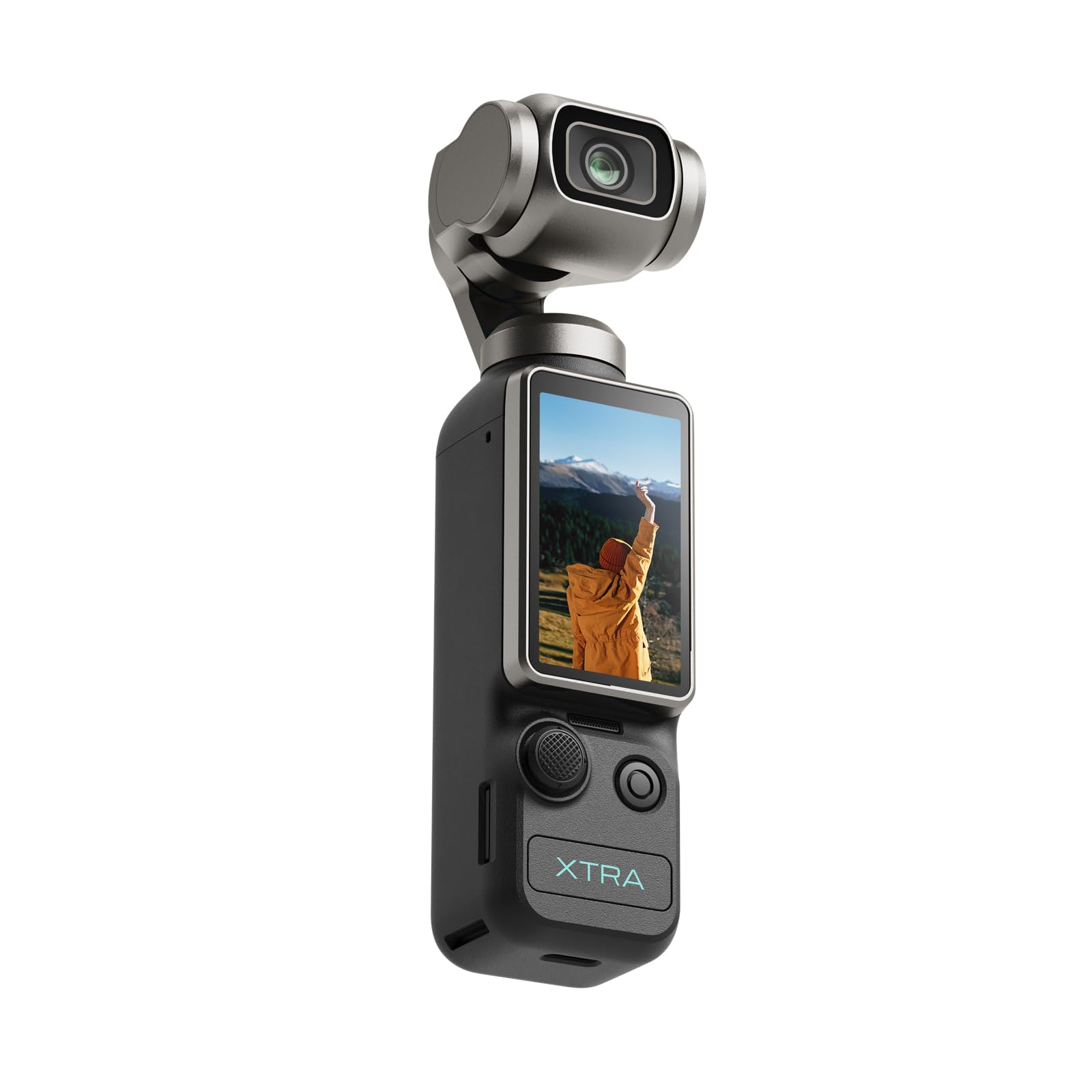
The Xtra Muse is a clear budget-friendly alternative to the DJI Pocket 3, packing the same 1-inch CMOS sensor and 4K/120fps recording capability into a very similar form factor. The 3-axis gimbal stabilizer performs admirably for walking and light jogging footage, and the face/object tracking keeps you in frame during solo shoots. The 2-inch touchscreen is responsive and adequate for framing, though it lacks the physical rotation of its DJI counterpart.
Color science is a strong point — the 10-bit X-Log mode captures over a billion colors and gives you real latitude in post-production for grading sunrise, sunset, or mixed-lighting scenes. Battery life averages around 161 minutes, which is competitive with the DJI, and the included carrying bag, wrist strap, and handle with a 1/4-inch thread add value out of the box. The built-in microSD slot supports UHS‑3 cards, so high-bitrate 4K recording writes smoothly.
For creators on a tighter budget who still want a 1-inch sensor and gimbal stabilization, this is a compelling option, but the software polish is visibly a notch below.
Why it’s great
- 1-inch sensor plus 3-axis gimbal at a lower price point
- 4K/120fps slow-motion capability
- 10-bit X-Log color for better grading headroom
- Excellent battery life and travel-friendly kit
Good to know
- Autofocus hunts more in low light
- Tracking can lose fast or erratic subjects
- Screen does not rotate natively for portrait/landscape
3. Sony FDR-AX43 Handycam

Sony’s FDR-AX43 is the traditional camcorder shape done right — a mid-range option built around a 1/2.5-inch Exmor R CMOS sensor and a 20x optical zoom lens with Balanced Optical SteadyShot. The optical image stabilization is not as aggressive as a gimbal, but for locked-down or slow-pan shots it produces smooth, natural-looking footage. The 26.8mm wide-angle end of the ZEISS Vario-Sonnar T lens is generous for indoor group shots.
The BIONZ X processing engine enables Fast Intelligent AF, which tracks subjects with good speed and accuracy in good light. Highlight Movie Maker is a useful bonus that automatically creates short highlight reels from longer clips, saving editing time for casual users. The built-in Wi-Fi and NFC allow for easy smartphone control and quick file sharing. The camera records to a single SD card with no dual-slot backup.
On the downside, the 4K capture is limited to 30p — no 60-frames-per-second option for smooth slow-motion — and the low-light performance, while decent for its sensor class, is noticeably grainier than 1-inch sensor cameras above its tier. The battery protrudes conspicuously from the back, which makes the camera harder to pack flat and less comfortable with a selfie stick. The built-in gimbal feature is a marketing term for Balanced Optical SteadyShot, not a true mechanical gimbal.
Why it’s great
- Smooth and detailed 20x optical zoom
- Balanced Optical SteadyShot for tripod-style pans
- Fast Intelligent AF locks quickly in good light
- Wi-Fi and NFC for remote control and sharing
Good to know
- 4K limited to 30fps, no 4K/60p
- Low-light noise higher than 1-inch sensor rivals
- Battery design protrudes awkwardly
4. Blackmagic Pocket Cinema Camera 4K

The Pocket 4K is not a camcorder in the consumer sense — it is a mini cinema camera with a Micro Four Thirds sensor that records 12-bit Blackmagic RAW and Apple ProRes up to 4K/60fps. The 13 stops of dynamic range let you retain highlight detail in clouds and shadow texture in dark clothing, making it the choice for narrative filmmakers, music videos, and commercial work where color grading is essential. The dual native ISO up to 25,600 gives it usable low-light performance that rival sensors struggle to match.
Recording options are flexible — CFast 2.0, SD UHS-II, or USB-C external SSD. The 5-inch touchscreen is bright and sharp enough to pull focus without an external monitor. The included DaVinci Resolve Studio license covers the full post-production workflow. The MFT lens mount means you can adapt almost any vintage or modern lens, giving you creative control over field of view and bokeh.
The camera lacks in-body stabilization, so you must budget for a tripod, gimbal, or rig for smooth handheld shots. The LP-E6 battery lasts only about 30 minutes in real shooting — external power or a battery grip is mandatory for a full day. Autofocus is contrast-based and slow, making it nearly unusable for run-and-gun or vlogging. This is a tool designed for manual focus, manual exposure, and controlled shoots.
Why it’s great
- Cinematic 13-stop dynamic range and 12-bit RAW
- Flexible recording to SSD, CFast, or SD
- DaVinci Resolve Studio license included
- Interchangeable MFT lens mount
Good to know
- No in-body stabilization
- Very short battery life (approx. 30 min)
- Slow contrast-detect autofocus
- Requires manual focus discipline
5. Canon VIXIA HF G70

The HF G70 is Canon’s prosumer answer to the camcorder segment, built around a 1/2.3-inch UHD 4K CMOS sensor and the DIGIC DV 6 processor. The 20x optical zoom lens is sharp throughout its range, and the 8-blade circular aperture produces soft, appealing bokeh highlights. The 5-axis advanced image stabilization does a good job smoothing out handheld micro-jitters at long focal lengths, though it is not as effective as a gimbal for walking shots.
The UVC livestreaming support via USB Type-C is a standout feature — plug it into a PC or Mac and it works as a high-quality webcam without capture cards or extra software. The OSD Time Stamp recording embeds date, time, and timecode directly into the video file, which is critical for event videographers and legal documentation. The 3.5-inch touchscreen LCD is responsive, and the tiltable OLED EVF works well in bright outdoor conditions.
Low-light performance is the G70’s main weakness — the small sensor generates visible noise when gain climbs above 4dB, and at maximum gain the image turns mushy. The Hybrid AF system with face detection is accurate in good light but can cause the background to pulse in and out of focus under certain conditions. HDMI output is limited to 1080p, even though the camera records 4K internally. No XLR inputs are present, which means an external audio adapter is required for professional microphones.
Why it’s great
- Long 20x optical zoom with excellent reach
- UVC plug-and-play livestreaming to computer
- Time stamp on-screen display recording
- Dual SD card slots for relay/backup
Good to know
- Noisy low-light performance at higher gain
- HDMI output capped at 1080p
- No XLR audio inputs
6. Canon VIXIA HF G70 Bundle

This bundle packages the Canon VIXIA HF G70 with an extensive assortment of accessories — two spare batteries, a charger set, wide-angle and telephoto adapter lenses, color filter kits, a 64GB Extreme PRO memory card, a flexible tripod, an LED light, and a padded soft bag. For a shooter starting from scratch, this eliminates the need for a separate shopping run, effectively delivering a complete field kit in one box.
The core camera performance mirrors the standalone G70 review — sharp 20x optical zoom, reliable 5-axis stabilization, and clean UHD 4K30 recordings. The 8-blade aperture maintains pleasing background blur, and the DIGIC DV 6 processor keeps color accurate out of the box. The dual SD card slots allow for hot-swap recording or simultaneous backup, which is a genuine professional safeguard.
The trade-offs are the same as the base model — the 1/2.3-inch sensor struggles in dim venues, and the bundle’s add-on lenses and filters are basic quality, adequate for protection but not optical upgrades. One reported unit arrived with focusing issues when zoomed in, so inspect the camera on arrival. The included tripod and LED light are usable for starters but will likely be replaced as the user’s demands grow.
Why it’s great
- Complete starter kit with everything included
- Two spare batteries in addition to the original
- Wide-angle and telephoto adapters for lens flexibility
- Dual SD slot recording with relay backup
Good to know
- Same low-light limitations as base G70
- Bundle lenses and filters are basic quality
- Some units have reported lens focus defects
7. Canon XA70 Pro Camcorder

The XA70 is the professional step up from the G70, swapping the smaller sensor for a 1-inch CMOS that delivers dramatically better dynamic range and low-light performance. The 15x optical zoom lens is more conservative than the G70’s 20x, but the glass is higher quality, with minimal chromatic aberration even at the telephoto end. The DIGIC DV 6 processor handles dual SD slot recording in XF-AVC and MP4 formats, up to 4K 160Mbps at 30p.
Audio is a major selling point — the detachable handle includes two XLR inputs with phantom power and four-channel linear PCM recording. This lets you plug in professional shotgun and lavalier mics without an external mixer, making the XA70 a self-contained package for interviews, documentaries, and live event coverage. The USB Type-C UVC support enables HD live streaming to a computer, and the mini-HDMI output carries a clean feed for external monitors.
The built-in ND filter system has three stops (1/4, 1/16, 1/64), but reports indicate the ND effect may be subtle or inconsistent depending on the unit. The 3.5-inch LCD touchscreen is clear and responsive, but the OLED EVF is a low-resolution panel that makes fine manual focusing difficult. Automatic exposure transitions can be abrupt in changing lighting, so manual iris control is recommended for consistent results. The XA70 is a capable all-in-one pro camcorder, but the EVF quality and inconsistent ND filters are worth checking before purchase.
Why it’s great
- 1-inch sensor for clean low-light footage
- Two XLR inputs with phantom power built into handle
- Dual SD slots with XF-AVC and MP4 recording
- UVC livestreaming over USB Type-C
Good to know
- EVF resolution is low, limiting manual focus precision
- Built-in ND filters may have inconsistent effect
- Auto exposure can be abrupt without manual setting
8. Blackmagic Pocket Cinema Camera 6K Pro

The 6K Pro takes everything the Pocket 4K did well and scales it up — a Super 35 sensor with 6144 x 3456 native resolution, 13 stops of dynamic range, and dual native ISO up to 25,600. The larger sensor gives you a more filmic field of view with shallower depth of field, and the 6K capture allows for 4K delivery with extra cropping and reframing room in post. The built-in 2, 4, and 6-stop ND filters are genuinely useful for outdoor shooting without external matte boxes.
The tilting 5-inch HDR LCD is bright and color-accurate, making it usable in direct sunlight — a significant upgrade over the 4K’s fixed screen. Recording options mirror the 4K: CFast, SD UHS-II, or USB-C SSD, with 12-bit Blackmagic RAW and Apple ProRes up to 4K DCI 120fps or 6K 60fps. The EF lens mount opens up a huge range of affordable and high-end glass, including adapted vintage lenses for unique character.
The same weaknesses apply as the Pocket 4K — no in-body stabilization, very short battery life from the NP-F570 (around 40 minutes with the screen brightness up), and contrast-detect AF that is too slow for run-and-gun or vlogging. The auto-exposure system jumps iris and shutter harshly, ruining continuous shots with lighting changes. This is a cinema camera that demands a gimbal or tripod, manual focus discipline, and external power solutions for all-day shoots.
Why it’s great
- Super 35 sensor with 6K resolution for flexible reframing
- Built-in 2, 4, 6-stop ND filters
- Tilting 5-inch HDR LCD screen
- 12-bit Blackmagic RAW recording up to 4K 120fps
Good to know
- No in-body image stabilization
- Battery life is very short (~40 min)
- Slow contrast-detect autofocus
- Auto exposure management can be harsh
9. Panasonic HC-X20

The HC-X20 is a pure professional camcorder built for news, interviews, and corporate events. It pairs a 1-inch 15-megapixel MOS sensor with a 24.5mm wide-angle lens and an optical 20x zoom that extends to 32x i.ZOOM in Full HD. The image quality is crisp and clean, with accurate color reproduction and minimal noise even as the gain rises. The 4K 60p recording in HEVC and MP4 formats gives you smooth slow-motion options and efficient file sizes.
The 5-axis HYBRID O.I.S. plus Intelligent Auto and Face Detection AF/AE work together to keep subjects sharp and stable, even in run-and-gun interview scenarios. Triple manual control rings for focus, zoom, and iris give you tactile, muscle-memory adjustment without diving into menus. The detachable handle includes two XLR inputs with phantom power, and the camera supports Wi-Fi and Ethernet streaming (via USB-LAN adapter) for live event broadcasts. The weight balance is excellent, sitting comfortably on the shoulder without a rig.
The auto balance system tends to darken the image aggressively in bright conditions, which requires manual intervention to correct. The digital i.ZOOM is software interpolation, not true optical reach, so it should be used sparingly. The HC-X20 does not feature built-in ND filters, requiring screw-on or matte box solutions for outdoor exposure control. For field journalists and event videographers who need a robust, self-contained 4K camcorder with solid audio integration, the HC-X20 is a top-tier workhorse.
Why it’s great
- 1-inch sensor delivers clean, professional image quality
- Optical 20x zoom with triple manual control rings
- Two XLR inputs with phantom power on detachable handle
- Wi-Fi and USB-Ethernet streaming for live events
Good to know
- No built-in ND filters
- Auto balance can over-darken in bright light
- Digital i.ZOOM reduces image quality
FAQ
Is a 1-inch sensor noticeably better than a 1/2.3-inch sensor in a 4K camcorder?
Can I use the Blackmagic Pocket 4K for vlogging or run-and-gun shooting?
What is UVC streaming and why does it matter for a 4K camcorder?
Why does the Sony FDR-AX43 only shoot 4K at 30fps when others shoot 60fps?
Do I need XLR audio inputs on my 4K camcorder?
Final Thoughts: The Verdict
For most users, the camcorder 4k winner is the DJI Osmo Pocket 3 because it combines a 1-inch sensor with true 3-axis gimbal stabilization in a pocketable body at a sensible mid-range price. If you want optical zoom and professional XLR audio, grab the Panasonic HC-X20. And for narrative filmmakers who need the maximum grading flexibility from a compact body, nothing beats the Blackmagic Pocket Cinema Camera 4K.

Mo Maruf
I created WellFizz to bridge the gap between vague wellness advice and actionable solutions. My mission is simple: to decode the research and give you practical tools you can actually use.
Beyond the data, I am a passionate traveler. I believe that stepping away from the screen to explore new environments is essential for mental clarity and physical vitality.